“I don’t care who said it.”

Aaron Boone

Aaron Boone fingers the culprit impressionist who really barked at umpire Hunter Wendelstedt after Boone kept his mouth shut following one warning. (YES Network capture.)

Umpire accountability. There, I’ve said it again. The longer baseball government refuses to impose it, the more we’re going to see such nonsense as that which Hunter Wendelstedt inflicted upon Yankee manager Aaron Boone in New York Monday.

The Yankees welcomed the hapless Athletics for a set. Wendelstedt threw out the first manager of the game . . . one batter and five pitches into it. And Boone hadn’t done a thing to earn the ejection.

Oh, first Boone chirped a bit over what the Yankees thought was a non-hit batsman but was ruled otherwise; television replays showed A’s leadoff man Esteury Ruiz hit on the foot clearly enough. Wendelstedt got help from first base umpire John Tumpane on the call, and Tumpane ruled Ruiz to first base.

The Yankees and Boone fumed, Wendelstedt warned Boone rather loudly, and Boone kept his mouth shut from that point.

Until . . . a blue-shirted Yankee fan in a seat right behind the Yankee dugout hollered. It looked and sounded like, “Go home, ump!” It could have been worse. Fans have been hollering “Kill the ump!!” as long as baseball’s had umpires. George Carlin once mused about substituting for “kill” a certain four-letter word for fornication. His funniest such substitution, arguably, was “Stop me before I f@ck again!” The subs also included,  “F@ck the ump! F@ck the ump!”

Neither of those poured forth from the blue-shirted fan. Merely “Go home, ump!” provoked Wendelstedt to turn toward the Yankee dugout and eject . . . Boone, who tried telling Wendelstedt it wasn’t himself but the blue shirt behind the dugout. “I don’t care who said it,” Wendelstedt shouted, and nobody watching on television could miss it since his voice came through louder than a boat’s air horn and, almost, the Yankee broadcast team. “You’re gone!”

I don’t care who said it.

“When an all-timer of an ejection happens,” wrote Yahoo! Sports’ Liz Roscher, “you know it, and this qualified.”

There was drama. There was rage. There was the traditional avoidance of blame on the part of the umpire. It’s a classic example of the manager vs. umpire dynamic, in which the umpire exercises his infallible and unquestionable power whenever and wherever he wants with absolutely zero accountability or consequences of any kind, and the manager has no choice but to take it.

Bless her heart, Roscher actually used the A-word there. And I don’t mean “and” or “absolutely,” either. She also noted what social media caught almost at once, that Mr. Blue Shirt may have mimicked Boone well enough to trip Wendelstedt’s trigger even though the manager himself said not. one. syllable. after the first warning.

May. You might think for a moment that a manager with 34 previous ejections in his managing career has a voice the umpires can’t mistake no matter how good an impression one wisenheimer fan delivers.

This is also the umpire whom The Big Lead and Umpire Scorecards rated the third-worst home plate umpire in the business last year, worsted only by C.B. Bucknor (second-worst) and Angel (of Doom) Hernandez (worst-worst). I’ve said it before but it’s worth repeating now. Sub-92 percent accuracy has been known to get people in other professions fired and sued.

A reporter asked Boone whether the bizarre and unwarranted ejection was the kind over which he’d “reach out” to baseball government. “Yes,” the manager replied. “Just not good.”

Good luck, Skipper. Umpire accountability seems to have been the unwanted concept ever since the issue led to a showdown and a mass resignation strategy (itself a flagrant dodge of the strike prohibition in the umps’ collective bargaining agreement) that imploded the old Major League Umpires Association in 1999.

The Korean Baseball Organisation is known for its unique take upon umpire accountability. Umps or ump crews found wanting, suspect, or both get sent down to the country’s Future Leagues to be re-trained. Presumably, an ump who throws out a manager who said nothing while a fan behind his dugout barked would be subject to the same demotion.

If the errant Mr. Blue Shirt really did do a close-enough impression of Boone, would Wendelstedt also impeach James Austin Johnson over his near-perfect impressions of Donald Trump?

Well after the game ended in (do you believe in miracles?) a 2-0 Athletics win (they scored both in the ninth on a leadoff infield hit and followup hitter Zack Gelof sending one into the right field seats), Wendelstedt demonstrated the possibility that contemporary baseball umpires must master not English but mealymouth:

This isn’t my first ejection. In the entirety of my career, I have never ejected a player or a manager for something a fan has said. I understand that’s going to be part of a story or something like that because that’s what Aaron was portraying. I heard something come from the far end of the dugout, had nothing to do with his area but he’s the manager of the Yankees. So he’s the one that had to go.

The fact that an umpire can order stadium personnel to eject fans or even toss a loudmouth in the stands himself (it happened to Nationals GM Mike Rizzo courtesy of now-retired Country Joe West, during a pan-damn-ic season game in otherwise-empty Nationals Park) seems not to have crossed Wendelstedt’s mind. The idea of saying “I was wrong” must have missed that left toin at Albuquoique.

Major league umpires average $300,000 a year in salary. If I could prove to have a 92 percent accuracy rate and learn to speak mealymouth, I’d settle for half that.

Commissioner, anyone?

Adapted from JK’s speech to the Las Vegas chapter of the Society for American Baseball Research delivered 10 June 2023.
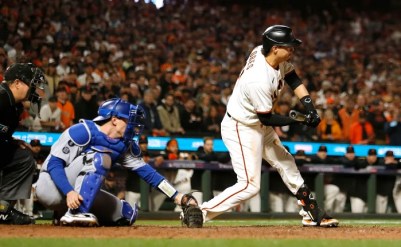
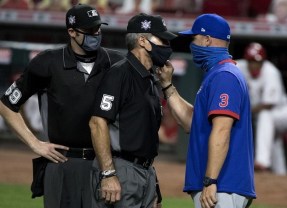
Calling baseball commissioner Rob Manfred an inveterate tinkerer is calling Donald Trump and Joe Biden mountebanks. Calling Manfred a visionary denigrates the very definition of vision. But those who pine for the so-called good old days, while letting themselves think Manfred’s lust for rule remaking/remodeling points toward them, must first be made to answer, “Which good old days?”

Certainly not the days when the bases were large stones. Certainly not when pitchers were required to throw no way but underhanded and from a standing position strictly. Certainly not when the one-hop hit to the outfield was ruled an out if the fielder snagged the ball on that hop. Certainly not when none but white men were permitted to play the major league game. 

There are some things from the so-called Good Old Days that ought to be preserved or exhumed, of course. That’s without regard to the particular period of Good Old Days the get-off-my-lawn crowd prefers to revive. There are also things heretofore inconceivable to which today’s governors of our game, Manfred on down, should lend far more thought than they do. But it cannot be Manfred to shepherd it any longer.

Would you like to become baseball’s next commissioner? If your answer is yes, at minimum you’ll need a reasonable station from which to disembark your train. What follows is a fourteen-step platform:

1. The august office itself. Upon assuming office, the new commissioner shall convene a rules committee to explore broadening the means by which commissioners are chosen in the future. There’s no sound reason why the owners alone should choose the game’s public steward and top administrator, since it’s long been proven that under the owners alone the commissioner thinks the good of the game is little more than making money for it, and them.

The commissioner of the future should be elected by the following group of 79 people: Single representatives of the owners and the players, each; and, designated representatives from each of major league baseball’s nineteen umpiring crews.

2.Tick-tock clock. On paper, and in the imagination, the pitch clock seemed sound as a nut. In actuality, it wreaks more havoc than should be allowed. Havoc, and no few injuries ranging from the simple to the serious and back. Not to mention the imposition upon pitchers with unique or at least colourful pitching styles. Those concerned about the coming of the Clockwork Baseball Player should concern themselves about and stand athwart anything that would make that coming reality.

3. Game time. Are we supposed to applaud that, thus far, the pitch clock and its concurrent impositions upon the batter have shaved a whole . . . half an hour on average off the time of play? Are we supposed to applaud that the truest culprit of the elongated major league game—namely, the broadcast commercial blocks after each half inning and during each pitching change—remains unmolested?

The pitch clock’s elimination should be matched by all effort to make a new broadcasting agreement that includes no commercial blocks longer than one minute after half-innings and thirty seconds during pitching changes. (Yes, Virginia, it really does take less time now for a relief pitcher to get from the bullpen to the game mound than for the commercials to play.)

4. Manfred Man. The free cookie on second base to open each extra half inning shall be eliminated. Permanently. The only Manfred man that should ever be in the public mind shall be, once again, the hitmaking band of the 1964-66 British Invasion.

5. We’re on the air, anywhere. Eliminate all blackout rules for television. Allow any major league game to be broadcast in any region regardless of whether the ballpark is in the same broadcast region. Let a million television sets bloom because decades of evidence have proven that, of all the reasons for people to stay away from the ballpark, television like radio before it is the least of those reasons.

(As a relevant aside, I still remember seeing Dodger Stadium fans clutching tiny portable TV sets in the park. With the pictures turned down but the sound turned up. Why? Because they wouldn’t believe what they’d just seen from beginning to end unless they heard it from the late Vin Scully.)

6. Umpires can be impeached, too. The umpires have been laws unto themselves for long enough. It’s past time for them to be held as accountable for their malfeasance as players, managers, and team administrators. There’s no reason on earth for accuracy below 96 percent to be permissible. If you doubt that, ponder that a surgeon with a 96 percent accuracy rating wouldn’t face job security, he’d face malpractise suits.

Umpires with accuracy below 96 percent shall be placed on probation for the rest of the incumbent season or the first half of the following season. Failure to improve will result in suspensions. And, yes, the rule book strike zone shall be enforced strictly. The days of umpires deploying their own strike zones must end. That by itself should help assure accuracy of 96 percent or higher behind the plate.

7. No tank you veddy much. Team ownerships who fail repeatedly to invest properly in their major league product and their minor league support systems shall be put on notice. You have one year to decide: Will you invest properly in your teams, every year, regardless of the free spoils of revenue sharings you receive before each season begin; or, will you sell your team to a local/regional ownership willing to do what needs to be done to put an honestly competitive team on the field.

Tanking is fan abuse, plain and simple. If you can afford to buy a major league baseball team, you can afford to put forth a product that gives honest effort to compete. Rebuilding on the fly has been done for eons, before and after the free agency era.

Concurrently, past commissioner Bowie Kuhn’s ridiculous prohibition on player sales shall be rescinded. Teams shall be allowed to sell their players on an open market for whatever price other teams are willing to pay—and the players to be sold shall receive at least 25-30 percent of the sale price. This will allow the supposedly not-so-rich teams to stay minimally competitive, too.

Call it the Averill-Landis Rule, after the ancient commissioner who thought Hall of Famer Earl Averill wasn’t nuts to demand to know how much of the sale price he might receive when the Cleveland Indians bought him from the Pacific Coast League.

While we’re at it, a tanking team must never be given permission to relocate, which leads to . . .

8. If you want to build it, we will come. Under no circumstances shall any team seeking to build a new ballpark go to the local and/or state government for help. For now we mean you, Oakland Athletics. It takes colossal gall to try strongarming your incumbent locale into building you a new ballpark and, when they call your bluff, try to strongarm Las Vegas into building one for you; or, at least, paying for half if not more of it.

The willful self-destruction of a team fan base should never be sanctioned. Neither should regional taxpayers be made to foot all or most of the bill for a new playpen. The Voice in Field of Dreams assuredly did not say, If you build it, they will pay for it.

9. Interleague, schminterleague. Eliminate it from the regular season. Entirely. Save it for when it truly matters—during the All-Star Game, and during the World Series.

10. Are the All-Stars out tonight? Absent one fan, one vote, one time requirements, eliminate the fan vote. Why? Because the All-Star Game must include rosters containing none but the absolute best players on the season thus far. If this means one or more teams lack All-Star representation, tough. This isn’t T-Ball.

While we’re at it, the next commissioner must rule that the All-Star Game also needs to cease being used as a gold watch, even for future Hall of Famers. They’ll get their tributes appropriately around the circuit without a final All-Star honorarium, not to mention those so qualified getting the big one in Cooperstown in due course.

11. Competition, not compensation. This nonsense must cease. The regular season’s meaning has been compromised long enough. And the saturation of postseason games has compromised more than enhanced the game. There’s no reason on earth why any team not parked in first place at season’s end should be playing for baseball’s championship.

Expansion should be pursued to create divisions with even numbers of teams. Then, two conferences of two divisions each shall be fashioned in each league. The wild cards shall be eliminated entirely.

Then, each league’s division champions will meet in a best-of-three division series. The winners in each league will then meet in a best-of-five League Championship Series. (You want the Good Old Days restored, there’s a splendid restoration.) The World Series shall remain its best-of-seven self with its primacy thus restored. (Postseason saturation will be scaled back considerably under such a system, too.)

Thus will baseball fans no longer be subject to the thrills, spills, and chills of watching teams fighting to the last breath to finish in . . . second or even third place.

12. We want a real ball! Something’s very wrong when the Japanese leagues can develop baseballs pitchers can grip easily and are eminently fair to both sides of the ball but the American major leagues—which own a major baseball manufacturer—can’t. All effort to develop a baseball that doesn’t require that new-fashioned medicated goo for pitchers but is consistent and fair to hitters as well shall be undertaken.

A new, consistent baseball shall be developed and brought into play within one year of the new commissioner taking office. It’s long past time for the thinking person’s sport and those who support and supply it to start thinking. Hard.

13. Pensions. The new commissioner shall convene an immediate panel from among all team ownerships and the Major League Baseball Players Association. This panel, at once, shall agree that it was wrong to eliminate pre-1980 short-career major league players from the realignment of 1980. That realignment granted pensions to all players who accrued 43 days of major league service time, and health benefits to all players accruing one day of major league time.

The calculations shall be done to ensure full and proper pensions, based on their actual major league time, to all 500+ surviving short-career players who played before the 1980 realignment. The 2011 Weiner-Selig stipend—one small payment per 43 days service time, which today equals $718 per 43 days—was laudable, but insufficient.

Those players backed their players union’s actions that led to or upheld free agency, too. They do not deserve to remain frozen out.

14. As your absolute first order of business in office. Before assuming office, the new commissioner’s first official pronouncement shall be to demand . . . a recount.

The strike heard ’round the world

Don Denkinger, you’re off the hook. Flores checking his swing into the arguable worst blown call in postseason history

Giants manage Gabe Kapler wouldn’t say it, even though anyone with eyes to see would say it for him. Even the Dodger fans among them. Maybe it wouldn’t change the outcome with that wired a Max Scherzer on the mound.

But ending this National League division series with that bad an umpire’s call? For the final out of the season for one team, not the first out of the ninth as was Don Denkinger’s infamous blown call at first in Game Six of the 1985 World Series?

There isn’t a jury in the land that would rule Kapler unjustified if he’d blown his proverbial stack or even demanded an investigation. This tight a Game Five between two of baseball’s most bitter of blood rivals plus the two winningest teams in this year’s Show deserved better than that.

These Dodgers and these Giants deserved better than first base umpire Gabe Morales ruling Wilmer Flores’s checked swing a strike to end it, after home plate umpire Doug Eddings—to his eternal credit—called for Morales’s help. That kind of help neither Eddings nor the Giants needed.

Two teams who’d been even-up in their regular season meetings, had the same number of hits against each other (173), and entered Game Five with each having 109 wins for the year including the postseason thus far, deserved better than a 2-1 Dodger win tainted through no fault of either team’s own.

“There are other reasons we didn’t win today’s baseball game,” Kapler said post-game. “That was just the last call of the game.” That was like a Japanese commander saying Hiroshima and Nagasaki were just the last blows of World War II.

Let’s give Morales a temporary benefit of the doubt. “[C]heck-swings are one of the hardest calls we have,” he said post-game. “I don’t have the benefit of multiple camera angles when I’m watching it live. When it happened live I thought he went, so that’s why I called it a swing.”

But Morales was shown a replay of that final pitch. Then, someone asked if he’d still call it failed check swing. Ted Barrett, the crew chief, answered for him. Sort of. As if Morales was incapable of speaking for himself.

“Yeah, no, we, yeah, yeah, he doesn’t want to say,” Barrett said. If there’s a more mealymouthed response upon a blown call’s questioning on record, I’d love to see it. Even Denkinger wasn’t that foolish when confronted with how badly he’d blown it calling Jorge Orta safe at first despite being out by almost a full step.

“Obviously you don’t want a game to end that way,” Kapler also said. “Obviously it’s going to be frustrating to have a game end like that, but pretty high quality hitter at the plate that can climb back into that count. There’s no guarantee of success in that at-bat. It’s just a tough way to end it.”

Flores checked his swing on an 0-2 pitch that came in just under the low outside corner. All things considered, especially the proliferation of dubious pitch calls all series long against both the Dodgers and the Giants, it wouldn’t have been the worst possible outcome for the plate appearance to continue.

But Flores checked his swing. Eddings called to Morales. Morales rang Flores up for game, set, and match. Sending the Dodgers to a National League Championship Series against the Braves, sending Giants fans reaching for the nearest possible liquid salves, and soiling the Game Five this series deserved otherwise.

They’d gone tooth, fang, claw, and just about anything else not just to get to Game Five in the first place but to get to the bottom of the ninth with only a single run separating them.

The Dodgers had gone to a bullpen game, opening with reliever Corey Knebel, continuing with fellow reliever Brusdar Graterol, then sending starting pitcher Julio Urias out of the pen to pitch a solid enough third through sixth. Then back to the pen men Blake Treinen for the seventh and Kenley Jansen for the eighth.

The thinking was that the Giants—a club full of elders and anonymous role players for the most part—were so deadly in situational play that, as The Athletic‘s Andy McCullough observed, the Dodgers’ best shot at neutralising that advantage by throwing two-thirds of their bullpen at the Giants and returning Urias to the postseason role where he’d been so effective in the recent past while they were at it.

It’s not that teams haven’t gone to bullpen games before. The Rays make about a third of their living doing it. Why, almost a full century ago the Washington Senators (Washington—First in war, first in peace, and last in the American League) won the 1924 World Series going to a bullpen game prototype in Game Seven.

All the Dodgers needed was Urias on board with the idea. “He earned the right to pitch in this game,” said Dodgers pitching coach Mark Prior. “If he said, ‘No, I want it,’ he was going to get it.” They surveyed other Dodgers including starters Scherzer, injured Clayton Kershaw, and Walker Buehler, who’d pitched so effectively in the Dodgers’ Game Four win.

“When they were on board,” Prior said, “it made sense. Everyone is in it to win it. Let’s go.”

That’s how they countered the Giants sending their stout young starter Logan Webb out for Game Five. He gave the Dodgers as good as their pen game gave the Giants. He pitched seven solid innings. The only blemishes on Webb were Mookie Betts delivering three of the four Dodger hits against him, and Corey Seager sending the Mookie Monster home with a double down the left field line in the top of the sixth to deliver the game’s first run.

Until Scherzer came into the game, the only real blemish against the Dodgers’ pitching was Giants left fielder Darin Ruf tying the game at one leading off the bottom of the sixth, by hitting Urias’s full-count fastball over the center field fence.

But until the Flores check swing that should have been, the co-story of the game might have ended up being the Dodgers leaving the Giants behind with yet another Belli-ache plus Max the Knife plunged into their backs in the bottom of the ninth. More’s the pity.

Continuing his re-adjusted postseason revival—after an injury-marred regular season reduced him to terms so low people questioned why Dodger manager Dave Roberts kept running his former MVP out there at all—Cody Bellinger broke the one-all tie in the ninth.

He made the Giants pay after their young relief ace in the making Camilo Doval hit Justin Turner up and in on the first pitch after Will Smith grounded out to shortstop to open the top of the ninth. Gavin Lux snuck a base hit through the right side of the infield to set first and second up.

Then, Bellinger took ball one low, swung through a slider around the middle, bounced a foul ball off to the right, then shot one up the middle and into center field sending Turner home with the tiebreaking run. Which probably amped Scherzer up in the pen even more than he’d already sent himself.

When he wasn’t throwing warmup pitches, Scherzer paced and pranced like a maniac. It was a wonder nobody had to shoot a tranquiliser dart into his rump to make sure he could go in and pitch the bottom of the ninth without dismantling himself.

He all but shot in from the pen to the mound as the sides changed. It was so must-see television that the TBS broadcast obeyed the call, too, not cutting to a commercial break as he made his way to the mound. You’d have thought the back of his uniform carried not his surname and number 31 but Danger! High Explosives! Keep Back 500 Feet!

Pinch hitter Matt Beaty ended the top of the ninth by grounding out to Flores playing first for the Giants. “Flores touched first base,” said Betts with a laugh, “and it felt like Scherz was halfway to the mound.”

This was virgin territory: Scherzer had never recorded a relief save in his entire professional pitching career. Yet he flew in from the pen as though fourteen years’ worth of a Hall of Fame pitching career to date was merely the overture to his kind of Unfinished Symphony.

So, with Bellinger shifted from first base to center field and Billy McKinney out playing first, Max the Knife unsheathed. He got Crawford to line out the other way to left. He shook off Turner bobbling Kris Bryant’s grounder up the third base line enabling Bryant safe on the error to strike out Lamonte Wade, Jr., who’d been making a name for himself with assorted ninth-and-later heroics for the Giants.

Then came Flores, the former Met who’d been part of their 2015 run to the World Series. A slider hitting the middle of the zone for a called strike. A foul off. Then, the fateful slider coming down and just off the corner. The checked swing. Eddings’ appeal to Morales at first. Strike three. Game, and Giants’ season, over.

There are eleven categories of reviewable umpire calls that managers are allowed to challenge. In the postseason, a skipper gets two challenges instead of the one allowed during the regular season. Check swings and pitches aren’t among the eleven. Maybe in the postseason they ought to be.

The “human element” be damned. When Whitey Herzog (Cardinals manager in 1985) called outright for replay in his 1998 memoir You’re Missin’ a Great Game, he had it as right as right can be: “This is for the championship—let’s get it right.” This was toward a potential championship and a win-or-wait-till-next-year game in the bargain. It should have been gotten right.

Seventy years ago, the Giants’ Bobby Thomson hit the Shot Heard ‘Round the World to finish a pennant playoff we’ve long since known, with full proof, was tainted by an off-field-based sign-stealing plot that helped those Giants come from thirteen games back to forcing that playoff in the first place.

Maybe it was tempting the fates a little too flagrantly when it turned out someone with the Giants—not a fan or fans, as I thought when seeing the sign in a flickering moment during the Game One telecast—tacked that “Remember ’51!” up on a deck rim in Oracle Park. Very clever, using a tainted triumph for motivation.

But ’51 was then, and this was Thursday night. Tainted not by cheating but by the kind of malfeasance that’s brought demands for further and fuller umpire accountability and for technology to help get the calls right. I don’t have to be as kind as Gabe Kapler.

Don Denkinger, you’re off the hook for the arguable worst blown call in postseason history. Maybe Scherzer would have retired Flores anyway if the proper call was made; maybe Flores would have kept the inning alive with a base hit. Maybe—unlikely as it might have been, considering his 0-for-17 lifetime jacket against Max the Knife—he might have tied or even won the game with one swing.

Maybe. We’ll never know now.

Until or unless baseball’s government effects real, substantial umpire accountability and stops allowing the “human element” to enable them to get away with murder, this NLDS Game Five’s finish should be known forever as The Strike Heard ‘Round the World.

End the umpires’ version of qualified immunity

Umpires Nic Lentz (left) and the ever-popular Angel Hernandez (center) debate with Chicago Cubs manager David Ross. On that day, it was Grandpa Rossy objecting to the umps tossing his coach Mike Borzello for objecting to the near-decapitation of Anthony Rizzo by a pitch. Umpire accountability remains a burden on the game for its lacking.

In more than one way, enough major league baseball umpires have something in common with rogue police. The rogue cop survives thanks to a disgraceful (and court-invented) doctrine known as “qualified immunity.” The rogue or at least incompetent umpire survives similarly, if not phrased formally in quite those words. Unlucky for us.

MLB’s government swears it’ll get to the bottom of Joe West throwing out the first general manager of the season Sunday. The way things continue to stand, it looks like that Antarctican beach club is still on sale at a bargain rate.

Mike Rizzo’s heinous crime, all by his lonesome in a club box in Atlanta’s Truist Park, was spending a considerable part of his weekend hollering over dubious calls by West’s crew while his Nationals played and took two of three from the Braves. When Rizzo objected to yet another dubious call Sunday, this time on a called strike that missed the zone, West said, “Enough is enough,” and his crew ordered ballpark security to cart Rizzo away.

Enough is indeed enough, but not the way West thinks. When it comes to MLB holding umpires just as accountable as they’re presumed to hold players, coaches, managers, trainers, medical staffers, front-office workers, and even owners now and then, enough was enough long before this surrealistic pandemically-truncated season. Prowl through the rule book and you’ll be hard pressed to find specific language handing incompetent or rogue umpires qualified immunity. But they have it mostly in spirit.

They also have one up on the rogue cop. We’re told an awful lot more about the periodic rogue cop who doesn’t escape consequences when he becomes the lawbreaker instead of the law enforcers than we’re told about the rogue ump’s consequences when he steps out of line.

On the extremely rare occasions when the Wests, the C.B. Bucknors, the Laz Barreras, the Angel Hernandezes, and others are held to account for their behaviours, fans usually  have no right to know how they were disciplined, if they were disciplined. (Usually, but not always exclusively.) Let a player or manager step out of line, and every dollar and day of their fine or suspension hits a line drive on SportsCenter.

I hate to resurrect a dead horse to beat, but many may forget now what happened over twenty-one years ago, when baseball government actually tried imposing a little accountability on the arbiters and the arbiters actually tried telling baseball government to perform an anatomical impossibility upon itself. It led to the self-immolation of the original umpires’ union and the creation of the current one.

We take you back to 14 July 1999, when Major League Umpires Association executive director Richie Phillips announced that fifty-seven of the Show’s then sixty-six umpires would resign effective that 2 September. The fifty-seven “wanted to continue working as umpires, but they want to feel good about themselves and would rather not continue as umpires if they have to continue under present circumstances,” Phillips harrumphed. “They feel in the past seven months or so, they have been humiliated and denigrated.”

The late Society for American Baseball Research analyst Doug Pappas described such humiliating denigration, or was it denigrating humiliation:

Many umps were outraged when umpire Tom Hallion was suspended for bumping a player — though not as outraged as they’d be if a player wasn’t suspended for bumping an ump. When MLB redefined the rulebook strike zone to reflect the umpires’ collective refusal to call the high strike, Phillips insisted that MLB had no right to do so without MLUA approval. Before the season, the MLUA blocked MLB’s proposal to move control of the umpires from the league offices to the Commissioner’s Office by claiming that the move would constitute a change of employer, entitling the umpires to millions in severance pay.

Phillips reserved his greatest scorn for attempts to hold the umpires accountable for their on-field performance. Upon learning of a MLBPA survey of players, coaches and managers which ranked each umpire against his peers, Phillips sneered, “I don’t give any credence at all to ratings of officials because ratings are always subjective.” When MLB asked clubs to chart pitches and file a report on each umpire’s strike zone, Phillips snarled that this was “just another case of Big Brother watching over us.”

An employer evaluating the competence of its employees. The nerve!

Phillips went so far as to proclaim that, as of that 2 September date, they’d form Umpires, Incorporated, both negotiating to provide MLB umpiring and becoming the sole umpire supervisor. “In short,” Pappas wrote, “Phillips proposed to turn the umpires into a self-governing association, free of MLB control.”

To owners and players alike, this demand was tantamount to a municipal police union demanding an end to civilian control of the police force. Even if the owners had been willing to cede such authority, the screams of the MLBPA would have killed the deal. And the owners weren’t willing. When informed of the umpires’ move, Sandy Alderson of the Commissioner’s Office termed the resignations “either a threat to be ignored or an offer to be accepted.”

Behind the scenes, Alderson and MLB’s lawyers must have been exchanging high fives. By “resigning” — a transparent attempt to evade the no-strike clause in their labor agreement — the umpires had abandoned the protections of their contract and left themselves at MLB’s mercy. Aided by the advice of their personal attorneys, a few arbiters came to the same conclusion and rescinded their resignations.

The net consequence was twenty-two umpires losing their jobs, and losing in court when they sued to allow rescinding those resignations. (In due course, an arbitrator ruled nine of had to be re-hired, while another three would be re-hired in a new collective bargaining agreement, and the ten not re-hired would receive severance pay.)

Dissidents from the Phillips-inspired self-immolation, led by Joe Brinkman and John Hirschbeck, pushed for and got the 2000 decertification of the MLUA, subsequently forming a new union, the World Umpires Association. The new union changed its name to the Major League Baseball Umpires Association in 2018. (The president since 2009, when he succeeded Hirschbeck: Joe West.)

The trigger for the old umps’ union’s madness may not be forgotten by either the umps or the game’s administration today. Perhaps nobody wants to pull it and provoke a madder calamity. Except that there’s no sane reason to keep a rogue cop in uniform entrusted with law enforcement, and there’s no sane reason to allow umpires to act as laws unto themselves, regardless of the rule book or the common sense God gave a paramecium but enough umpires and administrators ignore.

Too many balls continue being called strikes, too many strikes continue being called balls, through the courtesy of an umpire’s “own” strike zone rather than the one prescribed in the rule book. The errant ump can still lean on other clauses in the rules to purge those objecting, and MLB still has strictures against speaking publicly about errant umpiring by players, coaches, managers, and other team personnel.

When an umpire finally throws out a general manager way up in the pandemically-empty stands, for hollering loud enough and long enough that there’s less than consistent competence among the arbiters, it’s time long overdue to consider disqualifying the umpires’ version of qualified immunity. The rogues among the nation’s gendarmes have had it long enough.

The KBO actually holds umps accountable, too

2020-05-09 KoreanUmps

In this photo from South Korea’s Yonhap News, umpires work on a review with the Korean Baseball Organization’s video review office during a pre-season game last month. The KBO has demoted a full crew after complaints about inconsistent strike zone calling.

It almost seems as though every mistake by American baseball government instructs the Korean Baseball Organisation, “Study this and learn what not to do.” In American baseball, umpire accountability often seems something along the line of promiscuous celibacy. In South Korean baseball, umpire accountability is a necessity.

When enough players between the SK Wyverns and the Hanwha Eagles complained about an inconsistent strike zone following a Thursday game, the KBO didn’t just hoist platitudes about effort, they up and did it. They demoted the entire umpiring crew, re-assigning every member of the crew to the country’s Futures League for re-training.

What a concept. And, as a Yahoo! Sports writer named Mark Townsend observes, “Try to picture this scenario. MLB officials approach Joe West. MLB officials then inform Joe West that his entire crew is headed back to rookie ball for retraining. And you thought the stare West gave Madison Bumgarner was frightening?”

Stare, schmare. From what American baseball fans have seen of American umpires the past couple of decades, many if not most American umps might be tempted to take hostages at the very hint of the American game taking a KBO-like stance on accountability.

Townsend cites a writer with the Korean news service Yonhap News, Jee-ho Yoo, who quoted Eagles outfielder Yong-kyu Lee as asking the KBO to consider that the league’s umpires should take player complaints into consideration more seriously. The league actually listened.

“Even though [the KBO season has] only been three games this season,” Lee says, “a lot of players are really unhappy with the lack of consistency on ball-strike calls. I’d like to ask all the umpires to please be more considerate of the players. We’re all very confused. I know the umpires are doing their best out there, but I just hope they should start seeing things from the players’ perspective, too.”

Allow that Lee spoke in language considerably more polite than the average American major leaguer, and you still see a serious point. The KBO isn’t really in the mood to suffer foolish umpires gladly. They’re funny that way. You might think the American Show would reply, “Say what?” when you call for uniform strike zone call and enforcement, not this too-long-time nonsense regarding umpires’ “individual” zones, and the KBO says “Say this!” when demoting inconsistent umpires.

You would have thought American umpires learned the hard way, after the accountability question provoked their original union to implode over two decades ago.

You don’t remember? I take you back to the summer of 1999, right around the All-Star break, when Major League Umpires Association director Richie Phillips announced that 57 of the Show’s 66 umpires resigned effective the coming 2 September. The arbiters wanted “to continue working as umpires, but they want to feel good about themselves and would rather not continue as umpires if they have to continue under present circumstances,” Phillips proclaimed. “They feel in the past seven months or so, they have been humiliated and denigrated.”

Let’s review the humiliation and denigration, shall we? We can do so courtesy of the late Doug Pappas of the Society for American Baseball Research, whose essay “22 Men Out”  ran the entire business down admirably.

Pappas noted that umpire Tom Hallion got suspended for bumping a player during an argument and the umpires screamed blue murder, momentarily and blissfully ignorant of how much louder they would have been screaming if a player didn’t get suspended for bumping one of them.

Then-commissioner Bud Selig, who wasn’t customarily known for taking positions of wisdom, proposed that the commissioner’s office and not the individual leagues (they still had their own administrative structures at the time) should assume the business of umpire oversight. As Pappas observed, Phillips put the proverbial kibosh on that by proclaiming that would amount to a change of employer good for millions in umpire severance pay.

The Major League Baseball Players Association conducted a survey of players, coaches, and managers to rank umpire performance, which led to Selig’s office asking teams to chart pitches and file reports on each umpire’s strike zone. Pappas reminded his readers that Phillips dismissed the former as lacking “credence” because “ratings are always subjective” and the latter as “just another case of Big Brother watching us.”

Pappas cited a 14 June 1999 installment of the HBO series Real Sports aboard which Phillips “took his arrogance to a new level,” comparing umpires to federal judges who “should [not] always be subject to the voter, just like federal judges are not subject to the voter.” Sandy Alderson, then doing the job Joe Torre does now, could barely stifle a laugh.

“Federal judges can be impeached,” Alderson retorted. “I got worried when I found out that players were more concerned with who was umpiring the next day than they were about who was pitching.” (Who’s to say today’s players aren’t concerned likewise, often as not?)

Phillips didn’t stop with the mass resignation, either. On the same day he announced it, he proclaimed the umps would now be employed by a body called Umpires, Inc. that “would negotiate to provide umpiring services to MLB—and it, not MLB, would supervise and assign the umpires,” Pappas wrote. “In short, Phillips proposed to turn the umpires into a self-governing association, free of MLB control.”

To owners and players alike, this demand was tantamount to a municipal police union demanding an end to civilian control of the police force. Even if the owners had been willing to cede such authority, the screams of the MLBPA would have killed the deal. And the owners weren’t willing. When informed of the umpires’ move, Sandy Alderson . . . termed the resignations “either a threat to be ignored or an offer to be accepted.”

The final outcome, of course, was 22 umpires gone for good, seemingly, after the leagues hired 25 minor league umps (all of whom had major league experience) and several of the MLB arbiters scrambled to rescind their resignations. The American League re-hired the first fourteen rescinders; the National League decided “performance standards” would apply when picking the umps to re-hire. Imagine that.

A group of MLUA dissidents led by John Hirschbeck and Joe Brinkman called for a new union and for de-certifying the MLUA, both of which happened in the 1999-2000 off-season, with the World Umpires Association (now the Major League Baseball Umpires Association) born. Eleven of the 22 men out (including Joe West and Sam Holbrook) were finally re-hired in 2002.

All that because Phillips and his allies in the old union sought to become and remain a law unto themselves. Today there remain enough umpires who still think they alone and not the rule book have the power of the strike zone and other calls. They may even think that fans pay their way into the ballpark (whenever they’ll be allowed to do so again) to see the umpires. All things considered, it might be true in West’s case. Might. But not for the reasons he might think.

Commissioner Rob Manfred, whose reign has been inconsistent when phrased most politely, but who’s rarely been caught beyond mere thought when it comes to umpire accountability, ought to look more acutely at the answer the KBO handed to at least one umpiring crew who thought so: “Not so fast.”