Season lost, Scherzer gone

Max Scherzer

Scherzer waived his no-trade clause to go from the deflating Mets to the AL West-leading Rangers.

The contemporary Mets fan, to whom a season is usually lost over one terrible inning in early to mid-April, sees Max Scherzer speaking without boilerplate about talking to the front office regarding, stop, hey, what’s that plan, after the Mets traded solid relief pitcher David Robertson to the Marlins for a prime-looking prospect. And, is barely amused.

Then, they see the three-time Cy Young Award-winning future Hall of Famer traded within a day or so to the American League West-leading Rangers, for a more prime-looking prospect. They are somewhere between dryly amused and snarkily contemptuous. Not to mention terribly inattentive or misinformed.

Nobody questions that age has begun to catch up to the righthander. Assorted small injuries plus lingering issues with his back and his side did a little too much to keep him from resembling his vintage self. One moment, Scherzer did a plausible impression of what he once was. The next, he did a plausible impression of a piñata.

There are some who see this year’s 9-4 won-lost record and say, so there! There are others who see this year’s 4.01 ERA and 4.73 fielding-independent pitching rate (FIP) and see a man whose youth and prime may not be visible in the rear view mirror anymore.

When the Mets traded Robertson a few days ago, Scherzer didn’t hold back. He was neither nasty nor snarky about saying it was time for him to talk to the Mets’ front office about the rest of the season and just who projected what. But, first, he was honest enough to begin with a sober assessment of the Mets’ deflating season thus far.

“[O]bviously, we put ourselves in this position,” he said. “We haven’t played well enough as a team. I’ve had a hand in that for why we’re in the position that we’re at. Can’t get mad at anybody but yourself, but it stinks.”

Then he went forward: “You have to talk to the brass. You have to understand what they see, what they’re going to do. That’s the best I can tell you. I told you I wasn’t going to comment on this until [owner] Steve [Cohen] was going to sell. We traded Robertson. Now we need to have a conversation.”

That was after Scherzer looked a little like the old Max the Knife against his old team, the Nationals: striking seven out in seven innings, scattering six hits one of which was a solo home run, and the Mets rewarding him with a 5-1 win, not to mention their seventh win in eleven games. But still.

Some Met fans think the front office elected to punt on third down, metaphorically speaking. Others think that, when Scherzer said they “needed to have a conversation,” it might have meant a conversation about Texas being the next destination for Scherzer himself.

If that involved Scherzer agreeing to go from the sinking Mets to a division-leading troop of Rangers in return for a prize prospect who turns out to be Ronald Acuña, Jr.’s promising brother, it probably took less than we think (even allowing the time) for Scherzer to say yes to one more active, not passive pennant race.

Scherzer had to waive his no-trade clause and exercise his contract’s 2024 opt-in to make the deal. Luisangel Acuña is a middle infielder and center fielder with a live bat (if not always as powerful as big brother’s) who can hit pitching from both sides readily, and wheels to burn on the bases. (42 stolen bases in 82 games; an .894 stolen base percentage.) Most known analyses of him say his challenge is to harness his aggressiveness.

The prime issue for Scherzer at 38 is staying healthy and avoiding home runs. His 1.9 home runs per nine this season are a career high. Yet, his tenure as a Met overall hasn’t exactly been a wash. His Met totals include a 3.02 ERA, a 3.52 FIP, and a 1.02 walks/hits per inning pitched rate. And, a 10.05 strikeouts-per nine rate with a 5.54 strikeout-to-walk ratio.

But they also include his having run out of fuel in Game One of last year’s National League wild card series, battered for four home runs that accounted for all the Padres scoring in a 7-1 loss.

“If [Scherzer] can limit the long ball and stay healthy,” observes The Athletic‘s Brittany Ghiroli, “he should help the Rangers fend off the Astro in the AL West and avoid the wild-card round. What’s more, his competitive personality and postseason experience could rub off on his new teammates.”

He’ll join a Rangers rotation that took a hit when former Met superpitcher Jacob deGrom went down to Tommy John surgery, but resuscitated itself via Nathan Eovaldi and Dane Dunning. He’ll be backed by a bullpen anchored by Will Smith. And a roster hitting .274. So far.

Mets players said goodbye to Scherzer Saturday night, during a rain delay before a game against the Nats that ended in an 11-6 Nats win. Surely they also started wondering what else and who else after Max the Knife could be talked into waiving his no-trade clause. They might have cast eyes first upon Justin Verlander, who’s showing his age as well, but who shook an early injury to look a little better than his old Detroit rotation mate this year.

“It’s not a certainty that Verlander will be traded,” say Athletic writers Will Sammon and Tim Britton, “but the Scherzer deal offered a blueprint of what to expect should the Mets decide to unload their other top starter. Verlander has performed better than Scherzer and, in theory, should net a better prospect.

“However, Verlander also has a no-trade clause in addition to being under contract for 2024 with a vesting option for 2025. It’s also unknown whether the Scherzer trade made Verlander feel any different about playing for the Mets.” Not to mention whether reported serious interest from the Dodgers, the Rangers, and Verlander’s old team in Houston might compel him to revisit his feelings.

The Mets barely said goodbye to Scherzer when Sports Illustrated reported they were in, quote, deep talks with the Astros about bringing back the future Hall of Famer who won an unlikely Cy Young Award in their silks last year but signed with the Mets as an offseason free agent. Unlikely because Verlander’s the oldest pitcher to win the prize after returning from late-career Tommy John surgery.

As with Scherzer, the Mets will likely demand a choice prospect or two (or even three) while the Astros will likely insist the Mets help them pay for Verlander’s return, including his 2025 vesting option. As the Rangers did with Max the Knife, the Astros may not be averse to helping the Mets continue their farm replenishment and remake for the privilege of one more term with JV.

There’s just one problem with that idea, from the Houston side, encunciated by Three Inning Fan podcaster Kelly Franco Throop: “[T]hey have nothing to give: they are considered to have one of the worst farm systems in the game.”

So much for providing a delicious pickle in the AL West, the two who once headed the Tigers’ rotation together going against each other to help decide that division. As of this morning, the Astros were only a game behind the Rangers in the division and in a dead heat with the Blue Jays for AL wild card number one.

The Mets may have pushed the plunger on a 2023 that was getting away from them through too much fault of their own, but all is not necessarily lost. There’s 2024 toward which to gaze.

There’s also a very outside chance that losing their best reliever and one of their better starters sticks the ginger into their tails. They’re “only” seven back in the National League wild card race. But a Met fan since the day they were born says, “Anything can happen (and often enough does).” Today’s patience-of-a-Nile-crocodile Met fan says, “This year’s been next year since the end of spring training.”

Playing the trade deadline period for prime prospects is a win-win, too. Either they become better than useful Mets soon enough, or they provide fodder for a bigger/better deal or three down the road.

Even if all they’ve sacrificed yet is Max the Knife and their best relief pitcher, the Mets are still in position to bring a certain front line starting pitcher into the ranks for a longer period and potentially better results. The unicorn who now wears Angels silks, threatens Aaron Judge’s AL single-season home run record while he’s at it, and becomes a free agent after this season.

On this much the lifelong Met fan and the contemporary Met fan can agree: The Mets are many things. Dull isn’t one of them.

A sort of homegoing for Jacob deGrom

Jacob deGrom

In the end, Jacob deGrom wanted to be closer to home for five years. The Rangers gave him what he wanted and with handsome dollars. But the second-best pitcher in Mets history will be missed in New York.

Of course it’ll be strange to think of and see Jacob deGrom in a Rangers uniform. And of course the social media universe, especially those whose baseball fealty belongs to the Mets, blew like a kitchen full of whistling tea kettles over the news that deGrom signed for five years, ages 35-39, and $185 million.

Assuming a return to health, and no such further rude interruptions along the way, deGrom gives the Rangers instant credibility and the Mets the accelerated need to fill a starting rotation hole about the size of Stonehenge. With deGrom off the free agency boards, Justin Verlander now looks more like a delicious Met target.

For the Rangers, of course, the question is whether deGrom’s health will allow him to pick up where he left off before the injury assault began in May 2021. The Mets seemed just leery enough of that question and its potential answer to hold the line at the three-year deal Craig Calcaterra—the former NBC Sports baseball analyst now journaling independently—says most assumed before the Rangers offered five.

As Joel Sherman of the New York Post reported the Mets’ last offer to deGrom was around three years and $120 million. I don’t get the sense that that was a final offer or that the Mets walked away or anything, though. It was likely just the case that Texas came in with five and deGrom grabbed it, likely knowing it wouldn’t be beat.

And why wouldn’t the Rangers go for it? Texas starters had a collective 4.63 ERA last season, which ranked 25th in the majors. With deGrom at the top of the marquee above supporting players Martín Perez, Jon Gray, Jake Odorizzi, and introducing Dane Dunning, things seem poised for an improvement. The big question, of course, is whether the Rangers are going to see the insanely dominant Jacob deGrom of 2018-21 during this deal.

Until that May 2021 side injury, followed by a shoulder and then elbow injury forcing his season’s end early that July, deGrom wasn’t just off the charts, he was somewhere in his own solar system on the mound. His right scapula stress reaction took him out this year until 2 August, after which he pitched like deGrom until the stretch—when he pitched well but not quite deGrominantly.

“Some of that,” Calcaterra reminds us, “might’ve been a function of stamina but one never knows. Obviously the Rangers have seen his medicals and wouldn’t have offered him this deal if there were red flags, but deGrom will turn 35 in the middle of the 2023 season and no pitcher lasts forever.”

Let’s get this out of the way once and for all. No baseball player asks for injuries while doing his job. (Those who get injured being foolish off the field are often another matter.) It wasn’t deGrom’s fault that his 2021 was derailed by three injuries; it wasn’t his fault that his right scapula elected to hand him five-sixths of the 2022 season off.

Neither is it the Mets’ fault that they were leery of giving deGrom the fourth and fifth years he wanted and that the Rangers were willing to risk. They had baseball’s arguable best pitcher in their silks but his body betrayed him often enough to give them pause. Even if their owner Steve Cohen bought the team as much from his lifelong Met fandom as for anything else, he didn’t become wealthy enough to buy it by acting from his heart alone.

And yet . . . and yet . . .

We’re beginning to learn a little more that not everything was entirely sweet between deGrom and the Mets. He never hinted publicly at discontent, and he had reason for discontent that few of his teammates did. Remember: this is the guy who’s still accused of not being a “winner” and not knowing how to “win” because, despite winning back-to-back Cy Young Awards in 2018-2019, he “won” only 21 games over both seasons.

“Jacob deGrom’s issue wasn’t that he ‘didn’t know how to win’,” wrote MLB.com’s Anthony Castrovince, in A Fan’s Guide to Baseball Analytics. “It was that he didn’t know how to not be on the 2018 New York Mets.”

They put up 3.57 runs per deGrom start, the third-lowest support average for any qualified pitcher in the majors that season. In the end, deGrom, owner of the league’s best ERA (1.70), finished 2018 with the same number of wins as the White Sox’s Lucas Giolito, owner of the league’s worst ERA (6.13). As the great Jayson Stark wrote of deGrom’s Cy Young case in The Athletic late in the season, “So are you still asking why we’re ignoring wins? It’s obvious, isn’t it? Because there isn’t a single entry on the stat sheet that tells us less about how this man has pitched than the entry that most people used to check first. That’s why.

He had the same problem not knowing how not to be on the 2019 Mets, too. That team put up 4.1 runs per deGrom start—but gave him only 3.6 runs to work with while he was in the game. For those two Cy Young seasons, deGrom’s fielding-independent pitching (you can consider it a man’s ERA when the defenses behind him are removed from the equation) was a sterling 2.32—and his 2018 1.98 FIP led the entire Show.

He could have sued his team plausibly for non-support, but to the public and even in his clubhouse deGrom was a chronic non-complainer. “Throughout deGrom’s career with the Mets,” writes ESPN’s Buster Olney, “he was a respected teammate, especially for how he handled a chronic lack of run support.”

But he also felt in some ways like an alienated man. deGrom may be a private young man but he’s not obscure. When he made known his intention to opt out of his Mets deal—which he had every right to do since the option to do it was in the deal—it was a sign that something between the pitcher and the organisation fell just enough out of whack to compel deGrom to think of continuing and finishing his career closer to home.

There isn’t a dollar amount on earth that can match that value in a man’s soul. Not that the Rangers aren’t trying.

It’s not unlikely that, giving him the fifth year he really wanted (plus an option for a sixth), deGrom’s average annual value of $37 million a year as a Ranger was still a bargain. Sometimes, the home town discount really means the man’s actual as opposed to baseball home town, or close enough thereto.

“[T]o some in the [Mets’] clubhouse,” Olney goes on to say, “he also became a little more distant from teammates over his years in the organization; he was a private person who seemed to become a little more private.”

It was a perception likely exacerbated by that time away from the field—391 days passed between his last start in 2021 to his first start in 2022. Some teammates . . . developed a relationship with Steve Cohen after Cohen bought the Mets the fall of 2020, but friends felt that deGrom wasn’t really interested in that.

deGrom also had reduced his interactions with the large contingent of media that descends upon the Mets’ clubhouse, regularly speaking to reporters after his starts but increasingly deflecting any other requests. Early in his career, deGrom had agreed to do in-game interviews in national broadcasts on the days he did not pitch. But as deGrom’s stature in the game grew, that practice ended.

Instead, deGrom preferred to just focus on pitching. He didn’t seem particularly interested in the pomp and circumstance that can come from playing baseball in New York, a sentiment conveyed to members of the Braves even before this offseason. Based on their conversations with deGrom, some Atlanta players felt certain that if given the chance, deGrom—who had grown up in Florida as a fan of the Braves—would prefer to sign with the team he rooted for as a kid.

Indeed the Braves put themselves in play for deGrom, but they, too, didn’t want to assume the risk of deGrom’s desired five years versus the chances of deGrom’s body betraying him (and them) yet again. The Rangers were not just willing, but they had a secret weapon when it came to landing deGrom: their new manager.

Bruce Bochy managed the 2015 National League All-Stars after winning the 2014 World Series with the Giants. deGrom was one of his pitchers, the league’s 2014 Rookie of the Year. Bochy, says Olney, was impressed by both deGrom’s humility and his sixth-inning performance of striking out the side with only ten pitches.

Freshly minted as the Rangers’ manager, Bochy now engaged deGrom on a Zoom call. “To Bochy,” Olney continues, “it was clear that deGrom’s focus was on family, on pitching, on competing. The Rangers continued to dig into deGrom’s background, his preparation; they learned that deGrom was already assessing the housing market in the Dallas area. Said one of deGrom’s friends from New York: ‘He’ll probably wind up on a ranch’.”

If the Rangers continue to reconstruct a team their newly-signed top pitcher can be proud to front on the mound, and if that newly-signed top pitcher can keep doing what he does without further injuries, things in the American League West will become more than merely interesting.

Having deGrom in Ranger silks isn’t exactly the ideal scenario or best interest for the ogres of the AL West, the world champion Astros. Their Cy Young Award-winning grand old man, Justin Verlander, is now a free agent. The Mets are now said to be all-in on making sure they can make Verlander a happy man for a season or maybe two, particularly re-uniting with his old Detroit teammate/rotation mate Max Scherzer.

“deGrom is the best pitcher in baseball when he’s healthy. There’s no replacement for his potential,” writes Smart Baseball author Keith Law in The Athletic.

There is, however, a way to replace his production, since he threw just 64 innings last year, and while they were, again, comically great innings–the man made eleven starts and walked eight guys, at least one of which was probably a clerical error–he was worth about two wins above replacement, and someone else had to make the 21 starts he didn’t make. The Mets could just throw $40 million at Justin Verlander for a year, tell him they give him as good a shot as anyone at getting him another 15-18 wins, after which he can go ply his trade for another team if they didn’t give him enough run support. If he really wants to get to 300 career wins, which would be fantastic to see, they’re a great choice.

The Astros don’t exactly lack for starting pitching; their rotation made a very distinct and vivid impression during the World Series and that’s without including Verlander in the picture. But losing Verlander to their fan base isn’t quite like losing deGrom is to the Mets’ fan base. Until he signed with the Rangers Friday night, the Mets’ long-anguishing, often-masochistic fan base thought and hoped deGrom would end up a Met for life.

They’ll have to settle for deGrom having been the second-best pitcher in Mets history, behind Hall of Famer Tom Seaver. (Jerry Koosman, you say? Dwight Gooden? Try again. As a Met, Koosman’s FIP is 3.26 and Gooden’s is 2.77. deGrom’s 2.62 as a Met beats them both. He’s also only five FIP points behind Seaver as a Met. He also has the best walks/hits per inning pitched rate as a Met of the four. Better not go further, lest we careen into heresy.)

They’ve had to settle for far worse. If you don’t believe them, they’ll be more than disgustingly happy to remind you—chapter and verse. At least until they see Justin Verlander shouldering into a Mets jersey at his introductory press conference, they may now dare to dream.

A tale of two front office executions

Chris Young, Jon Daniels

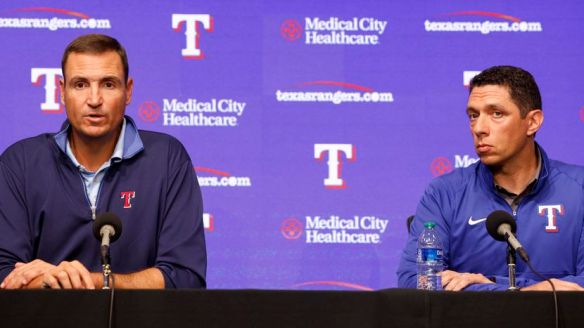
Pitcher-turned-MLB executive-turned-Rangers executive Chris Young (left) now succeeds Jon Daniels (right) as the Rangers’ GM . . . but the move’s timing days after Daniels was made to fire manager Chris Woodward was strange to be most polite.

When the Rangers executed manager Chris Woodward and general manager Jon Daniels, it looked at first as though the organisation simply decided too much was too little and enough already. Likewise when the Tigers decided several days earlier that there was a guillotine with general manager Al Avila’s name on it.

Avila’s dispatch wasn’t exactly likely to generate much in the way of sympathy or empathy.   Tigers owner Chris Illitch probably starting drawing up the warrant after Avila made a pair of 2017 deals that sent away future Hall of Fame pitcher Justin Verlander and ace designated hitter J.D. Martinez and brought back what proved no major league help.

Both those players went from there to help make World Series wins possible with their new clubs, back-to-back even: Verlander helped pitch the Astros to the 2017 Series rings and Martinez helped swing the 2018 Red Sox to the rings a year later.

Never mind how tainted both Series triumphs are, though it’s possible to make the case that Verlander (and his fellow Astros pitchers) wasn’t exactly among the conspirators that birthed and bred Astrogate. And we don’t know for dead last certain whether or how often Martinez himself benefitted from the Rogue Sox’s replay room reconnaissance ring.

From Avila’s first season on the job his Tigers, as Defector notes, were baseball’s second-worst hitters and second-worst pitchers on a team level, not to mention the second-worst in the Show for winning and losing—behind the Orioles, who’ve spent this year going remarkably and maybe inexplicably from the tanks to within a half game’s reach of the wild card picture.

“Then again,” observes Defector writer Ray Ratto (once a longtime San Francisco Bay Area sportswriter), “[Orioles GM] Mike Elias didn’t guarantee a quarter billion dollars in current and future salaries to players who have amassed a 43-68 record, worse than every team in baseball save Oakland and Washington, who have shed payroll to be bad. Spending more to be just as bad is, well, spectacularly contraindicated.”

That was the Avila legacy in an envelope. He gave them his son Alex as a catcher and in exchange steered the team into a ditch. His best year was his first, and that’s never a good way to keep the boss from snarking you up on your way out the door. The current team is on pace to have its second-lowest runs per game output in franchise history (and since we know you’re going to ask, 1904) and the fewest homers in a full season since 1954. We’d call them God-awful, but God has lawyers.

. . .The Tigers just . . .  faded away. Neither hated nor condemned, they just eased into the Phantom Zone and stayed there. They’re not even appreciated for playing the fastest games in the majors, which is the one blessing you can provide your fans when you stink on a daily basis.

Al Avila

Al Avila, watching the Tigers work out the day before Opening Day, seeded his demolition with two 2017 trades.

In other words, if Avila was actively and consciously tanking, he had a mad genius for doing it as far away from deep scrutiny as the current Cubs, Reds, Royals, Pirates, and Nationals have drawn. (“Even the Angels get more condemnation,” Ratto writes wryly, “but that’s because unlike the Tigers, they kept their best players and still failed.”)

So the rebuilding Tigers have to start their rebuild all over again. So, apparently, do the Rangers, whose owner Ray Davis announced Daniels’s firing by saying, “Bottom line is we’re not good, and we haven’t been good for six years. To be competitive going forward, I felt that we needed to make a change.”

It was the way Davis made the change that left more than a few eyes rolling and jaws falling. He made Daniels announce Woodward’s wiring into the electric chair just a couple of days before he threw the switch on Daniels himself, whose contract was due to expire at season’s end.

Saying the decisions were brewing for several months before last Monday’s Woodward execution leaves Daniels with what The Athletic‘s Rangers beat writer Levi Weaver calls “a bad look.” That’s like saying the deal with Adolf Hitler to swap Czech freedom for “peace in our time” left Neville Chamberlain with nothing more than the proverbial egg on his face.

Except that the Czechs knew exactly what was coming, even if portions enough of the world around them still couldn’t believe it. As Weaver writes, Daniels was sent to face the press explaining Woodward’s dispatch with no knowledge that his own hemlock cocktail was being mixed.

What troubles Weaver is that, for all that dispatching Daniels might have been necessary at last, it was done not only underhandedly but a couple of years too late:

After all, as Davis made sure to point out, the Rangers haven’t had a winning season since 2016. In retrospect, the rebuild that began in earnest in 2020 probably should have begun in 2017 — never mind that one source familiar with proceedings said that Daniels intended to do just that, but was pressured into putting a better product on the field for the first season of the new ballpark. Still, Nomar Mazara, Rougned Odor, Chi Chi Gonzalez and a passel of other home-grown talent didn’t turn out to be the next core of stars that fans hoped. Those decisions land at Daniels’ feet and maybe warranted a parting of ways.

But if that were the case, it should have been done back in 2020, when it was clear that plan hadn’t worked.

Those are purely baseball considerations. They fall under such headings as the Rangers’ farm yielding negligible crops; the front office’s unique stability in the Daniels era meaning a lack of fresh blood; and, a lot of circumstantial misfortune such as a pitching staff bedeviled with injuries over too long a period.

But Weaver isolates another problem with the manner in which Daniels was handled now. Reporters so often speak to a man’s peers in a business and Weaver learned things about Daniels from fellow GMs and their underlings that might make him an exception rather than a rule in a sport whose business is as cutthroat and duplicitous as its play is ennobling.

“Daniels cared about his people,” Weaver writes. “Sometimes, in the opinion of those around the league, he cared too much, seeing the best in his employees and keeping them around when others might have pulled the plug.”

Sure, he would make a hard decision when he had to — occasionally, the fit between employee and organization just wasn’t working and it was time to part ways. But the only times Daniels ever took me to task for my reporting was when I wrote those stories. Every time, the message was the same: if you need to blame someone, blame me. I don’t want this guy’s family to read him getting ripped in the press. I’m front-facing; I can handle it.

With [Daniels’ sudden firing] it’s clear that loyalty didn’t work its way up to the ownership level . . .

. . . Choosing one’s employees is an owner’s prerogative. But to fire Daniels publicly after such a long tenure showed a lack of common courtesy or decency. Even if Davis had decided not to renew Daniels’ contract at the end of the year, keeping him around to help with the transition would have accomplished two things. One, it would have given some well-deserved dignity to Daniels, allowing him to quietly step down at the end of the season. He has earned that, and to surprise him with a firing now — just two days after he was the face of a managerial firing — is disrespectful at best.

Secondly, allowing Daniels to finish the year could have potentially been beneficial to [pitcher turned MLB vice president in charge of discipline to Daniels understudy Chris] Young. In an advisory role, Daniels could have helped to prepare Young for the remainder of the responsibilities he was inheriting. We’ll never know now: Davis didn’t run the idea by Young before making the move, opting to act now and let Young deal with the fallout.

Respected for brains on the mound and as a baseball executive in the making, Young doesn’t exactly have people worrying about whether he’ll crack. But Daniels had almost two decades on the job and shepherded the last two (and back-to-back while they were at it) Rangers World Series entrants. (They lost decisively to the Giants in 2010; they were two outs from winning the 2011 Series when they ran into a Cardinals buzz saw named David Freese.)

Daniels and Young enjoyed a close relationship for a very long time, going back to Young’s initial major league seasons pitching for the Rangers. Surely Young knows that being a people person was one of Daniels’s above-average strengths. And the Rangers have had small improvements this year even if they weren’t obviously making more better promises for next year.

How Young balances himself between people personhood and making the hard assessents of the Rangers’ roster and front office should provide interesting observations. But if he assesses the depth of the handling and timing of his former boss’s sentence to the Phantom Zone and finds himself compelled to keep one eye over his shoulder, you can’t necessarily blame him.

On legally mandating the anthem before the games

If ten Texas state senators and its lieutenant governor have their way, it’ll be Texas law to play “The Star Spangled Banner” before all games in the Lone Star State including at the Houston Astros’ home.

Among many things, in his farewell address this nation’s first president hoped his thoughts and suggestions would move his countrymanpersons “to guard against the impostures of pretended patriotism.” The Father of His Country might have had legislating as well as posturing patriotism in mind. Even though Texas wasn’t even a gleam in the new nation’s eye just yet.

A tentet of Texas state senators wants “The Star Spangled Banner” as required playing, listening, and posturing before every sports contest hosted in the Lone Star State—preseason, regular season, and postseason. For openers. As reported by Reason‘s deputy managing editor, Jason Russell, the tentet would like to tell one and all playing games in the state, “or else!”

Or else, among other things, no government entity state or local can make deals “that require a financial commitment” with any sports team “unless the agreement includes written verification the team will play the anthem before all games,” Russell writes. “If a team fails to comply, it would be in default of the agreement.”

Apparently, the Texas Ten took their cue from Lt. Gov. Dan Patrick, who is no known relation to the longtime ESPN SportsCenter anchor now hosting his own show on Premiere Radio Networks. In February, Patrick was not amused to learn the NBA’s Dallas Mavericks weren’t playing “The Star Spangled Banner” before their pre- and regular-season home games.

It’s not that anybody noticed until the final such game, because thanks to the pan-damn-ic there were no fans present until that final game. Then the NBA decided, not so fast, it’s time to re-enforce the league’s rule that the national anthem will be played before all NBA games, whether or not the Mavericks or their owner Mark Cuban likes it.

What has this to do with baseball? Well, two American League teams hail from Texas. So do four minor league teams even under the dubious new minor league realignment. If Patrick and the Texas Ten get their way, they’ll be spanked, too.

Russell observes that if the bill passes and is signed into law, major sports teams that let teams dispense with “The Star Spangled Banner” would find such decisions “affect[ing] stadium subsidies, any kind of government-funded tourism sponsorship, and possibly even arrangements where local law enforcement provides security.” The good news: the bill isn’t likely to cut the mustard in the courts, possibly all the way to the Supreme Court.

It’s one thing for the NBA or the NFL (which has mandated it since after World War II) as essentially private organisations to require it. It’s something else entirely for any government at any level to do so.”This legislation already enjoys broad support,” Patrick harrumphed last month. “I am certain it will pass, and the Star Spangled Banner will not be threatened in the Lone Star State again.” (He meant the flag as well as the song.)

Threatened?

“Patrick’s proposal that the Texas Legislature pass a state law requiring the national anthem be played represents state action,” writes attorney and journalism professor Amy Kristin Sanders in an e-mail to the Website of televisions Law & Crime. “As a part of its speech protections, the First Amendment also bars state actors from compelling others to speak—and requiring someone to play the national anthem is just that.”

We can surmise with little fear of contradiction that that isn’t exactly what an ancient Red Sox third baseman named Fred Thomas had in mind during the 1918 World Series.

On leave from the Navy to play in the Series, with the Navy’s full blessing, Thomas heard a Navy band (it was common in those times for military bands to provide music at sports events) strike up “The Star Spangled Banner” during the seventh-inning stretch and saluted spontaneously, as he might have been expected as a Navy man himself.

Thomas’s salute prompted other players in both dugouts (the Red Sox played and would beat the Cubs in that Series) to stand and salute, not to mention the already-standing crowd to salute likewise. This, by the way, was thirteen years before “The Star Spangled Banner” became America’s official national anthem.

Red Sox owner Harry Frazee decided that for the rest of that Series two things would happen: 1) For all games played in Fenway Park wounded war veterans would have free admission. 2) “The Star Spangled Banner” would be played in their honour before the start of those games. As with Thomas’s spontaneous salute, Frazee’s gesture did not come to him at the wrong end of a gun, actual or rhetorical.

It inspired other sports teams and leagues to do likewise, gradually, and entirely on their own, in the years to follow before and after the anthem became official. Baseball has never had a formal rule mandating either “The Star Spangled Banner” or “God Bless America” (which became an unofficial but consistent tradition in the wake of the 9/11 atrocity), but neither has it rejected the tradition of it.

When kneeling protests emerged a few years ago among black athletes spearheaded by long-former NFL quarterback Colin Kaepernick over rogue police brutality against black suspects, the passions both ways soared like a grand slam. They still do when the anthem issue arises, with or without the kneeling protests, as with Cuban and the Mavericks.

And you can’t always interject that kneeling is as much a gesture of respect and genuflection as it might be a gesture of protest. Even if you argue that kneeling protesters might appeal as much to a higher authority as against a particularly abusive temporal one. Even if you agree without taking a knee that there should be no place for rogue police in any diligent such department.

I’ve gone on record about it before, but Patrick’s harrumph compels it one more time: Is it absolutely necessary to sound “The Star Spangled Banner” before every damn last sports contest played all year long? If we believe patriotism must originate and remain in the heart, doesn’t the day-in, day-out pre-game playing erode rather than enhance the patriotic impetus by making it formal obligation instead of free and organic?

My past thoughts haven’t changed. I have no wish to eliminate the National Anthem from sporting events entirely. I also have no wish that Patrick and the Texas Ten should prevail and inspire other states to likewise. I remain in agreement with National Review senior editor Jay Nordlinger, who wrote almost three years ago, “I’m not sure that patriotism is compatible with compulsion,” to which George Washington himself might have answered with a resounding if quiet “it isn’t.”

And, I remain convinced that, on behalf of removing only too much of the compulsory factor from an impetus that must come purely from the heart and soul, playing “The Star Spangled Banner” ought to be limited to the following sports events:

* Opening Day for major sports leagues’ regular seasons or, in the case of non-team sports, major tournaments. (The U.S. Open in tennis and golf; the Masters’ tournament; the PGA Championship; etc.)

* Any games played on major national holidays. (Since I’m a baseball writer, let’s start from there: Memorial Day, Flag Day, the Fourth of July, Labour Day. Also, Veterans Day, Thanksgiving, New Year’s Day, Martin Luther King, Jr.’s Birthday, Presidents Day.)

* All-Star Games in major sports leagues.

* The Super Bowl.

* Game One of each major sports league’s final round: the World Series (first things first!) NBA Championship, the WNBA Championship, the Stanley Cup Final (if Game One begins in the American team’s arena).

* Game Seven of such championship rounds, if they go that far.

And, in the immortal words of Porky Pig, eba-dee, eba-dee, eba-dee, eba-that’s all, folks.

I won’t expect the commissioners or governing bodies of major sports to stop and ponder, never mind enact the foregoing. They’re many things, but bold isn’t necessarily among them. Not the sort of bold that enhances and advances their games, anyway.

The eyes of the nation should be upon Texas, if only to see that the way to patriotic wisdom is more often than we think to travel the road assuredly not taken. Certainly not by the Lone Star State’s second in command plus ten lawmakers unaware that they wish to make dubious and unconstitutional law.

“It shouldn’t be against any rules”

2020-08-18 TatisMachado

Looks like a winner to me.

Collin McHugh may have opted out of pitching in 2020, but the former Houston Astro hasn’t opted out of thinking. Lucky for us. Concerning the Fernando Tatis, Jr. grand slam kerfuffle, McHugh has wisdom the old farts will likely ignore but the young and young-at-heart will receive as writ.

Swinging in a 3-0 count should not be against any rules, no matter the score,” McHugh tweeted the morning after Tatis’s eight-inning salami on 3-0 rubbed the Texas Rangers the wrong way and got the next San Diego Padres batter, Manny Machado, a pitch thrown right to and past his rump roast.

“Before a game I would always look to see what [percent] a guy swings 3-0,” McHugh continued. “If it’s over 20%, it means I can’t just groove one. The guys who will never ‘give you a pitch’ at the plate are the toughest AB’s.”

Someone among the Rangers brain trust ought to communicate McHugh’s wisdom to Ian Gibaut, who relieved Juan Nicasio after Nicasio’s 3-0 fastball just off the middle of the plate took a ride into the fan cutouts behind the right field fence off Tatis’s bat Monday. Gibaut is the Ranger who thought Tatis’s flouting of the Sacred Unwritten Rules earned Machado a target off his tail.

Tatis wasn’t the only hitter running afoul of the SURs that day. In Atlanta’s Truist Park, Washington Nationals outfielder Juan Soto had the temerity to send Braves reliever Will Smith’s service on a 445 foot trip to the seats in the top of the ninth and give it a far quicker look of self-admiration than the young Nat has given other such thumps in his young career.

Smith promptly switched his Braves hat for his Fun Police hat and fired an expletive Soto’s way. That’ll teach him. Not only did Smith’s bark prompt Soto to take an even slower trip around the bases than he might have planned, it prompted Nats manager Dave Martinez to play the other side of unwritten law enforcement as Soto’s defense attorney.

“Will Smith said something to Soto that I didn’t really appreciate,” the manager told reporters after that game—which the Braves came back to win on Dansby Swanson’s game-ending bomb. “So I just want to let him know, hey, it wasn’t Juan who threw the ball. His job is to hit so just be quiet and get on the mound. You threw the pitch, make a better pitch.”

Well, what do you know? A piece of me would love to think Martinez might have seen what I wrote earlier Tuesday morning:

You let a hitter get into a 3-0 count with or without the bases loaded? That’s on you. You throw him something he can meet with the bat at all? That’s on you. You want to scream bloody murder because he didn’t thank you nice fellows by taking strike one and his medicine after you were already so generous as to let him and his take a seven-run lead on you going in? That’s on you, too.

But I know better. I have about as much chance of being seen, never mind read and heeded, by the manager of the defending world champions as Donald Trump has of being added to Mount Rushmore. And Rangers manager Chris Woodward has less chance of being seen as a wise man than as an artery-hardened wisenheimer.

“You’re up by seven in the eighth inning — it’s typically not a good time to swing 3-0,” you may remember Woodward fuming after the Padres finished what they started, a 14-4 blowout. “It’s kind of the way we were all raised in the game. But, like I said, the norms are being challenged on a daily basis, so just because I don’t like it doesn’t mean it’s not right. I don’t think we liked it as a group.”

This season has already challenged norms enough. Remember: we’re trying to get through a major league baseball season in a time of coronavirus pandemic. The Show’s government has put into place enough truly dubious actual rules and experiments. The whole thing continues to play a lot like you’d imagine an episode of Alfred Hitchcock Presents the Inner Sanctum of the Outer Limits Brought to You By Chocolate Cookies with White Stuff in the Middle.

You would have thought the last thing any team wanted to exhume was yet another fruitless debate on yet another violation of the SURs that does nothing much more than make the exhumers resemble the would-be enforcers of a protection racket.

You might also have thought the Rangers had a working sense of their own 21st Century history. We take you back to 22 August 2007, in Camden Yards, when a different group of Rangers could have been brought up on charges of human rights violations for the 30-3 massacre they laid on the Baltimore Orioles that fine evening.

The abuses included a ten-run top of the eighth—including Travis Metcalf grinding salami—with the score already 14-3 . . . and a six-run top of the ninth when the casualties amounted to 24-3. I don’t remember if the Orioles raised any objections to any SURs that may or may not have been violated during the carnage, but I did wonder at the time whether they’d suffer post-traumatic stress syndrome.

McHugh isn’t the only pitcher present or past who thinks the Rangers should have spent more time making solid pitches and less time complaining because one not-so-solid pitch got demolished on 3-0 late in a blowout-to-be.

“I’m old enough that I grew up in a game that a lot of older guys had all the power and they would tell you how to act, what to do, and you did what they told you to do because that’s how it was,” said Ron Darling, once a world champion 1986 New York Mets pitcher and now a Mets broadcaster.

“Unwritten rules only work if everyone knows the unwritten rules,” Darling continued. “By their very definition, nobody knows an unwritten rule, so what you have now is you’re trying to make a decision that a 3-0 count in a seven-run game is off limits. I’m just not with that at all.”

How about we ask Zach Davies, the Padres’ starting pitcher Monday night, who might have a thing or three to say about whether the SURs ought to overthrow such game facts as the Padres bullpen entering the game with the third-highest collective earned-run average of any Show bullpen? Such bullpens make even seven-run leads feel about as secure as a bank whose vault is left open after closing time.

“A lot of guys talk about unwritten rules of baseball, but you’re in the heat of the moment, you’re gonna try to get your pitch as a hitter and he didn’t miss,” Davies told The Athletic‘s Dennis Lin.

So you can’t really fault him for that, in my opinion. Some guys feel differently, but everybody has their own opinion on it. Make sure your 3-0 pitch is a little bit better. I’ve been hit on 3-0 and homers have been hit off me, maybe not in the same situation, but that’s something that everybody kind of has a little bit different opinion on.

Would Tatis have escaped scrutiny (and would Machado have escaped a sailer toward his seat) if he hadn’t hit a three-run homer an inning earlier? That one made the score 10-3 in the first place. Grinding salami in the next inning regardless of the count could be taken by some teams and their pitchers as putting out the first insult’s fire with gasoline.

Meanwhile, it looks like San Diego’s Wil Myers taught the Rangers and their Tuesday starting pitcher Mike Minor a little lesson in manners in the top of the first. With two out and the bases loaded, Myers caught hold of a Minor changeup that hung like a condemned man and hung it into the left center field bullpen.

Then Tatis exacted his own revenge on Gibault in the top of the fourth, after Jurickson Profar belted a two-run homer. With Tatis singling to left with two out and Machado drawing the walk that pushed Minor out of the game, bringing in Gibault in the first place . . . Tatis stole third.

He was stranded, and the most the Rangers could muster was a four-run bottom of the fourth, kicked off when Joey Gallo bombed San Diego reliever Javy Guerra for a three-run homer with nobody out.

But the real messages were sent and re-sent. Including Gibault and Woodward being suspended for their upholding of the SURs Monday night. Gibault appealed his three-game suspension and thus was able to get Tatis’s return message; Woodward served his suspension Tuesday.

Another former major leaguer, Chris Singleton, tweeted a political campaign-style T-shirt emblazoned, Tatis-Machado ’20: Take the Cake. Sounds like a winning ticket to me. Neither actual presidential campaign has yet devised a campaign slogan that snarkily creative, which figures. And letting them have fun is just about the last thing the country needs.