ALCS Game One: Miller time for the Mariners

Bryce Miller, George Springer

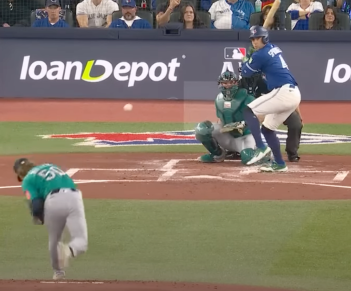
George Springer is about to demolish Bryce Miller’s first pitch of ALCS Game One. It was the only score Miller would allow over six otherwise spotless innings on short enough rest. (Fox Sports television capture.)

At the split second George Springer’s bat connected with Bryce Miller’s first pitch of this year’s American League Championship Series, you could be forgiven if you heard Mariners fans groaning. When the ball banged the Canada Dry sign above the right center field bullpen, you might have heard the groaning turn to moaning.

One pitch, one swing, the 21st postseason bomb of Springer’s career, and only the third leadoff bomb in League Championship Series history since pitch counting began in 1988, according to The Athletic‘s Jayson Stark. Just like that, the Blue Jays took a lead.

And Springer’s opposite-field smash on a fastball away, sending him past Hall of Famer Derek Jeter for fifth place on the all-time postseason bomb list, wasn’t the only reason Mariners fans groaned and moaned.

In the top of that first inning, they groaned, moaned, and fumed when the Mariners didn’t call for a review of that play at the plate on which Cal Raleigh (one-out hit, advancing to third on followup hit) was tagged out when it appeared he’d managed to get his foot on the plate through the legs of Jays catcher Alejandro Kirk. But television replays showed Raleigh’s foot landed a second or two after Kirk tagged his torso.

Were the Mariners unduly alarmed after Springer sprang?

Not after Miller wriggled out of further trouble in the form of a pair of walks courtesy of inducing a pair of line drive outs and a short fly out.

Not after Miller matched Jays starter Kevin Gausman point for point, dollar for dollar, from that point forward, until Raleigh atoned for missing the first inning score by squaring Gausman up, with two out in the top of the sixth, and driving a 2-2 service a little further than Springer’s traveled, about five rows up into the bleachers above that bullpen.

Not after Jays manager John Schneider decided that a followup walk to Julio Rodriguez should be he end of Gausman’s evening before he might incur jn any further damage. That came soon enough when Gausman’s relief Brendon Little wild-pitched Rodriguez to second and surrendered Jorge Polanco’s sharp opposite-field line RBI single to left to crack the one-all tie.

Not after Randy Arozarena wrung a leadoff walk out of Jays reliever Seranthony Dominguez in the top of the eighth, stole second and third while Raleigh suffered a called strikeout, then—after another walk to Rodriguez—came home on another Polanco steak, this time a spanker bouncing three times through the infield and a few more into right.

“I just choked up and wasn’t trying to do too much,” said Raleigh postgame about his bullpen-clearing blast. “I was just trying to get bat on ball and really put something in play, maybe find a hole. I didn’t want to punch out again.” He didn’t seem to mind putting that ball out of reach, out of play, and out of sight, either.

Kevin Gausman, Cal Raleigh

Raleigh is about to smoke Gausman’s splitter for a trip above the right field bullpen . . .

Aside from all that, it was Miller time. For a guy pitching on three days’ rest for the first time in his major league life. For six inning of one-run, two-hit baseball that including getting rid of seventeen of his final nineteen batters. He needed a little comfort from Raleigh at the mound while navigating his way out of that first-inning fire, but that was enough.

Miller went two innings longer than Mariners manager Dan Wilson expected him to go on short rest, only nobody told Miller until he was done for the night.

“They didn’t tell me anything, any plan,” said the lad who threw 27 pitches in the first inning and 49 the rest of his outing. “So I was going out there just letting it rip until they came out and got me.”

“That was incredible from him,” said Mariners reliever Matt Brash (now, there’s a classic name for a relief pitcher), who was one of three Mariners bullpen bulls along with Gabe Speier and Andres Munoz to pitch perfect innings once Miller’s time expired for the evening. Thus the 3-1 Mariners win Sunday night.

“I knew this was the biggest start of my career so far,” said Miller, whom one report revealed stood in Rogers Centre’s center field’s farthest location from the plate staring that direction to help focus, “and I just wanted to get out there and mentally kind of get in a zone and visualize having success on the mound.”

Miller’s season wasn’t always so simple. After a 2.94 ERA in 2004, he ran into elbow inflammation twice and an inflated ERA. He didn’t find himself on his horse fully until some time in August. Then he gave hints of his postseason potential in ALDS Game Four, pitching 4.1 shutout innings against the Tigers.

Remember: These Blue Jays are the ones who demolished the Yankees 34 runs worth in their American League division series and made the Bronx Bombers resemble the Bronx Broken. The Mariners got rid of 23 of the final 24 Jays hitters while they were at it. All of a sudden the Joltin’ Jays didn’t look all that intimidating despite Springer’s first-pitch flog.

Remember, too: These Mariners played fifteen innings Saturday to come out of their ALDS alive and reasonably well and leaving the Tigers for dead. They had to fly cross country and into Canada and endure a four-hour departure delay when mechanical issues forced their airline to get another plane up to Seattle from Los Angeles. They didn’t even have time for a Rogers Centre workout before ALCS Game One.

I’m not sure I’d recommend this as a continuous practise, but it seems as though now and then a team that should have been suffering exhaustion can turn one of the league’s howitzer corps to one side for one night. Now we’ll get to see if the Mariners can manhandle the Jays on a proper night’s sleep and with a proper pre-game workout.

We may even get to see Miller on the mound in a game that would mean the pennant for the Mariners if they win. The lad’s already proving that unthinkable isn’t necessarily impossible.

The unsinkable Mariners

Jorge Polanco

Jorge Polanco shooting the game and ALDS-winning base hit for the Mariners in the bottom of the fifteenth . . .

“Life is what happens when you’re busy making other plans,” sang John Lennon on the last album he released in his lifetime. Instead of singing it in the middle of a sweet lullaby he wrote for his then five-year-old son, the former Beatle could have been singing about baseball.

He could have been singing, too, about such contests as the just-concluded American League division series between the Tigers and the Mariners. The one that came to a fifth game that came down to a fifteenth inning and, possibly, both teams wondering just whom was going to commit a fatal flub, flop, or faux pas, Phillies-like or otherwise.

“It felt the whole game,” said Tigers shortstop Javier Baez post-mortem, “like whoever made a mistake was going to lose.”

Well, nobody in either Tiger or Mariner uniforms made any truly grave mistakes Friday night. The Mariners punched their ticket to the American League Championship Series the old-fashioned way, a hair-raiser of a ball game they finished when Jorge Polanco slashed a single with two out and the bases loaded in the bottom of the fifteenth.

Until that half-inning, the Tigers and the Mariners threw everything at each other except the proverbial kitchen sink. The sink showed up in the bottom of the fifteenth. When Tommy Kahnle relieved a gutsy Jack Flaherty for the Tigers, and J.P. Crawford opened the proceedings with a base hit, the third Mariners leadoff runner in four innings.

But Kahnle followed that by plunking Randy Arozarena on the first pitch, before Cal Raleigh lined out but left Arozarena safe at second thanks to Tigers center fielder Parker Meadows’s errant throw. Then the Tigers ordered Julio Rodriguez walked on the house. In situations leaving first base open with a season on the line, it was the smart move after dodging a Raleigh artillery shell.

Now came Polanco. He and Kahnle fought to a full count with no place to put him. Then Kahnle threw a fastball Polanco shot on a line through the right side and into right field, Crawford racing home and jumping onto the plate and into the arms of teammates who might have been forgiven if they’d just been wondering how much longer this epic could play.

“The back half of that game is like a game in itself,” said Tigers manager A.J. Hinch post-mortem. “We dodged a few bullets, and so did they . . . I didn’t want it to end, certainly,  the way that it did, but I wanted to just keep giving ourselves a puncher’s chance, and they outlasted us.”

Until the bottom of the fifteenth, it was fair to say the Tigers and the Mariners outlasted each other.

From the brilliance of starting pitchers Tarik Skubal and George Kirby to the magnificence of both bullpens plus a pair of starting pitchers pressed into all-hands-on-deck relief service, this game made you wonder whether anyone from the big bats to the supporting cast really knew how to hit anymore.

Skubal in particular pitched like the Cy Young Award winner he seems destined to become this year. He surrendered one run but set a new postseason record with seven straight strikeouts, then set another one with thirteen total strikeouts in a postseason elimination game. He pitched six virtuoso innings and left with his tank below empty.

How could he have known at that moment that things would end up with him making grand, Hall of Famer-like showings in his two ALDS starts but his team ending up on the losing side?

Kirby was almost as brilliant as Skubal. In fact, the only run charged against him scored when he’d left the game in the bottom of the sixth, after surrendering Baez’s leadoff double. Gabe Speier took over and Tigers right fielder Kerry Carpenter hit a 1-0 service into the right center field seats.

That gave the Tigers a 2-1 lead lasting long enough for the Mariners in the bottom of the seventh to tie it up with a little shuck-and-shuffling on the part of skipper Dan Wilson.

He sent Dominic Canzone to pinch hit for Mitch Garver, whose second-inning sacrifice fly opened the scoring in the first place. Hinch promptly brought Tyler Holton in to relieve Skubal’s relief Kyle Finnegan. Wilson countered by sending Leo Rivas up to pinch hit for Canzone.

In the first postseason plate appearance of his major league career, measuring Holton for the cutters and changeups he was most likely to throw, Rivas took a strike, then lined a changeup for a base hit to left to send Polanco home with the tying run.

From that point forward, the bullpens, with or without starters pressed into emergency all-hands-on-deck duty, were brilliant, even when they were slithering, sneaking, or bludgeoning their ways out of jams you could charge were some of their own making.

“It was like (we) got them on the ropes, and then they wiggle out of it. They got us on the ropes, and we wiggle out of it,” said Finnegan postgame. “It was an absolute roller-coaster of a game. That’s the beauty of this sport.”

“A heartbreaker of a finish,” said Tigers first baseman Spencer Torkelson, who’d gone hitless in six Game Five plate appearances, “but an unbelievable baseball game to be part of.”

“My experience feels like the ground was shaking every inning,” said Rivas. He wasn’t exactly wrong. Especially over the extra innings, when it seemed nobody in T-Mobile Park dared to sit back down.

“We knew this was not going to be a football score, that it was going to be a tight pitchers’ duel,” said Mariners president of baseball ops Jerry Dipoto, himself a former major league pitcher, “and our general take was: keep it close until Skubal’s out of there and we’ve got a chance to win this game.”

Even if it took nine innings from Skubal’s exit to do it. But once Speier yielded to Matt Brash, what came out of the Mariners’ bullpen—including and especially starters who hadn’t relieved in either eons or since early minor league days, whichever came first—was magnificent.

Brash himself got six outs for the first time since 2003. Andrés Muñoz, the Mariners’ usual designated closer, walked a pair but escaped and then pitched a spotless ninth. Logan Gilbert, a starter, pitched a pair of scoreless innings. Eduard Bazardo landed eight outs, something he’d never done in his career until Friday night. Luis Castillo, who hadn’t relieved in almost a decade, got rid of all four batters he faced.

The problem was the group of people rooting and cheering even louder than the ballpark crowd: the Blue Jays. Broadcast announcers noted it until even they got sick of saying it, but as the extra innings accumulated the Blue Jays had to have been roaring with delight knowing that, whichever team would meet them in the ALCS, that team’s pitching might be depleted temporarily.

That’s not what you want to throw at the Blue Jays and their own howitzer offense in their own playpen to open. The ALCS may come down to first and second game survival for the Mariners before they can bring the set back to T-Mobile Park. But when they do, the Mariners have at least one comfort upon which to lean: the Blue Jays were a game below .500 on the road while playing .667 ball at Rogers Centre.

And both teams want to end pennant droughts expeditiously as possible.

The Blue Jays haven’t hit the World Series since they won their second of two straight in 1993. The Mariners haven’t hit the World Series at all in their 48 years of existence. The last time they showed up in an ALCS, they’d won 116 games on the regular season, had the 2001 Rookie of the Year in future Hall of Famer Ichiro Suzuki, another Hall of Famer in Edgar Martinez, and lost to the Yankees.

The Tigers haven’t reached a World Series since 2006 or won one since 1984. They wouldn’t mind ending a drought, either. But on a night when Carpenter went four-for-five while the rest of the Tigers managed only four hits, Carpenter becoming the first since Babe Ruth to reach base five times and homer in a winner-take-all postseason game probably made Tiger fans wish they could have run nine of him to the plate Friday night.

It’s hard to think, “What a year,” when thinking of the Tigers. Sure, they’re talented, likeable, and their own kind of resilient. But these are the same Tigers who became this year’s first to win thirty, then forty, then fifty, then sixty games . . . before the worst September win percentage of any postseason baseball team ever. They played September as if on crutches.

The Mariners won their division handily enough, playing September with controlled fury and rolling their best month’s record of the season, 17-8/.680, while earning a round-one bye in the postseason. They proved unbreakable when the Tigers took them to the bitter end Friday night.

And the game proved unbreakable without Manfred Man, the free cookie on second base to begin each half inning. Manfred Man’s extinction should not be restricted to the postseason alone. No mistake.

They’ll love Arozarena in Seattle . . .

Randy Arozarena

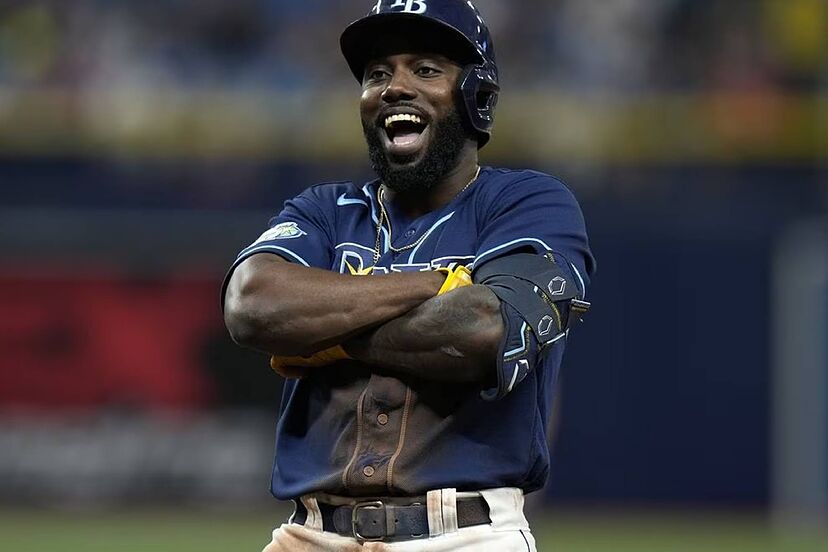
Arozarena’s smile could light up any ballpark felled by a power outage.

Nobody likes to see teams send their most heroic postseason heroes onward. Sometimes that happens when the most recent of their postseason heroics are still in full rearview mirror view. That stings the deepest.

So maybe the Rays did their fans a favour by sending Randy Arozarena to the Mariners long after the postseason postings that made his name disappeared from rearview sight. But it’s a small favour. And, depending upon the net results of the haul they got in return, it might not even prove that much of a favour.

Once up as high as ten games atop the American League West, the Mariners have since gone 11-20 as the formerly-moribund Astros reheated enough to take the division lead by a full game. Losing a ten-game lead in a 24-game stretch was unprecedented. No team before them ever blew that fat a lead that soon.

Arozarena’s season began slumping until he re-heated before the trade, but he hasn’t factored in the Mariners fortunes just yet, even if they took a pair from the White Sox after making the deal. The Mariners have the patience of Job when it comes to waiting for his full emergence in their silks.

They sent the Rays two prospects with upside enough if you consider the Rays’ ability to shape players, minor league outfielder Aidan Smith and pitcher Brody Hopkins. The Rays had better hope they can forge that pair into more than just replacement-level major leaguers. Arozarena was worth about a hundred times that much from the moment his 2020 coming-out party began.

Arozarena picked up one hit on Saturday but then went 2-for-4 with a run scored in Sunday’s 6-3 Mariners win. He beat an infield hit out in the first to score almost promptly on Cal Raleigh’s immediately-following home run, then he beat another infield hit out to load the bases with two out in the second only to be stranded there.

“He’s really loved by his teammates and fans,” said Mariners outfielder Luke Raley, himself an Arozarena teammate in Tampa Bay for two seasons, “and he’s going to be a fun addition for sure. He’s the low heart-beat kind of guy. He’s just made for the big moment. Late in the game, you need a big hit, you want Randy at the plate.”

Raley spoke after the Mariners demolished the bottom-crawling White Sox 10-0 Friday night. He even revealed Mariners president Jerry Dipoto consulted him on Arozarena before pulling the proverbial trigger on the deal. “I kind of gave him a three-, four-minute spiel about my thoughts and the things that [Arozarena] does,” Raley said. “You try to explain it, but it’s really hard—because until you see it, you don’t fully understand it. But he just is like a bright star.”

This is the effervescent who defected from Cuba in a rowboat and was first signed by the Cardinals. A year before that coming-out party, Arozarena made what some call a mistake and others call serious. When the Cardinals destroyed the Braves 13-1 in 2021 National League Division Series Game Five, manager Mike Schildt broke into a postgame rant that left himself and his team resembling sore winners:

They [the Braves] started some (excrement). We finished the (excrement. And that’s how we roll. No one (fornicates) with us ever. Now, I don’t give a (feces) who we play. We’re gonna (fornicate) them up. We’re gonna take it right to them the whole (fornicating) way. We’re gonna kick their (fornicating) ass.

Schildt’s rant went viral thanks to Arozarena capturing it on video and sending it there. Once the rejoinders went flying in earnest, he couldn’t wait to take the video offline. The only place the Cardinals went from there was to a four-game sweep out of that National League Championship Series by a team of Nationals whose manager was smart enough not to say they were going to [fornicate] the Astros up in the World Series—they simply did it, in seven thrilling games.

A cynic might suggest the Cardinals waiting to trade Arozarena to the Rays the following January was a matter of not wanting it to look as though they were teaching him a lesson about impudent videomaking. But their loss was the Rays’ gain, once baseball resumed after the long enough and weird enough pan-damn-ic shutdown. The Rays hit the expanded postseason running. Arozarena hit it exploding.

He hit ten home runs to smash Hall of Famer Derek Jeter’s record for a single postseason. He set a single-postseason record with 29 hits. He was named that American League Championship Series most valuable player. Perhaps fittingly, too, he slammed the exclamation point down upon one of the weirdest and wildest World Series game-ending walkoff hits in Game Four.

He pounded the plate nine times with his right palm to be sure he wasn’t imagining having scored the walkoff run to finish 2020 World Series Game Four’s insane finale. Compared to his grin, the Cheshire Cat was suffering depression.

Arozarena was on first in the ninth when pinch-hitter Brett Phillips singled Kevin Kiermaier home with the tying run. Except that Dodgers center fielder Chris Taylor coming in to field the ball had more eye on Kiermaier and the ball caromed off his glove to his left. Taylor scrambled to retrieve the ball and get it to his cutoff man Max Muncy.

Except that Muncy took the throw past first and wheeled to throw home, but the throw bounded off catcher Will Smith’s mitt at the split second Smith began wheeling for a tag on an oncoming Arozarena—who wasn’t within two nautical miles of the plate just yet. Arozarena tumblesaulted after tripping and stumble back toward third before righting himself when he saw Smith lacked the ball, diving home and pounding the plate with the palm of his right hand nine times.

The Rays would lose that Series, of course, but Arozarena went from there to become the 2021 American League Rookie of the Year, his rookie status unblemished by his late arrival down the 2020 stretch. He was likely the first ROY to win that award after making himself into a postseason breakout star. And few postseason breakout stars had Arozarena’s knack for making even opposing fans take to him.

He was made for the arena. A word that just so happens to be the final three syllables of his surname. But he’s also made of more endearingly human things. When he learned he’d been traded, Arozarena delivered a farewell to admire. He slipped into the stands and greeted, shook hands with, and thanked as many fans and stadium workers as he could before departing. No newspaper ad or billboard stuff for him.

Arozarena’s likely salary escalation plus the Rays’ apparent inability to make any AL East gains prompted the team to move him to Seattle and pitcher Zach Eflin to the Orioles. Closing the book on this season and looking toward next may make baseball sense for the Rays.

“Tampa Bay has been hovering on the edge of the AL playoff picture for nearly the entire season, but a late-season surge wouldn’t have been out of the question,” says FanGraphs writer Jake Mailhot. “By moving Arozarena at this point in the season, the Rays have indicated that they’re more interested in ensuring they’re set up well for the future than in hoping for a long-shot playoff run over the next few months.”

But sending a franchise icon away—in a year that cost them their $182 million shortstop to administrative leave over an underage sex scandal in the Dominican Republic—stings even more. The Rays may lead the Show in frugality, but don’t think for a nanosecond that they entered 2024 intending to change Arozarena’s home address just yet.

They’re not the first to think they had to move such an icon, of course. But depending on what’s to come the rest of this season and most of next, Rays fans may yet come to see the Arozarena trade as comparable to that of the Mets trading Hall of Famer Tom Seaver to the Reds in 1977. Breaking hearts and backs and what was left of a franchise’s spirit alike.

“I loved every challenge of playing third base”

Adrián Beltré

He hit home runs on one knee, he was a human highlight reel at third base. Welcome to Cooperstown!

Of all the stories that abounded this weekend about Adrián Beltré, on the threshold of his induction into the Hall of Fame, there’s one which may be forgotten except by Angel fans left (as almost usual) to ponder what might have been. It’s the story of the Angels pursuing Beltré as a free agent after he spent five often injury-plagued seasons in Seattle.

Essentially, Angels owner Arte Moreno wanted Beltré in the proverbial worst way possible, after the Dodgers who reared him were willing to let him escape to the Mariners in free agency—despite Beltré having just led the Show with 48 home runs in 2004—because then-owner Frank McCourt didn’t want to pay what the Mariners ultimately did.

Beltré went from the Mariners to the Red Sox on a one-year, prove-it kind of deal. When that lone Boston season ended in October 2010, Moreno kept Beltré in his sights. But nothing the Angels presented Beltré impressed him enough to sign with them. He opted to sign with the Rangers instead. Moreno was so unamused he ordered his then-general manager Tony Reagins to deal for Blue Jays outfielder/slugger Vernon Wells.

Well. The Angels learned the hard way (don’t they always?) that Wells was damaged goods. The fellow they sent the Jays to get him, bat-first catcher Mike Napoli, would join Beltré for a hard-earned trip to a World Series that would break their hearts, before moving on to help Cleveland to a pennant and the Red Sox to the 2018 World Series triumph.

Meanwhile, before leaving Seattle for a one-year, show-us deal with the Red Sox, Beltré by his own admission finally learned he could have a shipload of fun playing baseball without losing the focus, the discipline, or the outlying durability that were going to make him a Hall of Famer in the first place. With the Rangers, he finished his ascent into what Baseball-Reference calls the number four all-around third baseman ever and, concurrently, built and secured a reputation as a team-first Fun Guy.

Nail his 3,000th lifetime major league hit? Party time—for the whole team and then some. “After he got 3,000 hits he had a party,” says Rangers in-game reporter Emily Jones to The Athletic‘s Britt Ghiroli and Chad Jennings. “It was like our clubhouse moved to this place. Every clubbie. Every trainer. Every massage therapist. He was extremely inclusive.”

“He was the oldest guy on the field,” says his former Rangers teammate Elvis Andrus, “but acted like the youngest.”

Beltre’s fun-loving rep went hand in glove with being a veteran clubhouse leader to whom even his manager often deferred. “If he stared at you some kind of way,” says Ron Washington, now managing the Angels but then managing the Rangers, “you knew he meant business. A couple of times, I got off my perch to go get (on a player). He would stop me and say, ‘Let me get it, skip’.’

“I saw him chew veterans,” says one-time Rangers batting coach Dave Magadan, “like they were 19-year-old rookies.”

But he also never forgot teammates, even after he retired. Lots of players can make their teammates go with the flow during arduous seasons. Beltré made them friends. Even if he might chew them out one day, he’d re-cement the friendship side by asking, “You know why I did that, right?”

Former Rangers teammate Mitch Moreland remembers taking a group of later Athletics teammates to a Seattle restaurant to which Beltré had taken a host of Rangers once upon a time. “I called (Beltré) and I was like, ‘Hey, what was the guy’s name at Metropolitan? I’m going to take the boys there’.”

He goes, “Oh, I got you.” So, he called the guy up, set it up. I took the whole team over there, we ate, and I got ready to get the bill, and Adrián had picked it up. For the Oakland A’s. After he was retired.

What of the once-familiar running gag involving Beltré’s real distaste for having his head touched and teammates—usually spearheaded by Andrus—going to great lengths to touch it and get away with it? “I still do,” Andrus says. “He still doesn’t like it. That’s what I am going to try to do at Cooperstown . . . I need to touch his head. I need to touch his head while he’s talking!”

He didn’t get anywhere close to that. Hall of Famer David Ortiz did, right smack at the podium.

But no matter. The third baseman who declined a grand farewell tour didn’t need any further validation for his place in the Hall of Fame. Those who do, however, should marry his 27.0 defensive wins above replacement level player (WAR) to his Real Batting Average (total bases + walks + intentional walks + sacrifice flies + hit by pitches, divided by total plate appearances) among Hall third basemen whose careers were in the post-World War II/post-integration/night-ball era:

HOF 3B PA TB BB IBB SF HBP RBA
Mike Schmidt 10062 4404 1507 201 108 79 .626
Chipper Jones 10614 4755 1512 177 97 18 .618
Eddie Mathews 10100 4349 1444 142 58 26 .596
Scott Rolen 8518 3628 899 57 93 127 .564
George Brett 11625 5044 1096 229 120 33 .561
Ron Santo 9397 3779 1108 94 94 38 .544
Wade Boggs 10740 4064 1412 180 96 23 .538
Adrián Beltré 12130 5309 848 112 103 97 .533
Paul Molitor 12167 4854 1094 100 109 47 .510
Brooks Robinson 11782 4270 860 120 114 53 .458
HOF AVG .555

He’s not higher there because a) he drew far less unintentional walks than most of the men on that list; and, b) that aforementioned durability led him to playing through injuries insanely enough to cause him a few so-so seasons that pulled his numbers down somewhat. But as a defensive third baseman he’s the second-most run-preventive player (+168) who ever worked that real estate . . . a mere 125 behind a guy named Robinson.

“I loved every challenge of playing third base,” said the first third baseman in Show history to nail 400+ home runs and 3000+ hits. “I was hooked. Those hot shots, slow ground balls, double plays, I couldn’t get enough of them.” Come Sunday, the Cooperstown gathering almost couldn’t get enough of Beltré, either.

Self-awareness as a vice

George Kirby

George Kirby, a second-year pitcher who inadvertently proved a little self-knowledge might be a dangerous thing—for his image, not for his particular line of work.

Maybe the only thing that brings Joe and Jane Fan to a boil faster than a baseball player speaking honestly about an injury is a pitcher who admits he didn’t do well with being kept in a game past his sell-by date for the day. George Kirby, second-year Mariners pitcher, may be learning the hard way.

After surrendering back-to-back first-inning runs to the Rays Friday, Kirby pitched five more spotless innings. In the bottom of the seventh, he threw one pitch for an unassisted ground out to first base, a second pitch Jose Siri drilled for a double, then three pitches to René Pinto. The third was lined down the left field line and into the seats to tie the game at four.

Mariners manager Scott Servais lifted Kirby for Isaiah Campbell. Campbell walked Yandy Díaz, induced Brandon Lowe to force Díaz at second base, but then fed Harold Ramirez a pitch meaty enough to feed the left field seats. An eight-inning leadoff bomb off another Mariners reliever secured the 7-4 Rays win.

But Kirby faced the media postgame and admitted he wasn’t exactly thrilled about pitching the seventh, which he entered having thrown 93 pitches or so already. “I didn’t think I really could go any more,” the boyish-looking righthander said. “But it is what it is.”

Come Saturday, Kirby apparently couldn’t wait to walk that back, the faster the better: “Skip’s always got to pry that ball out of my hands. Just super uncharacteristic of me as a player and who I am out on that mound. I love competing. Like I said, I just screwed up.”

The social media jerk brigades turned out in force with the customary charges of gutless, backbone-challenged, you name it. So did a few former players, for that matter. There seemed little room for charity, little thought that Kirby might have spoken Friday out of frustration over surrendering a game-tying bomb, and even less thought that Kirby might actually have a little self-awareness going for him.

Kirby had already faced Pinto twice earlier in the game when they met in the bottom of the seventh. Pinto flied out in the second and lined out in the fifth. Including the close of business Friday, all batters facing Kirby for the third time around, lifetime thus far, have a meaty enough .814 OPS against him, including what are now twelve home runs in 46 such games in which they got that third chance.

The first time through a lineup, Kirby’s batters have a .684 OPS against him, but the second time through they have a .602. Their batting average against him drops from .265  the first time to .221 the second. The third time they see him? They’re two points below .300.

This is also a pitcher who kept the Astros in check in Game Three of last year’s division series. You might remember that game: the eighteen-inning marathon in which neither side could even sneak a run home, with Kirby starting for the Mariners and going seven shutout innings, scattering six hits. With Jeremy Peña hitting Mariners reliever Penn Murfee’s full-count meatball over the left center field fence for the game’s only run and the eventual world champion Astros’s trip to the American League Championship Series.

Kirby also made his first All-Star team this season, and if he didn’t quite pitch like one during his fourth-inning appearance (a leadoff double, a one-out RBI single), you could attribute that to All-Star inexperience. On this season whole, including Friday night, Kirby leads the entire Show with a 9.44 strikeout-to-walk ratio and an 0.9 walks-per-nine rate, not to mention having a very respectable 3.31 fielding-independent pitching rate that suggests his 3.48 ERA means a little hard luck pitching in the bargain.

He pitched 131 major league innings last year and, after Friday, has pitched 165.2 innings this year. The most innings he’d pitched in the minors in any full season was 111.1 in 2019.

Backpedaling his Friday comments may indicate that someone told Kirby it wasn’t such a great look to admit his true sell-by date for the game expired after six innings. The jerk brigades were only too happy to pile that message on, including dredging up the usual outliers who could and did go long and (figuratively, most of the time) threaten murder and mayhem if their managers even thought about lifting them early.

Allow me to reference a decade that ended with the average innings pitched per start being 6.4. Care to guess? The 2010s? The Aughts? The 1990s? Strike three. The decade I referenced was the 1950s. Now would you care to stop saying they were all “tougher” in the allegedly Good Old Days—the days when baseball people thought injuries were half in a player’s head if not signs of quitting?

(Further ancient history: Paul Richards, once thought a genius when it came to pitching, also thought once that the way to fix injuries—especially among his once-vaunted and unconscionably overworked “Baby Birds” Orioles kids of the late 1950s/early 1960s—was to send them for . . . tonsillectomies. True story.)

Hell if you do, hell if you don’t. But I’m not going to be one of the ones telling Kirby he should have kept his big mouth shut Friday. A little more self-awareness such as his might actually mean longer and less physically-stressing careers for a lot of young pitchers. Not to mention better chances of postseason success, considering the Mariners lead the American League’s wild card chase.

How often have pitchers who’ve insisted on “gutting it out” despite fatigue or sensing their best stuff’s expired end up murdered on the mound and thus hurting their team as a reward for their “guts?” How often have fans, hanging the no-guts/no-backbone tags on pitchers who don’t “gut it out” past their game’s sell-by date, turned around and hung the no-brains/no-sense tags on managers who left their pitchers in one inning too many?

Ponder that foolishness before you join the fools who think Kirby needs a spine transplant.