Freeman frees the Braves to await their NLCS opponent

Freddie Freeman

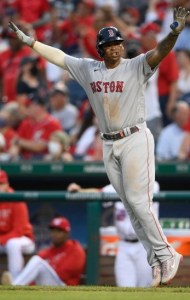
Jubilant Freddie Freeman approaches the plate to finish the eighth-inning bomb that held up to win the NLDS for the Braves Tuesday night.

Maybe it didn’t have quite the last-split-second hair raising quotient that the Red Sox’s final two American League division series wins had. But it wasn’t any less dramatic for Freddie Freeman and his Braves in winning their National League division series Tuesday.

Freeman’s eighth-inning tiebreaking home run off Brewers relief ace Josh Hader turned out the finishing blow in a set during which both teams scored as many runs in the first three games as they ended up scoring in Game Four alone.

What made the bomb so luminous, too, was that it was only the second time in the whole 145-year history of the franchise that any Brave delivered what proved a postseason series-winning hit in the eighth or later. It took one season shy of three decades for Freeman’s homer to join Francisco Cabrera’s National League Championship Series-winning base hit. (The fabled Sid Bream mad-broken-bodied-dash.)

“I’ve had a lot of cool moments in my career,” Freeman said postgame, “but so far I think that’s going to top them right there. But hopefully that’s not the last cool one.” Right now, nobody’s willing to bet too heavily against either Freeman or his Braves. Yet.

You heard all season long about this or that team being wracked by injuries and surrealities? Few had to compensate as heavily as the Braves did. Too many teams losing their number-two franchise player, one of their best young pitchers, and a reliable other power bat might have collapsed like a blimp.

The Braves lost Ronald Acuna, Jr. thanks to a torn ACL making a play in center field. They lost Mike Soroko after his Achilles tendon blew out in May—after nine months’ rehab following its initial 2020 tear. They looked as though their season had paid put to hit without once seeing .500.

They lost Marcell Ozuna when the outfielder/bombardier was arrested for domestic violence in July—charged first with felonious aggravated assault and attempted strangulation, charges reduced to misdemeanor simple assault and battery, on administrative leave through the end of the Braves’ season, after he entered a diversion program.

When Acuna went down, and the Braves more or less sputtered into and past the All-Star break, general manager Alex Anthopoulos made his first move, bringing former Dodger Joc Pederson aboard from the Cubs in exchange for a minor league prospect.

That was Pederson pinch hitting for Braves reliever Luke Jackson in the Game One eighth and hitting a solo home run off Brewers reliever Adrian Houser for the only Braves run in the only series loss. That was also Pederson in Game Three, pinch hitting for Braves starter Ian Anderson, facing Houser again, and launching the three-run homer that proved the only Game Three scoring.

Houser may start seeing Pederson in his sleep. The Braves just want to keep seeing him mash. Even if he got the Game Four start as his reward and had to settle for pushing home the first of the two runs that tied things at four with a ground out to second base.

Freeman thinks landing Pederson merely began the Braves’ reversal. “When Alex went out and got Joc,” he said, “it brought a sense of energy that it just showed us that they still believed in us, to go add at the deadline.” Which is exactly what Anthopolous did. He nailed three 30 July trades to bring Jorge Soler from the Royals, Adam Duvall from the Marlins, and Eddie Rosario from the Guardians-to-be.

The NL East wasn’t a powerful division to begin with. But the longtime-leading Mets imploded, the Nationals hit the reset button, and the Phillies proved just short of being able to hold on. In Atlanta, as proverbially and poetically as feasible, that which didn’t destroy the Braves only made them stronger.

They went 36-19 to finish the regular season, including a too-simple-seeming sweep of the Phillies opening the final week to keep them from finishing what they threatened awhile to do and overthrow the Braves. They even shook off Soler’s COVID diagnosis entering the postseason. Now they’ve dispatched a Brewers team that won seven more regular-season games to lead an only slightly stronger NL Central.

They’re waiting to see who’ll be the last men standing between the Dodgers and the Giants, after the Dodgers tied that division series in Los Angeles Tuesday night in an all-Dodgers/all-the-time 7-2 win.

The game was a still-manageable 2-0 Dodger lead, with the Giants compelled to a bullpen game against a short-rested but deadly effective Walker Buehler, when Mookie Betts checked in in the fourth against Jarlin Garcia—after Buehler himself led off by reaching on an infield error.

“It’s not something we want to do all the time,” said Buehler about going on only three days rest, “but I felt that if things didn’t go our way [in the third game], I would feel really weird not pitching a game that we could lose a series.”

He didn’t have to worry. Until he surrendered a leadoff single to Evan Longoria and a one-out walk to Steven Duggar in the fifth, Buehler pitched stoutly and had to shake only one previous first-and-second spot of trouble away in the second. He even had the Giants slightly flummoxed when he went to his changeup a little more often than they were accustomed to seeing from him.

When the Mookie Monster parked an 0-1 pitch into the right center field bleachers, it suddenly seemed a question not of whether but by how big the Dodgers would take the game. An inning later, Betts sent Cody Bellinger home with a sacrifice fly deep to left center field. But Dodger catcher Will Smith—just call him the Fresh Prince of Dodger Stadium—squared off against Giants reliever Jake McGee with Corey Seager aboard (leadoff line single) and hit the first pitch over the left center field fence.

The Giants looked so overmatched in Game Four that their only two runs scored on ground outs, one with the bases loaded. That was Evan Longoria scoring on Darin Ruf’s grounder to second. The other was Brandon Crawford coming home in the eighth when Kris Bryant grounded one to the hole at third.

Buehler’s short-rest deliverance plus the Dodgers’ bats ensured Julio Urias on regular rest starting Game Five against Logan Webb in San Francisco Thursday. For the Braves, that’s going to be very must-see television. Which is what it already was on the left coast and elsewhere.

For the Brewers, it’s a too-early winter vacation after their pitching virtuosity proved futile against the disappearance of their bats. Christian Yelich’s back injury-abetted struggles continued in the division series, and while the Braves didn’t exactly bring the walls crumbling down the Brewers hit a measly .192 in the set—32 points below the Braves.

They did get beaten in the end when the Braves’ best batter launched against their best pitcher in the Game Four eighth. Starting Eric Lauer for Game Four because ace Corbin Burnes said he wasn’t feeling one hundred percent proved a mistake, and so did manager Craig Counsell not bringing Brandon Woodruff in earlier in higher-leverage.

But then here’s where the Brewers’ best bats fell too short. Avisail Garcia? Eight strikeouts, only two hard-hit balls, and two singles in fifteen at-bats. Kolten Wong? Five strikeouts, likewise only two hard-hit balls, and one single in fifteen at-bats. Willy Adames? Five hits in seventeen at-bats—four singles and a double, plus nine strikeouts and only three balls hit hard.

That’s why the Brewers pitched the division series like Hall of Famers—their three starters Burnes, Woodruff, and Luis Peralta showed a collective 1.56 ERA and 0.92 walks/hits per inning pitched rate, not to mention nineteen strikeouts in 17.1 innings pitched—but the Braves still took them out sweeping three after a Game One Brewers win.

“The vibe is the best that we ever had in this series,” Adames said before Game Four. “Today, the guys, I guess they woke up in a great mood. They came with energy. And I feel today we had the best vibe that we’ve had so far this series so far.”

The trouble was that the Brewers went in with the best vibes but the Braves played them as if they were jazz vibes legend Milt Jackson hammering out another virtuoso chorus of “Bags’ Groove.” Now the Braves wait to see who gets bagged in San Francisco Thursday night.
The Dodgers give the Giants a Game Two Belli-ache

Cody Bellinger

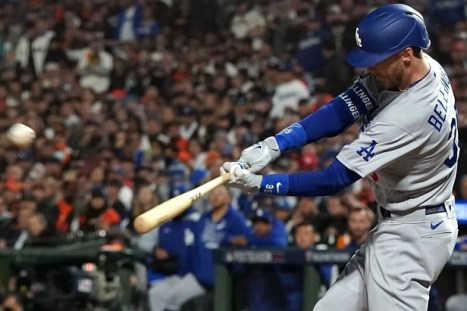
Cody Bellinger, hitting the Game Two-breaking two-run double in the sixth inning Saturday night.

If Cody Bellinger is finally, reasonably healing from everything that turned his regular season to waste, the timing couldn’t be better. For his Dodgers, and for himself.

First, he set up Chris Taylor’s wild card game-winning two run homer with a sharp theft of second base last Tuesday. Now, in division series Game Two, Bellinger started putting the game out of the Giants’ reach Saturday night with a sixth-inning, two-run double off Giants reliever Dominic Leone.

On a night that the Dodgers’ bats re-awakened following their half-asleep Game One loss in San Francisco—even starting pitcher Julio Urias managed to join the fun—Bellinger wasn’t exactly the most prolific Dodger at the plate, just the most important one.

With Trea Turner on second after a leadoff double lined down the third base line, and Will Smith walking his way aboard for first and second, Giants manager Gabe Kapler lifted his starting pitcher Kevin Gausman for Leone. Leone walked Taylor in part because plate umpire Angel Hernandez—what a surprise—called what should have been strike three ball three, on a pitch that hit the upper outside corner squarely enough.

Bellinger checked in at the plate next. With the kind of struggling regular season he had, he wasn’t about to look the proverbial gift horse in the proverbial mouth. He drove Leone’s first service to the back of center field, bounding off the wall, sending Turner and Smith home with Taylor having to stop at third.

Leone barely had time to regroup from that blow when A.J. Pollock lined his next pitch into left to send Taylor and Bellinger home while he bellyflopped his way into second safely for the double. Leone got the final two outs getting Urias’s pinch hitter Gavin Lux to ground out to second and Mookie Betts to fly out to center, but the four-run sixth held up toward the 9-2 Dodger win.

Pollock and Taylor collaborated on the Dodgers’ first run of the game in the top of the second, Taylor lining a one-out double into the gap in left center and Pollock going from 2-0 to a free pass to enable Gausman to get rid of Urias the easy way. Except that Urias refused to cooperate.

Something of an outlier among pitchers at the plate (he actually hit .203 in the regular season, 93 points above pitchers at the plate overall), Urias lined one to right to send Taylor home with the first Dodger run. Betts then lined a base hit to left to send Pollock home for the 2-0 Dodger lead.

Except for Donovan Solano’s one-out sacrifice fly in the bottom of the second, and Brandon Crawford singling home late-game entry Lamonte Wade, Jr. in the bottom of the sixth, the Giants had no answer for the Dodgers’ revival at the plate Saturday night.

The Dodgers weren’t about to provide the Giants answers, either. As if to slam a pair of exclamation points down on the salient point, Smith hit reliever Zack Littell’s first pitch of the top of the eighth into a voluptuous parabola that landed a few rows into the left field seats, and pinch-hitter Matt Beaty (for Dodger reliever Corey Knebel) plus Corey Seager added a pair of RBI singles before the inning expired.

But even though Bellinger struck out three times otherwise, that game-breaking two-run double in the sixth trained most eyes back upon him. He looked at last like the 2019 National League Most Valuable Player again, not like the guy who had everyone not looking deep thinking he spent this season sinking into oblivion with a ten-ton weight strapped to his ankle.

All season long, Bellinger tried to remake his swing to use the entire field while his body refused to cooperate. He’d had shoulder surgery last off-season, after injuring the shoulder first fielding several grounders and then celebrating his home run in Game Seven of last year’s National League Championship Series. Then, he missed the first eight weeks of this season after a leg fracture when he was spiked on a play at first base.

He also suffered a hamstring injury and, in September, a non-displacing rib fracture when he collided with Lux on a play in the outfield.

If you don’t think batterings like that can drain a fellow at the plate, you probably haven’t tried playing professional baseball. Bellinger’s tenacity in trying to play through or around those injuries is as admirable as the reality of his futility at the plate before healing completely from those injuries is deplorable.

Especially when the shoulder continued putting limits on his swing, opposing pitchers saw and exploited the resultant inability to catch up to rising fastballs or reach diver-down breaking balls, and Bellinger’s confidence eroded little by little as the season went forward.

Whether manager Dave Roberts was worse continuing to run him up there than Bellinger was in being so stubborn, despite the shoulder not recovering completely from that off-season surgery, it told you how deep this year’s Dodgers really are that they won 106 regular season games despite Bellinger’s injury-driven deflation.

Now, Bellinger could stand on second base in the sixth with a look akin to the many he had after big hits in his MVP season. Now, Roberts could laugh his fool head off trying to explain it postgame: “Mentally, I don’t see how it could hurt him. There can only be upside. He’s wanted to use the big part of the field, and for him to get rewarded was huge. I think there was a big weight lifted off his shoulders.”

If pun was intended, it wasn’t exactly the smartest or cleverest. It was difficult not to think that Bellinger should have had more extended recovery from that shoulder surgery, taken a somewhat extended spring training, and returned in May at fullest possible strength.

It was between sorrowful and infuriating to see Bellinger playing through the short recovery and subsequent injuries and listening to the witless writing him off as just another slumper who suddenly didn’t know what he was doing.

He’s not quite out of the wilderness yet. But watching him drive that Game Two-breaking double gave you almost as much hope as it seems to have given him. “I feel 100 percent, you know?” he said postgame. “I don’t know how my body is, but I feel really good.”

What he did Saturday night was enough to leave the Giants nursing a serious Belli-ache and the Dodgers feeling even better about moving the series tied at one to Dodger Stadium for Game Three.

Even if they might wonder privately which Max Scherzer will turn up on the mound. Will that someone be Max the Knife? Will he be the tired veteran who surrendered ten runs in his final two regular-season starts, before fighting on fumes to pitch one-run, four-and-a-third innings’ baseball in the wild card game? The answer comes Monday.

“Remember 1951?” OK, you asked for it.

The Shot Heard 'Round the World

No, Giants fan or worker, you do not want anyone  remembering the Mugging at Coogan’s Bluff.

This one’s for the Giants fan[s] or worker[s] who hoisted a large, stylish enough sign showing a flying baseball and the words, “Remember ’51,” in Oracle Park Friday night. Whomever you are, allow me to assure you that the last thing you want anyone remembering is 1951.

I get it. You’re remembering the Giants mounting a staggering pennant race comeback from thirteen games out of first place around mid-August to force a playoff against the Dodgers for the 1951 National League pennant.

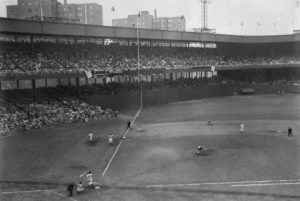
You’re remembering Ralph Branca relieving Don Newcombe and pitching to Bobby Thomson. You’re remembering, especially through that flying baseball image, Thomson turning on Branca’s 0-1 fastball and depositing it into the lower deck of the Polo Grounds’ left field seats.

You’re remembering The Shot Heard ‘Round the World. You’re remembering Giants broadcaster Russ Hodges going out of his mind screaming The Giants win the pennant! The Giants win the pennant!

In the thrill of history’s hour Friday night, the 107 game-winning National League West champion Giants and the 106 game-winning National League wild card Dodgers finally met in a proper postseason for the first time ever in their long, ancient, rivalrous history together.

That was then: A pair of pennant playoffs between each other, under the ancient baseball regimes, in 1951 and 1962, both won by the Giants. This was Friday night: The Giants won division series Game One, 4-0, in which the Dodgers weren’t even a quarter of the kind of tenacious and energetic they’d been in beating the Cardinals at the last minute in the wild card game.

Giants second-full-season starter Logan Webb out-pitched the Dodgers four-full-season veteran Walker Buehler. Webb deployed his impressive collection of breaking balls and changeups to catch the Dodgers off-balance, sometimes asleep. Buehler struggled to find a handle but managed to endure after Buster Posey—the last Giant standing from their 2010, 2012, and 2014 World Series winners—sent a two-run homer ricocheting off the back of a Levi’s Landing column into McCovey Cove in the bottom of the first.

By the time Buehler found his handle, he got to exercise it only long enough for another former World Series champion, Kris Bryant (2016 Cubs, a Giant since this year’s trade deadline), to park one into the left field seats to open the bottom of the seventh. With Buehler out of the game after one out in that inning, Brandon Crawford hit one into the center field bullpen with two outs against a second Dodger reliever, Alex Vesia, in the bottom of the eighth.

So, yes, the Giants opened decisively enough and impressively enough Friday night. Now, back to you, Giant fan/worker with the “Remember ’51” sign. I saw the sign, in a brief moment on the TBS telecast early in the game. They didn’t show it again all night but it stuck in my head well into Saturday morning.

You don’t really want the rest of baseball world to remember what you might actually hope the thrill of history’s hour now might compel it to forget. Here’s a hint: The Giants stole the pennant! The Giants stole the pennant!

The 2017 Astros weren’t baseball’s first cheating champions by a long Shot. Come to think of it, neither were the 1951 Giants. But since you brought it up with that stylish-looking sign, gather around and allow me to ask.

Do you really want us to remember again what ’51 Giants manager Leo Durocher hatched after he discovered his recently-acquired spare part, Hank Schenz, owned a hand-held Wollensak spy glass—and had used it to steal signs from the Wrigley Field scoreboard behind that park’s bleachers when he was a Cub?

Do you really want us to remember again that Durocher called a team meeting to announce he’d cooked up a plot to start stealing signs from the Polo Grounds clubhouse above and just beyond center field? With catcher-turned-coach Herman Franks wielding the Wollensak and tapping codes for the stolen signs to the Giants bullpen, from where the purloined intelligence would be flashed to the batter?

Do you really want us to remember again that, when Durocher asked his players who wanted the stolen signs, his Hall of Fame left fielder Monte Irvin refused them? Meaning his rookie Hall of Fame center fielder Willie Mays wouldn’t take them, either? Much as Mays felt beholden to “Mister Leo,” he felt even more beholden to Irvin as a big brother figure, and he’d assuredly follow Irvin’s lead.

Do you really want us to remember again how, while the Dodgers went a very solid 33-26 down the stretch in August and September 1951, the Giants with their little furtive intelligence operation cheated their way to shooting the lights out—going 40-14 down the same stretch, including a sixteen-game winning streak that included thirteen home wins—to end that season in the first-place tie?

Do you really want us to remember again the day Dodger coach Cookie Lavagetto smelled enough of a rat to bring a pair of binoculars into the Dodger dugout in a bid to catch the Giants in the act—but had them confiscated post haste by an umpire?

As now-retired Thomas Boswell snorted in 2001, after The Shot Heard ‘Round the World was chosen baseball’s greatest moment by The Sporting News and second-greatest sports moment by Sports Illusrated, “Why, it would be unfair for the victims to use binoculars to expose the telescopic cheaters!”

Do you really want us to remember Bobby Thomson telling Joshua Prager, the Wall Street Journal writer who affirmed the Durocher plot at last in 2001 (turning it into a splendid but troubling book, The Echoing Green), “I guess I’ve been a jerk in a way. That I don’t want to face the music. Maybe I’ve felt too sensitive, embarrassed maybe.”

Maybe you don’t remember that Ralph Branca never blamed anyone beyond Durocher directly when talking about it for publication. Branca always said of Thomson (who became his friend in later years), “He still had to hit the pitch.” He carried the weight of surrendering that pitch and that loss with uncommon grace for the rest of his and Thomson’s lives. (Thomson died in 2010; Branca died in 2016.)

“Over the years, when interviewing Thomson and Branca,” Boswell wrote, “I’ve been struck that Thomson seemed a bit ambivalent about his Moment while Branca never seemed the least ashamed. I took it that Thomson felt apologetic because he’d caused Branca a lifetime of nagging questions.”

You, Giant fan[s] or worker[s] hoisting “Remember ’51” Friday night. Before you bring that sign back Saturday night, rooting for the team that stunned this year’s National League by winning the West despite everyone else trying to write them off as a fluke phenomenon, think it over. Hard.

You don’t really want everyone else remembering the greatest shame and sham in Giants history. You don’t really want us remembering the Miracle of Coogan’s Bluff long exposed as the Mugging at Coogan’s Bluff. You don’t really want us to remember all over again that the Giants stole the pennant! The Giants stole the pennant!

Do you?

Baseball Tease Day

Rafael Devers

Wings and prayers—Rafael Devers’s tiebreaking two-run blast in the ninth Sunday punched the Red Sox’s ticket to the AL wild card game . . .

Crisis addicts of the world, unite. You won’t get the greatest possible fix for your addiction on what might have been Baseball Chaos Day. In fact, you’re getting a day off for reasonably good behaviour.

But at least you get four of the game’s most deeply storied franchises in the wild card games. That’s something, isn’t it?

If major league baseball fans must continue to bear with the thrills and chills of watching teams fight to the last breath to finish . . . in second place, at least you get to see the Cardinals host the Dodgers in the National League wild card game, and the Red Sox host the Yankees in the American League game. Right?

I know. I know. The crisis junkies among baseball’s fans were spoiling for that National League West tie between the Giants and the Dodgers. They wanted that four-way American League wild card tie so badly they could wrap themselves in it like frozen food in Reynolds Wrap.

The Blue Jays did their absolute best to make it happen when they parboiled the Orioles 12-4 Sunday afternoon. But the Mariners let them down by being unable to get past what was left of this year’s Angels.

Maybe we should have had a hint when Shohei Ohtani started the finish of his surrealistic individual season by hitting Mariners lefthander Tyler Anderson’s third pitch of the game about twelve rows into the right field seats.

Home run number 46, RBI number 100, for the guy who also finishes 2021 with a 3.18 ERA and a 10.8 strikeout-per-nine rate on the mound. If you can’t win it, just start playing spoiler. Ohtani’s surreal season could have finished a lot worse than becoming the Angels’ must-see-television in the injury-created absence of their all-universe Mike Trout.

The Mariners let themselves down, too, after a surprise season of playing slightly over their own heads to get thatclose to postseason-opening mayhem. Those were real tears in young outfielder Jarred Kelenic’s eyes as well as veteran third baseman Kyle Seager’s, when their run came one port short in losing two of three to the Angels over the weekend.

“It wasn’t a team where we were just more talented than the other team every single day,” said Seager postgame, after what may yet prove his last game as a Mariner, “but you had a group that just collectively played together and they collectively tried to win every single night.”

Trouble was, the Nationals couldn’t keep the Red Sox down despite opening an early 5-1 lead against them in Nationals Park. They couldn’t stop Red Sox third baseman Rafael Devers from hitting a hefty solo home run to open the top of the fourth and a five-all-tiebreaking two-run shot in the top of the ninth—with former National Kyle Schwarber, who’d reached on an inning-opening infield error—aboard ahead of him.

But two years after the Nats’ staggering World Series win, at least they could bask a little in the home crowd’s applause for possibly-retiring first baseman Ryan Zimmerman, the last truly Original Nat, the franchise’s first first-round draftee to play in their silks after moving from Montreal, when lifted from the game after the seventh. Even the Red Sox joined the applause unapologetically. Aretha Franklin used to spell that r-e-s-p-e-c-t.

Meanwhile, the American League East champion Rays battled the Yankees scoreless until the ninth. The Yankees even flashed something resembling past glories when third baseman Gio Urshela channeled his inner Derek Jeter in the sixth, chasing Austin Meadows’s foul pop 126 feet from an overshift position and catching it on the track, before he fell in a heap onto an empty spot on the Rays’ dugout bench.

But after Rays starter Michael Wacha pitched one-hit ball over five innings and the Yankees threw six pitchers at the Rays, Aaron Judge—the towering, snaggle-toothed, boyish-looking face of the Yankees—picked the right spot to deliver the first walk-off winner of his major league career.

With Rays reliever Andrew Kittredge freshly installed, after Josh Fleming allowed second and third with one out, Judge ripped a liner off Kittredge’s glove toward second, Tyler Wade dove home ahead of a throw from Rays second baseman Brandon Lowe. Thus the Yankees ducked a coming day’s chaos. “I wouldn’t say we exhaled,” Judge said of it postgame. “We still have work to do.”

Meanwhile, in San Francisco, the Padres’ second-half implosion finished when they all but rolled over and played dead for most of an 11-4 loss to the Giants. Enabling the Giants to become the first in Show ever to win their 107th regular season game while clinching a title on the regular season’s final regular day. Leaving the Dodgers, 10-3 assassins over the NL Central-winning Brewers, to deal with the Cardinals in the league’s wild card game.

That ages-old blood feud between the Giants and the Dodgers would just have to wait for a possible showdown in a National League division series, assuming the Dodgers get past a Cardinals aggregation that managed to do what enough teams couldn’t this year—shake off a few serious injuries and a few tough spells to get to at least the postseason’s entry game.

The Padres made life just a little too simple for the Giants Sunday afternoon. They had no answer for Giants starter Logan Webb—who struck out eight and, at the plate, threw in a line drive, insult-to-injury two-run homer in the fifth—until they finally chased him with three straight base hits in the eighth.

Entering the season it sometimes seemed as if the Padres were anointed the lords of the National League West by default and the Giants were anointed lucky to survive the races at all. But while growing pains, internal dissensions, key pitching injuries, and manager Jayce Tingler’s exposure as an inconsistent in-game thinker came more vivid as the Padres season went deeper, the Giants surprised just about the entire baseball world with their ability to hang with the Dodgers and take it literally to the last day.

Veteran or largely-veteran teams don’t work anymore, right? Baseball’s for the young, right? Letting the kids play means the veterans can’t romp, right? The Giants would like a few words with you. Their veterans played up and had just as much fun as the kiddie corps. And the Giants took their remarkable season right down to the wire to beat the Dodgers out for the title by one game.

“I think we all knew at the beginning of the season, or even dating back to the beginning of spring training, what the projections are and what the industry sort of thought of us as a club,” said Giants manager Gabe Kapler, who’d finally figured out what he couldn’t in Philadelphia—analytics hoists and supports you going in, but you’d better marry that to what’s in front of you inning by inning if you want to get the full job done.

“What I realized,” he continued, “is there are some intangibles that those projections and viewpoints failed to take into consideration.” There’s never a thing wrong with having the most possible information to open a game, but when it’s married unsuccessfully to the moments to come while you play, the offspring is usually disaster.

The Giants, the Brewers, the AL Central-winning White Sox, the Astros, and the NL East-winning Braves have to wait to begin their postseason dances. It’s both poetic and problematic that the party begins with the Olde Towne Team hosting the Empire Emeritus in a win-or-be-gone wild card game.

Poetic because of that similarly ages-old Yankee-Red Sox blood feud. Problematic because of . . . that ages-old feud having its script flipped in this century.

Go ahead and point to all those pennants and World Series rings, Yankee fan. You’ve only got one of those rings to show in the 21st Century. You may have the upper hand in division triumphs but that smothering Yankee dominance is just so 20th Century now. That’s the Red Sox sitting with four 21st Century World Series rings now.

If there’s one other thing by which the Yankees hold an edge over the Red Sox this time around, it’s a fan base that clings to “To err is human, to forgive cannot be Yankee policy” like a religious catechism. Calling for the manager’s perp walk and summary execution after a tough loss? Yankee manager Aaron Boone gets it after a tough inning as often as not.

The man who did what no Yankee manager before him could—lead his teams to back-to-back 100-wins-or-more seasons in his first two on the bridge—and has a .601 winning percentage as a Yankee manager must feel fortunate that his boss’s name is Hal, not George Steinbrenner. Hal Steinbrenner doesn’t have his father’s notorious hair trigger. It’s saved New York’s sanitation corps from barrels worth of washing blood from the streets around the House That Ruthless Built.

Maybe their own long-enough and disastrous enough history has finally given Red Sox Nation what some people thought would have been impossible to fathom—the patience of Job—compared to their counterparts turning to the south Bronx. The AL wild card game hasn’t been played yet, of course, but you don’t exactly hear Red Sox fans saying, to themselves and aloud, “OK, when’s it going to happen” and mean disaster over delight before the game actually begins.

Those two fan bases get only one day’s worth of living on the edge. If the Dodgers treat the Cardinals’ grand old man Adam Wainwright like target practise in the NL wild card game, the Dodger-Giant rivalry gets three games minimum, five maximum to go nuclear.

If the Cardinals treat the Dodgers’ cleverly imported grand old man Max (The Knife) Scherzer rudely, Giantland and Cardinal Country get to relive the 2014 disaster—disaster for the Cardinals, that is. This time, though, the Cardinals won’t have Mike Matheny on the bridge to decide The Book was more important than The Moment. Mike Schildt won’t risk paying through the feathers by allowing a Giant pennant to sail into the crowd atop Levi’s Landing behind right field. I think.

It’s enough to make you feel almost sorry for the White Sox facing the Astros in an American League division series. Even their first postseason meeting since the 2005 World Series the White Sox swept—that was before the Astros were traded to the American League, of course—doesn’t have half the blood boil potential. I think.

Baseball Chaos Day? Sunday’s regular season finales amounted more to Baseball Tease Time. It was fun to watch—but it was hell to pay. But as Hall of Fame scribe Jayson Stark would say, because . . . baseball!

Short of the track, short of the Giants

Fernando Tatis, Jr.

Tatis destroyed a hanging slider for homer number 40 in the seventh Wednesday night, but he couldn’t quite walk it off in the ninth, though not for lack of effort . . .

Fernando Tatis, Jr. started the Padres’ Wednesday night comeback attempt when he hit one out with one out in the bottom of the seventh. Why shouldn’t he have wanted to finish it by way of a game-winning blast with two on in the bottom of the ninth?

The National League’s leading home run hitter this year so far gave the Giants’ righthanded submariner Tyler Rogers’s climbing slider a high ride to Petco Park’s deep left. Even Giants broadcasters Duane Kuiper and Mike Krukow thought it was likely to go and the Padres were likely to win.

Except that it didn’t, and they didn’t. That’s been the Padres’ story in the season’s second half. Minutes late and dollars short.

The drive hung up just enough to fall short enough and into the waiting glove of Kris Bryant, playing left near the track for the Giants, snapping the ball shut to end an 8-6 Giants win that looked like a blowout in the making after six and a half innings.

“I wish I could celebrate in a different story,” Tatis said post-game, “but it’s been a long year, a lot of ups and downs, especially coming back from those injuries. At the end of the day, I’m pretty happy with the results and how I bounced back and this is history. It’s something to celebrate.”

He’d had to recover from a couple of shoulder injuries to become only the tenth man in Show history to hit forty homers or more in a season before his 22nd birthday. He might celebrate history, but he probably would have celebrated a Padres win more.

Every Giant fan in the house—there were plenty making the trek to San Diego, especially the group of orange-clad elders known as the Game Geezers—should thank Rogers for delivering the narrow escape. They should thank rookie Giants reliever Camilo Doval even more profoundly for the one he delivered in the bottom of the fifth.

One of the Giants’ soon-to-be-fabled retreads, lefthanded starting pitcher Scott Kazmir, ran into big trouble after delivering four innings of one-run ball that weren’t exactly on the virtuoso side but weren’t exactly on the weak side, either. But he walked Victor Caratini on a full count, surrendered a base hit to pinch-hitter Jake Marisnick, and walked Tatis on four straight.

Then Giants catcher Buster Posey made a might-have-been grave mistake. He got his glove out far enough to catch a piece of Jake Cronenworth’s bat as Cronenworth slashed a foul down the left field line. The interference call brought Caratini home, kept the bases loaded, and told manager Gabe Kapler Kazmir had had it for the night.

He brought Doval into the impossible nightmare. Ducks on the pond, nobody out, and Manny Machado checking in at the plate. This can be something comparable to trying to bring a Boeing 747 home without a scratch, bump, or crash after three of the four engines blow.

Doval attacked Machado as though he was just playing catch with Posey. Three hard, quivering sliders that didn’t get anywhere near the middle of the plate. Three hard, hell-bent swings on each of which Machado looked as though he wanted to send his mates on the bases around the horn twice on one drive. Then, Doval wrestled Tommy Pham into dialing Area Code 6-4-3 for the side.

Even the Padres’ faithful had to appreciate that kind of narrow-escape, safe landing, which Kapler called “one of the gutsier performances of the year from anybody in our pen.”

The irony of Caratini scoring on catcher’s interference wasn’t necessarily lost on anyone. It was Caratini’s glove touching Tommy La Stella’s bat, as LaStella fouled one high down the left field line opening the game, that put La Stella aboard and began Padres starter Vince Velasquez’s three-run nightmare, giving the Giants the extremely early lead in the first place.

Velasquez wasn’t exactly sharp in the first place. Not after starting Brandon Belt 0-2 and finishing by walking him, then throwing a 1-1 jammer that Posey somehow fisted into a balloon shot into short right center to load the pads.

He might have wrestled Lamonte Wade, Jr. into an eight-pitch strikeout, but Bryant nailed him for a bases-clearing double off the right center field wall, before Brandon Crawford pushed Bryant to third with a fly out to the back of center and Evan Longoria struck out swinging for the side.

La Stella’s no stranger to catcher’s interference. It happened to him twice in one game, as a Cub, on 7 June 2018, making him only the seventh player to benefit thus. Then-Phillies catcher Andrew Knapp’s mitt touched his bat twice—in the first, when he grounded one back to pitcher Nick Pivetta; and, in the eighth, against reliever Adam Morgan, when Knapp’s mitt hit the bat as La Stella fouled one off. But neither one figured in that game’s scoring, the Cubs beating the Phillies by a run.

The game ended up thickening the Giants’ National League West lead to two games with the Dodgers getting slapped silly, 10-5, by the Rockies in Coors Field. The Rockies’ season burial isn’t wholly official yet; the Padres still have a very outside, very slim wild card hope.

Kazmir, last seen among the silver medalists on the U.S. Olympic baseball team earlier this summer, pitched like an elder looking for one more season in the sun and finding various ways to justify it. He pitched into and out of trouble in the bottom of the second, turning a one-out single (Eric Hosmer), a two-out ground-rule double (Trent Grisham), and then offered evidence for the defense in favour of making the designated hitter universal.

Caratini came to the plate with Padres relief pitcher Ryan Weathers due to bat next. DH partisans often cite the frequent National League pitchers’ cop-out, described best by Thomas Boswell when recalling the “thousands of rallies I’ve seen killed when an inning ends with one pitcher working around a competent No. 8 hitter so he can then strike out the other pitcher. When you get in a jam in the [American League], you must pitch your way out of it, not ‘pitch around’ your way out of it.”

Kazmir threw Caratini two so-obviously weak changeups, then handed Caratini first on the house. Then he got Weathers to ground one to Crawford at short for the inning-ending force out. Exactly why the Giants thought that dangerous .215-hitting Caratini was liable to tie the game with one swing—he’s hit as many home runs over five years as Tatis hit by 15 June this year—escapes.

And exactly why the Padres didn’t think to pinch hit for Weathers escapes as well, particularly with known Giant-puncturer Adam Frazier (he’s hit .365 against them this year) on the bench for the evening. Casey Stengel once believed that when you have an opening, you shove with your shoulder. Padres manager Jayce Tingler forgot he had a shoulder (and enough decent bullpen still) with which to shove.

Until Kazmir ran into that fifth inning trouble, he kept the Padres mostly off balance from there, while Weathers and his successor Ross Detwiler kept the Giants mostly quiet until yielding to converted-from-shortstop Javy Guerra for the top of the sixth.

Oops. Posey lined the first pitch down the right field line, falling in fair to lead off with a double. Wade swatted a full-count sinker up the middle for first and third. Bryant grounded out to Hosmer playing first, but Crawford slapped an opposite-field single to left to send Posey home.

One Longoria strikeout and pitching change to Nabil Crismatt later, Mike Yastrzemski singled Wade home with a base hit right back up the pipe, before pinch hitter Wilmer Flores flied out to right to keep things 5-1, Giants.

Crismatt ended up really taking one for the team in the seventh. He handed La Stella a four-pitch leadoff walk, and Belt promptly hit the first pitch he saw for a line single into right. Then Posey lined a 1-2 changeup the other way down the right field line again, sending La Stella home. Wade doubled Belt and Posey home before going down trying to steal. Bryant grounded out to first, but Crawford shot a single past third before Longoria struck out for the third time on the night.

That made it 8-1, Giants. Then, with one out against Giants reliever Jarlin Garcia, Tatis fought back from 0-2, caught hold of a hanging slider on 2-2, and drove it into the left field seats. Cronenworth promptly doubled to the back of right field and Machado sent a hard liner over the hole at short to send Cronenworth home.

Exit Garcia, enter Domonic Leone, and Pham’s first-pitch liner the other way to right loaded the pads for the Padres again. But all they had to show for that was Hosmer poking a single up the middle to send Machado home, before Wil Myers struck out and Grisham slapped his way into an inning-ending force out at second.

Going 3-for-12 with men in scoring position wasn’t exactly the way to overthrow the Giants. Things weren’t helped any for the Padres when Crawford made an acrobatic spin and grab of a Myers grounder that had one-out base hit stamped on it, Crawford throwing Myers out off balance but right on the button for the second out of the fourth.

Against the submarining Rogers in the ninth, Pham worked a leadoff walk and Hosmer hit a ground-rule double to send him to third. Finally the Padres sent Frazier to the plate to pinch hit, and he pushed Pham home while grounding out to second, before Grisham singled Hosmer home with the sixth Padre run.

After Caratini flied out to left, up came Tatis. He wanted to hit that three-run homer so badly the entire ballpark could taste it. Especially after he opened with a foul out of play to the right side. Then Rogers’s slider climbed up to the middle of the zone somewhat away from Tatis. Tatis swung as if his and the Padres’ lives depended on it.

It wasn’t enough.

Things haven’t been enough for the reeling Padres since the middle of August. And just as they were about to lose their fifth straight and eleventh in fourteen games, general manager A.J. Preller continued an apparent organisational shakeup—shuffling assorted farm system roles two days after firing seven-year farm director Sam Geaney.

The Padres have gone from Preller’s inability to fortify a decimated starting rotation (they failed spectacularly at the trade deadline after the world only thought they’d bag Max Scherzer) to Tingler’s apparent inability to keep his clubhouse consistently steady. They’re already thinking wait till next year in San Diego. Next year, and maybe a new manager.

For the Giants the season’s going to end up with them finishing what they started, taking hold of their division and holding on no matter the overqualified Dodgers snapping at their heels. Those two antagonists could end up squaring off in a postseason set that’s liable to do what earthquakes can’t—blow the Richter scale to bits.