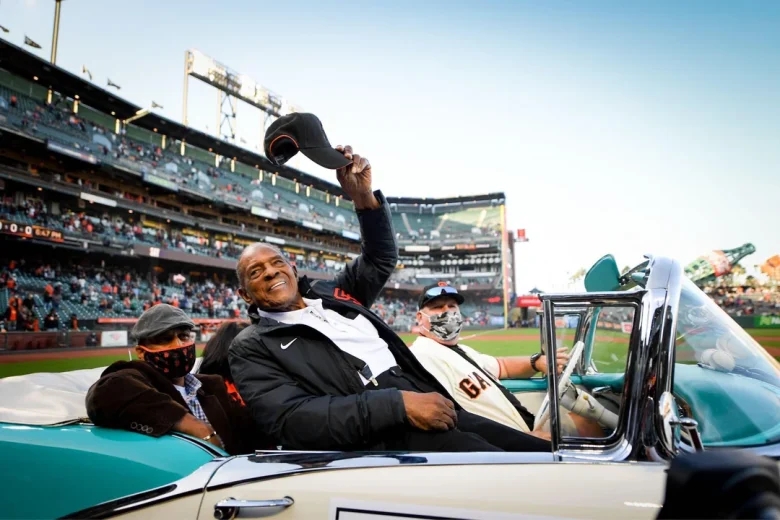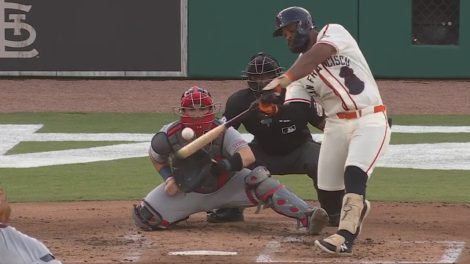
“Let him hear you, he’s listening.”

Heliot Ramos

Willie Mays played with Gary Mathews.. Who played with Edgar Martinez.. Who played with Ichiro.. Who played with Tim Beckham.. Who played with Blake Snell.. Who played with Heliot Ramos.. Who homered tonight while playing CF for the Giants… In Willie Mays’ first pro ballpark. Baseball!—Jayson Stark, Hall of Fame baseball writer.

In the first professional baseball park where the late Hall of Famer Willie Mays played as a Birmingham Black Baron, it was illegal until 1963 for white and non-white players to play on the same field. On Thursday, white and non-white players converged for the San Francisco Giants and the St. Louis Cardinals to play an official major league game.

None but the blind or the bigoted pretends racism is eliminated from American life entirely. But the Giants and the Cardinals, playing a game umpired by the Show’s first all-black umpiring crew, managed to keep it outside the gates of a ballpark where Hall of Famer Reggie Jackson played on the first interracial team Rickwood Field hosted.

That was then: Jackson’s parent club, the then-Kansas City Athletics, moved its AA-level minor league team into Birmingham at the insistence of its owner, Charles Finley, a Birmingham native who could be flagrantly wrong about many things but stood on the side of the angels when it came to racism. Jackson remembers only too well.

“I walked into restaurants and they would point at me and say, ‘The n—–s can’t eat here’,” Jackson said aboard the Fox Sports pre-game broadcast.

I would go to a hotel and they’d say, “the n—–s can’t stay here.” We went to Charlie Finley’s country club for a welcome home dinner and they pointed me out with the N-word, “he can’t come in here.” Finley marched the whole team out . . . Finally, they let me in there and he said, ‘We’re going to go eat hamburgers. We’ll go where we’re wanted.’

Coming back here is not easy. The racism when I played here, the difficulty of going through different places where we traveled—fortunately, I had a manager and I had players on the team that helped me through it—but I wouldn’t wish it on anybody.

This is now: The Negro Leagues are recognised formally (and appropriately) as having been major leagues. This year, the known statistics of Negro Leagues players and managers (surely there will be more to exhume, however long it might take) began becoming integrated into major league statistics at last.
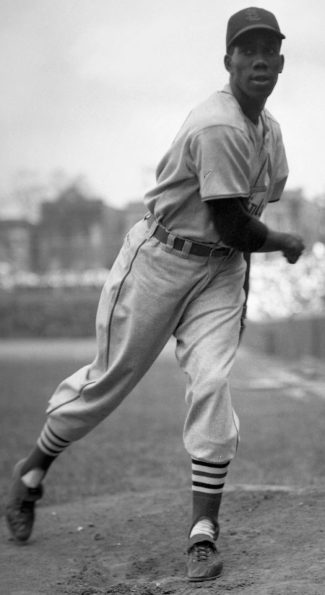
Bill Greason

The Rev. Bill Greason, former Birmingham Black Baron who got to pitch very briefly for the Cardinals in 1954.

Thursday evening, the oldest former Negro Leagues player, pitcher turned minister Bill Greason (99), was escorted to halfway between the mound and the plate by Cardinals coach and former player (and the National League’s 1985 Most Valuable Player) Willie McGee to throw a ceremonial first pitch. To Ron Teasley, Jr., whose father is the second-oldest living former Negro Leaguer.

Greason was six years Willie Mays’s senior when they were Black Barons teammates. “He was a determined young man,” the former pitcher told Ken Rosenthal. “He had the gifts, the talent, and he was sensitive to listening to those who were older than he was. It was a tremendous blessing, and we turned out to be real close. Like brothers.” Just the way Mays would look toward former Newark Eagles star Monte Irvin when Irvin was a third-year Giant and Mays a nervous Giants rookie.

Mays’s number 24 was painted in large white numerals behind the plate. A Giants uniform with his number hung in the Giants’ dugout. The Giants and the Cardinals—wearing the uniforms of, respectively, the San Francisco Sea Lions (West Coast Negro Baseball League, 1946) and the St. Louis Stars (Negro National League, 1920-1931)—wore circular patches on their jerseys with Mays’s surname and number.

Mays’s son, Michael, urged the Rickwood crowd to make some noise for his father before the game. “Birmingham, I’ve been telling y’all,” the younger Mays said, “if there was any way on Earth my father could be here, he would. Well, he’s found another way . . . Let him hear you, he’s listening. Make all the noise you can.” The Wil-lie! Wil-lie! chant just about drowned every other sound out.

Mays had issued a statement Monday saying his health would keep him from attending the game. The following day, he died at 93. America couldn’t decide whether to grieve over yielding Mays to the Elysian Fields or be grateful that he remained among us as long as he did.

“In a sense, Mays was too good for his own good,” wrote George F. Will in tribute.

His athleticism and ebullience—e.g., playing stickball with children in Harlem streets–encouraged the perception of him as man-child effortlessly matched against grown men. He was called a “natural.” Oh? Extraordinary hand-eye coordination is a gift. There is, however, nothing natural about consistently making solid contact with a round bat on a round ball that is moving vertically, and horizontally, and 95 mph. Because Mays made the extraordinary seem routine, his craftsmanship and intelligence were underrated.
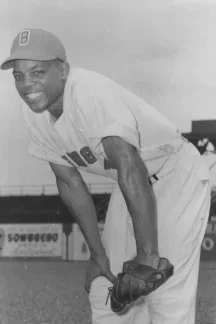
The late Willie Mays, as a young Birmingham Black Baron. (Photo: Birmingham Public Library.)

The arguable greatest position player ever to play major league baseball may have been watching and listening from his Elysian Fields roost on Thursday, but he surely lamented his Giants losing by one run to the Cardinals. Not for lack of trying.

The Athletic‘s irrepressible Hall of Fame writer Jayson Stark couldn’t resist pointing out: “Willie Mays played with Gary Mathews.. Who played with Edgar Martinez.. Who played with Ichiro.. Who played with Tim Beckham.. Who played with Blake Snell.. Who played with Heliot Ramos.. Who homered tonight while playing CF for the Giants… In Willie Mays’ first pro ballpark. Baseball!”

That would be Ramos tying the game at three-all when he took hold of a two-on, one-out, one-strike service from Cardinals starting pitcher Andre Pallante and launched it the other way, over the painted Budweiser ad on the right field fence.

The Cardinals kind of snuck back into the lead an inning later on a sacrifice fly (Nolan Gorman) and a run-scoring (Alec Burleson) wild pitch (from Giants reliever Randy Rodriguez), and padded it to 6-3 in the bottom of the fifth when Brendan Donovan sent home his third run of the game, singling up the pipe to score Burleson. The Giants got two back in the top of the sixth on an RBI single (Wilmer Flores) and a sacrifice fly (Nick Ahmed), but that was the end of the game’s scoring.

The all-black umpiring crew even managed to behave, from Alan Porter behind the plate onward. Perhaps wisely, they confined the otherwise dubious C.B. Bucknor to second base, where he couldn’t possibly commit half the mischief he normally does when he’s assigned to call balls and strikes.

For one evening Rickwood Field became the Show’s oldest park in which to play a game; built originally in 1910, it’s two years older than Fenway Park and four older than Wrigley Field. It also became the place where racism’s ghosts were made unwelcome, even as few, perhaps, beyond the assembled former Negro Leaguers, might have guessed whom its most troublesome ghost might have been.

The once all-white minor league Birmingham Barons, to whose games Mays listened as a youth, had a radio play-by-play announcer from 1932-1936 named Bull Connor, who just so happened to be Birmingham’s commissioner of public safety at the same time. “Pretty good announcer, too,” Mays once remembered of him, “although I think he used to get excited.”

That pretty good announcer eventually ordered fire hoses and attack dogs turned upon student civil rights demonstrators, in 1963, the horror of which helped speed the writing, passage, and acceptance of the 1964 Civil Rights Act. Connor is long gone. So is the legal framework by which Jim Crow wreaked his infamy. But only that.

There remain miles to go yet before racism’s cancer is eradicated entirely from too many hearts and minds, still, who might have remained oblivious Thursday night to what its absence can achieve, even on a baseball team. Thursday was one more round of chemo, but an instructive and endearing one.
Willie Mays, RIP: Loss, but Gratitude

Willie Mays

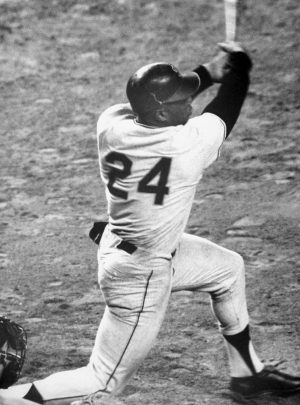
Mays hitting his 500th career home run, in 1965. “He has gone past me,” Ted Williams would say at his own Hall of Fame induction, after Mays hit number 522, “and he’s pushing, and I say to him, ‘Go get ’em, Willie’.”

Seeing Willie Mays in my boyhood when he was a Giant still in his prime was as transcendent as seeing him in his baseball dotage, as a late-career Met, was heartbreaking. Having Mays at all back in the city where he really made his baseball bones was as much a belated blessing as having him too much less than his best was sorrow. But . . .

“What do you love most about baseball?” asked Joe Posnanski, in The Baseball 100. (He ranked Mays number one.) Then, he answered. “Mays did that. To watch him play, to read the stories about how he played, to look at his glorious statistics, to hear what people say about him is to be reminded why we love this odd and ancient game in the first place.

“Yes, Willie Mays has always made kids feel like grown-ups and grown-ups feel like kids. In the end, isn’t that the whole point of baseball?”

But having Mays say farewell the way he did in Shea Stadium on 25 September 1973, with the Mets still yanking themselves back to take a none-too-strong National League East, brought tears not just of loss but of gratitude. If so few of the greats retire before the game retires them, fewer than that retire with Mays’s soul depth:

I hope that with my farewell tonight, you will understand what I’m going through right now. Something that—I never feel that I would ever quit baseball. But as you know, there always comes a time for someone to get out. And I look at the kids over here [pointing toward his Mets teammates], the way they are playing, and the way they are fighting for themselves, tells me one thing: Willie, say goodbye to America.

America never really said goodbye. Now America must say a reluctant au revoir. Mays left this island earth at 93 Tuesday. “I want to thank you all from the bottom of my broken heart for the unwavering love you have shown him over the years,” said his son, Michael, in a statement. “You have been his life’s blood.”

We’ve been his life’s blood? The younger Mays had it backward. His father was the lifeblood of every objective and appreciative baseball fan of his time. He didn’t have to wear the uniform of the team for which I rooted since their birth (not right away, anyway) to be that for me, in hand with Sandy Koufax, and believe me when I tell you that watching Koufax going mano a mano against Mays was something precious to behold.

(For the record, Mays faced Koufax 122 times and nailed 27 hits. Five were home runs, eight were doubles, one was a triple, for 33 percent extra bases off the Hall of Fame lefthander. Mays also wrung 25 walks out of him while striking out 20 times.)

Before Mays’s Giants and Koufax’s Dodgers high tailed it out of Manhattan and Brooklyn for the west coast, the most bristling debates in New York involved not politics, finance, or rush-hour traffic, but baseball. As in, whom among the three Hall of Fame center fielders patrolling the territory for each team was The Best of the Breed.

I was born in the Bronx and raised there and on Long Island; I heard the debates for years to follow after the Dodgers and the Giants went west. I had skin enough in that game long before Terry Cashman wrote and recorded his charming hit, “Willie, Mickey, and the Duke (Talkin’ Baseball).” Well, now. Let’s look at the trio during their New York baseball lives two ways, for all the seasons they played in New York together. (Snider was a four-year major league veteran by the time Mays and Mantle arrived in 1951.)

First, according to my Real Batting Average metric (total bases + walks + intentional walks + sacrifice flies + hit by pitches, divided by total plate appearances):

Together In New York PA TB BB IBB SF HBP RBA
Mickey Mantle 3493 1648 524 34 11 5 .636
Willie Mays 3299 1718 362 70 23 11 .662
Duke Snider 2629 1305 283 42 6 7 .625

Mays has a 26-point RBA advantage over Mantle and that’s with Mays losing over a season and a half to military service. (Mantle’s osteomyelitic legs kept him out of military service; Snider served in the Navy before his major league days began.) Mays also landed 70 more total bases and was handed 36 more intentional walks.

Mantle may have been a powerful switch hitter, but just from one side of the plate Mays outperformed him while they shared New York even with precious lost major league time between ages 21-23. Mantle also had a .756 stolen base percentage to Mays’s .738, but a) Mantle’s already compromised legs kept him from trying more often; and, b) Mays led his league in thefts twice during the period under review. (Snider? Even a hobbled Mantle left him behind: for their shared New York years, his stolen base percentage was .586.)

Sometimes Mantle gets the props as the best of the trio purely because his Yankees were far better teams than the others’. Actually, Snider’s Dodgers were almost as good as Mantle’s Yankees. It was no more Snider’s fault that his Dodgers couldn’t get over those Yankee humps until 1955 than it was Mantle’s sole doing that his Yankees won seven pennants and five World Series (three consecutively) while they shared the Big Apple.

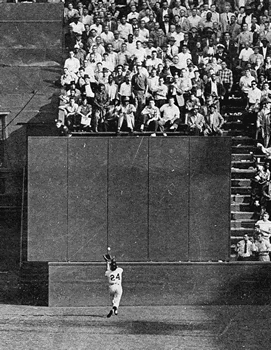
And it was hardly Mays’s fault that his Giants won a mere two pennants in the same shared span, even if Mays’s Giants got squashed by the Yankees in five in the 1951 Series but swept the far better Indians in the 1954 Series. You may have heard of a little play known as The Catch from Game One of that Series, happening when it seemed the Indians had a shot at taking the opener. (Mays would play on two more pennant winners, too, the 1962 Giants—who beat the Dodgers in another memorable pennant playoff—and the 1973 Mets.)

Willie Mays

“The Catch,” of course—460+ feet from home plate in the ancient Polo Grounds.

“That really wasn’t that great of a catch,” harrumphed curmudgeonly Indians pitcher Bob Feller, nearing the end of his own Hall of Fame career. What made him think not? “As soon as it was hit, everyone on our bench knew that he was going to catch it . . . because he is Willie Mays.” (But did they know Mays would also keep Hall of Famer Larry Doby from scoring with an equally staggering throw in to the infield off The Catch?)

Which brings me to the titanic triumvirate in center field. We’re going to look at them according to total zone runs, the number of runs their play in center field turned out above or below their leagues’ averages. Baseball-Reference begins measuring total zone runs with the 1953 season, so we’ll have five solid Big Apple seasons to review for each of the trio:

Willie Mays: +45.
Mickey Mantle: +22.
Duke Snider: +25.

Once again you see where Mantle’s physical health issues got in his way despite his supernatural talent and skill. But it might not have mattered. Mays and Mantle both played in unconscionably deep home center fields before the Giants and the Dodgers left the Apple for 1958. You can fantasise all you like how many runs Mantle might have prevented on good legs, but if you guess that he might have proven just about even you’re making a solid guess.

“Willie Mays going after a fly ball was cotton candy and a carousel and fireworks and a big band playing all at once,” Posnanski wrote. “His athletic genius was in how every movement expressed sheer delight.”

When Mays got to San Francisco, he and Mantle continued their top of the line play. When he got to Los Angeles, Snider had two decent seasons followed by a decline phase that actually took him back to New York for a round with the early Mets before finishing his career in 1964 as . . . a Giant, of all things.

Mantle managed to remain Mantle through the end of 1964. Mays managed to remain Mays through at least 1971. Even if his home run power had dissipated somewhat in the previous four seasons, he spent 1971—at age 40—leading the National League in walks and on-base percentage. Mantle’s body took him out at last at age 36; Mays’s, at age 42; Snider’s, at age 37.

And here is how the trio finished career-wise. First, how they sit among the Hall of Fame center fielders whose careers covered the post-World War II/post-integration/night-ball era, according to RBA:

Center Field PA TB BB IBB SF HBP RBA
Mickey Mantle 9907 4511 1733 148 47 13 .651
Willie Mays 12496 6066 1464 214 91 44 .631
Ken Griffey, Jr. 11304 5271 1312 246 102 81 .620
Duke Snider 8237 3865 971 154 54 21 .615
Larry Doby 6299 2621 871 60 39 38 .576
Andre Dawson 10769 4787 589 143 118 111 .534
Kirby Puckett 7831 3453 450 85 58 56 .524
Richie Ashburn 9736 3196 1198 40 30 43 .463
HOF CF AVG .588

But now, how they sit among center fielders for run prevention above their league averages, showing the top ten:

Andruw Jones +230
Willie Mays +176
Paul Blair +171
Jimmy Piersall +128
Kenny Lofton +117
Devon White +112
Carlos Beltrán +104
Willie Davis +103
Curt Flood +99
Garry Maddox +98

Thanks to his leg and hip issues, Mantle finished his career at -10. Snider finished his at -7; his late career was compromised by knee, back, and arm injuries. (Richie Ashburn, their great Hall of Fame contemporary, finished his career +39.) Two such talented center fielderss who’d had excellent throwing arms and range deserved far better than such physical betrayals.

Mays stood alone as the complete, long-enough uncompromised, all-around package. He was blessed with a body that wasn’t in a big hurry to betray him, but no blessing means a thing if you don’t take it forward. Good luck stopping Mays from doing so. Should-be Hall of Famer Dick Allen once advised Hall of Famer Mike Schmidt to play the game as though he were still the kid who’d gladly skip supper to play ball. Mays played the game precisely that way until age began to say “not so fast,” after all.

“The greats don’t always go gently into that good gray night when they can no longer play the games that made their names,” I wrote when Mays turned 90.

This son of an Alabama industrial league ballplayer fought a small war in his soul when his age insisted he was no longer able to play the game he loved so dearly at the level on which he’d played it for so many years. Some said he’d become sullen, moody, dismissive in the clubhouse. Some resented him, others felt for him, still others mourned.

. . . When he smiled as a Met, you still saw him in his youth, you didn’t see the manchild who was yanked rudely into manhood by a San Francisco that shocked him with skepticism as a New York import rather than a hero of their own. By a San Francisco that also shocked him, for all its reputation otherwise, when his bid to buy a home with his first wife was obstructed long enough by the sting of neighbourhood racism.

Willie Mays

Mays taken for a drive around PacBell Park in a 1956 Oldsmobile to celebrate his 90th birthday. San Francisco came to love him as New York did, but not without growing pains.

After his first marriage ended in divorce and in his son living across country with his mother, Mays dated Mae Louise Allen for about a decade before marrying her after the 1971 season. His happiness there was compromised by her premature Alzheimer’s diagnosis; his caring for her until her death in 2013 is the stuff of true love stories.

A welcome presence at the Hall of Fame’s induction ceremonies following his own in 1979 and at various Giants events (and numerous home games) in the years that followed, Mays wouldn’t be able to attend this year’s Field of Dreams game at Birmingham’s Rickwood Field, the field where he first played with the Birmingham Black Barons of the old Negro American League.

“I’d like to be there, but I don’t move as well as I used to,” he said in a statement on Monday. “So I’m going to watch from my home. But it will be good to see that. I’m glad that the Giants, Cardinals and MLB are doing this, letting everyone get to see pro ball at Rickwood Field. Good to remind people of all the great ball that has been played there, and all the players. All these years and it is still here. So am I. How about that?” A day later, sadly, he was gone.

Mays never apologised for making the game look fun with his fabled basket catches in front of his belt, his winging turns running the bases as his deliberately oversized hat flew off, his high-pitched voice sounding like a kid getting to play yet another inning.

“That’s what his idea was,” said one-time Giants relief pitcher Stu Miller, “to please the crowd.”

“I’m not sure what the hell charisma is,” said Ted Kluszewski, the musclebound Reds first baseman of the 1950s, “but I get the feeling it’s Willie Mays.”

“The only thing Willie Mays could not do on a baseball diamond,” Posnanski wrote, “was stay young forever.”

May his entry into the Elysian Fields, where it’s Willie, Mickey, and the Duke once again,  and especially his reunion with his beloved Mae, have been as joyous for him as the way he played the game was joyous to us for as long as we were honoured to see him play.

A star-spangled show of strength?

San Francisco Giants

The Giants crowd the dugout. The new skipper wants the dugout crammed before the national anthem now to show the other guys they mean business. But . . .

Tempted though I am to say “now I’ve heard everything” regarding “The Star-Spangled Banner” sounding before sports events, I don’t dare. That’s because every time I think and say I’ve heard it all, I get disabused rather rapidly. But you can’t help thinking it even for a moment when you see the Giants’ new manager’s explanation for why he’s mandating his players to stand for the National Anthem before a game.

Bob Melvin wants his entire team on the field, in the bullpen, in the dugout, standing for the anthem, whether spring training, the regular season, or the postseason to which the Giants are given +5000 odds of making this time around. And it has nothing to do with anything resembling patriotism, about which more anon.

“It’s all about the perception that we’re out there ready to play,” the manager told The Athletic‘s Andrew Baggarly. “That’s it. You want your team ready to play and I want the other team to notice it, too. It’s really as simple as that.” Seriously?

Seriously, says infielder Wilmer Flores. “It shows that we’re ready to play,” he says. “That’s the message we want to send to the other team. Even if you’re not playing, you’re engaged. You’re there to watch the game. It’s definitely something he wanted us to do. We’re here to play, right? I think it’s good. It doesn’t mean you’ll have a good result this season. But it’s a good way to start.”

But what if the National Anthem was no longer required playing and saluting before a ballgame? Is it impossible for a team to show it’s ready to play going in without it? Would a team be unable to stand en masse in the dugout or outside the bullpen while the starting lineup is announced without the anthem?

I get what the Giants say is the real thinking behind the rule. Not just a turnaround from previous manager Gabe Kapler’s stance, which Baggarly describes as a “‘no wrong answer’ situation” regarding the anthem, but a show of team strength after what outfielder Mike Yastrzemski described as a fend-for-yourself approach fostered by Kapler’s well-intentioned trust in his players to prepare.

That might be simple when you’re a team that won 107 games, as Kapler’s Giants did in 2021. It might not be all that simple when they spent the two seasons to follow going 160-164.

“I don’t know where it came from,” continues the grandson of Hall of Fame outfielder Carl Yastrzemski, “but it kind of took over where everybody felt like they could do their own thing and it made it feel like there wasn’t an entire group effort or a sense of unity. When you look at successful brands and successful teams, they have unity in a common goal. And I think that we need to refocus on that and to generate a very narrow window of where all of our eyesight should be.”

For better or worse, Kapler and his coaches trusted their players’ own preparation and swore that “‘eyewash,’ or going through the motions, would be kept to a minimum,” Baggarly writes. Melvin wants it known that quite the opposite will happen without him or his staff becoming tyrants about it if they can help it.

These Giants may not make the postseason this time around, but by gosh they’re going to come to play every day and they’re going to make a pre-game show of coming to play every day.

Somehow, this kind of going through the motion even in a crafted show of pre-game strength in the dugout, on the field, or outside the bullpen (relief pitchers and other bullpen personnel are now required to stand outside the pen in front of the fence under this mandate) is supposed to serve notice: These aren’t your lost 2022-2023 Giants, kiddies. At least, not until the umpire hollers, “Play ball!”

But the anthem is a tricky proposition for the Giants regardless. In 2022, Kapler elected to quit standing for the anthem in protest of the Robb Elementary School shootings in Uvalde, Texas and especially the Uvalde police who were present but did nothing to thwart them. Nobody wanted to condemn, hang, or guillotine Kapler for it, if you don’t count Tony La Russa. There was no Donald Trump in the White House that time to demand his firing post-haste, if not a firing squad.

“When I was the same age as the children in Uvalde,” blogged Kapler, once a World Series champion on the 2024 Red Sox, “my father taught me to stand for the pledge of allegiance when I believed my country was representing its people well or to protest and stay seated when it wasn’t. I don’t believe it is representing us well right now.”

Maybe this would be a good time to re-iterate something upon which I’ve stood since the National Football League elected to make it compulsory for its players to stand for the anthem unless they chose to remain in their locker rooms during its playing: stop playing it before every damn last baseball game of the year, already.

Save “The Star-Spangled Banner” for ballgames played on the national holidays that arrive during baseball season: Memorial Day, Flag Day, the Fourth of July, Labour Day. Save it for Opening Day. Save it for the All-Star Game. Save it for day one of the posteason (not the wild card games). Save it for Game One and (if it gets that far) Game Seven of the World Series.

(This could also apply to “O Canada” regarding Blue Jays home games: save that for Opening Day, the All-Star Game, day one of the postseason if the Jays make it, Games One and [if necessary] Seven of the World Series if the Jays make it, plus Victoria Day, Saint John Baptiste Day, Canada Day, Labour Day, National Day for Truth and Reconciliation, and Canada’s Thanksgiving Day.)

A nation whose first presidency ended with its first president warning against “the postures of pretended patriotism” should really have no issue with that.

“Compulsory patriotism is empty patriotism,” I wrote almost five years ago. “You probably don’t need me to tell you about those countries where patriotism was (and still is) enforced at actual or implicit gunpoint. Do you need me to remind you that there have been times enough in our own history where there’ve been those in the land of the free and the home of the brave who’ve favoured something as close to gunpoint patriotism as they could get away with?”

If we remove “The Star-Spangled Banner” from all but the aforementioned baseball season occasions, and Melvin really insists upon his Giants being all present and accountable before the game begins, he (and everyone else) might consider a fine, fine alternative. Here’s a hint: Put me in, coach, I’m ready to play . . .

Vida Blue, RIP: “You deserve it. But I ain’t gonna give it to you.”

I’m talkin’ baseball—like Reggie, Quisenberry
Talkin’ baseball—Carew and Gaylord Perry
Seaver, Garvey, Schmidt, and Vida Blue
If Cooperstown is calling, it’s no fluke—
they’ll be with Willie, Mickey and the Duke.

—Terry Cashman, “Willie, Mickey and the Duke (Talkin’ Baseball),” 1981.

Vida Blue

A Time cover star one season, Vida Blue became a poster child for Charlie Finley’s caprice and cruelty the next.

Out of 24 major league rookies to throw no-hitters, Vida Blue had the greatest sophomore season of the group—including the only Hall of Famer among them, Christy Mathewson. That sophomore season made him a national phenomenon, a Time cover star, a Cy Young Award winner, the American League’s Most Valuable Player . . . and a particular victim of then-Athletics owner Charlie Finley’s notorious caprice.

Blue died at 73 Sunday. He’d never again equal that surrealistic 1971, after his owner left him feeling worthless during offseason contract talks that took a turn called nasty even by Finley’s contradictory standards. He’d be a good pitcher who never again got anywhere near the greatness his 1971 promised.

On 21 September 1970, Blue struck nine Twins out (including Hall of Famer Harmon Killebrew twice), walked one, and landed a 6-0 gem supported by a run-scoring double play in the first and a five-run eighth, finished when A’s shortstop Bert Campaneris—in the middle of a very unlikely 22-homer season (he averaged five per 162 games lifetime)—yanked a three-run bomb with two out off the Twins’ Jim Perry.

Slightly over a year later, Blue finished that Time season credited with his 24th win, before what looked like a certain American League Championship Series Game One triumph turned into disaster: leading the Orioles 3-1 entering the bottom of the seventh, Blue and the A’s were torn for four runs, two scored by Hall of Famers Frank and Brooks Robinson, en route a 5-3 loss that led to being swept out in three.

Still, Blue sat atop baseball’s mountain. No Show sophomore sat higher. As Time put it with a corner banner on his cover issue, the 21-year-old lefthander put “new zip in the old game.” He’d posted a staggering 1.82 earned run average, a 0.95 walks/hits per inning pitched rate, and a 2.20 fielding-independent pitching rate. On the mound he looked taller than his six feet with his knee-up, arm-whip delivery. And, with a fastball considered the hardest that didn’t belong to Hall of Famer Nolan Ryan.

As would be said of another ill-fated child prodigy, Dwight Gooden, over a decade later, Blue was great before he’d even had much chance just to be good. He stood at 22 as the youngest man ever to win an MVP and the youngest (until Gooden over a decade later) to win a Cy Young Award. Analysts determined that one out of every twelve tickets to American League games were sold for his starts.

Even President Richard Nixon got into the act, when learning Blue’s 1971 salary ($14,500) was barely above rhe rookie minimum. Nixon called Blue “the most underpaid player in baseball.”

Then it came time to talk contract for 1972, in the days before Curt Flood lost his reserve clause challenge at the U.S. Supreme Court and well before Andy Messersmith pitched contract-less and prevailed to finish what Flood started. No player that offseason would better evoke the once-fabled malaprop of radio comedy legend Jane Ace: “You’ve got to take the bitter with the better.”

Audaciously, Blue engaged an agent and asked for a $100,000 salary for 1972. It happened, according to Jason Turbow’s Dynastic, Bombastic, Fantastic: Reggie, Rollie, Catfish, and Charlie Finley’s Swingin’ A’s, when Blue’s veteran teammate Tommy Davis—seeing him drowning in endorsement offers—introduced him to a California attorney named Bob Gerst, who agreed to represent Blue for a flat fee instead of percentages per.

You can only imagine how little Finley loved that idea. The same Finley who’d crowed during Blue’s sensational season, “Don’t you worry about him making money. He is going to make money. He is going to get more than money. He is going to get great things from this game. I’m going to see that he gets great things. I’m going to protect him.”

Come 8 January 1972, Finley proved just how much he’d protect Blue. Aghast as it was that Blue had Gerst in tow, Finley simply couldn’t resist talking down to the earnest lefthander.

Well, I know you won twenty-four games. I know you led the league in earned-run average. I know you had three hundred strikeouts. [Actually, 301, but let’s not get technical.—JK.] I know you made the All-Star team. I know you were the youngest to win the Cy Young Award and the MVP. I know all that. And if I was you, I would ask for the same thing. And you deserve it. But I ain’t gonna give it to you.

“He said it with a smirk,” Blue would say later, “and, man, it made me want to slide under the table.” This was the kid who’d gone on a USO tour of Vietnam with comedy legend Bob Hope and, when Hope asked how come he didn’t get more money from Finley, cracked, “Well, Mr. Finley claimed I was only using one arm.” Who knows how much of a strand of truth that crack contained?

The talks became contentious enough that Finley took them public while Gerst helped swing a profitable non-baseball job for Blue to prove he wasn’t kidding around. A’s players were torn between believing Blue should get every dollar he thought he was worth and wishing he’d sign for Finley’s proffered $50,000 just to be among them.

Gene Tenace, Vida Blue

Vida Blue (right) with catcher/first baseman Gene Tenace, at a 40th anniversary celebration of Oakland’s first of three straight World Series championships.

Blue even announced he would leave baseball for that job with a successful bathroom fixtures manufacturer. (Wags suggested Blue was going down the toilet.) Finley’s pressures included making Davis—maybe the team’s most valuable bench player in 1971—a scapegoat for introducing Blue to Gerst, and rather nastily. He ordered a very unwilling manager Dick Williams to wait until the A’s arrived at the ballpark, for a spring exhibition game three hours from home, before telling Davis he was released—and leaving Davis to find his own way home. (Turbow recorded that the A’s traveling seceretary loaned Davis his car.)

Blue got some relief from baseball’s first-ever players strike, over a 17 percent pension hike, the players finally agreeing to settle for a little over half that. Finley kept the pressure up, acquiring once-glittering but shoulder-ruined righthander Denny McLain and trading popular outfielder Rick Monday to the Cubs for pitcher Ken Holtzman. Finally, commissioner Bowie Kuhn interceded.

“It wasn’t that Finley’s $50,000 offer was outrageous, the Commissioner said,” Turbow wrote, “but that ‘Finley had a way of making it seem so’.” Blue finally came away with a $63,000 1972 salary. “He treated me like a damn coloured boy,” the lefthander told two California newspapermen when the deal was done. “Charlie Finley has soured my stomach for baseball. Tonight isn’t tell it like it is. Tonight is tell it like I feel.”

After being part of three straight A’s World Series titles, after being one of the players whose sales post-Messersmith Finley tried but Kuhn foolishly blocked*, and after a trade to the Giants that saw him become the first pitcher to start All-Star Games for each league, Blue would move on to the Royals—and become one of five teammates sent to the slammer on drug charges after the 1983 season.

Blue struggled with cocaine addiction until he retired before the 1987 season. He became a pre- and postgame television analyst for Giants games; he became known for philanthropy in the Bay Area and as a role model for children he worked with through a Giants’ outreach program. His marriage (the couple walked under a an arc of bats held by Giants players as they walked to the Candlestick Park mound) ended in divorce; he may have beaten cocaine but struggled further with drinking.

Maybe the Finley contract contretemps roots it. He became “bitter and withdrawn,” noted John Helyar in The Lords of the Realm, “eventually developing a drug problem that landed him in court.” Except that, somehow, away from the field, Blue remained likeable and magnetic.

“Vida’s such a wonderful guy,” said Hall of Famer Orlando Cepeda to the San Francisco Chronicle’s John Shea in 2005, after Blue was dinged for driving under the influence. “He’s been through a lot, but he likes to keep things inside. I went through some tough times myself, and sometimes you’ve got to open up and accept help from your friends.”

And, your children. Blue had a son and two daughters; the son, Derrick, told Shea, “He’s got great people skills, and I think that’s been a downfall. People have let him get away with more. People come to me and say, ‘He’s a great guy. He took us out drinking and partying.’ I cringe. That’s what’s wrong with being professional athletes, my dad included.”

A one-time A’s teammate, ill-fated pitcher Mike Norris—one of the early 1980s “Five Aces” said to be ruined by temperamental manager Billy Martin’s callousness toward pitchers and their workloads and by his own issues with drugs—wondered to Shea just how much substance abuse ruined Blue when Finley hadn’t.

I wanted to be the best black pitcher in the history of baseball, the first to win thirty games, but I screwed it up. So you kick yourself in the ass about it. Maybe I could’ve been in the Hall of Fame. It sounds cocky, but winning twenty games wasn’t hard for me. [Substance abuse] led to my arm injury. Being addicted, you’re not going to eat or sleep. You can’t play this game without eating or sleeping. Vida had the best fastball I’ve ever seen, and that includes [Hall of Famer] Nolan Ryan or anyone else. It was inevitable he’d go to the Hall of Fame. I believe . . . Finley turned him off to baseball. If he left him alone, there’s no telling what would have happened to this beautiful person.

Most recently, Blue took part in an A’s celebration marking the half-centenary of their 1973 World Series winners. Who knows what went through Blue’s mind and heart, riding in a classic, antique Thunderbird convertible, around a ballpark left gone to seed, hosting an A’s team left in ruins by an owner who might, maybe, make Finley resemble a kindly grandfather by comparison?

“I know he hung on for that last anniversary celebration like the absolute gamer he was,” tweeted Dallas Braden, another ill-fated A’s pitcher, whose Mother’s Day perfect game was the highlight of a career rendered brief by a shredded shoulder, and who’s since been an A’s game analyst for NBC Sports Bay Area. “Rest easy, Mr. Blue.”

We wish Blue’s family comfort in knowing the man will be remembered for what he was, for what his boss did to him, and for how he tried every time his addiction demons flattened him to flatten them right back. And we wish Blue nothing less than a deserved rest in the Elysian Fields, with the Lord’s embrace, forgiveness, and love.

———————————————————————————-

* In The New Bill James Historical Baseball Abstract, James probably said it best about Bowie Kuhn’s quash of the notorious Charlie Finley fire sale bid of 1976:

[It] was an ignorant, bone-headed, destructive policy which had no foundation in anything except that Kuhn hated Charlie Finley and saw that he could drive Finley out of the game by denying him the right to sell his [star] players.

What Kuhn should have done, if he had been thinking about the best interests of the game, is adopt the Landis policy: rule that players could be sold for whatever they would bring, but 30% of the money had to go to the players. Had he done that, the effect would have been to allow the rich teams to acquire more of the best players, as they do now. But this policy would have allowed the rich teams to strengthen themselves without inflating the salary structure, and would have allowed the weaker teams, the Montreal-type teams, to remain financially competitive by profiting from developing young players.

“The Landis policy” refers to longtime commissioner Kenesaw Mountain Landis’s suggestion—un-acted upon, of course—after Pacific Coast League star Earl Averill refused to report to the Cleveland Indians unless he got a percentage of the sale price the Indians paid the San Francisco Seals to buy him. It may have been the single smartest idea Landis ever had, and it fell on the proverbial deaf ears.

The players on Finley’s fire-sale market were Blue, Hall of Fame relief pitcher Rollie Fingers, and outfielder Joe Rudi.

What a long, strange trip it’s been . . .

Carlos Correa

Correa took a medicals-inspired, coast-to-coast trip back to the Twins in the end.

This much we should understand about today’s typical Met fan, and it’s not the first time this lifelong (theirs) Met fan has said so: Today’s typical Met fan is ready to push the plunger on a season over one bad inning—in April. The least shocking thing when Carlos Correa didn’t go from likely signing to donning a Met jersey at an introductory press conference was any Met fan surrendering 2023.

From the moment the Twins with whom Correa played last year came back into play for the shortstop, when the Mets proved as alarmed over Correa’s long-term health as the Giants had previously, many Met fans did. Social media was as crowded with them as a major subway transfer station is crowded during a New York rush hour. But there were voices of reason to be heard if you knew where to listen.

And what those voices said, from the top down, possibly including the fellow lifelong Met fan who owns the team now, was, If this guy’s rebuilt lower leg betrays him when the deal is halfway finished or less, he’s going to become a fan target and we are going to resemble the village idiots for signing him. At least, at the full thirteen and $350 million originally planned.

Now the Twins—who weren’t exactly circumspect about wanting to have Correa back longer term—have brought him back for six years and $200 million. ESPN’s Jeff Passan broke that news aboard Twitter Tuesday. The deal is now official with the physical passed.  Even if it took Correa two long stops aboard what sometimes resembled the crazy train to get there.

Remember: The Giants had landed him—until they didn’t. They quaked over something in Correa’s medical profile, enough to let him walk right into the Mets’ open arms on the day they expected to present him at a presser climbing into a Giants jersey. First it was thought to be Correa’s back. Then, as the Mets were ready to wrap him up for Christmas, the discourse turned to that now-notorious rebuilt ankle.

The Mets had Correa ready to place under New York’s Christmas tree—until they didn’t. They, too, quaked over something in the medical profile. Unlike the Giants, the Mets were willing to adjust. We know now they worked up an adjusted deal for six years and $157.5 million (were willing to go six assured at $175.5 million (roughly $27 million annually), with additional years up to six to follow based upon annual physical examinations.

The Giants’ prudence (if that’s what it was) about Correa in the end still leaves them with more holes to fill. The Mets’ such prudence doesn’t leave them with more than maybe a dent or two to fix. Remember: the Mets won 101 games last season before they collapsed in postseason round one. They’re not exactly in terrible 2023 shape, either.

But it looks as though Steve Cohen isn’t going to be the wild free-spender the rest of baseball world believed and maybe feared. It also looks as though he’s not willing to be as risky as people thought when it comes to players with injury histories no fault of their own but profound enough. Even players he says publicly, as he did about Correa, might be necessary pieces for a full-distance championship team.

Remember: Cohen once let a shiny draft pick (pitcher Kumar Rocker) walk rather than sign him over concerns about shoulder issues. He’s the owner who let Jacob deGrom, the arguable best pitcher in baseball when healthy (underline those two words), walk. (To the Rangers, for five years and $185 million.) If he was willing to let the game’s best pitcher when healthy (underline those words) walk, he wasn’t going to fear letting one of its best left-side infielders walk over similar alarms.

Is it unrealistic to think that the Astros, who raised Correa in the first place and saw him shine with them for seven seasons, let him walk into free agency in the first place because they, too, had long-term concerns about his long-term health?

Cohen may be willing to open the vault wider than any other major league owner, but it doesn’t mean he’s going to be that drunk a sailor. Remember: He had a plan and executed it regarding deGrom, signing seemingly ageless future Hall of Famer Justin Verlander for two years.

He also locked down late-game relief ace Edwin Diáz and outfield mainstay Brandon Nimmo. Extending first base anchor Pete Alonso isn’t unrealistic, either, especially after letting talented but too-firmly blocked Dominic Smith walk into the Nationals’ arms. The plan for Correa was moving him to third to play aside uber-shortstop incumbent Francisco Lindor. Without Correa? They have a pair of talented third basemen, veteran Eduardo Escobar and sprout Brett Baty.

The Mets aren’t hurting without Correa. The Twins are risking that they won’t be hurting if and when Correa begins hurting. As it was, Correa on his 2022 deal—three years, $105.3 million, and three opt-outs, the first of which Correa exercised to play the market in the first place this winter—proved a second half godsend, when the Twins became injury riddled enough but Correa managed to stay the distance.

The Twins also liked Correa’s clubhouse leadership and prodding teammates to improve. “The vision he has,” assistant pitching coach Luis Ramirez told The Athletic, “the awareness, the anticipation about what is going to come next. When he needs to talk to a teammate about an adjustment that needs to be made, or just, to like, picking up a teammate, or paying attention to small details in the game that others don’t see—he makes us better in everything, in the field, everywhere.”

They’re also banking on Correa maturing further and further away from his Astrogate past. Correa was once the staunchest public defender of the Astros’ 2017 World Series title. Yet he said not so fast, more or less, at that notorious February 2020 word salad-bar presser; their illegal, off-field-based, electronic sign-stealing Astro Intelligence Agency was “an advantage. I’m not going to lie to you.”

If you know what’s coming, you get a slight edge. And that’s why [then-general manager Jeff Luhnow and then-manager A.J. Hinch] got suspended and people got fired because it’s not right. It’s not right to do that. It was an advantage. But . . . it’s not going to happen moving forward.

Correa also took the Astros’ superstar second baseman José Altuve off the Astrogate hook, insisting—and the evidence since brought forth backs it up—that Altuve not only declined to work with stolen signs transmitted to him but actively objected to the infamous trash can banging of the pilfered intelligence while he was at the plate.

“The man plays the game clean,” Correa insisted, after then-Dodger Cody Bellinger fumed that Altuve should return his 2017 American League MVP award. “That’s easy to find out. [Astrogate whistleblower] Mike Fiers broke the story. You can go out and ask Mike Fiers: ‘Did José Altuve use the trash can? Did José Altuve cheat to win the MVP?’ Mike Fiers is going to tell you, straight up, he didn’t use it. He was the one player that didn’t use it.”

That’s what SNY’s Andy Martino said, too, in his Astrogate book, Cheated. It’s what Evan Drellich—one of the two Athletic reporters (with Ken Rosenthal) to whom Fiers blew the Astrogate whistle—is liable to reiterate in his forthcoming (next month) Winning Fixes Everything: How Baseball’s Brightest Minds Created Sports’ Biggest Mess. It’s what too many fans continue to ignore.

Without Correa, and placing their shortstop present and future into Gold Glove-winning rookie Jeremy Peña, last year’s Astros were down to only four or five remaining from the notorious 2017-18 Astrogate roster, including Altuve. The facts didn’t stop fans from hammering Altuve along with the others with chea-ter! chea-ter! chants—all the way into the World Series they won straight, no chaser at last.

The Twins bring Correa back with a front-loaded deal that includes no opt-outs and a full no-trade clause. They’re still taking a big risk on his health even for six years. God help Correa if his ankle or anything else breaks down and reduces him to journeyman status if he can play at all. Fans never let facts get in the way of fuming rants against what they think are fragile goldbrickers. Ask any Yankee fan when it comes to Jacoby Ellsbury.

But would a cynic suggest that, maybe, just maybe, in his heart of hearts, Correa was happy enough in Minnesota to let this weird coast-to-coast, medicals-scripted swing bring him back there in the first place, for a few more dollars than the Mets were willing to go on the same six guaranteed years? Maybe a cynic would. Maybe enough Met fans would. Did I just repeat myself?

The realist knows that, as fine as he’s still going to be, Correa’s ancient ankle repair did cost him in the long run. That, and not his controversial uber-agent Scott Boras, wrote this costly script. Costly for Correa. As The Athletic also points out, he lost seven years and $150 million compared to the original Giants offer, ended up with a lower offer from the Mets (half that $315 million over half the time), and signed with the Twins for four years and $85 million less than the ten/$285 million they first offered.

But realism isn’t half as much fun as ranting your head off about a season blown because of a signing blown, is it? Such is one of the major headaches of being a Met fan since the day they were born.