Two over the shoulder help tie an NLDS

Dansby Swanson, Austin Riley

Over the shoulders Wednesday night—Dansby Swanson hits the short left field turf to rob a bloop base hit from J.T. Realmuto; Austin Riley one-hands Bryson Stott’s foul over the tarp roll on which he might have turned his ribs to bone meal.

Well, I can’t decide, either. Atop a well-pitched National League division series Game Two, between the Braves and the Phillies, who put on the better defensive show between Braves shortstop Dansby Swanson and third baseman Austin Riley?

Don’t ask either one.

“I give him the credit,” Riley said, after the Braves banked the 3-0, series-tying win. “Just because running straight out, over the head is pretty tough.”

“I didn’t have to dodge a tarp,” Swanson said. “The guy, once again, a very under-appreciated defender, a lot more athletic than people give him credit for. The guy’s a gamer.”

That was like trying to choose between Lux Guardian and Lux Legacy vacuum cleaners. But come on, gentlemen. Quit being coy.

We might hand Swanson the slight advantage, though. With two out in the top of the sixth, Swanson ran out from shortstop into shallow left field chasing J.T. Realmuto’s bloop with center fielder Michael Harris II and left fielder Eddie Rosario pouring in from their positions. One false step or one body bump might have meant a base hit to a club that  isn’t terrible at turning two outs into a run-scoring chance.

Swanson took a small diving leap to nail it just before his glove hit the grass followed by the rest of him. “Play of the game, so far,” my game notes say. But if you press him on it, he’ll tell you he had a slightly unfair advantage going in.

“I should get my parents in here,” he said, “because they threw me a gajillion balls just like that all the time growing up over my head. I was the epitome of the kid that would throw a tennis ball off a wall and ricochet it and run, try to catch it over my shoulder. Probably threw a lot of tennis balls onto the field, too, to disrupt my brother’s baseball games. But I feel like I’ve been doing that since I was five.”

Two innings later, the Phillies had one out and Jean Segura aboard after a long drive to the left field wall that might have been a double was turned into a long single—thanks to Rosario playing the carom as if according to a script. He’s not the best defensive left fielder overall, but he has a powerful enough throwing arm that that kind of carom play keeps the other guy’s slugging percentage from creeping upward.

Then Phillies shortstop Bryson Stott popped a 1-2 service from Atlanta reliever Raisel Iglesias to the left side, beyond third base. Riley kicked his horse, ran it down, and reached to snap the ball into his glove above the Truist Park tarp roll—about a nanosecond before he would have hit that roll with a rib cage-cracking clank allowing Stott a reprieve.

“Couple of crazy catches,” said Braves first baseman Matt Olson. “Dansby going back, I think Rosario was going to have the play at it first. Rosario was pretty deep.”

“For me, that’s my best friend, is a good defense,” said Braves starter Kyle Wright, who kept the Phillies to a pair of hits and a walk while striking out six and turning his breaking balls loose enough to keep them out of balance. His only serious threat came when Bryce Harper, still in the Phillies’ designated hitter role, led off the second with an opposite-field double to left, took third when Nick Castellanos lined out to third, but was stranded by an unassisted ground out to first and a swinging strikeout.

“I try to get guys to put it on the ground. When they make catches like that, that’s good, too. That’s been one of my biggest weapons this year, I believe, is the defense.”

Phillies starter Zack Wheeler was almost as effective until he had two outs in the bottom of the sixth and perhaps got himself a little taken out of his game after his first pitch to Ronald Acuña, Jr. ran in hit the Braves’ right fielder on the inside part of his right elbow. Wheeler looked ashen on the mound as Braves trainers tended Acuña, who shook it off enough after about seven minutes to stay in the game and take first.

Swanson then worked out a full count walk to provide the Braves’ first man in scoring position all night to that point. Then Olson grounded one that took a tweener hop through Phillies first baseman Rhys Hoskins and sent Acuña home. With both starting pitchers working so stingily to that point, a single run must have felt like a three-run homer to the Braves.

Riley batted next. He hit a slow, small bouncer to the third base side of the mound, slow enough that Wheeler running to his right had no play to make when he speared the ball, but Swanson had a second Braves run to score on it. Then Travis d’Arnaud—the Braves catcher who’d caught Wheeler on days enough when the pair were Mets teammates—shot one sharply up the pipe for the single that sent Olson home with run number three.

A.J. Minter, Iglesias (with a little help from Riley), and Kenley Jansen kept the Phillies quiet to finish off. Andrew Bellotti and another former Met, Noah Syndergaard, kept the Braves quiet likewise to finish off. But their shoulders weren’t quite as burdened as those of the two Braves infielders who had to go over theirs to make plays that could have sent either one to the infirmary.

“[Swanson] had to readjust, get back on it and make an over the shoulder catch,” Olson said. “And then Riley going up against the tarp. Weird angle. Couple of great catches, and that’s the kind of game it was tonight.”

Game Three is set for Citizens Bank Park Friday. The Phillies had just played fourteen straight games on the road including the wild card set in which they swept the Cardinals to one side and future Hall of Famer Albert Pujols, plus ancient catcher Yadier Molina, into retirement well short of a shot at one more World Series ring.

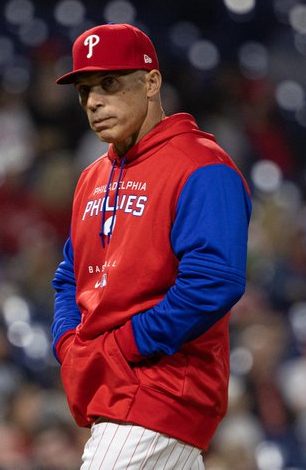
“To leave here with a split,” said Phillies manager Rob Thomson, who had the interim tag removed well before the postseason began, “and go back home in front of a packed house of passionate people . . . I think will give our guys a little shot in the arm.”

Unless the Braves keep up the stingy pitching and luminous leather, of course. Then, that Philadelphia house packed with “passionate people” might want to give the Phillies a little shot in the head.
Pete Rose’s ongoing grotesquery

Pete Rose

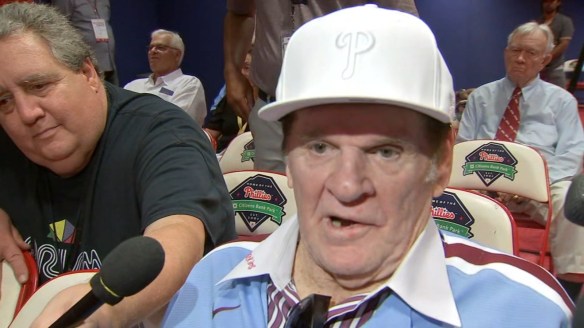
Pete Rose talks at a commemoration of the Phillies’ 1980 World Series conquest and exposes himself as a moral idiot. Again.

So long as he remains on baseball’s permanently ineligible list, Pete Rose’s presence at any major league team event sends a negative message as things stand already. But when he appeared at Citizens Bank Park to join the commemoration of the Phillies’ 1980 World Series winner, the mere negative went to grotesque in the same speed of light by which Rose made it so in the first place.

Not because of Rose’s Rule 21(d) violations that got him banished from baseball in the first place, but because Philadelphia Inquirer reporter Alex Coffey had the temerity to do her job Sunday afternoon.

“I asked Pete Rose what he would say to people who say his presence here sends a negative message to women,” Coffey tweeted. “His response: ‘No, I’m not here to talk about that. Sorry about that. It was 55 years ago babe’.” What “that” was is the early 1970s extramarital affair he conducted with a girl who wasn’t quite at the legal age of consent when it began.

That revelation first emerged in court in 2017, during Rose’s defamation lawsuit against John Dowd, the attorney who first investigated the depth of his baseball gambling under the aegis of then-commissioner A. Bartlett Giamatti. Two years earlier, Dowd gave a radio interview in which he said Michael Bertolini—through whom Rose often bet on baseball and whose notebooks had notes aplenty on those bets—told investigators Rose had “underage girls” brought to him during a spring training and, shall we say, engaged sexually with them.

The specific girl in question, the one who prompted Coffey’s question to Rose in the first place, provided the court a sworn statement in a motion. It amounted to saying Rose committed statutory rape, since the legal age of sexual consent in Ohio then and now (Rose was with the Reds at the time) is sixteen years old. (Both sides dropped the suit later.)

Rose was fortunate that he was beyond arrest and prosecution over that, since the statute of limitations for statutory rape expired long before that affair came to light. Morally, of course, it was another stain upon him well before he couldn’t help himself with Ms. Coffey.

“It was 55 years ago, babe?”

Put aside for one moment (and only one) the message Rose’s cavalier dismissal and term of address to Coffey. Consider that his presence Sunday sent a negative message to women and men as well as baseball. For a few grotesque moments the Phillies looked like a team that couldn’t have cared less about anything beyond a cocktail of nostalgic self-celebration and the ballpark gate.

After Sunday’s on-field ceremony, the Inquirer itself noted, Rose was made available to the press and asked about Coffey’s question and his comment. “I’m going to tell you one more time. I’m here for the Philly fans,” Rose replied. “I’m here for my teammates. I’m here for the Phillies organization. And who cares what happened fifty years ago? You weren’t even born. So you shouldn’t be talking about it, because you weren’t born. If you don’t know a damn thing about it, don’t talk about it.”

That’s the man who once said of Cincinnati naming a street after him that they “should have named an alley after me, the way I acted in school” and who once displayed a knowledge of baseball history that was almost as encyclopedic as his at-the-ready knowledge of his own statistics. (“We’re going down,” Rose once told a teammate when the Reds’ flight hit harsh turbulence, “and I have a .300 lifetime batting average to take with me. Do you?”)

He must have missed or ignored history classes having nothing to do with baseball and everything of the very anchorage that says teachers teach and students learn and discuss events far older than a mere half century.

“He’s an intellectual from Yale, but he’s very intelligent,” Rose said of Giamatti’s successor Fay Vincent. What would Rose know about intellect or intelligence above and beyond ninety feet between the bases, sixty feet from the pitching rubber to the rear point of home plate, and how to make enough occasions involving his old teams about himself above them?

What Rose does know is selectivity. Once upon a time it was the kind that enabled him to become (if you didn’t believe it, he’d tell you proudly) baseball’s first million-dollar singles hitter. Today it enables him to dismiss such inconvenient truths as his lifetime banishment for violating Rule 21(d) (he says of it that he was “suspended”) and his ancient but no less disgraceful extramarital dalliances with a girl who should have been thinking of the prom instead of the ballplayer old enough at minimum to have been her father.

Rose’s permanent banishment, of course, means that any of his teams who wish to include him in certain event must ask permission from the commissioner’s office. It’s probably a stretch to presume Rob Manfred will dismiss future such requests after Rose’s Sunday grotesquery, since this is a commissioner to whom the common good of the game usually involves making money for it first and Rose remains perversely good box office.

But if Rose hadn’t been so bluntly dismissive of Ms. Coffey’s very legitimate question, maybe the worst that would have come forth from Sunday’s doings and undoings would have been Rose’s 1980 Phillies teammate Bob Boone.

Bad enough that Boone had “no idea” whether Rose’s ancient dalliance with a teenager was considered when other 1980 Phillies insisted he be part of the celebration. Almost as bad: Boone saying, “This is the best hitter we’ve ever had. And he did some things wrong. If you want to, put something on the board that says he did these things wrong, but I always felt he has to be in there. He’s not in there, but I’m telling you, he’s the greatest hitter to ever play.”

This is the best hitter we’ve ever had?

Well, now. The best hitter on the 1980 Phillies posted a 1.004 OPS. He played his entire career with the Phillies, has a franchise-high 106.8 wins above a replacement-level player (WAR), and has the highest Real Batting Average (total bases + walks + intentional walks + sacrifice flies + hit by pitches, divided by total plate appearances), .626, of any Hall of Fame third baseman who played in the post-World War II/post-integration/night-ball era.

If Rose hadn’t written the script that got him banished not just from baseball but from standing for Hall of Fame election, he would be one of twelve postwar/post-integration/night-ball era Hall of Famers with a sub-.490 RBA. (Rose’s is .483.)

The best hitter the Phillies have ever had—who just so happens to have been named both the 1980 National League’s Most Valuable Player (one of his three such awards) and the Most Valuable Player of the 1980 World Series—was unable to attend Sunday’s doings because he tested positive for COVID-19. “I’m sorry that I can’t be with my championship brothers,” said Mike Schmidt in a video statement to be shared for the occasion.

“To have his body,” Rose once said of Schmidt, “I’d trade him mine and my wife’s and I’d throw in some cash.” To have Rose’s self-inflicted (and permanent, not “lifetime”) banishment from baseball and the Hall of Fame, self-soiled reputation, and self-imposed image as a statutory rapist who eluded account for it simply because of the statute of limitations and, we assume, his one-time teen paramour’s longtime reluctance to speak up and out, Schmidt probably wouldn’t trade even one brain cell.

The Phlying Phillies

Bryce Harper

Bryce Harper launches his seventh-inning blast off the Miller Park scoreboard behind the center field fence Thursday. Would you have predicted a seven-game winning streak for the Phillies  including six straight since Joe Girardi’s execution?

Don’t look now, but that’s a seven-game winning streak the Phillies have now posted, six of which—including Thursday’s 8-3 demolition of the Brewers in Milwaukee—have happened since Joe Girardi was thrown off the bridge in favour of his bench coach and longtime associate Rob Thomson.

From the moment they took down the Giants in what proved Girardi’s final game on the bridge, the Phillies’ thought-formidable offense went from sputtering to out-scoring the opposition 53-19. Living up at last to their preseason billing as a threshing machine at the plate, they posted an .877 team OPS entering Thursday’s game largely by way of hitting eighteen home runs during the streak.

They’ve also pitched above and beyond enough to make it matter. Entering Thursday, the Phillie streak showed a team 3.00 ERA and—better, yet, by far enough—a 2.38 team fielding-independent pitching (FIP) rate.

They even helped take another manager down while they were at it, sweeping the Angels last weekend and thus putting Joe Maddon into a guillotine that may have been built for him before the season began. Sweeping the National League Central-leading Brewers doesn’t measure their skipper Craig Counsell for beheading just yet. But still.

Before they beat the Giants last week the Phillies looked so lost, so unable to shake the late-inning deflations and bullpen arsons, that calling them by their ancient Phutile Phillies nickname seemed more than an exercise in phutility. Since beating those Giants, it looks as though it’s phun to be a Phillie again.

Even being out-hit by the Brewers 11-9 on Thursday, and opening by Brewers starter/defending Cy Young Award winner Corbin Burnes striking them out in order, the Phillies still found a way to turn a measly one-run lead after six full innings into a five-run margin of triumph.

It only began with Bryce Harper, whose UCL injury limits him to designated hitting, leading off the Philadelphia seventh with a parabolic home run banging off the scoreboard well behind the center field fence. Giving him three bombs in his past four games.

Then with outfielder Mickey Moniak aboard on a two-out walk in the top of the eighth, Kyle Schwarber hit a hanging 2-1 sinker 432 feet over the right center field fence. And in the top of the ninth, Harper set the table with a first-pitch base hit to right center and Odubel Herrera dined on a hovering changeup—after fouling off four straight—to prove practise makes perfect, sending it into the right field seats.

A first-inning blast from former Ray Willy Adames and a leadoff bomb in the sixth by Hunter Renfroe were the only damage the Brewers could do until former Phillie (and former longtime Pirate standout) Andrew McCutcheon singled Christian Yelich home with two outs, before Phillies reliever James Norwood got the game-ending ground out from Brewers third baseman Jace Peterson.

“Someone put the fear of God into them,” says a lady of my acquaintance regarding the suddenly Phlying Phillies. Considering Girardi’s reputation as a by-the-book, nuclear-intense martinet, perhaps it was more as though someone removed the fear of God from them. Most of it, anyway.

When they finished sweeping the Angels this past Sunday, the big blows were Harper’s grand slam and rookie third baseman Bryson Stott, Stott walking it off with a three-run blast against the Angels’ own wavering bullpen arsonists. Harper was almost beside himself over Stott’s blast.

“I’m so happy for the kid, man,” the defending National League Most Valuable Player crowed after that 9-7 win.

What an at-bat. What a situation for him. Being able to put our trust in our young guys the last couple days, and really let them just play . . . it’s been great. And it paid off today. The thing about Bryson is he’s got to play. He’s used to playing every day. From high school, to college, to minor league baseball, to now. He’s used to playing every day, and that’s what we’ve got to do for our young guys . . .

Our young guys have got to play. When you want your young guys to have success, they have to play everyday. And when they have those opportunities, I think they’re going to take full advantage of that. If that’s Bryson, if that’s [Nick] Maton, if that’s [Alec] Bohm-er or anybody else . . .

From Girardi’s difficulty in trusting his youth to Thomson’s apparent fearlessness in trusting the young guys to just play. There were those taking Harper’s commentary as a veiled shot at Girardi, and you can understand why to a small extent. On the other hand . . .

“We needed to get going,” Harper said after the Phillies finished sweeping the Brewers. “Everybody knew that. It’s just a different vibe. I think we’re just playing good ball right now.”

Maybe a change of managers doesn’t always ramp up into immediate winning streaks. But remember the 2009 Rockies pinking Clint Hurdle and installing former Dodger manager Jim Tracy on the bridge. Tracy took the gig with the Rockies when they were 18-28. They started 2-4 under him but then hit an eleven-game winning streak that turned into fourteen of fifteen and launched them toward the National League wild-card game.

Ironically enough, Hurdle took the Rockies bridge after Buddy Bell was executed in 2002 . . . and they won six straight to begin the Hurdle era. And, 107 years ago, Pat Moran took the Phillies bridge to open the season, went 8-0 out of the chute, and ended up in the World Series, where they lost to the Red Sox who featured a kid pitcher named Babe Ruth.

On the other hand, there were 81 mid-season manager switches from 1987-2010, eighty of which came courtesy of executions. Only nineteen of those teams changing skippers mid-season finished those seasons with .500 or better records for the year, and out of those nineteen only five—Tracy’s Rockies, the 2004 Astros, the 2003 Marlins, the 1989 Blue Jays, and the 1988 Red Sox—reached the postseason, with one (the ’03 Fish) going all the way to win the World Series.

Nobody wants to spoil the Phillies’ party now. But the precedents don’t favour them entirely, either. Savour it while you have it, Phillieppine Island. For however long it proves to last. And if the currently Phlying Phillies manage to make the postseason at all, count your blessings and your miracles. They don’t happen as often as we’d like.

The Phillies throw out the first manager

Joe Girardi

Girardi’s Philadelphia nightmare ends with his execution Friday morning.

Stop me if you’ve heard this one before: A front office builds a team with money no object and no other cohesive object in mind. They front-load the team with sluggers, leaving little room for defensive fortification, overtaxing a fine starting rotation, and discover they can’t out-slug the wasted defensive outs or the bullpen’s arson.

All of which leaves their third-year manager half lost for finding ways to prevent late-inning collapses, early-inning slaughters, and solving the riddle of how he could have been handed what amounts to a desperation roster built with no forward thinking and not even a nod toward replenishing the farm or delivering mid-season fortification.

Then, seeing that uncohesive, porous mess deliver a 22-29 season-opening record, they reach into their heart of hearts, pray hard, and decide it’s time answer all the last fortnight’s speculation and throw out the first manager of the season.

Ladies and gentlemen, your 2022 Phillies. Sitting twelve games behind the division-leading Mets in the National League East. Unlikely to improve even to a shot at one of the NL’s wild cards unless their fielders patch up the holes in their gloves and their defensive routes and their bullpen discovers more than just bull.

For openers. It’s not that Joe Girardi is any sort of managerial genius. He’s been a fairly overrated manager in his entire skippering career. But this one’s on that front office, led by Dave Dombrowski, an executive with a too-well-known tendency to sacrifice a future for a today that doesn’t always strike platinum. Not to mention the classic mealymouthed style of explaining why Girardi should have become the sacrificial lamb.

It has been a frustrating season for us up until this point, as we feel that our club has not played up to its capabilities. While all of us share the responsibility for the shortcomings, I felt that a change was needed and that a new voice in the clubhouse would give us the best chance to turn things around. I believe we have a talented group that can get back on track, and I am confident that [interim manager] Rob [Thomson], with his experience and familiarity with our club, is the right man to lead us going forward.

Translation: We still thought this team could slug more than enough to out-fly fielders who might as well be scrubwomen wearing oven mitts and save the asses of relief pitchers who forget to check the gasoline cans at the gates. And if you think we’re going to execute the people responsible for building that mess in the first place, you don’t know us vewwy well, do you?

Except that four of the Phillies’s sluggers (Nick Castellanos, Rhys Hoskins, J.T. Realmuto, and Kyle Schwarber) haven’t been slugging quite to the extent they were expected to slug, even if three of them dialed long distance during that ten-inning fall to the Giants last Monday.

The slugger who’s been hitting like the defending MVP he is and who just so happens to be their best defender, Bryce Harper, has a torn UCL in his throwing elbow that’s limited him to a DH role for long enough now. He’s been around the league average in right field when he played before the injury; he’s posting a .943 OPS/.166 OPS+ so far that are not too far under the numbers (1.044/181) with which he led the entire Show last year.

The Phillies have achieved the surrealistic feat of outscoring their opposition yet awakening this morning seven games below .500. The big reasons, as ESPN’s Bradford Doolittle reminds us, are a 4-10 record in one-run games and a fourth-highest-in-Show fourteen losses in games during which they held a lead at one or another point.

“Measures such as these are never wholly on the manager,” Doolittle writes, “but they are certainly not data points in his favor. The best embodiment of Girardi’s struggles is probably an early-May loss to the Mets in which Philadelphia blew a 7-1 lead it carried into the ninth inning. It sure seems the heat under his seat kept rising after that game.”

The Phillies also continued leaning upon Corey Knebel to close out games—but why? He spent May picking up four nebulous saves and earning very nebulous credit for one win during which he surrendered the game-tying run in the top of the ninth and was bailed out in the bottom by a two-run infield error.

Meanwhile, Seranthony Domínguez has been an assassin out of the pen through today: he has a 1.83 ERA and a 1.92 fielding-independent pitching rate in 19.2 innings’ work thus far. Knebel: 3.27 ERA/4.01 FIP. You tell me who should be getting the work when the games are squarely on the line—and screw the “save situations,” the real moments when a game needs saving aren’t limited to the ninth inning.

So maybe continuing to assign “roles” to his dubious-enough pen instead of training his eyes upon the best of the group falls on Girardi. He’s hardly the only manager who might still believe in “roles” instead of what the game moment and the records as they are tell him. Maybe his long-time associate Thomson will pay closer attention and move accordingly, even with the continuing dubious straitjacket of the three-batter minimum for relievers.

But everyone with eyes to see looked upon the stockpile of designated hitter-types Dombrowski and company assembled when the lockout ended and that hurry-up spring training began and said, with no sarcasm intended, just what Jayson Stark asked aloud in The Athletic: “Can a team as defensively challenged as the Phillies win anything?”

In one way Dombrowski did work with a hand tied behind his back. Last winter’s free agency market—rudely interrupted by the ridiculous owners’ lockout—offered him little enough chance to fix a dead-last defense (the 2021 Phillies were the Show’s worst for defensive runs saved) at all, never mind in one grand sweep. But there remains the sense that he didn’t have to go all the way the wrong way.

Fair play: There have been teams who could and did hit their way to even the World Series despite having defenses helpless even against a division of babies in carriages. Just ask the 2015 Mets, whose porous defense enabled them to lose a World Series in five games despite taking leads into the ninth inning in three of their four losses.

Maybe these Phillies have done their notoriously negative-think fan base a big favour. (Remember the Philadelphia wedding. Clergyman to the happy couple: I now pronounce you husband and wife. Clergyman to the gathering: You may now boo the bride.) Not by firing Girardi but by collapsing early and often under the weight of their slug-now/defend later construction. They’re not likely to make the postseason even as an outside entrant in the expanded wild card picture. They won’t be able to break the hearts the 2015 Mets broke.

But Girardi isn’t exactly innocent. Another Athletic writer, Britt Ghiroli, isolates the point. Again, stop me if you’ve heard this before, as in when his days managing the Yankees came to a halt, but make note of where Ghiroli places the core responsibility:

Two things seem to have sunk Girardi: recent bullpen-management moves that came under fire and players telling The Philadelphia Inquirer that it didn’t look like they were having any fun on the field. (They aren’t very fun to watch on the couch, either.) Girardi is known as a no-nonsense guy, and although clubhouse culture can be overrated, once players start mentioning it, it almost always spells doom for the manager. This is still a mess Dombrowski created, a defense far worse than anyone envisioned and a bullpen problem that just never seems to go away. Firing Girardi doesn’t make the Phillies a playoff team, or even a competitive unit. But it does quell the masses, at least temporarily.

The only thing missing now is Dombrowski saying, “I didn’t fire Joe. The players did.” The questions now include just how long before the Phillies’s administration gets what previous team regimes finally got and sends Dombrowski on his not-so-merry way, too, in favour of a builder whose materials aren’t limited to collapsible shelves.

Guest column: Gladstone—Pension shock for Shockley

Costen Shockley

Costen Shockley as a Phillie. After his trade to the Angels for 1965, he left baseball rather than return to the minors, fearing for his family’s discomfort.

By Douglas J. Gladstone

If you grew up rooting for the 1964 Philadelphia Phillies—and even if you didn’t, you’ve probably heard or read about the team because, by now, the story of that squad’s heartbreaking collapse over the last week of the season is etched in history—you probably remember Costen Shockley.

To countless Delawareans, Shockley was a legend. Not because he was one of the “Whiz Kids,” and not because he was all that great a player, but because he valued family first: he quit the game after being traded to the West Coast* so he wouldn’t have to abandon his wife and small child. He found jobs in construction and, by all accounts, never looked back or regretted his decision to place his family ahead of his career.

In a Society of American Baseball Research publication entitled The Year of Blue Show: The 1964 Philadelphia Phillies, the love Shockley had for his family was clearly in evidence. Authorr Mel Marmer quotes Shockley as having said the following:

In June (1965), when I approached (manager) Bill Rigney and asked if I was going to stay with the Angels, he said yes. So I moved my wife and baby out to California (from Delaware). Then (on June 12) they asked me to go to the minors instead, to Seattle. I wasn’t going to have my wife drive to Seattle. She didn’t know anything about the city. I never really adjusted to the big-league atmosphere. I wasn’t making any money then, only $1,000 a month. It cost me $600 to rent an apartment; I was using up my bonus money ($50,000); the major league minimum was only $6,000. . . So, I quit. I took my family over baseball. Do I think I could have played in the big leagues? Sure, I think I would have done well.

A resident of Georgetown, Shockley, who died on May 30, had his priorities straight.  Too bad neither Major League Baseball nor the union representing current players, the Major League Baseball Players’ Association, do.

See, Shockley was one of the ever dwindling group of retired men not receiving an MLB pension. As of this writing, there are only 511 left.

All these retirees don’t receive a traditional pension for having played the game they loved because the rules for receiving MLB pensions changed over the 1980 Memorial Day Weekend. None of these men accrued four years of service credit, which was what ballplayers who played between 1947–1979 needed to be eligible for a pension.

Instead, effective this past March, for every 43 game days of service a pre-1980 player accrued on an active MLB roster, all he receives is a yearly payment of up to $11,500.  That’s $718.75 for every 43 game days. By the way, that payment went up a whopping 15 percent. It used to be $625 for every 43 games on an active roster.

But now that he’s dead, Shockley’s loved ones won’t even get the $2,872 for his approximately four months of service; and that’s before taxes are taken out. Because if you’re a non-vested, pre-1980 player, the bone the league and union are throwing you cannot be passed on to a surviving spouse or designated beneficiary.

In rejecting the $300 million deal his former club, the Washington Nationals, offered him before signing with Philadelphia, current National League Most Valuable Player Bryce Harper famously rationalized that he didn’t want $100 million deferred on the back end of his contract. “What does that do for me?,” he asked. “What does that do for my family?”

Family means different things to different people, I suppose. The Pittsburgh Pirates embraced the concept of family when the team won the World Series in 1979. That is why MLB and MLBPA—Costen Shockley’s baseball family—need to do right by the remaining non-vested retirees now. Before it’s too late.

Douglas J. Gladstone is the author of A Bitter Cup of Coffee; How MLB & The Players Association Threw 874 Retirees a Curve.

* On 3 December 1964, Shockley was traded with pitcher Rudy May to the California Angels for notorious pitcher-playboy Bo Belinsky. May went on to enjoy a fine sixteen-season career for four major league teams, including the Yankees’ 1981 pennant winner.

Short-career pre-1980 players to whom I have spoken have attested that one reason for their freeze-out is that they were seen mostly as September call-ups. For the record, Shockley played his first major league game for the Phillies in July 1964; and, he made the Angels out of spring training 1965, playing in forty games before electing to leave baseball rather than go to the minors for his family’s sake.—JK.