The forecast is in

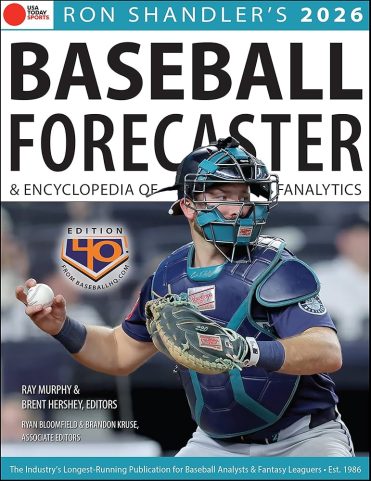
Yes, this year’s cover boy is Cal Raleigh. (And, yes, alas, Raleigh still wears the hideous nickname “the Big Dumper.”)

Well. Spring training is entering full swing, if you’ll pardon the expression. We like to think it’s as the poets and the pundits alike have enunciated time and again, the early acts producing the new birth, of spring by the calendar and by baseball season.

We’d rather not be sobered up until the first disgruntled fan of the White Sox, the Reds, the Rockies, the Angels, the Marlins, or the Mets pronounces the season to come lost upon one bad inning . . . on Opening Day.

The editors of Ron Shandler’s 2026 Baseball Forecaster & Encyclopedia of Fanalytics, alas, hew to the truth that facts don’t care about your feelings. (“Fanalytics” is their compound of fantasy and analytics.) They also uphold the truth that the only crime in information behind, beyond, and beneath the surfaces is rejecting it.

Whether you’re a fan, fantasy ballplayer, sportswriter, player, coach, manager, player agent, or front office muckety-muck, ignorance isn’t bliss.

This fortieth edition of Baseball Forecaster (Mr. Shandler birthed it the last year his beloved Mets won a World Series) contains what the old and very much missed Elias Baseball Analyst once contained: the most important information for Americans to master this side of the Declaration of Independence, the Constitution, and The Federalist Papers.

Shandler himself fires the opening high hard one after a brief anti-soliloquy regarding “Casey at the Bat” in which Mighty Casey’s descendants remain ascendant but his conqueror may be one pitch from disaster. Not the kind that flies over the fence, either: Oh here where hearts are heavy, and fans are homeward bound/The infield shouts in triumph, but there’s silence from the mound/The pitcher grabs his elbow, his face white as a ghost/Casey may have struck out, but our ace’s arm is toast.

Just in case you hadn’t taken the point, deciding Mr. Shandler tastes best when served up on the short end of a long stick, he has the temerity to point out that the number of major league pitchers who can throw past 95 miles per hour has risen from 64 in 2014 to 163 in 2024. And, the number of days pitchers spent on injured lists rose from 20,014 in 2014 to 32,250 in 2024.

Concurrently, Mr. Shandler obseves, the eight full seasons ending last October “have been an unprecedented era of record-breaking offensive performances. The new rules introduced in 2023—pitch clock, shift restrictions, larger bases, etc.—amped things up, but you can detect a subtle tipping point when hitters started making headlines even earlier.” (Italics in the original.)

The more detailed timeline Mr. Shandler sketches only begins with the team then known as the Indians including pitchers who set a new single-season major league team strikeout record in 2014. (The number: 1,450; or, eight more pitching strikeouts than that year’s Astros hitters recorded at the plate.)

Three years later, the Show set a single-season home run record. (6,105.) One year after that, major league batters struck out more than they hit safely. Don’t faint; the difference between the hits and the strikeouts was . . . 189. Or, three strikeouts fewer than ill-fated Orioles first baseman Chris Davis had at the plate that season.

One year after that, in 2019, the entire Show set a new single-season home run record (6,776) and Pete Alonso, the National League’s Rookie of the Year, set the rookie home run record. (53.) Two years later, Shohei Ohtani went nuclear: 46 home runs at the plate; a 3.18 ERA with 156 strikeouts on the mound. (Ohtani also led the Show with eight triples.)

What happened in the four seasons to follow? 2022: Aaron Judge broke Roger Maris’s American League home run record. (62.) 2023: Ronald Acuña, Jr. delivered baseball’s first 40/70 (home runs/stolen bases) season. 2024: Ohtani delivered its first 50/50 season and was the fastest to hit 40/40 en route. 2025: Cal Raleigh’s 60 home runs set single-season records for catchers (he only hit 49 while in the game as a catcher, but it was still enough to eclipse Hall of Famer Johnny Bench) and switch-hitters.

But 2025 didn’t stop there, either. Ohtani became only the sixth with back-to-back 50+ home run seasons. (Mr. Shandler notes four of the other five did it during the era of actual or alleged performance-enhancing substances and the fifth was a fossil named Ruth.) The year was also the first without no-hitters since 2005, and the Mets and the Braves set new Show records for using the most pitchers. (46.)

“[C]onsidering all [that],” Mr. Shandler writes,

I can’t escape one unavoidable conclusion:

MLB must view the destruction of pitchers’ arms as acceptable collateral damage for boosting offense and fan-friendly record chases. Pitchers are fungible, like the $1 players [fantasy baseballers] draft after Round 20. There are hundreds more arms available throughout the minors, after all. Yes, they are less skilled, but that only helps increase offense even more. It’s a win-win.

Unless you’re a pitcher. (Italics in the original.)

Baseball Forecaster includes a section of “Research Abstracts,” perhaps prime among them orthopedist Dr. James C. Ferretti addressing that recent spike in pitching injuries. He acknowledges the chase for speed is its major cause but advises there’s more to the story and analyses accordingly. Hint to Joe and Jane Fan and Old Coach Cup: Don’t think the ulnar collateral ligament just blows out, and don’t assume it’s only the hardest throw that does it.

Mr. Shandler and company deliver an “Encyclopedia of Fanalytics,” which divides into five portions: Fundamentals, Batters, Pitchers, Prospects, and Gaming. In the first portion, their performance validation criteria is instructive. It’s an attempt to determine whether Thumper O’Thrasher at the plate or Slingshot D. Stonegrinder on the mound post stats that reflect their skills accurately. It combines age, health, minor league background, his historical trends, ballpark effects, team chemistry effect, batting or pitching style, usage patterns, coaching effects or lack thereof, off-season life (Has the player spent the winter frequenting workout rooms or banquet tables?), and personal factors.

Don’t laugh or sharpen your nastygram pens just yet. Never discount a player’s personal life affecting his baseball play. Dig deep as you’re allowed and you’ll find any number of players whose seasons were compromised if not ruined by family crises. (Dig deeper and you may not want to know or stomach those whose seasons if not careers were ruined by their inability to reject domestic violence.)

Back to the health factors for a moment or three. Call this the “Watch Your Language” department. Especially when you hear a report on an injured player say, “No structural damage.” Mr. Shandler and company knock that one down the line: “[It] sounds reassuring, but it’s often misleading . . . it’s a way of saying that whatever body part being imaged is intact, with no broken bone or soft tissue tear. This is not the same as a ‘normal” or “negative’ diagnosis. When you hear ‘no structural damage,’ continue to keep a close eye on the situation.”

Wait until you get to their breakdown, “Paradoxes and Conundrums.” Read carefully and defy yourself to think to yourself that a good many sportswriters and no few team officials don’t talk through their chapeaus or see with their mouths: Play hurt, take statistical dive, risk your job; admit you’re hurt, leave the lineup or the rotation to recover, and . . . risk your job.

The crew also isolate what they consider three paths to a player’s retirement: the George Brett (you’re still producing and the fans still adore you), the Steve Carlton (you stayed too long, your numbers are toxic, and nobody remembers when you were top of the heap), and the Johan Santana. (You’re on the injured list so long your retirement flies past “until your name shows up on a Hall of Fame ballot.”)

Meanwhile, the news gets worse instead of better for Emmanuel Clase. The nearly thirty-page indictment against him unsealed Friday says he got a text message reading, “Throw a rock at the first rooster in today’s fight.” It wasn’t Warner Bros. Animation telling him how they wanted him to open a new Foghorn Leghorn cartoon.

“Yes, of course, that’s an easy toss to that rooster,” the indictment says Clase replied. Translation: The beneficiary of one of his rigged pitches in an interleague game against the Reds last May had a bet on Clase throwing it low. This revelation is part of a broadening picture of the federal case that includes charges of Clase rigging a pitch or two in 2024, including during Game One of the Guards’s American League division series against the Tigers.

Shandler and company note that Clase’s hits per ball in play and stranded runner rate regressed in 2025, but other than a drop in ground ball pitches and “save” opportunities, “it was mostly business as usual through” before his pitch-rigging scandal broke. Mostly.

“But then,” they continue, “it turned out his business was anything but usual—and in fact, was allegedly illegal. Indicted in a sports betting case in November, it’s very likely this will be his final box in this book.” The promise of Baseball Forecaster‘s continuance is far more appealing than the promise of Clase’s final punishment if he graduates from alleged to absolute pitch-rigger for fun and microbetting profit.

The Polar Bear of Baltimore

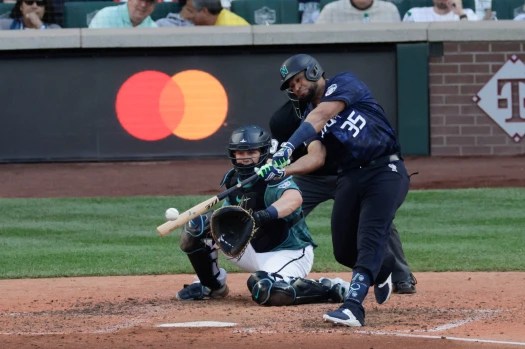
Pete Alonso

The Polar Bear gets his wings in Baltimore.

Those running baseball front offices will never lack for pressure. But there are always those among them who inflict the pressure upon themselves. Sometimes the intentions are noble. Sometimes the foresight is far. Sometimes the vision is blurry. Sometimes the blur becomes blindness.

Today’s Oriole fans have the unexpected luxury of believing their team’s president Mike Elias means business, when he says he was looking to take the Orioles’s promising lineup over the top and signing Pete Alonso was the means to that end.

Today’s Met fans have what they think is the too-familiar lack of luxury in believing their team’s president David Stearns is either talking through his head gear or blowing smoke, when he says the Mets were wary of going as far ahead in time with Alonso as the Orioles ultimately did.

Those Met fans, who’ve made a dark art out of pronouncing a season lost after a single bad inning on Opening Day, can’t fathom how a first baseman who’s still a young enough man, and has been one of their team’s most consistent power hitters since his 2019 arrival, became un-affordable beyond three years and unworthy of even receiving an offer this time around.

Stearns hasn’t kept his wish to upgrade the Mets defensively a state secret. The unfortunate flip side of Alonso’s batting prowess has been his fielding lack of it. As good as he is on the double play, as excellent as he is at snatching throws in the dirt, Alonso has slightly negative run prevention plus below-league average range factors.

The Orioles seem to be counting on Alonso’s formidable bat making up for the fielding shortfalls. The Mets seemed unwilling to continue taking that chance no matter how many home runs, no matter how many extra base hits, no matter that Alonso nudged Darryl Strawberry to one side as the franchise’s all-time home run hitter.

Alonso wasn’t the first free agent Stearns allowed to change addresses. The day before the Orioles landed him, relief ace Edwin Diaz elected to sign with the Dodgers. Three years and $96 million—and the largest average annual value for a reliever yet—wasn’t a figure the Mets couldn’t equal if they were thinking in three-year increments as seemed to be the case with Alonso.

So what made the bullpen bellwether return west? Part of it might have been Stearns signing bounceback relief candidate Devin Williams, with whom he was familiar from their time in Milwaukee. Part of it, too, and perhaps especially, might have been their coaching overhaul following the season included Jeremy Hefner, a pitching coach Diaz liked and respected.

The 2025 Mets had pitching issues that had nothing much to do with Hefner. But Diaz took his dismissal to mean the Mets suddenly got unserious about something dear to his heart.

“I spent seven years in New York,” the righthander said after he signed with the Dodgers. “They treated me really good. They treated me great. I chose the Dodgers because they are a winning organization. I’m looking to win, and I think they have everything to win. Picking the Dodgers was pretty easy.” Owitch.

And Alonso? He was both a fan favourite and an undisputed team leader, on the field and off it, known as much for his charitable acts as his bat and his fun-loving leadership style. But he spurned a significant extension offer a few years ago, and he re-upped with the Mets last winter in the face of a thinner market, taking two years with an opt-out after 2025. He exercised it after a big bounceback season and found a more accommodating new market.

Never underrate the power of betting on yourself and winning big even if it’s moving from the Grand Central Parkway to Cal Ripken Way.

“I’ve really enjoyed playing in New York,” said the Polar Bear, whose Oriole introduction included a large stuffed white polar bear on the table to his right and a brief struggle to button up his new Orioles jersey properly. He took number 25 only because his long-familiar number 20 has been long, long retired by the Orioles in honour of Hall of Famer Frank Robinson.

“I’m very gracious for that opportunity,” continued Alonso, who may have landed himself the Yogi Berra Malapropriety Award with that phrasing. “There’s some amazing people over there. Whether it be the locker room staff, clubbies, it was phenomenal. I really enjoyed my time. But this right here, this organization, this city, I’m so proud to call it home.” Double owitch.

“Losing franchise stalwarts Díaz and Alonso on back-to-back days is something a Mets fan might have expected from the Wilpon ownership—only with some ridiculous positive spin on how the team will be better for it,” said The Athletic‘s Ken Rosenthal.

Now, fans might wonder if Fred and Jeff Wilpon are practicing voodoo on David Stearns and owner Steve Cohen.

Stearns and Cohen have not said much of anything. That’s to be expected as they start to clean up the mess they’ve created, the baseball equivalent of a flooded kitchen floor. But they had better provide some answers quickly, and with actions, not words.

Maybe reuniting with Stearns gives Williams a clean shot at a big bounceback following a testy 2025 in Yankee pinstripes. Maybe bringing aging, injury-recovering Marcus Semien aboard—at the cost of another fan favourite, Brandon Nimmo, going to the Rangers—helps the Mets begin the defensive remaking Stearns has sung as a mantra. Maybe adding Jorge Polanco on a two-year deal helps likewise, especially since Polanco can play first as well as second with some pop at the plate. (He hit 26 homers last year.)

Alonso solves a huge portion of half the Orioles’s issues. They need pitching upgrades and  the best Alonso can do about that is help give that staff runs to work with. But they’re getting a class act who seems unable to wait to have a clubhouse impact as well as a scoreboard one.

“How I’m going to help is share my experience, and pretty much share whatever has helped me kind of step and rise to the occasion,” said Alonso, who has a sterling postseason resumé including an intergalactic moment or two. “I want to be an open book, pretty much to everyone in the clubhouse. For me, I take pride in that. Not only do I love performing, but ultimately I love forging great relationships and being a great teammate.”

That sounds like just the kind of guy the Mets should have wanted to keep.

Published originally at Sports Central.

2024: Taking the Fifth, and Other Lamentations

Aaron Judge

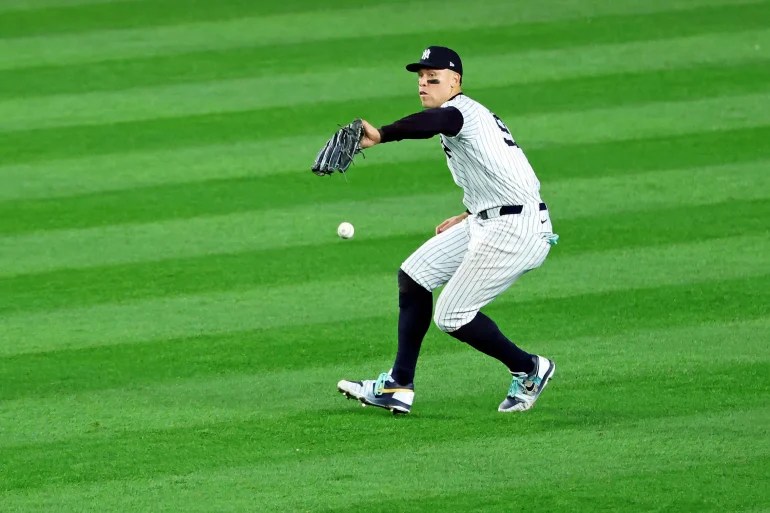
This is not what was meant when the phrase, “I’ve got the drop on you,” was coined . . .

Hands up to everyone who can’t wait for 2024 to depart. Now, hands up to everyone who thinks 2024 was just the most wonderful year of the decade. My, but that’s a barren sea of hands over that second suggestion.

Much like its home country, baseball’s 2024 was . . . well, why don’t we let some of the signature moments, doings, and undoings of baseball’s year speak for themselves. The new flimsy uniforms sucked. The All-Star Game uniforms didn’t suck that badly, but still. Meanwhile, I’m thankful to folks such as Jayson Stark and a few other intrepid sleuths of BBW—that’s Baseball Bizarro World, you perverts—who either unearthed or reminded us about . . .

Take the Fifth—Please Dept.—“Come an’ see my amazin’ Mets,” their manager Casey (I Lost With This Team What I Used to Win with the Yankees) Stengel liked to say of his maiden squad. “I been in this game a hundred years but I see new ways to lose I never knew were invented yet.”

That was the Ol’ Perfesser gazing down from the Elysian Fields, watching the team with whom he won ten pennants and seven World Series perform the single most splendid imitation of the 1962 Mets since . . . the 2024 White Sox finished their sad, sad, sad regular season.

Pace George F. Will, look to your non-laurels, White Sox—the Bronx Bumblers captured 21st Century baseball’s booby prize. You White Sox only out-lost the 1962 Mets this season. You probably never did in one regular season game what only began in a World Series game . . . with a Yankee center fielder who does a credible impersonation of the Leaning Tower of Pisa approaching the plate and Frank Howard at the plate committing his first error playing center field after 538 fly balls hit his way in his entire career to date became outs.

Then . . .

* A Gold Glove-finalist shortstop threw for a force play at third base and saw the ball ricochet off the base instead of reach his third baseman’s glove.

* The arguable best pitcher in the American League got thatclose to escaping a bases-loaded, nobody-out jam when he suffered the brain fart heard ’round the Bronx and the world: he forgot to cover first when Mookie Betts hit a screwdriving ball toward Anthony Rizzo. Oops.

* The Yankee anti-party included a balk and catcher’s interference.

* The Dodgers became the only team in baseball history to score five runs in a World Series game after they were in the hole 5-0.

* The Yankees became the only team in baseball history to serve up five unearned runs in a World Series game since they started counting earned and unearned runs as official statistics. (When did they start? In the same year during which premiered Ford’s moving assembly line, the first newspaper crossword puzzle (in the New York World), and Louis Armstrong’s first cornet. In the New Orleans Home for Coloured Waifs.)

* And the fifth-inning party actually started with everyone from the television announcers to the fans and back pondering whether Gerrit Cole might, maybe, consummate a no-hitter to keep the Yankees alive.

Your Reality Check Bounced Dept.—Too many Yankee fans continue infesting social media with proclamations that the Yankees still have the dynastic history of dynastic histories. And too many baseball fans steeped in reality and not fantasy keep reminding them, Your damn dynasty is just soooooo 20th Century!

Juan Not-So-Small Step for Met World—That’s $765 million the Mets will pay Juan Soto over the next fifteen years. This may or may not mean the end of Pete Alonso’s days as a Met, which may or may not mean . . .

Out with a Bang Dept. . . . that Polar Bear Pete’s final act as a bona-fide Met was the biggest blow on their behalf this century: the three-run homer he blasted in the ninth inning that proved the game, set, and National League division series winner against the Brewers. Which was also the only home run hit by any Met in the set.

Did I Do That Dept.—Alonso’s division series-winning blast came off Devin Williams . . . who’d never allowed a ninth-inning lead-changing bomb in his major leaguer life until then. Then, after some time passed, the Brewers let the Yankees talk them out of keeping Williams, sending them pitcher Nestor Cortes, infielder Caleb Durbin, and cash to take Williams. We still don’t know if the deal was Milwaukee payback for surrendering Alonso’s game-changing/game-swiping bomb.

Out with a Bigger Bang Dept.—That would be Walker Buehler, pitcher. One minute, locking down the Dodgers’ World Series win with a spotless Game Five ninth including two swinging strikeouts. The next, practically (well, give or take a few hours): Signing for one year and $21 million with the Red Sox. Anyone remember the Dodgers making Buehler a qualifying offer for that money and Buehler turning it down? He’s rolling serious dice on himself with this deal.

Shohei-hei Rock and Roll Dept.—You might think anyone can become a member of the 50 home run/50 stolen base club. But you won’t be able to predict who might do it the same way Shohei Ohtani did in September against the Marlins: 6-for-6 at the plate; three home runs; five extra base hits; two stolen bases; ten runs batted in. His own planet? Try realising Ohtani exists in his own quadrant.

A Cut Below Dept.—Pete Fairbanks, Rays reliever. He missed a game in 2024 because of a finger cut. He cut the finger opening a bottle of spring water. Considering his bizarre 2023 injury (incurring a black eye while trying to dunk against his toddler son through a water basketball net), it seems as though Fairbanks just couldn’t cut it anymore.

On Your Knee Dept.—Presented for your consideration: Miguel Sanó, Angel. Aleady on the injured list with an inflamed knee. He put a heating pad over it. He forgot about it just enough to burn the knee and place himself for another month on the IL. Miguel Sanó, who proved he certainly could stand the heat in . . . the Angels’ continuing Twilight Zone.

The King of Pop Dept.—Mookie Betts performs amazing feats at the plate and on the field. At the plate, they usually involve baseballs shot on lines into the outfield, or driven like ballistic missiles over fences. They didn’t involve him popping out for the cycle . . . until 25 September, when, in order, he popped out to: second baseman, third baseman, first baseman, and shortstop.

Don’t do it. Don’t Google “MLB players who’ve popped out for the cycle.” It won’t even call up the Mookie Monster, yet, never mind anyone else who might have had that kind of a day—whether a Hall of Famer, a Hall of Famer in the making, or a guy who’s destined to be forgotten outside such a single singular feat.

NLCS Game Five: A Mets blowout and a Dodgers gambit

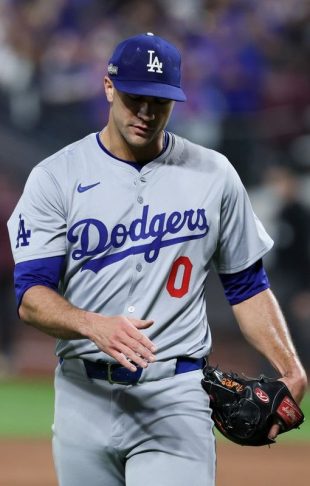
Jack Flaherty

On a day he didn’t have it, Dodgers righthander Jack Flaherty had to take eight (runs in three innings) for the team while the Mets blew them out in NLCS Game Five, so as not to compromise manager Dave Roberts’ Game Six bullpen game plan.

If the Mets deliver what some still think is near impossible, and snatch the National League pennant right out from under the Dodgers, don’t be terribly shocked if the number one question on the lips of Dodger fans and others will be, “Why did Dave Roberts leave Jack Flaherty in to take a three-inning, eight-run beating in Game Five?”

The most likely answer—considering the Mets would go on to finish what they started and blow the Dodgers out 12-6, thus sparing their elimination for another day—is Game Six.

In a National League Championship Series during which each team has won its games by blowout, Game Five may yet secure a place among the least conscionably allowed pitcher abuse by any manager. Ever. Abuse nobody could have seen coming. Could they?

Hadn’t Flaherty, a comeback kid of sorts starting with the Tigers before his trade to the Dodgers at this year’s deadline, pinned the Mets with seven shutout innings in Game One en route the Dodgers finishing with a 9-0 opening thrashing?

Yes, he had. But in Game Five he didn’t have it. His fastball wasn’t terribly fast, his breaking balls could have been court-martialed for insubordination, and the Mets were only too willing to wait him out, wait for the balls coming into the meat of the strike zone or close enough, and pounce.

Now the 29-year-old righthander went from virtuoso extension of Dodger pitching’s consecutive scoreless inning streak this postseason to a piñata in five days. But Roberts didn’t want to reach into his bullpen unless he absolutely had to with a likely bullpen game looming for the Dodgers in Game Six.

Their starting pitching has been so compromised that bullpen games became necessary survival for them. Roberts is counting on his Game Six bullpen game to win the pennant for him. He knows these Mets aren’t quite pushovers, but he has to take the chance that, somehow, his bullpen bulls can help him win a pennant and save Walker Buehler to open a World Series.

The manager had better be right, because what the Mets did to Flaherty Friday could have been called human rights violations. They only began with surrendering a one-out, three-run homer to Pete Alonso in the bottom of the first.

Flaherty shook a leadoff double by Starling Marte off to get three straight second inning outs. But then came the third. Then came back-to-back walks (Alonso, Jesse Winker) to open. Then came Marte doubling into left field to send them both home. Two outs later, Marte came home on Francsco Alvarez’s single, Francisco Lindor tripled Alvarez home, and Brandon Nimmo singled Lindor home.

Leaving things 8-1 Mets—Kiké Hernandez scoring on David Peterson’s wild pitch in the top of the inning seemed almost an excuse-us run for a good while—and leaving Flaherty the fourth pitcher in postseason history to get himself torn for eight or more runs in a game  that would have meant a series clinch for his team. (The others: Hall of Famers Walter Johnson [Game Seven, 1925 World Series] and Tom Glavine [Game Six, 1992 NLCS], and Charles Nagy [Game Five, 1999 American League division series].)

On a day Dodgers center fielder Andy Pages homered twice (solo in the fourth, three-run bomb in the fifth), you could remove Flaherty’s eight-run bequest and the Dodgers would have won the game and clinched the pennant with a 6-4 tally. Flaherty didn’t look like his best self early enough, but this was as unconscionable as it could get.

Roberts even hinted postgame that Flaherty was dealing with a health issue. He didn’t specify what, and Flaherty hadn’t discussed it at this writing. He’s dealt with injuries enough in his career—repeated shoulder injuries, an oblique injury—which helped reduce him from a Cardinals super pitcher to a kind of journeyman who shows flashes of his old mound brio and pitches as much on heart as stuff.

That the Dodgers don’t need. Not after everything else bedeviling their starting pitchers this year.

The Mets, of course, are showing how easy it isn’t to kill them this time around. Even if their bullpen isn’t as strong or consistent as the Dodgers. Blow them out one day, get blown out by them the next. With the set returning to Los Angeles, the Mets face yet another arduous test, even if they do find ways to pick, peck, pounce, and pound the Dodgers’ Game Six bullpen parade.

That test, if they make it, is called Game Seven, in hostile territory.

But wouldn’t it be nice to see one or two NLCS games that won’t become blowouts? They’re fun when the team for whom you root does the blowing out, but a good hair raiser has its place as well. Just so long as the hair isn’t raised because of sloppy or shaky play.

The All-Scar Game

Austin Riley, Pete Alonso

Austin Riley’s (Braves, left) kneeling throw to kneeling scooper Pete Alonso (Mets, right) ended the bottom of the All-Star Game eighth with a double play . . . (MLB.com photo) . . .

The best thing about Tuesday night’s All-Star Game? Easy. That snappy eighth inning-ending double play into which Athletics outfielder Brent Rooker hit. He shot one up the third base line to Braves third baseman Austin Riley, who picked and threw on one knee across to Mets first baseman Pete Alonso, who scooped on one knee to nail two outs for the price of one, doubling Blue Jays second baseman Whit Merrifield up.

That play preserved what proved the National League’s 3-2 win over the American League in Seattle’s T-Mobile Park. They got the second and third runs in the top of that eighth, when Elias Díaz (Rockies) pinch hit for Jorge Soler (Marlins) with Nick Castellanos (Phillies) aboard after a nine-pitch leadoff walk and nobody out. Díaz sent Orioles righthander Félix Bautista’s 2-2 splitter off a bullpen sidewall, then off an overhang into the left field seats.

It meant the first NL All-Star win since 2012. It also meant Díaz becoming the Rockies’s first-ever All-Star Game Most Valuable Player award winner. Otherwise? It meant almost nothing. Because the worst thing about this year’s All-Scar Game was . . . just about everything else.

Mr. Blackwell, call your office. All-Star Game specific threads have been part of it for long enough. They began ugly and devolved to further states of revulsivity. But Tuesday night took the Ignoble Prize for Extinguished Haberdashery. The only uniforms uglier than this year’s All-Star silks are those hideous City Connect uniforms worn now and then during regular season games. Both should be done away with. Post haste. Let the All-Stars wear their regular team uniforms once again.

Who are those guys? They sort of anticipated long ovations for the hometown Mariners’ All-Star representatives. But they didn’t anticipate they’d be longer than usual. To the point where two Rays All-Stars—shortstop Wander Franco, pitcher Shane McLanahan—weren’t even introduced, when they poured in from center field among all other All-Stars. (Rays third baseman Yandy Díaz, an All-Star starter, did get introduced properly. But still.)

Maybe the two Rays jumped the gun trotting in while the ovation continued, but they should have been announced regardless.

While I’m at it, what was with that nonsense about bringing the All-Stars in from center field instead of having them come out of the dugouts to line up on the opposite base lines? Some traditions do deserve preservation. Not all, but some. What’s next—running the World Series combatants’ members in from the bullpens? (Oops! Don’t give the bastards any more bright ideas!)

Down with the mikes! In-game miking of players has always been ridiculous. But on Tuesday night it went from ridiculous to revolting. When Rangers pitcher Nathan Eovaldi took the mound miked up, the poor guy got into trouble on the mound almost at once. He had to pitch his way out of a two-on, one-out jam in the second inning. He sounded about as thrilled to talk while working his escape act as a schoolboy ordered to explain why he put a girl’s phone number on the boys’ room wall.

What’s the meaning of this? We’ve got regular-season interleague play all year long now. The National League All-Stars broke a ten-season losing streak? Forgive me if hold my applause. So long as the entire season is full of interleague play, the All-Star Game means nothing. Wasn’t it bad enough during those years when the outcome of the All-Star Game determined home field advantage for the World Series?

The road to making the All-Star Game mean something once more is eliminating regular-season interleague play altogether.

Elias Díaz

. . . saving the lead (and, ultimately, the game) Elias Díaz gave the NL with his two-run homer in the top of the eighth. (And, yes, the All-Star uniforms get uglier every year. Enough!) (AP Photo.)

Tamper bay. Sure it was cute to hear the T-Mobile Park crowd chanting for Angels unicorn star Shohei Ohtani to come to Seattle as a free agent. The problem is, he isn’t a free agent yet. He still has a second half to play for the Angels. I’ll guarantee you that if any team decided to break into a “Come to us!” chant toward Ohtani, they’d be hauled before baseball’s government and disciplined for tampering.

I get practically every fan base in baseball wanting Ohtani in their teams’ fatigues starting next year. If they don’t, they should be questioned by grand juries. But they really should have held their tongues on that one no matter how deeply you think the All-Scar Game has been reduced to farce. Lucky for them the commissioner can’t fine the Mariners for their fans’ tamper chants. (Not unless someone can prove the Mariners put their fans up to it, anyway.)

Crash cart alert. Cardiac Craig Kimbrel (Phillies) was sent out to pitch the ninth. With a one-run lead. The National League should have put the crash carts on double red alert, entrusting a one-run lead to the guy whose six 2018 postseason saves with a 5.90 ERA/6.74 fielding-independent pitching still felt like defeats. The guy who has a lifetime 4.13 ERA/4.84 FIP in postseason play.

Kimbrel got the first two outs (a fly to right, a strikeout), then issued back-to-back walks (six and seven pitches off an even count and a 1-2 count, respectively) before he finally struck Jose Ramirez (Guardians) out—after opening 0-2 but lapsing to 2-2—to end the game. Making the ninth that kind of interesting should not be what the Phillies have to look forward to if they reach the coming postseason.

Sales pitch. How bad is the sorry state of the Athletics and their ten-thumbed owner John Fisher’s shameless moves while trying and failing to extort Oakland but discovering Nevada politicians have cactus juice for brains? It’s this bad—when the T-Mobile crowd wasn’t chanting for Ohtani to cast his free agency eyes upon Seattle, they were chanting “Sell the team!” when Rooker whacked a ground rule double in the fifth.

Can you think of any other All-Star ballpark crowd chanting against another team’s owner in the past? Not even George Steinbrenner’s worst 1980-91 antics inspired that. That’s more on Fisher, of course, but it’s still sad to think that a team reduced to cinder and ashes with malice aforethought captured an All-Star Game crowd’s attention almost equal to the attention they might have paid the game itself.