The All-Scar Game

Austin Riley, Pete Alonso

Austin Riley’s (Braves, left) kneeling throw to kneeling scooper Pete Alonso (Mets, right) ended the bottom of the All-Star Game eighth with a double play . . . (MLB.com photo) . . .

The best thing about Tuesday night’s All-Star Game? Easy. That snappy eighth inning-ending double play into which Athletics outfielder Brent Rooker hit. He shot one up the third base line to Braves third baseman Austin Riley, who picked and threw on one knee across to Mets first baseman Pete Alonso, who scooped on one knee to nail two outs for the price of one, doubling Blue Jays second baseman Whit Merrifield up.

That play preserved what proved the National League’s 3-2 win over the American League in Seattle’s T-Mobile Park. They got the second and third runs in the top of that eighth, when Elias Díaz (Rockies) pinch hit for Jorge Soler (Marlins) with Nick Castellanos (Phillies) aboard after a nine-pitch leadoff walk and nobody out. Díaz sent Orioles righthander Félix Bautista’s 2-2 splitter off a bullpen sidewall, then off an overhang into the left field seats.

It meant the first NL All-Star win since 2012. It also meant Díaz becoming the Rockies’s first-ever All-Star Game Most Valuable Player award winner. Otherwise? It meant almost nothing. Because the worst thing about this year’s All-Scar Game was . . . just about everything else.

Mr. Blackwell, call your office. All-Star Game specific threads have been part of it for long enough. They began ugly and devolved to further states of revulsivity. But Tuesday night took the Ignoble Prize for Extinguished Haberdashery. The only uniforms uglier than this year’s All-Star silks are those hideous City Connect uniforms worn now and then during regular season games. Both should be done away with. Post haste. Let the All-Stars wear their regular team uniforms once again.

Who are those guys? They sort of anticipated long ovations for the hometown Mariners’ All-Star representatives. But they didn’t anticipate they’d be longer than usual. To the point where two Rays All-Stars—shortstop Wander Franco, pitcher Shane McLanahan—weren’t even introduced, when they poured in from center field among all other All-Stars. (Rays third baseman Yandy Díaz, an All-Star starter, did get introduced properly. But still.)

Maybe the two Rays jumped the gun trotting in while the ovation continued, but they should have been announced regardless.

While I’m at it, what was with that nonsense about bringing the All-Stars in from center field instead of having them come out of the dugouts to line up on the opposite base lines? Some traditions do deserve preservation. Not all, but some. What’s next—running the World Series combatants’ members in from the bullpens? (Oops! Don’t give the bastards any more bright ideas!)

Down with the mikes! In-game miking of players has always been ridiculous. But on Tuesday night it went from ridiculous to revolting. When Rangers pitcher Nathan Eovaldi took the mound miked up, the poor guy got into trouble on the mound almost at once. He had to pitch his way out of a two-on, one-out jam in the second inning. He sounded about as thrilled to talk while working his escape act as a schoolboy ordered to explain why he put a girl’s phone number on the boys’ room wall.

What’s the meaning of this? We’ve got regular-season interleague play all year long now. The National League All-Stars broke a ten-season losing streak? Forgive me if hold my applause. So long as the entire season is full of interleague play, the All-Star Game means nothing. Wasn’t it bad enough during those years when the outcome of the All-Star Game determined home field advantage for the World Series?

The road to making the All-Star Game mean something once more is eliminating regular-season interleague play altogether.
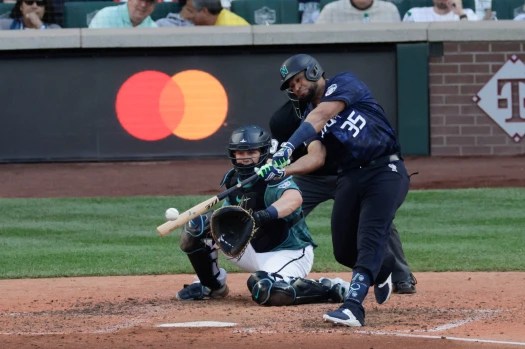
Elias Díaz

. . . saving the lead (and, ultimately, the game) Elias Díaz gave the NL with his two-run homer in the top of the eighth. (And, yes, the All-Star uniforms get uglier every year. Enough!) (AP Photo.)

Tamper bay. Sure it was cute to hear the T-Mobile Park crowd chanting for Angels unicorn star Shohei Ohtani to come to Seattle as a free agent. The problem is, he isn’t a free agent yet. He still has a second half to play for the Angels. I’ll guarantee you that if any team decided to break into a “Come to us!” chant toward Ohtani, they’d be hauled before baseball’s government and disciplined for tampering.

I get practically every fan base in baseball wanting Ohtani in their teams’ fatigues starting next year. If they don’t, they should be questioned by grand juries. But they really should have held their tongues on that one no matter how deeply you think the All-Scar Game has been reduced to farce. Lucky for them the commissioner can’t fine the Mariners for their fans’ tamper chants. (Not unless someone can prove the Mariners put their fans up to it, anyway.)

Crash cart alert. Cardiac Craig Kimbrel (Phillies) was sent out to pitch the ninth. With a one-run lead. The National League should have put the crash carts on double red alert, entrusting a one-run lead to the guy whose six 2018 postseason saves with a 5.90 ERA/6.74 fielding-independent pitching still felt like defeats. The guy who has a lifetime 4.13 ERA/4.84 FIP in postseason play.

Kimbrel got the first two outs (a fly to right, a strikeout), then issued back-to-back walks (six and seven pitches off an even count and a 1-2 count, respectively) before he finally struck Jose Ramirez (Guardians) out—after opening 0-2 but lapsing to 2-2—to end the game. Making the ninth that kind of interesting should not be what the Phillies have to look forward to if they reach the coming postseason.

Sales pitch. How bad is the sorry state of the Athletics and their ten-thumbed owner John Fisher’s shameless moves while trying and failing to extort Oakland but discovering Nevada politicians have cactus juice for brains? It’s this bad—when the T-Mobile crowd wasn’t chanting for Ohtani to cast his free agency eyes upon Seattle, they were chanting “Sell the team!” when Rooker whacked a ground rule double in the fifth.

Can you think of any other All-Star ballpark crowd chanting against another team’s owner in the past? Not even George Steinbrenner’s worst 1980-91 antics inspired that. That’s more on Fisher, of course, but it’s still sad to think that a team reduced to cinder and ashes with malice aforethought captured an All-Star Game crowd’s attention almost equal to the attention they might have paid the game itself.

The ten million-to-one shot comes in

Domingo Germán

German’s uniform number must have felt like adding insult to injury to the Athletics Wednesday night.

When the late Don Larsen pitched his perfect game in Game Five of the 1956 World Series, New York Daily News writer Joe Trimble was stuck for an opening line. His News colleague Dick Young handed one to him, practically in a glass case: The unperfect man pitched a perfect game.

That pretty much robs anyone of using it as a headline for Domingo Germán, who became the fourth Yankee pitcher to come away with a perfect game Wednesday night. Which is a shame, because Germán can be seen as having made Larsen resemble a saint.

Before he married in 1960, Larsen was a wild oat whom no less than Hall of Famer Mickey Mantle called the greatest drinker he’d ever known. That was saying something considering Mantle’s own prodigious taste for distilled spirits. The night before he went to a no-windup delivery and reached baseball immortality, Larsen went out—still steaming over an early Game Two hook—and got smashed.

Germán’s is a more grave backstory. He missed 2019’s final eighteen games plus the entire pan-damn-ically shortened 2020 after slapping his girlfriend during retiring Yankee legend CC Sabathia’s charity party late in the 2019 season. His 2021 return didn’t thrill all his teammates, even though there’d been Yankee fans swearing that a lack of formal criminal charges meant he should have been back in 2020.

“Sometimes,” relief pitcher Zack Britton said, before Germán’s 2021 return, “you don’t get to control who your teammates are.”

The Yankees entered spring training this year without figuring Germán in their starting rotation plans. Not until Frankie Montas needed shoulder surgery, Carlos Rodòn injured his forearm and then his back, and Luis Severino incurred a lat injury. And Germán himself—who has said he started undergoing treatment for depression following his 2019 incident and counseling to improve as a husband and father—dealt with shoulder inflammation last year.

Nothing in Germán’s 2023 entering Wednesday suggested he’d have anything coming such as what he’d do in Oakland’s RingCentral Coliseum—pitching the 24th perfect game in Show history and the fourth in Yankee history, following Larsen, David Wells, and—with Larsen and his Hall of Fame catcher Yogi Berra in attendance for a ceremonial pre-game first pitch—David Cone.

Germán was ejected, then suspended ten games, for too much of that new old-fashioned medicated goo on his hand after a May outing in Toronto. Before that, in April, he was suspected but allowed to wash his hands during a game against the Twins.

From early May through mid-June, Germán became, perhaps surprisingly, the best Yankee starting pitcher who wasn’t named Gerrit Cole, including a two-hit performance against the Guardians 1 May and six and two-thirds one-run ball against the Dodgers on a Sunday night game in June that was televised natinoally.

Then, his two outings prior to Wednesday night saw Germán abused by the Red Sox for seven runs in two innings; and, bushwhacked by the Mariners for ten runs including on four home runs.

I don’t know what Germán did on Tuesday night. I do know that he went out to the mound Wednesday night with absolutely nobody in the sparse-enough RingCentral house, perhaps including himself, expecting him to come away with the first perfect game ever pitched by a man whose previous start saw him take a ten-run beating.

That includes factoring that the A’s were the opposition. This year’s A’s have become such a pathetic set after long enough dismantling and disembowling under the all-thumbs hand of their owner that a perfect game against them might be considered doing it the easy way.

Especially since, during the top of the fifth, the Yankees made bloody well certain that Germán could go back out to the mound, pull up a lounge chair, and pitch from a sitting position serving up balls on tees without incurring serious damage.

They entered the inning with a mere 1-0 lead thanks to Giancarlo Stanton’s fourth-inning, two-out, first-pitch home run. They finished it with a 7-0 lead following an RBI double (Kyle Higashioka), a run home on a throwing error off a bunt (by Anthony Volpe, who stole third during the next at-bat), an RBI single (DJ LeMahieu), a two-run single (Stanton) after another A’s error enabled the bases loaded, and a two-out RBI single.

The Yankees then scored once in the top of the seventh (on Josh Donaldson’s sacrifice fly) and thrice in the top of the ninth (a run-scoring throwing error, an RBI double, a run-scoring ground out) to finish the 11-0 pile-on. It’s the fattest winning score in a perfect game since the Giants staked Matt Cain to a 10-0 conquest in 2012 and only the second time a perfect game pitcher had double-digit run support to work with.

All the while, Germán kept feeding the A’s things onto which they couldn’t attach sneaky eyes through the infield or wicked distractions in the outfield. He struck nine batters out, all before the eighth inning, and should have handed his defense at least equal credit for the perfecto as he might have accepted for himself. This is Germán’s gem with a win factor assigned, result of his strikeouts divided by the sum of his ground and fly outs:

  Score K GB FB WF FIP
Domingo Germán 11-0 9 8 10 .500 5.30

Essentially, Germán himself was responsible for half the game’s perfection. Which actually places him well enough ahead of Larsen’s perfecto (WF: .350) but behind those of Wells (.688) and Cone (.588).

Among the perfect games pitched in the World Series era (1903 forward) with available game logs, Germán’s win factor is higher than six perfecto pitchers (Larsen plus Charlie Robertson, Tom Browning, Dennis Martinez [the lowest at .227], Kenny Rogers, Mark Buehrle, Dallas Braden) but lower than eleven. (Cain, Wells and Cone, plus Jim Bunning, Sandy Koufax [tied for highest with Cain: 1.077], Catfish Hunter, Len Barker, Mike Witt, Randy Johnson, Roy Halladay, and Felix Hernández.)

You might care to know that Germán shares a .500 WF with one perfecto pitcher, one-time Yankee Philip Humber. But Germán’s curve ball, considered a sharp pitch when it’s thrown right, was responsible for nineteen of his 27 outs, including seven of his strikeouts.

“He threw that curveball in any count that he wanted to,” said A’s infielder Tony Kemp postgame. “It was spinning differently and moving differently. He put his fastball where he wanted to. Changeup as well. He just kind of mixed them.”

Larsen beat a somewhat aging but still formidable Dodgers team who’d ground their way to their final pennant during their Brooklyn life. Germán took on an A’s team that’s been compared often enough to the 1962 Mets—while lacking that team’s circumstantial popularity and flair for inadvertent ensemble comedy.

Those Mets merely got no-hit by Hall of Famer Koufax—who threw one of the most voluptuous curve balls in history himself—while Koufax’s Dodgers slapped eleven runs out of Met pitching . . . on 30 June 1962. These A’s accomplished something on 28 June 2023 that those Mets didn’t. They were victimised by Germán and the Yankees without the relief of the five walks Koufax surrendered.

Washington Post sportswriting legend Shirley Povich led his story of Larsen’s World Series perfecto with, “The million-to-one-shot came in.” It’s not unfair to suggest Germán was the ten million-to-one shot.

But you wonder whether his unusual uniform number—the only available single-digit number on the Yankees anymore, chosen when he gave Rodón his usual number 55 to indicate a new beginning for himself—didn’t look more swollen in the A’s eyes, adding insult to injury, than it looked on Germán’s back. Zero.

The Las Vegas Athletics of Oakland

Oakland Athletics

Will the owners do the right thing and block John Fisher’s final betrayal of the fan base he abused?

Now we know Nevada governor Joseph Lombardo lacks either a brain or a veto pen when he needs both. We’re about to discover—or rediscover, as the case probably is—whether major league baseball owners have brains and vetoes enough to do what Nevada’s legislature and governor couldn’t or wouldn’t do.

Lombardo signed off on the state pledge of $380 million tax dollars toward building the Las Vegas Athletics of Oakland a new playpen on the fabled Las Vegas Strip. That, as more than a few social media crawlers have snarked, makes Lombardo the rookie of the year. Not.

The only thing left to plunge the knife all the way into Oakland’s back are the owners. Are they willing to rubber-stamp A’s owner John Fisher and baseball commissioner Rob Manfred’s insistence on finishing Fisher’s betrayal of Oakland and, by the way, waiving the $1 billion dollar relocation fee the A’s would normally have to pay MLB to make the move?

You’d better not ask Manfred about that. All indications are that the commissioner has long surrendered Oakland as a lost cause without bothering himself to ponder that the cause wasn’t lost, it was discarded witlessly. And A’s fans smothered in frustration, rage, and sorrow alike have learned the hard way what Manfred thinks of them after all.

Almost 28,000 fans poured into RingCentral Coliseum Tuesday in a “reverse boycott” aimed at letting the world know the A’s atrocity wasn’t their doing. That they weren’t the ones who let the team and the ballpark—whose usefulness disappeared years if not decades before the A’s might—turn into the city dump.

Manfred himself didn’t see the game. He was occupied with dining with some of the owners after their week of meetings ended in New York. But he did see the game’s coverage. And it impressed him this much: “It’s great to see what is, this year, almost an average Major League Baseball crowd in the facility for one night. That’s a great thing.”

Was Commissioner Nero even mildly aware that Fisher reduced the A’s to rubble while trying and failing to strong-arm Oakland and its home Alameda County into handing the A’s a new home practically on the house? That Oakland called his bluff and compelled Fisher to think about sticking it to Las Vegas and its home Nevada?

“I think if you look at the A’s record over time and the economic circumstances, including the state of the stadium that they’ve operated in for a very long time, they had a very good record up through the pandemic,” he said.

Translation: Oakland wasn’t willing to just build Fisher a delicious real-estate development in Howard Terminal with a new ballpark thrown in for good measure. Except that that wasn’t the only option Fisher blew sky high. “Wasn’t Fisher committed to Fremont not that long ago?” asked The Athletic‘s Tim Kawakami—in April. “Then to San Jose? Then to rebuilding at the Coliseum? Then to the Laney College site? Then to Howard Terminal . . . ? This is the Death Lineup of squandered and blundering stadium efforts.”

Kawakami then was perversely optimistic that Fisher would fall on his face in Las Vegas and thus be compelled to sell the A’s if only because he wouldn’t be able to meet Manfred’s deadline of getting new digs by 2024 or else. Except that Fisher and Manfred and Fisher’s parrot David Kaval picked their Nevada marks well. Nevada’s cactus juice-for-brains lawmakers and governor fell for it hook, line, and stinker.

Oakland itself (the city, that is) isn’t entirely innocent. They were quite prepared to make $375 million worth of commitments to a new A’s stadium if only Fisher and Kaval left it at that. But no. Fisher and Kaval insisted on pushing the $12 billion Howard Terminal development project. That, said mayor Sheng Thao, turned the simple into the too-complex.

“There was a very concrete proposal under discussion,” Thao’s spokeswoman Julie Edwards said in a formal statement, “and Oakland had gone above and beyond to clear hurdles, including securing funding for infrastructure, providing an environmental review and working with other agencies to finalize proposals.

“The reality is the A’s ownership had insisted on a multibillion-dollar, 55-acre project that included a ballpark, residential, commercial and retail space. In Las Vegas, for whatever reason, they seem satisfied with a nine-acre leased ballpark on leased land. If they had proposed a similar project in Oakland, we feel confident a new ballpark would already be under construction.”

If you need me to explain why Fisher and Kaval are settling for just the ballpark in Las Vegas, remember my beach club in Antarctica? You can have it for a song now. Maybe just a short medley.

Thao’s statement said, essentially, spare us the crocodile tears, Mr. Commissioner. “I feel sorry for the fans in Oakland,” Manfred says.

I do not like this outcome. I understand why they feel the way they do. I think the real question is what is it that Oakland was prepared to do? There is no Oakland offer, OK? They never got to the point where they had a plan to build a stadium at any site. It’s not just John Fisher . . . The community has to provide support, and at some point you come to the realization that it’s just not going to happen.

“This,” tweeted retired (and one-time A’s) pitcher Brandon McCarthy, “is [fornicating] pathetic. How is this not disqualifying? This toad is the steward of a glorious sport, dripping with history and he feels entitled to mock fans who are making their voices heard as he sits by and caters to hiding billionaires?”

Why does Manfred think Oakland “has to support” a team reduced to pathos by its owner, in a ballpark allowed to become a dump for too many years, with its host city responsible for building a new ballpark and just handing it to the team on whatever terms the team demands—even and including a $12 billion development where the ballpark would have been oh-by-the-way?

All that was Fisher’s doing. He did his level best to make things unpalatable for A’s fans. Including but not limited to the abject gall of inflating prices after last year’s A’s finished 60-102; two years and more worth of shipping or letting walk any viable A’s players who now perform well for other teams; and, ten years worth of fielding baseball’s 26th highest payroll with only one postseason game win to show for it.

(For the curious, the win was Game Three of the 2000 American League division series against the Astros—when courageous Liam Hendricks was still an Athletic, and kept a late two-run lead intact pitching the final two innings to nail the game.)

“[T]he A’s could have made money in Oakland,” writes Mark Normandin in Baseball Prospectus, using Tuesday night’s “reverse boycott” game as a classic example, “but chose not to.”

They stopped trying a long time ago, and began to try even less after that. No matter how many executive fingers are pointed at the fans in Oakland for not attending games, it doesn’t change that there is money to be made if you simply give the fans a reason to give it to you. Nearly 28,000 people paid an average of $29 just to show up on TV and tell John Fisher he sucks and should sell the team; do you know how much more positive energy and money could be out there for the A’s if they had a team worth paying to see? This is a city that, after all the team has done to them, was still willing to give them hundreds of millions in taxpayer funds to stick around even longer!

All that stands in the way of the A’s hosing Las Vegas and the entire state of Nevada now are the owners. (You think $380 million tax dollars is a fortune? Just wait until the almost-inevitable cost overruns begin to make themselves manifest. Three guesses whom the A’s and MLB will try to stick with those bills.)

I say again: I’d love nothing more than major league baseball in Las Vegas. But not like that. Not by way of a taxpayer hosing. Not a team whose often colourful history was betrayed by an owner who treated the team and its fans who’ve loved them like nuisances. I don’t want major league baseball in Vegas that badly. I’m perfectly happy having the Triple-A Aviators.

An optimist may now be described as someone who thinks enough owners will a) wake up and decide, after all, that there’s something transparently stupid about billionaires unwilling to build their teams’ own digs without a taxpayer soak; and, b) show enough spine, accordingly, to stand athwart Fisher (and Manfred, their hired hand, after all), yelling “Stop!”

Keep your veto pen wet, Gov. Lombardo

Once the Athletics’ uniform insignia, this now represents what John Fisher has made of the A’s. And, what Nevada’s cactus-juice-for-brains lawmakers approved for taxpayer financing to move to Las Vegas. It’s your move, Gov. Lombardo.

Let’s put it this way, as Deadspin‘s invaluable Sam Fels has, in more words than I’m about to sketch: Nevada, you’re being had. You have better odds playing for the Megamillions slot jackpot ($14 million) won two months ago by a man in a Reno casino than you have that the Oakland Athletics will make it worth soaking your taxpayers for $350 million plus to build it when they may not come the way the A’s think.

Fels wrote before the state Assembly gave its blessing toward enabling A’s owner John Fisher and his enabler, baseball commissioner Rob Manfred, to count on that minimum $350 million tax soak to build a ballpark on the Las Vegas Strip that isn’t liable to draw anywhere near what Fisher and Manfred think it will. The Assembly approved it a day after the state Senate signed off on it eyes wide shut.

Newly-minted Nevada governor Joseph Lombardo is expected to sign it all. Before he does, you wish he’d read Fels’s warning. Not only are the A’s moving from a large market they threw under the proverbial bus, when they couldn’t shove their once-planned Howard Terminal project of mass real estate investment with a ballpark thrown in for good measure down Oakland’s throat, but they’re planning to build the smallest ballpark in the Show.

Fels warns properly that the A’s may be counting on most of Las Vegas, if not most of Nevada, having just as much cactus juice for brains as their state legislature and, apparently, their governor. The forthcoming ballpark, as planned now, and as Fisher and Manfred want you to believe, means 27,000 tickets sold per game, which is ninety percent capacity for 81 home games. Not so fast, Fels hollers: Nobody sells that much per game all home season long.

You know who doesn’t sell 90 percent of their seats on average? The Dodgers (86 percent). You know who else didn’t? The Best Fans In Baseball, Cardinals (87 percent). Neither did the Yankees (also 87 percent). Are we really supposed to believe that the A’s, run by the duopoly of knuckleheadedness that is John Fisher and David Kaval, are going to produce a team that’s going to draw 90 percent capacity through July in the desert?

Fisher, Kaval, and Manfred say of course you’re supposed to believe it. They’re a trio of Mad Hatters. Except that the Mad Hatter was unapologetically honest about inviting you to come have some tea because he had no tea. The disingenuity from which Fisher, Kaval, and Manfred spring is enough to make smarmy politicians the essence of candor.

Maybe the lawmakers should have asked a major league ballplayer who just so happens to be native to Las Vegas. He grew up the son of a Yankee fan and with friends who became Braves fans (thanks to superstation TBS); Dodger or Padre fans (since each team is a mere four and a half hour reach from Vegas by car); or, Cub or White Sox fans, thanks to lots of Chicago people moving to Vegas over three decades prior to his 1992 birth.

“Are they really going to sell out for a Yankees game on a Friday night?” asks Bryce Harper, now a Phillie for life and hoping to keep things that way. “Is it going to happen? I don’t know. I have no idea. I don’t think anybody knows . . . Do you think people are going to drop the Cubs or the White Sox to be A’s fans? There’s no way. No chance. But that five- or six-year-old, in the next ten years, they could grow up A’s fans. In ten years, you could have a lot of fans.”

Depending, of course, on one small detail nobody’s convinced the A’s can tend so long as Fisher ownes the club and Kaval is his trained parrot. “You can’t have (out-of-state) fans having to push this team,” Harper goes on. “You can’t have that. You need a fan base. They’re going to have to build a fan base, big time . . .”

They’re going to have to build behind a player. Who is that player going to be? Because it has to start next year . . . If they go to Vegas next year, you have to be able to go, ‘We’re going to get this player. We’re going to spend $300 million on him. And this is what it’s going to be.’ And he’s your guy. You have to build around that player. But it has to be a dude. It can’t be a middle-of-the-road guy. It has to be a dude. And it should be two.

Some people seem to think that if the NHL’s Golden Knights could thrive in Las Vegas—not to mention win a Stanley Cup Tuesday night, the second-fastest Cup win for an expansion team in NHL history—there’s hope for the A’s. Uhhhhh, not so fast, folks.

The Knights were born as an NHL franchise in 2017. In what’s surely one of the most grotesque cases of timing in this century’s sports history, great misfortune led to unforeseen reward. The Mandalay Bay atrocity of that year brought the best out in the newborn Knights, whose organisation from the front office to the men on the ice dove headfirst into helping a shattered city rehorse, financially and spiritually.

That cemented the Knights in turn as a “Vegas Born” city favourite. So did smart administration and solid play enable reaching the Stanley Cup final in their newborn season. The A’s won’t be Vegas born, they’ll be Vegas imported. (A joke since I moved to Las Vegas in 2007: if you’ve lived here seven years, you’re considered a native.) And it’ll be like importing pestilence, not princeliness.

When the Dodgers and the Giants went west for 1958, Los Angeles and San Francisco at least had the pleasure of welcoming teams whose owners believed in true competition and were recent World Series winners. (The Giants in 1954; the Dodgers, 1955.) When the A’s move a little ways east, unless Lombardo gets whacked with a wake-up stick, Las Vegas may have the dubious pleasure of welcoming what was once just the team’s uniform breast insignia: a white elephant.

(Harper: “I don’t think they should use the A’s name. I really don’t. I don’t think it’s fair to anybody in Oakland for that to happen. I really don’t. I think they should rebrand it. That’s my own personal opinion. Maybe people in Vegas might think differently. They might love the Las Vegas A’s name. You already have the [WNBA’s] Aces and they’re really good. You’re not going to take a New York Yankees fan and change them into an A’s fan overnight.”)

RingCentral Coliseum reverse boycott night.

Part of the scene from Tuesday night’s “reverse boycott” at RingCentral Coliseum. “Vegas Beware,” indeed!

On the same night the Knights secured the Stanley Cup by flattening the battered Florida Panthers, 9-3, in the finals’ Game Five, frustrated A’s fans in Oakland turned out large enough for a “reverse boycott.” Perfect timing: The A’s won (beware the shock factor) their seventh straight game. (“Break up the A’s!” became an immediate punch line.) The day after, of course, they reverted to their 19-51 form losing to the Rays.

“It was never going to stop the [relocation] process,” writes The Athletic‘s Tim Kawakami of the “reverse boycott,” never mind fans hoisting their now-customary banners demanding Fisher either sell the team or pay for his own relocation fully. “But the sights, sounds and emotional flavor of that 27,000-plus crowd were all indelible and important.”

MLB owners will not be persuaded by it, of course. They see the free win in Las Vegas, and they’re going to take it. But sometimes civic defiance just needs to happen. Sometimes the moral moment lingers even in the wake of a larger loss. Maybe especially then.

. . .This is a bad deal for Las Vegas, not only because of potential shortfalls that Fisher isn’t required to cover but also because I’ve not seen any deal language about who’s paying for overruns—which isn’t the only thing about this deal that seems to be unsettled. Do you trust Fisher in a $1.5 billion deal with tons of gray area? I wouldn’t.

. . . Oh, man, the final few months of this season are going to be brutal at the Coliseum, and possibly through next season, which is when the lease expires. I expect Fisher and Kaval to come up with a plan to play their home games somewhere in Nevada next season. But the most likely options are the minor-league stadiums in Las Vegas and Reno, and I can see the players union not being in love with those scenarios.

So there will be a lot of bumpiness in the coming weeks, months and years, to be sure. But soon, it’s likely to be all Nevada’s headache, not Oakland’s anymore. And Fisher will still be Manfred’s headache, too. That’s not going away. Manfred got one problem solved Wednesday, but he gave up a lot for it—that is, if you consider legacy, honor and moral standing important.

Legacy? Manfred’s legacy is liable to be trying to fix what wasn’t broken; ignoring what was and might remain broken; surrendering to the attention-deficit fan rather than enhancing the fan who knows baseball is a thinking person’s game requiring patience and the long view; and, now, enabling a billionaire who trainwrecked a colourfully-historic team and a fan base that loves them to move it out of town and jam too much of the cost down another town’s throat.

“This thing has the potential to be an absolute disaster,” Fels writes, “that will rob a passionate baseball city that’s been [screwed] over repeatedly of its team to give a team to a market that likely won’t want it after too long. But hey, Rob Manfred’s happy as long as Fisher didn’t have to pay for a stadium himself.”

Look. We in Las Vegas would love major league baseball. We’ve made the minor-league Aviators either the Pacific Coast League’s top draw or near enough to it since their lovely little ballpark was built and opened. And we know the only way the Show would work would be in a ballpark with any kind of retractable roof. The summer game would be played dry roasted otherwise. (The average Vegas temperature between the final third of June and the end of August: about 101 degrees. The known highs: As high as 120.)

But I think we in Las Vegas, and in Carson City, should have told Manfred, Fisher, and Kaval, “Halt right there,” when they decided they were going to abandon their Oakland loyalists—after abusing them no end—to come our way and stick us with a bigger bill for a bigger deception than they think they can deliver.

Manfred has spoken lovingly about expanding the Show to two more teams. That’s what Las Vegas should have had if he was that bent on planting a major league team here. Gov. Lombardo should awaken himself, be certain his veto pen has a full tank of ink, and tell Manfred, Fisher, and Kaval: If you want us to come, you build it and you pay for it.

No free lunch for the Sinkin’ A’s

This was once the Athletics’ uniform insignia. Now the A’s themselves are a white elephant—whose owner wants to jam down Las Vegas’s throat after he couldn’t strong-arm Oakland for new digs while deflating the team.

Look, again, to your non-laurels, 1962 Mets. The Oakland Athletics, proud owners of a nine-game losing streak and possibly counting, are off to the worst start of any major league team since the turn of the century. The turn of the 20th century, that is.

After losing 5-2 to the Astros Friday, the A’s sit as the none too proud owners of a 10-43 record after 53 games. The 1962 Mets sat with a 15-38 record through their first 53, after splitting a doubleheader with the Cubs. This year’s A’s stand a chance at knocking the 120-loss ’62 Mets out of the books for baseball’s most beaten team.

The Original Mets, of course, were formed of the National League’s flotsam and jetsam in its first expansion draft and became baseball’s last unintentional comedy troupe. These A’s, in all earnestness, are born of an owner’s ten-thumbed-and-toeless touch. They’re as entertaining and funny as the “Daddy, Daddy” joke about the missing Cabbage Patch Kid and an order to eat the cole slaw.

It’s anything but funny that the A’s may be on the threshold of a free lunch in Las Vegas. Commissioner Rob Manfred says the rest of MLB’s owners could vote some time in June on whether to allow the A’s to move to Vegas—if Nevada’s state legislature is blind or fool enough to approve soaking Nevada’s taxpayers to hand the A’s a new ballpark whose early indications show disaster a distinct possibility.

The preliminary design shows a partially retractable-roof, 30,000-seat park to stand where the soon-to-be-gone Tropicana Hotel & Casino stands, with a long walkway to the home plate entrance and nothing substantial in the way of parking. It’s not unattractive. Even if you’re reminded of early Mets manager Casey Stengel’s reaction to seeing Shea Stadium for the first time: “The park is lovelier than my team.”

All indications seem to be Manfred and his minions thinking the A’s will draw their support purely from walking tourists. Oops. Las Vegas has a population above and beyond the travelers making their pilgrimages to the city’s famous casinos, resort shows, and other entertainment along the fabled Strip and the almost-as-fabled Fremont Street Experience. The city’s real population (653,843) is a little less than half the population of the Bronx. Those who don’t live behind the Strip like coming to the Strip, anyway.

They also like baseball, seemingly. The AAA-level affiliate of the A’s, the Aviators, have led the Pacific Coast League in attendance ever since they became an A’s affiliate, playing in a charming, newly-built Las Vegas Ballpark since 2019. They averaged about 532,000 fans a year in the ten-thousand seat park. Those who think there’s little market for baseball in Vegas, think again.

Double oops. Maybe they did think about it. The artist rendering of the ballpark-to-be lacks parking. Let’s hazard a guess. They think the locals who won’t be walking to the park from the Strip will have to park in adjacent hotel-casino parking garages and then walk to the park. Too many of those garages charge hefty for parking now. Wait until they think about jacking the charges on game days. (Earl Weaver, Hall of Fame manager: This ain’t football. We do this every day.)

An artist rendering of what the A’s propose to soak Las Vegas to build. Where to park? Nearby hotel casino garages? Oops.

It would be nicer if Las Vegas was to get a major league team that behaves and thinks like a major league team. Under John Fisher’s ownership the A’s have behaved and thought like . . . a Triple-A team lacking affiliation. Fisher’s too-well-recorded shenanigans in Oakland have made rubble of a storied-enough franchise and fools of baseball’s Lords, who usually do splendid work making fools of themselves.

Las Vegas isn’t a huge television market. Baseball’s self-immolating television rights and restrictions don’t make things simpler. But the National Hockey League’s Las Vegas Golden Knights, now playing the Dallas Stars in the Western Conference finals, left cable television for free TV. They’re also tapping national as well as regional advertisers. Assuming Fisher isn’t prepared to sell the A’s any time soon, it’s not a given that he’d push toward the same things. More’s the pity.

I’ve lived in Las Vegas since 2007. Would I like major league baseball in town? You might as well ask whether I love playing a Gibson guitar. But here’s another jolt of reality for you: Las Vegas is a lovely place to live, climate-wise . . . from about the second week in September through about the second week in June. Around that are summers that mean a classic Beach Boys ode to having fun all summer long is greeted by a Las Vegas listener with two words. And they ain’t “surf’s up.”

The Aviators in their open ballpark play predominantly at night, when the heat is only slightly less oppressive than Vladimir Putin’s Russian regime. The A’s in Vegas, if they get the park toward which they aim, would probably not even think of opening the dome from about 10 June through about 8 September. Not unless they want to hand out buttons along the lines of those the Giants handed hardy fans in their ancient, oppressively chilled Candlestick Park: Veni, vidi, vixi—we came, we saw, we survived.

That, of course, presumes that there are a) Nevada legislators with something more than oatmeal for brains; and, b) baseball owners with likewise. It’s frightening to think you stand a slightly better chance finding brains among lawmakers.

(You’re laughing at the idea of the A’s being “storied?” They had a dynasty or three during their Philadelphia tenure. They had a couple of well-chronicled and well-remembered powerhouses in Oakland: the Swingin’ A’s who won three straight World Series from 1972-74; the Bashing A’s who owned the American League West from 1988-90 [and won a World Series around an earthquake in 1989]; the Moneyballers who made frugality and on-base percentage virtuous and owned the AL West from 2000-2003.)

That was then. This is now. The Sinkin’ A’s have a tentative agreement with Nevada governor Joseph Lombardo and other local muckety-mucks to seek a mere $380 million in tax dollars toward a ballpark estimated to cost $1.5 billion. Said muckety-mucks, writes The Athletic‘s Ken Rosenthal, “evidently consider it a win that public financing might account for less than 25 percent of the 30,000-seat ballpark’s construction cost. To which I ask: Have they seen the A’s play?”

Or, have they seen how the A’s in their non-glory might distort the championship picture? The American League East is a division in which the weakest team is two games above .500 at this writing. They could have three wild card contestants under the dubious new system. But only one might earn a card, as Rosenthal points out, because, in the AL West in which the A’s now play, the Rangers could win that division but the Mariners and the Astros could claim the other two cards by going 13-0 each against the A’s, which is doing things the easy way.

Don’t laugh. It could happen. As of this morning, the Mariners are 7-0 against the A’s and the Astros, 4-0. “[T]he A’s are so horrifyingly bad,” Rosenthal writes, “the possibility of them having an outsized impact on the postseason should tick off the owners of the AL East clubs, and frankly all of the other owners, too.”

It should also tick Lombardo, local Vegas leaders, and Nevada lawmakers off, too, that a man whose team opened the 2023 season with a team payroll only $17 million higher than Aaron Judge’s 2023 salary, and can’t be trusted to put a genuinely competitive team on the major league field, can even think about such a sad sack drawing in Vegas.

The tourists are liable to think soon enough that, if they’re going to get fleeced, they may as well get there the old fashioned way—at the tables. The locals, of whom there are far more than Fisher, Manfred, and even Lombardo think, know that, if we must see a white elephant, we prefer it on the A’s chests during throwback uniform days.

Some of us, too, have smarts enough to know this: The days of municipalities being soaked for sports stadiums must end. Team ownerships aren’t exactly impoverished. The NFL’s Las Vegas Raiders (they, too, came here from Oakland) got themselves a new playpen called Allegiant Stadium. Tourists will be paying for it for three decades to come by way of Vegas’s notorious room taxes; locals will pay for it by way of “bonds that are a general obligation of Clark County, putting taxpayers on the hook once the reserves run dry.”

In other words, Las Vegas gave the store away to get the Raiders. To get the A’s, it’s not unrealistic to think Las Vegas might give the shopping mall away.

A franchise relocation requires 75 percent of baseball’s owners to approve. The AL East’s owners could make note of the wild card kink described earlier, decide the A’s and their addlepated gnat of an owner are more trouble than they’re worth, and vote no. (They might also ponder that they’re being soaked, too—for revenue shares to a team whose owner won’t return the favour with legitimate competition.) But that would be only 16 percent. If they’re smart, they’re going have to do some smooth maneuvering to get another nine percent to do the right thing.

Brains now require telling Fisher and his minions, not to mention Manfred and his:

You reduced the A’s to the kind of rubble that attracts protestors to the near-empty park and boycotts otherwise. You failed to strong-arm Oakland or Alameda County or California whole into building you a new real estate paradise with a ballpark thrown in for good measure. You want to bring your POS (Planned Obsolescence Show) to Las Vegas? Pay for it yourselves, or stay the hell out.