The pangs of the Yankee reaper

2019-11-21 JacobyEllsburyRundown

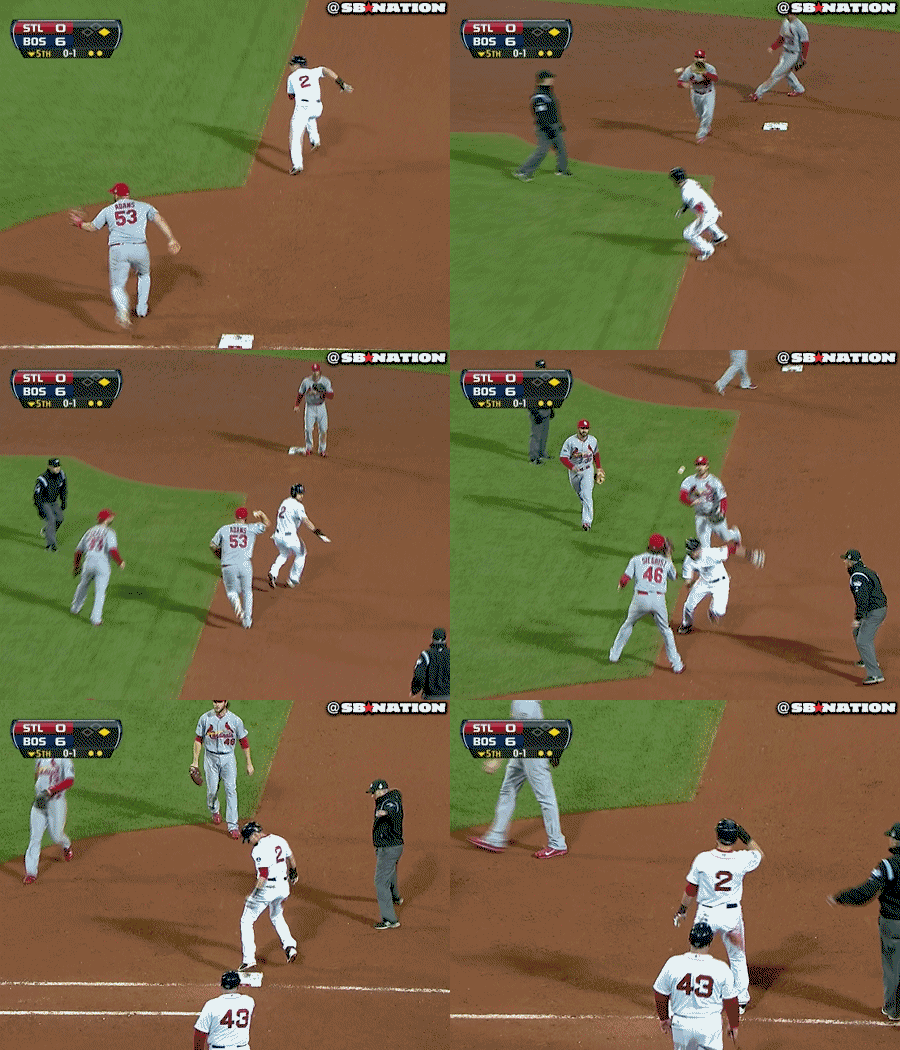
Jacoby Ellsbury (2), here Houdini-ing a rundown in the 2013 World Series, before the injuries finally started sapping the talent. (SBNation gif.)

Things got this bad for Jacoby Ellsbury: when he announced his daughter’s birth on the Fourth of July, on Instagram, he got hammered by Yankee fans indignant over the big contract to the too-often-injured outfielder. Well, nobody said Joe and Jane Fan were immunised completely against the stupid virus.

Such Yankee fans can breathe now. Ellsbury is still the first of Navajo descent (courtesy of his mother) to play major league baseball, but  he isn’t a Yankee anymore. The Yankees finally decided to cut him loose and eat the remaining $26 million Ellsbury’s owed on his original seven-year, $153 million deal. Contrary to what too-popular belief still says, neither side is to blame for Ellsbury’s none-too-fantastic voyage.

What does it do to a man to know that not only could he not perform his duties at his line of work because his body kept telling him “not so fast, dude,” but that people observing his particular company made him a hate object for no crime worse than the injuries he incurred on the job?

It’s as if being injured on the job at all equals a character flaw, especially if you happen to be paid a phenomenally handsome salary. On the flip side, it’s as if being paid a phenomenally handsome salary equals some sort of immunity to earthly harm. Here’s a bulletin for you: Handing Clark Kent a nine-figure payday doesn’t make him Superman.

And one of the reasons Ellsbury wouldn’t even think about listening to the Red Sox about staying in the family when he reached free agency after the 2013 World Series conquest was because he was alienated in the clubhouse after he heard one too many whisperings that he wasn’t exactly in a hurry to get back on the field after previous injuries.

It’s hell if you do and hell if you don’t for a professional athlete. Return too soon from an injury and you risk re-injury; return not soon enough (in whose medical opinion?) and you risk being dismissed as a fragile goldbrick.

The 2019 Yankees were so injury riddled that it was easy to joke that their yearbook was probably The New England Journal of Medicine, but Ellsbury was probably one Yankee who wasn’t laughing. Not even like Figaro that he might not weep. He’d been so often injured for so long that he might be tempted to name his memoir, should he write one, The Pangs of the Yankee Reaper.

Sooner or later, too, you suspected injuries would sap Ellsbury’s baseball talents even before he became a Yankee. Red Sox Nation at least had the pleasures of Ellsbury’s talents helping them noticeably enough to a pair of World Series rings including in his rookie season. Including but not limited to his magnificent Game Six rundown dodge in the 2013 Series.

Maybe that’s why Yankee fans showed as much empathy for his on-the-job slings, arrows, and whatever other medicals he had to bear as the empathy a barracuda shows for its prey. But now, let me count the ways Ellsbury didn’t get injured on the job.

He didn’t get a bite in the ass sliding into second thanks to having left the false teeth he doesn’t have in his back pocket. (An otherwise nondescript pitcher, Clarence Bethen, thought of that in 1923.)

He didn’t turn his knee into bone meal chasing Jill St. John down the ski slopes. (Freshly-crowned Cy Young Award winner and chairman of baseball’s Future Dentists of America, Jim Lonborg, was rumoured to have done just that when he tore his knee apart in a winter skiing accident after the 1967 season.)

He didn’t get the brilliant idea to demonstrate his slam-dunk technique on a storefront awning, catch his ring in the mechanism, and cost himself a season with shredded hand ligaments for his trouble. (Braves relief pitcher Cecil Upshaw slam dunked his way out of the 1970 season that way.)

He didn’t adopt an exercise routine that included running backwards and thus running into a gopher hole causing himself a back injury. (Pitcher Jamie Easterly did, however, in the 1980s.)

He didn’t break a toe running from his kitchen back to his living room because he couldn’t bear to miss watching a buddy at the plate on television. (Hall of Famer George Brett was so desperate not to miss a Bill Buckner at-bat that he ran from his kitchen and busted his toe.)

He didn’t strain or shred his back pulling his cowboy boots up. (Hall of Famer Wade Boggs once did.)

He didn’t fall asleep with a bitter-cold ice bag on his foot and awaken with a case of frostbite causing him to miss a few games—in August. (Hall of Famer Rickey Henderson stone cold did.)

He didn’t get his face badly sunburned on a tanning bed. (Marty Cordova was the genius who forgot the Coppertone.)

He isn’t known to have attended motivational speeches, necessarily, but if he did he probably had too much sense not to think after hearing one that he could tear the world’s thickest telephone book in half without dislocating his shoulder. (Relief pitcher Steve Sparks had to learn the hard way.)

He never once thought, we think, that he could haul a full heavy side of deer meat up a flight of stairs until the venison-to-be won the weight division by sending him flying downstairs and into a broken collarbone. (Clint Barmes, alas, lost that fight in 2010.)

He was part of no few on-field celebrations, we’re sure, but he never tore his left meniscus by smooshing a pie in a teammate’s face during a postgame interview. (Not the way Marlins utilityman Chris Coghlan did nailing Wes Helms in 2010.)

He’s not the genius who forgot to look all ways while reaching for a fallen sock before the suitcase his wife fiddled with fell over and landed on his hand, causing the injury he tried to hide until even the blind saw he couldn’t grip his bat right. (Jonathan Lucroy was such a genius, in 2012.)

And, he didn’t dislocate his ankle while trampolining with one of his children. (Joba Chamberlain jumped into that while with his then five-year-old son in 2012.)

Ellsbury once broke the Red Sox’s consecutive-game errorless streak record. He also once scored on a wild pitch—from second base. He was once so swift on the bases and in the outfield that he could have challenged the Road Runner to a foot race and won by a neck. He hit four doubles and stole a base in the 2007 World Series; he looked like he’d secure himself as one of the Red Sox’s all-time greats.

At least, he did until he ran into a human earth mover named Adrian Beltre at third base in an April 2010 game. He came back too soon from four hairline rib fractures, felt enough soreness to see a thoracic specialist who recommended more rest and rehab, rejoined the Red Sox early that August, and re-injured the ribs on a play against the Rangers later that month.

Then Ellsbury won the American League’s Comeback Player of the Year for 2011, not to mention both a Gold Glove and a Silver Slugger and a second-place Most Valuable Player finish, while being practically the only Red Sox player who didn’t collapse during that September and thus invite the Bobby Valentine nightmare of 2012.

Ellsbury smashed his shoulder up trying to break up a double play early in the nightmare. He returned in July, then almost made it injury free through 2013. Oops. Compression fracture in his right foot from fouling a ball off the hoof in late August. Returned in time to shine in that run to and through the World Series.

Fed up enough with the false whispering that he just didn’t like to rehab his injuries fast enough (for whom, folks?) that when the Yankees reached out to him with a yummy contract he couldn’t possibly say no.

In Year One of his Yankee tenure he performed, well, the way Jacoby Ellsbury was supposed to perform, including leading the American League with his 22.7 power/speed number. And it was the last season in which being injury free enabled him to perform that well.

Injuries, unfortunately, sap and catch up to players little by little. The Ellsbury Dough Boy had more than his share before becoming a Yankee. And then . . . and then . . . and then . . . and then along came:

2015—Right knee sprain on 20 May; out two months, rest of the season nothing to brag about, unfortunately.

2016—Uninjured but production falling further, including his lowest total stolen bases to that point during a healthy season.

2017—Smashed his head against the center field wall while making a highlight-reel catch. Concussion. Missed 29 games and lost his center field job to Aaron Hicks, but somehow managed to break Pete Rose’s career record for reaching base on catcher’s interference, doing it for the thirtieth time on 11 September, which also happened to be his 34th birthday.

2018—Strained his right oblique at spring training’s beginning. Turned up in April’s beginning with a torn hip labrum. Missed the entire season (and underwent surgery in August) because of it.

2019—Started the season on the injured list with a foot injury; also turned up with plantar fasciitis in the foot (the same injury plus knee issues that reduced Albert Pujols as an Angel to a barely replacement-level designated hitter) and another shoulder injury. Took until September for the Yankees to admit Ellsbury was lost for the year.

Not one of those injuries was caused by anything other than playing the game or performing other baseball-related activity. Remember that before you continue condemning Ellsbury the man or the Yankees as a team over him. He didn’t come to the Yankees believing his previous injuries began draining the talent that was once so electrifying, and he didn’t put on the pinstripes expecting to become an orthopedic experiment, either.

The 36-year-old is said to be finishing rehab and preparing to play in 2020 if there’s a team willing to have him. Ignore the jerk brigades and wish him well. Maybe even wish that he decides at last that his spirit may still be willing but his body’s already had notarised, “Don’t even think about it.”

It’s not easy for baseball players to get the game out of their systems, but if Ellsburry chooses to retire at last, instead of offering up any further sacrifices to the Elysian Field gods, who can blame him?

“Some people give their bodies to science. I gave mine to baseball,” Ron Hunt once said after a career in which his most notable accomplishment was teaching himself to be hit by pitches and taking every one of his 243 plunks. (Hunt led the Show in such plunks six straight during his twelve seasons.)

Ellsbury gave a lot more of his body to baseball than even Hunt did. He has three stolen base championships (two of which led the Show), one total bases championship (364 in 2011), one triples championship (ten in 2010), and a few million dollars in the bank for it. It’s the least he could have gotten for his sacrifices.

But if they ever come up with a surefire immunity to the stupid virus, fans who think on-the-job baseball injuries equal character flaws or teams whose brain trusts have suffered aneurysms should be first to get the shots.

“It was a wacky war”

2019-06-06 YogiBerraNavy

The well-circulated colourising of Yogi Berra’s official U.S. Navy portrait.

NOTE: As a way of thanking my fellow veterans for their service and—regarding those who served with me—their comradeship during my Air Force service of 1982-87, I’d like to repeat this essay, written on D-Day’s 75th anniversary this summer.

Specifically, this republication is dedicated to the memory of George Hursey, the last known survivor of Pearl Harbour living in Massachussetts, who passed away at 98 the day before Veterans Day.

————————————————–

Yogi Berra once gave a half-puckish beginning explanation as to how he became part of D-Day, World War II’s major Allied invasion of Europe from the Normandy beaches, as an eighteen-year-old Navy seaman. He made it sound like relief from boredom. As he so often did with his fabled Yogiisms, he had a knack for good humoured understatement.

Something still seems to be missing from America since Berra’s death four years ago, which was also more than a year and a half after his beloved wife, Carmen, preceded him. And there may be worse reasons to think about the Hall of Fame catcher and personality than remembering how he got himself aboard a Navy rocket boat in time to be part of D-Day.

Berra was a Yankee prospect playing for their Norfolk, Virginia farm in 1943. Norfolk also just so happened to be the headquarters of the Fifth Naval District. Which meant it was also the governing center of the Navy’s Atlantic Fleet. Which also meant Norfolk and nearby Newport News overrun with sailors and civilian defense workers, an estimated 750,000 of them in a pair of towns whose populations combined weren’t quite as large as that of the Bronx.

His biographer Allen Barra, in Yogi Berra: Eternal Yankee, has written that the lad’s first real problems in Norfolk were long lines at the movie houses he loved and trying to stretch his $90-a-month minor league salary. “I never got too hooked on cigarettes, because I couldn’t afford them,” he once said. “Maybe starvation kept me from getting cancer.”

Once, knowing his team’s two other catchers were ailing, Yogi launched a unique version of a strike, telling his manager he wasn’t well for lack of food and the ploy worked toward getting him a $5 a month raise. His mother, Paulina, helped by slipping him a few extra dollars in the mail with instructions not to tell his father. And Berra became popular enough on the Tars that one ardent fan, a lady, provided him a full hero sandwich of salami and provolone every Sunday game.

That sandwich, Barra wrote, “was for Yogi what spinach was for Popeye.” After he received the first such gift, he smashed twelve hits and drove in 23 runs in two games against Roanoke. (This was the doubleheader that prompted Carmen Berra to remember, “When I heard about the 23 RBI day, I figured he had a future.”) He played well enough to be able to think an equal or better 1944 would get him a Yankee call-up. “Yogi was looking forward to an explosive 1944,” Barra wrote. That’s a polite way to describe the one he got.

Berra knew only two things: 1) He’d be in military service soon. 2) He had no idea where. Told his draft papers were drawn back home in St. Louis, he asked for and got them sent to Norfolk. After the Tars played an exhibition game with the Norfolk Air Station (some of the Norfolk players included such Show men as pitchers Fred Hutchinson and Hugh Casey, outfielder Dom DiMaggio, and Yogi’s future Yankee teammate/fellow Hall of Famer Phil Rizzuto), he talked to a warrant officer at Norfolk’s Navy training station and took the man’s suggestion to enlist in the Navy.

When his boot camp in Maryland ended, his mother underwent surgery; he was allowed to be with her until she could return home. After that, Yogi went to Little Creek to train for the amphibious service. The routine otherwise was so hurry-up-and-wait that the kid relieved his boredom at the base movie theater and with the comic books he fell in love with. Then one night he was watching Boomtown, the Clark Gable-Spencer Tracy film, when the film suddenly stopped and the theater lights suddenly came back up.

Berra and all the other sailors in the theater were ordered to line up. Officers asked for volunteers—for rocket boat duty. None of the young swabbies had a clue about rocket boats but when someone called them rocket ships, Yogi perked up. The idea that volunteering in military service was tantamount to being very careful what you wish for hadn’t yet been programmed into his mental data base.

The boats, as Barra noted, “turned out to be small landing craft, LCSSs (Landing Craft Support Small), whose purpose was to spray rockets on the beach before troop landings. There were duller things to train for. Some of the men got the hint that they might be participating in a major troop landing, perhaps the invasion of Hitler’s Fortress Europe that the papers were always writing about.”

The sailors called the rocket boats big bathtubs. If you played with toy boats in the bath when you were a small child, try now to imagine having a bath with 48 rockets, one twin .50-caliber machine gun and two .30-caliber machine guns. The boats affirmed the aforementioned hints: their purpose in life was to hammer the Normandy beaches and clear the way for the troops’ landing crafts. Yogi and his fellows had a name for them: “The landing craft suicide squad.”

The rocket boatmen first went to Plymouth, England. Once again it seemed to be hurry up and wait. Three weeks after they arrived, though, Berra’s LCSS was attached to what was thought to be the smallest transport ship in the Coast Guard fleet, the USS Bayfield. It made for Normandy early on 4 June. The Bayfield carried six LCSSs. “Just before dawn, on the morning of June 6, 1944,” Barra wrote, “their rocket boat was lifted on the davits and lowered over the side and, in Yogi’s words, ‘expendable as hell, we headed in for Omaha Beach’.”

The LCSSs were the tiniest boats on the waters heading into firing position.

“It was scary,” Yogi would remember, “but really something to see. I was only eighteen, and I didn’t think anything could kill me. I didn’t know enough to be scared. I had my head up over the side of the boat all the time, looking around like it was the Fourth of July in Forest Park and after the fireworks we were going to go over and get some hot dogs and Cokes.”

Bless his innocent soul, Yogi probably had no idea how vulnerable the LCSSs were. The sides of those boats weren’t exactly thick. One errant enemy shell, especially one hitting any of the boats’ rockets, would have made not the Fourth of July hot dogs but them into duck soup. Berra’s peekings over the edges to see the show ended when his lieutenant advised him to put his head down if he had plans to keep it.

The LCSSs waited for their lead boat to fire a test and see if it reached the beach. If it did, the other boats would move in close. It did. And inimitably, Yogi described the boats moving in “closer than the hitter is to the left field [wall] at Fenway Park.” One and all of them began firing. “I couldn’t see all the bloodshed that they showed in the movie [Saving] Private Ryan,” he remembered years later, “but I did see a lot of guys drown.”

Berra’s and all the LCSSs did what they were sent to do. Well enough that by D-Day’s afternoon they could actually relax, though they were under orders to remain through 9 June for cover fire in the event the Nazis had ideas about the counterattack that never came.

They had more trouble from an anticipated storm smashing in on 8 June, battering the boats and even flipping Yogi’s over. Before that they had trouble through no fault of their own—a friendly fire incident. Three fighter planes appeared above and the LCSSs were under orders to shoot down anything flying below cloud level. The LCSSs fired and hit one plane. The pilot bailed and parachuted before the plane hit the drink. Yogi ordered his boatmates to keep him covered, expecting to hear a stream of German.

What he heard was a stream of English language swearing. The crew had shot down an American plane whose markings they couldn’t see in the murk of the storm. When the storm worsened, Berra’s boat flipped over. Try to resist the temptation to say that only Yogi Berra and his boat crew could survive D-Day just to get thatclose to drowning after the artillery stopped.

They hung on until they were rescued and returned to the Bayfield. A Nazi bomb fell near the ship but no serious damage occurred, according to Barra and others. Berra said later he was too tired to be scared. Years later, when he met D-Day’s mastermind, Gen. Dwight D. Eisenhower, he couldn’t bring himself to ask Eisenhower about the invasion. “I never talked about D-Day,” Yogi remembered. “It didn’t seem right, but now I wish I had.”

With good reason. Numerous sailors believed Eisenhower was aboard one of their ships on D-Day. This was because of Eisenhower’s soon-to-be-immortal radio message (You are about to embark on a great crusade) that was actually recorded at the 101st Airborne’s headquarters while watching the first Allied aircraft reach for the skies on that day. Even today, it sounds so clear that when you play it it sounds as though Ike’s telling it to you side by side as you’re about to hit the links.

Berra and his squadron got a break to rest at Portsmouth before going to Bizerte, the coastal North African coastal town, and by 15 August 1944 he was part of the LCSS force hitting Marseilles and strafing hotels and other facilities co-opted by German forces. Berra’s boat was almost hit by mistake by a British shell that turned out to be a dud.

Berra himself got close enough to death when ships of the British Royal Navy behind the LCSSs fired at targets past the hotels and, while holding a rocket, one of his crew hollered to hit the deck. As he ducked under a gun mount, Yogi accidentally dropped the rocket. “It did not go off,” Barra wrote, “or you wouldn’t be reading this book.”

During a furious barrage, Berra got nicked by a bullet from a German machine gun before he manned his twin .50s and fired to cut down fleeing Nazis. As American troops landed, the locals swarmed the sailors with gifts and song. “It was a wacky war,” Yogi would remember. “A half hour after we were getting shot at by the Germans, the French were welcoming us.”

He rarely talked about his World War II experiences in the decades to follow. On the rare occasion he did so, even that provoked a little humour, as in the Los Angeles Times overhearing Berra talking to Hall of Fame pitcher Jim Palmer and Hall of Fame broadcaster Tim McCarver. Wrote the Times: “Yogi survived D-Day and George Steinbrenner, and all in forty years.”

He had to survive a more sensitive customer, though: his mother. After receiving a month’s leave for the Christmas holidays, Berra went home and showed his family his hard-earned decorations: a Distinguished Unit Citation, two battle stars, a European Theater of Operations ribbon, and a Good Conduct Medal.

Paulina Berra was already in tears as it was. Her boy also earned the Purple Heart when he was nicked by that Nazi bullet, but Yogi didn’t dare make the formal application for that medal. He figured that if Mama Berra knew what the Purple Heart really meant, she’d suffer a purple heart attack.

How the Yankees beat themselves

2019-10-20 AroldisChapman.jpg

It almost figures that Aroldis Chapman’s smile of utter disbelief would be taken the wrong way by Yankee fans after Jose Altuve’s Saturday night special.

Aroldis Chapman showed a very odd smile almost immediately after Jose Altuve ended his assignment and the Yankees’ season with one swing. Then, as the Astros’ little big man rounded third, Chapman finally made the long, head-down walk off the mound into the Minute Maid Park visitors’ clubhouse.

Every report from that clubhouse after the Astros’s stupefying 6-4 win Saturday night describes Chapman as, phrased politely, bent out of shape. He sank at his locker, refusing to look up unless one or another teammate happened by for a pat on the back. And when he looked up, the towel he put over his head stayed put.

He’s not the only man who ever smiled in disbelief after being humiliated in front of a full house in the ballpark and a throng watching on television or listening on radio. And he won’t be the last. He’s not even the only Yankee who ever smiled in disbelief in a moment like that.

Even Hall of Famer Mariano Rivera showed a very similar smile after Luis Gonzalez singled the Diamondbacks into a World Series ring on the longtime Yankee bellwether’s dollar. But I don’t remember Yankee fans crawling all over The Mariano the way they hammered Chapman over it.

“At that moment when the ball went out, I couldn’t believe it,” the 31-year-old lefthander who still throws the proverbial lamb chops past wolves said after Altuve’s drive banged off the left field pavilion concrete. “I couldn’t believe it went out at that time of the game. For that split-second, I just couldn’t believe it.”

Why did Chapman throw Altuve a second straight slider on 2-1 after showing him two fastballs that didn’t quite reach his once-signature 101 mph but still had plenty enough giddyap to stay above the average? Did beleaguered Yankee catcher Gary Sanchez lose the plot? Did manager Aaron Boone call the pitch from the dugout? And did either or both simply make a terrible call?

“I fell behind in the count and wanted to get ahead with the slider, and I didn’t,” Chapman said. “It didn’t land in the spot where I wanted, and he took full advantage of that. That’s what I was trying to do in that at-bat.”

In the moment you, too, sat in disbelief, even if you were an Astro fan and even if you knew that if anyone could or would come up big enough in that moment, a pennant on the line in a game tied in the top of the ninth, it just had to be Altuve.

Look at the Astros through the full ALCS set. Alex Bregman, who’s liable to be named the American League’s Most Valuable Player if Mike Trout isn’t, had a solid on-base percentage but slugged .222.

Yuli Gurriel looked like an Astro bust overall until he smashed a three-run homer in the Game Six first. Carlos Correa hit a couple of home runs including the electrifying Game Two winner but hit 22 points below his weight otherwise. And their likely AL Rookie of the Year, Yordan Alvarez, was last seen offering a ransom for his kidnapped bat.

And look at the Yankees. Aaron Judge hit one out in Game Two (and it was his only homer all postseason long) but nothing else among his six hits in 27 plate appearances went for extra bases. Except for one home run Giancarlo Stanton’s bothersome quad made him useless in the designated-hitter role. Brett Gardner, Mr. Savages-In-The-Box? He had a .345 . . . series OPS.

Sanchez, the classic good-hit/terrible-field catcher, hit one out and managed to drive three in but he was otherwise good for nothing much at the plate. Of all the Yankee regulars, only D.J. LeMahieu—whose two-run homer in the top of the ninth set the stage for Altuve’s heroics in the bottom of the inning in the first place—and Gleyber Torres showed real value in the batter’s box.

Then you remembered Chapman began reaching for his slider more after 2016. Including 31.1 percent of the time this season and 38.3 percent of the time when he had a hitter at two strikes, according to MLB.com. And with George Springer aboard on a two-out walk, Chapman and the Yankees didn’t even think about putting Altuve on to pitch to Jake Marisnick, a late-game insertion who’s known for his defense far more than his bat.

Boone said it wasn’t an intentional walk situation but a situation to pitch aggressively. “[H]e just hung a breaking ball,” Boone told reporters after the game. “That’s obviously a pitch he’s trying to not give in and probably get down and out of the zone, see if you get a chase or something, and he hung it.”

Except that there wasn’t a jury on earth who’d convict him for malfeasance or cowardice if he’d ordered the free pass to Altuve. And of the eleven breaking balls Chapman threw in the inning, four of them hung—including the strike at which Altuve looked one pitch before the hanger that graduated Altuve from mere Astro heart and soul into eternal Astro legend.

All season long Boone and the Yankees operated around their bullpen. All season long Boone managed his pen adroitly, refusing to overwork those bulls, refusing to let the other guys have the same looks at the same arms in too-short intervals.

And all of that disappeared in the American League Championship Series. Against a team that pounces on the slightest mistake and refuses spurn such gifts as seeing the same arms in just about the same situations. And, against a Chapman whom the Astros hadn’t even seen except for two ALCS innings before Saturday night but whose slider suddenly made the ten most wanted list.

In fact, Chapman was almost in danger of resembling the forgotten Yankee this postseason. And when he did appear, he didn’t miss as many bats as usual. Even inserted to pitch the ninth in a Game One division series blowout, when he got one strikeout and two contact outs plus a walk. When a man with a 13.4 strikeouts-per-nine rate on the season doesn’t miss that many bats, the alarm should be blasting.

Just don’t ask Chapman if his use during this postseason factored into the final disaster. He isn’t buying it. “What happened on the field is what happened on the field,” he said matter-of-factly. “It had nothing to do with that.”

Far more sensible to point to assorted Yankee mistakes all series long and even all Game Six long. They weren’t as slapstick in Game Four as they were in Game Six, but Game Six was its own comedy of errors, official and unofficial alike:

* Playing for the double play with nobody out and the Astros having first and third in the bottom of the sixth. Down a run, the Yankees should have played the infield in. Instead, they got the double play grounder, but shortstop Didi Gregorius unexpectedly took a quick peek toward the plate before throwing. That moment cost the Yankees the double play and the run scored regardless.

* Letting Tommy Kahnle pitch a third day in a row. Kahnle was one of the Yankees’ best relievers in the set but it was bad enough the Yankee bullpen rarely if ever appeared in differing conditions without Kahnle being extended like that. The Yankees may have been lucky to escape the sixth with only one run scoring in the inning.

* Judge ambling too far toward second base on Aaron Hicks’s seventh-inning pop to shallow left. Granted that Astros left fielder Michael Brantley wasn’t known for his defensive virtuosity, but his diving catch, springing up promptly, and throwing strongly back to first doubled Judge up too easily. You got why Judge got over-aggressive but every baserunner matters in a tight game and he cost the Yankees a chance to push one around the circuit.

* Edwin Encarnacion was such a bust as the Yankee designated hitter this series that, with Stanton still ailing, Boone could and should have reached for alternatives. He had Cameron Maybin on the bench. He could have assigned the defensively challenged Sanchez to DH in Game Six and sent Austin Romine, who doesn’t hit much but handles things far better defensively, out behind the plate.

The Astros entered Game Six with a shot at both the pennant and at not having to burn Gerrit Cole in a Game Seven when they’d far prefer to have him open the World Series if they got there. The Yankees entered Game Six needing to do or be dead. Those Game Six mistakes built the Yankee coffin Altuve nailed tight shut.

Neither the Astros nor the Yankees hit with authority during most of the ALCS, but the Yankees had potential tying or go-ahead runs at the plate 26 times in the set. Entering Game Six they were 5-for-29 with men on second base or better. The Yankees also became notorious this set for failing to cash in several bases-loaded situations including first innings in Games Three and Four. But staying loyal to the veteran Encarnacion, a June trade acquisition, cost the Yankees dearly.

He may have hit 34 home runs during the season but come the ALCS Encarnacion looked twice his 36 years. He wasn’t anywhere near resembling the bombardier who once sent the Blue Jays into a division series with a mammoth game-ending three-run homer made possible when Orioles manager Buck Showalter wouldn’t even think about bringing in his best reliever because it wasn’t a quote save situation.

All season long Boone looked like a master administrator. You don’t win 100+ games in your first two seasons otherwise. But in Game Six he looked like a novice while his team got out-played, out-thought, and out-smarted most of the way.

Right down to the moment he wouldn’t even think about giving up the ghost, walking Altuve on the house after 2-0, and pitching to a .289 regular-season on-base percentage instead of a .353 OBP with a man on in the bottom of the ninth. If he’d ordered Altuve walked he might have gotten extra innings and another chance.

And don’t even think about blaming Game Six plate umpire Marvin Hudson. Both the Astros and the Yankees had plenty of reasons to complain about his Rocky Horror Picture Show-wide strike zone: a little to the left, a little to the right, let’s do the Time Warp again. The only wonder was that no Astro or Yankee was tempted to try fouling Hudson into the concussion that took Jeff Nelson out of the set unintentionally.

The Yankees measure their success by World Series appearances. And they’re not even a twentieth as obnoxious about it as their fans. Of all the cliches around the Yankees, the truest is that they don’t like to lose. Of all the cliches around Yankee fans, the truest are a) they think annual trips to the World Series are their birthright; and, b) to err is human, but to forgive is not Yankee fan policy.

They’ve just finished only the second decade in their history without reaching a World Series. And they did it by failing to deliver the second part of their most successful manager ever’s wisdom: Baseball is percentage plus execution. With occasional lapses operating the former.

The first ended the year Eugene Debs was imprisoned for speaking against World War I, Prohibition took legal effect, Albert Cushing Read made history’s first transatlantic flight, American women received the vote, and eight members of the White Sox either did their best to throw a World Series or kept their mouths shut about those trying to do it.

It’s enough to make a team whose average age this season is 28 feel as though the average age is 86.

And the way Jose Altuve 86ed the Yankees in the end sent him to the same chamber of legends where Lew Burdette, Bill Mazeroski, Luis Gonzalez, Dave Roberts, and David Ortiz reside in the small but honoured sub-chamber of Yankee slayers.

From bull run to big swing

2019-10-19 JoseAltuve

Jose Altuve ended Game Six’s running of the bulls with one American League pennant-flying swing.

Brad Peacock took the mound to open American League Championship Series Game Six for the Astros on Saturday night. The moment he did, the righthander did something undone since the year Native Americans were finally awarded American citizenship, J. Edgar Hoover was named to run the FBI, and Macy’s held its first Thanksgiving Day parade.

He became the first pitcher to finish one postseason game and start the very next one, the very next day, since Washington Senators righthander Firpo Marberry nailed the final out of Game Three before starting Game Four, the following day, in the 1924 World Series.

The Series into which the Senators entered after finally making it, “Washington—First in war, first in peace, and first in the American League.” In which the Old Nats won Game Seven against the New York Giants in twelve innings. With (oh, the horror!) a bullpen game. Climaxed by a starter-as-reliever finishing it. Instigated by a kid shortstop made player-manager who outsmarted a Hall of Fame manager.

It may not be nice to fool Mother Nature, the old bat, but Bucky Harris knew it was more than nice to fool John McGraw. He started a righthander named Curly Ogden to deke McGraw into loading his lineup with lefthanded hitters. What McGraw didn’t know or suspect was Harris and Ogden knowing going in that Ogden would face two batters maximum.

Then Harris reached for his Game Four starter, lefthander George Mogridge. And with the game tied three all going to the ninth, Harris married sentiment to baseball and brought in his Hall of Fame righthander Walter Johnson for the ninth. And, yes, the Griffith Stadium crowd went nuts. Johnson pitched four scoreless, the Senators pushed the winning run home in the bottom of the twelfth, and Bucky Harris looked like a genius.

For the Senators, of course, their Game Seven bullpen game was do or be dead. For the Astros Saturday night, Game Six was do or face a Game Seven showdown with the Yankees. For the Yankees, Game Six was, of course, do or be dead. This promised to be a very brisk and bristling running of the bulls.

Until it turned into a pennant-winning two-run homer. And the relief of the Astros not having to burn Gerrit Cole in a Game Seven so they can send him out to tangle with Max Scherzer when they open the World Series at home against the Nationals.

Peacock’s manager A.J. Hinch didn’t have to outsmart a Hall of Fame manager Saturday night. All he needed was Jose Altuve in the bottom of the ninth to prove what one of Washington’s favourite and most fabled sons made law: It don’t mean a thing if it ain’t got that swing.

And unlike the 1924 Senators, the Astros didn’t have to send a future Hall of Famer out to the mound for the finish. Though it probably would have made as many people weep for joy if Justin Verlander went out for the ninth as wept for joy in the stands in Washington 95 years ago.

Altuve decided to win the American League pennant a little more dramatically than Earl McNeely hitting the ball that hopped over Freddie Lindstrom’s head at third to send Muddy Ruel home with the 1924 Series-winning run. And Altuve had a tougher challenger in Aroldis Chapman.

Chapman shot through the Astros in the Game Five ninth, using only nine pitches to finish one-two-three. In Game Six, Yankee catcher Gary Sanchez called for so many sliders–one of which struck out Martin Maldonado swinging to open—it was as if he were trying to tell Chapman his fastball, which still had giddyup to spare, crossed over to the enemy side.

“I wanted to be on time for the fastball but looking up in the zone,” said the ALCS Most Valuable Player, half out of breath, after the game. “Something I can drive.”

On 2-1 he was on time enough for a Chapman slider landing just off the middle that he drove a two-run homer off the left center field pavilion. Finishing a 6-4 Astros win that knocked on the door of extra innings after a hard day’s night on both sides. “There’s nobody I want up in that situation other than José Altuve,” said Cole after the game. “He’s just got a gift from God.”

God apparently loves nothing more than a hair-raising finish to a mostly hair-raising game. Because with one on and one swing in the top of the ninth Yankee first baseman D.J. LeMahieu silenced the Minute Maid Park audience. And with one swing in the bottom of the ninth, Altuve ignited exponential pandemonium.

It was the most appropriate thing for which an Astro fan could have asked, even if it was the most extraterrestrial thing for which the Astros themselves could have seen. “I can’t believe that just happened,” said George Springer, whose two-out walk set Altuve’s table in the first place, and who had the hardest view in the house in the top of the ninth after moving to right field in a late defensive switch.

Springer wasn’t sure he could believe LeMahieu in the top of the inning, wrestling Astros closer Roberto Osuna to a tenth pitch, after four straight foul offs on 2-2 and ball three up and away, then driving a slightly hanging cutter over Springer’s leaping reach and into the right field seats to tie things up at four.

“He’s been a thorn in our side all series,” said Verlander, theoretically the World Series Game Two starter against Nats righthander Stephen Strasburg, of LeMahieu. One of the few thorns in the Astro sides all week.

For a few brief, shining moments, the Yankees—the St. Elsewhere Yankees, who’d survived and persevered in an injury-battered season as admirable as that of the Grey’s Anatomy Astros who’d survived and persevered likewise—had a hope of forcing the seventh game of a set in which they looked lost too often lost at the plate and too often like Candid Camera victims in the field.

The Yankees didn’t look that bad in the Game Six field. But the Astros in the field looked like they were playing Can You Top This, from Josh Reddick’s face-planting dive to catch Brett Gardner’s sinking liner to right with two on in the sixth, saving a potential two-run double, to Michael Brantley’s seventh-inning dive to catch Aaron Hicks’s shallow left popup before springing to his feet and throwing strong to double off Aaron Judge half way to second.

Not to mention at the plate in the bottom of the first, when Altuve drilled a one-out double up the alley in left center, Alex Bregman wrung Yankee opener Chad Green for a walk, and Yuli Gurriel hit the first pitch into the Crawford Boxes. LeMahieu got close in the top of the ninth but Altuve copped first prize in the bottom.

Brad Peacock performing his Firpo Marberry impression had a simple time getting three swift outs to open the game. Green, who’d opened fifteen Yankee games on the regular season with the Yankees winning eleven of them, probably had a hard time believing what just happened to him after one full inning in the book.

Seven Yankee pitchers surrendered six hits, struck out six, and walked six. If Jose Altuve’s a gift from God, the Yankees must think the devil is plaguing them. Seven Astro pitchers turned up deuces wild: two runs, two hits, two strikeouts. They didn’t have to do anything much more than that.

The Yankees’s series-long futility hitting with men in scoring position made it almost as easy for Peacock, Josh James, Ryan Pressly, Jose Urquidy, Will Harris, Joe Smith, and—until LeMahieu teed off in the ninth—Osuna to keep the Yankees from too much mischief.

They pushed a run home in the second on Didi Gregorius’s one-out double off the right field fence and Sanchez’s almost immediate single up the middle. They yanked one home in the fourth when Gio Urshela with one out hit Urquidy’s first pitch to him into the right center field seats. And that was all until the top of the ninth.

Again the Yankees flashed a series-long allergy to cashing in scoring opportunities, especially with the bases loaded. Aaron Judge worked a one-out, full-count walk off James in the third, Gleyber Torres fought back on 2-2 to send a soft liner into left center, and Edwin Encarnacion—back in the DH slot after Giancarlo Stanton didn’t deliver in the slot in Game Five—wrung James for a four-pitch walk to load the pillows.

That’s when Pressly came in. He threw one pitch to Gregorius. He got Gregorius to bounce back to the first base side of the mound, fielded it himself, tagged Gregorius for the side, and promptly left the game with a knee strain that scared the Astros a spell, since if he had to go off the roster injured he wouldn’t be eligible to return for the Series. He’s being listed day to day for now.

But after Urshela’s rip Urquidy held fort for two and two thirds and probably saved Hinch from reducing his Tums supply by a third at least. With the Yankees left to ponder whether Reddick’s or Brantley’s dives finished the coffin into which Altuve eventually hammered the nails.

“You can’t script it,” said Verlander. “I’m just trying to take it all in, see the crowd, feel the atmosphere.” That’s what two World Series trips in three seasons does for you.

You can say Yankee general manager Brian Cashman punted at the new single mid-season trade deadline by failing to land one more serviceable starting pitcher. That fail ended up biting the Yankees severely when Domingo German landed on the suspended list in late September over a domestic violence incident involving the mother of his two children—on the same day the Yankees honoured retiring CC Sabathia at a Hudson Yards party.

And you can point to a tiny handful of tactical moves manager Aaron Boone made that backfired, after he’d spent so much of the season essentially preparing his bullpen for the postseason, knowing his starting dearth and losing one of his bulls, Dellin Betances, to an Achilles tendon tear, tied one hand behind his back going in.

Boone’s heartaches now will include that he’s just become the only man in major league history to hit a pennant-winning walk-off homer as a player and surrender a pennant-losing home run as a manager. In the same uniform, yet.

And this loss is on the Yankee players as much as the Astros’ triumph is on their players. From a remarkable .294/.372/.518 collective regular-season slash line with runners on second or better, and 11-for-34 in that situation against the Twins in the division series, the Yankees in the ALCS seemed to approach men on second or better as though they thought someone would shoot them dead if they even thought about cashing in.

They went 6-for-35 in that situation all ALCS long and 1-for-6 in Game Six. Their threats amounted to the none-too-strong parent who admonishes his overindulged child, “If you do that again, so help me God I’m going to . . . be very, very angry at you!” Against these Astros, who don’t know the meaning of the word mercy when they spot weakness, that was tantamount to a death wish.

Put their pitching to one side and the Astros were smarter on the bases, they were stingier than Jack Benny (the radio and television character, not the man himself) in the field, and they weren’t ignorant at the plate when they saw Yankee relief arms more often than they might have expected going in.

“That’s a helluva team over there,” said Springer after the game, still catching breaths after the surrealistic finish. “That was a fight. I have a lot of respect for them.”

Some among the least forgiving Yankee fans—and that’s saying too much considering no fans in baseball are less forgiving, and few are more obnoxious, than Yankee fans denied World Series trips they still believe to be their annual birthright—would tell Springer that Game Six’s running of the bulls merely exposed the Yankees as full of it.

The only heartaches awaiting the Astros now will be whichever ones the just-as-hungering Nats might have in store for them. They’re not exactly worried. Yet. “We are a team that’s working together and pulling in the right direction,” Altuve said after the game. And that’s no bull.

From nuts to soup

2019-10-18 AaronHicks

Among other things, Aaron Hicks went where only two Yankee center fielders went before the bottom of the first Friday night . . .

The Astros had no worries entering American League Championship Series Game Five. Other than winning. And maybe the prospect of yet another tiny but noisy pack of Yankee Stadium creatures discovering that maybe Justin Verlander did something naughty before he became one of his generation’s greatest pitchers.

If the Yankees’ least civilised fans could hammer Game Four starter Zack Greinke over his too-real anxiety and clinical depression issues, never mind Greinke saying no, he didn’t hear it, God and His servant Lou Gehrig only knew what they’d try if they discovered Verlander turned up with so much as an unpaid parking ticket in his past.

Playing the Yankees with a trip to the World Series on the line is one thing. To a man the Astros consider that a high honour. “We don’t want to take anything for granted,” said second baseman Jose Altuve after they helped themselves to a heaping Yankee implosion in Game Four. “We want to make sure we win tomorrow. We’re playing against a great team.”

A great team that entered Game Five after a night on which they looked like they couldn’t decide between being the 1962 Mets and the Washington Generals. Not even during the lowest days of their 1965-75 low or the most insane days of George Steinbrenner’s King of Hearts act of the 1980s did the Yankees look that inept.

The Astros are too kind to say the Game Four Yankees looked like they had Abbott catching Costello, the four Marx Brothers in the infield, the Three Stooges in the outfield, Charlie Chaplin coaching first base, Buster Keaton coaching third, and the cast of legendary radio dumb fest It Pays to Be Ignorant in the bullpen. With Allen Funt (Smile! You’re on Candid Camera!) managing them.

Whom would the Yankees resemble in Game Five? Would it be sock-it-to-me time in the south Bronx with the Yankees throwing their own buckets of water over each other? Maybe they’d pratfall to the mound, the bases, the outfield, hollering “Live from New York—it’s Friday night!!”

It’s not that the Astros were entirely without concerns of their own. Verlander may be a Hall of Famer in waiting but even he’s only human. The Rays proved that when Verlander started Game Four of their division series on a mere three days’ rest for the first such short-rest start of his life. And, was had.

Normally, Verlander only human is still better than many if not most. With a trip to the World Series on the line, the last thing the Astros needed for Friday Night Live was a merely human Verlander.

They needed a reasonable facsimile of the Hall of Famer in waiting who entered Game Five with a lifetime 2.89 ERA when he faces the same team twice in a postseason contest. They needed a reasonable facsimile of the Verlander who had a lifetime 1.05 ERA in three previous lifetime shots at closing out a postseason series.

The Astros got that reasonable facsimile Friday night. The trouble was that they had to wait until after the first inning to get it. And that was after the top of the first looked as though it was going to be another round of Yankee slapstick handing the Astros their World Series trip.

When George Springer shot a leadoff grounder under Yankee starter James Paxton’s glove that second baseman Gleyber Torres couldn’t barehand, and Yankee catcher Gary Sanchez allowed him to second on a passed ball, the fun looked like it was beginning for the Astros again. And, like it would continue after Springer reached third on a Jose Altuve ground out and scored on a wild pitch off Sanchez’s knee.

You’d have forgiven the Yankee Stadium public address people for sounding opening bars of “Dance of the Cuckoos,” right?

Even allowing the chilly Yankee Stadium night nobody, maybe even the Yankees, expected D.J. LeMahieu to lead off the bottom of the first by sending an 0-1 Verlander fastball into the right center field seats. Or, Aaron Judge to send a base hit into left and Torres to dump a quail down the left field line for first and third. Or, Aaron Hicks wringing a full count before ripping one off the right field foul pole.

And that’s the way the scoring remained in Game Five, the Yankees winning 4-1.

That pole ringer was only the third time any Yankee center fielder hit an elimination-game bomb to put the Yankees ahead. Hall of Famer Mickey Mantle did it to break a two-all tie off National League Rookie of the Year Joe Black in Game Seven of the 1952 World Series. And Roger Maris—usually a right fielder but playing center this time out—nailed one off the Cardinals’ Curt Simmons to bust a one-all tie in Game Six of the 1964 Series.

And never before in their long history of postseason presence and triumph had the Yankees ever hit a pair of first-inning bombs. That, folks, covers (count ’em) 404 baseball games. And all it took was an all-fields-hitting first baseman and a center fielder who missed over two months with an injured right elbow before he came back for the ALCS.

“We wanted to get ahead early,” Hicks told ESPN’s Buster Olney in a postgame field interview. “To take the first punch.”

Verlander never surrendered two first-inning home runs in any postseason game in his life until Friday night. And it was just the second time in 29 postseason starts that he surrendered four runs or more. “It was a combination of things,” he said after the game in front of his locker. “Fastball command wasn’t very good, and the slider was just hanging. I just wasn’t able to execute really anything.”

But from there he and Paxton, plus three Yankee relievers and Brad Peacock in his first postseason gig out of the Astro pen, hung nothing but zeroes up while putting on a pitching clinic so profound you were tempted to wonder whether pitching in the cold was their real secret weapon after that testy enough first.

Each pitcher kept each batter from much more than soft contact the rest of the way, each pushed periodic threats to one side, thank you, if you didn’t count Tommy Kahnle surrendering a base hit and a four-pitch walk following a seventh inning-opening out.

Verlander after the first resembled as close to his Hall of Fame self as he could on such a frigid night, and Paxton resembled the guy who pitched up big enough down the stretch as opposed to the guy who couldn’t get out of the third inning in Game Two. And Paxton looked like a reasonable facsimile striking out nine in six to Verlander’s nine in seven.

And there wasn’t a pratfall, tumble, stumble, rumble, trip, bad hand, or butter finger to be found from the first inning forward until Yankee closer Aroldis Chapman shot through the top of the ninth with strikeout, fly out to left, and ground out to third faster than you could say see you back in Houston.

“Getting those runs were big,” Paxton said in an on-field interview. “I was grinding the whole time, that’s a great team over there, they really battle, so I had to grind all the time. Making one pitch at a time.”

Never before, too, in 1,608 previous postseason games, too, had any pair of contestants scored in the first inning together without scoring a single run further the rest of the way.

Both sides turned in some defensive acrobatics, from LeMahieu tumbling to the foul track and falling toward the sidewall to catch Yuli Gurriel’s third-inning pop foul to late Astros right field insertion Josh Reddick running Gio Urshela’s long fly to right down deep in the corner and making a basket catch before he might have hit the wall to end the Yankee seventh.

The Yankees hope they don’t hit the wall in Game Six; the Astros would love nothing better than to make them hit it hard enough to send the ‘Stros back to the World Series. And considering the likelihood that it may be a bullpen game for both sides, with neither manager seeming to want to short-rest their Game Three starters Gerrit Cole and Luis Severino, Game Six should be a very intriguing running of the bulls.

At this writing the arms that begin Game Six may be anyone’s guess. Nobody’s said anything yet out of either team’s camp, but speculations runs that it could be Jose Urquidy for the Astros to open and, maybe, Chad Greene or J.A. Happ (who has starting experience) for the Yankees.

Not that either team’s necessarily worried. “If we find out in the morning,” said Yankee right fielder Aaron Judge, “we’ll do our homework and get ready.”

“Everybody’s ready,” said Astros third baseman Alex Bregman.

Not everybody. One Twitter twit lamented, “Such a sad day for baseball.” Please. You’re trying to win, you need to not send a pair of prime starters out on short rest because it’s liable to mean disaster, for them and for your team. You do what you must to win. The game won’t be any worse and probably be a little more of a good old fashioned hair raiser.

Such a sad day for baseball is actually an idea as old as the year Rhapsody in Blue and Mercedes-Benz were born, Woodrow Wilson died, and Hall of Fame pitcher Walter Johnson perfected the starter-as-reliever technique that this year’s National League pennant winner applied mostly successfully.

And on Saturday evening, 7:08 Central standard time, the best two teams in the American League this year will play to win in Minute Maid Park. One of them will win the pennant or host a Game Seven. One will force a Game Seven or lose the pennant.  Let’s play ball!