Ed Kranepool, RIP: “Wouldn’t it be great?”

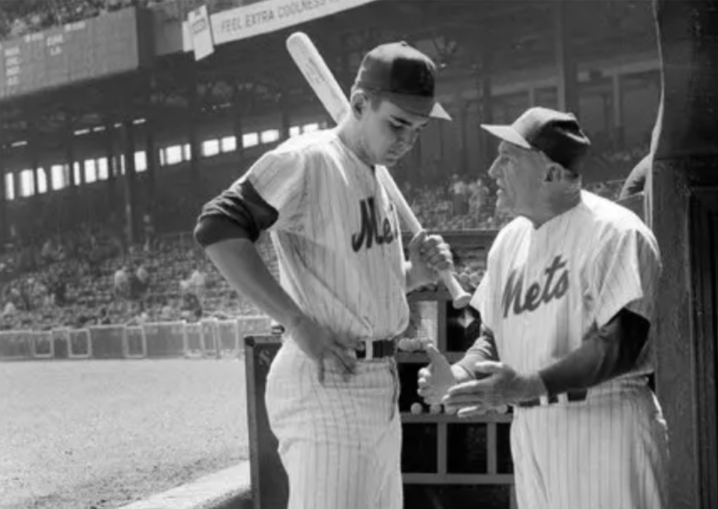
Ed Kranepool, Casey Stengel

Teenage Met Ed Kranepool listens to Professor Stengel, 1962.

As a teenage prospect out of New York’s James Monroe High School, Ed Kranepool landed an $80,000 bonus plus incentives to sign with the original Mets. He spent what the government let him keep of the bonus partly on a Thunderbird convertible and mostly on a split-level home for his widowed mother in White Plains.

Then he caught his first airplane flight ever to join the Mets in Los Angeles. Lucky him. He landed in time to join the team on the June 1962 day Hall of Famer Sandy Koufax no-hit them. The seventeen-year-old missed getting into the game; manager Casey Stengel wanted a pinch hitter late but decided on his old Yankee platoon hand Gene Woodling instead.

“Thank God,” Kranepool was recorded as saying. He’d have to settle for playing on the losing side of three no-hitters including Hall of Famer Jim Bunning’s Father’s Day 1964 perfect game.

A kid who begins his major league life as a 1962 Met surely had something to say about this year’s Blight Sox who threaten those Mets’ record for season-long futility. “I’ve gotten calls lately about the White Sox, but there’s not much to say,” said Kranepool, who died at 79 Sunday.

I don’t care if they lose more games than that original Mets team. It was a bad baseball team with a bad mix of young guys and some great older stars whose best years were behind them. In a clubhouse like that, when you’re young like I was, all you want is to learn and get better and have the season end. But whether the White Sox finish with more losses than that team—what does it matter to me?

Kranepool didn’t just have that season end. Before the decade ended, he’d go as he once phrased it, “from the outhouse to the penthouse,” as a member of the 1969 Miracle Mets. The outhouse years were rarely pretty for a kid upon whom wild expectations were piled. On the other hand, Kranepool developed a Metsian sense of humour about it.

He was one of only two licensed stock brokers playing in the National League at the time; Bunning was the other. He took to discussing Mets life in stock market terminology.

“During the World Series,” he told New York Times sportswriter Joseph Durso in 1967, “the Dow-Jones wire carries the score every inning, plus the home runs and pitchers. Wouldn’t it be great if the Mets got into the Series and I hit a home run that was flashed over the ticker along with the quotations? Boy, the office would go wild.”

A few million offices and residences in New York, when it actually did happen to both the Mets and Kranepool two years later. The Mets shook off a Game One loss to demolish the Orioles in four straight . . . and Kranepool smashed a one-out homer off Oriole reliever Dave Leonhard, sending a slightly hanging breaking ball over the center field fence with one out in the bottom of the Game Three eighth.

He had an up and down relationship with his teammate-turned-manager Gil Hodges, though. Both men headstrong but one the boss who’d survived World War II and the other a young man whose father was killed in that wae before he was born. They butted heads often as not until 1971, when Kranepool had a fine if not spectacular season.

“[T]hings seemed to get a little better between us, Gil and me,” he told Maury Allen for After the Miracle: The Amazin’ Mets Twenty Years Later.

I think we were beginning to understand each other. I had matured and was becoming a more productive player. Then he got his fatal heart attack in West Palm Beach that next spring of 1972, and Yogi [Berra] took over. Maybe I never appreciated Gil. I don’t know. He was a hard man to get to know. He was very tough, very strong. But he was smart. I think he was the first to know in 1969 how good we were.

Just like any other manager asked after a miracle Series triumph to explain how it came to be and answering by spreading his palms apart, grinning, and saying, “Can’t be done.” Kranepool thought otherwise. “Gil was a great manager, a very smart baseball man,” he told Allen. “I’m sure I would have learned a lot more about the game if he had lived.”

When Wayne Coffey wrote They Said It Couldn’t Be Done a few years ago, for the 50th anniversary of the 1969 Mets, Kranepool was even more concilatory, even if it could only be with Hodges’s ghost. “We really were a team,” he began.

Sometimes you win in spite of your manager, but not with this club. Gil did everything right. He made every possible move to help our club. He never tricked you. He was so consistent . . . You never showed up at the ballpark not ready. Once he said he was going to do something, he stuck to it. You were prepared when you went to the park. You got your rest. You were ready. You worked hard to stay in shape because you knew you would be called on. He kept everybody sharp.

Kranepool never became a bona fide superstar, but he remained iconic in New York, especially when he enjoyed a late career second life as a successful pinch hitter. Three years ago, studying pinch hitters with over 300 plate appearances since the heyday of their patron saint Smoky Burgess, I ranked Kranepool number sixteen according to my Real Batting Average metric. (TB + BB + IBB + SF + HBP / PA. Kranepool: .484 RBA.) Shea Stadium rocked with “Ed-die! Ed-die!” chants every time he loomed as a pinch hitter.

As content as he became with his Mets career as it was, as embittered as he became over the team’s mal-administration following the death of their beloved original owner Joan Payson (“Joan Payson was like a grandmother to me and to everybody else,” he once said), Kranepool came to take a realistic view of his Mets life. (His eighteen-season tenure remains a Mets record.) Including the ill effect of rushing a seventeen-year-old to the Show and not exactly letting him develop in short minor league stints in the seasons to follow.

“They shoulda left me in the minor leagues to develop, and they woulda got a better player out of it,” Kranepool was once quoted as saying. “A kid of seventeen isn’t equipped to handle that pressure. They said, ‘Ed’s going to lead them from a bad ballclub to the pennant.’ One player, even a Hall of Famer, can’t do that.”

1969 Mets

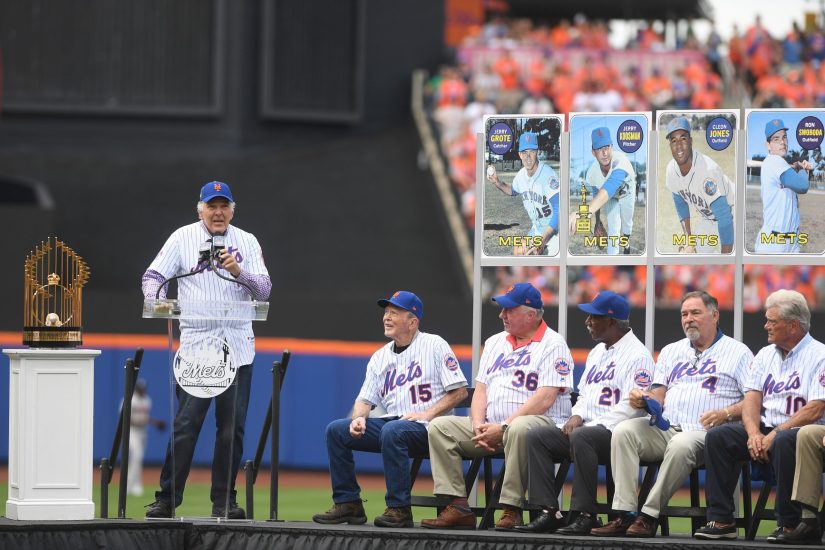
Ed Kranepool (at the podium) addresses a Citi Field crowd on the 50th anniversary of the 1969 Mets. Listening, left to right: Jerry Grote (C), Jerry Koosman (LHP), Cleon Jones (LF), Ron Swoboda (RF), Duffy Dyer (C). (Bergen Record photo.)

Nobody questioned his fortitude. After one such brief minor league turn in 1964, Kranepool was recalled to the Mets in time to play a doubleheader . . . all 32 innings of it at first base. He went 4-for-14 on the day/night with two runs scored, plus a double and a triple among the four hits. His mother went the distance with him in the Shea Stadium stands . . . because she was holding onto his car keys and house keys.

After his playing career ended. Kranepool took up life as a businessman, made peace with future Mets administrations, and became a happy presence at assorted Mets functions and commemorations as well as spring training. He also dealt with diabetes and kidney disease, receiving a transplant in 2019 after a two-year wait that was frequent news in New York. (A then-59 year old Met fan–whose own husband had received such a transplant—turned up as the donor.)

“I knew Krane for 56 years,” said Miracle Mets outfielder/first baseman Art Shamsky. “We did so many appearances together. We had lunch last week and I told him I would be there next week to see him again. I’m really at a loss for words. I can’t believe he’s the fourth guy from our 1969 team to pass this year.”

“We knew each other so well,” said pitcher Jerry Koosman, “and I could tell by his eyes if a runner was going or not. He saved me a lot of stolen bases.”

Kranepool’s death of cardiac arrest followed the 2024 deaths of shortstop (and eventual Mets coach and manager) Bud Harrelson, catching anchor Jerry Grote, and pitcher Jim McAndrew. As Mets together, those plus others listened attentively whenever Kranepool told them of those early Met seasons as lovable losers.

“We used to celebrate rainouts,” the man the fabled Shea Stadium Sign Man, Karl Ehrhardt, once called the Killer Krane would say.

In time Kranepool would be respected by teammates for baseball smarts as well as his straight, no chaser personality. A personality that compelled his teammates to name him their player representative as the Major League Baseball Players Association began finding its wings after hiring Marvin Miller to run the union.

“I wasn’t afraid to protect the players and attend the meetings and the associations,” he once told a reporter. “And the players, themselves, that doesn’t bode well for you, sometimes, when you’re speaking on behalf of the group, owners can take it as a bone of contention. I wasn’t afraid of getting traded, nor was I afraid of speaking out against others’ interests.”

Kranepool and his first wife, Carole, raised a son who was athletic but far more interested in music and electronics and ultimately raised two sons and a daughter himself. Kranepool remarried happily a Sotheby’s realtor named Monica whom he met during his stock brokering days. (She has four grandchildren of her own.)

“I’ve been lucky to have a great team at home—my wife and family. And also the Met organization,” he said after his transplant. “I’ve been with them since 1962. Those are the only two teams I knew up until that time. Now I have an extended team.”

He didn’t just mean his medical team, either. Kranepool was also one of several Mets who set up Zoom calls with residents of assorted elder care facilities, during the original COVID-19 pan-damn-ic, as a way to pay forward his kidney transplant. “This is a summer that none of us will forget,” he told northjersey.com writer Justin Toscano. “You’re always looking to talk to somebody to brighten their day, and hopefully they can brighten mine.”

He needn’t have worried. He had an immediate and extended family to brighten his days. He now has an even more extended one welcoming home to the Elysian Fields. Led, perhaps, by the skipper whom he didn’t always understand but who probably greeted him with, “We’re ok, Eddie. You got the point, after all.”

They’re not the ’62 Mets. More’s the pity.

Francisco Lindor, Garrett Crochet

White Sox lefthander Garrett Crochet’s fourth-inning opening service had but one destiny Sunday afternoon: a blast into the left center field bleachers by Mets shortstop Francisco Lindor. (SNY image.)

Who’d have thought? Certainly not baseball’s 2024 schedule makers, who couldn’t possibly have predicted that this year’s White Sox’s road to eternal infamy would include hosting the team whose ancestors they threaten to eclipse for season-long futility.

“Meet the Mets,” the White Sox said of their weekend’s house guests. They certainly proved extremely generous hosts, allowing the postseason-contending Mets to sweep them in Guaranteed Rate Field. By now, Chicago’s South Side shrugs, when other condign responses seem more futile than the White Sox themselves.

In a way, the Mets out-scoring the White Sox 12-4 could be construed as showing mercy upon the downtrodden. By Baseball Reference‘s blowout definition (a five-run difference or better), the White Sox are 8-33 and counting. The Mets won with only a four-run advantage Friday, a two-run advantage Saturday, and a two-run advantage Sunday.

“They are not quitting,” said White Sox interim manager Grady Sizemore of his hapless charges after Saturday’s loss. “They are not folding. But it would be nice to have some of those balls fall, to get some bleeders or something.”

They’ve been the fastest to a hundred losses, the fastest to mathematical postseason elimination, and finished the weekend with a new franchise record for regular season losses. Their ballpark rang with chants of “M-V-P! M-V-P!” Sunday afternoon . . . for Mets shortstop Francisco Lindor, who started the day’s scoring by hitting Garrett Crochet’s first pitch of the fourth inning into the left center field bleachers.

I’m not sure “bleeders” is an appropos word out of a White Sox mouth this year. This team’s been bleeding from square one. And they haven’t even had a fragment of the perverse charm of the 1962 Mets whose modern-era single-season record of 120 losses the White Sox now threaten with too much credibility.

Which may be one reason why one starting pitcher and one relief pitcher on the 1962 Mets are wary of the Blight Sox pushing them out of the record books. Jay Hook was credited with the Mets’ first pitching win, when he helped bust a Met life-opening nine-game losing streak. Craig Anderson was credited with back-to-back wins in relief during a May 1962 doubleheader, and they’d be the last pitching wins with which he’d be credited in his entire major league life, a nineteen-decision losing streak just ahead of him.

They’re both well aware that this year’s Mets are chasing a place in the postseason while this year’s White Sox are chasing them and their 1962 teammates living, dead, or otherwise. Neither Anderson nor Hook wants to see the White Sox break their team’s 120 in ’62. “I want them to win at least twelve more games,” Anderson told The Athletic‘s Tim Britton before the weekend set began. “I hope they do, for their sake.” The White Sox would have to win half their remaining 24 games to make Anderson’s wish come true.

“It’s shattering when it’s happening to you, and I’m sure the White Sox are feeling that right now,” said Hook to the same writer. “I wouldn’t wish that on anybody. You don’t like to go through life thinking you were part of the worst team of whatever you did.”

It’s what the pair didn’t say aloud to Britton that makes the big difference. So I’ll say it, yet again. This year’s White Sox, like numerous historically horrible baseball teams, merely suck. The Original Mets sucked . . . with style. This year’s Blight Sox don’t even have the sense of humour of undertakers.  The Original Mets cultivated one to survive.

Now, it’s hardly the White Sox’s fault that they lack a Casey Stengel to take and keep the hardest heat off their players. But deposed manager Pedro Grifol was something between a wet blanket and a grump, and Sizemore is too earnest to help. He’s almost like National Lampoon’s Animal House’s Chip Diller, upright in his ROTC uniform, the streets overrun by the panicked under siege from a Delta House operation, pleading, “Remain calm. All is well!”

Telling the world his team isn’t folding isn’t enough. Especially since it’s been folded since the end of May. That’s when the Blight Sox stood proud with a 15-43 record. It wasn’t even enough to leave them room for a comeback comparable to the 2019 Nationals—who were 15-23 on 10 May but 24-33 at that May’s end, before overthrowing themselves to go 69-36 the rest of the way and wrest their way to a World Series conquest while they were at it.

Give Stengel the keys to a city, as New York did, and he’d say (as in fact he did), “I’m gonna use this to open a new team.” Give Sizemore the keys to Chicago and he’s liable to hand it to the opposition with the most sportsmanlike intentions after they handed his men their heads yet again.

“Come an’ see my amazin’ Mets,” Stengel would hector. “I been in this game a hundred years but I see new ways to lose I didn’t know were invented yet.” Sizemore wouldn’t shock anyone by saying, “It is what it was.” He’s hardly Grifol’s kind of grump, he’s too innately cheerful for that, but neither has he seized the moment with wit. He’d never cut the mustard in the Ol’ Perfesser’s parlour.

Sizemore can say his Blight Sox have hit more doubles so far than those Mets did all ’62, and stolen more bases, too. But the ’62 Mets even had a respectable team .318 on-base percentage to the Sox’s .278. Getting the ’62 Mets on base wasn’t half the problem that keeping them there or cashing them in without them dying by hook, crook, or schnook was.

Well, on Sunday afternoon, the White Sox had an inning that could have been from the 1962 Mets play book: Luis Robert, Jr. took one for the team leading off the seventh, getting plunked by Mets starter Sean Manaea, but then he was thrown out stealing. Andrew Vaughn drew a two-out walk and Gavin Sheets dropped a base hit in front of sliding Mets left fielder Jesse Winker, but Miguel Vargas flied out to Winker and out went that threat.

Those ’62 Mets were also infamous for the sort of fielding that made you think (ha! you thought I could resist another telling) they really had Abbot pitching to Costello with Who the Hell’s on First, What the Hell’s on Second, You Don’t Want to Know’s on third, and You Don’t Even Want to Think About It’s at shortstop. The National League’s first expansion draft rules and entry fees had much to do with it. But the Mets turned into Ringling Brothers and Barnum & Stengel Circus entirely on their own from there.

The Blight Sox defense at this writing is worth a few less defensive runs below league average than the Original Mets. But they don’t have anyone on the team with a fortieth of the perverse endearment of the Mets’ mid-May ’62 acquisition Marvelous Marv Throneberry. Their whole defense is about as funny as a stink bomb in a sewage treatment plant.

“[T]he Mets are losers, just like nearly everybody else in life,” wrote Jimmy Breslin in his post-1962 valedictory, Can’t Anybody Here Play This Game?

This is a team for the cab driver who gets held up and the guy who loses out on a promotion because he didn’t maneuver himself to lunch with the boss enough. It is the team for every guy who has to get out of bed in the morning and go to work for short money on a job he does not like. And it is the team for every woman who looks up ten years later and sees her husband eating dinner in a T-shirt and wonders how the hell she ever let this guy talk her into getting married.

They were also the team through whom those people found ways to laugh through their sorrows before trying to drown them. Not so these Blight Sox.

“I love the idea that [the Original Mets] were the worst baseball team of the modern era,” writes A Year in Mudville author David Bagdade, whose book reviewed the 1962 Mets but who admits to being a White Sox fan, the poor dear, “but that they lost with personality and humor and that they remain one of the most loved teams of any era despite (or possibly because of) their record. The ’24 Sox are just a steaming pile of baseball ineptitude. They don’t lose with personality and humor. They just lose. I don’t want anything about this Sox team to be enshrined in baseball immortality.”

Too late, perhaps. In their perversely entertaining ways, the Original Mets gave the downtrodden hope. If these White Sox caught the downtrodden drowning, they’d sooner throw them anchors.

Willie Mays, RIP: Loss, but Gratitude

Willie Mays

Mays hitting his 500th career home run, in 1965. “He has gone past me,” Ted Williams would say at his own Hall of Fame induction, after Mays hit number 522, “and he’s pushing, and I say to him, ‘Go get ’em, Willie’.”

Seeing Willie Mays in my boyhood when he was a Giant still in his prime was as transcendent as seeing him in his baseball dotage, as a late-career Met, was heartbreaking. Having Mays at all back in the city where he really made his baseball bones was as much a belated blessing as having him too much less than his best was sorrow. But . . .

“What do you love most about baseball?” asked Joe Posnanski, in The Baseball 100. (He ranked Mays number one.) Then, he answered. “Mays did that. To watch him play, to read the stories about how he played, to look at his glorious statistics, to hear what people say about him is to be reminded why we love this odd and ancient game in the first place.

“Yes, Willie Mays has always made kids feel like grown-ups and grown-ups feel like kids. In the end, isn’t that the whole point of baseball?”

But having Mays say farewell the way he did in Shea Stadium on 25 September 1973, with the Mets still yanking themselves back to take a none-too-strong National League East, brought tears not just of loss but of gratitude. If so few of the greats retire before the game retires them, fewer than that retire with Mays’s soul depth:

I hope that with my farewell tonight, you will understand what I’m going through right now. Something that—I never feel that I would ever quit baseball. But as you know, there always comes a time for someone to get out. And I look at the kids over here [pointing toward his Mets teammates], the way they are playing, and the way they are fighting for themselves, tells me one thing: Willie, say goodbye to America.

America never really said goodbye. Now America must say a reluctant au revoir. Mays left this island earth at 93 Tuesday. “I want to thank you all from the bottom of my broken heart for the unwavering love you have shown him over the years,” said his son, Michael, in a statement. “You have been his life’s blood.”

We’ve been his life’s blood? The younger Mays had it backward. His father was the lifeblood of every objective and appreciative baseball fan of his time. He didn’t have to wear the uniform of the team for which I rooted since their birth (not right away, anyway) to be that for me, in hand with Sandy Koufax, and believe me when I tell you that watching Koufax going mano a mano against Mays was something precious to behold.

(For the record, Mays faced Koufax 122 times and nailed 27 hits. Five were home runs, eight were doubles, one was a triple, for 33 percent extra bases off the Hall of Fame lefthander. Mays also wrung 25 walks out of him while striking out 20 times.)

Before Mays’s Giants and Koufax’s Dodgers high tailed it out of Manhattan and Brooklyn for the west coast, the most bristling debates in New York involved not politics, finance, or rush-hour traffic, but baseball. As in, whom among the three Hall of Fame center fielders patrolling the territory for each team was The Best of the Breed.

I was born in the Bronx and raised there and on Long Island; I heard the debates for years to follow after the Dodgers and the Giants went west. I had skin enough in that game long before Terry Cashman wrote and recorded his charming hit, “Willie, Mickey, and the Duke (Talkin’ Baseball).” Well, now. Let’s look at the trio during their New York baseball lives two ways, for all the seasons they played in New York together. (Snider was a four-year major league veteran by the time Mays and Mantle arrived in 1951.)

First, according to my Real Batting Average metric (total bases + walks + intentional walks + sacrifice flies + hit by pitches, divided by total plate appearances):

Together In New York PA TB BB IBB SF HBP RBA
Mickey Mantle 3493 1648 524 34 11 5 .636
Willie Mays 3299 1718 362 70 23 11 .662
Duke Snider 2629 1305 283 42 6 7 .625

Mays has a 26-point RBA advantage over Mantle and that’s with Mays losing over a season and a half to military service. (Mantle’s osteomyelitic legs kept him out of military service; Snider served in the Navy before his major league days began.) Mays also landed 70 more total bases and was handed 36 more intentional walks.

Mantle may have been a powerful switch hitter, but just from one side of the plate Mays outperformed him while they shared New York even with precious lost major league time between ages 21-23. Mantle also had a .756 stolen base percentage to Mays’s .738, but a) Mantle’s already compromised legs kept him from trying more often; and, b) Mays led his league in thefts twice during the period under review. (Snider? Even a hobbled Mantle left him behind: for their shared New York years, his stolen base percentage was .586.)

Sometimes Mantle gets the props as the best of the trio purely because his Yankees were far better teams than the others’. Actually, Snider’s Dodgers were almost as good as Mantle’s Yankees. It was no more Snider’s fault that his Dodgers couldn’t get over those Yankee humps until 1955 than it was Mantle’s sole doing that his Yankees won seven pennants and five World Series (three consecutively) while they shared the Big Apple.

And it was hardly Mays’s fault that his Giants won a mere two pennants in the same shared span, even if Mays’s Giants got squashed by the Yankees in five in the 1951 Series but swept the far better Indians in the 1954 Series. You may have heard of a little play known as The Catch from Game One of that Series, happening when it seemed the Indians had a shot at taking the opener. (Mays would play on two more pennant winners, too, the 1962 Giants—who beat the Dodgers in another memorable pennant playoff—and the 1973 Mets.)

Willie Mays

“The Catch,” of course—460+ feet from home plate in the ancient Polo Grounds.

“That really wasn’t that great of a catch,” harrumphed curmudgeonly Indians pitcher Bob Feller, nearing the end of his own Hall of Fame career. What made him think not? “As soon as it was hit, everyone on our bench knew that he was going to catch it . . . because he is Willie Mays.” (But did they know Mays would also keep Hall of Famer Larry Doby from scoring with an equally staggering throw in to the infield off The Catch?)

Which brings me to the titanic triumvirate in center field. We’re going to look at them according to total zone runs, the number of runs their play in center field turned out above or below their leagues’ averages. Baseball-Reference begins measuring total zone runs with the 1953 season, so we’ll have five solid Big Apple seasons to review for each of the trio:

Willie Mays: +45.
Mickey Mantle: +22.
Duke Snider: +25.

Once again you see where Mantle’s physical health issues got in his way despite his supernatural talent and skill. But it might not have mattered. Mays and Mantle both played in unconscionably deep home center fields before the Giants and the Dodgers left the Apple for 1958. You can fantasise all you like how many runs Mantle might have prevented on good legs, but if you guess that he might have proven just about even you’re making a solid guess.

“Willie Mays going after a fly ball was cotton candy and a carousel and fireworks and a big band playing all at once,” Posnanski wrote. “His athletic genius was in how every movement expressed sheer delight.”

When Mays got to San Francisco, he and Mantle continued their top of the line play. When he got to Los Angeles, Snider had two decent seasons followed by a decline phase that actually took him back to New York for a round with the early Mets before finishing his career in 1964 as . . . a Giant, of all things.

Mantle managed to remain Mantle through the end of 1964. Mays managed to remain Mays through at least 1971. Even if his home run power had dissipated somewhat in the previous four seasons, he spent 1971—at age 40—leading the National League in walks and on-base percentage. Mantle’s body took him out at last at age 36; Mays’s, at age 42; Snider’s, at age 37.

And here is how the trio finished career-wise. First, how they sit among the Hall of Fame center fielders whose careers covered the post-World War II/post-integration/night-ball era, according to RBA:

Center Field PA TB BB IBB SF HBP RBA
Mickey Mantle 9907 4511 1733 148 47 13 .651
Willie Mays 12496 6066 1464 214 91 44 .631
Ken Griffey, Jr. 11304 5271 1312 246 102 81 .620
Duke Snider 8237 3865 971 154 54 21 .615
Larry Doby 6299 2621 871 60 39 38 .576
Andre Dawson 10769 4787 589 143 118 111 .534
Kirby Puckett 7831 3453 450 85 58 56 .524
Richie Ashburn 9736 3196 1198 40 30 43 .463
HOF CF AVG .588

But now, how they sit among center fielders for run prevention above their league averages, showing the top ten:

Andruw Jones +230
Willie Mays +176
Paul Blair +171
Jimmy Piersall +128
Kenny Lofton +117
Devon White +112
Carlos Beltrán +104
Willie Davis +103
Curt Flood +99
Garry Maddox +98

Thanks to his leg and hip issues, Mantle finished his career at -10. Snider finished his at -7; his late career was compromised by knee, back, and arm injuries. (Richie Ashburn, their great Hall of Fame contemporary, finished his career +39.) Two such talented center fielderss who’d had excellent throwing arms and range deserved far better than such physical betrayals.

Mays stood alone as the complete, long-enough uncompromised, all-around package. He was blessed with a body that wasn’t in a big hurry to betray him, but no blessing means a thing if you don’t take it forward. Good luck stopping Mays from doing so. Should-be Hall of Famer Dick Allen once advised Hall of Famer Mike Schmidt to play the game as though he were still the kid who’d gladly skip supper to play ball. Mays played the game precisely that way until age began to say “not so fast,” after all.

“The greats don’t always go gently into that good gray night when they can no longer play the games that made their names,” I wrote when Mays turned 90.

This son of an Alabama industrial league ballplayer fought a small war in his soul when his age insisted he was no longer able to play the game he loved so dearly at the level on which he’d played it for so many years. Some said he’d become sullen, moody, dismissive in the clubhouse. Some resented him, others felt for him, still others mourned.

. . . When he smiled as a Met, you still saw him in his youth, you didn’t see the manchild who was yanked rudely into manhood by a San Francisco that shocked him with skepticism as a New York import rather than a hero of their own. By a San Francisco that also shocked him, for all its reputation otherwise, when his bid to buy a home with his first wife was obstructed long enough by the sting of neighbourhood racism.

Willie Mays

Mays taken for a drive around PacBell Park in a 1956 Oldsmobile to celebrate his 90th birthday. San Francisco came to love him as New York did, but not without growing pains.

After his first marriage ended in divorce and in his son living across country with his mother, Mays dated Mae Louise Allen for about a decade before marrying her after the 1971 season. His happiness there was compromised by her premature Alzheimer’s diagnosis; his caring for her until her death in 2013 is the stuff of true love stories.

A welcome presence at the Hall of Fame’s induction ceremonies following his own in 1979 and at various Giants events (and numerous home games) in the years that followed, Mays wouldn’t be able to attend this year’s Field of Dreams game at Birmingham’s Rickwood Field, the field where he first played with the Birmingham Black Barons of the old Negro American League.

“I’d like to be there, but I don’t move as well as I used to,” he said in a statement on Monday. “So I’m going to watch from my home. But it will be good to see that. I’m glad that the Giants, Cardinals and MLB are doing this, letting everyone get to see pro ball at Rickwood Field. Good to remind people of all the great ball that has been played there, and all the players. All these years and it is still here. So am I. How about that?” A day later, sadly, he was gone.

Mays never apologised for making the game look fun with his fabled basket catches in front of his belt, his winging turns running the bases as his deliberately oversized hat flew off, his high-pitched voice sounding like a kid getting to play yet another inning.

“That’s what his idea was,” said one-time Giants relief pitcher Stu Miller, “to please the crowd.”

“I’m not sure what the hell charisma is,” said Ted Kluszewski, the musclebound Reds first baseman of the 1950s, “but I get the feeling it’s Willie Mays.”

“The only thing Willie Mays could not do on a baseball diamond,” Posnanski wrote, “was stay young forever.”

May his entry into the Elysian Fields, where it’s Willie, Mickey, and the Duke once again,  and especially his reunion with his beloved Mae, have been as joyous for him as the way he played the game was joyous to us for as long as we were honoured to see him play.

Do better, Met fans

Max Weiner

Max Weiner, hoisted by the fan group Metsmerized Online, in the image that stirred SNY’s Andy Martino to outrage. Weiner didn’t call himself the Rally Pimp, so far as we know.

A Mets fan named Max Weiner has been turning up often at Citi Field of late. This would not be great news except that Weiner has a thing for appearing in assorted garish haberdashery at least some of which appears comparable to that worn by actual, professional pimps, and he has become a symbol of the Mets’ in-season resurgence.

Identity unearthed by the Mets fan group known as The 7 Line, Weiner has been tagged colloquially as the Rally Pimp by fans; he may not have  assumed the nickname for himself. But he and they have stirred up a small social media storm, particularly since the Mets have gone 9-3 since his first known appearance at the park following a 1-5 season opening that included losing their first five straight.

We’ve become coldly accustomed to “pimp” as a verb referencing the bat flips and other celebratory displays upon home runs long and longer or theatrical plays in the field. It’s sobering to think that those deploying it so casually may have too little comprehension about the word’s actual, core meaning, in times when baseball’s handlings of domestic violence and sexual assault matters stir contradictory but deeply troublesome passions.

The deployers aren’t just fans any longer; you can hear some broadcasters and journalists use it with the same casual carelessness. But one journalist, SNY’s Andy Martino, author of Cheated, one of a pair of excellent books conjugating the Astros’ illegal, off-field-based, electronic sign stealings of 2017-18, isn’t amused one feather by the Rally Pimp idea. Saying so has gotten him a few rounds of social media abuse.

“Pimp imagery is problematic on so many levels,” Martino Xtweeted, after spying and re-Xtweeting a previous Xtweet from a Mets fan account a photo of Mr. Weiner in a purple fur jacket and large gold-looking chain around his neck holding the Mets’ interlocking NY cap logo at the chain’s end. “Let’s think about it for 2 seconds. Can we please not make this a big part of the 2024 Mets’ imagery? Cue replies about woke culture blah blah. I don’t care, I’m right about this.”

We don’t really know whether Weiner called himself the Rally Pimp or whether the tag was attached to him by zealous Met fans. It certainly didn’t help Martino to say flatly at the finish, “I don’t care, I’m right about this.” But Martino has a point. To tag such haberdashery that way above others, you might (must?) first ask how much you know about the actual doings of actual pimps. Reclaiming Hope, a group dedicated to caring for the survivors of sex trafficking, offers as clear a definition as you might ask of the pimp and his operating style:

Traffickers are often referred to as “Master Manipulators”. They use a variety of tactics to recruit victims and pimps are many times classified as (1) “A Romeo” pimp or someone who portrays himself as a “boyfriend” who loves her and will take care of her, or (2) A “guerilla” pimp who controls through force.

The modern day pimp/trafficker initially seems like a very nice guy who cares deeply about their victims. Then the manipulation and threats begin. One of the most powerful ways traffickers keep their victims controlled is by the trauma bond that develops between the victim and trafficker. Victims are controlled by their pimp through repeated beatings, rapes, drug dependency, withholding of food and sleep, debt bondage, isolation, and psychological abuse, which can include threats against family or friends.

Sex trafficking is a high profit, low risk business with a relatively small risk of a pimp going to prison for human trafficking. Additionally, their “product” can be sold repeatedly, unlike drugs or weapons, where the product can only be sold one time. The faces of victims know no ethnic, religious or social-economic boundaries.

Considering that baseball’s last few seasons have been pockmarked by several players and even front office personnel tagged and disciplined for domestic violence, sexual harassment, and sexual abuse, bringing “pimp” to bear as a term of endearment for a particular and colourfully expressive on-field celebration or a particular and colourfully expressive fan in the stands is described most civilly as grotesque.

More agreeably, the Mets have gone 10-3 since that season-opening five-game losing streak. They’ve done it against teams seen as contenders in the early going, though some may think it debatable that the like of the Reds (from whom they took two of three), the Royals (two of three likewise), and the Pirates (a three-game sweep) will go the distance that way.

Why soil it by attaching to one hideously if demonstrably dressed fan in particular a colloquialism that emanates from a profession whose victims often incur damage even more deranged than those victims of the Roberto Osunas, Aroldis Chapmans, Domingo Germáns, Trevor Bauers, Sam Dysons, Julio Uríases, Wander Francos?

This Met fan since the day they were born urges: Do better, Met fans. Weiner’s costumery is also the type that might be seen wrapped around the bodies of contemporary rock, pop, and hip-hop musicians. Would “Rally Rocker” have had insufficient thrust?

Whitey Herzog, RIP: The Rat that roared

Whitey Herzog

The White Rat on the Cardinals’ bridge. Winning three pennants and a World Series before a later, lackluster edition prompted him to walk.

It’s forgotten often enough, but Whitey Herzog was supposed to be the man who succeeded Gil Hodges on the Mets’ bridge if that time should have come. It came when Hodges died of a heart attack during spring training 1972. But the White Rat ran afoul of the Mets’ patrician chairman of the board M. Donald Grant well before that.

Herzog, who died Monday at 92, ran the Mets’ player development after one season as the Mets’ rather animated third base coach (1966)  and one managing in the Florida Instructional League (1967). He was  part of bringing the Mets such talent as pitchers Gary Gentry and Jon Matlack, first baseman John Milner, third baseman Wayne Garrett, and outfielders Amos Otis and Ken Singleton.

But his role in the first try at bringing eventual Miracle Met outfield acrobat Tommie Agee to the Mets from the White Sox got Herzog in big trouble with Grant. Then-Mets general manager Bing Devine, who’d hired Herzog in the first place, led a Mets contingent to the 1967-68 winter meetings and cobbled a deal to get Agee in exchange for veteran outfielder Tommy Davis and a decent but not spectacular relief pitcher named Don Shaw.

Shaw posted a 2.98 ERA and a respectable 3.44 fielding-independent pitching rate in forty 1967 appearances. The Mets had a crowded bullpen then, and Shaw was attractive to other teams including the White Sox, though. The Mets wanted Agee in the proverbial worst way possible. For reasons lost to time, Shaw was also one of Grant’s particular pets.

“Gil Hodges wanted him,” Herzog would remember. “Bing, [personnel director] Bob Sheffing, and I all wanted him, and we had the deal set.”

But Bing said we’d have to wait until Grant flew in to approve it.

The deal leaked to the papers, and when Grant hit town, he was furious. “How could you think about trading my Donnie Shaw?” he asked.

And he killed the deal. We eventually got Agee anyway [for Davis, pitchers Jack Fisher and Billy Wynne, and catcher Buddy Booker], but Grant’s decision cost us a good man—Bing Devine. ‘I don’t really believe they need a general manager around here,’ he told me.

And he went back to the Cardinals.

It wasn’t the last time the White Rat dealt with the kind of team lord who meddled without knowledge aforethought. Snubbed by the Mets upon Hodges’ death (they named Hall of Famer Yogi Berra to succeed Hodges, instead), Herzog took his first managing gig with the Rangers for 1973.

Owner Bob Short promised Herzog that high school pitching phenom David Clyde would be allowed to go to the minors for proper further development after two major league starts to goose the hapless Rangers’ home gate. Clyde did pitch well in those first two starts. Then Short reneged on his promise.

“You could have renamed the owner Short Term for the way his mind worked,” Herzog remembered in his memoir, You’re Missin’ a Great Game. When I had the pleasure of interviewing Clyde a few years ago, I asked him whether Herzog was the only man in the Rangers’ organisation who wanted to do right by him.

“As far as I know,” replied Clyde, the lefthander who now fights for pension justice for over 500 pre-1980, short-career major leaguers frozen out of the 1980 pension realignment, “that’s the absolute truth.”

Herzog didn’t survive 1973 in Texas; he was cooked the moment Billy Martin was fired by the Tigers that August and Short could snap him up post haste. The White Rat was brought aboard in Kansas City in 1975, after managing the Angels a year, and he managed the Royals to three straight postseasons in a five-year tenure. In each one, the Yankees thwarted his Royals.

Then he ran afoul of Royals owner, Ewing Kauffman and GM Joe Burke, with whom he’d also tangled in Texas. He despaired of trying to build the kind of bullpen that would help him get past the American League Championship Series, and he despaired equally of trying to convince the Royals brass that he knew what he was talking about when he advised them  several key players now had drug issues.

The Royals faced the problem by shooting the messenger. It cost them in nasty headlines and four players (outfielders Willie Mays Aikens, Jerry Martin, and Willie Wilson; pitcher Vida Blue) behind bars after the 1983 season.

Whitey Herzog, Frank White, Al Cowens

Herzog with two of his Gold Glove-winning Royals, second baseman Frank White and outfielder Al Cowens. The Royals rewarded the Rat’s warnings of drug problems on the team with a firing squad and paid an embarrassing price a few years later.

In the interim, Cardinals owner Gussie Busch hired Herzog to manage them. Herzog told Busch bluntly his team needed a near-complete overhaul. So Busch put his money where Herzog’s mouth and mind were and named him the GM in addition to being the field skipper.

Herzog overhauled those Cardinals into three-time pennant winners with a 1982 World Series title in the bargain. He also savoured his relationship with Busch, who gave him free reign to visit any time to talk business. (“Draw me up a Michelob, Chief,” the White Rat often hailed Busch on the phone before his visits, “I’m coming up.”)

He rebuilt the Cardinals into a team suited ideally for old Busch Stadium’s canyon dimensions and pool table playing field, for fast grounders, line drivers, swift runners, defensive acrobats (especially Hall of Fame shortstop Ozzie Smith), and maybe one or two power swingers (a George Hendrick here, a Jack [the Ripper] Clark there) to drive them home. And, for control pitchers who knew how to pitch to the ballpark. Just the way he did in Kansas City.

His pitching management was especially effective with his bullpens. Unlike most managers, Herzog paid attention to what was done in the bullpen as well as on the game mound. He knew what others didn’t: relievers throw voluminously enough getting ready to come in. If he warmed a reliever up without bringing him into the game, he gave the man the rest of the day or night off.

The White Rat (so nicknamed because the Yankees thought his hair resembled that of a former Yankee pitcher with the same nickname, unlikely 1951-52 World Series hero Bob Kuzava) was a marriage of old-school tenacity and newer-school depth, though people often forgot the latter while worshipping the former. He told things the way he saw them, charming many and outraging about as many.

He disliked interleague play and the expanded postseason, believing (correctly) that the former was fraudulent and the latter penalised the best teams even if one of them should end up with the final triumph. He also stood well ahead of the pack when—after the Don Denkinger blown call on the play at first in the bottom of the ninth, Game Six, 1985 World Series—he began calling for postseason instant replay. Denkinger himself came out for replay as well, soon enough. Would Herzog have come out in favour of Robby the Umpbot?

“What they’re fighting about,” he wrote about the Missourians who could still see photos of the fateful play in bars and restaurants for years to follow, “is as old as the game: What’s more important, getting it correct, or following the idea that the ump’s always right, no matter how far his head’s gone up his ass?” (Angel Hernandez, call your office.)

Herzog eventually forgave Denkinger, sort of: at a dinner honouring the 1985 Cardinals, team members were presented new Seiko wristwatches . . . and Herzog himself presented Denkinger one in Braille.

Whitey Herzog

A marginal player on the field, Herzog turned what he learned early from Yankee manager Casey Stengel into a Hall of Fame path that started as a Mets third base coach and, after a year, director of player development.

He didn’t flinch when handed players described most politely as “eccentric”; he embraced them. He treated one and all the same whether praising them or telling them off. He rejected officially what he called the “buddy-buddy” relationship between manager and player(s), but he’d still take a player or three out fishing to help them get their minds clear when struggling for spells.

“I tend to like my players,” he wrote in You’re Missin’ a Great Game. “As long as they knew who was boss, as long as they respected my knowledge of the game when I put the uniform on, I didn’t see any reason not to bring my personality into the situation. It’s one of my resources; why shouldn’t I use it?

“Herzog had only four rules,” wrote Thomas Boswell, when Herzog walked away from the Cardinals in July 1990. “Be on time. Bust your butt. Play smart. And have some laughs while you’re at it.”

Only when those Cardinals stopped half or more of the above did Herzog do the unthinkable. In the same piece, Boswell led with, “They say you can’t fire the whole team, so you have to fire the manager. Nobody told Whitey Herzog.”

On Friday, he fired his team.

Technically, Herzog resigned. But it amounted to the same thing.

The White Rat got sick and tired of watching the St. Louis Cardinals play baseball in a way that offended his sensibilities and injured his enormous pride, so he quit—with a flourish of dignified self-recimination worthy of a disgraced British prime minister.

“I’m totally embarrassed by the way we’ve played. We’ve underachieved. I just can’t get the team to play,” said Herzog. “Anybody can do a better job than me . . . I am the manager and I take full responsibility.”

Translation: They quit on me. So I’m quitting on them. Get me a new team.

Herzog would get a new team when the Angels hired him to examine their farm system up and down. Herzog discovered the Angel system had plenty of good and the parent club needed only a little pitching fortification while letting that good young talent make its way to Anaheim. Then, after winning a power struggle with another Angel exec, Herzog himself took a hike.

“He was the one who gave us a chance to do anything with guys like Tim Salmon and Jim Edmonds and Garret Anderson,” said successor Bill Bavasi. “The attitude before Whitey came in was that those guys weren’t good enough, that we didn’t have any good young players in the system, but Whitey said, ‘Yes you do, leave ’em alone.’ I’ll always be grateful for that and the fact he was willing to share everything he knows.”

When he turned 90, the White Rat talked to St. Louis Post-Dispatch writer Rick Hummel  and trained fire at commissioner Rob Manfred’s game-shortening lab experiments. He might have neglected the broadcast commercials that are at the core of baseball’s lengthening games, but he had most of everything else he mentioned right.

He keeps talking about the three-batter rule for [relief] pitchers. Stupid. And then the tenth inning rule [the free cookie on second to open each extra half-inning]. Stupid. Seven-inning doubleheaders. Stupid. None of that is going to shorten the games at all, until we can lower the amount of pitches that they throw.

Baseball has probably had enough prophets without honour to stock an entire organisation. Herzog’s a prophet with honour but it’s almost as though electing him to the Hall of Fame was a way of saying, “Congrats, Rat, now go back to your fishing boats and shut the hell up.”

He’ll enjoy the afterlife of the just in the Elysian Fields, fishing happily when never failing to miss a great game. It’s we remaining on this island earth who’ll miss the White Rat among us, watching our game, fuming over its self-destructions, but still loving its pleasures, its teachings, its remaining tamper-proof fineries.