The Mets crank up the MixMatzer

2019-07-27 StevenMatz

Steven Matz put on a a splendid off-speed clinic Saturday night.

Beneath Steven Matz’s magnificent throttling of the Pirates Saturday evening lay a stone cold sobering fact. Mets manager Mickey Callaway, that embattled former pitching coach whose pitching management is under as much fire as almost everything else around the Mets, rolled serious dice to make room for it.

“To do it in 99 pitches is something else,” Callaway said of Matz’s masterpiece of a five-hit shutout. “That doesn’t happen too often. That was tremendous. That was unbelievable. We really needed him to do that.”

All he left out was “stupendous” and “colossal” and wearing a ringmaster’s striped pants, tailcoat, and top hat while rapping his cane on the Citi Field entrances, in describing maybe the single best Mets pitching performance of the season. By a guy who’d been exiled to the Mets’ bullpen for a spell before the All-Star break.

Callaway didn’t dare suggest what might have happened if Matz hadn’t found himself a way to work with efficiency and with a well-balanced blend between his slider, his changeup, and his sinkerball, not to mention if the Mets’ defense hadn’t been just as efficient behind him when he needed them to be the most.

Because sending Matz back to the mound late in games or the third or more time around the enemy batting order was previously a balance between a tightrope ride and a flying trapeze act that includes buttering the bar.

Matz came into Saturday’s game with the opposing order posting a lifetime .278/.323/.431 slash line against him when he’s still in for a third time around it. He’s least vulnerable historically the second time around the order and most vulnerable the first time, for all his talent. But it was still a considerable risk to let Matz even think about shooting for the complete shutout.

It would have been about twenty times the risk for Callaway to even think about going to his bullpen. Especially when Matz entered the seventh with a mere 1-0 lead that everyone in Queens knows is rarely if ever safe once the bullpen gate opens and out comes another bull. Clearly the skipper had to think fast. With about minus two seconds worth of time to think.

But closer Edwin Diaz, who’s suffered enough misuse and abuse so far, was deemed available somewhat officially, except that when he’s nursing a sore big toe on his landing foot you’re liable to be nursing a ninth-inning beating if you send him out and his delivery is hijacked.

Late-inning option Luis Avilan worked in three straight games before Saturday. Seth Lugo, who saved Friday night’s 6-3 Mets win, worked in two straight. Callaway might not have wanted to trust mightily struggling Jeurys Familia, even though Familia hadn’t pitched in a game in two days but was lit for two earned in two thirds of an inning against the Padres two days before the Pirates sailed into town.

And, perhaps re-learning a lesson about prudent bullpen usage, Callaway probably didn’t want to burn Justin Wilson—arguably the least arsonic Mets reliever the past week plus (five gigs, four innings, one earned run, four punchouts)—a second straight night.

So with Matz getting all those ground outs Callaway stood by him. And how could he not, when Matz put on a clinic in finding and using something other than pure raw power to get outs, something other than a howitzer to pull himself back from behind.

“The changeup got me back in some counts,” said Matz, who got first pitch strikes on only half his 31 batters. “So I just think, really mixed everything . . . It was just a recipe.”

Be gone, food processors. Welcome home, old-fashioned Mixmaster. Control the blending more directly. Between speeds when need be. Take that, all you guys trying to throw the proverbial lamb chops past the proverbial wolves. No wonder the game took a measly two hours and ten minutes and Matz missed a 100-pitch tally by one.

All of a sudden it didn’t seem all that tough to let Matz begin the seventh with a mere 1-0 lead. Oh, yes, he even shook off first and second and one out in the sixth by getting Melky Cabrera to dial an Area Code 5-4-3 that went around the horn smooth as whipped cream.

Then Michael Conforto made only the second Met hit of the game off Pirates starter Trevor Williams count with a drive into the right field seats in the bottom of that sixth. “Unfortunately for us,” Williams said after the game, “I was the one that blinked first.”

Matz and the Mets were so efficient that they almost blinked through the top of the seventh despite a two-out single. But in the bottom, after Todd Frazier reached on a one-out pop that Pirates shortstop Jung Ho Kang inexplicably let fall to the ground, J.D. Davis hit the first Williams service of the plate appearance, a four-seam fastball right down the chute, right over the center field fence.

Then Matz zipped through the top of the eighth with three straight ground outs and shoved Kevin Newman’s leadoff single aside in the top of the ninth to put the Pirates away on a fly out, a strikeout, and a ground out.

The Pirates played most of the game without manager Clint Hurdle, who was ejected in the first trying to keep Starling Marte from ejection after Marte huffed over a called third strike that ended the inning. Hurdle wasn’t thrilled about plate umpire Hunter Wendelstedt’s slightly generous strike zone, and it did look as though Wendelstedt pulled a slightly too-swift trigger on the skipper.

But in fairness Wendelstedt blew a pocketful of strikes against both sides. One minute, Williams and Matz got strikes that were obvious balls, the next both pitchers got balls that were obvious strikes, just a little too often. It didn’t stop Williams from no-hitting the Mets through four and two thirds and pitching his own splendid seven innings ruined only by the pair of Met bombs. Any more than it stopped Matz from running the speed dial full spread against the Pirates.

The game left the Mets 9-5 since the All-Star break and the Pirates losers of seven straight and 2-15 since the break. Nobody’s quite ready to pronounce the Pirates officially doomed, nobody’s quite ready to pronounce the Mets officially back from the living dead, either, but it sure felt like the Mets got real old-fashioned pennant-race pitching.

. . . but the little gulls understand

2019-07-19 AT&TParkSeagulls

A flock of seagulls over AT&T Park’s outfield, not unlike the one Pete Alonso of the Mets scattered in the sixteenth Thursday night.

A pair of National League also-rans meeting to start a four-game set in San Francisco. One managed by a three-time World Series-winning skipper, the other managed by a former pitching coach who’s caught too often unawares but still might break a record for in-season votes of confidence that make his team’s fan base anything but confident.

A pair of starting pitchers whose names appear as often in trade-deadline speculation as Harold Stassen used to run for the presidency. Backed by one bullpen that has three bulls whose names are sometimes whispered in trade talks and another backed by a group that plays with matches a little too often for its own good.

And, a marathon in which both sides’ pitching traded off otherwise lockdown work around twenty hits, ten for each side, with 32 strikeouts between them for fifteen innings, and a flock of seagulls flying above the left side of the AT&T Park outfield in circular patterns that looked taunting one minute and challenging the next.

Thus the Mets and the Giants Thursday night entering the sixteenth inning tied at one. Until Pete Alonso opened the top of the inning almost doing to a seagull with his bat what Hall of Fame pitcher Randy Johnson once actually did to a dove from the mound to break the tie at long enough last.

The Mets entered the bottom of the sixteenth with a 2-1 lead and exited with a 3-2 loss to the Giants in which Mets reliever Chris Mazza, who’d worked a spotless fifteenth, couldn’t get an out if he’d pre-ordered them on Amazon Prime Days just before the Mets hit the Bay Area.

Both teams all but emptied their bullpens, following seven strong innings from Mets starter Noah Syndergaard and nine from the Giants’ Madison Bumgarner, with the Mets’ pen of all people having a little bit of the better of things until the sixteenth. And that was after both Syndergaard and Bumgarner could swap a few jibes about how the single runs each surrendered might look almost like happy accidents in the box score.

Mets rookie Jeff McNeil scored in the top of the first—while Alonso himself dialed Area Code 6-4-3 with nobody out. Giants center fielder Kevin Pillar scored Pablo Sandoval with a sacrifice fly in the bottom of the fourth. And no matter what the Mets and the Giants threw at each other or swung against each other, nobody else came home until the sixteenth.

Bumgarner still felt his oats after the ninth, doing everything he could short of bringing Perry Mason in to plead his case to manager Bruce Bochy to go out for the tenth. “He lobbied, trust me, he did,” Bochy said after it finally ended. “In fact, I came in after the game, he’s still mad at me for not letting him go out there in the 10th.”

“I didn’t try to make it much of a conversation but he wasn’t having it,” the normally ornery Bumgarner said with a few chuckles punctuating his remarks. “Usually if I really want to I can get my way with him, but he wasn’t having it today. How many times do you get to go out for the tenth?”

He struck out six in nine to Syndergaard’s eight in seven. Then came the running of the bulls. The Mets’ pen—in order, Seth Lugo, Luis Avilan, Edwin Diaz, Jeurys Familia, Robert Gsellman (working two innings), and Justin Wilson—scattered three hits and three walks with a combined ten strikeouts (including Gsellman’s three) before manager Mickey Callaway sent Chris Mazza out for the fifteenth.

The Giants’ pen—in order, Will Smith (another trade deadline subject), Reyes Moronta, Tony Watson, Derek Holland, and Trevor Gott—was equally stingy until the sixteenth, scattering four hits and a walk while striking out a collective eight. (Including three each by Smith and Gott.)

Both the Mets and the Giants, riding concurrent hot or semi-hot streaks into Thursday night, might yet be pondering the reset buttons. But several players on both sides made themselves look a little more attractive to prospective contending suitors a fortnight before the new single trade deadline.

The men don’t know, but the little gulls understand.

Then Williams Jerez, who’d shaken off first and second in the top of the fifteenth, went to work in the top of the sixteenth. He had Alonso 0-2 with a foul. Then he hung a changeup, and Alonso hung it into the left field seats, missing one of the circling gulls by inches. Imagine the gulls as they scattered: Incoming! Hit the deck! There is no deck!

Jerez nailed a pair of back-to-back strikeouts before walking Amed Rosario, but he escaped when he picked Rosario off and got him thrown out for attempted grand theft. Then it was Mazza’s turn to work a second inning.

He got that turn because Callaway had no choice: he had nobody left in the pen, it wasn’t their fault the Mets were as futile in getting runs home until Alonso’s blast, and he didn’t want to burn a starting pitcher if he could help it. Callaway admitted after the game that if it went somehow to a seventh inning he would have sent left fielder J.D. Davis to the mound and pitcher Jacob deGrom out to play left field.

Thank God it didn’t quite come to that, except that the Giants made sure it wouldn’t get to that point off Mazza in the bottom of the sixteenth. It’s a luxury the Mets couldn’t have afforded unless they’d gotten more in their half than just Alonso’s almost-seagull shoot.

A leadoff double (Alex Dickerson), RBI double to re-tie (Brandon Crawford), a hit batsman (Austin Slater, who took over for Mike Yastrzemski in right field in the ninth), a bases-loading single (Pillar), and the Mets’ infield in to choke off the run that wouldn’t be choked off when Donovan Solano (who’d replaced Joe Panik at second in the tenth) sort of snuck a base hit into shallow right field.

“Syndergaard did a great job of pitching out of some jams early and their guys did too,” said Callaway after the game. “There were a lot of baserunners at third with less than two outs and nobody got in. It was a tough night to score runs.”

It was for fifteen innings, until the bases-loaded jam the Mets couldn’t escape the way they did in the fourth, when Pillar’s sacrifice fly began life as a potential bases-clearing hit until J.D. Davis ran it to the rear end of left field and made a leaping snatch.

But the Giants finally banked a win to be proud of and the Mets banked a loss they couldn’t really be ashamed of. Even the gulls looked as though they tried congratulating both sides when it finally ended.

Pumpsie Green, RIP: The modest pioneer

2017-07-19 PumpsieGreen

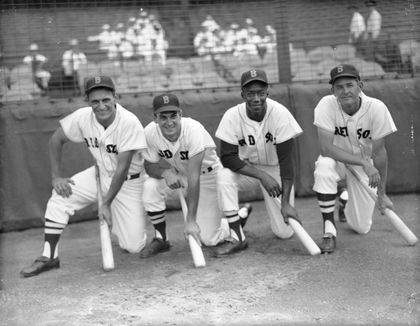
Pumpsie Green poses with three Red Sox who helped make his integrating the team that much more bearable. From left: third baseman Frank Malzone, shortstop Don Buddin, and first baseman Pete Runnels.

For those whose hobbies include forging off the wall trivia questions, here’s a beauty.  What does Pumpsie Green have in common with Jackie Robinson and Lou Brock? The answer is two parts: 1) Green, too, was the first black man to play on a particular major league baseball team. 2) He was also a teammate of the now-late Ernie Broglio, traded most notoriously for Hall of Famer Brock in 1964.

Part two is the far less problematic, of course: Green and Broglio were teammates for El Cerrito High School in California. Part one, alas, is the more so: Green was the first black man admitted to the ranks of the Red Sox, who were, alas, the final team in major league baseball to admit a black player and one of the first, alas far further, to reject Robinson, Willie Mays, and others over a decade earlier.

A catcher/first baseman in high school, Elijah Jerry Green, Jr., who died at 85 Wednesday morning, two years older and the morning after cancer claimed Broglio, became a middle infielder who wasn’t as well endowed with baseball gifts as Robinson and wasn’t built to blow the walls down. Pioneers—reluctant (a word so often used to describe Green) and otherwise—are quiet as often as they are vibrant. And Green, a handsome young man with a smile that said “Hello, my friend,” was as quiet as the season was long.

He was the son of an Oklahoma transplant who’d farmed in the Sooner State before moving his family to California. The old man became a sanitation worker and mother worked on the Oakland docks as a welder during World War II before becoming a convalescent nurse. It was Mom who gave Green his nickname, calling him Pumpsie from when he was a toddler. He had no idea what inspired it.

But loving baseball as he did, he had a fine idea what inspired him to set his sights on a possible major league life. The tough old Pacific Coast League integrated in 1948, and when the Oakland Oaks hosted a barnstorming team of all-stars led by Jackie Robinson himself, the teenage Green—who attended as many Oaks games as he could—wasn’t going to miss the game.

“I scraped up every nickel and dime together I could find,” Green told Herb Crehan for Red Sox Heroes of Yesteryear. “And I was there. I had to see that game . . . I still remember how exciting it was.” Green’s ambition then was to play for the Oaks, whose shortstop Artie Wilson was their first black player, and Green modeled his own playing style on Wilson, who once led the PCL in batting average and stolen bases.

The Oaks did sign Green but assigned him to an A-level affiliate in Washington state. By 1955, he was Red Sox property, but when they wanted to send him to their affiliate in Montgomery, Alabama, Green was only too understandably reluctant. Young black men were about as anxious to go to Alabama then as a cobra might be to go on a dinner date with a mongoose.

By spring 1957 Green impressed the Red Sox’s farm system administrators, including then-system director Johnny Murphy, the former Yankee relief pitcher and future Mets general manager. He was assigned to the Oklahoma City Indians in the AA-level Texas League, where he discovered he was good for a break whenever the Indians had to play the Shreveport (Louisiana) Sports.

“When the team went to Shreveport,” Green recalled, “I didn’t go, because they didn’t allow blacks to play in Louisiana. So I had a three- or four-day vacation.” Some vacation. But he played well enough with the Indians to earn a promotion to the Minneapolis Millers, whom the Red Sox made their AAA affiliate after the New York Giants moved to San Francisco and surrendered their rights to Minneapolis, where they first planned to move.

Every major league team except the Red Sox had integrated by the time Green became a Miller in 1958. Green didn’t play particularly well on the regular season but, in the American Association postseason, he went 5-for-12 with four runs scored and three batted into help the Millers win it.

The good news is that Green was finally invited to spring training with the Red Sox themselves in Scottsdale, Arizona, in 1959. The bad news is that spring training was the only place the Red Sox broke the colour line at first. They refused to do as some of the other integrated teams did, forcing Green to stay at a hotel seventeen miles from camp because the team’s regular spring hotel near camp refused to admit black guests.

Green finally found spring training lodging at the hotel where the Giants trained in Phoenix, the Giants having been integrated since 1949 and compelled the hotel to accept the entire team long since. And despite being considered the best rookie in camp, the Red Sox officially seemed ambivalent about him. Their manager at the time was Pinky Higgins, a former infielder known as a close buddy of owner Tom Yawkey but also known to be rather a bigot.

Even in Howard Bryant’s magnificent study of the Red Sox’s and Boston’s racial growing pains, Shut Out: A Story of Race and Baseball in Boston, it’s not entirely clear whether it was Yawkey or Higgins who declared, a decade earlier, “There’ll be no niggers on this ballclub as long as I have anything to say about it.”

Most notoriously in the mid-1940s, the Red Sox worked out Robinson, Mays, and other black players in sessions long since shown to have been shams for show after enough in the Boston press (particularly Boston Record columnist and Ted Williams nemesis Dave Egan) and the increasingly influential black press (such as the Pittsburgh Courier) pressured the team to do it.

While the rest of the Show caught on, little by little, to the good the black talent pool could do their teams, the Red Sox remained clueless. And, futile. The black talent pool didn’t suddenly make winners of all the teams, of course (we mean you, Cubs, for one example), but choosing to remain in the paleozoic era did the Red Sox no favours, either.

Higgins left room for further ambivalence when he sent Green back to Minneapolis to begin the 1959 season. “The Red Sox won no prizes this spring for the way they treated Pumpsie Green,” fumed Boston Globe baseball columnist Harold Kaese. “From a strict baseball point of view they may have been doing the wise thing when they optioned their first Negro player to the Minneapolis farm club yesterday. From every other point of view, they undoubtedly have pulled a colossal boner.”

All this blew around the head of a soft-spoken 25-year-old middle infielder who had no intention of fomenting revolution and who could never grok—even four decades after the fact—why such men as Higgins and other Boston racists had to be as they were. “Sometimes,” he told Bryant for Shut Out, “when I think of the things people like me had to go through, it just sounds so unnecessary. When you think about it, it is almost silly, how much time and energy was wasted hating.”

2017-07-19 PumpsieGreenMets

Pumpsie Green finished his major league career with the early Mets, though he missed the insanity of the original edition of the team.

“His,” Bryant wrote, “is the outsider’s story of life in a very insular city.” Today it seems somewhat difficult to remind yourself that the Jim Crow South wasn’t the only part of the country that couldn’t decide whether, as Malcolm X once phrased it, it should be, “Let’s keep the niggers in their place” or “Let’s keep the Knee-grows in their place.”

“I want to be judged like any other ballplayer,” Green said after his return to Minneapolis. “I don’t want to be a crusader. I just want to play ball.” He finally got his chance with the Red Sox after Higgins—whose alcoholism was almost as notorious around baseball as his racism—was canned in favour of Billy Jurges.

Jurges welcomed Green with open arms, as did such teammates as Hall of Famer Ted Williams plus Pete Runnels and Frank Malzone, the splendid third baseman who had Hall of Fame talent but had been buried in the minors a little too long before he finally made the Red Sox in 1955.

“I used to love to talk to Ted Williams, once of the nicest guys I ever met,” Green once told the Globe. Williams took enough of a liking to Green personally, too, that the Splinter made Green his regular for playing catch to exercise both their throwing arms during spring training and later.

As things turned out, Williams proved far more. His 1966 Hall of Fame induction speech jolted the Hall:

The other day Willie Mays hit his five hundred and twenty second home run. He has gone past me, and he’s pushing, and I say to him, ‘Go get ’em, Willie.’ Baseball gives every American boy a chance to excel. Not just to be as good as someone else, but to be better. This is the nature of man and the nature of the game. I hope that some day Satchel Paige and Josh Gibson will be voted into the Hall of Fame as symbols of the great Negro players who are not here only because they weren’t given the chance.

Pumpsie Green was the reluctant Red Sox pioneer, but his pal Williams instigated the moves that finally brought the best of the Negro Leaguers, including Paige and Gibson, into the Hall of Fame.

Green had other allies among his Red Sox teammates, including pitcher Bill Monbouquette. When coach Del Baker and then Higgins both dropped the N bomb, according to the Society for American Baseball Research, Monbouquette told coach and skipper alike he didn’t want to hear that. “[T]hen [Baker] started to give me a bunch of crap, and I said, ‘I’m going to tell you something. I’ll knock you right on your ass. I don’t care if you’re the coach or not.’ I said, ‘You don’t do things like that!’”

It would be wonderful to say that, when Green was finally brought to the Red Sox, he knocked the team’s and the leagues’ record books for the proverbial loop. He wasn’t that talented, unfortunately. He was good enough for the Show but it wasn’t going to make him a baseball star, never mind a Hall of Famer, on purely baseball grounds.

He has a respectable .357 lifetime on-base percentage and walked a little more often than he struck out, but he was used preponderantly as a pinch swinger and defensive replacement. And by his own admission he probably pressured himself far more than need be to produce in his unique circumstances.

In 1962, Green hit the headlines in one of the most peculiar ways imaginable, when he joined pitcher Gene Conley and walked off the team bus on a hot New York day, after a tough set with the Yankees, looking for refreshment. And, while moseying in and out of assorted watering holes, Conley invited Green to join in heading for Bethlehem in Israel “to be nearer to God.”

The astonished Green elected instead to return to the Red Sox immediately. Conley made his way as far as Idlewild Airport in Queens (not yet renamed for the assassinated President John F. Kennedy) before rejoining the team two days later. “We were just crying in our beer,” Green once remembered.

After that season Green was traded to the embryonic Mets, along with Tracy Stallard, the pitcher known best as the one who served Roger Maris his 61st home run at the end of the 1961 season. The Mets sent the Red Sox third baseman Felix Mantilla, once a comer with the Braves, who’d devolved into a player whose most amazing gift was for going the wrong way when batted balls came his way.

Green needed to knock himself back into shape in spring 1963. The Mets sent him to AAA Buffalo and recalled him in September. He had only 66 plate appearances as a Met but showed a very respectable .278/.409/.426 slash line, even hitting the last of his thirteen lifetime major league home runs off Philadelphia’s Ray Culp on 17 September. He began suffering hip issues, played two more seasons in Buffalo, was released in July 1965, then gave it one more try with the Syracuse Chiefs and retired.

The quiet man called Pumpsie had a fine life after his playing days. He went to college and earned a degree in physical education from San Francisco State, then ran baseball programs in the Berkeley Unified School District and coached the game for a quarter century. Some of his charges eventually made the major leagues, including Glenn Burke, Ruppert Jones, and Claudell Washington.
2019-07-18 PumpsieGreen

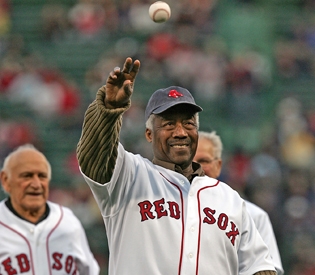
Pumpsie Green, serene and happy, throwing out a ceremonial first pitch in Fenway Park.

Green also taught mathematics and helped oversee school security while he was there. When not doing all that, he and his wife, Marie, raised two children, one of whom became a high school teacher and principal herself. And despite his quiet struggle for acceptance with the Red Sox, the years passing by made Green appreciative of just what he achieved there.

“There’s really nothing that interesting about me,” he once told Danny Peary. “I am just an everyday person happy with what I did. I take a lot of pride in having played for the Red Sox. I would like to be remembered in Red Sox history as just another ballplayer.”

One then remembers reading often enough that the Robinsons and Mayses and Larry Dobys and Frank Robinsons were one thing, but the real test would be whether and when black men could be accepted when they were as ordinary as the most ordinary white player, too. Green, however, was ordinary only as a baseball player. As a man, he wasn’t as ordinary as he liked to describe himself. Not even close.

“He laughs bitterly that the Red Sox humiliated Jackie Robinson, that it slept when it could have acquired Willie Mays, and that these twists of fate left it to unassuming Pumpsie Green to integrate the Red Sox,” Bryant wrote.

It is a fact that he is proud of, even if during those days he wanted little to do with the attention that came with being at the epicenter of a moral drama within a franchise and a city. He harbours no bitterness toward the Red Sox or the city of Boston for any reason. He wanted an opportunity to play baseball and they gave him that chance. If he does not rage at being set apart from the Red Sox in those early Scottsdale days, it is this personality that allows him not to be devoured by the past, and that makes him healthier today. It is, he says evenly, what healing is all about.

Green followed the Red Sox for the rest of his life. You may rest very assured that he was among those pumping his fists and cheering at home when the Red Sox—long past their 1950s shame, long enough removed from the Yawkey era, in which the real curse on the team was boneheaded administration, and as well integrated as the day was long—returned at last to the Promised Land, for the first of four such returns after the turn of this century.

“In 1997, they asked me to come back for opening day and throw out the first pitch,” Green told Bryant. “[Then-general manager] Lou Gorman was very friendly. They brought a limousine for me and my wife. We had a hell of a time.” A very different hell of a time than the one he had to make the Red Sox in the first place.

The Mets leave the Twins a mess for now

2019-07-17 PeteAlonso

Pete Alonso hits . . . not just a two-run homer but a conversation piece Wednesday in the eighth.

Until the All-Star break the Twins, of all people, looked like the shock of the season with reasonable ownership of the American League Central. And the Mets looked like the National League’s clown show without the benefit of drawing laughs other than those mixing disgust and dejection.

Twins fans have taken the ride savouring every day so far. Mets fans have laughed like Figaro—that they might not weep.

Except when Pete Alonso catches hold of one, with or without men on, in the eighth inning or otherwise. Then, Mets fans weep for sheer joy. Unless their jaws hit the floor as on Wednesday afternoon, when Alonso didn’t just hit a two-run homer, he hit something liable to be picked up on satellite-orbiting radar.

This was one day after the Mets kind of snuck a 3-2 win past the Twins. A former Minnesotan of my acquaintance habitually believes anything good from the Twins is an illusion and anything bad a matter of established fact, phrasing it as politely as longtime Twins fans are reputed for being. Then came Wednesday’s top of the eighth and it was too much for even the most cynical Twins fan.

Who did the Twins think they were all of a sudden—the Mets?

It began with a walk. It climaxed with a monstrous home run. In between came the sort of thing for which the Mets are only too well disregarded and the Twins aren’t exactly among baseball’s most notorious practitioners.

Twins reliever Matt Magill opened by walking Robinson Cano, the designated hitter on the day, who’s come to that point in his career where he’ll take his base any way he can get there, unfortunately for the Mets. Then, Magill struck out Todd Frazier and Michael Conforto swinging in succession. Followed by Amed Rosario shooting a base hit up the pipe for first and second. And then it happened.

Mets second baseman Adeiny Hechevarria sent a fly toward the left field track. Eddie Rosario, sunglasses wrapped snugly around his eyes, drifted back with a perfect bead on the ball until, so it looked, even the sunglasses couldn’t keep his eyes focused as the sun hit the lenses with a nova-like blast. The ball descended to his glove, then rebounded right out of it.

Cano and Rosario hit the jets and scored handily. Then Jeff McNeil doubled off the right field wall to send Hechevarria home. Dominic Smith—who’d smashed a pinch-hit three-run homer to give the Mets a 5-3 lead in the first place an inning earlier—sent McNeil home with a single.

Up stepped Alonso. He looked at two sliders sailing up to the plate under the strike zone floor. He looked at another slider hitting the inside wall of the zone, barely. Then he saw a slider hanging up in roughly the same spot, maybe an inch further on the inside of the plate. And he sent it halfway up the third deck past the left field fence, bouncing off an empty seat and past a female fan who’d bent over futilely trying to grab the ball.

It was only Alonso’s first bomb since he won the Home Run Derby in Cleveland over a week earlier. But the 474-foot flog couldn’t have been any deadlier if he’d hit it with a sledgehammer and not a bat.

Magill got Mets catcher Wilson Ramos to ground out to end the carnage—temporarily. The Twins kindly sent reserve shortstop Ehire Adrianza out to take one for the team in the top of the ninth. The poor guy ended up taking three for the team thanks to a two-run triple (Amed Rosario) and an RBI double (Hechavarria).

Alonso himself looked as though he took pity on the Twins when he ended that inning with a hard ground out to third. Then Mets reliever Chris Mazza shook off a run-scoring ground out in the bottom of the eighth to work two solid relief innings and finish the 14-4 flogging.

These Twins opened the day with a cozy five-and-a-half-game lead over the Indians in the AL Central. But the Indians spent Monday and Tuesday dropping sixteen runs on the toothless Tigers for 8-6 and 8-0 final scores. And the Tribe didn’t seem likely to just roll over and play dead for the Detroit pussycats Wednesday night.

All of a sudden, the Twins thumping and bumping their way into being one of baseball’s 2019 feel-great stories looked very vulnerable after the Mets got through with them in a two-game set.

It didn’t start that way for the Mets. Already in certain disarray because of assorted issues and controversies on the field, in the clubhouse, and in the front office, they were forced to change plans when Zack Wheeler—scheduled to start Tuesday, in a certain trade-deadline-period showcase—hit the injured list with shoulder fatigue instead.

Forcing the Mets to turn to a bullpen game by using Steven Matz, a starter recently moved to the bullpen to fix himself, as an opener. Maybe it was an omen, because a lot of the kind of peculiar fortune that went against the Mets so far on the season went their way for a change.

Like in the top of the first, when McNeil and Conforto moved to third and second on a passed ball, Cano sent McNeil home with a sacrifice fly, and an error by Jonathan Schoop at second allowed Conforto home. Like when Rosario got to score while Conforto beat out a grounder to shortstop in the top of the fifth. And when six Mets relievers kept the Twins scoreless—despite loading the bases on closer Edwin Diaz—after the fourth.

A little more of that and a lot less of the kind of thing that turned them into a hybrid between nursery school and a slapstick academy and the Mets might not have made the wrong kind of truth out of rookie general manager Brodie Van Wagenen’s preseason challenge, “Come get us.”

Don’t look now, but the Mets are 5-1 including now a four-game winning streak since the All-Star break. And they’ve just taken a pair from the reputed threshing machine of the AL Central, including Wednesday’s human rights violations. It may or may not mean a turn of their sad seasonal tide, but this was one time the Mets didn’t need to ponder calling their therapists after a game.

Nor does being sliced, diced, pureed, and nuked Wednesday afternoon mean the Twins face a turn of their otherwise joyous seasonal tide in the wrong direction, either, just yet. But you might forgive them if they pondered calling Dial-A-Shrink for a few minutes.

Baseball takes the Fourth

2019-07-04 LouGehrig

Lou Gehrig, who said farewell eighty Fourths of July ago . . .

This year is a splendid one for baseball anniversaries, not all of them pleasant. A hundred years ago the Reds were cheated out of the thrill of World Series victory by the agony of the Black Sox’s chill of self-conscious defeat; fifty years ago, the eight-year-old, crazy Mets were crazy enough to win a division, a pennant, and a World Series. Just to name two.

Today America will have its annual red, white, and blue pyrotechnic racket celebrating the declaration without which this hardy if too often self-buffeted experiment would not be alive to watch twelve major league baseball games and a few hundred more minor league games.

And the Mets, crazy this year for reasons having too little to do with the craziness of 1969, get their first Fourth of July off in a non-strike-impacted season in their entire franchise history, after splitting a pair with the Yankees Tuesday and Wednesday. No such luck for the Empire Emeritus; they have landed in Florida to open a weekend with the freshly upstart but lately teetering (they’ve won 5 of 7 but lost 9 of 16 entering today) Rays.

Twenty seasons after the shenanigans of the 1919 World Series, America’s 4 July fireworks were handed a sober contrast in the old Yankee Stadium. Two weeks after receiving his diagnostic death sentence, the insidious disease that now bears his name, Lou Gehrig accepted the honour of his teammates past and present and did what he’d rarely done on the field prior to his self-imposed removal from the Yankee lineup.

He wore his heart on his sleeve. He also spoke without a script, without premeditation, without a speechwriter. You can hunt all you like but find no actual or alleged American leader that gifted by spontaneous soul:

Fans, for the past two weeks, you have been reading about the bad break I got. But today, I consider myself the luckiest man on the face of the earth.

I have been in ballparks for seventeen years and have never received anything but kindness and encouragement from you fans.

Look at these grand men. Which of you wouldn’t consider it the highlight of his career just to associate with them for even one day? Sure, I’m lucky.

Who wouldn’t consider it an honor to have known Jacob Ruppert? Also, the builder of baseball’s greatest empire, Ed Barrow?

To have spent six years with that wonderful little fellow, Miller Huggins? Then to have spent the next nine years with that outstanding leader, that smart student of psychology, the best manager in baseball today, Joe McCarthy? Sure, I’m lucky.

When the New York Giants, a team you would give your right arm to beat, and vice versa, sends you a gift—that’s something. When everybody down to the groundskeepers and those boys in white coats remember you with trophies—that’s something.

When you have a wonderful mother-in-law who takes sides with you in squabbles with her own daughter—that’s something. When you have a father and a mother who work all their lives so you can have an education and build your body—it’s a blessing. When you have a wife who has been a tower of strength and shown more courage than you dreamed existed—that’s the finest I know.

So I close in saying that I may have had a tough break, but I have an awful lot to live for.

Leave it to Hollywood to bowdlerise such transcendence the way it did when, despite availability’s freshness, they put a completely fictionalised version of Gehrig’s “Luckiest Man” speech into Gary Cooper’s mouth, the crowning insult from a film that insults more than embraces Gehrig’s actualities. In a later generation a Hell’s Angels president lamented their press coverage by wondering, “All that bullshit, hell, ain’t the truth bad enough for ’em?” Film students and baseball fans alike have every right to ask of The Pride of the Yankees, “All that bullshit, hell, ain’t the truth good enough for ’em?”

On the same day Gehrig graduated from baseball excellence to soul transcendence, Jim Tabor, a Red Sox third baseman, hit two grand slams in a doubleheader nightcap against the Philadelphia Athletics. (One of them was an inside-the-park number.) He became one of only thirteen players to perform that feat, on a day he driving in eleven runs over the entire doubleheader.

In 1983 a Yankee pitcher, Dave Righetti, subsequently a respected pitching coach, kept the Red Sox from making their own Fourth of July fireworks. He threw a no-hitter, the first Yankee to do it since Don Larsen’s perfect game in the 1956 World Series and the first Yankee lefthander to do it since George Mogridge—in 1917, while the world war alleged to be ending all wars continued apace.

Righetti finished his no-hitter with a flourish. In 1983 Hall of Fame third baseman Wade Boggs struck out a mere 36 times. The bad news is that one of those strikeouts completed Righetti’s masterwork. Which reminds me that sixteen pitchers have struck out 3,000 or more batters and only two of them secured number 3,000 on the Fourth of July: Nolan Ryan (1980; his victim: Cesar Geronimo) and Phil Niekro. (1984; his victim: Larry Parrish.)

One year after Knucksie’s milestone the Mets and the Braves played a game that started on the Fourth of July and ended on the fifth of July. The good news for the Mets: Keith Hernandez hit for the cycle. The better news for the Braves: pitcher Rick Camp tied the game with a home run—in the bottom of the eighteenth. (“If this team needs me to tie a game, they’re in trouble,” Camp remembered later.) The best news for the Mets: They scored three in the top of the nineteenth before Ron Darling—now a Mets broadcaster, then a starting pitcher pressed into survival relief—struck out Camp himself to end the 16-13 win.

The Braves said nuts to that and went ahead with their postgame fireworks show anyway. Nothing keeps some people from their red, white, and blue racket making—not even the fifth of July and nineteen innings of baseball.

Sixty years to the day before that Fourth, two Hall of Famers—Lefty Grove (Athletics) and Herb Pennock (Yankees)—tangled in a pitching duel that went fifteen innings before Grove surrendered the game-losing RBI to Yankee catcher Steve O’Neill. The bad news: It was one of only ten RBIs O’Neill would have all season long. The worse news: it was the first game of a doubleheader.

Today, the eyes of baseball will fall most likely upon the Dodgers, who enter a home game against the Padres on a streak of five consecutive games won in the final plate appearance of the inning. The last two of the streak were won by Cody Bellinger, the Dodger outfielder doing his level best to give Dodger fans a taste this season of what Angel fans have tasted since 2012 from Mike Trout.

On Tuesday night, Bellinger received the fifth consecutive walk of the bottom of the ninth to win, 5-4. On Wednesday night, having opened the scoring with a parabola over the center field fence, and with his parents in Dodger Stadium, Bellinger stepped up in the bottom of the tenth and sent one into the right center field bleachers. Winning again, 5-4.

The two Wednesday blasts put Bellinger into the Dodgers’ record book. He knocked two Brooklyn legends—Hall of Famer Duke Snider, and eventual Miracle Mets manager Gil Hodges—to one side for the most home runs by a Dodger in any season prior to the All-Star break.

But the eyes of baseball are just as likely to fall upon the Nationals, in Washington, when they host the Marlins in the nation’s capital. The Nats have gone from basket case in the making to winners of 15 out of 17 and a resurrected National League East threat, and even their once-lamented 2019 bullpen seems to be shaking off its early season penchant for throwing kerosene balls.

An American president-to-be fired the pronouncement heard ’round the world 243 years ago. (If you’re scoring at home, that’s one year more than the total home runs a former Nationals manager hit during his own playing career.)

May [our Declaration] be to the world, what I believe it will be (to some parts sooner, to others later, but finally to all) the Signal of arousing men to burst the chains, under which monkish ignorance and superstition had persuaded to bind themselves, and to assume the blessing & security of self government.

Let today’s American political (lack of) class sully America’s birthday all it wishes, if only because the formal legal holiday allows even a single day’s relief from their suffocating mischief. Immune as almost completely they are to America as an idea as well as a country, let them stew all they choose that they can’t really impose that immunity upon still-sovereign Americans, enough of whom will re-embrace America the idea in hand with America the country today.

Descended from stock as varied in international origin as baseball players are in performance, approach, and style, still-sovereign Americans will spend a fair portion of her birthday watching the game that above all others begins with the act of a sovereign individual but scores with the act America the idea embraces in the abstract and, at her best, the actuality. Enunciated best by the Yale scholar of renaissance literature (Dante in particular) who eventually became baseball’s overseer, if for a tragically brief term:

Baseball is quintessentially American in the way it tells us that much as you travel and far as you go, out to the green frontier, the purpose is to get home, back to where the others are, the pioneer ever striving to come back to the common place. A nation of migrants always, for all their wandering, remembers what every immigrant never forgets: that you may leave home but if you forget where home is, you are truly lost and without hope.

Mr. Jefferson, meet Professor Giamatti. Preferably behind home plate, but anywhere you might see America’s best annual birthday present, that roaming to the frontier, that hope of coming home, its starting cry the one with which you, Mr. Jefferson, might have finished your declaration and America’s, had you been clairvoyant enough to see its advent: Play ball!