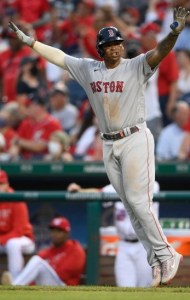
The Red Sox Devers-ify . . .

Rafael Devers

Devers in the on-deck circle. He now joins the Giants in a deal that may not bear immediate fruit for the Red Sox but manna at the plate for the Giants.

Even leading the 21st Century in World Series titles (four), the Red Sox haven’t lost their capacity to stun. They can sweep their eternal rivals and neutralize those rivals’ number one hitting threat one moment (they held Aaron Judge to 1 bomb, while striking him out 9 times during the sweep) and trade a slugging three-time all-star the next.

Yes, that sounds too simple. So we’ll flesh it out a big more. A relationship fractured by foolishness on both sides ends with Rafael Devers going to the Giants and left-handed pitcher Kyle Harrison, right-handed pitcher Jordan Hicks, outfield prospect James Tibbs, and minor league right-hander Jose Bello going to the Red Sox.

Almost five years after the Red Sox traded Mookie Betts rather than think much about paying him his true value, they’ve unloaded a far more problematic player than Betts ever was. That won’t make the deal go down any more smooth for a Red Sox Nation too much flummoxed by the team’s front office follies in recent seasons, alas.

The deal also means the last of the Red Sox’s 2018 World Series winners are gone. The Mookie Monster has since been a critical element in two Dodgers world champions; Xander Bogaerts has become a mainstay in San Diego and a few National League pennant races.

Say what you will about Devers, the man can hit. His to-date .858 OPS, his average 33 home runs per 162 games lifetime, both prove it. His batting eye improves with age; he led the American League in walks at the time of the deal. And he took care of the second of two runs the Red Sox needed to finish sweeping the Yankees with a hefty 2-out home run in the bottom of the fifth. The Giants may have a home ballpark nowhere near as hitter-friendly as Fenway Park, but they’re getting a guy to whom the dimensions don’t matter so long as he can tee it up and swing big.

Part of the problem, and a critical reason why things came to Devers’s transcontinental change of baseball address, is that when you play him at third base “poisonous” doesn’t begin to describe it. He led the league in errors in six of his first seven seasons and the entire Show for the first four of those. He was 80 defensive runs below league average. (Fair disclosure: Bogaerts hasn’t exactly been toxin-free at shortstop, not being 27 defensive runs below league average for his career to date.)

That’s a compelling reason why the Red Sox thought signing free agent third baseman Alex Bregman was a smart idea. The problem was that the Red Sox took the clumsy way to handle both that and the little matter of convincing Devers that the longer he stayed at third base the more likely the Red Sox were to declare the area off limits pending a hazmat cleaning.

How would Devers have done at first base? We won’t know, at least regarding the Red Sox, because Devers didn’t exactly pounce on the opportunity when it was offered as Triston Casas hit the injured list. He won’t be taking a new shot on third in San Fran, either, since the Giants have a verified Gold Glover holding it down (Matt Chapman). He may not get a crack at first, either, with the Giants having a willing Wilmer Flores to move over in case former Met Dominic Smith needs a break or can’t hold it down longer-term.

But Devers will provide the Giants with something they haven’t had since their freshman top executive, Buster Posey, was last seen behind the plate for the Giants — a great hitter. Posey may also give Devers what the Red Sox couldn’t for whatever reason, a clear presentation of the “why” behind any move without insulting Devers’s considerable pride. Posey had bloody well better, too, considering the Giants have taken on the remainder of Devers’s contract — running through 2033 and paying him a nifty $250 million plus.

What do the Red Sox get other than out from under Devers’s remaining money and maybe a little more egg on their faces considering they didn’t exactly handle Devers with graceful hands and heads?

Harrison — Considered highly talented and still only 23, so he has time to put things together despite his 4.56 fielding-independent pitching rate to date. Depending on the Red Sox pitching injury picture, Harrison just might be seen in Red Sox silks before the stretch drive arrives. And that might occur next to any pitching the team ponders acquiring at or before the trade deadline now that they have about $250 million to play with.

Hicks — Serviceable relief pitcher whom the Giants tried out of the rotation last year, but when that experiment imploded Hicks went back to the bullpen, and the Red Sox are liable to keep him there.

Tibbs — A first-round pick last June, he’s been showing plenty of upside in the minors, but the Red Sox will likely wait for his AA-level results before thinking of him as Show bound.

Bello — Has bullpen upside to burn, from the look of his minor league life to date.

The rest of the Sox — With Devers gone, it looks as though there will be plate appearances to spare to spread around especially in dispersing an outfield crowd partially. But it’s an open question as to just whom would replace Devers’s plate production. For now. And maybe longer. Which means the Red Sox’s re-entry into the AL East race picture may be an arduous re-entry to sustain.

Published originally by Sports Central.

“I’m the one probably most surprised . . . “

Shohei Ohtani

Ohtani takes one of his curtain calls from the Miami audience Thursday evening.

If you absolutely must become baseball’s first 50/50 man, as in 50+ home runs and 50+ stolen bases in a single season, you couldn’t pay for any more earth-moving way to do it than Shohei Ohtani found Thursday evening.

A 6-for-6 day at the plate. As many runs batted in in one game as his Dodgers teammate Freddie Freeman has so far in all September. Three RBI hits serving as just the overture to both Ohtani’s history-making suite and the Dodgers smothering the hapless Marlins, 20-4, in the Fish’s own tank.

Theft number 50 after a first-inning double and theft number 51 after the second-inning RBI single. A two-run double in the third ruined only by Ohtani getting himself thrown out trying to stretch it into a triple.

Almost exactly the way Hall of Famer in waiting Albert Pujols demolished the Rangers after the sixth inning in Game Three of the 2011 World Series (three bombs: one each in the seventh, eighth, and ninth innings), Ohtani’s real mayhem began in the sixth:

A man on second and one out in the sixth, Ohtani sent an 0-1 slider into the second deck behind right center field. It made him only the second Dodger behind Shawn Green to hit 49 in a season. Second and third off a wild pitch and two out in the seventh, Ohtani hit one the opposite way into the left field bullpen. That founded the 50/50 Club and earned him a loud curtain call in a road ballpark.

First and second and two out in the ninth, Ohtani slammed the best possible exclamation point upon the proceedings when he drove a high meatball from a sacrificial lamb (read: Marlins position player, Vidal Bruján) well into the upper deck behind right field. With another curtain call to follow.

“To be honest,” Ohtani told a television interviewer through an interpreter post-game, “I’m the one probably most surprised. I have no idea where this came from, but I’m glad that I performed well today.”

The loanDepot Park audience in Miami didn’t have much to root for from their own lack of heroes this year (the Marlins have already been eliminated from the postseason mathematically), so it didn’t cost them anything but netted them plenty of respect to hand history their day’s loudest ovations.

If you’re my age, you can compare it to the day the usually unapologetic rooters of the early Mets suddenly turned on their anti-heroes on that fine 1964 Father’s Day in Shea Stadium, when Hall of Fame pitcher Jim Bunning threatened to pitch the first perfect game in the 20th Century National League. When Bunning finished what he started, he was hit with a wild standing O and an invitation to appear on The Ed Sullivan Show.

Credit Marlins manager Skip Schumaker, whose ten-year major league playing career included one season (2013) with the Dodgers, for looking into the teeth of the hurricane demolishing his club, with Ohtani potentially carrying number 50 in his bat, seeing second and third and two outs in the seventh, electing not to put Ohtani aboard to give the Fish a better survival chance with aging Kevin Kiermaier—whose bat is now as useless as his glovework remains a study—due to hit behind him.

“If it was a tight game, one run lead or we’re down one,” the manager said postgame, “I probably put him on. Down that many runs [nine], that’s a bad move baseball-wise, karma-wise, baseball god-wise. You go after him to see if you can get him out. I think out of respect for the game, we were going to go after him. He hit the home run. That’s just part of the deal.”

“A lot of us actually looked at the opposing dugout and I think a lot of the coaches were telling Skip, ‘Hey, we should walk him right here’,” said Dodger third baseman Max Muncy, who’d scored on Ohtani’s early single and final home run. “I’ve always loved Skip. When he was the first base coach in San Diego, I always talked to him. I heard all guys love to play for him. For him to do that, that’s awesome.”

“The game was certainly out of hand,” said Dodger manager Dave Roberts. “Guys got their starters out and then to take that potential moment away from the fans, Shohei himself, Skip understood that. It was bigger than that and I’ve got nothing for respect for that.”

Kiermaier striking out to end that seventh merely amplified the magnanimity of what Schumaker refused to do. A team out of any pennant race has a lot more for which to apologise to their fans than trying to stop the unstoppable force on a night he’s making history on its dollars. And leading his team to a National League West division clinch while he’s at it.

Ohtani previously entered the rareified 40/40 club by hitting a grand slam. This was different. This was a night the Dodgers used the Marlins for target practise and Ohtani proved to have the most ammunition to expend. Even MLB officials were in on the act, swapping out regulation game baseballs for pre-authenticated balls before Ohtani batted in the seventh.

When he turned Mike Baumann’s curve ball into history, those officials scurried to siphon as much memorabilia as they could carry away from Ohtani, perhaps leaving observers to ask only how they’d managed to miss his uniform belt, undershirt, and jock strap.

It isn’t every day that a player has a ten-RBI, six-hits, five extra-base hits, three home runs, two stolen bases day. No player had done all of those over a career, according to OptaSTATS. Not Babe Ruth or Lou Gehrig, not Ted Williams or Stan Musial, not Mickey Mantle or Willie Mays, not Henry Aaron or Roberto Clemente, not Dick Allen or Mike Schmidt, not Barry Bonds or Ken Griffey, Jr.

Ohtani did all five in a single day.

“With this game of baseball, it was a win for Major League Baseball,” said Roberts. “I know people all over the globe were watching this game and we’re excited to see that they got a chance to witness history.”

Roberts and Schumaker understood what too many forget, including among those who administer the game, but which longtime New York Times baseball writer George Vecsey got, watching then-commissioner A. Bartlett Giamatti getting it, too, when Giamatti almost gave in and pumped his fist watching Hall of Fame pitcher Nolan Ryan ring up his 5,000th lifetime strikeout at Hall of Fame outfielder/base larcenist Rickey Henderson’s expense: “baseball is about rooting, about caring.”

Nowhere was that more evident than when Ohtani popped out of the visitors’ dugout to take one of a couple of curtain calls after his blasts. A young fan on the other side of the side rail, holding a sign up just above the rail, but level with Ohtani’s face:

I SKIPPED MATH
TO WATCH
HISTORY.
OHTANI 50/50.

If I’m that boy’s English teacher, I give extra credit for the school-age pun of the season.

Peter Seidler, RIP: “He saw the cup as three-quarters full”

Yu Darvish

Padres pitcher Yu Darvish arrives with flowers at the Petco Park memorial for Peter Seidler last Tuesday.

There have been exceptions to the axiom that no fan ever buys a ticket to a major league baseball game to see a team’s owner. One of them died last week, two days before his fellow owners voted foolishly to allow John Fisher’s hijack of the Athletics from Oakland to Las Vegas.

Fisher’s one of those owners whom fans would pay to demand he sell his team, in their more polite moments of fury. Yankee fans of the 1980s didn’t go that far but they didn’t mind having chances to let George Steinbrenner have it over his Mad Hatter-meets-the-King-of-Hearts style in that decade.

Conversely, fans loved seeking Bill Veeck out (and he, them) when he owned the Guardians (known as the Indians in his day), the St. Louis Browns, and the White Sox twice. So did Mets fans seeking out their original owner, Joan Payson; so have Met fans with current owner Steve Cohen. And so did Padres fans with Peter Seidler, who died last Tuesday at 63.

What Seidler had in common with Veeck, Payson, and Cohen was that he loved baseball genuinely and wasn’t afraid to wear it on his sleeve. He was known to walk around Petco Park with a baseball in his hand and a readiness to talk his love of the game at the slightest inspiration. Padres fans were known to wear team jerseys with his name on it as often as they wore those of various Padres players past and present.

Ground Floor Murals, a San Diego outfit known for having done mural tributes to various Padres players, wasted no time in hoisting one in Seidler’s memory last Tuesday evening on a wall in San Diego’s Little Italy section.

“Baseball is a social institution, and it always has been,” he said in a 2021 interview. “I believe to this day it’s America’s pastime, and the impact that the San Diego Padres can have on the city and county of San Diego is something like no other business can have. And that was important to me.”

He was talking about what provoked him to buy the Padres in the first place, in 2011, when by his own admission he was bored while undergoing treatment for non-Hodgkins lymphoma (a disease he’d beat twice) and discovering the team was for sale. He went to his first game at Petco Park. The simple allure of the ballpark joined his knowledge that San Diego had yet to party over a major sports championship.

Seidler was one of the grandchildren of legendary Dodgers owner Walter O’Malley but one who made his own way and fortune as a private equity investor. He joined his uncle, former Dodger successor owner Peter O’Malley, and his longtime friend Ron Fowler to buy the Padres, becoming its managing partner in 2020.

Peter Seidler

The Ground Floor Murals tribute to Seidler that first appeared last Tuesday night.

Seidler was known to be warm, gentle, and kind. Among other things, he was known equally around San Diego for his efforts on behalf of the homeless, which he believed was a problem that shouldn’t be left to government alone. He backed that belief by creating the Tuesday Group and getting involved with the Lucky Duck Foundation that reaches to homeless youth.

“Peter was probably the most positive person I knew,” Fowler told The Athletic‘s Dennis Lin after Seidler’s death.

To say he saw the cup as half-full is probably a misstatement. I think he saw it close to three-quarters full. He saw the possibilities, the upside in everything. He always said things could be fixed or “this will happen.” He just was extremely positive with how he looked at people, problems, everything. He always saw the good. I think that was the way he was in relationships, that’s the way he was in business, and obviously it served him well.

“How many baseball owners,” asked one owner, the Brewers’ Mark Attanasio, believed to be Seidler’s closest friend among the owners, “can you say are gentle?”

Like his counterpart in Philadelphia, John Middleton, Seidler had neither shame nor remorse in actually investing in his baseball team. Among a very dubious fraternity that seems more than ever to believe baseball’s common good equals making money for them, Seidler, like Middleton, really did believe there was honour in actually trying to win and keep winning.

“A lot of people thought that that San Diego would never be a baseball city,” Attanasio told USA Today‘s Bob Nightengale. “It’s a military town. It’s a beach town. He made baseball more than relevant. He brought passion to that fanbase, and that’s as loud a crowd as you will ever hear.”

Nobody pretends Seidler didn’t have a few trips and tumbles toward that goal. The Padres got as far as last year’s National League Championship Series but lost in five games to Middleton’s Phillies. They’ve gone to two postseasons in four seasons since Seidler became their managing partner.

He wasn’t afraid to take the big swing whether it delivered big or imploded big. For every Manny Machado to whom he showed the glandular dollars there was an Eric Hosmer to whom he showed the dollars but got an aged shell for his trouble. He committed big to shortstop Xander Bogaerts, pitchers Yu Darvish and Joe Musgrove, and infielder/outfielder Fernando Tatis, Jr.

But he didn’t deliver weekly fusillades demanding a World Series or bust like yesterday, either, before or after he ascended to the number one ownership slot. He didn’t demand summary executions monthly over bad spells or decisions on the field.

So James Shields turned out to be less than his old and overstated Big Game James reputation? So Hosmer turned out to be old before his time? No sweat. Seidler just picked himself up, dusted himself off, started all over again.

So the Padres faltered last June, recovered slightly in July, faltered again in August, then put on a September stretch to a) be proud of; and, b) miss the postseason by a few hairs? Nobody doubts that Seidler would have done whatever seemed needing to be done to fix that. Even if it meant potentially dealing rather than extending Juan Soto. Even if it meant letting Blake Snell, this year’s National League Cy Young Award winner, test his free agency market before possibly thinking of trying to re-up him for another tour.

When the owners locked the players out in 2021-22, the eventual five year collective bargaining renewal wasn’t good enough for Seidler: he actually wanted a ten-year deal.

Seidler’s death prompted an outpouring from Padres fans and from all around baseball, including a memorial set up at once outside Petco Park. Among the visitors to that memorial were several Padres players including Darvish, who probably spoke for most of Seidler’s players when he Xtweeted after the news broke:

My heart hurts with the unfortunate news of Peter Seidler’s passing. I’m sure everyone that knew him would agree with me when I say Peter was a truly wonderful human being, and being in his presence was always a blessing. He was a teacher of life, and taught me countless lessons form the all the interactions we had. May his beautiful soul rest in peace.

Would Seidler have voted against Fisher’s hijack of the A’s to Las Vegas after too many years of playing Oakland for fools? Would he have stood athwart his fellow owners (even Anastasio and Middleton) in standing athwart Fisher yelling “Stop!” while reminding them how they were forgetting baseball as a social institution and doing their level best to destroy what remained of that status?

We’ll never know now. Just as we don’t know why Middleton and Cohen—and maybe Attanasio, plus one or two other owners to whom the game’s good really does mean far more than just making money for it—threw their hands up, and let Fisher get away with gutting his team and without the usual relocation fee (waived by Commissioner Pepperwinkle) and with continuing to remain heavily enough on their revenue-sharing teat.

What we do know is that Seidler wanted his Padres to stand with and up to any of the other real or alleged big boys in baseball, and for his team and their fans not to back down to anyone for affection and achievement. The Padres didn’t win the World Series while he was alive and operating, but Seidler did whatever was needed to make sure it wasn’t for lack of trying.

As long as he ran the Padres, there was always the chance that somehow, some way, Seidler’s example might yet affect enough of his fellow owners that they might, maybe, begin to think of baseball once more as far more than just a moneycatcher, far more than just a rude interruption to turns on the cell phones. Might. Maybe.

Fernando’s pride away

Fernando Tatis, Jr.

Tatis drydocked for actual/alleged PEDs the rest of this year and part of next. Did he really get it unknowingly?

Whether you saw it happen live or you had only to read about it, you couldn’t get it out of your head. Manny Machado—who’d been suspect of immaturity often enough in his Baltimore years—being the adult in the Padres’ room when Fernando Tatis, Jr. still couldn’t or wouldn’t shake off a pitch he thought was a ball but plate umpire Phil Cuzzi called a strike last September . . . correctly.

It wasn’t enough for Tatis that he gestured with pronouncement, though he faced away from Cuzzi, while his then-manager Jayce Tingler hustled out of the dugout to protect him and take up the argument and get himself tossed from the game. Tatis kept it up in the dugout, banging a bench a few times, grumbling all inning long while Jake Cronenworth’s one-out double ended up fruitless.

Finally Machado had enough. The wealthy veteran third baseman could be heard loud enough bawling the kid outGo play baseball! You play baseball. You can’t worry about that sh@t! You go play baseball! [Fornicate] that sh@t! At that point, Tatis must have tried pleading about the disputed pitch. Machado didn’t bite. No, it’s not. It’s not about you! It’s not [fornicating] about you! Go [fornicating] play baseball.

The Padres ended up losing to the Cardinals, some of whom were almost as frustrated with Cuzzi’s shifting strike zone as Tatis. But the Cardinals didn’t let it cave them in, either. In the eighth, Tyler O’Neill smashed a 2-2 cutter from Padres reliever Emilio Pagan into the left field bullpen. Two innings earlier, O’Neill was frustrated visibly over a Cuzzi pitch call or two. He just didn’t melt down over them.

He also earned Adam Wainwright’s admiration while he was at it. “That was a great job by him not getting too animated there,” the veteran Cardinal righthander said postgame. “If we lose him right there, we probably lose the game . . . That was a lot of maturity by him to not get thrown out right there on some tough calls.”

Maturity. The word’s being thrown around a lot in San Diego now, since Tatis—who’s missed all season so far rehabbing a shoulder injury—was handed a mandatory eighty-game suspension after a routine required drug test turned up positive for clostebol.

After the Padres hogged the trade deadline headlines by landing outfielder Juan Soto from the Nationals and relief ace Josh Hader from the Brewers, but still looking like paper tigers after getting manhandled by their up-freeway National League West rivals in Los Angeles, this was the last thing they needed when they thought they were on the threshold of Tatis’s return.

The shortstop who can and so often did electrify crowds with his bat and his derring-do on the left side of the infield said he discovered the hard way that a medication he took to fight a case of ringworm had clostebol in it.

“I should have used the resources available to me in order to ensure that no banned substances were in what I took. I failed to do so,” he said in a formal statement Friday, after pondering but choosing not to appeal his suspension. “I am completely devastated. There is nowhere else in the world I would rather be than on a field competing with my teammates.”

Once you shook off the shock of Tatis being drydocked for the rest of this season, the postseason if the Padres get there, and part of next season, your first question—other than, perhaps, what on earth this kid was thinking or not thinking—had to be just what the hell clostebol is.

A former professional bodybuilder named Greg Doucette was more than happy to discuss that, as he has on YouTube: Clostebol is a synthetic, anabolic/andreogenic steroid “that essentially mimics testosterone.” Several countries use it medically to treat ringworm, a common fungus in professional athletes, but neither the United States nor Canada are known to prescribe ringworm relief with medications including the substance.

By itself, says the San Diego Union-Tribune, clostebol is “[a]lso known as 4-cholortestosterone [and] is a synthetic derivative of the muscle-building steroid the body naturally produces in larger amounts in men than women.” Blended with another substance, as the former East Germany did under state sponsorship to create then-undetectable Oral Turinabol, it becomes potent enough to turn athletes into record breakers.

“The doping advantage of injectable clostebol,” says U-T writer Mark Zeigler, “is that, while less potent, it mimics the muscle-building properties of testosterone without the estrogen buildup that counteracts them.” You’d have to make a very assumptive stretch to determine that Tatis knew any of that about what was in his ringworm medicine.

Doucette accepts that somebody did indeed prescribe something with clostebol in it when Tatis complained about ringworm. Bear in mind that, during last off-season’s owners’ lockout, Tatis and the Padres lacked much direct communication between the club’s staff and Tatis’s home in the Dominican Republic. Was he prescribed the now-suspect medication there, in a country that may allow clostebol’s prescription to treat ringworm?

“Either somebody needs to get fired,” Doucette says emphatically, “or Fernando Tatis needs to be the picture boy for Major League Baseball . . . How do you know, when getting medications, whether or not [they include] a banned substance or not? You don’t. So what do you do? Ask an expert.”

Tatis didn’t ask. Prideful youth that he still is, it didn’t cross his mind to ask. Maybe this will prove the blow that trims his pride down to the level where it’s a virtue more than a vice.

Essentially, Doucette says, Tatis trusted his doctor and didn’t think to question what he was prescribed. He’d be far from the only human being who goes in with the assumption that his doctor knows it all and wouldn’t hand him something believed to be harmful medically or otherwise.

Baseball may have its list of banned substances, and enough of those substances may not do what they’re thought (feared) to do for a player, but even veterans aren’t likely to visit their doctors carrying that list to ask whether their forthcoming prescriptions include any of those.

Sports medicine has long been a dubious proposition in the first place. Even today, with so much more known about sports injuries now than in the so-called Good Old Days, too much sports medicine remains meatball medicine to get them back on the field as soon as possible regardless. (Preferably, yesterday often enough.) And athletes are not always trusting of team doctors, with reason enough.

Likewise, for all we know now that we didn’t decades ago, Joe and Jane Fan continue believing injuries equal character flaws and fragility. Who really knows what a cocktail of dubious meatball medicine plus a public that thinks getting hurt exposes a player as weak does to an athlete’s thinking when he has a real injury or another medical issue, never mind one while rehabbing from another?

Padres general manager A.J. Preller, whose wheeling and dealing to bring Soto and Hader aboard made him the star of the trade deadline, sounded as though he didn’t necessarily want to know. “I haven’t had a chance to talk to him yet about it,” he told reporters after the Padres squashed the Nationals Friday.

I think the biggest thing just from our standpoint, just from (MLB’s) standpoint, there’s a drug policy in place. He failed the drug screen, and ultimately he’s suspended, he can’t play, and that’s the biggest thing. It’s the player’s responsibility to make sure that he’s within compliance of that. He wasn’t, and ultimately we’re supportive of that.

Tatis can be called for not quite being mature enough to ask questions of his doctor before accepting any kind of prescription? It’s not exactly unfair to call Preller and other Padres staff for just such a dismissal, without being mature enough to keep real communication lines clear with their player, asking questions of their own when a medical issue arises even during rehabilitation for a different issue.

Practical baseball terms tell us Tatis was on the threshold of finishing his shoulder rehab (this wasn’t the first time he dealt with shoulder issues in his career) and providing the postseason-aspirant Padres a truly incendiary plate threat joining Soto, Machado, and Brandon Drury in the lineup. The kind of deep threat that often makes the difference between a mere postseason aspirant and a prospective World Series champion.

Now the threat is to Tatis’s eventual baseball legacy and to the Padres’s World Series aspirations. (They’ve been there twice without winning since they were born the year man first walked on the moon.) The previous weekend, they were swept in style by those ogres from Dodger Stadium, losing three straight and being outscored 20-4 including surrendering eight Dodger runs each in the first two games.

“He hasn’t been part of the team all year,” said Machado after the 10-5 win over the hapless Nats Friday. “We’ve gotten to this point so far without him. We were waiting to get him back and hopefully be a spark plug for the team.”

“You hope he grows up and learns from this and learns that it’s about more than just him right now,” said pitcher Mike Clevinger, echoing last year’s Machado-Tatis confrontation over the third-strike call. “It would be nice to have somebody else, but we don’t need anybody else. We’ve got everyone we need right here.”

Without Tatis, and until they can really hang with the big boys, the Padres sitting seventeen games out of first in the NL West may not have everyone they need right there now. What they have can get them to the postseason. It can’t necessarily get them to a World Series the likely path to which runs through Los Angeles.

“Friday’s stunning revelation,” writes The Athletic‘s Dennis Lin, “did not paint anyone in a positive light.”

Tatis had been busted for, at best, gross negligence or, at worst, cheating and dishonesty. If the Padres fail to make the postseason, he will end up missing more than half of his first 578 opportunities to play a major-league regular-season game. The team, meanwhile, has suffered a thorough embarrassment just eighteen months after characterizing Tatis’ [fourteen-year, $340 million contract] extension as a slam dunk. Preller has long prided himself on knowing the makeup of players, but his most prized asset has joined James Shields, Will Myers, and [now-departed] Eric Hosmer on a list of questionable contracts.

Tatis is now the biggest name in baseball to have drawn a suspension for actual or alleged performance-enhancing substances since Álex Rodríguez’s war against baseball over the Biogenesis scandal turned into a 211-game suspension. (It proved ultimately to be a 162-game suspension, since A-Rod appealed the original starting in August 2013.)

Whether he walked into it eyes wide shut or just made a reputation for self-centricity a little less small remains to be seen, in full and in final.

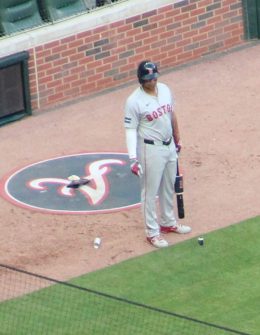
Baseball Tease Day

Rafael Devers

Wings and prayers—Rafael Devers’s tiebreaking two-run blast in the ninth Sunday punched the Red Sox’s ticket to the AL wild card game . . .

Crisis addicts of the world, unite. You won’t get the greatest possible fix for your addiction on what might have been Baseball Chaos Day. In fact, you’re getting a day off for reasonably good behaviour.

But at least you get four of the game’s most deeply storied franchises in the wild card games. That’s something, isn’t it?

If major league baseball fans must continue to bear with the thrills and chills of watching teams fight to the last breath to finish . . . in second place, at least you get to see the Cardinals host the Dodgers in the National League wild card game, and the Red Sox host the Yankees in the American League game. Right?

I know. I know. The crisis junkies among baseball’s fans were spoiling for that National League West tie between the Giants and the Dodgers. They wanted that four-way American League wild card tie so badly they could wrap themselves in it like frozen food in Reynolds Wrap.

The Blue Jays did their absolute best to make it happen when they parboiled the Orioles 12-4 Sunday afternoon. But the Mariners let them down by being unable to get past what was left of this year’s Angels.

Maybe we should have had a hint when Shohei Ohtani started the finish of his surrealistic individual season by hitting Mariners lefthander Tyler Anderson’s third pitch of the game about twelve rows into the right field seats.

Home run number 46, RBI number 100, for the guy who also finishes 2021 with a 3.18 ERA and a 10.8 strikeout-per-nine rate on the mound. If you can’t win it, just start playing spoiler. Ohtani’s surreal season could have finished a lot worse than becoming the Angels’ must-see-television in the injury-created absence of their all-universe Mike Trout.

The Mariners let themselves down, too, after a surprise season of playing slightly over their own heads to get thatclose to postseason-opening mayhem. Those were real tears in young outfielder Jarred Kelenic’s eyes as well as veteran third baseman Kyle Seager’s, when their run came one port short in losing two of three to the Angels over the weekend.

“It wasn’t a team where we were just more talented than the other team every single day,” said Seager postgame, after what may yet prove his last game as a Mariner, “but you had a group that just collectively played together and they collectively tried to win every single night.”

Trouble was, the Nationals couldn’t keep the Red Sox down despite opening an early 5-1 lead against them in Nationals Park. They couldn’t stop Red Sox third baseman Rafael Devers from hitting a hefty solo home run to open the top of the fourth and a five-all-tiebreaking two-run shot in the top of the ninth—with former National Kyle Schwarber, who’d reached on an inning-opening infield error—aboard ahead of him.

But two years after the Nats’ staggering World Series win, at least they could bask a little in the home crowd’s applause for possibly-retiring first baseman Ryan Zimmerman, the last truly Original Nat, the franchise’s first first-round draftee to play in their silks after moving from Montreal, when lifted from the game after the seventh. Even the Red Sox joined the applause unapologetically. Aretha Franklin used to spell that r-e-s-p-e-c-t.

Meanwhile, the American League East champion Rays battled the Yankees scoreless until the ninth. The Yankees even flashed something resembling past glories when third baseman Gio Urshela channeled his inner Derek Jeter in the sixth, chasing Austin Meadows’s foul pop 126 feet from an overshift position and catching it on the track, before he fell in a heap onto an empty spot on the Rays’ dugout bench.

But after Rays starter Michael Wacha pitched one-hit ball over five innings and the Yankees threw six pitchers at the Rays, Aaron Judge—the towering, snaggle-toothed, boyish-looking face of the Yankees—picked the right spot to deliver the first walk-off winner of his major league career.

With Rays reliever Andrew Kittredge freshly installed, after Josh Fleming allowed second and third with one out, Judge ripped a liner off Kittredge’s glove toward second, Tyler Wade dove home ahead of a throw from Rays second baseman Brandon Lowe. Thus the Yankees ducked a coming day’s chaos. “I wouldn’t say we exhaled,” Judge said of it postgame. “We still have work to do.”

Meanwhile, in San Francisco, the Padres’ second-half implosion finished when they all but rolled over and played dead for most of an 11-4 loss to the Giants. Enabling the Giants to become the first in Show ever to win their 107th regular season game while clinching a title on the regular season’s final regular day. Leaving the Dodgers, 10-3 assassins over the NL Central-winning Brewers, to deal with the Cardinals in the league’s wild card game.

That ages-old blood feud between the Giants and the Dodgers would just have to wait for a possible showdown in a National League division series, assuming the Dodgers get past a Cardinals aggregation that managed to do what enough teams couldn’t this year—shake off a few serious injuries and a few tough spells to get to at least the postseason’s entry game.

The Padres made life just a little too simple for the Giants Sunday afternoon. They had no answer for Giants starter Logan Webb—who struck out eight and, at the plate, threw in a line drive, insult-to-injury two-run homer in the fifth—until they finally chased him with three straight base hits in the eighth.

Entering the season it sometimes seemed as if the Padres were anointed the lords of the National League West by default and the Giants were anointed lucky to survive the races at all. But while growing pains, internal dissensions, key pitching injuries, and manager Jayce Tingler’s exposure as an inconsistent in-game thinker came more vivid as the Padres season went deeper, the Giants surprised just about the entire baseball world with their ability to hang with the Dodgers and take it literally to the last day.

Veteran or largely-veteran teams don’t work anymore, right? Baseball’s for the young, right? Letting the kids play means the veterans can’t romp, right? The Giants would like a few words with you. Their veterans played up and had just as much fun as the kiddie corps. And the Giants took their remarkable season right down to the wire to beat the Dodgers out for the title by one game.

“I think we all knew at the beginning of the season, or even dating back to the beginning of spring training, what the projections are and what the industry sort of thought of us as a club,” said Giants manager Gabe Kapler, who’d finally figured out what he couldn’t in Philadelphia—analytics hoists and supports you going in, but you’d better marry that to what’s in front of you inning by inning if you want to get the full job done.

“What I realized,” he continued, “is there are some intangibles that those projections and viewpoints failed to take into consideration.” There’s never a thing wrong with having the most possible information to open a game, but when it’s married unsuccessfully to the moments to come while you play, the offspring is usually disaster.

The Giants, the Brewers, the AL Central-winning White Sox, the Astros, and the NL East-winning Braves have to wait to begin their postseason dances. It’s both poetic and problematic that the party begins with the Olde Towne Team hosting the Empire Emeritus in a win-or-be-gone wild card game.

Poetic because of that similarly ages-old Yankee-Red Sox blood feud. Problematic because of . . . that ages-old feud having its script flipped in this century.

Go ahead and point to all those pennants and World Series rings, Yankee fan. You’ve only got one of those rings to show in the 21st Century. You may have the upper hand in division triumphs but that smothering Yankee dominance is just so 20th Century now. That’s the Red Sox sitting with four 21st Century World Series rings now.

If there’s one other thing by which the Yankees hold an edge over the Red Sox this time around, it’s a fan base that clings to “To err is human, to forgive cannot be Yankee policy” like a religious catechism. Calling for the manager’s perp walk and summary execution after a tough loss? Yankee manager Aaron Boone gets it after a tough inning as often as not.

The man who did what no Yankee manager before him could—lead his teams to back-to-back 100-wins-or-more seasons in his first two on the bridge—and has a .601 winning percentage as a Yankee manager must feel fortunate that his boss’s name is Hal, not George Steinbrenner. Hal Steinbrenner doesn’t have his father’s notorious hair trigger. It’s saved New York’s sanitation corps from barrels worth of washing blood from the streets around the House That Ruthless Built.

Maybe their own long-enough and disastrous enough history has finally given Red Sox Nation what some people thought would have been impossible to fathom—the patience of Job—compared to their counterparts turning to the south Bronx. The AL wild card game hasn’t been played yet, of course, but you don’t exactly hear Red Sox fans saying, to themselves and aloud, “OK, when’s it going to happen” and mean disaster over delight before the game actually begins.

Those two fan bases get only one day’s worth of living on the edge. If the Dodgers treat the Cardinals’ grand old man Adam Wainwright like target practise in the NL wild card game, the Dodger-Giant rivalry gets three games minimum, five maximum to go nuclear.

If the Cardinals treat the Dodgers’ cleverly imported grand old man Max (The Knife) Scherzer rudely, Giantland and Cardinal Country get to relive the 2014 disaster—disaster for the Cardinals, that is. This time, though, the Cardinals won’t have Mike Matheny on the bridge to decide The Book was more important than The Moment. Mike Schildt won’t risk paying through the feathers by allowing a Giant pennant to sail into the crowd atop Levi’s Landing behind right field. I think.

It’s enough to make you feel almost sorry for the White Sox facing the Astros in an American League division series. Even their first postseason meeting since the 2005 World Series the White Sox swept—that was before the Astros were traded to the American League, of course—doesn’t have half the blood boil potential. I think.

Baseball Chaos Day? Sunday’s regular season finales amounted more to Baseball Tease Time. It was fun to watch—but it was hell to pay. But as Hall of Fame scribe Jayson Stark would say, because . . . baseball!