Fixing the Hall of Fame vote, revisited

National Baseball Hall of Fame and Museum

The National Baseball Hall of Fame and Museum. It’s time to look again at how to fix the Hall of Fame’s voting processes.

Last year’s Hall of Fame vote by the Baseball Writers Association of America was troubling enough, for more reasons than just Curt Schilling falling short sixteen votes and Schilling’s demand to be removed from their ballots. This year’s vote could prove just as big a pain in the rump roast.

It’s the last roundup for a few players thanks to the ten-year limit on the BBWAA ballot. Schilling is one of them. Others include some with that storm cloud of actual or alleged performance-enhancing substances still hovering above them. (Good morning, Barry Bonds and Roger Clemens.) It’s also the first roundup for a couple of players above whom the cloud hovers (Alex Rodriguez) or gets pulled (David Ortiz).

Whatever those issues truly are, I’m still convinced we can agree upon this much: Something is still drastically wrong with the Hall of Fame vote. The vote still needs to be fixed. The question remains how to do it. The answers won’t be any more simple now than last year. But they’re worth revisiting.

Last year, the big sub-issue was the blank ballot. There was too much talk about some voting BBWAA members turning in blanks. What I said then still holds: how many blanks came in isn’t as relevant as thinking that, if you do submit a blank ballot, you should lose your Hall vote a spell.

What I didn’t suggest was how long following such a submission. Maybe losing your next two Hall votes should send the message: This isn’t the presidential election where, in some states, you’re entitled to answer to no parties producing candidates to your taste with a) the write-in vote; or, b) the ballot choice “none of these candidates.”

I’m not all that willing to allow the voting baseball writers a write-in vote. Some of their published arguments for or against certain Hall candidates cross into Cloud Cuckoo-Land as it is. But if a voting writer submits a complete blank, he or she should be blanked from the next two Hall votes.

At least, so long as the foolish ten-year limit for BBWAA ballot candidates remains in place. The far better course would be to re-open the eligibility window. It used to be fifteen. Why not make it twenty? You’d run far less risk of ballot logjams that might squeeze a Hall-worthy player out of the running through no fault of his own.

All that said, let me repeat what I wrote last year: Voting for the Hall of Fame isn’t exactly a right. The Hall gave the writers the privilege almost a century ago. With privilege comes responsibility, regardless of any controversies attached to any Hall candidates. The responsibility still includes the one holding the voting privilege doing his or her job—thinking hard, and voting.

It would be far simpler to exercise that responsibility without the ten-year eligibility limit. So here’s hoping the BBWAA thinks that one over and re-opens it to fifteen or twenty years’ eligibility.

Every year, the Internet Baseball Writers Association of America sends its membership a ballot for the Hall of Fame. Yes, it’s only symbolic, since the Hall of Fame doesn’t recognise us as a voting entity. No, the vote isn’t simple, cut, dried, or pre-natal surgery.

When I get my IBWAA Hall ballot, I take some time to think it all over. Then I vote. I even write about how and why I voted for the players I choose. I might now advocate returning the fifteen-year eligibility period or making a twenty-year period for candidates, but the flip side of that coin is that the BBWAA asked for it with the ten-year period—and, if I can do my symbolic job, they can do their real ones.

The ten-year maximum eligibility was imposed in the first place out of concern to do whatever the writers could think to keep those nefarious suspected users of actual/alleged PEDs from getting through. Aside from that jet taking off decades ago (greenies, anyone?), the bullets with which they shot themselves in the proverbial foot traveled far enough to delay or torpedo entirely more than a few legitimate Hall of Fame cases thanks among other things to several jammed ballots.

Kenny Lofton surely wasn’t the only man wondering why the number ten center fielder ever to play major league baseball can’t be in Cooperstown (pending a future Era Committee consideration) except as a visiting customer.

Everybody still with me? (All ten of you?) Good. Now hear (well, read) this. If we really want to fix the Hall of Fame vote, the Hall itself should step up, step in, and decide the BBWAA has played enough games for long enough. It’s time to broaden the Hall vote. It’s time for the BBWAA and the assorted Eras Committees to have company among those conferred the privilege of voting for the Hall of Fame.

Who else should be invited to the party? I had some ideas about that last year, and they’re worth revisiting with a couple of adjustments:

1) The living Hall of Fame players and managers themselves. No one should feel funny about allowing such as Jeff Bagwell, Johnny Bench, Craig Biggio, George Brett, Bobby Cox, Dennis Eckersley, Rollie Fingers, Tom Glavine, Ken Griffey, Jr., Vladimir Guerrero, Rickey Henderson, Whitey Herzog, Trevor Hoffman, Derek Jeter, Randy Johnson, Chipper Jones, Sandy Koufax, Greg Maddux, Willie Mays, Mike Piazza, Tim Raines, Cal Ripken, Jr., Nolan Ryan, Mike Schmidt, Ted Simmons, Ozzie Smith, John Smoltz, Joe Torre, and Larry Walker, to name a few, voting for successors worthy of joining their fraternity.

Some of them get to be part of assorted sixteen-member Eras Committees, of course, which also include “executives, and veteran media members” according to the Hall itself. We can adjust that reasonably: The living Hall of Famers should have to choose whether to vote concurrent to the BBWAA or as members of one or another Era Committee considering overlooked/snubbed BBWAA candidates—but not both.
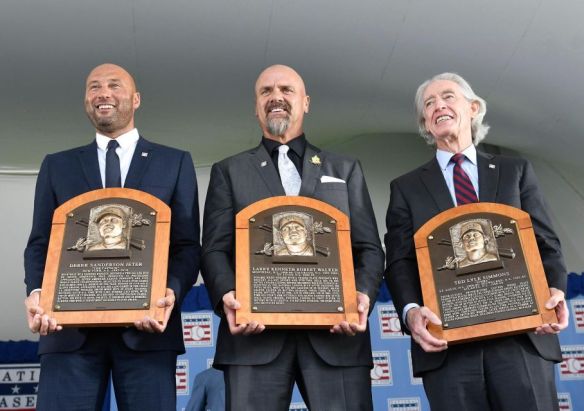
Left to right: Derek Jeter, Larry Walker, Ted Simmons. Why shouldn’t they and their fellow living Hall of Famers have Hall of Fame votes?

2) The living Ford C. Frick Award winning broadcasters, and those currently working in major league broadcast booths. They see as much of the games as the writers do. The Hall would not be disgraced by the like of Marty Brennaman, Joe Buck, Chip Caray, Bob Costas, Jaime Jarrin, Jim Kaat, Brian Kenny, Buck Martinez, Tim McCarver, Al Michaels, Jon Miller, Vin Scully, Bob Uecker, or Suzyn Waldman, among others, having a vote.

3) The statistics mavens, since statistics remain the life blood of baseball.  No, ladies and gentlemen, it would not be a travesty for Allen Barra, Bill James, Keith Law, Rob Neyer, or the folks at Baseball Prospectus, Baseball Reference, FanGraphsretrosheet, and The Elias Sports Bureau to be included in the Hall of Fame vote. So much of their work has provoked re-assessments of several subsequent Hall of Famers as well as incoming Hall candidates. They should not be regarded as voting interlopers.

4) Those writers/historians who were never admitted to the BBWAA ,but who’ve established themselves long and with particular distinctions as blessings to the game. Find us a valid reason for ageless Roger Angell plus Paul Dickson, Richard Goldstein, Peter Golenbock, John Helyar, Donald Honig, Peter Morris, George F. Will, or plenty of the fine excavators of the Society for American Baseball Research, just for openers, to be excluded from the Hall vote. You’ll have a simpler time finding Atlantis.

5) Umpires with above-average ratings. (God and His servant Doug Harvey only know you don’t even want to think of bringing Angel Hernandez or half the arbiters who worked this year’s postseason into the voting fold.) Those people had the second-best views of Hall of Fame candidates for themselves. (The first-best is probably a tossup among several.) The best umpires didn’t just call the pitches or the plays, they developed particular appreciation for players who strove for and achieved Hall of Fame-level excellence.

They would not lack credibility as Hall voters if allowed the chance. Should a voting umpire lose his (or her, in due course?) above-average rating, their Hall vote can be suspended for that year.

6) How about the IBWAA? As in, members not concurrent BBWAA members (we do have a few, including Spink Award Hall of Famer Jayson Stark) but whom the IBWAA leadership deems by their actual works to be worthy of a Hall of Fame vote to exercise wisely and diligently. (Fair disclosure: I’m not an IBWAA leader or officer yet.) The IBWAA is not just another gaggle of fans ranting our heads off. We’ve got some excellent observers, analysts, commentators among us who have earned the chance.

7) Establish a Pioneer Committee. This would be a group considering and giving due to those people—players, executives, statisticians, others—whom we’d consider to have changed the game profoundly in ways other than how they played or managed or administered the game. (It wouldn’t have let Marvin Miller wait until death did he part for his well-deserved Cooperstown enshrinement, either, if it lived while he did.)

The Pioneer Committee could begin with considering Curt Flood, who kicked the door to free agency open just enough with his reserve clause challenge. It could consider Andy Messersmith, who shoved the door open all the way by finishing what Flood started and prevailing right to the end. It could consider Tommy John, who enjoyed a long, distinguished second act after undergoing the first of the ligament-replacement elbow surgeries that’s long since borne his name.

They didn’t quite post Hall of Fame playing careers, but they all changed the game profoundly, and irrevocably. There should be a place in the Hall of Fame for all three.

This Pioneer Committee should also consider those such as Allan Roth, arguably the godfather of deep statistics. Bill James, who picked up where Roth left off, all but invented sabermetrics, and sired subsequent generations of deeper analysts many of whom came to play key roles in re-developing baseball organisations. Bob Kendrick, whose administration and representation of the Negro Leagues Baseball Museum does invaluable work advancing the Negro Leagues legacy not as mummified artifacts but as a just portion of living, breathing major league baseball history.

If those are unworthy of consideration for having Hall of Fame votes, remember that my Antarctic beach club has yet to find a buyer.

8) Dump once and for all the prejudice against first-time votes/first-ballot Hall of Famers. If you think a player or manager belongs in the Hall of Fame, vote him in the first time. (Again, raising the eligibility limit back to fifteen years or all the way to twenty years should help.) You don’t need reminders of how many Hall of Famers you assumed to be locks waited five or more times to get their due. Or, of how often you wrote fuming over that sad fact.

People still think it’s more than a little surreal, if not insane, that Yogi Berra, Craig Biggio, Joe DiMaggio, Whitey Ford, Hank Greenberg, Lefty Grove, Vladimir Guerrero, Willie Mays, Juan Marichal, and Cy Young aren’t first-ballot Hall of Famers. Even if things worked out well enough for Ford that he got in on his second try, the following year—next to his old running mate Mickey Mantle, on Mantle’s first.

By now you’ve probably noticed no mention of Joe and Jane Fan into the Hall vote discussion. There’s one bloody good reason not to even think of handing them a Hall vote: the hash they’ve made over All-Star Game votes, too many times, either with ballot-box stuffings or choosing to confer gold watches.

The All-Star Game vote needs a complete overhaul, too, though that’s still a subject for another day for now. But do you really want to know how much worse Joe and Jane Fan would make the Hall than the Today’s Game Committee that decided Harold Baines deserved a platinum watch?

Portions of the foregoing essay have been published previously.—JK.
Marvin and Ted, a love story revisited

Marvin Miller, Joe Torre

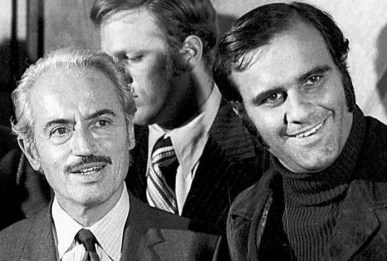
Marvin Miller (left) with then-Cardinals catcher-turned-third baseman Joe Torre at a 1972 press conference.

Yes, Marvin Miller decided before his death that being elected to the Hall of Fame was no longer worth it. Not even if it was no less than his due. “At the age of 91,” he said, “I can do without farce.”

But there’ll be a nice synergy in Miller and catcher Ted Simmons being inducted into Cooperstown Wednesday, along with two more from last year’s class, Derek Jeter and Larry Walker. Miller and Simmons were joined in an unlikely way early in Simmons’s career.

The pan-damn-ic then told the new Hall of Famers, “Wait ’till next year.” Wherever he reposes in the Elysian Fields, perhaps Miller has bumped into Charlie Watts, the lifelong drummer for a band that once sang, “You can’t always get what you want/but if you try sometimes, you just might find/you get what you need.”

What Miller and Simmons needed from the last-convened Modern Era Committee in 2019 was twelve votes minimum. Miller got the twelve, one shy of Simmons’s thirteen. Both men deserved Hall of Fame plaques long enough before they finally got them. And one inadvertently provided the other with invaluable intelligence.

At age 22 Simmons found himself the Cardinals’ regular catcher entering spring training 1972. Self-aware enough, Simmons decided his emergence should be worth more than a $6,000 raise. He refused to sign a new contract that would pay him one penny less than $30,000. The Cardinals’ general manager, Bing Devine, said not so fast, son, holding the team’s offer to somewhere in the lower $20,000s.

That was while Curt Flood’s reserve clause challenge awaited its day in the Supreme Court. (Flood, alas, would lose there, but he’d kick open a door that refused to be shut again.) Simmons started the reason without a signed new contract. The Cardinals renewed him automatically as the rules of the time allowed.

Everyone in baseball trained their eyes upon the sophomore catcher who belied the usual athletic stereotypes. (Among other things, Simmons would serve active and knowledgeable time on the board of a St. Louis art museum in due course.) They also trained their eyes on the reserve clause abused so long by the owners to bind their players like chattel, until they damn well felt like selling, trading, or releasing them.

Simmons played his way onto the National League’s 1972 All-Star team as its backup catcher. Once he went to Atlanta for the game, Devine rang his hotel phone post haste. Would Simmons kindly accept a mere $75,000—as in, the $30,000 he wanted for 1972 in the first place, plus $45,000 for 1973?

Miller watched Simmons a little nervously, too, knowing the kid pondered taking it to court himself. He understood completely when Simmons accepted Devine’s new proposal. But Simmons handed Miller intelligence you couldn’t buy even on the black market: Those  owners would rather have handed a barely-seasoned kid $75,000 than let any arbitrator get a look at the reserve clause even long distance through a telescope.

Miller had once been a United Steelworkers of America economist. After a players committee including two Hall of Famers (pitchers Robin Roberts and Jim Bunning) and two respected other veterans (pitcher Bob Friend, outfielder Harvey Kuenn) chose him to run their embryonic union, Miller won the rest of the players over by being just who he was—a brain, not a bludgeon. It didn’t hurt that Miller instilled an open-door policy: “It’s your union,” he insisted.

Miller didn’t follow the stereotypical union playbook, either. He may have kept the players’ eyes on the ultimate prize, but he knew and convinced them reasonably that it had to be done step by step, from pension and clubhouse issues forward. Even as he told them, as often as need be, “You are the game. Without you, there is no game.”

His two signature triumphs came almost by accident. The first was when then-Athletics owner Charlie Finley reneged on a contracted-for insurance payment to Hall of Fame pitcher Catfish Hunter. Hunter filed a grievance and won. He also became subject of a game-wide bidding war that reached the millions and ended with him taking the third-most lucrative offer put in front of him.

Why only the third? Because the Yankees (whose representative Clyde Kluttz was the former A’s scout who signed Hunter for the A’s in the first place) were willing to divide the dollars Hunter’s way, right down to a certain amount put into an annuity to guarantee his children’s education. It was still enough to make Hunter a rich man on a fair, open market.

But Hunter was a single, isolated case. His triumph didn’t mean the end of the reserve era just yet. To do that, it took then-Dodgers general manager Al Campanis making contract talks far too personal for pitcher Andy Messersmith’s taste in spring training 1975. Messersmith promptly refused to talk to anyone below team president Peter O’Malley. He also refused to sign any contract that didn’t include a no-trade clause.

The Dodgers merely harrumphed that they’d never given no-trade clauses before and they weren’t about to start now. Messersmith said, essentially, that he’d rather be caught naked in a barracuda school than let the Al Campanises dictate his baseball future. He, too, refused to sign a 1975 contract. The Dodgers, too, renewed him automatically under the old rules.

Messersmith pitched on and pitched very well. (He’d lead the National League in starts, complete games, and innings pitched, while throwing seven shutouts and finishing second with a 2.29 ERA.) He withstood the snark of both indignant, ignorant fans and indignant, artery-hardened sportswriters.

“Every time he took the ball,” Simmons once said, “everybody in management wanted him to fail and everybody from the players wanted him to succeed.” Just as long as they didn’t have to bat against him. (The National League’s hitters batted a mere .213 against Messersmith in 1975.)

By that August, Messersmith found himself receiving two things: continuing Dodger offers for then-glandular dollars, and an education from Miller about the reserve clause itself. He was also the only active player left that season who hadn’t signed a 1975 contract. By September, the Dodgers offered him a pot of $540,000 for three years including 1975. “Where’s that no-trade clause?” Messersmith retorted, essentially. Without it, he wouldn’t budge.

When Peter came up with the dough, I was adamant. The money was incredible, but they wouldn’t bring the no-trade to the table. I’d gotten stimulated by Marvin and Dick [Moss, the players’ union’s general counsel]. Now I understood the significance of what this was all about. I was tired of players having no power and no rights.

Ted Simmons

Now a Hall of Fame catcher, Ted Simmons as a Cardinal helped Miller build his leverage against the old reserve clause abuse.

That August, too, Messersmith agreed to file a grievance seeking his free agency if he remained unsigned. The season ended; Messersmith’s stout pitching alone couldn’t keep the Dodgers from finishing second in the National League West. He filed the grievance.

(Arm-and-shoulder-troubled pitcher Dave McNally, technically unsigned but intending to stay retired after leaving the Expos in June, agreed to join the grievance in August, upon Miller’s persuasion—as insurance, in case the Dodger dollars finally seduced Messersmith, who refused to be seduced by dollars alone.)

The owners had no essential argument better than “this is the way we’ve always done it.” The evidence in the grievance included a newspaper article, in which penurious Twins owner Calvin Griffith basically admitted proper reserve clause application allowed a player’s free agency after one contracted season and a second team option season and no more.

Messersmith won. (The owners promptly fired arbitrator Peter Seitz.) The Lords of the Realm author John Helyar described Simmons as “choked up” when he said, “Curt Flood stood up for us. [Catfish] Hunter showed what was out there. Andy showed us the way. Andy made it happen for us all.”

Miller was smart enough not to demand immediate free agency for all. Even he recognised teams had certain rights in players they developed, even as he insisted baseball players deserved the same rights as any other American—from the greenest labourer to the most seasoned executive—to test their value on a fair, open job market when no longer under contract.

It did far more for the good of the game than the artery-hardened hysterics of 1975 would have had you believe, especially when they mourned the death of “competitive balance.” Pace Mark Twain, the rumours of that death would prove greatly exaggerated. More teams have won the World Series since the Messersmith triumph than won the Series before it.

It’s not the players’ fault that the owners since have tried everything in their power, and sometimes beyond it, to try putting them back into their “places.” (The 1980s collusion, anyone? Isolated front-office executives willingly handing the gold to players who’d barely proven themselves worth copper? The 1994 strike born of the owners insisting the players stop them before they overspent/mis-spent/mal-spent again? Tanking?)

And they said free agency would destroy the undestroyable game. If you’d asked former commissioner Fay Vincent about that, he’d tell you what he told ESPN’s Jerry Crasnick in 2009: Blaming Miller for “destroying” baseball was “like blaming Thomas Edison for putting the candle industry out of business,” which didn’t happen, either.

Perhaps the only thing more astonishing than the owners’ post-Messersmith chicaneries was the years passing by with the idea of Miller in the Hall of Fame not so popular with his former clients (he left the union in 1982) as his work on their behalf. No less than Hall of Famer Reggie Jackson said the Hall of Fame should be for players only. You wonder what he thought when the Hall inducted Effa Manley—co-owner of the Negro National League’s Newark Eagles—as a pioneer in 2006.

“Instead of pointing to the sky,” the late Jim Bouton told Crasnick, referring to gestures often made by players crossing the plate after hitting home runs, “today’s players should be pointing to Marvin Miller.” As also to Curt Flood, Ted Simmons, Catfish Hunter, Andy Messersmith, and others who collaborated to do the once unthinkable.

Simmons himself went on to enjoy a career that should have gotten him elected to Cooperstown. His peak value matches that of the average Hall of Fame catcher. He went one and done in his only year’s eligibility on the Baseball Writers Association of America’s Hall ballot. Exactly why never really seemed clear. If he was a better hitter than catcher, the metrics simple and complex alike still show him the number eleven catcher ever to strap it on.

Maybe it was residual ill will over Simmons’s late-career tangle with Whitey Herzog. (Herzog traded him to the Brewers citing defensive shortcomings, after he declined moving to another field position. Yet Herzog eventually became a member of the Modern Era Committee that finally elected Simmons.) Maybe they had a problem marrying baseball’s most honorific museum to an art museum board member.

Miller died in 2012 with only one other regret: not having been able to convince the MLBPA to revisit the 1980 pension realignment that froze players with short careers prior to 1980 out of the pension plan. Players since 1980 need only 43 days major league time to receive a pension and one day to receive health benefits.

The only thing the frozen-out have received since comes from a 2011 deal between then-commissioner Bud Selig and then-MLBPA leader Michael Weiner: $625 per quarter for every 43 days’ major league service time for up to four years. Before you say that’s something, at least, be reminded that they can’t pass those dollars to their loved ones if they pass before the final dollars are collected.

The MLBPA leadership since Miller’s departure has little to no known desire anywhere in its ranks to redress that or anything else involving the pension freeze-out. Attrition has reduced the number of affected players from over 1,100 to just over 600. Would anyone with leverage in the game now think to resolve Miller’s regret?

“Nobody has picked it up,” former Twins pitcher Tom Johnson, one of the affected, told me last December. “Don Fehr [Miller’s successor] didn’t pick it up, [present MLBPA director] Tony Clark hasn’t picked it up, nobody has picked it up and cared about it. I wish they’d go back and listen to that.”

Listening was one of Miller’s strong suits. “It took forever for each of us to get in,” Simmons has said. “He was the real deal. During my career, Marvin was the Players Association. He was an incredible man who was very special to me specifically. It’s an honor to be inducted with him. It’s bittersweet for his family but I’m lucky I can arrive in the flesh.”

Simmons has also said he hoped restoring the Hall inductions would be a stride in the right direction of returning life to something resembling normalcy. Surely he knows that “normalcy” doesn’t always mean without hiccups or pratfalls, both of which baseball has had in abundance for too long.

Portions of this essay have been published previously.

Call him anything, but don’t call him a thief

Albert Pujols, Mike Trout

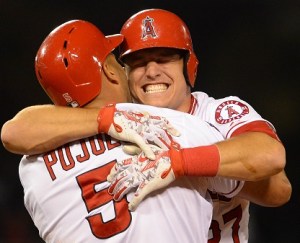
This wasn’t just a celebratory hug after Pujols walked a win off with a sacrifice fly; Albert Pujols made Mike Trout a friend as well as a protege.

When the Angels decided it was time at last to let Albert Pujols go as gently as possible into that good gray baseball night, I wasn’t the only baseball observer to say it was heartbreaking. I’m sure I wasn’t the only one, either, to say his decline following his first Anaheim season was just as heartbreaking.

But I’m still astonished, if not sickened to my stomach, from seeing assorted social media denizens speaking as one such baseball group member did after the Dodgers dropped more than a few jaws by signing Pujols as a bench and very occasional role player for the rest of the season.

“Where are they going to put him? There’s [sic] no [designated hitter] in the NL, and hopefully there never will be one,” said one in particular. “He can afford a rocking chair with all the money he stole from the Angels.”

Stole?

Bad enough the gentleman writing those words clings to one of baseball’s most nebulous and negative traditions. (Pitchers overall have hit .158/.207/.199 from the end of the 1910s until the end of 2020, for a big fat .406 OPS. As of this morning, they’re hitting .102/.136/.137 in 2021, for a whopping .273 OPS.)

But “all that money he stole from the Angels?” Rest assured, this gentleman probably isn’t even close to the only fan who feels that way. He just so happened to put it into cold print,  and I just so happened to catch it in cold print.

What he and anyone else thinking like that is really saying is that a player ground down as Pujols was because of injuries is nothing but a common thief. Well, I heard and saw Yankee fans and observers say similar things about now-retired Jacoby Ellsbury, too. As if they held their teams at gunpoint for x number of seasons.

If you thought Joe and Jane Fan believe losing is practically mortal sin, there are times that seems nothing compared to what they seem to think about being injured on the job.

When the Yankees gave up the ghost and elected to pay Ellsbury the $26 million left on his contract not to play for them any longer, I wondered aloud what it might have done to a man knowing he couldn’t do his job because his body kept him from doing it no matter what his heart and mind desired—and, because it made him a hate object among the witless.

“It’s as if being injured on the job at all equals a character flaw, especially if you happen to be paid a phenomenally handsome salary,” I wrote then. “On the flip side, it’s as if being paid a phenomenally handsome salary equals some sort of immunity to earthly harm. Here’s a bulletin for you: Handing Clark Kent a nine-figure payday doesn’t make him Superman.”

Ellsbury was talented and tenacious (and a two-time World Series champion) when he could play. He wasn’t a Pujols-level talent, but he could and often did break a game open with his own skill set, too. Yet one of the reasons Ellsbury wouldn’t even think about returning to the Red Sox when he hit free agency was because, appropriately, he was fed up over incessant clubhouse whispers that he took too much of his own sweet time recovering from injuries.

“It’s hell if you do and hell if you don’t for a professional athlete,” I wrote then, too. “Return too soon from an injury and you risk re-injury; return not soon enough (in whose sound medical opinion?) and you risk being dismissed as a fragile goldbrick.”

For Joe and Jane Fan, the paradox which is borderline hypocrisy is that they put on pedestals ballplayers who play through injuries regardless of whether that might lead to further injury, as it usually does—but then Joe and Jane Fan become the first to denounce the big jerks for playing through the earlier injuries only to incur bigger and more costly ones.

Pujols’s problems in Anaheim began when he developed plantar fasciitis in one of his heels during spring training 2013. He’d had a first season with the Angels in 2012 that resembled a down season on his terms but a career year for mere mortals.

Then, in late July 2013, he suffered a tear to that bothersome area during a game against the Athletics, while running out a ninth-inning base hit off Grant Balfour. He rehabbed the foot and heel as best he could until the Angels, out of contention by then, shut him down for the rest of that season.

It never got better for him. What nobody outside the Angels clubhouse really knew was that if his feet and legs could drain him, nothing and no one could drain Pujols’s iron will.

“He could easily have shut down a couple of these years. But just the toughness is off the charts,” said Mike Trout to The Athletic‘s Fabian Ardaya in 2019. “A lot of guys would have shut it down for good. He plays banged-up, doesn’t complain. I think that’s what people don’t see.”

“I’ll remember,” said ESPN writer Alden Gonzalez, after the Angels finally designated Pujols for assignment, “that even though his lower half was shot and he wasn’t quick enough to get around on the devastating stuff pitchers throw these days, he still showed up early, still spent hours in the training room to get ready for games, still took batting practice with intent, still crouched really low on defense and still looked for any opportunity to take an extra base. He might not have been productive, but it wasn’t for lack of effort.”

Trout was right. Showing up at the ballpark early and spending hours in the training room despite the physical sappings is what Joe and Jane Fan didn’t see. Maybe they didn’t want to see. Maybe they couldn’t believe the guy who’d played as off the charts as Pujols did as a Cardinal was forced into a far steeper decline phase to his career than he should have been.

Maybe they still clung to the illusion that a nine-figure payday in and of itself could keep a man Superman despite his body turning him into Clark Kent.

In only one way did Pujols have himself to blame for the outside perception that he was just going downhill at warp speed no matter how much money he was paid. He wasn’t the type to lament continuously over his lower body’s continuing betrayals. So much so that, when he finally did speak up about it, in the same 2019 Athletic piece, Joe and Jane Fan didn’t and wouldn’t listen.

“It’s made my move here so tough,” Pujols said to Ardaya then. “I don’t wish that anyone would have had those lower-half injuries, because I know that when I’m healthy, I know what I can do. To come over here and just be pounded by injury after injury, year after year . . . This game is tough when you’re at 100 percent with no injuries. Then imagine dealing with knee, heel, elbow, everything. It’s just tough, man.”

Pujols isn’t the only baseball player who ever kept believing to his soul that all he had to do was return to reasonable health to be what he once was. He isn’t the only player who’s learning the hardest way possible that there comes a time when the badly compromised body married to your age just wouldn’t let you be that anymore.

But not all such players get paid $255 million over ten years, whether they’re future Hall of Famers or future Hall of Shamers.

Nobody held the Angels at gunpoint, either, to offer Pujols that deal in the first place when nobody else was considering it, including the Cardinals (who didn’t until Pujols was practically taking measurements for his Angels uniform), or to keep him on the field when his body was clearly and cruelly draining him faster than a proper decline phase should have done.

Writing in The Inside Game last year, Keith Law came right out and said the Angels were foolish to keep suiting Pujols up even as a designated hitter, despite that iron will, because his body compromised him too deeply.

“If you have already paid for something,” Law wrote, nodding toward the guaranteed deal, “your choice of whether to use it should be a function of whether you want or need to use it, not a function of the money that is already gone regardless of what you do.” Don’t even go there about “eating money” if that’s what the Angels had elected to do. “Major league baseball player contracts are guaranteed,” Law wrote. “[T]here is no way to un-eat that meal.”

It’s one thing to argue against guaranteed long-term baseball contracts in all but the most unique circumstances. It’s something else entirely to argue against one retroactively because the player who signed one got hit unexpectedly with one of the worst injury bugs in baseball history a year after he finished his first season under such a deal.

The clumsiness with which the Angels parted with Pujols speaks only further ill of a team whose administrative culture makes a pratfalling putz resemble Joe DiMaggio roaming center field. The Dodgers’ willingness to bring him aboard even as a part-time bench player, perhaps an occasional first base fill-in, would look a lot better if there wasn’t even the momentary sense that it was a concurrent chance to stick it to their down-freeway rival.

It won’t cost the Dodgers a dollar beyond the pro-rated minimum major league salary to give Pujols one more chance at possible postseason triumph and a possible third World Series ring that the Angels couldn’t. (The Angels’ chronic inability to build a viable pitching staff has harmed them several years; if the Pujols deal tied their hands financially, the Angels haven’t been brilliant at drafting pitching or even acquiring low-cost/high-enough-performance arms, either.)

Personally, I’d hoped Pujols would surrender to his body’s betrayals and call it a career sooner, if only because he wasn’t really Albert Pujols anymore and hadn’t really been for too long through no fault of his own. I wanted him to be as close to Hall of Famer Mike Schmidt as possible, Schmidt having retired in May 1989 because, essentially, he didn’t believe he was Mike Schmidt anymore.

Such Hall of Famers as Willie Mays and Steve Carlton couldn’t do it, either; we saw their baseball ghosts a little too long. Hall of Famer Sandy Koufax did do it when he was still ten dimensions beyond the top of his game: “I don’t regret one minute of the past twelve seasons, but I might regret the season that was one too many.” Even more so than Schmidt, Koufax left the world wanting more, not less.

Whether mere mortal or Hall of Fame immortal, not every player is as self-aware as Koufax and Schmidt. But there’s another kind of self-awareness that imposes a cruelty of its own. It’s the kind Pujols has, the kind that kept him grinding his way back in search of the trans-dimensional greatness he once evoked. The kind that guaranteed him a berth in the Hall of Fame before his body left him nothing but his will.

Knowing what we should know now of that stubborn will no matter what Mother Health and Father Time declared otherwise, we should accept that Pujols earned the chance to leave the field with whatever remains of his professional dignity intact. Maybe he has one more game- or set-changing swing left in him. Maybe he doesn’t.

But calling him the thief who stole all that money from the Angels, however, is way out of line, Joe and Jane Fan. It exposes you as the couple too witless to comprehend just what Pujols put himself through to live up to that contract no matter how often his body told his heart and mind where to shove it.

La Maquina, al finale?

Albert Pujols

That was last fall: Pujols tying Willie Mays on the all-time home run list. This is Mays’s 90th birthday, today: the Angels announced they designated the sadly-declined Pujols for assignment.

Late in February, Albert Pujols’s wife posted a social media message suggesting that, when his mammoth contract with the Angels expired after this season, so would her husband’s playing career. That option may not belong to him anymore.

The Angels jolted baseball when they announced Thursday that they designated the Hall of Famer in waiting for assignment. Once upon a time, timing was Pujols’s ally at the plate and beyond. Announcing the designation on Willie Mays’s 90th birthday, of all days, just made it sting that much more.

It had to. No less than Mays himself sent Pujols a text message last year saying, “It’s your time now. Go get it.” Meaning, go meet and pass Mays’s 660th lifetime home run. Pujols met 660 last September and passed it with 661 five days later. The Machine had six more bombs in him before the Angels finally gave up his ghost.

Let’s get this out of the way right now: Pujols didn’t ask to have maybe the most heartsickening, prolonged decline in the game’s history.

It wasn’t his idea to have a down season his first time out as an Angel. (Codicil: a down season for Pujols in 2012 was still a career year for more players than you can fit aboard two Dreamliners.) He didn’t ask for plantar faascitis in his heel the following year to begin a punishing series of lower half injuries that drained everything he had left.

ESPN writer Alden Gonzalez, who’s covered Pujols for most of his Angels life, saw up close and personal what Pujols put himself through in what we now know was a futile attempt to find the St. Louis smash buried somewhere inside what was left of him now.

“I’ll remember,” Alden says, “that even though his lower half was shot and he wasn’t quick enough to get around on the devastating stuff pitchers throw these days, he still showed up early, still spent hours in the training room to get ready for games, still took batting practice with intent, still crouched really low on defense and still looked for any opportunity to take an extra base. He might not have been productive, but it wasn’t for lack of effort.”

The stubborn, proud spirit was too willing, but the body was likewise too ready to tell him where to shove it at long enough last. No recent play was more emblematic than the ground ball he hit to the hole at shortstop but didn’t run out—because he couldn’t. He’d have been better off taking a skateboard out of the box up the line; he was thrown out on a lob across the infield before he was even halfway up the line.

The only tool Pujols’s body left alone was his still-devastating long ball power. Gonzalez’s ESPN colleague David Schoenfield is right to observe that’s not enough to stay aboard a major league roster. Not even though Pujols remained mostly as difficult to strike out as he always was. (His average per 162 games: 74; or, a single punchout every other game.)

But he’s all but quit taking walks; he rarely hits for extra bases beyond home runs; and, no matter how ironed up his will is, he hasn’t been the first base defender he once was for what seems eons. His Cardinals era was off the charts enough to keep his lifetime statistics showing him a plus first baseman by 95 runs saved above his league average. Fortunately.

Aside from what it did to him as a man, Pujols’s injury-instigated and perpetuated decline robs him of sitting atop the rest of the Hall of Fame’s post-World War II/post-integration/night-ball era first basemen according to my Real Batting Average. (Total bases + walks + intentional walks + sacrifice flies + hit by pitches, divided by total plate appearances.)

First Base PA TB BB IBB SF HBP RBA
Jim Thome 10313 4667 1747 173 74 69 .653
Jeff Bagwell 9431 4213 1401 155 102 128 .636
Albert Pujols 12486 5955 1334 313 115 111 .627
Willie McCovey 9692 4219 1345 260 70 69 .615
Harmon Killebrew 9833 4143 1559 160 77 48 .609
Orlando Cepeda 8698 3959 588 154 74 102 .561
Eddie Murray 12817 5397 1333 222 128 18 .554
Tony Perez 10861 4532 925 150 106 43 .526
HOF AVG .597

Had his career ended when his years with the Cardinals did, Pujols would have retired with a .708 RBA. Had he not been betrayed by his heels, feet, and most of the rest of his lower body as an Angel, he might still have finished with a higher RBA than Jim Thome did. And none of those Hall of Fame first basemen are as far above their league average for runs saved at the position as Pujols. (Eddie Murray’s +61 are 34 below Pujols.)

Pujols’s berth in Cooperstown is solely a question of when he retires as a player officially. No matter how sad his injury-instigated, protracted decline, he secured that in St. Louis to devastating effect. If the Angels don’t work a trade out now, and there’s no assurance they’d find a trading partner willing to part with viable talent in exchange for a ghost, there’s no guarantee another team would sign him for a pro-rated minimum salary as a free agent, either.

His longtime Cardinals manager Tony La Russa came out of his Hall of Fame retirement to take on the White Sox—but La Russa has already shown trouble handling today’s experimental rules as it is. No matter how much he still respects and loves Pujols, La Russa isn’t going to convince his bosses to take the ghost over young and establishing designated hitter Yermin Mercedes.

The DHs in Tiger uniforms are hitting this year at levels low enough to make Pujols continue resembling his Hall of Famer-to-be old self—but the Tigers have an aging incumbent themselves, named Miguel Cabrera. Hands up to anyone and everyone who thinks that even the current Tiger regime would hold with manager A.J. Hinch sending Cabrera to the pine in favour of Pujols now.

Purely in baseball terms, designating Pujols for assignment makes too much sense. Especially with Jared Walsh standing in for injured right fielder Dexter Fowler but far better suited to play first base. Especially with Shohei Ohtani more than capable of holding a DH slot on the days he doesn’t pitch. Pujols’s designation means the Angels don’t have to let Ohtani bat on his pitching days; they can save him for the final role Pujols can’t handle anymore.

But in human terms, this is a heartbreak. Especially for a man so community and charity oriented that you could believe the Angels well enough, even committing boilerplate, when owner Arte Moreno’s formal statement praised Pujols in character terms, as a man whose “historical accomplishments, both on and off the field, serve as an inspiration to athletes everywhere, and his actions define what it means to be a true superstar.”

If only the announcement didn’t have to happen on the 90th birthday of Mays, a man Pujols respects and maybe even loves almost as much as he loved and respected St. Louis icon Stan Musial. This may have been the worst case of bad timing in baseball since . . .

Maybe since Brad Lidge’s bad timing hanging Pujols a breaking ball to demolish for a National League Championship Series Game Five-tying three-run homer in 2005. Or, the bad timing of Rangers relievers Alexi Ogando, Mike Gonzalez, and Darren Oliver gifting Pujols three meatballs to destroy beginning in the top of the sixth in Game Three, 2011 World Series.

When Hall of Fame pitcher Tom Seaver was traded to the Reds from the Mets, following contract extension talks that went from difficult to scurrilous thanks to Mets management and certain sports columnists smearing him, A. Bartlett Giamatti—then president of Yale University, as opposed to his eventual higher calling as a baseball commissioner—wrote in Harper’s, “[A]mong all the men who play baseball there is, very occasionally, a man of such qualities of heart and mind and body that he transcends even the great and glorious game, and that such a man is to be cherished, not sold.”

If Giamatti had lived to see Pujols, he might have thought likewise, ending with “such a man is to be cherished, period.” Pujols wasn’t sold, but half his body sold him out. Whether you called him El Hombre (the nickname he hated, insisting there was only one Man and his name was Musial) or The Machine (La Maquina in his language), he didn’t deserve having his gears stripped into a long, painful, sad decline.

Appreciating Willie, at 90 and beyond

Willie Mays

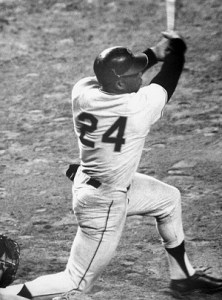
Willie Mays hits his 500th career home run in the Houston Astrodome, 1965.

I started watching baseball in earnest with the 1961 World Series, when I was pushing six, and the almighty Yankees faced the almost all-surprising Reds and beat them in five. Something about the game put a vise grip upon me that hasn’t let go in the years and over the changes good and bad since.

The Reds’ Frank Robinson was named the National League’s Most Valuable Player for 1961. Willie Mays finished sixth. As I would learn in due course, Robinson won the award as much because he had an MVP-type season as because he played on a pennant winner, but there were better MVP cases in the 1961 National League by Mays and fellow Hall of Famer Hank Aaron.

Then they finished inventing the Mets. I was no longer stuck with having to think purely about the Yankees in New York, since the National League was coming back into business there. (Assorted family members, especially my maternal grandfather, began telling me about the former exploits of the Dodgers and the Giants.)

And I’d get to see Willie Mays, even if on television alone. His Giants came to play my embryonic Mets in their former cavern, a big, horseshoe-shaped, rambling wreck of a ballpark known as the Polo Grounds. They played against each other there nine times in 1962. The Giants didn’t visit their former home until 1 June, but it certainly felt like a visit to the old neighbourhood—they swept the Mets in four.

I got to see the first of those four. Mays came exactly as advertised, playing center field as though he were part of a track meet; hitting a home run off future Giants manager Roger Craig the other way in the fifth, about 390 feet from the plate and into the right field seats; taking third from first on a seventh-inning single by another future Giants manager, Felipe Alou.

The bad news is that even a Willie Mays who leaves magnificent first impressions just warming himself up in the on deck circle can have days where someone else makes bigger impressions in the game. Fellow Hall of Famer Willie McCovey hit two bombs for the price of one Mays mash. And even McCovey didn’t steal the day’s headlines.

That theft belonged to Jim Davenport, a left-side infielder who wasn’t quite that serious a plate threat, squareing off against Mets reliever Willard Hunter two batters after Mays scored, with the bases loaded and one out. Davenport hit one not too far short of where Mays’s bomb landed in the right field seats.

It made the score 9-1, the Mets’ lone run to that point courtesy of Rod Kanehl hitting Giants starter Billy Pierce for a leadoff jack into the left field seats. The Mets managed to chase Pierce in the eighth with an RBI double (Charlie Neal) and a two-run single (Frank Thomas) back to back, before Felix (Wrong Way) Mantilla greeted Giants reliever Bobby Bolin rather rudely with a two-run homer.

That was the last of the day’s scoring. I’m reasonably certain that that was not the game during which Mets manager Casey Stengel visited Craig at the mound with McCovey due to hit and asked, “How do you want to pitch him—upper deck or lower deck?”

The Giants banked the 9-6 win. I didn’t get to watch the next three games, alas. Perhaps just as well, since the Giants outscored the Mets over those three games 22-6, including a doubleheader in which the scoring difference was 16-6, Giants.

Mays had himself a grand time playing baseball in New York for the first time since the Giants went west four years earlier. In game one of that doubleheader he opened with an RBI single and a run scored on a sacrifice fly in the first and continued with a two-run homer in the second, though somehow the Mets kept him quiet in the nightcap.

Then, he had one more homecoming message to deliver in the fourth game of the series, taking one of the Mets’ two Bob Millers (the righthanded one) into the left field seats with one out in the sixth.

The Giants met the Mets nine times in New York in 1962 and beat them seven times. Mays had himself an .851 OPS during those nine games. He was a lot more rude a house guest of the National League’s other newborn team in 1962, the Houston Colt .45s: despite Colt Stadium being a whole pitcher’s park, Mays battered the Colts for a 1.214 OPS in 1962.

Mays was 31 years old in 1962. But he still played as though still ten years younger. He had that stance with his feet about half a foot forward and aft of home plate, the stride starting his swing where you saw his front foot step forward about another full foot plus, swinging down and across his midsection, not extending his muscular forearms until a split second before contact, the bat sweeping a little up going around.

The stride and swing that delivered 3,283 Show hits including 523 Show doubles and 660 Show home runs, and leaves open for question even now how many of his 140 Show triples came mostly from his bat or from his legs, considering how relentless a baserunner he really was.

“Willie had great instincts on the bases and he was always aggressive,” Pete Rose has said of him. “I was an aggressive baserunner also. I developed my baserunning skills watching Willie Mays play.” An interesting recollection, that—Mays took extra bases on followup hits 63 percent of the time he reached base, meaning he took more than one base on such a hit. Rose did it 49 percent of the time.

“[O]n a single, it would have been strange if he didn’t go first to third,” Rose’s teammate, Hall of Famer Johnny Bench has said. “He had one of the best turns rounding second or third you could possibly have. With his agility, he made the most perfect turns.”

Mays’s legs did as much for him playing center field as they did on the bases. He thought nothing of starting in as shallow a positioning as he could get away with before reading, hunting down, and snaring a drive. “Curt Flood was the best I’ve ever seen against the wall. He was better than Willie against the wall,” Flood’s Cardinals teammate Tim McCarver has said. “But Curt played deep. Willie didn’t play deep; he played shallow. Willie never went to the wall. Willie was the wall.”

Hall of Fame pitcher Bob Feller had a dugout seat with the rest of the Indians during the 1954 World Series, including and especially for the catch for which Mays remains remembered singularly, the run to the absolute rear of the Polo Grounds’ right center field, some 460 feet from the plate, to haul down Vic Wertz’s drive.

To everyone else in the house—including a writer named Arnold Hano, sitting in the bleachers and writing A Day in the Bleachers about that game and that play—the play seemed God’s next to last miracle. (My last miracle, said George Burns as God in a 1977 film, was the 1969 Mets.)

“That really wasn’t that great of a catch,” the curmudgeonly Feller once said. And why? “As soon as it was hit, everyone on our bench knew that he was going to catch it . . . because he is Willie Mays.”

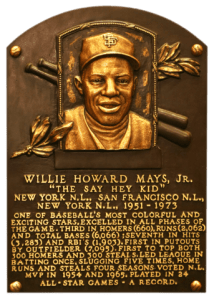
Willie Mays Hall of Fame

Wouldn’t you love to know even now just whom the meatheads were that denied Mays first-ballot Hall enshrinement?

When Ted Williams was inducted into the Hall of Fame in 1966, he name-checked Mays respectfully. “The other day Willie Mays hit his five hundred and twenty-second home run,” said Teddy Ballgame himself. “He has gone past me, and he’s pushing, and I say to him, ‘go get ‘em Willie’.” Willie went and got 138 more of ’em before his life as a player finally ended.

For me it was baseball fortune to get to see the better of Willie Mays even in his thirties, even if he was on the road team or I had to wait for one of the Giants’ turns on the old national network Game of the Week telecasts. It was worth the wait to see him square off against such Hall of Famers as Sandy Koufax, Bob Gibson, Don Drysdale, the aging Warren Spahn, the young Tom Seaver, the young Steve Carlton.

You might care to note that Mays faced Spahn more than he faced any pitcher, Hall of Famer or otherwise, and had ownership papers on the lefthander who owned a nasty screwball and was a bit of a screwball himself. According to Stathead, Mays faced Spahn 253 times, hitting eighteen home runs among 68 hits, with a slash line pretty close to his overall career slash: .305/.368/.587, and a .955 OPS.

His first major league hit was a home run off me,” Spahn said often enough, “and I’ll never forgive myself. We might have gotten rid of Willie forever if I’d only struck him out.”

Drysdale might have told Spahn, “Why the hell didn’t you strike him out?” Mays faced Drysdale 243 times and, while he hit a measly thirteen bombs off the Dodgers righthander, the slash line is .330/.374/.604. The OPS is .978. Why the hell indeed.

Having learned more than a shard of baseball history by age 16, and having seen more than enough of Mays even as a road player to know that I was watching greatness that belonged not of this world but about five dimensions beyond it, it was easy to feel a little New York sentimentality when the Giants—entering a somewhat testy reconstruction and no longer able to afford carrying aging players, not even Hall of Famers—sold Mays to the Mets to let him finish where he began.

He only looked resplendent in the Mets’ fatigues, under the blue hat that brandished the same orange interlocked NY which once crowned Mays’s forehead on the old black Giants hat. Sunday, 14 May 1972, was my mother’s 42nd birthday; she was a year older than Mays. The date was also Mays’s first game as a Met.

The Mets took an early four-run lead thanks to Rusty Staub’s first-inning grand salami off erstwhile Indians howitzer Sudden Sam McDowell. The Giants tied the game with a four-run fifth. Leading off the bottom of the fifth came Mays, who’d been 0-1 with a walk and a strikeout when he checked in against Giants reliever Don Carrithers.

Mays hit one about 400 feet over the left field fence to bring the Shea Stadium house to a boil of delight. The fan’s heart prayed it might be an unlikely revival; the analyst’s head knew in its heart that it was only a question of when, not if we’d have to imagine baseball games played somewhere without Mays playing in one of them.

The greats don’t always go gently into that good gray night when they can no longer play the games that made their names. This son of an Alabama industrial league ballplayer  fought a small war in his soul when his age insisted he was no longer able to play the game he loved so dearly at the level on which he’d played it for so many years. Some said he’d become sullen, moody, dismissive in the clubhouse. Some resented him, others felt for him, still others mourned.

The smiles may have become rare now but when they came he still looked like the Say Hey Kid. But, yes, you can look it up: Mays never said, “Say hey!” His early habit of starting greetings to people with “Hey . . . ” inspired beat writers covering the Giants to tab him the Say Hey Kid.)

When he smiled as a Met, you still saw him in his youth, you didn’t see the manchild who was yanked rudely into manhood by a San Francisco that shocked him with skepticism as a New York import rather than a hero of their own. By a San Francisco that also shocked him, for all its reputation otherwise, when his bid to buy a home with his first wife was obstructed long enough by the sting of neighbourhood racism.

But when he accepted the now-inevitable, you cried the tears he fought to suppress when the Mets gave him a Willie Mays Night, 25 September 1973, and he addressed the Shea Stadium throng and his pennant-aspiring teammates alike, when Mets announcer Lindsey Nelson beckoned him to a microphone:

I hope that with my farewell tonight, you will understand what I’m going through right now. Something that—I never feel that I would ever quit baseball. But as you know, there always comes a time for someone to get out. And I look at the kids over here [pointing toward his Mets teammates], the way they are playing, and the way they are fighting for themselves, tells me one thing: Willie, say goodbye to America.

The game couldn’t possibly love Mays back as deeply as he loved the game, but it did its best with what it had. Today Mays celebrates his 90th birthday as the oldest living Hall of Famer, and someone like me who was there for enough of his best on the field and at the plate wishes almost as much as he must at times that we could take him back to one more day in the prime of his youth and turn him loose.

This sexagenarian and a half who saw more of him than he had a right to expect would love to shake his hand and say thank you for the honour of watching him play the game the way he played, but the fear is that “thank you” would be insufficient.

We’d love to remove the glaucoma that’s caused him to stop driving and playing golf, and take him back eyes wide open to make one more rambling catch in the depth of the Polo Grounds or in the eye of the Candlestick Park hurricane. We’d love to take him back to the day he won a second National League Most Valuable Player award eleven years after he won his first; we’d love to show him the record and get him at least two or three other MVPs he should have won.

We’d love to take him back to hit one more bomb off the Warren Spahn who only thought we’d have gotten rid of Mays if Spahn had only struck him out; to have his way with Spahn, Drysdale, fellow Hall of Famer Robin Roberts, and others; to let him have one more crack at the Bob Gibson who more or less owned him in comparison; to let him have, especially, one more chance in the single most transcendent one-on-one battle between pitcher and hitter you could ever hope to see, Willie Mays facing Sandy Koufax.

We’d also love to bring back his beloved Mae Louise, his second wife, who wept with him that farewell night at Shea Stadium, and whose eventual suffering with Alzheimer’s her loving husband didn’t allow to stop him from tending her, caring for her, loving her until she died a little over eight years ago.

But all we can do is say “Happy birthday, Willie, and here’s to many more,” we Americans who’ve never really said goodbye to the man who transcended the game we’ve loved, and who have no known inclination to do so. America without Willie Mays would feel like England without the Beatles: anything except themselves anymore.