Martinez surprises with Max the Knife

2019-10-05 MaxScherzer

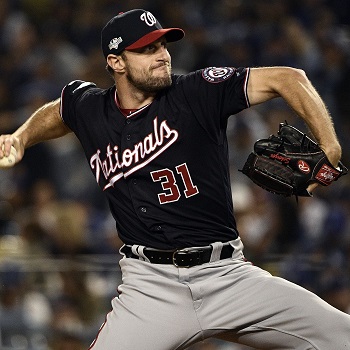
Could that someone out of the pen be Max the Knife?

Bet on it: it doesn’t happen if Matt Williams was still the Nationals’ manager. Bet a little on it: it might not even happen if Dusty Baker was still the manager. Davey Johnson, maybe. But it happened through the courtesy of incumbent Dave Martinez.

And it got him a return to Nationals Park with their National League division series against the Dodgers tied at one apiece. The Nats ain’t ready for the last dance just yet. And if they keep this up, they just might get one in the World Series in due course. Might.

Williams was too wedded to The Book, whatever he thought it was, to have even thought about bringing Max Scherzer in from the bullpen in National League division series Game Two. Compared to Williams, Baker was John Coltrane, but I’m not sure even Baker might have gone there, either.

Johnson’s the man who once inserted one relief pitcher into right field and the other on the mound (Roger McDowell and Jesse Orosco, or was it Jesse Orosco and Roger McDowell), then rotated them between the positions until his Mets won the damn game. Johnson just might have reached for Scherzer Friday night.

But Martinez did, in the eighth inning. “We weren’t expecting that,” lamented Dodgers manager Dave Roberts after the Nats finished the 4-2 win they’d started. The Dodgers and just about everyone else in the solar system.

After a long season that only began with the distinct appearance of Martinez awaiting his call to the guillotine as its victim, not its operator, who the hell did he think he was Friday night, Casey Stengel?

The good news was Scherzer striking out the side in the eighth. The bad news was, the Nats still have an honest to God bullpen, and they’re still one of the shakiest bunches this side of the old Soul Train dancers. Daniel Hudson got the ninth inning gig and got himself the bases loaded—partly because Martinez took the gamble of putting the winning run aboard with two out to set up a possible force—before swishing Corey Seager out to end it.

And before Max the Knife came in for the eighth, Sean Doolittle, usually the Nats’ closer, relieved Stephen Strasburg for the seventh and, after striking out MVP candidate Cody Bellinger to open, threw Max Muncy a dead center meatball that Muncy drove dead over the right field fence to close the Nats’ lead to a single run.

Good thing Doolittle’s pinch hitter Asdrubal Cabrera smacked Dodger reliever Dustin May’s first service into right center field with second and third for the fourth Nats’ run. Better thing that Martinez was only too willing to say screw the protocols and reach for Scherzer for the eighth. Best thing that Scherzer got Gavin Lux, pinch hitter Chris Taylor, and Joc Pederson on three straight Duke Ellingtons: It don’t mean a thing if it ain’t got that swing.

It’s one thing to go all-hands-on-deck in a win-or-be-gone play-in like a wild card game. It’s something else, seemingly, to load your bullpen with your grand starting pitchers in a division series. If you still want Scherzer to start Game Three for you in Washington, it’s entirely doable after Scherzer worked only the one inning without even thinking about asking what the hell he was doing strolling in from among the arson squad.

“All the chips are on the table,” Scherzer said after the game.

Except that Martinez hinted powerfully enough that it’d be Anibal Sanchez likely to start Game Three—with Patrick Corbin available in the bullpen. Nobody around the Nats thinks it’s such a beyond-sane idea. Certainly not Scherzer.

“I’ve been in these situations before where you’re pitching on two days’ rest in all-star games and different times in the postseason,” he told reporters after Game Two. “I know that on two days’ rest, you’ve got one inning in you. So, I said whatever the situation is, I’m ready to pitch.”

Remember: that’s the man who refused to let something so trivial as a black eye and a swollen face stop him from taking his next turn and throwing a ten punchout, four-hit gem in a doubleheader nightcap in late June. A man who’ll pitch when, never mind until he’s black and blue in the face isn’t going to flinch over coming out of a postseason bullpen for a quick round.

Oh, goody (not), the Dodgers must be thinking. Remember last year. They were undone in a World Series when the Red Sox started David Price twice and closed with him once, started Chris Sale once and closed with him once (the Series winner, as it happens), and started Eduardo Rodriguez once and drew him in from the pen twice. Hello, Yogi, wherever you are around the Elysian Fields, it’s threatening to get late early out there again.

Strasburg didn’t seem to mind that Max the Knife stole some of his thunder on a night when he needed to be a little beyond his best himself. You can afford to be sanguine when your mates pry three runs out of a Clayton Kershaw who still can’t seem to find and sustain the best of his best in postseason play, while you’re busy punching out ten in six innings, surrendering three measly hits, and one measly earned run.

And it helps even more when you now have a postseason career 0.64 ERA while allowing but one run so far this October. This keeps up, we’re going to be saying Strasburg’s name in the same postseason sentences as those of Sandy Koufax, Bob Gibson, Mickey Lolich, Orel Hershiser, Curt Schilling, Madison Bumgarner, and Justin Verlander.

You may also be saying other names to refer to the Nats before long. Ringling Brothers and Scherzer and Strasburg Circus. Brother Martinez’s Traveling Salvation Show. The Mothers of Inversion. The Dodgers could be describing them with the last of those with “of Inversion” replaced by a twelve-letter compound euphemism for “maternal fornicator” before long.


Rickey don’t lose those numbers

2019-08-26 RickeyRoth

Hiring Allan Roth (right) as MLB’s first full-time (and then some) team statistician in 1947 may remain Branch Rickey’s least appreciated baseball innovation.

The good news: I looked forward to appearing on a Sunday podcast for which the subject was to be Branch Rickey. The bad news: I didn’t get a chance to discuss the one thing about Rickey that nobody, seemingly, thinks about whenever his name arises in most baseball discourse. The mere mention of it inspires a sub-topic change faster than you’d try to elude a visible virus; the nostalgist wishes merely to hasten back to reminiscence, the troglodyte contingent wishes you quartered without drawing first.

Understood: Say “Branch Rickey” and the usual first response is “Jackie Robinson,” and that’s exactly the way it should be. After decades of hoping to do so, but lacking the opportunity so long as Kenesaw Mountain Landis dictated baseball, Rickey ended a wrong with an irrevocable right and chose the absolute right player to do it. If “Jackie Robinson” isn’t your first response to “Branch Rickey,” the lacking is yours, not theirs.

Understood further: If “the farm system” isn’t your second response to “Branch Rickey,” take a remedial crash course in elementary baseball history. Even the most free agency-conscious teams in baseball today still believe in their farm systems, even if not all of them operate them as acutely or with foresight as they should. Both the rich talent pool mined since Robinson plus the farm system’s continued if oft-compromised operation are Rickey legacies not to be dismissed.

If “sabermetrics” or “analytics” isn’t your third response . . . Aw, jeez, not that you-know-what again! I hear you shuddering. Hear me out.

Like it or not, however shallow or deep anyone looks, statistics are the life blood of baseball. Long before anyone spoke of sabermetrics, baseball fans obsessed over baseball numbers as much as over Hall of Fame prospects. Simple (and often misleading or short on vision) though they were, baseball cards did not live by handsome face pictures alone.

For better or worse, Rickey was as obsessed with numbers and their meanings as with anything else about the game he loved and changed. And, like almost anything upon which he cast his bushy-browed eyes, Rickey dove right into the deep end of the pool, when a Canadian-born, thirty-year-old number cruncher with a passion for tabulating sports statistics, baseball in particular, convinced the Mahatma (only one of Rickey’s nicknames) to hire him.

The hire was Allan Roth, who’d grown up loving baseball, hockey, and figuring out stats for both, before he was forced to forget his college plans when family issues compelled him to hire as a salesman. After trying but failing to get then-Dodgers president Larry MacPhail to hire him, Roth met then-National Hockey League president Frank Calder and got a job with that league. Enter World War II and a stint in Canada’s Army to interrupt Roth’s statistical career.

The Canadian Army leaned on his statistical analyses before discharging him in 1944, upon his diagnosis of epilepsy. Roth cast his eye upon the Dodgers again, with MacPhail long gone and Rickey running the Bums since. When a first meeting between the two went like “a disaster,” according to Tom Cronin of  Statliners, Roth managed to tell Rickey he wanted “only ten minutes of your undivided attention.”

Told to give Rickey’s assistant a detailed paper, Roth obeyed. As Roth’s Society for American Baseball Research biographer Andy McCue wrote, “Some of these were standard, but others, such as where the ball was hit and the count it was hit on, hadn’t been compiled regularly.”

Roth also proposed to break the statistics down into various categories that would reveal tendencies which the front office and the manager could use to win ballgames. Breakdowns such as performance against left-handers and right-handers, in day games versus night games, in the various ballparks, in situations with runners in scoring position, are all mundane to us now. But in Roth’s time, they were rarely compiled or used, and never part of the public discussion. The letter was intriguing enough to get a meeting with a still-skeptical Rickey.

It got Roth a second direct shot with the Mahatma: “The second meeting was the opposite of the first. Roth later stated that Rickey was intrigued with some of his ideas during the meeting, especially on how RBI’s are overrated.” This time, Rickey was more than intrigued. Once Roth solved his visa problems, and on the same day Jackie Robinson premiered with the Dodgers, Rickey finally hired Roth to be the Dodgers’ statistician, the first full-time such man in major league baseball.

Roth would do the job for eighteen years, recording every pitch the Dodgers threw, every swing they took, every base they reached or advanced, every ball they fielded. He was once somewhat renowned (and often mocked) for tabulating those on copious sheets of graph paper, apparently his favourite charting device.

Taking as long as five hours after each game to break down the game and the players, Roth also spent copious off-season time digging deeper into what we know long since as matchups, best- and worst-count performances, at home and on the road. He also developed a fine sense of humor about it; The Boys of Summer author Roger Kahn once credited Roth with inventing the game Silly Records. Except that some of those silly records weren’t as silly or meaningless as they probably sounded then.

Until he was pressured into selling his percentage of the Dodgers to Walter O’Malley in 1950, Rickey paid close enough attention to Roth’s charts and graphs to draw plenty of conclusions of his own in addition to what Roth himself enunciated. And in 1954, as if hiring Roth at all hadn’t been heresy enough, Rickey wrote and Life published “Goodbye to Some Old Baseball Ideas,” much of which was mulcted from Roth’s work. Including:

Batting average is only a partial means of determining a man’s effectiveness on offense.

The ability to get on base, or On-Base Average, is both vital and measurable.

The correlation shows that OBA went hand in glove with runs scored.

The next measurable quantity is Extra base power . . . My own formula computing power . . . is called isolated power, is the number of extra bases over and above singles in relation to total number of hits.

Runs batted in? A misleading statistic.

Fielding averages? Useless as a yard stick.

As Brian Kenny wrote, in Ahead of the Curve: Inside the Baseball Revolution, Rickey “didn’t just say, ‘Hey, ever wonder why the Dodgers have been kicking your ass for the last eight years? Would you like to know the best way of quantifying talent and production? Oh, shoot, here ya go!'” Today’s sabermetricians were children when Rickey (and Roth) wrote the Life piece; baseball’s lords and princelings were all too ready to take it with a pillar of salt when not laughing hysterically over the Mahatma’s impudence.

The Dodgers kicked the National League’s ass for most of the rest of their Brooklyn life (the Boys of Summer were, after all, Rickey teams), and the Pirates finished in 1960 what Rickey began from 1951-55. (The nucleus of that world champion was Rickey’s nucleus: Vernon Law, Elroy Face, Bill Mazeroski, Dick Groat, and a talented minor leaguer he drafted from the Dodgers in the Rule 5 minor league draft: Hall of Famer Roberto Clemente.)

Which was rather splendid for a number cruncher who didn’t consider himself a pure numbers man. Roth “didn’t do his own taxes. He couldn’t remember his phone number,” McCue wrote. “What he would do is record the numbers in myriad detail and then use his true talent, recognizing what the numbers meant, to provide value to his employers. He summed up his philosophy: ‘Baseball is a game of percentages—I try to find the actual percentage, which is constantly shifting, and apply it to the situation where it will do the most good’.”

(Was Casey Stengel eavesdropping a little on Rickey and Roth near the beginning? Baseball, the Ol’ Perfesser told anyone within earshot, is percentage plus execution. You thought the Dodgers kicked the National League’s ass? Stengel’s Yankees only had ten pennants and seven World Series rings in twelve seasons to show for his willingness to put old thinking, even old “traditional” Yankee thinking aside.)

Though such crustily visceral managers as Leo Durocher and Charlie Dressen spurned Roth’s analyses, Walter Alston accepted them. It took Alston one full season to get his sea legs managing the Dodgers after he was hired to succeed Dressen for 1954, and there were a few growing pains as he asserted his authority and learned his players, but in Alston’s second season? Dem Bums finally won the World Series.

Walter O’Malley could challenge you until you and he were the proverbial blue in the face, but the core of the Dodgers who finally made next year this year were still Rickey’s boys: Hall of Famers Robinson, Roy Campanella, and Duke Snider, Carl Furillo, Gil Hodges, Don Newcombe, Carl Erskine, and Clem Labine. We won’t suggest what we now know as analytics put World Series rings on the 1955 Dodgers’ fingers, but it didn’t hurt them to have the data, either.

Then they almost won the ’56 Series while they were at it. It wasn’t Alston’s fault that the Dodgers began showing their age in their final Brooklyn season. (The average age of the regular lineup: 32.) And even their 1959 pennant winner was still a team transitioning from the further-aging Brooklyn veterans.

During the Dodgers’ first serious pennant race in Los Angeles, facing a critical late-season doubleheader against the Giants, Roth convinced Alston, based on his tabulations, that Hall of Famer Don Drysdale pitched far better at night than during the day, while another Dodger righthander, Roger Craig, was almost the same pitcher day or night. Alston switched his planned doubleheader rotation, starting Craig in the day game and Drysdale for the night game.

The result? The Dodgers swept the Giants, helping them force the three-game playoff against the Braves that meant the pennant. By then even Dodger players received regularly updated Roth tabulations on their own performances and worked accordingly.

Seriously? You really thought that started in this century? Anyone who knew the Dodgers well in those years knew Allan Roth’s role with the team, and that it wasn’t just rehashing or writing out their baseball cards. They could have told you the Dodgers had a lot more going for them than balls and strikes, runs and hits, and Hall of Famer Sandy Koufax’s latest beyond-belief performance, right up to the day the Dodgers let Roth go in 1964.

And they really had Branch Rickey to thank.

“Rickey and Roth’s fundamental contribution to the advancement of baseball statistics,” wrote John Thorn and Pete Palmer in The Hidden Game of Baseball, “comes from their conceptual revisionism, their willingness to strip the game down to its basic unit, the run, and reconstruct its statistics accordingly.”

A man who evaluated character in hand with performance but wasn’t always the most astute judge of the former when all was said and done, Rickey died a year after the Dodgers lost Roth. He was foresighted and devious, compassionate and penurious, all at once. He was maybe baseball’s deepest thinker and one of its most pompous. “A man of strange complexities,” the New York Times‘s John Drebinger once wrote, “not to mention downright contradictions.”

For every one who canonises Rickey for elevating and supporting Jackie Robinson as a player and a man, appropriately, there’s another who broils him just as appropriately for the shifty penury that prompted his Hall of Fame Pirate Ralph Kiner to credit him with doing the most to seed the Major League Baseball Players’ Association.

“Rickey believes in economy in everything,” the New York Daily Mirror‘s Dan Daniel once wrote, “except his own salary.”

Roth’s Dodger days ended, McCue wrote, after O’Malley discovered his statistician, whose marriage was collapsing, had a romantic relationship with a black woman at a time when too many Americans, O’Malley included, yet quaked over the very idea of such interracial romance, never mind the scandal quotient still attached to it. That romance ended in a shouting match and Roth’s marriage itself ended, but so did his Dodger career.

He returned to free-lance work until ABC, then NBC, hired him to give announcers (including two former players he’d once analysed, Koufax and Pee Wee Reese) the same deeper analyses he’d previously provided the Dodgers and Scully, until his health failed in the 1980s. (He died in 1992.)

“Roth was a firm believer that you do not have to be an expert mathematician to record baseball stats,” Cronin wrote. “You just had to be an innovative thinker and have a passion for the game. He also realized that human element of baseball and numbers could only help aid the game, not run it.”

So did Branch Rickey. Sabermetricians aren’t the only ones who should thank him for his patronage of and further education from Roth, no matter how dearly baseball’s paleozoics would like to spank him for it.

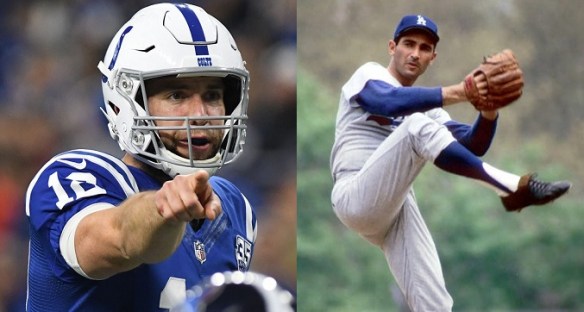
Andrew Luck, meet Sandy Koufax

2019-08-25 LuckKoufax

Andrew Luck does at 29 what Sandy Koufax did at 30—walking away from the sport at which he excelled, and shocking his sport while he was at it.

The football world, and a few other worlds in sports, took a jolt when Indianapolis Colts quarterback Andrew Luck decided it was time to retire at 29. For the sake of his health and the rest of his life. If F. Scott Fitzgerald said there were no second acts in American life, Luck seems determined to have one in the first place, and good luck (no pun intended) to him sincerely.

Even if you’re not a football fan, and I’m not, you could read of him, know he was one of his game’s genuine greats, and get that a young man can give up what he loves and does so well because the idea that perhaps the next injury might compromise him having a second life makes him just as sick as any of the injuries that interfered with playing his chosen sport.

If you’re my age you remember a baseball great who was a mere year older than Luck is now who made the same decision, shocked his sport and his country while he was at it, and stuck to his decision because he, too, was determined to make Fitzgerald a liar. And he sat on a far higher plane than Luck ever achieved.

Sandy Koufax didn’t begin the way Luck did. He was discovered a decade before baseball initiated its own college draft; he was a bonus signing forced to be on the major league roster two years under a foolish rule of his time; he was an outsize talent whose fastball speed and curve ball arc was throttled by lack of control.

It took Koufax the first six seasons of his career to discover control. (And, for a particularly observant companion in a Vero Beach pizza joint to discover just what kept him from it, a hitch between his windup and his delivery that obstructed enough of his view of the plate.) He went, as his biographer Jane Leavy phrased it, “from nothing special to never better.”

The second six seasons of Koufax’s career weren’t just off the charts. They obliterated the charts. It only began with smashing Christy Mathewson’s 58-year-old National League strikeout record in 1961. It only ended when his final season showed a 1.73 ERA for his fifth consecutive ERA title and his sixth consecutive major league-leading fielding-independent pitching rate. (2.07.)

Koufax so bedazzled the Yankees with his ownership of them as his Dodgers did what no opponent before them had, sweeping them out of the 1963 World Series, that his fellow Hall of Famer Mickey Mantle, asked if he wished there were a couple more Jewish holy days on the October calendar, replied, “You mean like Yom Koufax?”

If only Mantle really knew. (“I can understand how he won 25,” another Yankee Hall of Famer, Yogi Berra, said after that Series. “What I can’t understand is how he lost five.”) Two years later, Koufax refused to pitch Game One of a World Series because it fell on Yom Kippur.

Among other transdimensional achievements, Koufax would pitch pennant-clinching games in back-to-back seasons on two days’ rest, a World Series shutout on two days rest after a previous Series shutout, show a 2.25 ERA over a lifetime’s 24 games pitched on two days’ rest, and a batting average against him of (wait for it) .201 when he pitched on such short rest.

In the years when the Cy Young Award was a major league award (the late Dodger righthander Don Newcombe won the first, in 1956), Koufax won it three times, 1963, 1965, and 1966, and his dominance probably kept fellow Hall of Famer Juan Marichal from winning at least one and possibly two. Was it coincidence that, after Koufax retired, the Cy Young Award became awarded for each league?

His record four no-hit, no-run games would be eclipsed by Nolan Ryan, but Ryan didn’t pitch all of his in consecutive seasons. And Ryan doesn’t have one bragging right Koufax has if he wants it: after pitching no-hitters in 1962 (against the hapless Original Mets), 1963 (against the Giants), and 1964 (against the Phillies), Koufax in 1965 (against the Cubs) proved that practise makes perfect.

If you consider that his mound opponent that day, Bob Hendley, surrendered only one hit that didn’t even figure in the scoring (the Dodgers got the game’s only run in another inning, on a walk, a sacrifice, a steal, and a throwing error on the theft), Koufax’s perfect game is an entrant when you ask and talk about the greatest games ever pitched, period.

An injury on a baserunning play in August 1964 dictated his future—when he, of all people, was the baserunner. (Told that those giving him the 1963 World Series MVP left the Corvette parked on the sidewalk, with a $15 parking ticket attached to the windshield, Hall of Famer Whitey Ford cracked, “Sandy has only two flaws. He can’t park and he can’t hit.”) He scrambled back to second on a pickoff attempt (I know, I know, who on earth would think about trying to pick Sandy Koufax off, but yes, you can look it up) and made a four-point landing, elbows and knees.

The following morning Koufax awoke with his elbow the size of his knee and worse. The verdict: traumatic arthritis. The hope by spring training: he might be a once-a-week pitcher at best. The outcome: His 1965 and 1966 seasons made everything he’d achieved in the previous four seem like the mere overture to the main events. On a medical regimen that could and maybe should have killed him.

“I just told your pitcher to retire,” said Dodgers team physician Robert Kerlan during spring training ’65. Koufax confided in San Diego Union reporter Phil Collier in spring ’66 that this would be his final season no matter what. Collier eventually staggered his colleagues in the press when they learned he kept his promise to Koufax and sat on the story until Koufax’s actual retirement conference that November.

“I don’t know if cortisone is good for you or not,” Koufax said at the conference. (We know now that it isn’t, in ten or more such shots a lifetime.) “But to take a shot every other ball game is more than I wanted to do and to walk around with a constant upset stomach because of the pills and to be high half the time during a ball game because you’re taking painkillers . . . I don’t want to have to do that . . . I don’t regret one minute of the last twelve years, but I might regret the one year that was too many.”

Koufax even helped strike a blow toward beginning the end of the reserve era that kept players bound to their clubs with no say in their own employment and left them largely at the mercy of their owners in terms of their earnings. His joint spring 1966 holdout with fellow Hall of Famer Don Drysdale landed them baseball’s highest 1966 salaries and showed players what they could do if they really knew each other’s earnings and worked together to redress it.

All the while, he enjoyed a quiet accommodation with his fame. Never rude to reporters after the occasional bad game, Koufax drew a line between the pitcher and the person and navigated each side with a quiet dignity. Bachelor though he was, Koufax didn’t let his off-field life become the kind that earns the randy headlines provoked by the Bo Belinskys and Joe Namaths of sport. “Baseball,” Thomas Boswell eventually wrote, “could fascinate him, but not control him.”

After five years as a colour commentator on NBC’s weekly baseball broadcasts, during which his discomfort wasn’t talking about and analysing games but continuous bids to try getting him to talk about himself, Koufax gave it up. He’s as much a Renaissance man as any man can be.

“People ask all the time,” said Hall of Fame pitcher Don Sutton, whose rookie season with the Dodgers was Koufax’s final season, to Leavy, “‘What’s he done with his life?’ He’s enjoyed it.”

When not working spells since as a Dodgers’ or a roving pitching coach (to this day he loves to teach the art, asking pitchers who come to him to understand the why almost more than the how of pitching), he made himself into a master carpenter and home restorer (he did that in Maine once upon a time), a gourmet cook, a wine expert, a marathon runner, a fisherman, a pilot, whatever he thought would challenge as well as interest him.

The one subject above all others that didn’t interest Koufax, Leavy noted, is himself.

He does not disavow who he was or what he accomplished. He is proud of it. He simply refuses to exist in cinders and ashes. He doesn’t speak of himself in the third person, but he does think of “Sandy Koufax” as someone else, a persona separate from himself. If he was seeking refuge from anything, it was that.

And nobody can separate him from that separation. Asked not long after he married a third time (his first two marriages ended in divorce, and those who knew him noted their ends hurt deeply) what he dreamed about, Koufax gestured toward his wife (Jane Purucker Clarke, a one-time sorority sister of former First Lady Laura Bush) and said, “Her.”

The man who laughs when not shuddering even today when told he’s renowned for his quiet, private style (“I haven’t disappeared, I’m not lost, and I’m not very mysterious,” he once told reporters, after a magazine cover story described him as “The Incomparable and Mysterious Sandy Koufax”) said the following, in a 1965 memoir a copy of which his mother asked for simply to learn things about her son (“You certainly never told me anything,” Mom was once quoted as having told him):

I do not think the ballplayer is of an extraordinary importance in our national life. We do not heal the sick or bring peace and comfort to a troubled world. All we do is to provide a few hours of diversion to the people who want to come to the park, and a sort of conflict to those who identify their fortunes with ours through the season . . . it is a brief, self-liquidating life. It is a temporary life, really, a period between the time of our youth and the beginning of our lifetime career.

It’s not unreasonable to assume Andrew Luck—who retires from football as Koufax did from baseball, because the idea of crippling himself and perhaps denying himself the simplest pleasures and tasks of life offends that profoundly—understands the same thing.

“I haven’t been able to live the life I want to live,” Luck said when announcing his retirement. “It’s taken the joy out of this game. The only way forward for me is to remove myself from football. This is not an easy decision. It’s the hardest decision of my life. But it is the right decision for me.”

Luck may not have transcended his sport quite the way Koufax did his, the truly transcendent being the truly few. But Luck may hope to transcend the shock of those Koufax described, those who identify their fortunes with those of athletes and their teams.

It’s a hope Luck deserves to see actualised as Koufax has long actualised his. It’s more important in too many ways than any postseason to which Luck ever led his team, any World Series in which Koufax triumphed, any game-changing touchdown pass Luck ever threw, any bullet fastball or voluptuous curve ball Koufax ever threw.

“He didn’t need baseball to be Sandy Koufax,” a fan named Al Meyers, who once got close enough to ask Koufax to sign a baseball for his father but couldn’t bring himself to ask, told Leavy. Luck doesn’t need football to be Andrew Luck, either.

Those who identify their fortunes with those of teams and their players forget too readily. We’re ready to canonise a team that blows away the competition and players who execute in the highest leverage; we’re ready to damn a team that crumples under the whitest competitive heat and players who fail when only a single football or baseball rests between themselves and competitive disaster.

Koufax in 1966 and Luck in 2019 should remind us that they’re men first, capable of great achievement and great shortfall, sometimes at once, and always forgotten in what Jim McKay once said famously, week after week, on the old ABC’s Wide World of Sports: the thrill of victory, the agony of defeat. Win, and you’re a genius; lose, and you’re a criminal against the state.

“I have something more important to do,” the late Hugh Hefner once said, when he bought his sumptuous Los Angeles home and spent more time making and living in its environment than working the magazine he created that nearly un-created him by the end of its second decade. “It’s called living.”

Luck today and Koufax then had something more important than football and baseball to do. It’s called living. If Luck needs a guide for how to do it after you walk away from the craft that made you famous in the most public of public eyes, he has no further to look than the now 83-year-old former lefthander spending five decades plus in league with all who’ve made F. Scott Fitzgerald a liar.

Greinke makes the ‘Stros trade winners

2019-08-01 ZackGreinke

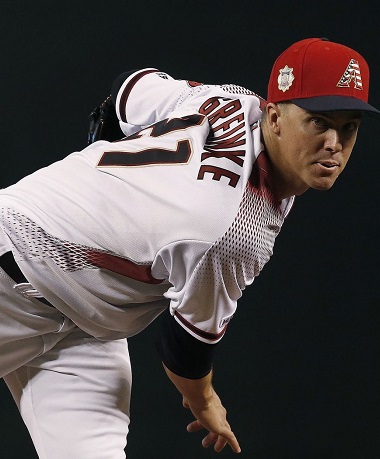
Zack the Knife makes the Astros the big trade winners. Will he help make them World Series winners?

No questions asked. The Astros slipped in at the eleventh minute, practically, and not only stole the new single trade deadline show but they did the absolute most to fortify themselves for the postseason run nobody doubts is theirs this season. Barring unforeseen disaster, of course.

With Gerrit Cole looking at free agency after the season it made sense for the Astros to seek a top-of-the-line starting pitcher with at least another full season of team control to line up with (don’t doubt it) future Hall of Famer Justin Verlander, so far the new ageless wonder of baseball.

So it came forth after the deadline passed that the Astros sent a quartet of prospects—good, promising, but not quite platinum-rated prospects—to the Diamondbacks for Zack Greinke, who isn’t exactly a slouch on the mound and who’s having a solid season in his own right so far.

They’ll get the rest of this season plus the final two seasons on the gigadeal Greinke signed with the Diamondbacks. The Snakes also sent the Astros a reported $24 million to help cover the rest of Greinke’s contract, on which the Astros will be responsible for the other $53 million. They’re not exactly complaining.

General manager Jeff Luhnow knew only two things about Greinke before he pulled the trigger on the big deal of the day: Zack the Knife has been a consistent pitcher who’s on the borderline of a Hall of Fame case; and, the righthander isn’t exactly one of the most combustible personalities in baseball.

“I don’t know him personally,” Luhnow told reporters, “but I think he’s not a guy that seeks the limelight, and that actually works well for us here in Houston. And slotting in with Verlander and Cole, he’s gonna not have to be the guy that’s in front of the camera the whole time.”

The Astros weren’t exactly over-occupied on doing the Greinke deal. Before that deal hit the news running Wednesday, they did a little bullpen fortification, getting Aaron Sanchez and Joe Biagini from the Blue Jays. The Jays also sent the Astros minor league outfielder Cal Stevenson. The Astros sent the Jays outfielder Derek Fisher.

Greinke was last seen striking out seven Yankees in five innings Wednesday. He left the park without talking to reporters, which may or may not have been an indication that he suspected or was told it was time to re-pack his bags.

On the same day, the Astros got flattened by the Indians, 10-4, in Cleveland; they finish with the Tribe Thursday before a weekend hosting the Mariners, but Greinke may not have his first Astros start until the Rockies hit town starting Monday.

“I know he’s really good. I don’t know him personally, but I’m going to get to know him,” said Astros manager A.J. Hinch. “We acquired him because of how good he is. Certainly we expect him to be a big part of our push to win the division and keep winning into October. He’s an incredible pitcher.”

He has been, and he still is when all is said and done. His new teammates won’t disagree. “What a pickup!” Cole himself crowed. Referring to the front office, he added, “They nailed it. They did a fantastic job.”

Landing Greinke shot the Astros into being World Series co-favourites with the Dodgers at Caesar’s Palace Sports Book. But the Astros are smart enough to know Berra’s Law is immutable. Zack the Knife increases their odds of a return to the Series, but so is Andujar’s Law, as uttered by a long-ago Astro, the late Joaquin Andujar: “In baseball, there’s just one word—you never know.”

What we do know, though, is who were really the big winners and the big losers of major league baseball’s first single mid-season trading deadline.

THE WINNERS

Braves—Another starting pitcher wouldn’t have hurt them, necessarily, but what the National League East leaders really needed was a back-of-the-bullpen retooling. And, they got it, in an almost rapid fire series of deals.

They landed Shane Greene from the Tigers. They landed Chris Martin from the Rangers. They landed Mark Melancon from the Giants. As CBS Sports’s Matt Snyder observes, if the prices were too high for such reported availables as Edwin Diaz (Mets) and Felipe Vasquez (Pirates), the Braves did well enough shopping the sale aisle.

None of the new pen trio are anything near the most glittering names in the relief world, but neither are they slouches or pushovers. Changes of scenery from nowhere land to pennant contention do wonders for such pitchers, and it would be absolute gravy if the Braves get something out of Melancon resembling his final years in Pittsburgh and his only spell in Washington.

Greene, of course, was an All-Star this year and was wasted on a Tigers team in the middle of a rebuild. When the Braves can turn to him near the end of a game, either as the sure ninth-inning option or if things get a little dicey in the eighth, the sight of Greene warming up with his 1.18 ERA should be enough to make their division and the rest of the league quake.

Throw in Martin’s 10+ strikeout-to-walk ratio and 10.2 K/9 rate, and all of a sudden the Braves’ bullpen doesn’t look like it’s full of bull anymore.

Indians—So Trevor Bauer turned out to be a bigger pain in the you-know-where than his otherwise solid pitching was worth. Doesn’t mean the Indians dealt from weakness. Not with Corey Kluber on the threshold of returning from the injured list.

And the Tribe managed to address their biggest weakness in the deal: their corner outfielders weren’t hitting anywhere near the same area code as their new toys Yasiel Puig (from the Reds) and Franmil Reyes (from the Padres) put together. Add Puig’s mostly plus throwing arm in right field, and all of a sudden the Indians outfield isn’t just going to roll over and play dead.

The Indians also landed lefthanded pitching youth Logan Allen (also from the Padres), and when you consider how well they develop or re-tool starting pitching this is an upside acquisition for them, too.

But the real key was the impact bats. Puig secures them in right field for the rest of the season, and perhaps if he continues doing well enough the Indians would think of pursuing him when he hits free agency in the fall. Reyes, though, secures a DH spot for them for the foreseeable future while giving them an outfield platoon option in the bargain.

Suddenly it’s not to laugh about the Tribe’s outfield anymore.

Mets—Don’t laugh. Not only are they on a six game winning streak at this writing, the formerly left for dead Mets—and even I thought they were just awaiting the nails to be hammered into their coffin after that terrible weekend in San Francisco—are 12-7 since the All-Star break.

And maybe it’s an illusion since, aside from the Giants, they faced only real contender during the string. But they did take both games against the Twins in Minnesota, including a 14-4 blowout. All of a sudden, these Mets can play as well as they can pitch.

And while the world seemed to be sure only that either Noah Syndergaard or Zack Wheeler would have a change of address after Wednesday’s deadline, it took the Astros landing Greinke to knock the Mets’ landing Marcus Stroman well enough before the deadline out of the park.

Maybe Stroman wasn’t thrilled at first to go to what he thought was a non-contender. And maybe someone ramped up for kicks a rumour that the Mets had ideas about flipping Stroman to the Yankees post haste for some of the Yankees’ top farm produce. But the Mets wasted no time ridding themselves of Jason Vargas—who should have been cashiered over a month earlier—sending him to the Phillies almost as soon as Stroman’s acquisition was a done deal.

The Mets rotation now looks like Jacob deGrom (who pitched brilliantly against the White Sox Wednesday night only to get his almost-usual no-decision, the poor guy), Stroman, Syndergaard, Wheeler, and Steven Matz. And with Matz putting on a deadly off-speed clinic shutting out the Pirates last Saturday night, looking as though he’s finally found the secret to pitching without the power of a deGrom or a more disciplined Syndergaard, it gives the Mets a rotation with two number-ones, a two, and a pair of threes.

Nationals—Like the Mets, the Nats were left for dead a few times before the All-Star break. Like the Mets, too, the Nats are riding resurgent, sort of: 10-9 since the break. And the Nats needed a bullpen remake in the worst way possible.

Not at the absolute rear end, where closer Sean Doolittle remains effective when he has something to save. It’s getting the games to Doolittle that caused one after another National migraine. But then the Nats landed Jays reliever Daniel Hudson and Mariners reliever Roenis Elias.

All of a sudden, the Nats seemed to find relief in the best way possible for that beleaguered bunch of bulls. And then they got really surreal—it turned out that they also got an old buddy (ho ho ho) from the Mariners, Hunter Strickland.

Strickland—who carried an almost three-year grudge over then-Nat Bryce Harper taking him deep twice in a division series, the second time awaiting whether his fresh blast straight over the foul line would leave the yard fair but misinterpreted as admiring the shot. (It flew fair into McCovey Cove.)

Strickland—then a Giant, who somehow hadn’t gotten the chance to face Harper until 2017, then entered a game with Harper leading off an inning and threw the first pitch right into Harper’s hip. Triggering Harper’s charge to the mound and the very delayed Giants pouring out of their dugout, during which pour former Nat Michael Morse’s career ended up being sealed when he collided with Jeff Samardzija and suffered a concussion.

Harper, of course, now wears the Phillies’ silks. But it would have been intriguing if Harper was still a Nat with Strickland coming aboard. Strickland’s coming back from a lat strain that disabled him for almost three months. And the Nats don’t see hide nor hair of the Phillies again until a four-game home set beginning 23 September.

By which time, the Nats may or may not be in the thick of the NL East race (the Braves suddenly started looking human enough the past couple of weeks), securing a wild card berth, or hoping they’ve got a leg up on 2020. A lot rides on the new bulls. But for now, the Nats took their number one need and addressed it respectably enough.

THE LOSERS

Red Sox—Like the Braves and the Nats, the Red Sox needed bullpen help badly. Unlike the Braves and the Nats, the Red Sox landed nothing. Not even a calf, never mind Diaz, whom the Mets were making available and who probably could have been had for a little less than they were said to have demanded for Syndergaard and Wheeler.

The Red Sox bullpen ERA in June: 4.92. The Red Sox bullpen ERA in July: 5.18. Letting some reasonably effective pieces make their ways to Atlanta and Washington instead does not portend well for the Olde Towne Team.

Dodgers—I know, it sounds funny to apply “losers” in any context to the National League’s 2019 threshing machine. But the threshing machine has one monkey wrench looming: the Dodger bullpen isn’t as formidable as it used to be.

Kenley Jansen isn’t really pitching like the Kenley Jansen of old this year. What’s behind him in the pen depends on whose description you read: mess, disaster, toxic waste dump, landfill, take your pick.

If the Mets and the Pirates were asking the moon for Diaz and Vasquez, the Dodgers if anyone had the moon to give in return. They’re loaded with prospects on the farm, and money in the vault, enough to have dealt a package of them for either reliever and still have a bountiful harvest to come.

Good luck holding leads against postseason lineups with that kind of pen. And the Dodgers won’t be able to hit themselves beyond their pen’s capability eternally. They won’t lose the NL West, necessarily, not with a fifteen-game lead at this writing, but their chances at a third consecutive World Series appearance and just one Series ring since 1988 just got a lot more thin.

Brewers—The pre-season favourites to defend their NL Central title aren’t exactly that good anymore. Losing Brandon Woodruff and Jhoulys Chacin to the injured list has left their rotation in tatters, and with the Giants yanking themselves back into the wild card play there went their ideas of maybe adding Madison Bumgarner for a stretch drive.

But they also needed some pen help, and what they brought aboard (Ray Black, Jake Faria, Drew Pomeranz) is serviceable but not quite as serviceable as what the Braves and the Nats brought aboard. The Brew Crew is liable to spend the rest of the season watching the Cardinals’ and the Cubs’ rear ends, but then with the NL Central as it’s been this year there could be a surprise in store. Could. Remotely.

Because the Brewers can’t live by Christian Yelich alone.

Twins—The AL Central leaders have gone from a double-digit division lead to looking only human at three games up on deadline day. They needed a little rotation help and a little bullpen help.

And they got only a little in the pen. Sam Dyson (from the Giants) and Sergio Romo (from the Marlins) are solid but not overwhelming. Maybe not for lack of trying, but the Indians’ blockbuster suddenly puts the Twins close enough to the Tribe’s mercy to make for a too-interesting stretch drive for them when they once looked like the division’s runaway train.

They can hit all the home runs they want, but if their pitching is compromised the Twins have a big problem coming. Like the Yankees, the Twins should have been more aggressive trade deadline players. Like the Yankees, they weren’t, for whatever reasons. And it could come back to haunt them down the stretch.

Yankees—Even Yankee haters won’t understand this one. The number one need for the injury-battered Bombers was rotation help. Especially after they’d just been flattened by the Twins and the otherwise-troubled Red Sox. And they did nothing to fix it.

The question may be why, or why not. If Bumgarner was off the market, they could have played for Stroman or for Mike Minor, even allowing for Minor’s rough July after a sterling June. They didn’t seem to play for any of the above. They didn’t even seem to be a topic if the Diamondbacks—knowing their own chances were still none and none-er—were looking to move Greinke to a contender.

And since their number one American League competition overall did land Greinke, the Yankees may ride a weakening AL East into October but they’re not liable to get past round one again, even if it may not be the Red Sox shoving them to one side this time.

He can’t rant with the masters, either

2019-06-23 MickeyCallaway02

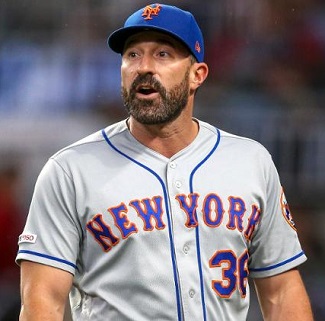
As postgame ranters go, Mickey Callaway won’t make anyone forget Tommy Lasorda or Lee Elia.

If the Mets do what seemingly three quarters of the Internet thinks has to be done and fire embattled manager Mickey Callaway after Sunday’s postgame profanities, so be it. But they may want to know that Callaway’s isn’t even close to the absolute worst outburst major league baseball people have been known to release after harsh losses.

After the Mets lost to the Cubs 5-3, Callaway—himself a former pitcher and pitching coach presumed to understand such things—should have expected the number one postgame question would be why he left not-so-strong reliever Seth Lugo in for a second inning after over-labouring a first one, long enough for the Cubs’ Javier Baez to drill a three-run homer that overthrew a Met lead and held up for a Cub win.

Just about everyone watching the game, including Mets broadcasters Gary Cohen and Ron Darling (himself a Mets pitcher on their 1986 World Series winner), knew Lugo barely got through his scoreless first inning’s work. Callaway warmed up Robert Gsellman but didn’t bring him in until after Baez’s blast.

And closer Edwin Diaz, who might have been asked for a five-out or even a two-inning save, since he’d only pitched a single inning Friday night (for a save) after five days without a game appearance, wasn’t even a topic. Until Callaway was asked about it postgame and insisted, a little snappishly, that five-out save opportunities weren’t a topic, either.

No matter how much pressure Callaway’s been under, reporters shouldn’t have had to expect him to throw down a couple of [maternal fornicators], or order his people to get another [maternal fornicator] out of the clubhouse. Or, when Mets pitcher Jason Vargas was asked in all innocence by reporter Tim Healey if he had something to say, as Healey swore Vargas appeared, Healey shouldn’t have had to have Vargas threaten to knock him the [fornicate] out, bro.

With Mets first-season general manager Brodie Van Wagenen said to be en route Philadelphia, where the Mets open a set with the teetering Phillies Monday, it might not be a shock if he greets Callaway by putting the manager’s head on a plate. As of this writing, nothing from inside the Mets yet appears to indicate its likelihood.

But if so, Sunday’s postgame behaviour was only the wick that ignited the powder keg. All season long it’s been a question of when, not whether Callaway would meet the guillotine. And wags could suggest plausibly that one reason to execute Callaway could be that, when it comes to postgame tirades, he can’t cut the mustard in Lee Elia’s or Tommy Lasorda’s parlours.

About the only thing Callaway has in common with those two is that their still-legendary, still-heard expletives-undeleted rants had something to do with the Cubs, too.

Elia was the Cubs’ manager on 29 April 1983, when the Cubs lost a one-run game to the Dodgers in Wrigley Field. The Cubs’ Hall of Fame closer Lee Smith threw an eighth-inning wild pitch to Pedro Guerrero with Ken Landreaux on third, allowing Landreaux to score what proved the winning run.

Aside from the season’s early losing—the game dropped the Cubs to 5-14 and dead last in the National League East—the sparse Wrigley audience, and a fan dropping a beer on Cubs outfielder Keith Moreland, left Elia in no mood to play nice, never mind accommodating, after the game. And never mind most of the press corps going to the Dodgers’ clubhouse because first baseman Mike Marshall played in Wrigley for the first time and homered in the fifth.

The unwitting provocateur was radio reporter Les Grobstein, who asked Elia about the Cubs’ fan support. Elia delivered a tirade in which he tried defending his players but ripped the boo birds, unloading 41 profanities before unloading the money quote: They oughta go out and get a [fornicating] job and find out what it’s like to go out and earn a [fornicating] living. Eighty-five percent of the [fornicating] world is working. The other fifteen percent come out here. (The Cubs still played strictly day games then.)

Elia by all accounts was lucky his [fornicating derriere] wasn’t fired almost on the spot; he happened to return to his Wrigley Field office to retrieve a set of keys when then-general manager Dallas Green, who’d just heard the recording of Elia’s rant, called the skipper’s office.

The mortified Elia apologised to the GM. He probably survived because, near the end of his bellowing, he did urge people to rip him and not his players if they were unhappy with the Cubs’ play. Unfortunately, Elia would be fired later in the season as the Cubs fell fifteen games under .500.

In due course he’d sell for a cancer charity autographed baseballs displayed in specially-made cases that included specially-made players that delivered a cleaned-up version of the infamous schpritz. He’d also manage the Phillies for a short period and eventually work in the Braves’ front office.

Five years earlier, the Cubs inadvertently seeded a postgame jewel by Hall of Fame manager Tommy Lasorda, after a fifteen-inning win in Dodger Stadium on 14 May 1978. The inadvertent provocateurs were Cubs slugger Dave Kingman—whose home runs were typically conversation pieces that approached earth orbit no matter the venue in which he swung at the plate—and Los Angeles radio station KLAC reporter Paul Olden.

Kingman was 1-for-2 when he batted in the sixth against Doug Rau and smashed a two-run homer to pull the Cubs back to within a run. An inning later, Kingman grounded into a run-scoring force out, but in the ninth he hit Dodger reliever Mike Garman for another two-run homer to tie the game at seven. In the fifteenth, though, Kingman squared off against Rick Rhoden and hit a three-run homer that proved the game winner.

Like just about everyone else in the stadium and among the press corps following that 10-7 Dodger loss, the number one subject on Olden’s mind when he met Lasorda was Kingman’s particular destruction that day. Olden might have had a simpler time asking Emperor Hirohito what he thought of the atomic bomb destruction of Hiroshima.

Some thought Lasorda still seethed over Hall of Famer Reggie Jackson’s three-bomb demolition of the Dodgers in Game Six of the previous fall’s World Series. Whether that was true or false only Lasorda knows for certain. Lasorda knew only that the last thing he wanted to talk about was Kingman’s mayhem:

What’s my opinion of Kingman’s performance? What the [fornicate] do you think is my opinion of it? I think it was [fornicating] horseshit. Put that in. I don’t [fornicating] . . . opinion of his performance? Jesus Christ, he beat us with three [fornicating] home runs. What the [fornicate] do you mean what is my opinion of his performance? How can you ask me a question like that? What is my opinion of his p – of his p-p-performance? Jesus Christ he hit three home runs. Jesus Christ. I’m [fornicating urinated] off to lose the [fornicating] game, and you ask me my opinion of his performance. Jesus Christ. I mean that’s a tough question to ask me, isn’t it? What is my opinion of his performance?

It’s entirely possible that Lasorda survived that rant because he’d just taken his Dodgers to a World Series and had his team in the thick of the National League West hunt they’d win in due course en route a second consecutive Series. (And, a second straight Series loss to the Bronx Zoo edition of the Yankees.)

Lasorda cooled down little by little, especially after Olden admitted he hadn’t necessarily asked a brilliant question. But the outburst was on tape, and in short order a copy fell into the hands of a rival radio station whose owner just so happened to be Angels owner Gene Autry.

Lasorda shook off his mood enough to attend a charity dinner for the Cystic Fibrosis Foundation. Either at the dinner or before it, Lasorda apologised to Olden. And in due course Lasorda was asked once to look back upon what was known as the Kingman Rant:

You know Paul said to me he was sorry he did that, I said “Hey, you did your job Paul. Don’t worry about it”. He asked me, ‘What is your opinion of Kingman’s performance?’ Nobody asked me about an opinion. They’ve always asked me, ‘Well, Kingman hit three home runs’, ‘What did he hit’, ‘What did it do to you’, so and so. This guy says, ‘What is your opinion’. So I proceeded to give him what was my opinion of Kingman’s performance. I’d like to have the rights on that, on that tape, because what happened, uh . . . was when it was first played on the Jim Healy show, I guess Gene Autry heard it and he wanted a copy of the real tape. And then all of a sudden, within a two week period, that tape had gone from the west coast to the east coast. Everybody had that tape. Within a month’s time, I couldn’t go anywhere without somebody telling me they had the tape—the real tape of that, uh, opinion. I think it was finally translated into Japanese.

Both the Elia and the Lasorda explosions have survived to get major play around the Internet. And Paul Olden ended up having a surrealistic last laugh: since 2009, Olden has been the once-removed successor to the legendary Bob Sheppard as Yankee Stadium’s public address announcer.

Jackson tagged Sheppard as “The Voice of God.” Lasorda can say the day he went Dodger blue on Olden sent Olden on his way to God’s perch. I’m pretty certain Callaway won’t be able to make the same claim. Whether he’s fired Monday or in time enough.