NLCS Game Two: The mighty are falling

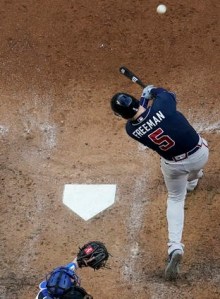
For the second NLCS game in a row, Freddie Freeman hits one out to start the Braves’ scoring.

Another entry from our Tales of the Unexpected Dept. The Atlanta Braves have a clean shot at shoving the Los Angeles Dodgers into early winter vacation without seeing Clayton Kershaw poke his nose out of his hole even once.

They were supposed to deal with Kershaw in Game Two of their National League Championship Series, until Kershaw’s back decided not so fast, bub. So there he was confined to leaning on the Dodger dugout rail and watching his mates under the thunder of the Braves’ stellar pitching. Again.

The spasms that scratched him from his scheduled Game Two start were the talk of Tuesday—at least until the Tampa Bay Rays in Game Three of the American League Championship Series pushed the Houston Astros to the elimination brink.

The Dodgers were counting on the resurgent Kershaw, the future Hall of Famer who became their best pitcher again this season and who’d been his future Hall of Fame self in two previous postseason gigs this time around. They needed him take the sting out of their Game One bullpen meltdown.

They needed him to find some way, any way of telling the Braves’ opportunistic and unsinkable hitters it was time to get sunk. When his back spasms told him and the Dodgers not to even think about it, the Braves must have thought Christmas came early and Santa’s sleigh was overloaded.

Dodgers manager Dave Roberts decided Game Two was the perfect time to hand young Tony Gonsolin his first-ever postseason start in Globe Life Park, Arlington, the Texas Rangers’ brand new playpen, the hangar that was supposed to be a hot tub for pitchers.

The Braves decided Game Two was the perfect time to hand young Gonsolin and every Dodger pitcher to follow their heads on plates, while pitching the Dodgers’ ears off the way they’ve been doing to every challenger all postseason long thus far.

Yet again, what the Braves have been doing pretty much all postseason long. Pitching the opposition’s ears off. Hitting the opposition’s pitchers as if discovering new and heretofore untapped human resources for batting practise. And, beating the Dodgers 5-1 in Game One and 8-7 in Game Two.

Freddie Freeman, the Braves’ first baseman who may well be this irregular season’s National League Most Valuable Player in all but the formal announcement and plaque presentation, decided it was too good to resist doing in Game Two what he did in Game One.

Monday—Freeman provided the first Atlanta hit and score when he took Dodger starter Walker Buehler into the right field seats with one out in the top of the first. Tuesday—Freeman provided the first Braves hit and score again, this time with Ronald Acuna, Jr. on board with a leadoff walk ahead of him, ending Gonsolin’s three-inning, three-and-three cruising, with a full-count blast about halfway up the right field seats . . . in the top of the fourth.

The Show’s government decided to let fans into the Globe Life stands on a limited and socially distanced basis for this NLCS. After a half summer of seeing nothing but cutouts in the seats, it was jolting to realise Freeman’s Game One launch was the year’s first live baseball souvenir.

Gonsolin lasted into the top of the fifth Tuesday night. He was lifted after Cristian Pache’s one-out RBI double and a followup walk to Acuna. In came Pedro Baez, the Dodger reliever who often threatens to hijack long-ago Cleveland first baseman Mike Hargrove’s nickname, the Human Rain Delay.

Up came Freeman again. He singled Pache home and set up first and third while he was at it. Baez then walked Marcell Ozuna to load the pads for Travis d’Arnaud, who walked right behind him to push Acuna home. Ozzie Albies then whacked a sacrifice fly to left to push Freeman home.

On a night Braves rookie Ian Anderson did what Max Fried and most company did well enough in Game One, the Braves didn’t have to play long ball to paint the scoreboard. About the longest ball other than Freeman’s fourth-inning flog from there looked to be Dansby Swanson bouncing d’Arnaud home with a ground-rule double in the seventh.

Then the Dodgers finally started making things extremely interesting in the bottom of the seventh. When they set up first and second right out of the tunnel against Braves reliever Darren O’Day and, after O’Day managed somehow to get a swinging strikeout out of Mookie Betts, Corey Seager hit one into the Braves’ bullpen behind the center field fence.

Suddenly the Braves advantage was cut to four runs. No wonder Ozzie Albies decided like State Farm to be the good neighbour in the top of the ninth, sending Adam Kolarek’s 2-1 service into the same bullpen.

Where Braves reliever Mark Melancon made a running catch of the ball, a little fancier than just standing there in Game One when Albies hit a two-run homer for which Melancon had only to raise his glove for the catch. In Game Two, the gags started pouring forth that the Braves could stick Melancon in for late-game defense when he wasn’t going to be a bullpen factor.

As it was, Melancon’s thoughts of a Game Two night off vaporised in the bottom of the ninth. He had an unexpected (we think) Dodger uprising to thank for that, when Seager slashed reliever Josh Tomlin for an RBI double and Max Muncy smashed Tomlin for a two-run homer. Unfortunately, Melancon’s ruined off-night opened in near-ruin in its own right.

An infield error allowed Will Smith aboard before Cody Bellinger sent one to the back of right field to triple him home. Leaving Melancon to deal with A.J. Pollock and lure him into grounding one to the hole at shortstop that Swanson picked off to throw him out and finish it with the Braves escaping to within an inch of their lives.

Melancon was less than thrilled when a Braves beat reporter named David O’Brien faced the righthander as though the team blew a lead. “We didn’t blow the lead,” Melancon said, slightly in shock, knowing the Braves won the game by a single run. “I don’t really understand your question.”

He didn’t really approve of it, either. And you couldn’t blame him.

“Can you still take something positive out of this?” O’Brien promptly asked. When a team survives an eleventh-hour uprising to take a 2-0 NLCS lead, do you expect them to take something negative about it? If I’d asked a question like that in my own newspaper and radio reporting days, I’d have been broiled, basted, and braised—and then my subject and my editors would have gotten mad.

O’Brien’s silliness spoiled Melancon’s jovial mood from talking about his bullpen home run catches, when another reporter reminded him he’d just caught more homers than he’d surrendered all year. “That’s more home runs than I’ve caught in my entire life, never mind  one season,” he said through a mischievous grin.

Don’t go thinking that late uprising means that vaunted Dodger firepower’s about to make mincemeat out of these exuberant, relentless Braves just yet. Four-game LCS winning streaks aren’t exactly easy to deliver against teams that don’t know the meaning of the word “quit.”

Especially when you don’t know for sure whether Kershaw will recover in time for Game Four. And, when you may suspect in your heart of hearts that that late-Game Two uprising came a little too little, a little too late, against the weaker side of a bullpen that’s normally anything but generous with runs.

The Dodgers hit .220 when the Washington Nationals blasted them out of the postseason last year. They hit .180 in the 2018 World Series, .205 in the 2017 Series, and .210 in the 2016 NLCS. They’re hitting .206 in this LCS after hitting .287 to knock San Diego out in the division series.

This has been their burden during their National League West ownership. When the bigger of the big stages invite them, the Dodgers don’t look so fierce at the plate. Good pitching staffs can take them. These Braves, National League East owners, have a terrific pitching staff, and their own hitters don’t wilt on the larger stage. Yet.

Monty Johnstone’s flying circus

Jay Johnstone (left) with fellow prankster Don (Stan the Man Unusual) Stanhouse (center) and frequent victim Tommy Lasorda, in spring training.

I first saw the news around social media, though with no apparent formal verification. Even Wikipedia updated his page showing the date. Then, it updated swiftly by removing it. Did Jay Johnstone really pass away at 74 last Saturday?

The way things progressed as Monday went onward, I thought to myself, then said aloud to acquaintances, that if the rumour of Johnstone’s death was slightly exaggerated it could have been 93-year-old Tommy Lasorda’s revenge for myriad pranks the fun-loving utility outfielder pulled at Lasorda’s and others’ expense.

The bad news is that Johnstone’s family affirmed the sad news later Monday. The concurrent news turned out to have been Dodger Stadium’s power failing at around the time of Johnstone’s death. You couldn’t resist wondering if Johnstone hadn’t delivered one more practical joke en route the Elysian Fields. And you knew it would have figured if he had.

“He may have had a hand in it,” said his former Dodger teammate Rick Monday, now one of the Dodger broadcast team. “Or a victory lap of remembrance.”

Baseball’s allegedly dying breeds include its merry pranksters, and few owned it as unapologetically as Johnstone, who called his memoirs Temporary Insanity, Over the Edge, and Some of My Best Friends are Crazy. He played for eight major league teams, was a member of two World Series winners (the 1978 Yankees, the 1981 Dodgers), and any timely hits or plays he delivered played second fiddle to his unapologetic sense of humour.

Johnstone may have been the last of baseball’s permanent kids, though rumours today include that Yankee outfielder/nuclear bomber Aaron Judge is a pretty good practical joker. I hope it’s true. Baseball needs its comedians now more than ever. Let the kids play? How about let the kids prank?

Johnstone never stopped looking the part, either, right down to the big smile that suggested six parts pure joy and half a dozen parts look out below because that hotfoot was about to explode up your heel to your calf. Nobody deserves to endure dementia and, as things turned out, COVID-19. But Johnstone, especially not.

Boyish looking enough that his first baseball card suggested the California Angels might have been cradle-robbing when they brought him up to the Show in 1966, Johnstone then was 20 and looked thirteen. When he retired after a final go-round with the Dodgers in 1985, he was 39—and still looked thirteen.

There may have been those who’d swear under oath that, when his Australian-born mother went into labour with him, the medical staff anesthetised her with a cocktail of St. Vitus Dance and laughing gas. Johnstone earned his place in baseball’s Hall of Insane.

His plaque would be as likely to feature a whoopee cushion as a glove. (He was actually a fine defensive outfielder.) It would hang gloriously along with such diamond jokers as Arlie Latham, Casey Stengel, Lefty Gomez, Mickey Mantle, Jimmy Piersall, Bo Belinsky, Moe Drabowsky, Doug Rader (as a player; as a manager, he apparently got religion and became a Fun Police lieutenant), Pete Richert and Eddie Watt (Richert and Watt liked to prank opposing bullpens by slipping live goldfish into their water coolers while hosting wienie roasts in their own), and Roger McDowell (once voted the Met most likely to be committed).

“Sadly, there are fewer creative thinkers these days in baseball,” lamented Baseball Digest writer Dave Joseph in 2003. “There are fewer flakes, if you will, who break up the monotony of an endless season played, for the most part, by robotic athletes afraid to express opinion or originality.”

We’re not talking about malcontents, clubhouse lawyers, or smugger-than-thou Fun Policemen here. We’re talking about the guys who’d light candles atop the dugout to force the issue of calling a game for darkness in prehistoric times. (Latham with the St. Louis Browns—the ones who eventually became the Cardinals, not the eventual sad sacks of the American League—thought of that one in 1887.)

Or, guys who could mimic opposing managers so well they’d call the opposition bullpen to order relievers warming up—rattling and unraveling the incumbent pitcher who’d been working on an easy shutout. (Drabowsky, Orioles relief pitcher, pranking the Kansas City Athletics with his dead-on impression of their manager Alvin Dark. The ultimate victim: A’s starter Jim Nash.)

Or, guys who’d have lawyer friends draw up realistic-looking paternity suits against teammates (Seattle Pilots catcher Merritt Ranew once scared his pitching roommate Fred Talbot out of ten years’ life with a gag like that) or run the bases in reverse after hitting a milestone home run. (Piersall thought of that as a very brief 1963 Met.)

The guys who’d tweak their manager’s penchant for celebrity hanging by swapping out all the photos of the skipper with his glitterati pals and gals for photos of themselves all around the office. Johnstone enlisted Dodger pitchers Jerry Reuss and Don (Stan the Man Unusual) Stanhouse to treat Lasorda to that one often enough.

Johnstone also thought nothing of seizing an occasional Lasorda off day by donning Lasorda’s uniform, stuffing it appropriately, and walking out to the mound to talk to a pitcher—extending a can of Slim-Fast diet drink, which Lasorda endorsed at the time. Or, convincing Reuss to join him dressing as groundskeepers and joining the crew to drag the infield.

Lasorda was so amused he fined the pair on the spot. Then, he inserted Johnstone into the game as a pinch hitter—and Johnstone hit one into the bleachers. “Jay came back,” Monday remembered, “and wanted to know if he could get a discount on the fine.”

“What makes Jay Johnstone unusual,” said his manager during a tour with the Phillies, Danny Ozark, “is that he thinks he’s normal and everyone else is nuts.”

Teammates weren’t immune to Johnstone’s deviltry. When not cutting the crotch out of pitcher Rick Sutcliffe’s underwear, or leaving a particularly soft and gooey chocolate brownie in first baseman Steve Garvey’s glove (and nonchalantly brushing a spot of chocolate on Reuss’s pant leg to trick Garvey into blaming the wrong culprit), he shortened the locker of third baseman Ron Cey—to penguin size, in honour of Cey’s nickname, complete with placing a tiny stool in front of it.

He even took it to the broadcast booth, where he once worked as a Yankees and Phillies radio commentator. On one occasion, he interviewed Yankees Deion Sanders and Mel Hall. He presented them with a covered bread basket to help relax them. When they removed the cover, they were greeted by a living snake and relieved promptly of their skins.

Johnstone knew where to draw the line between player and prankster, though. When his Angels teammate Clyde Wright threw a no-hitter against Oakland in 1970, Johnstone saved it for him with a spectacular at-the-wall running catch to rob Reggie Jackson of a likely extra-base hit.

And, in Game Four of the 1981 World Series, Johnstone squared off as a pinch hitter against Yankee reliever Ron Davis in the sixth in Dodger Stadium, with Mike Scioscia aboard, hitting a 1-2 service the other way into the right field bleachers to close a Dodger deficit to a single run. Bill Russell’s RBI single later in the inning tied the game, and the Dodgers went on to win, 8-7, tying the Series at two each.

“When the game was on the line,” Monday said, “he was able to transform that little 7-year-old child that was always in a playful mood into serious. “Jay was always bigger than life. If the team was in a spot where you felt your backs were against the wall, he was one of the reliable guys.”

Johnstone stopped writing books when his collaborator, the Chicago Tribune‘s Rick Talley, suffered the brain aneurysm that ended his writing career and, too soon from there, his life in 1995. “Johnstone had felt Talley . . . was the only writer who could truly capture his voice,” wrote the Pasadena Weekly in 2011. “He recalls telling Talley he never wanted to have his stories embellished because they were already wildly entertaining, and he never wanted to deal with ballplayers angry at what he wrote.”

He also had a side serious enough to visit American military personnel around the world, raise money for children in need, and help form Hope4Heroes, a non-profit that aids military veterans. (The son of a World War II Army combat veteran who met his mother while in the South Pacific, Johnstone himself was a Marine reservist during his early baseball career.)

“He spoke at Little League banquets, gave impromptu batting tips to kids, made other appearances when no one else was available and was there when a friend needed a helping hand,” Reuss told the Los Angeles Times. “That’s also Jay Johnstone.”

Johnstone’s lunacy didn’t stay at the ballpark or in the broadcast booth. His daughter, Mary Jayne Sarah, has said her father thought nothing of filling their pool with rubberised creepy creatures and getting laughs from her and her friends. “He wanted to find the humor in life no matter how serious things got,” she told a reporter. “That was his motto to everything, bring a smile to people’s faces. Everyone loved him.”

Especially his wife, former actress Mary Jayne Saunders. Her television credits included comedies such as The Danny Thomas Show, The Donna Reed Show, and Petticoat Junction. She ended her career when she married Johnstone in 1967. She settled happily for playing straight woman to baseball’s version of Monty Python’s Flying Circus.

Life as such a wife must have been many things with dull not being one of them. We can only imagine her bereavement until they meet again in the Elysian Fields, though if he greets her there with anything short of a gag accompanying a kiss, surely the lady will feel something very amiss. May her husband rest in peace with all the Lord’s angels in pieces from laughter until that happy reunion.

Practise makes perfect

Hall of Famer Sandy Koufax poses after the perfect game he pitched 55 years ago tonight. Said Cubs pitcher Bob Hendley, who almost no-hit the Dodgers on the backside of the game, “It’s no disgrace to get beat by class.”

Now and then the best story of a particular baseball game doesn’t happen during the game itself. I can think of one that happened four decades after the fact, a story Sandy Koufax’s biographer Jane Leavy exhumed when writing her remarkable book, which wrapped  around the perfect game he pitched 55 years ago tonight.

Leavy had just written that Koufax remains proud of his accomplishments while refusing “to exist in cinders and ashes” when she described him as a good friend who remembers birthdays and has an open heart. She also observed, almost insistently, that Koufax would love nothing more than to be another regular guy if only people would let the man come before the legend—as he strives to do even now.

“He does not disavow who he was or what he accomplished,” she wrote. “He is proud of it . . . He doesn’t speak of himself in the third person, but he does think of ‘Sandy Koufax’ as someone else, a persona separate from himself.”

Her immediate example of the open heart from there was Bob Hendley, the righthanded Chicago Cubs pitcher he defeated in the perfecto. Earlier in the same chapter, Leavy noted that Hendley’s youngest son, Bart, clipped a local article about Hendley and the game and sent it to Koufax. Koufax returned the clip autographed and included a note saying, “Say hello to your father.”

Then, around the actual anniversary, Hendley received an unexpected package. Inside was a clean baseball hand-inscribed, “What a game.” Included was a handwritten note: “We had a moment, a night, and a career. I hope life has been good to you—Sandy.”

Koufax’s path to the Hall of Fame includes that he threw no-hitters against the embryonic New York Mets in June 1962, the San Francisco Giants in May 1963, and the pennant-contending/ultimately collapsing Philadelphia Phillies in June 1964. It looked then as though among the other achievements that placed him somewhere in his own quadrant, a Koufax no-hitter was likely to become an annual ritual.

Then he squared off against Hendley in Dodger Stadium that Thursday night 55 years ago. Except for Dodgers outfielder Lou Johnson in the bottom of the seventh, Hendley himself would have pitched a no-hitter on the backside of Koufax’s jewel. Surrealistic as it still sounds, Johnson accounted for the game’s only hit and the game’s only run but never the twain did meet.

With two out, Johnson blooped one behind second, eluding both Cub second baseman Glenn Beckert and Hall of Famer Ernie Banks running over from first. By the time Banks reached the ball, Johnson had second, credited with a bloop double. Dodgers right fielder Ron Fairly grounded out to shortstop Don Kessinger for the side.

The irony was Johnson scoring the game’s only run two innings earlier. He led off with a walk, took second on Fairly’s bunt, then stole third with eventual 1965 National League Rookie of the Year Jim Lefebvre at the plate and scored when Cubs catcher Chris Krug’s throw sailed past Hall of Fame third baseman Ron Santo.

Of all the cliches about the mid-1960s Dodgers, the most enduring one is that they were so weak at the plate the leadoff batter working out a walk, taking first base clean after a strikeout pitch was lost by the opposing catcher, or getting hit by a pitch was equivalent to starting a rally with the bases loaded and nobody out.

The pitching win has become devalued in the decades since Koufax’s time, mostly because you can count on half your hand how many pitchers really do the bulk of the work needed to win. Koufax was one of those pitchers when all was said and done.

In 1965 he was probably lucky to average three runs to work during the games he pitched. Marry that to the league hitting .179 against him while he led the entire Show with a 2.09 earned run average and a 1.93 fielding-independent pitching and Sandy Koufax earned every one of his Show-leading 26 wins and the second of his three major league Cy Young Awards.

Perfect games aren’t usually the sole work of the pitcher who performs them, either, but Koufax again is an outlier.

When he no-hit the Mets in June 1962, he struck out thirteen but walked five while facing thirty batters, accounting for 43 percent of the game outs himself. Against the Giants in May 1963, he struck out only four and walked two while facing 28 batters, accounting for 14 percent of the outs himself. Against the Phillies in June 1964, he struck out twelve and walked one while facing the minimum 27. (He walked should-be Hall of Famer Dick Allen with two out in the fourth, but Allen was thrown out stealing while Koufax pitched to Danny Cater.) That meant he accounted for 44 percent of the outs himself.

But when he pinned the Cubs 55 years ago today, Koufax struck out fourteen including nine straight in the final two innings. He was responsible for 52 percent of the outs directly. Breaking Bob Feller’s record of three career no-hitters, Koufax did what Feller couldn’t—he proved that practise makes perfect.

Only one other pitcher has struck out as many as fourteen batters in a perfect game, and that was Giants pitcher Matt Cain striking fourteen out in 2012. Unlike Koufax, Cain didn’t strike anyone out in the ninth. It also took half a century before another no-hit pitcher struck out the side in the ninth, when two pitchers—the Giants’ Chris Heston and the Cubs’ Jake Arrieta—did it in 2015.

Koufax is also the only pitcher to consummate two no-hitters against two separate teams by retiring the same batter. He did it to grizzled veteran Harvey Kuenn to finish his 1963 no-no, with John Roseboro behind the plate for him, getting Kuenn to ground out right back to the box. Then, finishing the 1965 perfecto, with Jeff Torborg behind the plate for him, he got Kuenn—traded by the Giants to the Cubs with Hendley himself in May 1965—on a swinging strikeout.

The 1965 strikeout climaxes Vin Scully’s much-anthologised call of the ninth inning, often under the title, “29,000 People and a Million Butterflies.”

He is one out away from the promised land, and Harvey Kuenn is coming up. So Harvey Kuenn is batting for Bob Hendley. The time on the scoreboard is 9:44. The date September the ninth, 1965. And Koufax working on veteran Harvey Kuenn.

Sandy into his windup, and the pitch—fastball for a strike. He has struck out, by the way, five consecutive batters, and that’s gone unnoticed.

Sandy ready, and the strike-one pitch—very high, and he lost his hat. He really forced that one. That was only the second time tonight where I have had the feeling that Sandy threw instead of pitched, trying to get that little extra, and that time he tried so hard his hat fell off. He took an extremely long stride toward the plate and Torborg had to go up to get it. One and one to Harvey Kuenn. Now he’s ready—fastball, high, ball two.

You can’t blame a man for pushing just a little bit now. Sandy backs off, mops his forehead, runs his left index finger along his forehead, dries it off on his left pants leg. All the while, Kuenn just waiting.

Now Sandy looks in. Into his windup, and the two-one pitch to Kuenn—swung on and missed, strike two. It is 9:46 p.m. Two and two to Harvey Kuenn, one strike away.

Sandy into his windup. Here’s the pitch—swung on and missed, a perfect game!

When the game ended, Koufax faced reporters, one of whom asked, “Who gave you the most trouble?” Still spent from his evening’s work, Koufax quipped, “Torborg.” The rookie catcher lingered to get a Koufax autograph on something as a memento. The joke went past the scribes faster than Koufax’s final fastball shot through Kuenn’s swing.

The same home plate umpire who called Koufax’s 1964 no-hitter against the Phillies worked behind the plate for the perfecto. “He had a perfect game, too,” Hendley said of Ed Vargo. “Except for getting hit by a foul ball,” Koufax said. So call Vargo the only umpire in major league history to be hit by a foul calling two no-hitters by the same pitcher when he was behind the plate.

Koufax didn’t let Vargo’s work go unheeded, Leavy recorded. When the tumult and shouting dissipated in the Dodger Stadium clubhouses, Koufax handed Vargo a ball signed, “Thanks for a second great game, Eddie.” To which Vargo could reply, appreciatively, “The game called itself.”

Bart Hendley, the same son who sent Koufax the commemorative newspaper clip, looked at the ball and accompanying note Koufax sent around the 35th anniversary of the game. “Dad,” he said, “this ball is from that era.” It was, indeed—a 1965 Rawlings ball, showing the official signature of then-National League president Warren Giles.

Koufax and Hendley squared off again later that September. That time, Hendley beat Koufax, 2-1. The two pitchers posed for pictures at Wrigley Field before the game. An Internet search shows a copy of one showing Hendley to Koufax’s right, Hendley in his home Cubs uniform and Koufax wearing a Dodgers jacket over his road uniform. Koufax autographed the picture—on Hendley’s side.

Hendley became a physical education teacher and high school baseball coach near his home in Macon, Georgia, after his pitching career ended. He told Leavy he would have liked doing better in his own pitching career, but that he wouldn’t have wanted to be Koufax. Not even if the roles could have been reversed and he’d thrown the perfect game while Koufax settled for just missing a no-hitter on its backside.

“I am who I am,” Hendley said. “I’m from where I’m from. I understand he has a problem wherever he goes, he’s swarmed. I don’t want to switch places.” He admitted to Leavy he’d have liked to have something like a signed ball to pass to his grandchildren, but he didn’t expect something like that.

Then came the autographed newspaper clip to his youngest son, and that 1965 National League ball with the accompanying, handwritten note. “I’d often been asked what it was like to be the other guy,” Hendley told Leavy. “I wrote Sandy a note and I said I always responded, ‘It’s no disgrace to get beat by class’.”

What a game.

Protest by postponement

When Mookie Betts (far left) elected not to play in protest over Jacob Blake’s shooting by police, his Dodgers mates—including manager Dave Roberts (second from left) and pitchers Clayton Kershaw (second from right) and Kenley Jansen (far right)—had his back and joined him postponing against the Giants.

This is now: The Show’s government stood by teams postponing games Thursday in a show of respect to Jacob Blake, a young African-American man shot by rogue police, and quiet outrage over the manner in which Blake was shot. (Seven bullets in the back, with his children in sight in their car.)

But that was then: A Cincinnati Reds pitcher was hustled the hell out of Dodge for standing on behalf of not playing baseball during Robert F. Kennedy’s funeral. What a difference 52 years makes.

“Given the pain in the communities of Wisconsin and beyond following the shooting of Jacob Blake,” MLB’s official statement said Thursday, “we respect the decisions of a number of players not to play tonight. Major League Baseball remains united for change in our society and we will be allies in the fight to end racism and injustice.”

It could also have said plausibly that baseball stood athwart the grotesquery of Kyle Rittenhouse—a white teenager (seventeen), making his way from Antioch, Illinois to Kenosha, Wisconsin, where violence and destruction reigned courtesy of those who seize upon genuine grief, rage, and sorrow as a beard to destroy—now accused of shooting two to death after his arrival.

Once the National Basketball Association’s Milwaukee Bucks stepped up front as the first professional sports team to decline play Thursday in protest over Blake’s shooting, and theirs was a playoff game, baseball teams who had yet to play on the day—several games had finished already or were well enough in progress—began to step up front as well.

The Milwaukee Brewers and the Reds postponed, particularly after Brewers relief star Josh Hader spoke publicly about the team considering it. Those who chose to condemn Hader a few years ago, after immaturely racist tweets in his school days surfaced, should ponder once again (if it occurred to them in the first place, when Hader apologised publicly) that, yes, mis-oriented youth can and often does mature into thoughtful adulthood.

The Los Angeles Dodgers and San Francisco Giants postponed their Thursday night game after Dodgers outfielder Mookie Betts, informing his teammates earlier in the day he had no intention of playing as a show of protest, discovered to his happy surprise (he’d encouraged the Dodgers to play anyway) that one and all his teammates had his back on that.

The Dodgers’ long-enough-time franchise face Clayton Kershaw took the lead on backing him. “Mookie was saying, ‘If you guys want to play, I support that’,” Kershaw said when asked. “But we made a collective, group decision to not play tonight and let our voices be heard for standing up for what is right.”

The Seattle Mariners elected as a team not to play Thursday night, and their scheduled opponents, the San Diego Padres, agreed no questions asked. “For me, and for many of my teammates,” tweeted Mariners infielder Dee Gordon, “the injustices, violence, death and systemic racism is deeply personal. This is impacting not only my community, but very directly my family and friends. Our team voted unanimously not to play tonight.”

Elsewhere around the Show individual players declined to play even if their teams went ahead and played, and none of those players looks to face retribution or team discipline for their decisions while their teammates mostly (not unanimously, alas) likewise supported their stance.

Paralyzed waist down by his wounds, Jacob Blake isn’t exactly a model citizen, alas. He had a knife on his car’s floorboard though not in his hands, and police were dispatched to the location after a woman’s call that her boyfriend (Blake) was present when enjoined formally against being there. He also had an arrest warrant upon him. Neither gave Kenosha police officer Rusten Sheskey the right to pump seven bullets into his back.

Wherever he is in the Elysian Fields, Miltiades Stergios Papastergios must be thinking to himself, “Slowly comes the dawn.” You know him if at all by his Americanised name, Milton Steven Pappas. In 1968, he took a stand similar to that taken by the aforementioned teams and players and refused to budge when circumstances altered the original plan. The Reds traded him post haste afterward, and nobody knew for certain whether that stance provoked it.

Milt Pappas became a Red, of course, in the infamous trade that sent Hall of Famer Frank Robinson to the Baltimore Orioles, where Pappas was once part of the Orioles’ heralded but ruined “Baby Birds” starting rotation full of fresh youth. He pitched serviceably if not spectacularly for the Reds but, with Robinson winning a Triple Crown in his first Baltimore season and continuing to play like his Hall of Famer self, it wouldn’t have mattered if Pappas was the second coming of Robin Roberts.

When Dr. Martin Luther King, Jr., was assassinated in early April 1968, baseball’s Opening Day coincided with the day of King’s funeral. Baseball would have played fully if the Pittsburgh Pirates—with such non-white stars as Hall of Famers Roberto Clemente and Willie Stargell, plus former Dodgers shortstop Maury Wills—hadn’t refused to play. The Pirates triggered similar actions by other teams.

Baseball’s then-commissioner, William D. Eckert, was denounced for “calling up the club owners, not to tell them what to do, but to ask them” over the King funeral, wrote New York Daily News columnist Dick Young. But two months later former U.S. attorney general turned senator from New York, Robert F. Kennedy, freshly triumphant after winning California’s Democratic Party primary, was murdered after he left the stage at Los Angeles’s Ambassador Hotel on 6 June 1968.

With the Kennedy assassination, Eckert decreed no games should be played during Kennedy’s funeral. The man nicknamed Spike but derided previously as “the unknown soldier” (he was a retired Air Force general with no known previous baseball tie) proved he learned fast, even if he had to learn the hard way.

The Reds were scheduled to play the St. Louis Cardinals with a starting time well after the Kennedy funeral might have ended originally. Then, the funeral was delayed, after Washington’s notorious enough traffic issues delayed the funeral train’s procession. It looked as though the Reds and the Cardinals would play during the funeral after all.  Not so fast, Pappas insisted. He felt then and to the day he died four years ago that the game shouldn’t be played out of respect to Kennedy.

Reds manager Dave Bristol and general manager Bob Howsam felt the opposite. Howsam even visited the Reds clubhouse to pronounce that RFK himself would have wanted the game played. Pappas argued against playing right then and there. “Who is this guy, anyway,” Pappas told a reporter later on, “to tell us what Bobby Kennedy would have wanted us to do?”

The Reds’ players promptly took a team vote, some after having been strong-armed by Bristol, Howsam, or both. The vote was 13-12 in favour of playing. Pappas quit on the spot as the Reds’ player representative. Six games ended up postponed anyway despite the funeral delay. Three days later, in a deal Howsam swore was in the works before Kennedy’s assassination, he traded Pappas to the Atlanta Braves in a five-man swap making Reds out of fellow pitchers Tony Cloninger and Clay Carroll.

Baseball’s government, much like America’s, often has to learn the hard way about doing the right things as opposed to doing the expedient or the partisan things. There’s little to the appropriate causes monetarily as many do, other than symbolic acts that speak louder than rioters enough because their familiarity and popular appeal is powerful weight to throw above and beyond a game.

Those who think Thursday night’s players and team were out of line might care to ask what they’d prefer as a protest against rogue police and citizens alike—postponing baseball games and denouncing racism; or, breaking entire cities.

“They [screwed] it up twice”

2020-08-14 AJHinchAlexCors

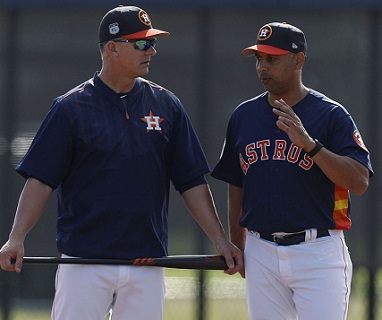
Former Houston Astros manager A.J. Hinch and bench coach Alex Cora. Los Angeles Dodgers relief pitcher Joe Kelly fumes that Astro players tainted Hinch’s and Cora’s names to save their own.

With everything else buffeting major league baseball before delayed “summer camp” and the truncated season, it was easy enough to miss. But Alex Cora—considered an Astro Intelligence Agency co-mastermind and unproven shepherd of the Red Sox Replay Room Reconnaissance Ring—spoke out in June.

And Los Angeles Dodgers pitcher Joe Kelly, one of Cora’s Red Sox charges during their run to the World Series title in 2018, spoke up likewise in a podcast by Dodger teammate Ross Stripling days before his suspension—for throwing at Alex Bregman and Carlos Correa, the latter drawing Astros and Dodgers alike out of dugouts in social-distance violation—was cut from eight to five games.

Between them comes an alteration of the former Astrogate narrative, and it’s not likely to mitigate the AIA stain on the 2017 world champions. If anything, it’s liable to make the stain deeper. Upon the 2017-18 Astros’ players and upon commissioner Rob Manfred, who handed those players blanket immunity in return for spilling about the AIA’s off-field-based, electronic pitch sign espionage.

“The people who took the fall for what happened is nonsense. Yes, everyone is involved,” said Kelly aboard Stripling’s podcast.

But the way [the AIA] was run over there was not from coaching staff . . . They’re not the head boss in charge of that thing. It’s the players. So now the players get the immunity, and all they do is go snitch like a little bitch, and they don’t have to get fined, they don’t have to lose games.

Kelly’s remarks hark among others to Cora telling ESPN writer Marly Rivera in early June that he didn’t object to shouldering his own responsibility for the 2017 Astros’ chicaneries, having been their bench coach before becoming the Red Sox’s manager, but also wanting one and all to know that neither himself nor 2017 Astros designated hitter Carlos Beltran were the sole drivers.

When Manfred dropped his Astrogate hammer earlier this year, he fined owner Jim Crane the maximum-allowable $5 million, virtual tip money. He suspended general manager Jeff Luhnow and manager A.J. Hinch for all 2020. Crane fired the pair almost at once.

Then the Red Sox more or less forced Cora out as their manager before the Rogue Sox sign-stealing report emerged. And the New York Mets more or less forced Beltran out as their newly-hired manager—before Beltran got to manage even a single exhibition game for the team he once starred for as an outfielder.

“When you take someone’s livelihood . . . to save your own ass, that’s what I don’t like,” Kelly continued.

Cheating? They cheated. Everyone knows they’re cheaters. They know they’re cheaters. It’s over. That’s done with. But now they mess it up by ruining other people’s lives, so they [screwed] it up twice . . . When you taint someone’s name to save your own name, this is one of the worst things that you could probably do . . . That really friggin’ bugs me. I think I’ll be irritated forever.

In other words, the Astros players accepting Manfred’s immunity to throw Cora, Beltran, and even Hinch and Luhnow under the proverbial bus isn’t even close to being Mike Fiers—frustrated that attempts by himself and others in the know to get reporters to push for exposing the AIA previously—finally blowing the Astrogate whistle to The Athletic‘s Ken Rosenthal and Evan Drellich last November.

Kelly may have missed Cora telling Rivera it wasn’t only players who might have made himself and/or Beltran sacrificial lambs. “There has been a narrative out there of what happened,” Cora said.

Ever since mid-November until the commissioner announced the results of the Red Sox investigation, I have read many things that are true and many others that are not.Out of this whole process, if there is one thing that I completely reject and disagree with is people within the Astros organization singling me out, particularly Jeff Luhnow, as if I were the sole mastermind. The commissioner’s report sort of explained, in its own way, what happened. But the [Astros players] have spoken up and refuted any allegations that I was solely responsible.

If there is one thing I am absolutely sure of, it is that it was not a two-man show. We all did it. And let me be very clear that I am not denying my responsibility, because we were all responsible.

Manfred’s subsequent report on the Rogue Sox determined—after the commissioner handed 2018-19 players the same immunity to spill as he handed the Astros—that their replay-room sign-stealing scheme was actually executed without Cora’s direct knowledge of the operation.

Remember: The AIA involved either installing an illegal real-time camera or altering an existing camera off mandated eight-second transmission delays to send opposition pitch signs to a clubhouse monitor, where someone deciphered them and signaled them to hitters by way of banging a can slowly next to that monitor.

The Rogue Sox didn’t go that far. They married old-fashioned on-field sign-stealing gamesmanship to new-fashioned technology all but gift-wrapped for them. MLB itself handed them and anyone else so inclined the keys to the kingdom when it installed multiple-monitor replay rooms in both clubhouses in all ballparks.

Someone deciphered opposition signs on one of those monitors and transmitted them to a Red Sox baserunner who’d send it on to a batter. The key is that the Red Sox needed a man on base to execute the reconnaissance operation in the first place. They couldn’t and didn’t have stolen signs for every man in the lineup.

The AIA didn’t need baserunners to do its dirty work, though it could only operate in Minute Maid Park. Which made the scheme even more bizarre, never mind unnecessary, since the 2017-18 Astros actually won sixteen more games total on the road than at home.

Cora, remember, once made himself a Dodgers folk hero thanks to an epic eighteen-pitch plate appearance against Chicago Cubs pitcher Matt Clement that ended in a two-run homer into Dodger Stadium’s right field bullpen. Now he’s a pariah for being the bench coach of the ’17 Astros and the manager of the ’18 Red Sox, both of whom beat the Dodgers in back-to-back World Series.

Unlike those Astros who met the press as spring training opened (pre-coronavirus shutdown) and sounded as unapologetic as men offering apologies can sound, outraging about seven-eighths of MLB players, Cora did apologise for both the AIA and the Rogue Sox. “I understand why people think that our championship is not valid, and it’s our fault that they think that,” he told Rivera.

I am being honest and I apologize for what happened and for the mistakes we made as a group. I understand why people are disappointed. I am disappointed in myself. At the time, one doesn’t think about the consequences. It was something that kept growing and growing, and in the end, it was wrong. We made a mistake and I must pay for the consequences of my actions.

Kelly pondered aloud whether those Astros who spilled to Manfred called Beltran, Cora, Hinch, and even Luhnow—whose administration was controversial enough before Astrogate’s exposure, and whose departure may have been mourned the least—“and said, ‘Hey, I’m sorry’ . . . If they had said, ‘Hey, I’m super scared, I didn’t know what to do, I didn’t want to lose money, I had to rat’ . . . Grow a pair of balls and say that.”

Would that make any difference to Beltran, Cora, and Hinch now?

Beltran lost a job he’d barely begun to do but one for which he seemed qualified enough. Cora lost a job in which he’d become only the fifth rookie manager ever to win a World Series, after Bucky Harris (the 1924 Washington Senators), Eddie Dyer (the 1946 St. Louis Cardinals), Ralph Houk (the 1961 New York Yankees), and Bob Brenly (the 2001 Arizona Diamondbacks).

The hapless Hinch, who’d shown himself mostly as an ideal managerial marriage between smarts and sensitivity, was exposed as powerless to stop his charges from plunging deeper into baseball crime or to stop his superiors from fostering such an atmosphere in the first place.

Before you return to the false narrative of Kelly’s “hypocrisy” for scoring the Astros while being a member of the Rogue Sox, remind yourself: Red Sox pitchers catching on to baserunning teammates sending stolen enemy signs to hitters probably thought the runners got the signs the old fashioned way, catching on to and exploiting an enemy catcher’s inadvertent tells.

The Red Sox fell to the ’17 Astros in a division series but beat the Astros in five—abetted especially by Andrew Benintendi’s Game Four-ending, three-run-saving, series tie-thwarting catch in left field—in the ’18 American League Championship Series.

Six Astros regulars on the 2017-18 team remain with them today. How long before the AIA stain dissipates is anyone’s guess, never mind that there were those from the scandal’s birth who suggested the stain wouldn’t leave the Astros until all the 2017-18 players had either moved on or ended their career.

There’s little enough comfort for Astro and Red Sox fans still coming to terms with having rooted for two great teams who, obviously enough, lost enough faith in their own greatness. There’s also the distinct possibility that the bad blood between the Astros and the Dodgers won’t dissipate too soon, either. They meet again in Dodger Stadium in September.

“Just to say, ‘Oh, it’s done, it’s over with, move on,’ I don’t think is a reality for anyone,” Dodger third baseman Justin Turner told a Fox Sports pre-game show. “I think around the league, there are a lot of guys upset, who kind of feel like the punishment didn’t really fit the crime. I don’t know if that’ll ever go away for me.”

Millions of fans and an awful lot of players don’t know, either.