“They want to get to the bottom of it.”

Los Angeles Angels

For their first home game after Tyler Skaggs’s death, the Angels wore his uniform and beat the Mariners in a combined blowout no-hitter, before laying the uniforms around the mound. Skaggs’s widow and parents have now sued the Angels for negligence over the pitcher’s death.

Two days before the second anniversary of his death, Tyler Skaggs’s family struck in court. His widow, Carli, filed suit in the Texas county where Skaggs was found dead of an opioid overdose; his parents filed in Los Angeles. Texas law allows only a spouse to claim damages for wrongful death or negligence.

ESPN writer T.J. Quinn says both Carli Skaggs and her in-laws are suing the Angels’ former communications director Eric Kay, who admitted to buying the drugs for Skaggs, and Kay’s former boss Tim Mead. Skaggs died at 27 1 July 2019 of asphyxiation provoked by fentanyl in his system, on the night the Angels arrived in Texas for a road set with the Rangers.

“The crux of the lawsuit is that the Angels were negligent in allowing Kay, a longtime opioid abuser, to have access to players, and that Mead failed to properly supervise him,” Quinn writes.

Kay told U.S. Drug Enforcement Administration agents that he also had provided oxycodone for five other players at Skaggs’ request. No other players have been publicly identified. The lawsuit claims that the Angels had a culture that pushed players to play through injury and that the club knew or should have known about Skaggs’ use of opioids.

The Angels didn’t respond to Quinn directly when he contacted them, he added. But the team issue a statement saying the suits’ accusations “are entirely without merit . . . baseless and irresponsible,” promising a “vigorous” court defense.

In 2019, Angels Baseball hired a former federal prosecutor to conduct an independent investigation to comprehensively understand the circumstances that led to Tyler’s tragic death. The investigation confirmed that the Organization did not know that Tyler was using opioids, nor was anyone in management aware or informed of any employee providing opioids to any player.

The Angels alone? One of the worst-kept secrets of professional sports for decades, including baseball, has been teams pushing players to play through their injuries before those injuries are healed completely. Who knows how many teams either looked the other way or feigned ignorance when injured players turned or were turned to addictive substances to get back out there faster?

One of the worst-kept companion secrets, of course, is that players smart enough to know when they’re not quite healed up, insisting they’re not going to be fool enough to get back out there before they’re fully healed, often get dismissed as fragile hypochodriacs most politely—and as feline euphemisms for a woman’s vagina most impolitely.

Skaggs underwent Tommy John surgery in 2014. “[O]pioid abuse often begins after surgeries, when the drug may be prescribed to the patient,” wrote Halos Heaven‘s Jessica DeLine three months after Skaggs died. “Per the Mayo Clinic, opioids are highly addictive and your risk of addiction is increased after taking the drug for just a few days. Skaggs had TJ Surgery in 2014 and didn’t pitch at all in the 2015 season.”

DeLine cited an Outside the Lines report suggesting Skaggs and Kay had a shared opioid history of over four years: “Did Skaggs manage to keep this a secret from all his teammates over the years? Was his TJ surgery in 2014 an inciting event for his opiate abuse? That would seem to fit with the timeline Kay provided.”

“As the federal grand jury indictment made plainly and painfully clear, were it not for the fentanyl in the counterfeit pill provided by Angels employee Eric Kay, Tyler would be alive today,” said Skaggs family attorney Rusty Hardin in a statement following the lawsuit filings. “And if the Angels had done a better job of supervising Eric Kay, Tyler would be alive today.”

Maybe. Maybe not. We’ll never know for dead last certain.

What we should know is that this business of dismissing players injured in the line of play as mal-constructed vaginas should have ceased and desisted a very long time ago.

“Leaving it all out on the field” works both ways. Would you like a litany of players from most eras who left it all out on the field and had to leave it before their times thanks to injuries in the line of duty?

Dizzy Dean, Pistol Pete Reiser, Rex Barney, Monte Irvin, Herb Score, Ralph Kiner, Roger Maris, Wally Bunker, Jim Bouton, Sandy Koufax, Tony Conigliaro, Frank Tanana, Mark (The Bird) Fidrych, Pete Vuckovich, Joe Charboneau, the entire Oakland starting rotation of 1981-83, Bo Jackson, Eric Davis, Don Mattingly, Kirby Puckett, Darin Erstad, Nomar Garciaparra, Mo Vaughn, Jason Kendall, Justin Morneau, Grady Sizemore, Ryan Howard, Mark Prior, Kerry Wood, Mark Mulder, David Wright, Prince Fielder, and Jacoby Ellsbury are just a few who should ring a few bells for having gotten their bells rung in various ways.

They didn’t get hurt showing off slam-dunk techniques on the street, hauling a heavy side of deer meat up the stairs, trying to rip Manhattan-thick phone books apart with their bare hands, or staying too long on tanning beds, to name a few examples. (Those really happened. In order, to Cecil Upshaw, Clint Barmes, Steve Sparks, and Marty Cordova.)

Few players in any era took the abuse Ellsbury took for the multiple injuries he incurred playing baseball. As if a nine-figure Yankee payday could turn Clark Kent into Superman. Even before he became so ill-fated a Yankee, Ellsbury finally couldn’t wait to high-tail it out of Boston in free agency, where he’d been an often-injured Red Sox star with two World Series rings on his finger. Too many whisperings that he took too much of his sweet time recovering from injuries.

Thank God they also don’t all get hooked on opioids or other drugs out of surgery or because of doctors administering or prescribing them.

Uh-oh. Remember Denny McLain? Now, forget everything else you know about his post-baseball history, and maybe some of his career history, and think about this. McLain felt something pop in his shoulder during a 1965 start. By 1967-68, he’d hooked himself on cortisone. He used it practically the way most of us drink coffee at the breakfast table. Used to excess—and sound medical opinion has long since determined you should have no more than ten cortisone shots in your entire lifetime—cortisone can weaken the areas where it’s administered.

Now are you surprised that McLain’s shoulder was shot to hell by the time he ended up a very disgruntled Washington Senator in 1971? When, somewhat insanely, he was allowed to start 32 games anyway, and was charged with two more losses in one season (22) than he’d been charged with in his previous three? Or that he only got to pitch in twenty more games the following year before he called it a career?

Or that he eventually said, emphatically, “The name of the game back then was you gotta win one for the Gipper. [Fornicate] the Gipper!”

“The myth that baseball players were tougher and more resilient back in the day, that they were willing to endure anything for the sheer love of the game, is just that—a myth,” wrote Sridhar Pappu in The Year of the Pitcher four years ago. “In truth, they were victims of terrible medical advice, merciless management, and unforgiving fans who believed that a worn-out, hurting arm signaled a kind of moral weakness.”

The grief over Skaggs’s unexpected death was very real. So was the staggering joy when the Angels returned home following his death, memorialised him movingly (including the team all wearing his uniform number 45), and beat the Mariners with a combined no-hitter and a 13-0 final launched when his buddy Mike Trout smashed a two-run homer in the first inning.

But his widow and his parents may be out to prove that he and too many other players are still victims of terrible medical advice or practise, and merciless or at least ignorant management. In more ways than one.
Callaway’s ban shouldn’t be the end

Mickey Callaway

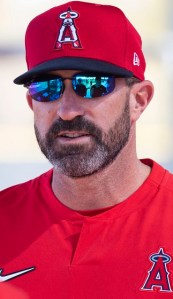
Mickey Callaway, shown here during aborted 2020 spring training—on MLB’s ineligible list through the end of 2022 for his sexual harassment across three organisations.

Mickey Callaway finally got his, sort of. His rather incessant sexual harassment of women while employed in three major league organisations, as exposed by The Athletic‘s Brittany Ghiroli and Katie Strang, landed him unemployment after the Angels fired him as their pitching coach—and a place on baseball’s ineligible list through the end of 2022. The question is why only that long.

Callaway’s penchant for sending suggestive and lewd text messages, shirtless photographs, and requests for topless images and drinking dates to five media women at minimum, was exposed at February’s beginning. “The worst kept secret in baseball,” one of the women was quoted as saying of his predations.

The Angels suspended Callaway post haste and agreed to cooperate with a full investigation by baseball’s government. The full details came forth almost immediately after the first revelations, showing Callaway’s telecommunicative tomcattery spread over a five-year period from his pitching coach days with the Indians to his self-immolating term managing the Mets to his very brief Angels tenure.

This wasn’t a man who made a couple of isolated bad mistakes. This was a man who sank himself into a morass of abasement from which he saw women as impressionable targets.

At least once Callaway was affirmed as having offered to share inside information about the Mets’ doings and undoings with one of his media women targets in exchange for getting drunk with him, possibly for openers. At least once otherwise, Indians manager Terry Francona and general manager Chris Atonetti were compelled to defend Callaway to the outraged husband of a Callaway target, before a team attorney suggested Francona himself speak to the man on behalf of making amends.

“Some of it was laziness,” writes Yahoo! Sports‘s Shalise Manza-Young, “since Callaway was hitting on women he came in contact with on a day-to-day basis, in what is supposed to be a professional setting, women who dutifully reported to the ballpark to do their jobs, to share with their respective audiences what was happening within and around the teams they were covering.”

But Callaway knew he had information he could give those women that would help them advance in their careers, and he tried to exploit that . . . You’re put in the position of saying yes and potentially getting yourself into a dangerous, compromising spot at worst, and journalistically unethical position at best; if you say no, you’re potentially burning a critical source. Few people know more about the ins and outs of a team than its manager. If you’re not breaking stories or getting fresh information, you may not be on the beat for long.

Given that woman after woman in The Athletic‘s story said Callaway’s propensity for inappropriate behavior was well known throughout MLB, it’s a stretch to believe his predation was limited to the five women who were brave enough to share their stories with the outlet.

Indeed. If at first it seemed the commissioner’s office moved a little slowly upon the original and damning revelations, putting Callaway on the ineligible list as announced on Wednesday now seems an inevitability. But Manza-Young surely isn’t the only one suspecting Callaway’s future in baseball is limited to non-existent not because he was shown to be even a virtual sexual predator but because his once-vaunted abilities as a pitching coach were belied by the Angels’ continuing inability to find and build viable pitching staffs.

“In a perfect world,” she goes on to write, “Callaway’s suspension would just be a formality and he’d never work for another baseball team again, though history tells us differently. This is a league that saw the Houston Astros trade for and celebrate relief pitcher Roberto Osuna while he was on trial for domestic assault.”

Not to mention the body that saw the Astros try first to throw under the proverbial bus the Sports Illustrated reporter, Stephanie Apstein, who exposed then-assistant GM Brandon Taubman’s post-2019 ALCS whoop about being so fornicating glad they’d gotten Osuna in the direct earshot of three women reporters. It took days for the Astros to smarten up at least to the point of canning Taubman, himself put on the ineligible list until after last year’s World Series.

Callaway can be disposed of readily enough. But the toxin of sexual harassment remains. Writing about Hall of Famer Roberto Alomar’s entry onto baseball’s permanently ineligible list over sexual misconduct in 2014 (three years after Alomar was elected to Cooperstown), Toronto Star columnist Rosie DiMinno pondered how much of the Alomar incident and the Blue Jays’s intended vaporising of his presence passed the proverbial smell test while adding that, yes, she wasn’t exactly a stranger to sexual misconduct, either:

I wish there were more details disclosed about the alleged incident, which surely could have been done without identifying the complainant . . . [and that] comes from someone who was once called a [fornicating (four-letter euphemism for ‘vagina’ starting with ‘c’)] by a player in the Jays clubhouse; who, on another occasion, had a player simulate pelvis thrusting from the rear while I was bending over to conduct an interview with another player at his stall. These were not incidents I reported to the club or to my employer. I’m just not that delicate a flower.

A woman need not be a delicate flower to work with reasonable assurance that the men with whom she deals in her line of work see and act upon her as something and someone above and beyond a target to be plucked. Callaway’s harassment was out of line whether his targets were jasmines or nerium oleanders.

It’s one thing for a man not restricted by a marital or relationship commitment to ask a woman for a date, but it’s something else entirely for a man—whether single, committed, or married—to pursue even one woman, never mind five or more, on terms that might be considered obscene even in the editorial offices of Hustler.

Callaway was a coach and manager and a man in considerable formal authority, but players wield their own kind of authoritative influence, too. His banishment should mean the overdue beginning and continuing of a reasonable remaking/remodeling of the professional baseball work atmosphere. Whether “should” graduates to “does,” alas, remains to be seen.

Call him anything, but don’t call him a thief

Albert Pujols, Mike Trout

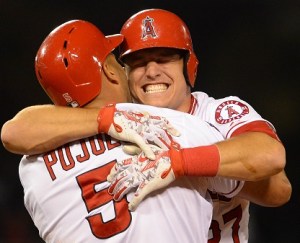
This wasn’t just a celebratory hug after Pujols walked a win off with a sacrifice fly; Albert Pujols made Mike Trout a friend as well as a protege.

When the Angels decided it was time at last to let Albert Pujols go as gently as possible into that good gray baseball night, I wasn’t the only baseball observer to say it was heartbreaking. I’m sure I wasn’t the only one, either, to say his decline following his first Anaheim season was just as heartbreaking.

But I’m still astonished, if not sickened to my stomach, from seeing assorted social media denizens speaking as one such baseball group member did after the Dodgers dropped more than a few jaws by signing Pujols as a bench and very occasional role player for the rest of the season.

“Where are they going to put him? There’s [sic] no [designated hitter] in the NL, and hopefully there never will be one,” said one in particular. “He can afford a rocking chair with all the money he stole from the Angels.”

Stole?

Bad enough the gentleman writing those words clings to one of baseball’s most nebulous and negative traditions. (Pitchers overall have hit .158/.207/.199 from the end of the 1910s until the end of 2020, for a big fat .406 OPS. As of this morning, they’re hitting .102/.136/.137 in 2021, for a whopping .273 OPS.)

But “all that money he stole from the Angels?” Rest assured, this gentleman probably isn’t even close to the only fan who feels that way. He just so happened to put it into cold print,  and I just so happened to catch it in cold print.

What he and anyone else thinking like that is really saying is that a player ground down as Pujols was because of injuries is nothing but a common thief. Well, I heard and saw Yankee fans and observers say similar things about now-retired Jacoby Ellsbury, too. As if they held their teams at gunpoint for x number of seasons.

If you thought Joe and Jane Fan believe losing is practically mortal sin, there are times that seems nothing compared to what they seem to think about being injured on the job.

When the Yankees gave up the ghost and elected to pay Ellsbury the $26 million left on his contract not to play for them any longer, I wondered aloud what it might have done to a man knowing he couldn’t do his job because his body kept him from doing it no matter what his heart and mind desired—and, because it made him a hate object among the witless.

“It’s as if being injured on the job at all equals a character flaw, especially if you happen to be paid a phenomenally handsome salary,” I wrote then. “On the flip side, it’s as if being paid a phenomenally handsome salary equals some sort of immunity to earthly harm. Here’s a bulletin for you: Handing Clark Kent a nine-figure payday doesn’t make him Superman.”

Ellsbury was talented and tenacious (and a two-time World Series champion) when he could play. He wasn’t a Pujols-level talent, but he could and often did break a game open with his own skill set, too. Yet one of the reasons Ellsbury wouldn’t even think about returning to the Red Sox when he hit free agency was because, appropriately, he was fed up over incessant clubhouse whispers that he took too much of his own sweet time recovering from injuries.

“It’s hell if you do and hell if you don’t for a professional athlete,” I wrote then, too. “Return too soon from an injury and you risk re-injury; return not soon enough (in whose sound medical opinion?) and you risk being dismissed as a fragile goldbrick.”

For Joe and Jane Fan, the paradox which is borderline hypocrisy is that they put on pedestals ballplayers who play through injuries regardless of whether that might lead to further injury, as it usually does—but then Joe and Jane Fan become the first to denounce the big jerks for playing through the earlier injuries only to incur bigger and more costly ones.

Pujols’s problems in Anaheim began when he developed plantar fasciitis in one of his heels during spring training 2013. He’d had a first season with the Angels in 2012 that resembled a down season on his terms but a career year for mere mortals.

Then, in late July 2013, he suffered a tear to that bothersome area during a game against the Athletics, while running out a ninth-inning base hit off Grant Balfour. He rehabbed the foot and heel as best he could until the Angels, out of contention by then, shut him down for the rest of that season.

It never got better for him. What nobody outside the Angels clubhouse really knew was that if his feet and legs could drain him, nothing and no one could drain Pujols’s iron will.

“He could easily have shut down a couple of these years. But just the toughness is off the charts,” said Mike Trout to The Athletic‘s Fabian Ardaya in 2019. “A lot of guys would have shut it down for good. He plays banged-up, doesn’t complain. I think that’s what people don’t see.”

“I’ll remember,” said ESPN writer Alden Gonzalez, after the Angels finally designated Pujols for assignment, “that even though his lower half was shot and he wasn’t quick enough to get around on the devastating stuff pitchers throw these days, he still showed up early, still spent hours in the training room to get ready for games, still took batting practice with intent, still crouched really low on defense and still looked for any opportunity to take an extra base. He might not have been productive, but it wasn’t for lack of effort.”

Trout was right. Showing up at the ballpark early and spending hours in the training room despite the physical sappings is what Joe and Jane Fan didn’t see. Maybe they didn’t want to see. Maybe they couldn’t believe the guy who’d played as off the charts as Pujols did as a Cardinal was forced into a far steeper decline phase to his career than he should have been.

Maybe they still clung to the illusion that a nine-figure payday in and of itself could keep a man Superman despite his body turning him into Clark Kent.

In only one way did Pujols have himself to blame for the outside perception that he was just going downhill at warp speed no matter how much money he was paid. He wasn’t the type to lament continuously over his lower body’s continuing betrayals. So much so that, when he finally did speak up about it, in the same 2019 Athletic piece, Joe and Jane Fan didn’t and wouldn’t listen.

“It’s made my move here so tough,” Pujols said to Ardaya then. “I don’t wish that anyone would have had those lower-half injuries, because I know that when I’m healthy, I know what I can do. To come over here and just be pounded by injury after injury, year after year . . . This game is tough when you’re at 100 percent with no injuries. Then imagine dealing with knee, heel, elbow, everything. It’s just tough, man.”

Pujols isn’t the only baseball player who ever kept believing to his soul that all he had to do was return to reasonable health to be what he once was. He isn’t the only player who’s learning the hardest way possible that there comes a time when the badly compromised body married to your age just wouldn’t let you be that anymore.

But not all such players get paid $255 million over ten years, whether they’re future Hall of Famers or future Hall of Shamers.

Nobody held the Angels at gunpoint, either, to offer Pujols that deal in the first place when nobody else was considering it, including the Cardinals (who didn’t until Pujols was practically taking measurements for his Angels uniform), or to keep him on the field when his body was clearly and cruelly draining him faster than a proper decline phase should have done.

Writing in The Inside Game last year, Keith Law came right out and said the Angels were foolish to keep suiting Pujols up even as a designated hitter, despite that iron will, because his body compromised him too deeply.

“If you have already paid for something,” Law wrote, nodding toward the guaranteed deal, “your choice of whether to use it should be a function of whether you want or need to use it, not a function of the money that is already gone regardless of what you do.” Don’t even go there about “eating money” if that’s what the Angels had elected to do. “Major league baseball player contracts are guaranteed,” Law wrote. “[T]here is no way to un-eat that meal.”

It’s one thing to argue against guaranteed long-term baseball contracts in all but the most unique circumstances. It’s something else entirely to argue against one retroactively because the player who signed one got hit unexpectedly with one of the worst injury bugs in baseball history a year after he finished his first season under such a deal.

The clumsiness with which the Angels parted with Pujols speaks only further ill of a team whose administrative culture makes a pratfalling putz resemble Joe DiMaggio roaming center field. The Dodgers’ willingness to bring him aboard even as a part-time bench player, perhaps an occasional first base fill-in, would look a lot better if there wasn’t even the momentary sense that it was a concurrent chance to stick it to their down-freeway rival.

It won’t cost the Dodgers a dollar beyond the pro-rated minimum major league salary to give Pujols one more chance at possible postseason triumph and a possible third World Series ring that the Angels couldn’t. (The Angels’ chronic inability to build a viable pitching staff has harmed them several years; if the Pujols deal tied their hands financially, the Angels haven’t been brilliant at drafting pitching or even acquiring low-cost/high-enough-performance arms, either.)

Personally, I’d hoped Pujols would surrender to his body’s betrayals and call it a career sooner, if only because he wasn’t really Albert Pujols anymore and hadn’t really been for too long through no fault of his own. I wanted him to be as close to Hall of Famer Mike Schmidt as possible, Schmidt having retired in May 1989 because, essentially, he didn’t believe he was Mike Schmidt anymore.

Such Hall of Famers as Willie Mays and Steve Carlton couldn’t do it, either; we saw their baseball ghosts a little too long. Hall of Famer Sandy Koufax did do it when he was still ten dimensions beyond the top of his game: “I don’t regret one minute of the past twelve seasons, but I might regret the season that was one too many.” Even more so than Schmidt, Koufax left the world wanting more, not less.

Whether mere mortal or Hall of Fame immortal, not every player is as self-aware as Koufax and Schmidt. But there’s another kind of self-awareness that imposes a cruelty of its own. It’s the kind Pujols has, the kind that kept him grinding his way back in search of the trans-dimensional greatness he once evoked. The kind that guaranteed him a berth in the Hall of Fame before his body left him nothing but his will.

Knowing what we should know now of that stubborn will no matter what Mother Health and Father Time declared otherwise, we should accept that Pujols earned the chance to leave the field with whatever remains of his professional dignity intact. Maybe he has one more game- or set-changing swing left in him. Maybe he doesn’t.

But calling him the thief who stole all that money from the Angels, however, is way out of line, Joe and Jane Fan. It exposes you as the couple too witless to comprehend just what Pujols put himself through to live up to that contract no matter how often his body told his heart and mind where to shove it.

La Maquina, al finale?

Albert Pujols

That was last fall: Pujols tying Willie Mays on the all-time home run list. This is Mays’s 90th birthday, today: the Angels announced they designated the sadly-declined Pujols for assignment.

Late in February, Albert Pujols’s wife posted a social media message suggesting that, when his mammoth contract with the Angels expired after this season, so would her husband’s playing career. That option may not belong to him anymore.

The Angels jolted baseball when they announced Thursday that they designated the Hall of Famer in waiting for assignment. Once upon a time, timing was Pujols’s ally at the plate and beyond. Announcing the designation on Willie Mays’s 90th birthday, of all days, just made it sting that much more.

It had to. No less than Mays himself sent Pujols a text message last year saying, “It’s your time now. Go get it.” Meaning, go meet and pass Mays’s 660th lifetime home run. Pujols met 660 last September and passed it with 661 five days later. The Machine had six more bombs in him before the Angels finally gave up his ghost.

Let’s get this out of the way right now: Pujols didn’t ask to have maybe the most heartsickening, prolonged decline in the game’s history.

It wasn’t his idea to have a down season his first time out as an Angel. (Codicil: a down season for Pujols in 2012 was still a career year for more players than you can fit aboard two Dreamliners.) He didn’t ask for plantar faascitis in his heel the following year to begin a punishing series of lower half injuries that drained everything he had left.

ESPN writer Alden Gonzalez, who’s covered Pujols for most of his Angels life, saw up close and personal what Pujols put himself through in what we now know was a futile attempt to find the St. Louis smash buried somewhere inside what was left of him now.

“I’ll remember,” Alden says, “that even though his lower half was shot and he wasn’t quick enough to get around on the devastating stuff pitchers throw these days, he still showed up early, still spent hours in the training room to get ready for games, still took batting practice with intent, still crouched really low on defense and still looked for any opportunity to take an extra base. He might not have been productive, but it wasn’t for lack of effort.”

The stubborn, proud spirit was too willing, but the body was likewise too ready to tell him where to shove it at long enough last. No recent play was more emblematic than the ground ball he hit to the hole at shortstop but didn’t run out—because he couldn’t. He’d have been better off taking a skateboard out of the box up the line; he was thrown out on a lob across the infield before he was even halfway up the line.

The only tool Pujols’s body left alone was his still-devastating long ball power. Gonzalez’s ESPN colleague David Schoenfield is right to observe that’s not enough to stay aboard a major league roster. Not even though Pujols remained mostly as difficult to strike out as he always was. (His average per 162 games: 74; or, a single punchout every other game.)

But he’s all but quit taking walks; he rarely hits for extra bases beyond home runs; and, no matter how ironed up his will is, he hasn’t been the first base defender he once was for what seems eons. His Cardinals era was off the charts enough to keep his lifetime statistics showing him a plus first baseman by 95 runs saved above his league average. Fortunately.

Aside from what it did to him as a man, Pujols’s injury-instigated and perpetuated decline robs him of sitting atop the rest of the Hall of Fame’s post-World War II/post-integration/night-ball era first basemen according to my Real Batting Average. (Total bases + walks + intentional walks + sacrifice flies + hit by pitches, divided by total plate appearances.)

First Base PA TB BB IBB SF HBP RBA
Jim Thome 10313 4667 1747 173 74 69 .653
Jeff Bagwell 9431 4213 1401 155 102 128 .636
Albert Pujols 12486 5955 1334 313 115 111 .627
Willie McCovey 9692 4219 1345 260 70 69 .615
Harmon Killebrew 9833 4143 1559 160 77 48 .609
Orlando Cepeda 8698 3959 588 154 74 102 .561
Eddie Murray 12817 5397 1333 222 128 18 .554
Tony Perez 10861 4532 925 150 106 43 .526
HOF AVG .597

Had his career ended when his years with the Cardinals did, Pujols would have retired with a .708 RBA. Had he not been betrayed by his heels, feet, and most of the rest of his lower body as an Angel, he might still have finished with a higher RBA than Jim Thome did. And none of those Hall of Fame first basemen are as far above their league average for runs saved at the position as Pujols. (Eddie Murray’s +61 are 34 below Pujols.)

Pujols’s berth in Cooperstown is solely a question of when he retires as a player officially. No matter how sad his injury-instigated, protracted decline, he secured that in St. Louis to devastating effect. If the Angels don’t work a trade out now, and there’s no assurance they’d find a trading partner willing to part with viable talent in exchange for a ghost, there’s no guarantee another team would sign him for a pro-rated minimum salary as a free agent, either.

His longtime Cardinals manager Tony La Russa came out of his Hall of Fame retirement to take on the White Sox—but La Russa has already shown trouble handling today’s experimental rules as it is. No matter how much he still respects and loves Pujols, La Russa isn’t going to convince his bosses to take the ghost over young and establishing designated hitter Yermin Mercedes.

The DHs in Tiger uniforms are hitting this year at levels low enough to make Pujols continue resembling his Hall of Famer-to-be old self—but the Tigers have an aging incumbent themselves, named Miguel Cabrera. Hands up to anyone and everyone who thinks that even the current Tiger regime would hold with manager A.J. Hinch sending Cabrera to the pine in favour of Pujols now.

Purely in baseball terms, designating Pujols for assignment makes too much sense. Especially with Jared Walsh standing in for injured right fielder Dexter Fowler but far better suited to play first base. Especially with Shohei Ohtani more than capable of holding a DH slot on the days he doesn’t pitch. Pujols’s designation means the Angels don’t have to let Ohtani bat on his pitching days; they can save him for the final role Pujols can’t handle anymore.

But in human terms, this is a heartbreak. Especially for a man so community and charity oriented that you could believe the Angels well enough, even committing boilerplate, when owner Arte Moreno’s formal statement praised Pujols in character terms, as a man whose “historical accomplishments, both on and off the field, serve as an inspiration to athletes everywhere, and his actions define what it means to be a true superstar.”

If only the announcement didn’t have to happen on the 90th birthday of Mays, a man Pujols respects and maybe even loves almost as much as he loved and respected St. Louis icon Stan Musial. This may have been the worst case of bad timing in baseball since . . .

Maybe since Brad Lidge’s bad timing hanging Pujols a breaking ball to demolish for a National League Championship Series Game Five-tying three-run homer in 2005. Or, the bad timing of Rangers relievers Alexi Ogando, Mike Gonzalez, and Darren Oliver gifting Pujols three meatballs to destroy beginning in the top of the sixth in Game Three, 2011 World Series.

When Hall of Fame pitcher Tom Seaver was traded to the Reds from the Mets, following contract extension talks that went from difficult to scurrilous thanks to Mets management and certain sports columnists smearing him, A. Bartlett Giamatti—then president of Yale University, as opposed to his eventual higher calling as a baseball commissioner—wrote in Harper’s, “[A]mong all the men who play baseball there is, very occasionally, a man of such qualities of heart and mind and body that he transcends even the great and glorious game, and that such a man is to be cherished, not sold.”

If Giamatti had lived to see Pujols, he might have thought likewise, ending with “such a man is to be cherished, period.” Pujols wasn’t sold, but half his body sold him out. Whether you called him El Hombre (the nickname he hated, insisting there was only one Man and his name was Musial) or The Machine (La Maquina in his language), he didn’t deserve having his gears stripped into a long, painful, sad decline.

The first five days

Stop me if you’ve heard it before: Jacob deGrom pitched like a Hall of Famer, but the new Mets bullpen puked the bed like the old one did.

The fans are back in the stands, however limited by ongoing COVID-19 safety protocols, but the Nationals have yet to play a regular-season game thanks to a few players and a staffer or two testing positive. There went that Opening Day must-see match between Max Scherzer and the Mets’ Jacob deGrom.

With their opening set with the Nats thus wiped out, deGrom had to wait until the Mets went to Philadelphia Monday. Oops. That and everything else seemed to play a support role to the horrid news out of San Diego.

The news that Fernando Tatis, Jr., the Padres’s new bazillion dollar shortstop, suffered a partial left shoulder dislocation on a hard third inning swing at the plate during a Monday loss to the Giants.

Padres manager Jayce Tingler told reporters he thinks team trainers and medical people were able to pop the shoulder back together, but the team isn’t taking chances. At this writing, MRI results aren’t available and nobody knows yet whether Tatis will spend significant time on the injured list.

If it’s more than a small shoulder dislocation, it may not be significant time. If it’s something like a labral tear, Tatis could miss six months—essentially, the rest of the season—according to one doctor who knows such shoulder troubles and spoke to the Los Angeles Times. Don’t fault the Padres if they’re saying to themselves, “Thank God for insurance.”

DeGrom could use a little extra insurance himself, alas. The good news for the Mets: deGrom was his usual self Monday night. Six shutout innings, seven punchouts, three hits, three-figure speed on his fastballs. The bad news, alas: the Mets are gonna Met, so far. At least out of the bullpen.

Their on-paper impressive offense found nothing more than two runs to support their ace. They got an inning of shutout relief from Miguel Castro relieving deGrom for the seventh, but the bullpen puked the bed in the eighth—including hitting Bryce Harper with the bases loaded. Not exactly a Rhodes Scholarship move there.

The Old Fart Contingency thundered aboard social media that Mets manager Luis Rojas blew it lifting deGrom after six strong—until they were reminded the added layoff after the Washington postponement put both deGrom and the Mets into caution mode.

“If that was [last] Thursday and I’m on normal rest,” the smooth righthander said postgame of the early hook, “I don’t think there is any chance I’m coming out of that game. We discussed it before what was the right thing to do. Long season and talking to them coming in, it felt like was the right decision.”

It was neither deGrom’s nor Rojas’s fault that, after Garcia took care of the Phillies in the seventh with just one infield hit within a fly out and two ground outs, the Phillies loaded the bases on the Mets’ new relief toy, Tyler May, in the eighth with one out, before Rojas went to another new Met bull, Aaron Loup. And Loup promptly hit Harper to push Miller home, before J.T. Realmuto singled home pinch runner Quinn, Mets late third base replacement Luis Guillorme threw home off line allowing Harper and Rhys Hoskins to score, and Didi Gregorius pushed Realmuto home with a first-pitch sacrifice fly.

The Mets had nothing to answer except a two-out ninth-inning stand that came up two dollars short against Phillies closer Alvarado. Kevin Pillar singled up the pipe, Francisco Lindor—the Mets’ own new bazillion-dollar lifetime shortstop—dumped a quail into shallow right that landed just in front of and then off the glove on oncoming, diving Harper, and Michael Conforto singled Pillar home while setting up first and third.

Pete Alonso, their 2019 Rookie of the Year bomber, hit one to the back of right field that looked as though it had a chance to ricochet off the top of the fence if not clear it. It wasn’t quite enough to stop Harper from running it down, taking a flying leap with his back against the fence, and snapping it into his glove to stop a game-tying extra-base hit and end the game with the Phillies on the plus side, 5-3.

Marry the foregoing to deGrom going 2-for-3 at the plate including an RBI single, and no wonder May himself said post-game, “Jake shouldn’t have to do everything himself. That’s not what teams are, and frankly Jake did almost everything today.”

Just don’t marry that to things such as the Angels’ Shohei Ohtani hitting 100+ mph on the mound and hitting a mammoth home run that flew out 100+ mph in the same inning last Friday night. Ohtani the two way player is an outlier among outliers; deGrom’s merely an outlier.

As of Tuesday morning— with the National League’s pitchers having to bat because Commissioner Nero simply couldn’t bring himself to keep the universal designated hitter this year at least, and Ohtani batting second in the Angel lineup the night he started on the mound, among other things—the pitchers have a .131/.157/.192 slash line and a .349 OPS.

The pitchers at the plate from Opening Day through the end of Monday night collected thirteen hits in 149 plate appearances: nine singles, three doubles, and Ohtani’s Friday night flog a third of the way up Angel Stadium’s high right field bleachers. They also walked three times and struck out 56 times. And the OFC still insists the National League just say no to its own invention.

All around the Show, too, there was one home run hit every 35 plate appearances and fourteen percent of all 928 hits the season’s first five days cleared the fences. It took five outs to create a single run, with 5.3 average runs created per game and 631 runs created while 559 scored.

It was fun to hear the fan noises even in limited capacities, too, though the limits in Angel Stadium made Ohtani’s blast sound even more explosive at the split second he hit it. If only things had been more fun for the home crowds: the many themes for the Show’s first five days could include, plausibly, the blues classic “On the Road Again.”

The home teams’ slash lines: .225/.313/.374/.687 OPS. The road teams: .245/.328/.403/.731 OPS. The road teams drove in fifteen more runs, hit thirteen more home runs, seven more doubles, and had seventy more hits overall. They also took eleven more walks, though they struck out fifty more times and grounded into fifteen more double plays. The road rats also had a +29 batting average on balls in play over the home boys and 108 more total bases while they were at it.

Maybe the shocker among the opening road rats were the Orioles. The Woe-rioles. Taking three straight from the Red Sox in Fenway Park. Out-scoring the Olde Towne Team 18-5, including and especially an 11-3 battering on Sunday afternoon. Even those paranoid about ID cards might want to insist the Orioles show theirs, even after the Orioles got a brief return to earth from the Yankees beating them 7-0 Monday in New York.

Unless it was the Reds, taking two out of three from the Cardinals to open, including and especially a 12-1 battering Sunday afternoon that proved the best revenge against abject stupidity is to slap, slash, scamper, and smash your way to a six-run seventh when you’re already up three runs—thanks to Nick Castellanos ripping Cardinal starter Carlos Martinez for a two-out, three-run homer an inning earlier.

Castellanos got drilled by Cardinals reliever Jack Woodford Saturday . . . two days after he bat-flipped a home run. Then, when he dove home to score on a wild pitch, Castellanos got bumped by Woodford sliding in to bring down the tag Castellanos beat. Castellanos sprung up, barked at Woodford, and began walking away before trouble could arrive. Oops. Trouble arrived—when Yadier Molina shoved him from behind to spark a bench-clearing brawl.

Baseball government myopically suspended Castellanos two games for “provoking” the brawl. Who’s baseball’s official optician? Who couldn’t see what everyone else with eyes saw? And how long has Molina—handed only an “undisclosed fine” along with a few others in the scrum—been so privileged a character that he can get away with the actual kickoff of a brawl that was seeded in the first place because the Cardinals are one of the game’s self-appointed Fun Police precincts?

“I was pleased,” Cardinal manager Mike Schildt told the press after that game. “Our guys came out there. We’re not going to take it. I know Yadi went immediately right at him, got sidetracked by [Cincinnati’s Mike Moustakas]. Woody, to his credit, got up and was like, ‘I’m not going to sit here and be taunted.’ Good for him.”

Taunted? All Castellanos said when he sprang up, by his own admission, was “Let’s [fornicating] go!” Anyone who thinks Woodford lacked intent didn’t see that ball sailing on a sure line up into Castellanos’s shoulder and rib region. Nor did they see Molina very clearly shoving Castellanos without Castellanos having the benefit of a rear-view mirror.

Castellanos appealed the two-game suspension. The final result wasn’t known at this writing. But the Cardinals should be getting a message of their own: Defund the Fun Police. Pronto.

How about the Astros, who went into Oakland and swept four from the Athletics before ambling on to Anaheim and losing 7-6 to the Angels Monday night? That was despite dropping a three-run first on Angel starter Jose Quintana and yanking a fourth run out of him in the top of the fourth, before the Angels finally opened their side of the scoreboard with Mike Trout (of course) hitting Luis Garcia’s 2-2 meatball about twelve or thirteen rows into the left field seats.

The Angels pushed a little further back, the Astros pushed a little further ahead, until the Angels ironed up and tore four runs out of the Astros in the bottom of the eighth with an RBI single (Dexter Fowler), a run-scoring force play (David Fletcher), a throwing error (on Jared Walsh’s grounder to first), an intentional walk (to Trout, of all people), and a sacrifice fly (Anthony Rendon).

Kyle Tucker’s ninth-inning solo bomb turned out more a kind of excuse-us shot than a last stand. The game left both the Astros and the Angels at 4-1 to open the season and what could be very interesting proceedings in the American League West. Now, if only the Astros could finally get past Astrogate.

They’ve been playing and winning through numerous catcalls, howls, and even a few inflatable and actual trash can sightings in Oakland and Anaheim. Jose Altuve—who’s looked more like his old self at the plate so far—seemed mildly amused when an inflatable trash can fell to the warning from those high Angel Stadium right field bleachers.

Astrogate was and remains anything but amusing. The Astros could keep up their torrid opening and overwhelm the AL West this season, but the scandal won’t go away entirely (nor should it) until the absolute last Astrogater standing no longer wears their fatigues. Yes, you’ve heard that before. That doesn’t make it any less painful for Astro fans or less true for everyone else. The Astros, nobody else, wrote the script that made them pariahs. Bang the cans slowly, fans.

Will off-field-based illegal electronic sign stealing disappear at all? Players got same-game video access back this year. There are three security people in every team’s video room at home and on the road. League cameras have been installed in those video rooms. Maybe it wouldn’t hurt to add guard dogs?

The players union agreed last year: there’ll be no more players getting away with murder even in return for spilling the deets—the commissioner can drop a lot more than a marshmallow hammer on the cheaters from now on. All by himself. He can demand answers without plea bargaining. And he doesn’t need a permission slip.

“But one of the prevailing lessons from the electronic sign-stealing era is that even if a scheme sounds far-fetched, someone might give it a whirl if they believe they can get away with it,” writes The Athletic‘s Evan Drellich, one of the two reporters (Ken Rosenthal was his partner) who helped break and burrow deep into Astrogate. “This holds true no matter what MLB does. Even a total ban on electronics, which the players would never agree to, would not be enough. In that case, a player or staffer could simply go rogue.”

In other words, boys will be still be boys, if they can-can.