The deeper issue at play in the Kay trial

Matt Harvey

Harvey admitting on the witness stand that he did coke as a Met shouldn’t be bigger than Harvey suggesting too many players still feel desperate to return to action despite not being recovered fully from injuries.

The Eric Kay trial—in which the former Angels communications director faces up to twenty years in prison on drug charges if convicted, stemming from the unexpected overdose death of pitcher Tyler Skaggs in 2019—seemed the sleeper of the week. Until it suddenly wasn’t, after sworn testimony from one-time Angels pitcher Matt Harvey.

Harvey, once a star in New York but still trying to rebuild a career compromised less by his once-notorious night life than by the aftermath of thoracic outlet syndrome surgery. Harvey, once the Dark Knight, but since struggling to find any semblance of the form that once made him what his old rotation mate Jacob deGrom has become.

You had to strain yourself, though, to hear anyone discussing what ESPN writer T.J. Quinn  tweeted Tuesday morning from the trial. “[Matt] Harvey is describing culture of MLB,” Quinn wrote, “guys desperate to stay on field and play through injuries.”

That was about as cryptic as a sledgehammer blow. Harvey wasn’t exactly revealing classified information he’d formerly flushed down the nearest precious-metal commode, either.

But for every one who got what Quinn described him saying during his testimony, there were probably a few hundred more interested in Harvey copping to doing coke as a Met and how many Angels were getting and gulping assorted painkillers from Kay directly or by way of others.

Joe and Jane Fan would rather just dump on the druggies than admit a big reason they get their meathooks on assorted painkillers and other naughty pills and powders in the first place is that too many team medical staffs—even today, even with everything we know about sports injuries that wasn’t known or ignored for generations preceding—could still be tried by jury for medical malpractise.

The Twitterpated are more titillated that the former Dark Knight had a few too many off-field nights partying than that he, too, felt all but forced to perform despite his body’s inner warnings. The talk about the “drug culture” on those Angels (and don’t think it doesn’t exist on other teams) seemed to override talk about the pressures placed upon the injured to get back onto the mound or onto the field like yesterday—no matter how fully they’ve recovered from their injuries.

Harvey wasn’t the only one of Skaggs’s teammates looking for pain relief. Pitcher Mike Morin, an Angel from 2014-2017 now with the Marlins, testified he sought Kay’s help after Skaggs mentioned Kay as someone who could provide painkillers like oxycodone to help Morin, too, deal with what turned out thoracic outlet syndrome. Former Angels relief pitcher Cam Bedrosian (now with the Phillies) and first baseman C.J. Cron (now with the Rockies) also said they got painkillers from Kay.

Harvey also copped to giving Skaggs one Percocet. Why? He thought he was doing his teammate in pain a favour and wanted to be a good teammate. That may still be enough to get him suspended under baseball’s drug policy. Now a free agent, after an up-and-down 2021 that ended almost a month early due to a knee injury, Harvey may have a harder time catching on when the current lockout ends.

In case you forgot or didn’t know in the first place, Skaggs himself had an injury history. He underwent Tommy John surgery after returning to the Angels in a trade from Arizona and starting eighteen games in 2014. Missing all 2015 recovering and rehabbing, he subsquently incurred oblique, adductor, and ankle injuries. And it’s not impossible that he was given something powerful enough coming out of TJ surgery to hook him.

When the Texas coroner’s report revealed fentanyl may have caused Skaggs’s accidental overdose death, USA Today columnist Bob Nightengale wrote of him as a young man in pain.

“Perhaps more physical than even the doctors and trainers knew,” he wrote. “Maybe more mental than even any team therapist knew. It will be a bigger tragedy if we never understand why. Prescription painkillers are a scourge in this country, and professional sports—with catastrophic injuries and the expectation to play through the pain they cause—are ripe for potential abuse.”

It’s not just a particular contingent among current players talking these things, on a witness stand or elsewhere. Hall of Famer Pedro Martinez is talking about those pressures, too. His freshly-published memoir, Pedro, includes a portion where Martinez says that, as a Met, then-chief operating officer Jeff Wilpon forced him to pitch despite a toe injury that affected either his push off the rubber or his landing as he threw—in September 2005, despite the Mets being out of the pennant race.

Before Joe and Jane Fan start barking ohhhhhh, he was forced to earn his keep when his itty bitty toesy hurt, they should try to remember Dizzy Dean. That Hall of Fame pitcher once forced himself to alter his delivery to compensate, after suffering a broken toe courtesy of an Earl Averill batted ball in the 1936 All-Star Game. Dean ruined his shoulder with the new motion, turning the second half of his career from Hall of Fame great to nothing special.

Maybe if Dean had been allowed to recover completely from the toe fracture it would have been a different story? “I was unable to pivot my left foot because my toe hurt too much,” the ever-locquacious Dean was quoted as saying, “with the result I was pitchin’ entirely with my arm and puttin’ all the pressure on it and I felt a soreness in the ol’ flipper right away. I shouldn’ta been out there.”

When the 1969 Cubs burned out and faded down the stretch as the Miracle Mets heated up to take the National League East en route their championship series sweep of the Braves and World Series conquest of the Orioles in five games, it turned out that manager Leo Durocher cowed too many of his players into not disclosing injuries for fear he’d denounce them—in the press as well as in clubhouse reamings—as quitters.

Now retired, Jacoby Ellsbury was oft injured even in his Red Sox years . . . and accused of malingering when he tried his best not to return prematurely. After shining in his contract walk-year during the Red Sox’s 2013 World Series conquest, Ellsbury signed big with the Yankees—and ran into the injury bug again.

And again. And again. Knee injuries, concussions, hip injuries, setbacks rehabbing. Joe and Jane Fan wrote him off as a waste of Yankeebucks. Some even called him a quitter, never mind that his injuries came from playing the game as hard as he could with what he had.

Was it Ellsbury’s fault he’d been injuried on the job, in honest competition? Maybe we should wonder that, so far as anyone knows, Ellsbury didn’t seek the kind of extracurricular pain relief others have, clearly enough.

Skaggs’s death at 27 “shines a harsh spotlight on the dark underbelly of playing professional sports,” writes FanSided‘s Gabrielle Starr. “Many players feel forced to go to extremes to be able to compete, and we’re now witnessing the worst possible outcome of that desperation.”

What is it with the Angels’ organisational culture that compelled several players including Skaggs to seek extracurricular pain relief? Were they, too, being pushed beyond reasonable expectation to come back from injuries? Do you really think they’re the only team who’d be guilty of that?

Could those Angels have been pushed unreasonably compared to the team’s Hall of Famer-in-waiting Mike Trout, who’s been injured often enough but was never pressured improperly so far as anyone knows to return before he was healed completely? As in were the Angels’ administrators sending the message Trout himself would never send, that, well, he’s Mike Trout and . . . you’re not?

Don’t dismiss the Kay trial as just another sports drug trial. It’s easy to denounce the druggies. It’s a lot harder to remember that a lot more of them than we might have thought went there not for kicks but for genuine pain relief. It didn’t have to take the death of a still-young major league pitcher, whose death provoked game-wide grief, to mean those issues might finally be addressed with the seriousness they deserve.

Unless you’re diffident or soulless, it makes you stop to ponder that maybe we shouldn’t be too swift to worship the players or teams who “grit” or “gut” or “grind” it out through various injuries of all dimensions. (The 2019 Yankees, the Broken Bombers, using 53 different players and sending thirty to the injured list that season, come to mind as a recent example.)

Maybe, instead, we should question the sanity lost when they push themselves or are pushed to play injured—with the reward now barely worth what might be lost to their futures. Think about that before you denounce the injured as gutless, heartless, useless quitters. Again.
What Syndergaard wanted most

Noah Syndergaard

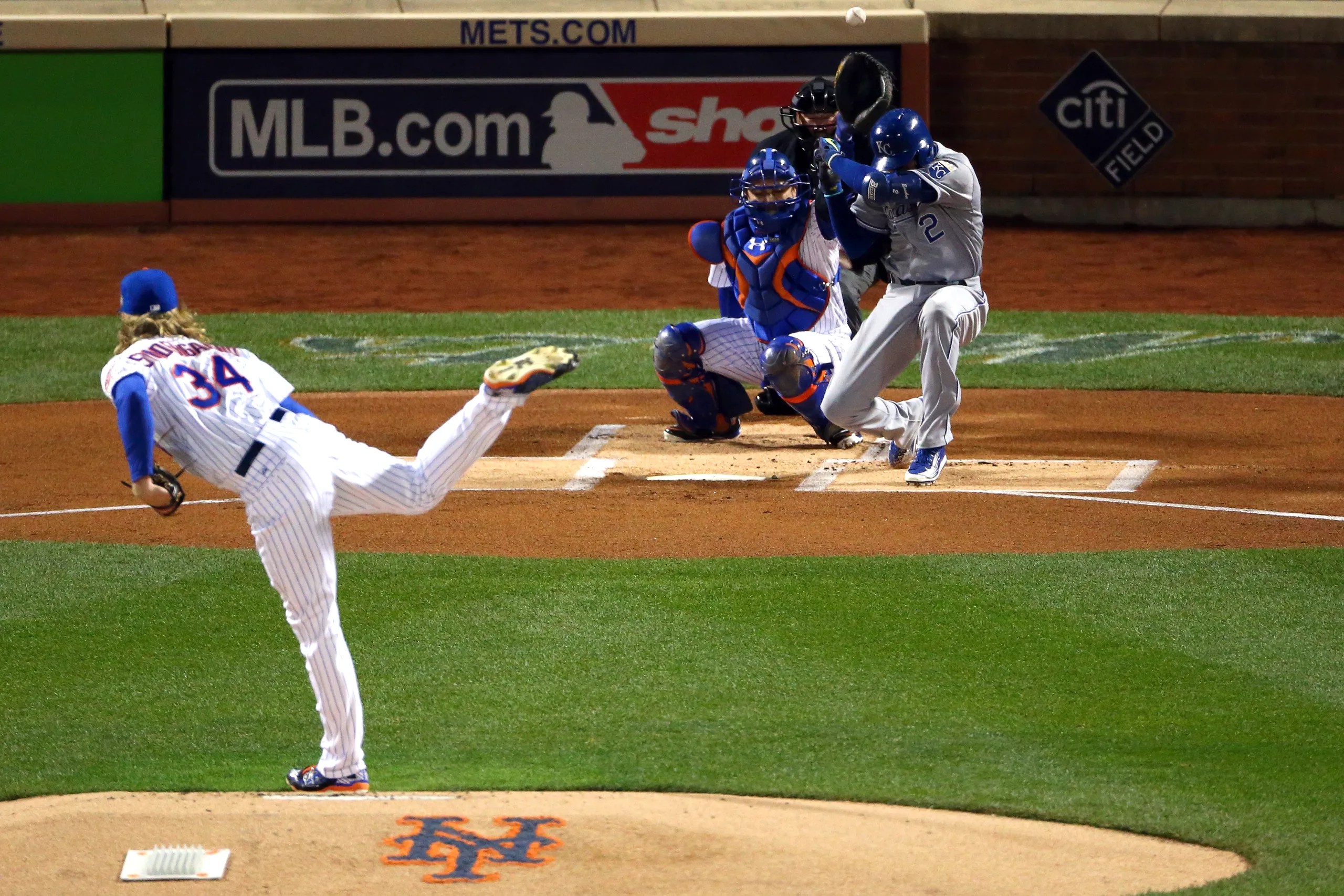
Met fans won’t forget Noah Syndergaard dropping Alcides Escobar to open Game Three of the 2015 World Series. Now the talented but oft-injured Syndergaard will be an Angel because the Mets’ administration slept at the switch after making his qualifying offer.

Go ahead and cling to the surface look if that’s your preference. Cling to the Mets showing Noah Syndergaard a qualifying offer and Syndergaard electing instead to let the Angels seduce him for a couple of million dollars more for next year, if it makes you happy. Cling to the narrative that Syndergaard’s heart with the Mets could be bought, if you must.

But now you must ask yourself concurrently just why it was that Syndergaard’s Mets heart was abandoned while the Angels swept in and swept him off their feet. Your answer is no further than New York Post writer Joel Sherman, who says the Angels had a plan for the power-pitching righthander coming back from Tommy John surgery—and the Mets apparently lacked one.

Oh, sure, the Mets plan to win if they can help it. But that’s it. When they tendered Syndergaard his qualifying offer, that was it, too. They had no general manager at that moment. They had no manager. They still don’t. They’ve got a pitching coach, Jeremy Hefner.

But nobody in the Mets’ organisation talked much of anything yet about how they were going to shepherd a starting pitching staff going forward. They didn’t talk about how they were going to manage Syndergaard’s work load during his first full season back after Tommy John surgery, recovery, and rehab.

Enter Angels general manager Perry Minasian. He knew Syndergaard wanted a deal and the physicals done before today’s qualifying-offer deadline, just in case the physicals didn’t wash, leaving Syndergaard a Mets fallback after all. He also knew what Syndergaard wanted beyond a solid-enough, prove-it-year’s deal.

Syndergaard wanted a plan. Minasian high tailed it to New York to present him one. “[F]or the best organizations these days preparing pitchers physically, for the season and for each game, is a collective effort across multiple departments,” Sherman writes.

There were efforts in the first year under [Steve] Cohen’s ownership to bulk up these areas, but [the Mets] still pale in comparison to clubs such as the Dodgers, Giants and Blue Jays, among many others.

Minasian . . . came to New York armed with details on, among other things, how his club would have him pitch to individual players on each team in the AL West. He spoke of the success the Angels enjoyed last year with a six-man rotation, which helped get Shohei Ohtani through a season of hitting and pitching healthy. Minasian said the plan would stay the same and showed Syndergaard how pitching in a six-man rotation would give more time for recovery and lower his overall inning total when all he had in 2020-21 in the majors was two one-inning stints to close out the past season. Minasian brought data to show what the Angels liked about his delivery and pitch mix and how to make them even more effective.

In other words, Minasian caught the Mets sound asleep at the Syndergaard switch. While the Mets just slid a qualifying offer under the righthander’s nose with nothing substantial behind it to show him anything resembling love or respect, the Angels’ GM—who goes back with Syndergaard to the Blue Jays, having been part of their drafting team when they first picked him—brought all three. Love, respect, and substance.

Minasian also brought it with the most aggressive and committed push among several contenders for Syndergaard’s prove-it season, including the world champion Braves, the Red Sox, and the Jays.

Sherman notes that the Angels weren’t exactly thrilled about having to lose a draft pick for signing Syndergaard, but they were less thrilled than that about the prices in the free agency starters’ store—and starting with a Syndergaard whom Minasian knew well enough would give them decent odds in the upside department before pondering another starter or two on that market

The Angels’ seduction, Sherman writes, mattered as greatly as the Mets’ apparent lack of it: “Syndergaard is going to pitch at 29 this year. He recognizes how vital it is that he performs well to set himself up to re-enter the market next year at 30 to try to score a lucrative, long-term pact. And here were the Mets not even talking to him throughout this process. Here they were without an infrastructure in place. Here they were unable to provide a detailed plan to him beyond the big picture that Cohen wants to win now.”

The Mets hired former Angels GM Billy Eppler—Minasian’s immediate predecessor—as Syndergaard’s deal with the Angels came forth. This can be called crossing one end of the street without bothering to see who’s coming down the block from the other end. This can also be called too little, too late. This can be called, further, that’s still so Mets.

Leaving Mets fans with memories of a stout, tenacious pitcher who could be lights out when healthy and who gave them one whale of a performance in the 2015 World Series: Syndergaard dropping plate-crowding, plate-overcomfortable Royals shortstop Alcides Escobar to open Game Three, the only game in the Series that the Mets’ then-porous defense couldn’t cost them.

God knows the Angels themselves need a starting pitching overhaul—again. If a year’s worth of Syndergaard at minimum helps it begin, the deal will have been worth it. If Minasian’s plan for him works well enough, the Angels might think of extending Syndergaard or Syndergaard will have a solid market when he hits free agency next winter.

If losing Syndergaard now means a swift enough kick to the Mets’ posterior on behalf of shaking them further out of their funk before and after any possible lockout, it might be worth it, too. Eppler’s hiring to the contrary, with these Mets that’s a glandular if.

Will Eppler get to run the Mets unimpeded?

Billy Eppler, Mike Trout

Then-Angels GM Billy Eppler—seen with Mike Trout, whom he signed to a glandular Angel-for-life extension in 2019—now gets to run the Mets without a contradictorily heavy hand above and undermining him.

The good news (yes, it’s good news) is that the Mets finally have a new general manager. The bad news is that an awful lot of people may be shaking their heads and lamenting, “They put on that crazy hunt to end up with this?”

Billy Eppler wasn’t exactly a resounding success when he held the same job with the Angels from 2015-2020. Not overall, anyway. In isolated moments he looked like a budding genius. In the big picture, he looked like another one of Angels owner Arte Moreno’s designated fall guys.

The budding genius side: Eppler did the heavy lifting when it came to making Mike Trout an Angel for life and for making Shohei Ohtani an Angel at all after his Japanese splash. He secured the game’s best all-around position player and his three American League MVPs and landed this year’s two-way sensation who just might shake out as this year’s AL MVP.

The fall guy side: Moreno’s contradictory penchant for splash signings, low enough budgets otherwise, and moves he pushed out of sheer fury after failures to strike  designated targets. Moreno is a lot more like Eppler’s one-time boss George Steinbrenner’s bad side than Angel fans often dare admit outright.

Before Met fans continue shrugging their shoulders and lamenting that this, too, is so Mets, ponder if you will that when the Angels hired Eppler in the first place—after he’d spent copious time as Brian Cashman’s assistant with the Yankees after running their scouting system a few years—Eppler went in with an arm and a half tied behind his back before he could make his first phone call.

Perhaps insanely, Moreno gutted just about his entire scouting system. He made international scouting director Clay Daniels pay with his head after some of Daniels’s subordinates were caught skimming signing bonuses. He pinked his overall scouting chief Eddie Bane over a series of bad drafts and free agency signings, even if one of Bane’s last solid moves was pressing the Angels to sign a kid named Trout in the first place.

Several of Eppler’s moves blew up through no fault of his own. Zack Cozart struggled as a new Angel in 2018 before a torn labrum killed the second half of that season and neck and further shoulder surgery killed much of his 2019 before he was traded away and ultimately retired.

Eppler made a number of reclamation-project free agency signings that failed miserably enough, as in former Met Matt Harvey plus Cody Allen, Trevor Cahill, Tim Lincecum, and Julio Teheran. With the best intentions Eppler looked foolish for those deals, just as he would for extending outfielder Justin Upton.

But Upton points to Eppler’s better side as well. Left to half by Moreno’s big-sign/low-budget-otherwise style, Eppler did what he could with whatever he was left to work with, and it wasn’t exactly his fault that his penchant for sharp trading and a sharp waiver-wire eye was made to look foolish by subsequent events.

Trading for Upton in the first place looked smart at first—before the extension and before the unanticipated injuries that have throttled Upton since 2019. Eppler also made several trades that made useful Angels out of Dylan Bundy (pitcher), Tommy La Stella (middle infield), Andrelton Simmons (shortstop), Felix Pena (pitcher), Patrick Sandoval (pitcher), and Max Stassi (catcher), for short whiles, anyway.

Eppler was also deft enough to land Brian Goodwin, Blake Parker, Noe Ramirez, and Hansel Robles off the waiver wire, getting some success from the group before they, too, petered away.

None of those moves translated into postseason trips for the Angels, of course, but you can look closely at just about all of them and discover the issues and baggage of most of those players didn’t arise until well after they arrived in Anaheim. But just as a manager takes the fall for “underachieving” or “shortfalling” teams, GMs take the fall when their moves turn out disastrous even through no fault of their own.

Essentially, the Mets played that postseason song-and-dance GM hunt to end up with a guy who’s been in and out of the reputed New York incinerator. (Remember Sandy Alderson saying it was just that overwhelming Apple heat that kept the Mets from bringing the best and the brightest aboard?) A guy who may not be cuffed and stuffed by a contradictory owner with a reputation for hard meddling.

It couldn’t have come at a stranger time. This may be so Mets—the former Angels GM taking the Mets’ helm as one of their key pitchers signs with the Angels. All Noah Syndergaard had to do—following his recovery/rehab from Tommy John surgery—was show a little enough of his classic Thor form in a pair of token gigs at season’s end, plus reject a Mets’ qualifying offer after the season, and the Angels take a flyer on his recovered self for a one-year, $21 million deal . . . pending physicals.

So Eppler gets to go to work right away redressing the Mets’ pitching depth issues. With all-world ace Jacob deGrom a question mark until he actually gets back on the mound next year, and their most reliable non-deGrom starter Marcus Stroman now a free agent, the Mets’ starting corps isn’t exactly a finalised 2022 product just yet.

Eppler will also have to step into the Mets’ efforts to convince middle infielder Javier Baez to keep his defensive virtuosity and reviving bat in Queens next to his keystone partner Francisco Lindor. He’ll have to start pondering moves to fortify their outfield. He’ll also have to think swiftly enough before any possibility that, with the current collective bargaining agreement due to expire and the owners threatening a lockout, the game shuts down for enough of a winter chunk.

But you can almost picture Eppler looking back upon his Angels tenure, then looking out now from his new perch with the Mets, and thinking to himself, “Jeez, I thought it was going to be impossible!” He may yet think that, compared to where he was, he’s in the next best thing to a professional jacuzzi now. May.

Phoenix rising—for one night in Baltimore

Over the entrance to old Memorial Stadium, it saluted Baltimore’s war fallen: “Time Will Not Dim The Glory of Their Deeds.” Over the entrance to Camden Yards, the temptation is powerful enough to hang a sign reading “Deed.” Singular.

This is how badly the Orioles wanted to snap their losing streak before it arrived into the Terrible Twenties: Catcher Austin Wynns had sage shipped to Camden Yards, which he and first baseman Trey Mancini paraded around the park before the game. Mancini bragged about his freshly-grown superstition mustache, and center fielder Cedric Mullins went the opposite way and shaved his beard.

You’ll do anything to break the spell. If you’d seen assorted Orioles conducting a clubhouse seance asking for kind permission to address Frank Robinson in the Elysian Fields, you wouldn’t have been terribly shocked—though you might have expected Robinson to pass the line to any St. Louis Browns who happened to be eavesdropping.

The Orioles entered Wednesday with the sixth-lowest season’s winning percentage of any team in franchise history. Of the other five, four were Browns . . . and one was the sadder-sack 2018 Orioles. The last thing these Birds wanted was to continue like cooked geese.

They finally put superstition, supernatural, and extraterrestrial to one side and decided the only way to do it was to play baseball. When Angels third baseman David Fletcher flied out to deepest right field in the top of the ninth Wednesday night, the ballpark audience already on its feet roaring let out a scream as though their Woe-rioles had just won the seventh game of the World Series.

That’s what ending a nineteen-game winning streak with a 10-6 win does for a crowd maybe half of whom actually came to the park to see the Angels’ two-way star Shohei Ohtani. As if they were half conceding the game before Orioles opener Chris Ellis threw his first pitch of the evening.

That’s what prying, pushing, and pounding a five-run eighth out of the Angels’ bullpen does, an inning after it looked as though the Orioles wasted their best chance to overthrow the Angels for good.

That’s what shoving back after an early two-run lead turned to a still-too-early four-run deficit closed back up to a pair does. That’s what playing in the end like anything but a team designed explicitly to go into the tank for who knows how long does, too.

That’s also what knowing damn well you need to atone for one of the least-timely wasted outs of the season when you have only six outs left to play with, which is just what the Orioles in the eighth had to do about the seventh. Two on, nobody out, is the time to shove with your shoulder, not nudge with your hip.

Damn lucky for the Orioles that they had an eighth-inning push, shove, and mind over matter with a pair of bases-loaded walks setting up a bigger shove and a punctuation mark to nail the win that would keep them short of the gates of infamy for the time being. They haven’t joined the 20+ loss in a row club occupied ignominiously by the 1961 Phillies (23), the 1988 Orioles (21), the 1969 Expos (20), the 1943 and 1916 A’s (20 each), or the 1906 Boston Americans (20).

Yet.

But when Orioles manager Brandon Hyde ordered Austin Wynns to sacrifice with Jahmei Jones (leadoff single) on second and Victor Gutierrez (plunked) on first, jaws should have dropped. And Hyde should have had his hide tanned. Why not reach for Jorge Mateo—hitting .356 as a part-timer—to pinch-hit for Wynns and take over at shortstop the rest of the game, and insert Pedro Severino behind the plate, when you might get a two-run base hit out of Mateo?

Oops. Wynns dropped his bunt right back to the box. The Orioles merely closed the deficit to a single run. They had a lot to atone for in the eighth.

Lucky for them Mancini greeted Angels reliever Jake Petricka with a base hit up the pipe. Lucky for them that Anthony Santander—he taking the American League’s best OPS in August into the game—doubled to the right field corner almost promptly for second and third. Lucky for them Petricka and the Angels decided to hand D.J. Stewart first on the house to load the pads.

Lucky for them Jose Urias and, one out later, Gutierrez caught Petricka unable to find the strike zone if he’d sent out a surveillance mission, sending Mancini and Santander strolling home with the tying and go-ahead runs. Very lucky for them pinch hitter Austin Hays introduced himself rudely to Petricka’s relief James Hoyt with a double off the left field fence, and that Mullins greeted yet another Angel bull, Sam Selman, with a sacrifice fly to left.

That all had to be far more satisfying than Mullins hitting Ohtani’s first pitch of the bottom of the first over the center field fence, or Santander sending an 0-1 fastball into the right field bleachers two outs later. Or, Stewart following Satander’s leadoff single in the bottom of the fourth with a blast over the left field fence.

The crash carts stayed on double red alert when the Angels tied at two with rookie Brandon Marsh lining a two-run single down the right field line. But after Marsh got thrown out stealing with Adell at the plate, and Juan Lagares lining out for the side, the game suddenly looked like a question of who’d outplay their own mistakes better.

When the Angels took the 6-2 lead in the fourth, it looked like the answer would be them. Ellis’s evening ended when Jared Walsh hit his inning-opening meatball into the right field bleachers. Reliever Marcos Diplan carried a 1.80 ERA over his past seven days in from the Oriole bullpen. Jose Iglesias was so unimpressed he whacked a double into the right field corner. Stassi was even less impressed, letting Diplan fail to find the strike zone even with a GPS and taking a leisurely walk up to first.

Up came Marsh, who resembles a young man with the life ambition to star in any future reboot of The Life and Times of Grizzly Adams. He cared about Diplan’s impressive week’s ERA the least, sending his first career home run over the left center field fence. Making him the sixth Angel to hit his premiere Show bomb in Camden Yards.

I’m rooting for the Orioles to lose two more games,” tweeted an Oriole fan, “not because I don’t like them, but because at this point it’s like, why not go for the history books?”

“”There was tension in our dugout, there was pressure,” Hyde told reporters after the game. “Everybody was on the top step. “Our guys just really wanted this one. We’re tired of hearing, tired of seeing it on TV. Everybody’s tired of it.”

“”It’s electric in there,” Mullins said of the post-game clubhouse, after Wells got Fletcher to hit the game-ending fly out and took a hug with (read carefully) ninth-inning catching insertion Severino, while their mates celebrated more casually on the playing field than the fans in the stands.

Conner Greene relieved Diplan after ball one to Lagares and got rid of him, Ohtani, and Fletcher almost in a blink. On a night the Orioles couldn’t afford too many blinks. As if to remind his mates, Stewart followed Satander’s leadoff single in the bottom of the fourth with his own launch over the left center field fence. And Greene kept the Angels quiet in the top of the fifth.

Yet another Oriole bull, Cole Susler, shook Marsh’s leadoff single off in the top of the sixth to lure Adell into forcing him out at second before striking Lagares and Ohtani out swinging. At minimum, the Orioles might at least brag that they sent Ohtani’s season ERA up to three after five full innings.

Dillon Tate picked up where Susler left off in the Los Angeles seventh. Oriole fan kept telling him- or herself that a two-run deficit wasn’t equal to trying to climb the Transamerica Tower in beach sandals. Tate shook a two-out walk (to Walsh) off and lured Iglesias into an inning-ending ground out to third. Nine outs left to close and overcome.

Tate got rid of Stassi on an inning-opening ground out in the top of the eighth, then yielded to Tanner Scott. Scott struck Marsh out and got Adell to ground out to third. Swift enough inning. The Orioles still had six outs to play with, with three reasonably loaded weapons—Mancini, Santander, and Stewart—due up in the bottom of the eighth.

Wynns ought to buy Hays chateaubriand for dinner for the rest of the year, after Hays performed his penance for that seventh-inning bunt. The Orioles might want to send Ohtani a bottle of wine—Wednesday was the first time any team hit two or more home runs off him in the same game.

“These guys have dealt with a lot,” said Hyde. “Call it rebuilding or what you want, but it’s not fun to lose. You want to show your fans that the big league club is going to be fun to watch and there’s pieces coming. That’s what’s been disappointing.” If only Hyde could pound that into the thick skulls of the Orioles’ ten-thumbed ownership and by-design-hobbled front office.

No. We’ve already made that argument. It’ll be made again come the off-season and the talks for a new collective bargaining agreement. Tanking is a disgrace. It’s fan abuse and unworthy of the game. Even Oriole fans know the difference between this year’s model and the team that opened 1988 0-21 is that that team, at least, wasn’t built to tank.

Let’s push that all away for other days. There’s no percentage or pleasure in it now. On Wednesday night, the Orioles played and stood beyond. They played like . . . anybody but the Orioles.

Sure they caught a few breaks and damn near wrecked their own cause themselves late. But they took fair advantage of the breaks they caught, atoned for their self-near-ruination in fine style, and looked for once in their lives like something resembling their well-storied forebears.

Cooked geese the night before, the Orioles became a phoenix for one night. For the first time in nineteen games, and maybe all season long, these built-for-failure Orioles found a way to play better than the way they were built.

How long can the Shotime really go on?

Shohei Ohtani

Shohei Ohtani hitting his 32nd home run of the season. How long before his two-way life compromises him one or both ways?

Baseball’s flavour of the month, if not the season, is a 27-year-old fellow from Japan about whom The Sporting News once cited unnamed major league scouts saying he’d never be able to hit American big-league pitching. Some say that now compares to the British Decca Records executive who dismissed the Beatles’ manager with, “Groups of guitars are on the way out.”

That fellow is now half way on the way to hitting more home runs in a single season than Babe Ruth and Roger Maris ever hit. (Number 32.) He even has an outside but not unrealistic shot at hitting more home runs than the tainted Mark McGwire and Barry Bonds ever hit in a single season. (McGwire: 70, in 1998; Bonds: 73, in 2001.)

Shohei Ohtani awoke this morning leading the Show with his 32 home runs and his .700 slugging percentage, not to mention leading the American League with four triples. He also performs reasonably at his baseball hobby, pitching: he has a 3.49 earned run average and a 3.58 fielding-independent pitching rate.

That makes him the ace of an Angels pitching staff that hasn’t seen a genuine ace since the first Obama Administration, when Jered Weaver laid claim to the title. That was a decade ago; this is now: The Angels’ starting rotation has a 5.41 ERA; the entire pitching staff, 4.97. With Ohtani in the equation. Without him, the rotation would be 5.90.

So many baseball people, employees, fans, writers alike, rush to anoint Ohtani the 21st Century’s Babe Ruth. But Ruth’s career began on the mound and went from merely impressive to out of this galaxy when he exchanged the mound for right field full-time.

In five more or less full-time seasons as a pitcher, Ruth showed a 2.16 ERA and a 2.74 fielding-independent pitching rate—a period in which the American League’s ERA was 2.88 and its FIP, 2.91. Ruth’s ERA was .72 below the league average and his FIP was .20 below the league. Except for 1916, when his ERA was better than 1.00 below league average (and his only ERA title), Ruth wasn’t exactly the best pitcher in the league—or even the best pitcher on his team. (In 1916, Dutch Leonard had a lower FIP and a better K/BB ratio.)

Really, it’s Ruth’s 1919 that stirs the blood toward comparing Ohtani to him. Well, now. On the mound Ruth posted a 2.97 ERA/3.58 FIP—while leading the American League at the plate in on-base percentage (.456), slugging percentage (.657), and OPS (1.114) in his first season playing 130 games as an outfielder.

Ohtani’s 3.49 ERA thus far is .84 below the American League through this morning; his 3.58 FIP, .66 below. Like Ruth, Ohtani is a good pitcher who can be great now and then. Unlike Ruth, Ohtani can be a strikeout machine on the mound; his 11.7 K/9 is far, far, far beyond Ruth’s 3.7 from 1915-1919. But also like Ruth, Ohtani negates both that and the league hitting a measly .195 against him this year with a 4.9 walks-per-nine rate. (The Babe in 1919: 3.9 walks per nine.)

Ruth pitched in a time when pitchers were still, generally, trained to pitch to bat contact instead of trying to miss bats. (Walter Johnson and Christy Mathewson were outliers in that regard.) Of course, Ruth’s entire career took place in an arbitrarily limited game in terms of the available talent pool. A young Japanese man such as Ohtani would have been persona non grata in Ruth’s Show.

But he didn’t become The Babe until he changed jobs. He was a good pitcher with very occasional moments of greatness, but if he’d remained strictly on the mound he wouldn’t have become a Hall of Famer. He was a great (in 1919), then glandular hitter (just about the rest of his career), the absolute best of the pre-World War II/pre-integration/pre-night ball era position players.

It begs a serious Ohtani question. Co-hosting MLB Now for the MLB Network a few days ago, Brian Kenny—author of Ahead of the Curve: Inside the Baseball Revolutionsuggested it was time to think about restricting Ohtani to one or another role. Either make him a full-time pitcher, or make him a full-time designated hitter/periodic outfielder.

That suggestion sent apoplectic the New York Post‘s Joel Sherman, co-hosting the program with Kenny. “Why,” Sherman demanded, “would you stop him from doing one or the other?” Because, Kenny replied, “one could damage the other.”

Kenny was willing to acknowledge that it’s “great” if you can get an ERA under four and a slugging percentage beyond the tenth dimension, but he reminded Sherman audaciously enough that Ruth only really became Ruth when allowed to flourish (Kenny’s word) full-time with a bat in his hands.

“So,” Sherman shot back, “you would like one of the fifteen to twenty best starting pitchers in baseball to stop starting because you’re worried about something that could happen?” You can look it up: By his ERA and his FIP, Ohtani isn’t even one of the twenty-five best starting pitchers in this year’s Show. (ERA: 34th; FIP: tied for 30th.) What could happen, of course, is an injury determining Ohtani’s future employment one or the other way.

Stop snarling, Joe and Jane Fan. It happens. It has happened. Jacob deGrom, the best pitcher in baseball for several seasons, missed time enough this season due to a couple of injuries to his side incurred . . . swinging the bat. A few years ago, deGrom suffered a hyperextended pitching shoulder . . . from a hard swing-and-miss at the plate.

Adam Wainwright’s pitching life was compromised irrevocably by a torn Achilles tendon . . . running the bases. Before Steven Wright ran into trouble over domestic violence, his 2016 was ruined when he injured his pitching shoulder . . . diving back to second base. Chien-Ming Wang’s career was compromised irrevocably when he injured his right foot, the one with which he pushed from the pitching rubber . . . while running the bases.

Who’s to say a particularly hard swing or baserunning move won’t compromise an Ohtani body part whose health is required for even one of the top thirty starting pitchers in the game this season? Who’s to say a particularly hard or off-line throw from the mound won’t compromise the parts he needs to swing and hit balls into earth orbit?

Ohtani dodged such a bullet against the Red Sox two nights ago. He got hit on his surgically-repaired left knee (that’s on his landing leg for pitching, folks) when he fouled an Edwin Rodriguez pitch off his foot. One opposite foul later, Ohtani hit one halfway up the right field bleachers to pass Yankee legend Hideki Matsui for most single-season home runs by a Japanese-born Show player.

Lucky for him that he only had to jog around the bases. You still think the risk is just speculation? That time, it was just a foul off his foot and his knee. The next time, he could get blasted upside his head or his right shoulder (his pitching shoulder) with a pitch. Or, his brains blown out by a line drive on which he can’t get his glove.

I pondered the entire Ohtani phenomenon this morning in an essay for the International Baseball Writers Association of America’s Here’s the Pitch subscription newsletter. “I get the hungering and hankering for someone like Ohtani the so-called two-way player,” I wrote therein.

I get that baseball has done such a terrible job finding and promoting its stars that Ohtani presents a brilliant opportunity entirely on his own. That’s great for the gate and the press. “Shut up and let us enjoy the ride,” Joe and Jane Fan holler at the Brian Kennys.

But it isn’t smart baseball.

Smart baseball requires the maximum placement of a player into the maximum position to do the best he has to help his team win with the least risk possible. It requires Shohei Ohtani to spend his complete days at the serious work of play at the plate. Do you really want a roll call of outsize talents ruined because the gate and the hype were allowed to override if not steamroll the game?

A man walking four batters per nine innings on the mound is a phenomenal risk that really reduces his value from eleven to seven strikeouts per nine. The same man with a .745 real batting average in 2021 so far (total bases + walks + intentional walks + sacrifice flies + hit by pitches, divided by total plate appearances) is a man who can out-hit your pitching staff’s liabilities.

Go right ahead and keep up the two-way hype if it makes you happy.

With the incomparable Mike Trout still out with a calf injury, Ohtani is indeed just about the only reason Angel fans have to celebrate what shapes up to be yet another season lost.

The Angels can hit tons. They’re third in the American League for team hitting average and OPS; they’re fifth for OBP and second for slugging. Trout before his injury and Ohtani still have a lot to do with that. But they have a team administration that still seems to think building a viable pitching staff is beyond its pay grade.

So the bad news is that Ohtani, their best among (shall we say) modest starting pitchers  and their best damned hitter period, must continue going both ways, regardless of the prospective detriment to his career. He may well end up the new single-season home run champion and the league’s OPS leader. He may even get to both pitch and hit in the All-Star Game.

Wowie zowie, as Frank Zappa once sang.

Ohtani is the Rosetta Stone at the plate. He’d be the number four or five starter on another staff. There’s danger in that thar two-way business. There usually is danger when you put the gate and the hype ahead of the game. There’s better gate when you field winning baseball than a single outlying Shoman. (Just ask the 2002 Angels—the only World Series winner in the franchise’s history so far.)

Enjoy Shotime while you can, ladies and gentlemen. But if danger becomes actuality, and it costs the Angels either the most viable starter on a pitching staff hitters pray to face, or their most dangerous hitter (or maybe both at once), don’t say nobody warned you.