It’s the same sad song . . .

Mike Trout

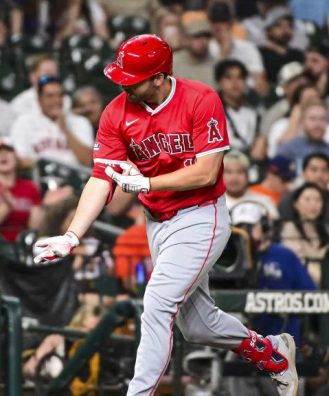
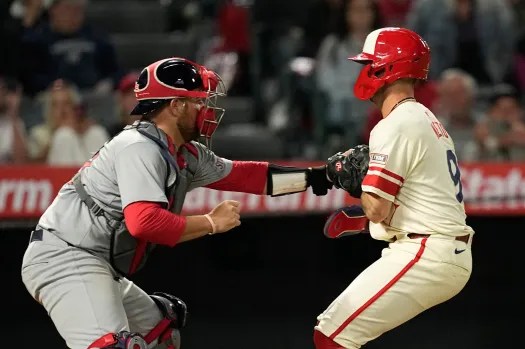
Another season, another unwanted injury for a star-crossed star.

Once upon a time, when cooler heads actually found a hearing in the Angels’ front office, the idea was floated to talk Mike Trout into moving out of center field and into one of the less demanding outfield positions. Maybe even moving him toward designated hitting for the majority of his time in due course, went a reasonable concurrent thought.

With Trout then coming away from some injury-disrupted seasons, they talked about it during the owners’ lockout of 2021-22. They planned to talk to Trout about it when the lockout ended. They didn’t bank on then-manager Joe Maddon blabbing about it to reporters before they had the chance to present it to Trout.

Idea killed before it could spend its first hour out of its crib. Maddon’s execution orders may have been written right there, awaiting only one false move on the season to stamp them irrevocably.

The guillotine blade dropped after those 2022 Angels went from a deceptive 27-17 start to a twelve-game losing streak. And, after Maddon ordered an intentional walk to the Rangers’ Corey Seager with the bases loaded and the Angels down. Just as inexplicably, the Angels overthrew a wider deficit to win that game at the witching hour. It wasn’t enough to save Maddon’s rep or his kishkes.

But the busted Trout plan probably did make it a matter of when and not if the Angels would purge Maddon. The plan might also have kept Trout from inflicting any further great risk upon a body that simply refuses to cooperate with its owner’s iron will.

We may never know whether a leftfielder named Mike Trout or a right fielder named Mike Trout would have managed to avoid some of what bedeviled him from that point forward. 2022: Five weeks on the injured list with a back issue that might yet bear the potential of putting paid to his career. Last season: Hamate bone fracture in July, one game in August, season lost otherwise.

Now we have a spectre that’s only too familiar to baseball world as a whole and Angel fans in particular: Trout on the injured list, about to undergo surgery for a torn meniscus in his knee. Expected to be out anywhere from eight to twelve weeks. Exactly what triggered the tear isn’t quite known, but we do know that Trout felt it go while walking back to the Angels’ dugout.

Even though he said, “It’s just frustrating. But we’ll get through it,” we can’t really know the precise thoughts and feeling that poured into his heart and mind when he noticed the tear and resigned himself to yet another injured list term. If he’s telling himself, “This is getting to be more ridiculous than a contemporary presidential campaign,” there isn’t a jury on earth that would convict him of warped thinking.

Until that injury, Trout spent the season’s first month doing whatever he could to prove he still had what made him both the single most outstanding player of the 2010s and, concurrently, the number five all-around center fielder who ever played the game.

His hitting average was an anemic .220 and pulled his lifetime number down to .299, but even at this writing he leads the Show with ten home runs, while exactly half his 24 hits have been for extra bases. He’s even stolen six bases, something he’d said he wanted to return to doing after letting that side of his run-making game expire after 2019.

According to my Real Batting Average metric (total bases + walks + intentional walks + sacrifice flies + hit by pitches), Trout was actually batting .611 before his knee said not-so-fast. Little by little, piece by piece, he put himself back together into a semblance of his 2010s self when disaster decided it was time to speak up. Again.

For his first eight full seasons, Trout’s ability to post wasn’t even a topic. He’d averaged 145 games a year over the eight, and he did things the best players do in their fantasies. After the pan-damn-ically short 2020, his body became an orthopedic experiment. And all he’d ever done wrong was play the game firmly.

He’s also been loyal to a fault to an organisation administered like the Mad Hatter’s tea party, overseen and often overlorded by an owner whose fortune came from marketing but who hasn’t yet figured truly that marketing doesn’t build winning baseball teams.

The Angels had two generational talents, Trout and Shohei Ohtani. The latter took the first available hike as a free agent. The former insists he wants to be around when the Angels return to a winning culture and even a postseason or two. But the Angels’ administration still hasn’t figured out how to restore that culture. And, may not for the rest of Trout’s career—however long his body allows him to have one.

Trout could retire this instant and his Hall of Fame plaque would be prepared for his first-ballot election. That might still outrage fans who still cling to the idiocy that injuries are signs of moral turpitude and character weakness. Those fans should be dismissed.

“It’s not as though he has a singular chronic issue,” writes The Athletic‘s Sam Blum. “They’re all independent of each other, and seemingly haven’t impacted him beyond the duration of their individual recoveries. But they add up to the same problem: an all-time legend who can now no longer stay on the field.”

Trout is still good enough that, as FiveThirtyEight says, “the cost to the Angels of losing him for only a couple of months would be on par with season-ending injuries suffered by other star players.” Indeed.

Almost promptly, the Angels signed veteran Kevin Pillar as a fourth outfielder. Once a good center field defender, he’d be behind Mickey Moniak now despite Moniak’s modest bat. Pillar cleared waivers after the White Sox designated him for assignment. He’s considered good in the clubhouse and has a relationship with Angels manager Ron Washington from Atlanta, where Pillar played last year while Washington was the Braves’ third base coach.

Pillar will cost the Angels nothing more than a prorated major league minimum salary. That’s the least of their losses. Losing Trout—again—costs them something no dollars can replace. But imagine what it’s costing Trout in his mind and heart. Again.

Anthony Rendon, only human

Anthony Rendon

Rendon admitting he places family and faith ahead of baseball didn’t go over well with those who think nothing’s more important than that big game, that long season.

Let’s admit it. We often wish all baseball players were of the same mind as Hall of Famer Willie Stargell. Asked once during a particularly arduous road trip, Pops replied, “The umpire doesn’t say, ‘Work ball.’ I asked to be a ballplayer.” We often wish every player on the planet was as romantic about the game as us.

We swear we’d be the ones who’d tolerate everything around the game for the privilege of playing it professionally because, you know, if we’re making in even ten years what Donald Trump was fined in his New York fraud case we’d damn well better be ready to tolerate it.

We swear we’d come through in the clutch, we swear we wouldn’t have blown that play, we swear we would put those pain in the you-know-what writers in their place, we swear we would play through injuries and not sit it out when our team needs us to win that big game, we swear we wouldn’t let anything or anyone get in the way of . . .

We are full of it. And most of us won’t admit that we’re full of it.

That’s why so many of us were ready to have Anthony Rendon hung by his shorthairs from the top of southern California’s tallest lamppost for saying outright that baseball doesn’t quite command his priorities ahead of his family and his spiritual faith. You’d think Rendon had just admitted to painting graffiti on the Washington Monument.

The third baseman who once made a pros-and-cons list about playing the game is a decade older now. “It’s a lot different now,” he told The Athletic‘s Sam Blum on Monday.

I’m married. I have four kids. My priorities have changed since I was in my early twenties. So definitely my perspective on baseball has been more skewed . . . It’s never been a top priority for me. This is a job. I do this to make a living. My faith, my family, come first before this job.

If you choose to see him as just expressing some bitterness about the game, Rendon’s certainly earned the right. Since he signed a seven-year, $245 million free-agency contract with the Angels, after he factored big in the Nationals’ first World Series conquest, Rendon’s baseball life has been battered by injuries.

After his first Angel season, in pan-damn-ically truncated 2020, his 2021 only began with a groin strain and a ten-day injured list spell. He incurred a knee contusion and a hamstring strain, and that was before his season ended early thanks to right hip surgery.

His 2022, which featured hitting one out lefthanded for the first time in his Show career (and during Reid Detmers’s no-hitter, yet), ended in June with surgery on his right wrist. 2023? Left leg injury, not to mention a tibia fracture he swore was diagnosed at first as another contusion.

You can rest confident in the knowledge that nobody signs up to play professional baseball looking to spend as much time on the injured list as Rendon has spent since becoming an Angel. But if you’d been paying attention close enough since his Washington years, Monday wasn’t the first time Rendon ever denied baseball über alles, either.

“I want to be known as the Christian baseball player,” he told the Baptist Press in 2018. “I’m still trying to grow into that. But at the end, I want to be more ‘Christian’ than ‘baseball player’.” Nobody was ready to arrange his execution then. Maybe finishing eleventh in that year’s MVP voting and leading the National League with 42 doubles, not to mention posting a .909 OPS and 137 OPS+ had something to do with that.

Guess you’re just not supposed to talk that way after four years of a filthy lucrative seven-year contract have been spent on the injured list and you’ve only been able to play an average 52 games a year over the four.

“[A]ny job, no matter how hard you worked for it, how much you wanted it, how much you love it, is still a job,” writes Deadspin‘s Julie DiCaro. “Baseball is no different.”

Sure, players get winters off, their offices are pastoral cathedrals, and they get paid millions to play a child’s game. But they still have to go (almost) every day from mid-February to September, in nagging injuries and in health, when things are going great and when they aren’t. They have bosses, performance expectations, long stretches away from their families, and, especially on days when things go south, a scrum of reporters standing around their lockers, waiting to ask them exactly why things went so poorly.

. . . [W]hy is it that, in almost any other profession, saying one’s job is their top priority is thought of as cold, heartless, anti-family, and some kind of Cat’s Cradle tragedy, unless the person saying it is a pro-athlete? You’re supposed to say your family is a bigger priority than your job, unless your job is to entertain the masses. Then you’d better kick your wife to the curb during childbirth because we need your bat in the five-hole.

Baseball history should remind us that Yankee legend Thurman Munson died at 32 trying to split the difference. He bought and was learning to fly a Cessna jet that may have been above his pay grade operationally because he wanted to spend more time with his wife and children in their native Ohio during Yankee homestands.

Some ballplayers wouldn’t let themselves think of marriage and family until after their playing careers ended. Some of those, of course, preferred the swinging bachelor’s life, but others sensed that being professional baseball players might not really be conducive to happy home lives. Some marry sports-oriented women, many don’t. It’s not for us to judge what the heart embraces.

I remember a player who learned the hard way. If you’re my age, the name Steve Kemp might register. He was a solid ballplayer, an above-average hitter and a hustling outfielder with the Tigers and the White Sox, who enjoyed his first and only free agency payday when he signed with the Yankees for 1983. Five years, $5.45 million, big money that year.

Whoops. An early shoulder injury on a basepath collision; then, after rebounding following a sluggish first third of the year thanks to the injury, hit in the eye by a line drive during batting practise. Facial fracture, vision and depth perception loss, never the same player again. The Yankees eventually dealt him to the Pirates, willing to take him because of his determination, in a deal making Yankees out of Dale Berra and (especially) Jay Buhner.

Kemp lost more than that, alas. He made a jarring admission to Peter Golenbock, author of The Forever Boys: The Bittersweet World of Major League Baseball as Seen Through the Eyes of the Men Who Played One More Time. He was so single-minded about the game from boyhood forward that it cost him his marriage.

“He learned,” Golenbock wrote of Kemp’s days playing college ball, “that if he selfishly, myopically concentrated on his own needs—excelling at the game—he would succeed in life.” Not quite. “[T]he one part of your life that seems to get cut out is family,” Kemp said. “That’s wrong, totally wrong.”

You’re on the road, and your family wants to come, and you say, ‘Fine, but I’m not going to go out with you. You get up on your own and go. I have to sleep in.’ And I looked at myself as being very selfish. I look back, and I see it cause a lot of problems for me. I learned it, but too late. Baseball was the most important thing.

Steve Kemp

Kemp was so singleminded making baseball his priority that it cost him his family, once upon a time.

When Kemp’s playing career ended in 1988 after spells in the minors (and a fleeting sixteen games with the Rangers), he returned home to California to discover his wife asking for a divorce. The divorce happened in 1989.

“We were the American family with two beautiful, intelligent children,” he said. “It was a very good situation that was thrown out the door. A lot of people were saddened when our family split up. Now I’m saying to myself, I realise there are more important things in life than baseball.”

Kemp went on to play for the St. Petersburg Pelicans in the short-lived Senior Professional Baseball Association (1989-90). He did it for love of the game and to help take the sting out of his divorce, not necessarily in that order. He dealt with injuries, fought his own perfectionism, and mid-season asked for two days off—to take his two visiting children to Disney World. Owner Jim Morley granted them even if manager Bobby Tolan wasn’t thrilled.

“You can be bitter and negative,” he told Golenbock, “or you can try to get the most out of a situation, to learn from your mistakes. I’m trying to change myself so that I can enjoy life. I know that I have a long way to go, but before I never gave. Now I’m trying to give. That’s the important thing.”

“Mindful of how much he lost,” Golenbock wrote, “[Kemp] took his kids to Disney World for two days instead of insisting that baseball come first. He knew that Bobby Tolan would be angry, that his teammates wouldn’t understand, but it didn’t matter anymore. The happiness of his kids, that’s what counted most. The Pelicans would be there when he got back.”

It’s not as unreasonable as Rendon’s critics might think to surmise that he knows already that there are more important things in life than baseball. No matter how much or how deeply anyone loves the game, no matter how much fans who don’t know him as a human being would prefer to incinerate him for admitting it.

Maybe he doesn’t want to let the game consume, fracture, or divorce him, the way it did Steve Kemp and who knows how many other players about whom we know little beyond what they did on the field or said to the press.*

Rendon’s done nothing more evil than admit that baseball players are human beings, after all. Maybe those attacking him since it hit the press running can’t bear that. Because they’re supposed to be infallible, indestructible, dream-affirming, life-denying. That’s their job, the attackers seem to say. We don’t want to know you’re only human.

————————————-

* Steve Kemp ended his professional playing days when the SPBA folded. He returned to southern California and became both a part-time salesman for a golf accessory firm and an annual participant in Tigers fantasy camps. 

Even Trout has his limits

Image

Mike Trout

The greatest position player in Angels history may yet become fed up with the Angels’ lack of loyalty in return for his.

When Shohei Ohtani signed with the Dodgers in December, the nearly-universal observation—by those not wanting to trash his merch in protest—was remembering he was well on record as saying he wanted to win above and beyond his own performance papers. At least two trade deadlines featured thoughts about the return the Angels could have hauled in in a deal for him.

Then they let Ohtani walk as a free agent, knowing his would be one of the most high-ticket free agencies in baseball history. While he begins life as a Dodger, the eyes of those who still care about the Angels turn to the other big ticket in their fatigues, a guy who sacrificed his free agency-to-be in return for staying with the team that unearthed, nurtured, and let him shine, while building nothing truly serious around him.

He’ll never put it into just these words, but even Mike Trout has his limits. And he’s no longer just the child prodigy who delivered more prodigiously than any other player during his time. Now, he’s man of the house. But his team doesn’t behave that way.

The man Baseball Reference holds as the number five all-around center fielder ever to play the game doesn’t need any more accolades. The 32-year-old from New Jersey who leads all active players at this writing with a .997 OPS and a 173 OPS+ has already punched his ticket to the Hall of Fame several times over.* If and when the Angels elect to retire number 27, it’ll be for Trout and not for Hall of Famer Vladimir Guerrero, Sr.

It’s one thing for Trout to smile upon the Angels giving their too-often-suspect bullpen a big overhaul this offseason. But with significant free agents still unemployed as spring training is in full operation, Trout is no longer shy about saying what, oh, every last Angels observer thinks and he in his heart of hearts knows.

“I was in contact with both of them, just pushing, pushing, pushing,” Trout said before the team began its first full-squad workouts this week, “them” being owner Arte Moreno and president John Carpino.

There’s still some guys out there that can make this team a lot better. I’m going to keep pushing as long as I can. Until the season starts or until those guys sign. It’s just in my nature. I’m doing everything I can possible. It’s obviously Arte’s decision. I’m going to put my two cents in there.

And, while he reiterated his intent to remain an Angel for life, something the glandular contract extension he signed in 2019 made clear enough, even he would be amendable to a trade in the near future if things come to that. The same trade deadlines that pounded with thoughts of the return haul for Ohtani pounded likewise for Trout, even during the seasons when injuries kept him off the field for long, long periods.

“I think the easy way out is to ask for a trade,” he added. “Maybe down the road, if some things change.” Meaning, probably, that he still sees the Angels’ administration trying for real, but if he senses they quit trying even his loyalty isn’t going to hold for very much longer.

Praising Moreno’s willingness to spend up to certain points is one thing. So is praising general manager Perry Minaisian for the bullpen overhaul. But the Angels haven’t yet overhauled their starting rotation or the lineup around Trout. Asking them for the same commitment to actually winning, overall, that Trout’s made, is something else entirely.

“[W]hen I signed that contract, I’m loyal. I want to win a championship here,” Trout insisted. “The overall picture of winning a championship or getting to the playoffs here is bigger satisfaction [than] bailing out and just taking an easy way out. So, I think that’s been my mindset. Maybe down the road if something’s changed, but that’s been my mindset ever since the trade speculations came up.”

Moreno—the man who made his fortune in marketing, the man who still seems to think more like a marketer than a baseball man when he does move toward big or semi-big signings—isn’t making it easier for Trout. “I’m not going to spend money just to show that we’re going to spend money,” he told an interviewer, “unless it’s going to substantially change the team.”

Trout’s told at least one reporter and possibly more that, if that was exactly what Moreno told him directly, it didn’t exactly mean he was going to hit what free agency market remains now. “It’s, uh, yeah, no, you know how Arte is,” he said. Some said he laughed a bit. If only it was really funny.

Ordinarily, when an eleven-time All-Star talks, his team listens. Trout may well be perfectly content still to be where he is, but even he has his limits. Until now, he’d never hinted that greatly about those. But they’re there. For the moment, Trout wants to play a full season unimpeded by yet another injury in the line of duty.

Loyalty is supposed to be a two-way street, right? For Trout, as for Ohtani, loyalty in return means building a viably contending team around them with brains more than the kind of impulsiveness that saw the Angels plunge all-in last July . . . only to have it blow up in their faces (an 8-19 August) and into waiving five players—including two they acquired at that trade deadline—when September arrived.

Ohtani was lucky the Dodgers had a readymade contender awaiting him. He’s lucky that his new team has won ten of the past eleven National League West titles and gone to eleven straight postseasons. He’s lucky that, barring unexpected catastrophe, the Dodgers are liable to reach to the postseason to come at minimum. That’s a guarantee the Angels haven’t been able to hand Trout.

They can’t just put nine prime Mike Trouts into their starting lineup. They can barely build something to sustain the one Mike Trout they’ve been blessed to have. “I’m going out there and play my game,” that one Mike Trout said. “I got to put a full season together and see what happens.”

Uninjured, he may yet have another couple of seasons of the kind of play that punched his Cooperstown ticket in the first place. Whether it means anything above and beyond his place in baseball history isn’t up to him, and never has been.

———————————————————————-

* For those who gaze upon wins above replacement (WAR) without seeing it the be-all/end-all of a player’s value, but still an extremely valuable way to measure him, be advised at this writing of this: Trout’s 65.1 peak WAR and 85.2 career WAR are, respectively, 20.4 and 13.6 above the average Hall of Fame center fielder.

And, despite his recent injury history, Trout still holds the number one slots among active players for: offensive winning percentage, adjusted batting runs and wins, situational wins added, and power-speed number. He also enters this season with a lifetime .301/.412/.582 slash line.

For perspective, the last two entries on the lifetime slash are higher than those for Hall of Famers Willie Mays and Henry Aaron, and his lifetime .301 “batting average” thus far is one point below Mays.

For further perspective, according to my Real Batting Average (RBA) metric, this is how Mike Trout would look among Hall of Fame center fielders who played all or most of their careers in the post-WWII/post-integration/night-ball era, if he were to retire this instant and await his call to Cooperstown. (One more time: RBA = total bases + walks + intentional walks + sacrifice flies + hit by pitches, divided by total plate appearances.)

Center Field PA TB BB IBB SF HBP RBA
Mike Trout 6521 3142 964 119 55 99 .672
Mickey Mantle 9907 4511 1733 148 47 13 .651
Willie Mays 12496 6066 1464 214 91 44 .631
Ken Griffey, Jr. 11304 5271 1312 246 102 81 .620
Duke Snider 8237 3865 971 154 54** 21 .615
Larry Doby 6299 2621 871 60 39** 38 .576
Andre Dawson 10769 4787 589 143 118 111 .534
Kirby Puckett 7831 3453 450 85 58 56 .524
Richie Ashburn 9736 3196 1198 40 30** 43 .463
HOF AVG .587

** Sacrifice flies weren’t official until 1954. Doby and Snider played a third or more of their careers before the rule. How to overcome that hole? I found one way a few years ago: take their recorded sac flies, divide them by their total MLB seasons under the rule, then take that result and multiply it by their full number of MLB seasons.

The formula, for you math nerds: SF / SFS x YRS (years). Thus a reasonable if not perfect number of sac flies you could have expected them to hit for their entire careers.

Ohtani gets his lucre and his wish

Shohei Ohtani

Shohei Ohtani signs with the Dodgers for a decade, $700 million, and the thing he wants most—better chances to win. Angel fans mourn the absolute waste of the game’s most transcendent talent.

It was almost to laugh. Within an hour of the news breaking and confirmed that Shohei Ohtani signed at last, and with the Dodgers, yet, there also came the news that some Angel fans began holding burnings of one or another kind of Ohtani merchandise. It was to laugh that you wouldn’t weep, of course.

Set aside what Ohtani signed for for the moment. Yes, it’s ten years and $700 million. It’s also no opt-out clauses in the deal. It’s also Ohtani himself deferring a considerable pile of that guaranteed money the better to enable the Dodgers to continue sustaining excellence via the farm and the market.

Now, consider the abject stupidity of the Angels and some of their fans. You want to burn Ohtani merch because, as a legitimate, lawful free agent, he signed elsewhere at all? Never mind with the beasts just up the freeway? Be my guest—and stand exposed as the fools you are.

The fools who’d rather turn Ohtani merch into burnt ashes than demand better of the team that let him walk with nothing of value in return—while going for broke elsewhere at the trade deadline only to unload two of the pieces they did acquire by way of the waiver wire at September’s beginning . . . just after Ohtani’s elbow took him off the mound for the season without sitting him down as a designated hitter.

The fools who’d rather have kept Ohtani bound to a team whose administration seems clueless about the point that you need a viable team around them to enable Ohtani and whatever might be left of future Hall of Famer Mike Trout to play for chances at championships. The point that one or two players do not a championship contender make, no matter how overendowed in ability and execution they’ve been.

You want to make Ohtani an example instead of holding Angels owner Arte Moreno and his trained seals in the front office accountable for thinking the box office is the thing and if you just so happen to win it’s mere gravy? Be my guest again. And stand exposed further.

For so long as he’s owned the Angels Moreno’s marketing background, the business in which he earned his fortune, has dominated what the Angels put on the field. Whether what they put on the field could play competent or cohesive baseball up and down the lineup seemed secondary to having what George Steinbrenner used to call “name guys who put fannies in the seats.”

It was bad enough that the Angels unearthed the transcendent Trout and saw him build a jaw-dropping Hall of Fame case in his first nine seasons before the injury bug bit into him in too much earnest over the past four. It was worse that Trout showed his loyalty to the team that discovered him and turned him loose on the field by signing a glandular extension only to have too many people wondering if he hadn’t lost his marble for it.

It was worse that Trout got to play with Ohtani, himself an injury bug victim for a couple of years following his Rookie of the Year season, and formed a tandem of transcendence (when Trout could play) that proved nothing more than a two-man supershow in the middle of a sad-sack sideshow.

“Ohtani has said he wanted to win,” writes The Athletic‘s Andy McCullough.

The Dodgers have won their division in ten of the past eleven seasons and tallied more than one hundred victories in five of the past six full seasons . . . [Ohtani] has been never part of a team with a front office capable of regularly rebuilding a pitching staff with excellent results, as Andrew Friedman has often done. And he has never played for an ownership consortium like Mark Walter’s Guggenheim group, who have been willing to invest in facilities, infrastructure and ancillary considerations.

That’s putting things politely. The hottest item at last season’s trade deadline was whether the Angels would wake up, wise up, and trade him for legitimate return value on the field and in the organisation at last. No chance.

Now it’s possible that Trout will return healthy, play like something close enough to the Trout who punched his Cooperstown ticket, stir up speculation on whether the Angels finally deal him to a contender with rich return to offer, and find himself still bound and gagged to an owner who’s willing to invest in his box office alone.

Quit the hemming and hawing over Ohtani’s deal raising an unconscionable ceiling for the free agents to follow him in the current market. Instead of bellowing over the big bad Dodgers handing him what amounts to a Delta Quadrant kingdom plus safe passage through the Cardassian Empire and ownership of Ferengi Enterprises, try bellowing over other owners’ too-entrenched refusal to invest and build in the major league product and the organisation behind it.

The Red Sox unloading Babe Ruth to the Yankees was nothing like this. Then, believe it or not, the Red Sox thought they were unloading a problem child to help relieve their owner’s financial stresses, not all of which was tied to his concurrent theatrical production operation. The Ruth sale helped temporarily.

Ohtani, anything but a problem child, was allowed to walk into free agency eyes wide shut on the part of the Angels. It was perverse fun, too, watching the sports press get their proverbial panties into twists trying to figure out what was in Ohtani’s heart of hearts while he and his agent played things close enough to the vest. I couldn’t resist joining the fun for a moment, outlining a top ten list of what Ohtani was really thinking, feeling, wanting . . .

When Dodger manager Dave Roberts admitted the Dodgers talked to Ohtani and he’d have loved nothing more than to see Ohtani in Dodger silks, panties into twists turned nuclear, they thought Roberts’s honesty might have killed any deal in gestation. So much for that idea.

Too often with Trout injured Ohtani had to provide most of the Angels’ offense. Joining the Dodgers that burden is lifted. He can swing the bat comfortably and not believe every one of nine innings of baseball is on his shoulders. When he recovers from elbow surgery and takes the mound again in 2025, Ohtani has good reason to believe the Dodgers will have remodeled the starting rotation whose dissipation cost them this past postseason.

He didn’t have one millionth of a prayer of seeing that happen if he elected to re-sign with the Angels. Being a guy who makes baseball fun again is one thing. Coming home after yet another losing or short-of-the-postseason season proved something else.

So go ahead, some of you Angel fans. Burn his jerseys, blow up his bobbleheads, use his photos and posters for fish wrap if you must. You’re going to look almost as foolish for it as your team’s owner has looked for having resources unfettered and brains inoperable the entire time Ohtani wore Angels red. Almost.

Angel fans who don’t have coconut juice for brains began flocking to Angel Stadium to mourn within two hours of Ohtani himself scooping the world by announcing his Dodgers deal on Instagram. A crane already began stripping Ohtani’s mural from the side of the stadium. Fans slipped into the stadium’s team store to snap up Ohtani merch before it would disappear forever.

They came to mourn.

And one fan, Sebastian Romero, lifted a page from the books of long-suffering Athletics fans whose owner has stripped the team of credibility only to wrest approval for hijacking them to Las Vegas. Outside the stadium, Romero held up a sign before the Ohtani mural behind him was stripped, as photographed by Athletic writer Sam Blum:

As Blum noted so mournfully, Ohtani’s past three seasons have been three of the greatest the game has ever seen from a single player, on both sides of the ball, yet, with the Angels going 77-85, 73-89 and 73-89. What a waste of Ohtani hitting 124 home runs and striking out 542 batters worth two unanimous Most Valuable Player awards over that span.

A young man of few words for the press, Ohtani is on record as saying that, much as he loved the Angels, “More than that, I want to win. That’s the biggest thing for me. So, I’ll leave it at that.” Nobody can say the Angels weren’t warned. Nobody can say the Dodgers lack the resources or the brains to make that wish come true, either.

Now, I wonder. When Ohtani meets Clayton Kershaw as a Dodger for the first time, will he begin the conversation by saying, “About that All-Star Game pickoff, buddy . . . ?”

The Shoh is on hiatus

Shohei Ohtani, Mike Trout

Ohtani (left) is done for the season, an oblique injury added to his elbow’s now-reinforced UCL tear. He can walk in free agency, but Trout (right) may be entertaining trade thoughts a lot more deeply now . . .

George F. Will once wrote (in Men at Work: The Craft of Baseball) that A. Bartlett Giamatti was to baseball’s commissionership what Sandy Koufax was to the pitcher’s mound, having “the greatest ratio of excellence to longevity.” The Athletic‘s Marc Carig wrote last Satuday of Shohei Ohtani, “singular excellence is no match for collective mediocrity.”

Last Friday, Ohtani’s Angel Stadium locker was empty, and a large duffel containing his equipment and other belongings sat in front of it, after he was placed in the injured list at last—with an oblique strain. “No ceremonial sendoff,” Carig wrote. “No expressions of gratitude. Just a tender oblique and a good old-fashioned Gen Z ghosting. How appropriate. Now the credits roll on a baseball travesty.”

Ohtani has also undergone surgery on his pitching elbow at last. His surgeon, Dr. Neal ElAttrache, the same surgeon who performed Ohtani’s prior Tommy John surgery—called the new procedure “reinforcement” of the torn ulnar collateral ligament, not full Tommy John surgery. It means Ohtani won’t pitch again until 2025, but he will suit up as a DH in 2024. For whom, only time and the off-season free agency market to be will tell.

“Thank you very much for everyone’s prayers and kind words,” Ohtani said on Instagram following the Tuesday procedure. “It was very unfortunate that I couldn’t finish out the year on the field, but I will be rooting on the boys until the end. I will work as hard as I can and do my best to come back on the diamond stronger than ever.”

Note that he didn’t say for whom he expects to come back after signing a new deal this winter.

A baseball travesty? The Angels had the two greatest players of their time together in their fatigues for six years, and they couldn’t support the two with a competent, competitive supporting cast who could pick it up when one or both was injured. It was as if the 1962-66 Dodgers had swapped in the ’62-’66 Mets for everyone except Hall of Famers Koufax and Don Drysdale.

Carig called it “sabotage.” You could think of far worse applications. “They did this through general mismanagement and their own brand of incompetence,” Carig continued. “Those sins endured despite their churn of managers and front-office regimes, only further reinforcing that the full credit for this failure falls at the feet of the constant throughout it all: the owner, Arte Moreno.”

It may be wasting breath and writing space to recycle that Moreno brought a marketer’s mentality to a baseball team, aiming once and forever at what George Steinbrenner used to call “name guys who put fannies in the seats,” without stopping first to ponder whether they’d equal a cohering team on the field and at the plate and whether his true baseball people had other such cohering parts in mind. And, whether it was always good for a player’s health.

Baseball people who did stop to ponder such things didn’t last long under Moreno’s command. Whether by way of the owner’s caprices or by way of their own mistakes turned into impossible-to-ignore disaster, Moreno’s Angels have been the Steinbrenner Yankees of the 1980s as you might have imagined them if The Boss hadn’t been so shamelessly public a nuisance.

Think about this: It took an oblique strain almost four weeks later for the Angels to do what should have been done when Ohtani’s ulnar collateral ligmanent tear took him off the mound but not out of the batter’s box. The adults in the room should have overruled Ohtani’s understandable desire to continue at least with his formidable bat, disabled him entirely, and placed his health at top priority.

You can only imagine the look when last Friday came with Ohtani’s packed duffel in front of his locker. Don’t be shocked at it. If he can’t play the rest of the season, he can come to the park in moral support without having to unpack it or bring it from home.

Someone had to find the adults in the Angel room in the first place. Apparently, there were none to be found. Whether draining the farm at the trade deadline for one more run at it that proved impossible, whether turning right around and waiving most of what they drained the farm for, whether managing the health of their two supermarquee presences, the Angels room remains bereft of adults.

Oft-injured third baseman Anthony Rendon, who’s had little but injury trouble since signing big with the Angels as a free agent, developed a habit of discussing his injuries with a wary sarcasm, until he finally cut the crap and said the shin injury incurred on the Fourth of July wasn’t the mere bone bruise the Angels said it was but, rather, a full-on tibia fracture—and that he only learned it was a fracture in mid-August.

Now, Rendon was asked whether he was actually considering retirement from the game. “I’ve been contemplating it for the last ten years,” he said. If he actually does it, it would give the Angels something other teams would love but might raise fresh alarms in Anaheim: financial flexibility. Just what they need, more room for fannies-in-the-seats guys assembled with no more rhyme, reason, or reality.

Mike Trout, the player of the decade of the 2010s and still formidable when healthy, has been injury riddled the past few seasons. He may not be jeopardising his Hall of Fame resume, but something is badly amiss when he feels compelled to return perhaps a little sooner than he should return, then ends up back in injury drydock yet again after one game.

Once upon a time it was impossible to think of Trout anywhere but Anaheim. But trade speculation and fantasies around him have sprung up now more than in the recent past. Trout himself has dropped hints that he’s exhausted of the team doing either too little or not enough (take your pick) to build a genuinely, sustainingly competitive team around himself and Ohtani.

That’s not what he signed up for when he signed that blockbuster ten-year, $370 million plus extension a year ahead of what would have been his first free agency. That’s not what he signed up for when he showed the world he wasn’t that anxious then to leave the team on which he fashioned and burnished a jaw-dropping Hall of Fame case.

It was Trout, too, who welcomed Ohtani to the Angels with open arms and personal charm, then had to find too many ways to grin and bear it as the pair—when healthy—performed transcendence while surrounded by unimportance. If Trout now questions the Angels’ commitment to competitiveness and their regard for the health of those in their fatigues, pondering himself as well as Ohtani, only fools would blame him.

Most major league teams would kill to have even one such king of kings on their roster. Two of this year’s affirmed division winners (the Braves, the Dodgers) have at least one each. (Ronald Acuna, Jr., Braves; Mookie Betts, Dodgers.) The Angels had the two most singular such kings of kings and blew it higher and wider than the Hiroshima mushroom cloud.

“What remains stunning in all of this,” Carig wrote, “is the level of waste. The Angels have succeeded like nobody else in doing so little with so much.”

Sound organizations create a plan and then follow it. These Angels, not so much. A throughline can be drawn from Albert Pujols to Anthony Rendon, with Ohtani and Trout’s extension in between. What’s clear is that all of these big-ticket transactions weren’t part of some grand plan. Rather, they were the product of a billionaire collecting baubles, just faces to slap on a billboard.

Ohtani’s free agency is still liable to become a bidding war of stakes once thought unfathomable. With or without his recovery time limiting him to a DH role, Ohtani’s going to have suitors unwilling to surrender until he does. Which one will convince him they know what they’re doing to fashion truly competitive teams around him? We’ll know soon enough.

But considering that baseball medicine can still be tried by jury for malpractise, whomever plans to out-romance the Angels for Ohtani and seduce them into a deal for Trout had better come with adults in the room to manage them and their health prudently. There’s no point telling the billionaire with his baubles and billboards to grow up otherwise.