The Mets finally support Jacob deGrom

Jacob deGrom

These meatheads couldn’t get me even three runs a start even if I offered to pay for them to bribe the other teams into taking dives. Now they get me six, and I’m supposed to be trying to beat them? Just. So. Mets.—What Jacob deGrom could have been forgiven for thinking before he went to work against his old team on Friday night.

Having been a Met fan since the day they were born, I’ve seen enough cringe to last three lifetimes and two Hall of Fame careers. Enough so that I’ve earned the stripes required to tell today’s Met-fans-come-lately (say, strictly this century) that even the Mets deserve not to be written off entirely for a season over one bad inning . . . in April.

Friday night almost changed my mind.

When Jacob deGrom was the best Mets pitcher this century, winning two Cy Young Awards on merits that (among other things) should have shattered the myth of the pitcher “win,” he did it despite getting an average of 3.3 runs to work with per inning pitched in his starts. He could have taken the Mets to court and sued for non-support, and no judge would have remanded him to the nut farm.

“So are you still asking why we’re ignoring wins?” The Athletic‘s Jayson Stark asked, then answered. “[T]here isn’t a single entry on the state sheet that tells us less about how this man has pitched than the entry that most people used to check first. That’s why.”

“Jacob deGrom’s issue wasn’t that he ‘didn’t know how to win’.” It was that he didn’t know how to not be on the 2018 New York Mets,” wrote Anthony Castrovince, in A Fan’s Guide to Baseball Analytics. That was deGrom’s issue in 2019, as well.

So. After more injury miseries and one change of address, deGrom finally showed up in Citi Field Friday night. The Mets thanked him for his distinguished previous service with a video presentation that had the righthander very appreciative. “It was really cool,” he said after the game. “Like I said before, this is where it all started. And then coming back here, I thought it was going to be a very special day. So thankful to the Mets for playing that. And you know, like I said, these fans were great to me when I was here. And you know, that was a really nice thing they did.”

What a difference three years makes. The Mets got deGrom six runs to work with before the first inning was over. There was just one little problem with that, before you start thinking about old times’ sake. They gave him the runs to work with before he even had to take the mound.

DeGrom pitches for the Rangers now. (More injury miseries kept him from pitching more than nine games for the Rangers between 2023-24.) It’s not that he would have objected to getting six runs for a cushion before he even had to go to his office, but you couldn’t blame the man if he allowed himself even one moment to think: These meatheads couldn’t get me even three runs even if I offered to pay for them to bribe the other teams into taking dives. Now they get me six, and I’m supposed to be trying to beat them? Just. So. Mets.

Of course, deGrom could have laughed like Figaro that he might not have wept. The Rangers hit the plate against young Mets starter Jonah Tong, a pitcher with promise getting perhaps a too-early education in shaking it off and starting over. That’s after his first major league start found him sitting prettily enough with twelve runs to work with after two innings. (Against the Mighty Marlins, 29 August, en route the Mets’ 19-9 Fish fry.)

Now, in his third major league start, Tong started by walking Josh Smith, striking Wyatt Langford out, walking Joc Pederson, and getting Jake (Whata) Burger to fly out to center field, pushing Smith to third. Two out, two on. And then . . . and then . . .

And then along came Jung. Josh Jung, lining a single to right to send Smith home and Pederson to third. Then came Alejandro Osuna to poke a first-pitch single into shallow enough left to sent Pederson home. Then came a walk to Jonah Heim to load the pads for Cody Freeman to shoot a 2-2 fastball into right for a two-run single. Then came a full-count fastball for Michael Helman to line down the left field line for a two-run double. And then came Huascar Brazoban to lure Smith into flying out for the side.

The Mets did manage to pry three runs out of their old buddy in the bottom of the third, when Francisco Alvarez greeted him with a home run to open, then a single and a double turned to Juan Soto and Pete Alonso going back-to-back with sacrifice flies. The Rangers made it 8-3 to stay when Dylan Moore yanked a two-run homer off Mets reliever Gregory Soto in the top of the seventh, before deGrom’s evening ended.

DeGrom sports a neat 2.82 ERA and a staggering 0.92 walks/hits per inning pitched rate this season. Neat enough for a guy who turned 37 while we blinked in his absence. A guy who enjoyed getting another chance to pitch in front of Mets fans once again. “[T]he fans were great to me tonight,” he said of the ovation he got pregame and after his evening looked over. [He pitched seven strong.] They were great to me when I was here. So I always enjoyed taking them out in front of this crowd. So tonight was just as special.”

But getting six runs to work with from the Mets right off before pitching against them, deGrom must have felt unable to decide whether to call for a glass of champagne or the Looney Limousine.

26 minutes and other Opening Day salvos

Rafael Devers

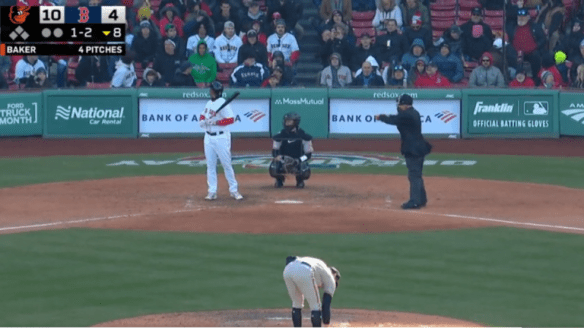
Rafael Devers (Red Sox), the Show’s first ever to strike out without a pitch thrown, taken, or swung on and missed—on a pitch clock violation.

So. After encyclopædic volumes worth were said and done, the average shortening of games on Opening Day was a whopping . . . 26 minutes. The new rules, don’t you know?

I may be on board with the pitch clock, but I’m not on board with cheers about the shortening when a fourth grade math student can tell you they’d have been shortened more by eliminating half the broadcast commercials. That’s accounting for the spots before each half inning and during any inning jam in which a pitching change was made.

But it didn’t stop the Blue Jays and the Cardinals needing three hours and 38 minutes to finish with a 10-9 Blue Jays win, paced by George Springer’s five hits for the Jays and opened with Cardinals pitcher Adam Wainwright warbling “The Star Spangled Banner” to just about everyone’s surprise in Busch Stadium.

Two players made history under the new rules. Rafael Devers (third baseman, Red Sox) became the first in Show to strike out on a pitch clock violation. Marcus Stroman (pitcher, Cubs) became the first in Show to be assessed a ball on a clock violation.

Leading off the eighth, Devers was rung up on 2-2 with Bryan Baker on the mound for the Orioles and the Red Sox in a 10-4 hole. “This doesn’t make sense to me,” said an announcer, “because he’d already looked at the pitcher. The pitcher’s not even ready to throw.”

Devers had checked back into the box with a few seconds remaining after stepping out to knock dirt out of his cleats. Even as Baker wasn’t quite ready to throw, plate umpire Lance Barksdale bagged him. It didn’t stop the Red Sox from posting a three-spot in the inning. “There’s no excuse,” said manager Alex Cora. “They know the rules.”

Knowing them and being able to maneuver within them for the first time in regular-season play are not exactly common. But it’s entirely possible that Devers not being dinged might have made a small difference. Led by Adley Rutschmann becoming the first catcher in Show history to have a five-hit Opening Day, the Orioles out-lasted the Red Sox, 10-9, after almost handing the game all the way back to the Olde Towne Team in the bottom of the ninth.

Remember: I’m also on board with turning the damn clock off in the eighth and later. Devers may yet prove evidence on behalf of that.

Stroman got his while checking Brewers runner Brice Turang at second with Christian Yelich at the plate in the third. The pitch clock expired about a hair before Stroman turned to pitch from the stretch. “It’s tough, this pitch clock,” Stroman told reporters postgame. “It’s a big adjustment. I don’t think people really realize it. It just adds a whole other layer of thinking.”

Yelich finally worked a walk out. The Brewers didn’t score then or the rest of the game. The Cubs won it, 4-0.

Jeff McNeil became the first Met to be hung with a pitch clock violation strike—for waiting for Pete Alonso to get back to first on a foul ball. Oops. Manager Buck Showalter was unamused that the clock began to tick before Alonso returned to the pad. McNeil remained mad just long enough to nail a base hit.

That was in an Opening Day game the Mets won, 5-3, beating the Marlins, but they might have had one more, at least, if not for someone whacking Brandon Nimmo with the stupid stick in the third. With first and third, Nimmo dropped a bunt—and hit into an inning-ending double play despite the run scoring. Thus the risk the wasted out, which is exactly what the sac bunt is, carries against defenders alert enough.

The good news there was Max Scherzer holding on despite all three Miami runs charged to his account and the Mets making simple enough work against a still not quite ready Sandy Alcantara. The bad was Justin Verlander having to miss a week while dealing with a muscle strain in his upper back near his throwing shoulder.

Perhaps it was miraculous that Aaron Judge picked up right where he left off from last season and hit one out in his first plate appearance against the Giants. That launched a 5-0 Yankee win that saw both starting pitchers, Gerrit Cole and Logan Webb, nail eleven and twelve strikeouts, respectively—the first opposing Opening Day starters to do that since Max the Knife (then a National, with twelve) and Jacob deGrom (then a Met, with ten) in 2019.

Speaking of deGrom, alas, the good news was, the Rangers got him a small truckload of runs. The bad news was that deGrom, still not all the way ready after a spring training disrupted by a side strain, also surrendered five before the Rangers unloaded for a nine-run fourth and held on to win, 11-7. They became the first Opening Day team to have a nine run-or-better inning since the Padres dropped 11 in the sixth against the Mets in the 1997 opener.

And Shohei still gonna Shohei. The Angels’ two-way unicorn struck ten Athletics out before his day’s work was finished. He even ripped a 110 mph base hit and threw a 101 mph pitch before he was done. And what did it prove worth in the end? Squatski. The Angels lost, 2-1. It put Ohtani onto a dubious record book page: the only pitcher to punch ten out and surrender no runs in his team’s Opening Day loss.

Meanwhile, the Rockies are still gonna Rockie, alas, even when they win. With a pair of home runs by first baseman C.J. Cron leading the way, the Rockies battered the Padres for seventeen hits—despite striking out at the plate seventeen times against four Padres pitchers. Making them the first team since 1900 to deliver that dubious 1-2 punch in a nine-inning game. Ever.

I’ve said it before, but I’ll say it once more. This is baseball. Where anything can happen—and usually does. With or without rule changes running the bases from the sublime to the ridiculous and back to the absurd. And wish though Commissioner ADD and his minions might, 26 minutes isn’t exactly that big a difference from even last year’s average.

A sort of homegoing for Jacob deGrom

Jacob deGrom

In the end, Jacob deGrom wanted to be closer to home for five years. The Rangers gave him what he wanted and with handsome dollars. But the second-best pitcher in Mets history will be missed in New York.

Of course it’ll be strange to think of and see Jacob deGrom in a Rangers uniform. And of course the social media universe, especially those whose baseball fealty belongs to the Mets, blew like a kitchen full of whistling tea kettles over the news that deGrom signed for five years, ages 35-39, and $185 million.

Assuming a return to health, and no such further rude interruptions along the way, deGrom gives the Rangers instant credibility and the Mets the accelerated need to fill a starting rotation hole about the size of Stonehenge. With deGrom off the free agency boards, Justin Verlander now looks more like a delicious Met target.

For the Rangers, of course, the question is whether deGrom’s health will allow him to pick up where he left off before the injury assault began in May 2021. The Mets seemed just leery enough of that question and its potential answer to hold the line at the three-year deal Craig Calcaterra—the former NBC Sports baseball analyst now journaling independently—says most assumed before the Rangers offered five.

As Joel Sherman of the New York Post reported the Mets’ last offer to deGrom was around three years and $120 million. I don’t get the sense that that was a final offer or that the Mets walked away or anything, though. It was likely just the case that Texas came in with five and deGrom grabbed it, likely knowing it wouldn’t be beat.

And why wouldn’t the Rangers go for it? Texas starters had a collective 4.63 ERA last season, which ranked 25th in the majors. With deGrom at the top of the marquee above supporting players Martín Perez, Jon Gray, Jake Odorizzi, and introducing Dane Dunning, things seem poised for an improvement. The big question, of course, is whether the Rangers are going to see the insanely dominant Jacob deGrom of 2018-21 during this deal.

Until that May 2021 side injury, followed by a shoulder and then elbow injury forcing his season’s end early that July, deGrom wasn’t just off the charts, he was somewhere in his own solar system on the mound. His right scapula stress reaction took him out this year until 2 August, after which he pitched like deGrom until the stretch—when he pitched well but not quite deGrominantly.

“Some of that,” Calcaterra reminds us, “might’ve been a function of stamina but one never knows. Obviously the Rangers have seen his medicals and wouldn’t have offered him this deal if there were red flags, but deGrom will turn 35 in the middle of the 2023 season and no pitcher lasts forever.”

Let’s get this out of the way once and for all. No baseball player asks for injuries while doing his job. (Those who get injured being foolish off the field are often another matter.) It wasn’t deGrom’s fault that his 2021 was derailed by three injuries; it wasn’t his fault that his right scapula elected to hand him five-sixths of the 2022 season off.

Neither is it the Mets’ fault that they were leery of giving deGrom the fourth and fifth years he wanted and that the Rangers were willing to risk. They had baseball’s arguable best pitcher in their silks but his body betrayed him often enough to give them pause. Even if their owner Steve Cohen bought the team as much from his lifelong Met fandom as for anything else, he didn’t become wealthy enough to buy it by acting from his heart alone.

And yet . . . and yet . . .

We’re beginning to learn a little more that not everything was entirely sweet between deGrom and the Mets. He never hinted publicly at discontent, and he had reason for discontent that few of his teammates did. Remember: this is the guy who’s still accused of not being a “winner” and not knowing how to “win” because, despite winning back-to-back Cy Young Awards in 2018-2019, he “won” only 21 games over both seasons.

“Jacob deGrom’s issue wasn’t that he ‘didn’t know how to win’,” wrote MLB.com’s Anthony Castrovince, in A Fan’s Guide to Baseball Analytics. “It was that he didn’t know how to not be on the 2018 New York Mets.”

They put up 3.57 runs per deGrom start, the third-lowest support average for any qualified pitcher in the majors that season. In the end, deGrom, owner of the league’s best ERA (1.70), finished 2018 with the same number of wins as the White Sox’s Lucas Giolito, owner of the league’s worst ERA (6.13). As the great Jayson Stark wrote of deGrom’s Cy Young case in The Athletic late in the season, “So are you still asking why we’re ignoring wins? It’s obvious, isn’t it? Because there isn’t a single entry on the stat sheet that tells us less about how this man has pitched than the entry that most people used to check first. That’s why.

He had the same problem not knowing how not to be on the 2019 Mets, too. That team put up 4.1 runs per deGrom start—but gave him only 3.6 runs to work with while he was in the game. For those two Cy Young seasons, deGrom’s fielding-independent pitching (you can consider it a man’s ERA when the defenses behind him are removed from the equation) was a sterling 2.32—and his 2018 1.98 FIP led the entire Show.

He could have sued his team plausibly for non-support, but to the public and even in his clubhouse deGrom was a chronic non-complainer. “Throughout deGrom’s career with the Mets,” writes ESPN’s Buster Olney, “he was a respected teammate, especially for how he handled a chronic lack of run support.”

But he also felt in some ways like an alienated man. deGrom may be a private young man but he’s not obscure. When he made known his intention to opt out of his Mets deal—which he had every right to do since the option to do it was in the deal—it was a sign that something between the pitcher and the organisation fell just enough out of whack to compel deGrom to think of continuing and finishing his career closer to home.

There isn’t a dollar amount on earth that can match that value in a man’s soul. Not that the Rangers aren’t trying.

It’s not unlikely that, giving him the fifth year he really wanted (plus an option for a sixth), deGrom’s average annual value of $37 million a year as a Ranger was still a bargain. Sometimes, the home town discount really means the man’s actual as opposed to baseball home town, or close enough thereto.

“[T]o some in the [Mets’] clubhouse,” Olney goes on to say, “he also became a little more distant from teammates over his years in the organization; he was a private person who seemed to become a little more private.”

It was a perception likely exacerbated by that time away from the field—391 days passed between his last start in 2021 to his first start in 2022. Some teammates . . . developed a relationship with Steve Cohen after Cohen bought the Mets the fall of 2020, but friends felt that deGrom wasn’t really interested in that.

deGrom also had reduced his interactions with the large contingent of media that descends upon the Mets’ clubhouse, regularly speaking to reporters after his starts but increasingly deflecting any other requests. Early in his career, deGrom had agreed to do in-game interviews in national broadcasts on the days he did not pitch. But as deGrom’s stature in the game grew, that practice ended.

Instead, deGrom preferred to just focus on pitching. He didn’t seem particularly interested in the pomp and circumstance that can come from playing baseball in New York, a sentiment conveyed to members of the Braves even before this offseason. Based on their conversations with deGrom, some Atlanta players felt certain that if given the chance, deGrom—who had grown up in Florida as a fan of the Braves—would prefer to sign with the team he rooted for as a kid.

Indeed the Braves put themselves in play for deGrom, but they, too, didn’t want to assume the risk of deGrom’s desired five years versus the chances of deGrom’s body betraying him (and them) yet again. The Rangers were not just willing, but they had a secret weapon when it came to landing deGrom: their new manager.

Bruce Bochy managed the 2015 National League All-Stars after winning the 2014 World Series with the Giants. deGrom was one of his pitchers, the league’s 2014 Rookie of the Year. Bochy, says Olney, was impressed by both deGrom’s humility and his sixth-inning performance of striking out the side with only ten pitches.

Freshly minted as the Rangers’ manager, Bochy now engaged deGrom on a Zoom call. “To Bochy,” Olney continues, “it was clear that deGrom’s focus was on family, on pitching, on competing. The Rangers continued to dig into deGrom’s background, his preparation; they learned that deGrom was already assessing the housing market in the Dallas area. Said one of deGrom’s friends from New York: ‘He’ll probably wind up on a ranch’.”

If the Rangers continue to reconstruct a team their newly-signed top pitcher can be proud to front on the mound, and if that newly-signed top pitcher can keep doing what he does without further injuries, things in the American League West will become more than merely interesting.

Having deGrom in Ranger silks isn’t exactly the ideal scenario or best interest for the ogres of the AL West, the world champion Astros. Their Cy Young Award-winning grand old man, Justin Verlander, is now a free agent. The Mets are now said to be all-in on making sure they can make Verlander a happy man for a season or maybe two, particularly re-uniting with his old Detroit teammate/rotation mate Max Scherzer.

“deGrom is the best pitcher in baseball when he’s healthy. There’s no replacement for his potential,” writes Smart Baseball author Keith Law in The Athletic.

There is, however, a way to replace his production, since he threw just 64 innings last year, and while they were, again, comically great innings–the man made eleven starts and walked eight guys, at least one of which was probably a clerical error–he was worth about two wins above replacement, and someone else had to make the 21 starts he didn’t make. The Mets could just throw $40 million at Justin Verlander for a year, tell him they give him as good a shot as anyone at getting him another 15-18 wins, after which he can go ply his trade for another team if they didn’t give him enough run support. If he really wants to get to 300 career wins, which would be fantastic to see, they’re a great choice.

The Astros don’t exactly lack for starting pitching; their rotation made a very distinct and vivid impression during the World Series and that’s without including Verlander in the picture. But losing Verlander to their fan base isn’t quite like losing deGrom is to the Mets’ fan base. Until he signed with the Rangers Friday night, the Mets’ long-anguishing, often-masochistic fan base thought and hoped deGrom would end up a Met for life.

They’ll have to settle for deGrom having been the second-best pitcher in Mets history, behind Hall of Famer Tom Seaver. (Jerry Koosman, you say? Dwight Gooden? Try again. As a Met, Koosman’s FIP is 3.26 and Gooden’s is 2.77. deGrom’s 2.62 as a Met beats them both. He’s also only five FIP points behind Seaver as a Met. He also has the best walks/hits per inning pitched rate as a Met of the four. Better not go further, lest we careen into heresy.)

They’ve had to settle for far worse. If you don’t believe them, they’ll be more than disgustingly happy to remind you—chapter and verse. At least until they see Justin Verlander shouldering into a Mets jersey at his introductory press conference, they may now dare to dream.

Clowns to the left of me, jokers to the right

Victor Robles

That was a clown dismissal, MadBum . . .

Grumpy Old Men Dept.—It’s tough to determine which stung Madison Bumgarner more, Victor Robles hitting one over the fence and savouring it visibly on his dollar or Robles responding with a classic troll when Bumgarner dismissed him as a clown: Perhaps if MadBum wishes not to be clowned, he might ponder the thought that surrendering 24 homers a year on average goes a long way toward denying such wishes. Earth to MadBum: that was a clown dismissal, bro.

Busted Dept.—I’d like to go on record yet again as saying and believing that a player who’s sent from promise to unfulfilled promise because of injuries incurred while he actually plays the game isn’t a bust. I’d also like to go on record in that regard as saying anyone who claims otherwise and matches such players to those who either can’t cut it after all or squander their talent (drugs, too much high life, too little conditioning and work ethic, etc.) should be dismissed as a damn fool.

Glove Story Dept.—Amidst most of the high-fiving among Yankee fans over the team acquiring left fielder Andrew Benintendi from the Royals in exchange for a pitching prospect trio, maybe 99 percent of the chatter pointed to Benintendi’s on-base machinery this year and maybe one percent pointed to his equivalent gift for preventing runs.

I get Yankee fans trying to swallow that this guy was once a rival on the Red Sox, but they should be very mindful of Benintendi’s ability to break the other guys’ backs with his legs and glove in left field. Their Yankees may yet need him to save a pennant the way he helped do for the 2018 Red Sox:

Giant Steps Dept.—That was then: the Giants not looking to deal away veterans. This may be now: the Giants may order about face! to the rear, march! on that. Various reports indicate the recent Giants fade has “other teams” keeping one eye on that possibility—including prospective free-agent veteran pitcher Carlos Rondon and outfielder Joc Pederson. But will the eyes have it?

Relief Dept.—It’s enough that Juan Soto is on the trade market, apparently. But Nationals general manager Mike Rizzo, also apparently, insists that he’s also not going to use moving Soto as a tack to unload a bad or at least compromised contract—such as pitcher Patrick Corbin’s remaining $50 million. You’d love to think that even the forthright Rizzo wouldn’t really play that game. Memo to teams interested in Soto: Trust your mother but keep the spare tire inflated properly.

You’ll Be Happier with a Hoover Dept.—The Astros got beaten, swept, and cleaned this week. By the Athletics. The dead-in-the-(AL)-West Athletics. In Oakland, where the A’s were 17-30 before the first-in-the-West Astros came to town. They even beat Luis (Rock-a-Bye Samba) Garcia and Cristian Javier while they were at it. And, won each game by exactly two runs. Break up the A’s?

You Can Be Sure Dept.—From self-described king of the Mets’ Twitter underground, handling himself METSMENACE, after the Mets swept the Yankees in a two-game set with Max Scherzer punching out six including Aaron Judge thrice: “It’s a good thing [Jacob] deGrom wasn’t in the dugout when Scherzer was giving high fives from hell or he’d be out for another 9 months.” As if Max the Knife would be that blind.

Bronx Savings Bank Dept.—In one way, Andrew Benintendi didn’t lose a thing being traded to the Yankees: the Royals were scheduled to fly to New York for a weekend set with the Empire Emeritus, so he was going to the Bronx one way or the other. The only thing he has to change is his field wardrobe. This is what’s known at times as the perfect storm. But what if the Yankees use the Royals for target practise and Benintendi proves one of the best marksmen this weekend?

Portside Dept.—The Red Sox insist they have no intention of trading either of their left-side infield mainstays, Xander Bogaerts (shortstop) and Rafael Devers (third base). They insist despite recent struggling that they’d prefer to buy and sell at once for the coming trade deadline, maybe selling other veterans and buying a few long-term pieces. Says Red Sox Nation: Heavy sigh of relief. Says experience, and not just regarding Boston: Is that just the same old song? Don’t touch that dial.

On the other hand . . .

Javier Baez, J.D. Davis

The Good Javy (left, after scoring on J.D. Davis’s [center] two-run bomb in the seventh) returned from the injured list and doubled down against the Dodgers Sunday afternoon.

This time, J.D. Davis didn’t shrink. Either with one man on or with the bases loaded.

This time, too, trade deadline addition Javier Baez came off the injured list, swung like a pro, scored like a pro, and doubled down, literally. He put a small shot of rocket fuel into a team looking like the living dead too often this month.

This time, the Mets may have left eight men on but they also sent seven runs across the plate. They’ve now done that only twice since 21 July. And, this time, too, they didn’t let the Dodgers take a single lead all Sunday long.

The bad news is that Sunday’s 7-2 win to stop the Dodgers’ winning streak at nine probably won’t be enough to salvage the Mets’ 2021. They’d need a finish from here that you can describe politely as miraculous to do that. Losing eleven games in the standings this 6-15 doesn’t leave room for miracles.

But let’s worry about that later. Right now, let’s savour Baez cashing in Brandon Nimmo (leadoff full-count walk, on which he sprinted up the line to first) with one out, sending one ricocheting off the left center field fence in the top of the first, with Nimmo gunning home all the way from first.

Let’s savour Davis shooting one the other way up the right field line to send Baez home, and Jonathan Villar with two outs punching a quail into short center, Davis scoring when Cody Bellinger’s throw in brought Dodger catcher Will Smith well out in front of the plate.

Let’s savour Villar trying to take second on the throw in and Smith throwing wild enough to let Villar have third on the house, before a foul out caught by Dodger starter David Price ended the inning at three for the Mets.

Let’s savour the Dodgers getting only a pair back in the fourth, when Bellinger reached Mets starter Marcus Stroman for a two-out, two-run line single to right, making Stroman pay for walking the bases loaded ahead of Bellinger—whose season has been compromised badly by a couple of nagging leg issues and not having been able to recuperate properly from off-season shoulder surgery.

Let’s savour the Mets catching Bellinger in an inning-ending rundown out, catcher to short, Baez playing his old position in Francisco Lindor’s absence, feinting a throw toward third to keep A.J. Pollock from even thinking about a score before tagging Bellinger as he tried turning back toward second.

Let’s savour Stroman managing to keep the Dodgers at bay long enough for Baez to hustle a single into a double after two swift outs in the top of the seventh and Davis, right behind him, hitting the first pitch he saw from Dodger reliever Phil Bickford on a line over the left field fence.

Let’s savour the Mets loading the pads with one out in the top of the ninth off Dodger reclamation project Shane Greene—Nimmo’s base hit to right, Pete Alonso taking another plunk for the team, then Baez taking another plunk for the team.

And let’s savour Davis yet again, a day after he’d swung through a Max Scherzer meatball with the bases loaded for a strikeout. This time, Davis recovered promptly from falling into an immediate 0-2 hole. He wrung his way from there to a walk on four straight balls, resisting the temptation to pull the trigger on a sinker that sunk just a little too far below the strike zone floor for ball four and Nimmo trotting home.

But let’s not fool ourselves. These Mets may have a few energy reserves left, but there’s just a little too much still missing to give them much more than prayers. On paper, they’re only seven games out of first in the National League East. On the field and at the plate, Sunday’s showing is what they’ll need only every day from now on, practically, to have the prayer of even a prayer.

It may require what they may not have the rest of the way.

So just spend today thinking about Baez maybe playing his way into an extension that would keep him around the keystone with Lindor, when Lindor returns days from now.

Think about the Good Javy re-joining Lindor to turn the second base region into the swamp where base hits get sunk into ground outs. Lindor may have struggled at the plate this year but he remained a shortstop Electrolux. (Thirteen defensive runs above the league average shortstop before he was injured.)

Think about the Good Javy who turns the plate into his personal game-changing playpen, providing an energy jolt through this team that not even Con Edison could deliver, just the way he did Sunday afternoon.

Don’t think about the Bad Javy who chases pitches that deserve to escape, the one who tries a little too often to hit eight-run homers on pitches that provide the power just by the bat giving them a kiss. Not until or unless he shows up again, that is.

Think about the Good Javy outweighing the Bad Javy enough to convince Mets owner Steve Cohen it’ll be worth it to keep him around and use him as the perfect out to purge Robinson Cano, who’s due back for 2022.

Don’t say the Mets “will eat” Cano’s money for the final two years of his deal. That meal already went through the digestive tract and out the other end. They accepted him as part of the deal when they wanted relief pitcher Edwin Diaz that badly from the Mariners. Once his current suspension ends, Cano’s going to get paid whether or not he suits up for the Mets again.

Cano isn’t the defensive second baseman he used to be. He hasn’t been the hitter he once was since 2016, either. That’s something to ponder especially if wisdom finally prevails otherwise and the designated hitter finally becomes universal to stay.

The Mets may not be that inclined to have back a 38-year-old millstone drydocked an entire season over actual/alleged performance-enhancing substances, his second such suspension in four years. The Good Javy showed up in time Sunday to start helping make that decision so simple for the Mets that even Joe Biden could make it without screwing the proverbial pooch into a blood bath.