We’re in for one hell of a World Series ride

J.T. Realmuto

Realmuto’s leadoff launch in the top of the tenth held up for the Phillies to win opening this World Series. But he almost didn’t make it that far . . .

Listen up, you sore-losing Met, Dodger, and Yankee fans. At least, those among you who think that there’s nothing more worth watching until hot stove season since your heroes (anti-heroes?) got pushed, shoved, and slugged out of the postseason.

Yours aren’t the only heroes (anti-heroes?) who got turned aside. So you can just boil yourselves alive in your harrumphing that the World Series means nothing to you. Because if Game One was any indication, the rest of us—including this Met fan since the day they were born—are in for one hell of a Series ride.

For those of us who put aside our personal rooting disappointments and watched, we got to see a script flipped Friday night.

We went in knowing that assorted polls pretty much sketched the Phillies as America’s team this time around. We also went in knowing numerous oddsmakings sketched the Astros as liable to grind the brave little Philsies into hamburger, one way or the other.

But we came away from the Phillies’s 6-5 Game One upending knowing we’d seen a dogfight turned strategic bombing turned bullfight all in the space of ten must-see innings. And, with just a few little shruggings un-shrugged along the way.

Until Phillies catcher J.T. Realmuto hit an opposite-field home run leading off the top of the tenth, and Phillies reliever David Robertson shook off a one-out double and a two-out walk to make it stick, that is. And that’s when it might have hit, good and hard:

The ogres of the American League might have swept their way here in the first place, but they’re not exactly impenetrable or invincible. Last year’s Braves sure proved it, but some things need proving all over again. Come Friday night, the Phillies finally proved it. But it did take a little early survival to do so.

Astros right fielder Kyle Tucker got to within about a foot above several fans of pulling Realmuto’s drive back for what would have been a jaw-dropping out. He leaped, reached back, extended, everything short of a net springing from his gloves’ fingertips, but the ball eluded his reach by about a full visible foot.

“Honestly, I thought I got enough of it, but I kind of had flashbacks of the play that Tucker made on (Aaron) Judge’s ball [in the American League Championship Series],” Realmuto said postgame. “And once I saw him running back to the wall, I was thinking in my head, oh, please just don’t catch it, just don’t catch it. I knew it was going to be close.”

Nobody going in expected Game One itself to be that close.

I mean, admit it. Didn’t we think it was all but game over when Tucker took it upon himself to provide four-fifths of the Astros’ early scoring, staking future Hall of Famer Justin Verlander to a 5-0 lead after three innings?

Didn’t we think the Phillies might be a little demoralised after Aaron Nola—who’d pitched six and two-thirds perfect innings against the Astros to pull the Phillies towards their postseason berth clinch in the first place—got thumped by Tucker’s solo bomb halfway up the lower right field seats in the second and, when the game was still a manageable 2-0 Astro lead an inning later, his three-run blast a little further up those seatxs in the third?

Sure we did. We thought that, no matter how strong and deep would be the bullpen bulls for whom Phillies manager Rob Thomson would reach soon enough, the Astro machinery would either make that five-zip lead hold or pile another couple more on before the game was finally over.

We might even have thought Rhys Hoskins and Bryce Harper singling to set first and third up in the fourth, Nick Castellanos singling Harper home, then Alec Bohm lining a two-run double to left was just Verlander’s and the Astros’ way of toying with the Phillies, tossing them a couple of cookies before burying them alive.

Right?

We just didn’t quite bargain for Realmuto sending a two-run double of his own to the back of left center to tie it at five the very next inning. (For those to whom such things matter, in Minute Maid Park’s dimensions Realmuto’s double traveled 42 feet more than his tenth-inning bomb would.)

“No excuses,” Verlander said postgame. “I felt like I had some guys in good situations and just wasn’t able to quite make the pitches that I wanted to. A lot of credit to them as a lineup. They laid off some good pitches, and they were able to, when I did execute pitches, they were able to foul it off or put it in play and find a couple hits that way. Then when I did make a mistake, they hit it hard.”

“We knew they could hit when they came in here,” said Astros manager Dusty Baker. “They’re known for that. They just took it from us tonight.”

We didn’t quite bargain for five Phillies relief pitchers—including their scheduled Game Three starter Ranger Suarez—and four Astros relief pitchers keeping both sides scoreless, with a few hiccups along the way on both side.

We sure didn’t bargain for Castellanos, defying the Phillies’ season-long reputation as a defense-challenged team, running for his life in from deep right—where he’d positioned respecting Astros rookie Jeremy Peña’s power—to send the game to extras in the first place, taking it from Peña and the Astros with a past-textbook sliding, one-handed catch just short of the line.

“I felt like I read the swing pretty well,” Castellanos said postgame, “and as soon as I saw the direction of the ball I felt like I got a good jump on it. I just thought he had a better chance of trying to bloop something in there than torching something over my head. So that was kind of my thought process there, just thought of it on the fly.” Good thinking.

We didn’t quite bargain for Realmuto, either, squaring up Luis (Rock-a-Bye*) Garcia, usually a starter but pressed into relief duty this postseason—and a man Realmuto had never before faced in his life.

The count ran full. Then Garcia threw Realmuto a fastball reaching the outer edge of the strike zone. Realmuto reached, connected, and sent it on its way. Yet, for a few brief, shuddering moments four innings earlier, it was lucky for the Phillies he got that far in the first place.

Astros center fielder Chas McCormick foul-tipped a hard one straight back and straight into blasting Realmuto’s old school-style catcher’s mask right off his head. It also knocked the husky catcher backward and down. Those watching on the Fox Sports 1 telecast could hear plate umpire James Hoye say, “You all right? Stay there a minute.”

“Honestly, my head wasn’t the problem,” Realmuto said. “It just smoked my jaw pretty good. It’s probably not going to be very easy for me to eat dinner tonight, but as long as my head’s OK, I’ll be good to go.”

“I didn’t move,” said Phillies backup catcher Garrett Stubbs postgame. “That guy’s not coming out for anything.” He was right. He didn’t even move his pinkie as Thomson and Phillies trainer Paul Buchheit tended the temporarily fallen Realmuto.

These Phillies won’t come out for anything, either. Unless it’s for Game Two. And, maybe, another few steps toward their own October/November surprise. Listen up one more time, sore-losing Met/Dodger/Yankee fans. (Maybe even you, too, Padres fans.) You may end up missin’ a great Series.

————————————————————————-

* Just why is Luis Garcia’s rocking-the-baby motion while he does that little back-and-forth, samba-like step before delivering home just fine, while the Guardians’ Josh Naylor’s rocking-the-baby routine as he rounds the bases after hitting a home run is a capital crime

I don’t have an issue with either one, frankly. I’m still a big believer in letting the kids play and, if you want to see baseball played like Serious Business, find yourself a league where they play the game in three-piece suits.

But why isn’t Garcia accused of taunting the batters he faces with it while Naylor took heat for doing it to pitchers against whom he’s just gone the distance?

AL dragons vs. NL dragonslayers

Houston Astros

The Astros celebrate winning the AL pennant Sunday night in New York. The AL’s dragons get to tangle with some NL dragonslayers from Philadelphia in the World Series.

Maybe the Astros would have found ways to beat the Yankees yet again regardless. Maybe it wouldn’t have mattered if Aaron Judge could have tied Game Four of the American League Championship Series with one intercontinental ballistic launch and sent it to extra innings.

The Astros won their third American League pennant at the Yankees’ expense Sunday night in Yankee Stadium. They did it in 2017, 2019, and now this year. But if Game Four proves to be free agent-in-waiting Judge’s final game as a Yankee, it couldn’t have ended more ignominously for him and for them.

The engaging, still-young man who pushed Roger Maris aside as the AL’s single-season home run champion, already 1-for-14 in the ALCS when he checked in against Astros reliever Ryan Pressly with two out in the bottom of the ninth, swung on a slider somewhat outside on 1-2.

The guy who can hit a ball of yarn past the Van Allen Belt grounded it right back to Pressly, who speared it one-handed coming off the mound toward first base. Pressly trotted a few steps further before underhanding it to Astros first baseman Yuli Gurriel for game, set, sweep, and the Yankees heading home for the winter.

It continued the second-longest Yankee pennant drought since 1979-1994. It made the Leaning Tower of 161st Street resemble the giant who’d carried an entire town on his shoulders from one end of the hemisphere to the other only to collapse under its weight at long enough last.

“I could sit here and make excuses about if a ball falls this way, a ball drops that way or a pitch is made here and there,” Judge lamented after Game Four ended. “But what it comes down to is they just played better than us.”

The Yankees spoiled themselves leaning on Judge as their in-house extraterrestrial. The Astros, say what you still will about them, didn’t make that mistake. They didn’t lean too heavily upon any single big man, either winning the second-most games in the regular season or sweeping their way to the coming World Series.

Leaning that heavily upon one big man merely held the Yankees’ other issues aloft too high. Their bullpen was injured and inconsistent. They lost key secondary elements such as D.J. LeMahieu and Andrew Benintendi to injuries. Anthony Rizzo and Giancarlo Stanton weren’t consistent second bananas to the Judge Show. If Harrison Bader proved a pleasant surprise at the October plate, it wasn’t enough to overcome Judge and Stanton combining to go 6-for-32 the entire postseason.

Oh, the Astros had some heroics of their own, of course. Yordan Alvarez looked like Paul Bunyan earlier in the postseason, enough so that enough thought he alone might be the one to blast the Astros forward. But he was awful quiet in the ALCS. There lay the Astros’ real secret weapon this time, though: if one guy falters, there are others too happy to pick up the slack.

Rookie Jeremy Peña said, “Sure, no problem-o.” A kid whose regular-season on-base percentage fell well enough short of just .300 tied Game Four in the top of the third, with two on aboard back-to-back inning-opening walks, when an ailing Yankee starting pitcher Nestor Cortes hung a cutter and Peña hung it down the left field line and over the fence fair past the foul pole.

“It’s surreal,” said Peña postgame, after he was named the ALCS’s Most Valuable Player. “You dream about this stuff when you’re a kid.” Nobody among his teammates cared two pins that he was a rookie stealing the thunder.

“If you’re in this clubhouse, you’re one of us,” said Lance McCullers, Jr., the Astros’ Game Four starting pitcher. “You don’t need to earn your stripes with us. You don’t need service time. If you’re in this clubhouse and you’re wearing this uniform, you’re one of us. It doesn’t matter if you’re here for a day or you’re here for seventeen years.”

“It’s been a blessing to play with this group,” said third baseman Alex Bregman, who’d sent Peña home with what proved the insurance run in the seventh, after yet another fielding mishap that came to define the Yankees’ postseason collapse the way their deflation from 15.5 games atop the AL East to a 10-18 August defined their regular-season descent from surreal to mere division champion.

Alvarez may not have provided strategic bombing in this ALCS, but after Yankee second baseman Gleyber Torres flipped what should have been a seventh inning-ending double play-starting toss past shortstop Isiah Kiner-Falefa, he re-tied the game at five each by swatting Peña home with an RBI single off Yankee reliever Jonathan Loaisaga.

Just like that, the Yankees handed the Astros the means to end the lead Bader handed his team in the bottom of the sixth, when the former Cardinal caught hold of Hector Neris’s first two-out pitch to him and sent it into the left field seats.

When Gurriel clutched Pressly’s underhand toss for the final series out, it handed baseball its first day with both pennants clinched since 1992. It handed the Astros yet another chance to give manager Dusty Baker yet another chance at the one thing that’s eluded him in his long and mostly distinguished managing career—a lease to the Promised Land.

Baker took on the Astros after Astrogate cost them A.J. Hinch, whose failure to put the brakes on the Astro Intelligence Agency’s illegal, off-field-based, electronic sign-stealing operation could have broken both the game and the organisation in half when it was exposed after the Astros fell to the Nationals in the 2019 World Series.

He might be the sentimental favourite come Series time—individually. The Astros will be up against a Phillies team that electrified their city and maybe most of the country with their own pennant conquest at home Sunday afternoon. Baker may be America’s manager but the Phillies may be America’s team this time. And Bryce Harper just may be America’s man within America’s team, if that’s the case.

No Astro delivered quite the transcendent blow Sunday that Harper did in the bottom of the eighth. Judge’s record-breaking 62nd home run merely broke a hallowed AL and Yankee team record and guaranteed his coming free agency riches. Harper’s deficit-overthrowing two-run homer held up to mean the pennant, in a rainy game that looked as though the Phillies and the Padres did more mud wrestling than ball playing.

The pitchers couldn’t grip properly or resist their landing feet sliding more than single inches on the muddy mound. The hitters changed batting gloves as often as they could. Batting helmets shone with rain water on top. New York wasn’t exactly paradise but Philadelphia’s Citizens Bank Park was practically a swamp. And no fan dared leave until it was done.

Harper stunned the Padres first by taking a tumbling Robert Suarez changeup on which he might have swung otherwise, once upon a time. He anticipated Suarez bringing a fastball soon enough, hoping only to find an outfield gap into which to send one, enough to bring J.T. Realmuto home from first with a tying run.

He got and did better than he hoped. He got a cutter hovering over the outer half of the plate and swung. The ball traveled about three or four rows the other way into the left field seats. The city that once hosted a record label proudly calling its brand of soul music The Sound of Philadelphia now had a new sound: bedlam.

The Biblical admonition goes that the last shall be first. The Phillies entered the postseason aboard the new three wild card system with the weakest regular season record of any postseason entrant and the eleventh-best record in the Show.

They’d survived an early season hump prompting their front office to throw out the first manager of the year. They’d survived injuries, including the two-month loss of Harper who needed the rest of the regular season to get his groove back. Both the Phillies and the Padres hit a partial re-set button at mid-season and burrowed their ways to their wild cards.

The Padres slew the NL dragons out of New York and Los Angeles. The Phillies slew those out of St. Louis and Atlanta. Then the Phillies won the pennant by taking four of five from the Padres. They ground, pushed, thumped, slashed, and thundered their way to the Series.

They reminded you that, when the dragonslayers meet each other, one of them gets fried.

They’re going to go up against an Astro team that still isn’t America’s favourite team thanks to the continuing taint of Astrogate. Never mind that only three position players from those 2017-18 cheaters remain with the team. Never mind mind that one (Jose Altuve) actually rejected being part of it. I say again, sadly: the taint won’t dissipate until the last member of the Astrogate teams no longer wears their uniform.

The Phillies haven’t won a World Series ring since the final months of the second George W. Bush administration. The Astros still hunt their first un-stained World Series rings. If the Astros think the Phillies can be taken as readily as the Yankees, the Astros may be in for a Series that’ll only feel as long as the Yankee winter now begun.

The valiant but vanquished Mariners

Jeremy Peña

The Mariners fought the Astros off long and luminously in their ALDS Game Three, but Astros rookie Jeremy Peña brought the fight near to the end with his eighteen-inning, scoreless tie-breaking bomb that proved the end of the Mariners’ season.

Maybe nobody really expected the Mariners to get to their first postseason since the wake of the 9/11 atrocities in the first place. Maybe nobody really expected them to stay there when they up and bumped the Blue Jays to one side in a wild card series.

But they did.

Maybe nobody expected them to survive against the American League West ogres from Houston. Even if they made a reasonable enough-all-things-considered 7-12 showing against them on the regular season. Even if they’d beaten the Astros two out of three in two first-half sets.

They didn’t.

But a three-game sweep out of their division series still stings, no matter how valiant the Mariners effort was. Even if the series was as close as a closed clothespin, the Mariners compelling the Astros to win the first two games by comeback.

Mariners fans and just about everyone else couldn’t possibly have been surprised that Yordan Alvarez was the bombardier who flattened the Mariners in Games One and Two, first with that jolting three-run homer to turn a 7-5 lead into an 8-7 Game One win in the bottom of the ninth, then with a just-as-jolting two-run homer in the Game Two bottom of the sixth.

But going long distance two games’ worth in Game Three to see it end via Astro rookie Jeremy Peña’s leadoff bomb off Penn Murfee, after Luis (Rock-a-Bye) Garcia held them at bay over four relief innings with only one measurable threat against him, had to sting soul deep.

After a marathon exhibition of run prevention—the 42 combined strikeouts (20 by Astro batters, 22 by Mariners batters) set a postseason record; the Astros going 11-for-63 and the Mariners going 7-for-60 all night, it couldn’t feel otherwise.

“It’s kind of what we’re accustomed to, playing those tight games and finding a way,” said Mariners manager Scott Servais postgame Saturday night. “I mean, that is a big league game, with the pitching and defense that was fired out there. We just weren’t able to put anything together.”

“This at-bat,” Pena said, after his homer broke the foot-thick ice at last, “was not going to be possible if our pitching staff didn’t keep us in the ballgame. They dominated all game. Their pitching staff dominated all game.”

Sometimes you had to think what was wrong with these Astros—if they were going to prevail anyway against the Seattle upstarts, how the hell could they not have just done it in the regulation nine? Didn’t they want to avoid wheeling Justin Verlander to the mound in a Game Four if they could help it?

Now, of course, Verlander and Framber Valdez can have a little extra rest/rejuvenate time before opening the Astros’ unprecedented-in-the-divisional-play-era sixth consecutive American League Championship Series. They won’t know their opponent until things are settled between the Guardians and the Yankees in New York Monday night.

But how could these Astros, whose stocks in trade include becoming the biggest pains in the ass in the AL West with runners in scoring position, do worse with RISP (0-for-11) than the Mariners (0-for-8) did all night long?

How could Kyle Tucker and Jose Altuve hitting back-to-back one-out singles and pulling off a double-steal in the top of the second end with Mariners starting pitcher George Kirby striking Chas McCormick out to strand them?

How could Kirby plunk two Astros in the top of the third—Alvarez leading off, Trey Mancini to set up ducks on the pond—and escape with his life after McCormick’s deep fly to center was run down and hauled down by Julio Rodríguez?

How could the Astros plant first and second on Kirby with one out in the top of the seventh—and strand them by way of Christian Vazquez flying out to center and Altuve striking out?

How did Mariners reliever (and erstwhile Rays bullpen bull) Diego Castillo slither out of second and third and one out in the top of the ninth by striking Vazquez and Altuve out back-to-back swinging?

How did six Mariners out of the bullpen keep the Astros hitless from the tenth through the fifteenth, with their only baserunner of the span coming when Paul Sewald plunked McCormick to open the the top of the twelfth?

And how did Murfee save Matthew Boyd’s bones midway through the top of the sixteenth, after Boyd surrendered a base hit (Alex Bregman) and a walk (Kyle Tucker) following a leadoff fly out? Murfee got Yuli Gurriel to line out to fairly deep right center and Aledmys Diaz to pop out beyond first base in foul ground.

The longer this one went, the more improbably it continued to look. And not one muscle in T-Mobile Park dared obey any Mariner fans’ thoughts of making for the exits.

The Mariners proved just as good at leaving runners for dead as the Astros until the eighteenth. They stranded Cal Raleigh on third in the second, Ty France on first in the third, J.P. Crawford on first in the fifth, Rodríguez on second (a two-out double) in the eighth, Eugenio Suarez (leadoff single) and Mitch Haniger (one-out plunk) in the ninth, France (two-out walk, then stealing second) on second in the thirteenth, Haniger on first in the fourteenth, and Carlos Santana (two-out single; to second on a wild pitch) on second in the seventeenth.

This game threatened to end as a classic case of long-term, non-constructive abandonment against both side. (For the first time in his major league life Altuve took an 0-for-8 collar, big enough to fit Secretariat.) It only began with Astros starter Lance McCullers, Jr. pitching two-hit, six-inning shutout ball, and Mariners rook Kirby plus his defense keeping the Astros at bay for seven innings despite six hits and five walks.

Raleigh, the Mariners catcher, played all eighteen innings with a thumb fracture and a torn ligament or two that he’s dealth with for over a month. Some call it toughness. Others might call it foolishness.

He had a Clete Boyer kind of regular season at the plate: 27 home runs (leading all Show catchers) plus 20 doubles but a .284 on-base percentage. He clinched the Mariners’ postseason trip in the first place with a game-winning home run; he scored what proved the game-winning run that pushed the Blue Jays out of the postseason.

The league-average Mariners backstop who handled his pitchers well enough to help them deliver a collective 3.30 ERA on the season struck out three times in six plate appearances Saturday night, batted only once with a man in scoring position, in the bottom of the ninth, and hit into a force out.

At last Raleigh will be able to visit a hand specialist and get that paw repaired. Who knows what further damage catching two games’ worth without a break might have done? The spirit may be willing but more often than not all or part of the body can be defiant. Which reminds me that Rodríguez’s late-season back injury needs to be pondered more thoroughly, too—did he feel lingering after-effects the rest of the way?

But Peña turned on Murfee’s full-count fastball almost down the central pipe and sent it over the left center field fence and turned all eyes upon him. Peña, the rookie who slotted in at shortstop for the departed Carlos Correa. And, earned no less than his manager Dusty Baker’s lasting respect.

“You could tell by his brightness in his eyes and his alertness on the field,” Baker said postgame, “that he wasn’t scared and he wasn’t fazed by this. Boy, he’s been a godsend to us, especially since we lost Carlos, because this could have been a disastrous situation had he not performed the way he has.”

It proved a disastrous situation for the Mariners in the end. They’re likely to remain competitive with a few patches to sew and gaps to fill during their off-season. But nobody can accuse them of going down without one of the grandest and longest fights in postseason history, either. Be proud, Seattle. There was honour to spare in this defeat.

“I felt like there was an angel by my side tonight”

Noah Syndergaard

The mighty Thor didn’t have to strike ’em out to get ’em out and help shut ’em out Saturday night.

About the only correct observation out of the Angels’ 2-0 shutout of the Astros Saturday night was this, about the starting duel between two returning Tommy John surgery patients, Noah Syndergaard (Angels) and Justin Verlander (Astros): it was a matchup of returning former aces. Vintage, it was not.

But it didn’t have to be. Especially so far as the Angels were concerned. “He’s just a strike thrower,” said Angels manager Joe Maddon of his new pitching toy. “The changeup is outstanding, and the slider, he’s willing to pitch inside . . . He was totally in command of everything that he’s doing out there.”

“It was fun to play behind him,” said Mike Trout, who accounted for the second Angels run with a mammoth late game home run. “He gets on the mound, throws strikes. He tries to get back in the dugout as quick as he can. You saw that tonight. He’s just out there grinding.”

Syndergaard entered the game with a lifetime 4.63 strikeout to walk ratio and 9.7 strikeout-per-nine rate. Verlander entered with a lifetime 2.33 strikeout-to-walk rate and a 12.6 strikeout-per-nine rate. Now, have a gander at their Saturday night special.

The former Met known as Thor struck nobody out, surrendered two hits and issued two walks, and lived mostly on the ground, with eleven grounders among the sixteen outs he got in five and a third innings’ work. Verlander struck seven out (including designated-hitting Shohei Ohtani thrice), walked three, and surrendered three hits while getting an even number of grounders and flies.

“It’s a long road, man,” Verlander said postgame. “Lots of nervousness and anxiousness leading up to it. Felt like my debut. Got some things to work on, but coming out of it feeling pretty good.”

One problem was Verlander feeding Angels first baseman Jared Walsh a fat enough fastball to open the bottom of the second and Walsh hitting it over the right center field fence. Another was no Astro except Kyle Tucker (in the top of the second, a single) and Chas McCormick (top of the third, single) hitting anything that didn’t find an Angel glove, though a third (Aledmys Diaz) reached on a throwing error opening the top of the seventh.

A third, for the Astros, anyway, was Trout serving notice that he’d had it with the slump that marked his first two games and the Astros demolition that accompanied it. The Astros had battered Angels pitching for eight home runs in those games. But while their contact wasn’t hard Saturday night, Trout’s was.

He smoked a fly out to the rear end of Angel Stadium in the first, a hard ground out to second in the fourth, a hard line out to center stranding two runners ending the fifth, and then—as if to prove practise makes perfect—he turned on a 1-2 fastball a little low and a little away, from Astros reliever Ryne Stanek, and yanked it off the rocks behind the left center field fence, 445 feet from the plate, in the eighth.

“Trout’s gonna get you,” observed Astros manager Dusty Baker postgame. After a 2021 ruined early enough by a torn calf muscle, and an owner-lockout-imposed short spring training this time around, one that included a short illness toward its end, Trout found a dramatic way to shake away his season-opening rust.

So did the Angels’ bullpen. Ryan Tepera entered Opening Night by surrendering prompt, back-to-back homers to Alex Bregman and Yordan Alvarez, but on Saturday night he got five straight outs in relief of reliever Aaron Loup—who’d gotten three in relief of Syndergaard but was hapless to prevent Diaz reaching aboard third baseman Anthony Rendon’s off-line throw. And designated closer Raisel Iglesias used only eight pitches to retire the Astros in order to finish it.

The bulls also struck four Astros out, three more punchouts in their 3.2 innings’ work than Syndergaard in 5.1.

Syndergaard had other things on his mind to accompany his manhandling of the Astros’ formidable lineup. Wearing the same number 34 he’d worn as a Met, the number had particularly sober significance for his new team.

No Angel had worn the number since 22-year-old pitcher Nick Adenhart, thirteen years to the day before—when Adenhart was killed by a drunk driver celebrating his successful Angels debut. The Angels didn’t retire 34 officially, but no player sought that number since, just as no Angel since the death of pitcher Tyler Skaggs almost three years ago has asked for Skaggs’s number 45.

By most accounts, Syndergaard asked the team to wear the 34 he’s worn all his life, after signing a one-year, $22 million deal with the Angels, and he was only too well aware of what Adenhart’s death meant to the franchise and its fans. “I felt like there was an angel by my side tonight,” Syndergaard said postgame. “That was really special to me.”

As athletes, I feel like our number—to the everyday person, it’s just kind of a number—but to us, it’s part of our identity. Growing up, my number was 34 because I was a huge fan of Nolan Ryan. But now it kind of means something a little bit different to me. I want to use that to lift up his name.

If Syndergaard continues lifting his team the way he did Saturday night, there could be more than a few angels on the Angels’ shoulders over the long, arduous season yet to come.

Opening Day: Cross it off the bucket list

Shohei Ohtani

Shohei Ohtani, shown on the Angel Stadium video board during his pre-game warmup as the teams lined up on the foul lines, on Opening Day. He pitched brilliantly but in a lost cause, the Angels losing 3-1.

The owners probably won’t stop by to see what I’m about to write, but their otherwise ill-advised 1 December-10 March lockout did me one solid. But only one.

After the World Series, and as soon as they went on sale, I’d bought tickets for what I thought would be the Angels’ home opener. They were scheduled originally to open the season on the road. But commissioner Rob Manfred’s cancellation of the regular season’s first series, in light of the owners’ further goalpost-moving shenanigans, turned the Angels’ home opener into Opening Day, after all.

It wasn’t enough to turn my thinking toward the owners’ side one iota, but it did enable me to cross something off my bucket list. Despite a lifetime of loving the game and watching countless games in the stands and on television, I’d never actually had the chance to be at the ballpark on Opening Day. Until Thursday evening.

The best part of the evening was that I got to do it with my now 28-year-old son, Bryan. The second-best part was being able to cross another item off the baseball bucket list within half an hour of us getting our pre-game food and drink, after putting replica 1972-1990 Angels hats onto our heads.

The Ball

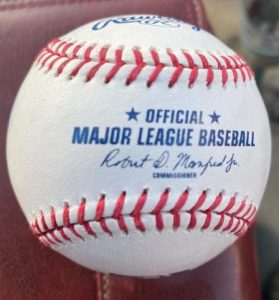
The foul ball, now crossed off my bucket list, sitting atop my notebook, before I handed it to my son.

While the visiting Astros took batting practise, a line drive sailed into our section down the right field line. Adjacent fans made it impossible for me to see just which Astro hit the ball, but the ball bounced around off seats in front of us, then under them, and riocheted off a fan two seats to our right, before rolling on the floor under us to where I could grab the ball before another fan reaching under the seat in front of me did.

I held the ball up to see for myself that I wasn’t seeing or imagining things, then handed it to my son. He’d only been asking to try to catch a ball at Angel Stadium since, oh, the first time I got to take him there—in 2000, when the Angels beat the visiting Yankees one fine evening by prying the winning run out of The Mariano himself. We’d gone to plenty of games since. Thursday night, it was pay dirt at long enough last.

Of course, there was now a game to play, and the Angels lost, 3-1. These are my ten takeaways:

1) Shoh-time! The good news for the Angels was Shohei Ohtani starting on the mound. I’m convinced that what looked to be a lockout-dejected, ho-hum crowd in advance, shot into a near-sellout once Ohtani was announced as the Opening Day pitcher. Lockout after-effect, I suspected: I’d checked the ticketing for the game just prior to the announcement and there were several thousand seats remaining for the taking.

Well, now. The day before I set out for southern California from my home in Las Vegas, I checked the ticketing again. The tickets seemed to have flown off the board once Angel fans knew it would be Shoh-time. And Ohtani didn’t disappoint, much. He pitched four and two-thirds innings of one-run, nine-strikeout, four-hit, one-walk baseball.

The best the Astros could do against him was the third inning, after he caught Martin Maldonado looking at strike three and blew Jose Altuve away with a swinging third strike: Michael Brantley banged a double off the right center field fence and Alex Bregman sent him home promptly with a base hit to left center.

As a matter of fact, when Ohtani wasn’t becoming the first player in Show history to throw his team’s first pitch of the season and make his team’s first plate appearance of the season (the Angels like to bat him leadoff), he manhandled Altuve for three strikeouts on the night, including the nasty slider that shot over Altuve’s hard swing for the third such strikeout in the top of the fiftyh.

2) The bad news: Astros starter Framber Valdez was just as effective in six and two-thirds innings. (The Angels planned to keep their starting pitchers on an 80-pitch limit for the time being, after the lockout-imposed too-short spring training.) He struck six out, walked one, and surrendered two of the Angels’ four hits on the night.

3) The worse news, for the Angels: They came to within inches of taking a 2-1 lead in the seventh. Mike Trout led off by beating out a throw from shortstop that should have been ruled an infield hit but was ruled an error. Then Anthony Rendon hit a high liner that sailed into the left field seats . . . but missed the foul pole on the wrong side by a hair.

“When I saw the ball flying in the air,” Valdez said post-game of his narrow escape, “I got mad with myself that I didn’t make my best pitch. I just took a deep breath and threw my best pitch.” That would be the hard sinkerball on which Rendon promptely dialed Area Code 4-6-3.

Matt Duffy promptly beat out an infield hit to third, which promptly moved Astros manager Dusty Baker to end Valdez’s night and bring Phil Maton in to strike Jo Adell out swinging for the side.

4) Cruising speed: Maton seemed on a bit of a cruise in relief until he hit Brandon Marsh with a pitch with two out in the bottom of the eighth and David Fletcher shot a 1-2 pitch through to the back of left center and gunned it for an RBI triple. That was the Angels’ first and last run of the game, alas.

5) The worse news, for baseball as a whole: That ridiculous three-batter minimum for relief pitchers. Under normal circumstances, if your reliever comes into the game and gets murdered right away—as Angels reliever Ryan Tepera was in the top of the eighth—you’d know he didn’t have it that night, right?

Father and son

Father (right) crossed Opening Day off his bucket list at last—and had the pleasure of doing it with his 28-year-old son.

Oops. Tepera’s first pitch to Alex Bregman sailed into the left field seats. The next Astros batter, Yordan Alvarez, hit a hanging slider on 1-1 over the center field fence. The Angels were lucky to escape with their lives after two prompt deep fly outs (Yuli Gurriel, Kyle Tucker) followed by a sinking liner up the middle (Jeremy Peña) that Trout caught on the dead run in from somewhat deep center to retire the side. (Trout also drew a loud ovation after he turned around and, from half-shallow center, winged the ball to fans halfway up the right center field bleachers.)

6) But there was good news on the relief front. Neither manager burned his relievers in the bullpens. If either Baker or Joe Maddon warmed a pitcher up, he either came into the game as soon as needed or he was handed what amounted to the rest of the night off. No Angels or Astros reliever was called upon to warm up more than once.

I paid as much attention to the relievers in the pen as I could, considering I was seated far opposite the pens behind the left field fence. The Angels used five relievers and the Astros, three. None of those eight pitchers threw any more than maybe 20-25 pitches before they were brought into the game. None of them could be called gassed going in.

Tepera simply didn’t have it Thursday night; Maton got vulnerable after ending one inning and getting two outs to open the next. The rest of the two teams’ bullpen corps (Hector Neris and Ryan Pressly for the Astros; Aaron Loup, Austin Warren, Jose Quijada, and Archie Bradley for the Angels) pitched clean-as-a-hound’s-tooth relief. Would that all major league managers were that judicious handling their pen men.

7) Memo to: Angel fans. Subject: The Wave. The 1980s called. They want their obnoxious, obstructive Wave back. One fan adjacent to our section kept calling for fans to do the Wave. I kept shaking my head, but I did notice that each of about ten attempts at it starting in our part of the park died before flowing to a fourth section of the field-level seats. Maybe there’s hope in such deaths, after all.

8) You were saying? The back-to-back Astro bombs to one side, this game wasn’t exactly the kind to send the old farts screaming to the whiskey shots. The game’s twelve total hits included three Astros doubles, Fletcher’s triple, and six singles. Altuve even stole second in the ninth, for whatever that was worth, since he ended up stranded.

9) Wasted Out Department: Altuve, the Astros’ pint-sized, gallon-hitting second baseman, also dropped a sacrifice bunt to third with one out in the seventh against righthanded reliever Warren, after Chas McCormick opened the inning with a double. Remember: A man on second with one out, and you have less chance of scoring a run after that bunt than you did before the bunt, even if you do exactly what Altuve did pushing McCormick to third.

Just what a man with a lifetime .512 Real Batting Average (total bases + walks + intentional walks + sacrifice flies + hit by pitches, divided by total plate appearances), and a .297 lifetime hitting average with a man on second and one out, is doing thinking sacrifice escapes. With his team leading a mere 1-0 at the time, the Angels brought Quijada in to pitch to Brantley, and Brantley flied out shy of the track in right center for the side.

That’s what a wasted out did. The righthanded-hitting Altuve might have been futile against Ohtani on the night, but he has a lifetime .301 hitting average against righthanded pitchers. The Astros would have had a better chance scoring McCormick if Altuve hit away.

10) When Bregman checked in at the plate in the top of the eighth, the Angel Stadium video boards flashed a graphic with Bregman’s head shot plus this: [He] donated over 200 iPads  w/protective cases and iTunes gift cards to several Houston-area elementary schools that have autistic classrooms. He does that through his Bregman Cares charity, with a particular focus upon autistic children.

It was almost as admirable for the Angels to show Bregman such respectful acknowledgement as it was for Bregman and his wife, Reagan, to take such an interest in lending hands to autistic children. Even if Bregman’s idea of saying thank you for such respect was to smash a leadoff homer in reply.