Smash, slash, and smother

Mike Trout, Brandon Drury

Trout accepts congrats from Drury after his leadoff blast in the third—unaware that Drury would hit the next pitch out and Matt Thaiss would hit the next pitch after that out, opening the thirteen-run third-inning carnage against the Rockies Saturday night.

Saturday night was one night the Angels could well afford Shohei Ohtani having an off night. One RBI single in seven plate appearances might be cause for small alarm ordinarily. But who the hell needed Ohtani, on a night that the Angels dropped a 25-1 avalanche atop the walking-wounded Rockies in Coors Field?

The Rockies went into the game knowing they’ll miss right fielder Charlie Blackmon another few weeks, hitting the injured list with a broken right hand, after he tried playing through it following the hand having been hit by a pitch in Kansas City. They were already missing Kris Bryant with a heel injury. Not to mention three key starting pitchers including Germán Márquez and Antonio Senzatela.

But nobody saw Saturday’s kind disaster coming when the Angels opened a 2-0 lead after two full innings.

They spent the second inning nailing a pair of back-to-back base hits before Rockies starter Chase Anderson plunked Angels right fielder Mickey Moniak on 0-2 to load the pads, and David Fletcher slashed a two-run single on the first pitch—all with nobody out.

Anderson looked rehorsed after he induced a double play grounder and caught Ohtani himself looking at a full-count third strike. You’ll find fewer more grave instances of looks being deceiving than what the Angels did to him in the top of the third.

It only began with future Hall of Famer Mike Trout leading off by hitting a 1-0 pitch over the center field fence, then with Brandon Drury hitting Anderson’s very next pitch over the left center field fence, and then with Matt Thaiss hitting Anderson’s very next pitch over the right field fence.

Three pitches. Three thumps. To think the fun was just beginning for an Angels team whose past few seasons have been anything but in the end.

Not even the most cynical observer of the thin-aired yard known as Coors Field expected what happened after Thaiss completed his circuit around the bases, and after Anderson walked a man, induced a force out at second, surrendered a base hit, and induced a pop out around the infield:

* Taylor Ward singling home new Angel toy Eduardo Escobar, acquired from the Mets a day or so earlier and going 2-for-4 in his Angels premiere.

* Ohtani singling Moniak home and sending Anderson out of the game in favour of Matt Carasiti.

* Trout walking to re-load the pads.

* Drury sending a two-run single up the pipe.

* Thaiss walking to re-set first and second.

* Hunter Renfroe yanking a bases-clearing double, one of his team-leading five hits on the night.

* Esobar singling Renfroe home.

* Moniak sending a two-run homer over the right center field fence.

The third-inning carnage ended only when Carasiti got Fletcher to ground out right back to the mound. And wouldn’t you know that at least one Twitter twit harrumphed about the injustice of it all after Moniak connected: “21st-century MLB, taken to its most absurd extreme. This is one example of why I can’t get that excited about homers, anymore.”

Not even over three straight to open an inning in which only five of the thirteen runs scoring in the frame scored by way of home runs and half the hits were singles? Not even over five runs scoring off singles and three off a double? Not even ten of the thirteen Angel runs of the inning coming home with two outs?

You want to harrumph about something, harrumph about why the Rockies were caught woefully unprepared and left two relievers in to take fifteen for the team. Not just the six Carasiti surrendered of his own as well as adding two to Anderson’s jacket, but poor Nick Davis starting in the top of the fourth.

The Angels slapped him silly for eight runs on seven hits including back-to-back one-out RBI singles followed by an RBI double, another bases-loading walk, a two-run double, and Fletcher hitting a three-run homer. Then Davis got Ward to ground out and struck Ohtani out swinging to stop that inning’s carnage.

Davis survived a pair of two-out singles in the fifth. I confess—I couldn’t resist tweeting at that point: “With apologies to the Roaring Twenties, after five it’s Angels 23, Rockies skiddoo.”

The Rockies’ righthander wasn’t quite so lucky in the sixth, but he might have felt just a small hand of fortune: the worst the Angels did to him in that inning was a double (Moniak) and a single (Fletcher) to open the inning with first and third, before the Angels’ 24th run scored on a force out at second.

That would be the same way the Angels got their 25th and final run of the night two innings later, with Karl Kauffmann on the mound for the Rockies. The only thing spoiling the Angels’ smothering shutout would be Rockies center fielder Brenton Doyle leading the bottom of the eighth off with a 1-0 drive over the center field fence off Angels reliever Kolton Ingram.

Just days earlier, the Angels were humiliated by back-to-back shutouts courtesy of the Dodgers. Now, they ended Saturday night setting a franchise record for runs in a single game—a franchise record they broke by one, having scored 24 against the  Blue Jays in an August 1979 game. They also became the first in Show in the modern era to score twenty or more runs in a two-inning span.

All that on a night when the only Angels not to get any hits were one pinch hitter and two mid-to-late game insertions. And, when they secured themselves in second place in the American League West—six games behind the division-leading Rangers.

“Today,” said Moniak postgame, “was just one of those days, where everyone was feeling good and we were getting the right pitches to hit.” That may yet qualify as the understatement of the season.

3,000 hits, and one for the game’s integrity

Miguel Cabrera

Miggy Stardust standing alone at first base after becoming baseball’s only 3,000-hit/500-home run/Triple Crown winning player Saturday afternoon.

Well, it proved too much to ask that Miguel Cabrera should get number 3,000 by launching one over the fences in Comerica Park Saturday afternoon. Sometimes the Elysian Fields insist that drama takes an inning off. But he didn’t wait long for the big knock, either. A sharply-cued single is equal to a home run in the hit total.

With Robbie Grossman aboard with a leadoff single in the bottom of the first, Cabrera shot a 1-1 fastball from Rockies pitcher Antonio Senzatela through the right side of the infield as if he’d lined up a money shot in a pool tournament. The bedlam began before he had a chance to hold up at first.

The Comerica audience chanted and cheered down upon him from just about the moment he left the batter’s box. He raised his fist at first as the ballpark scoreboard gave him the fireworks equivalent of a 21-gun salute. Former teammate José Iglesias, now a Rockie, ambled over to give him a bear hug—and the ball he’d just hit into history.

The Tigers poured out of their dugout to congratulate their man. His wife, his son, his daughter, and his mother gave and received hugs with him behind the plate while time was still in effect. Who says it wasn’t worth the extra day’s wait?

Cabrera barely had time to settle back in at first base when Jeimer Candelario struck out but Jonathan Schoop pushed him to second and Austin Meadows (safe on a fielder’s choice) home with an infield hit, and Spencer Torkelson—who’s taken first base over while Cabrera settles in strictly as a designated hitter—hit Senzatela’s first pitch to him into the right field seats.

Just like that, the Tigers showed they knew how to celebrate Miggy Stardust’s big knock the right ways. Then, after Grossman singled home a fifth run in the fourth, the big puddy tats ramped up the party with two outs in the sixth, and the guest of honour struck again, his two-run single being sandwiched between a pair of RBI singles, including Candelario pushing Meadows home on another infield hit.

Tigers manager A.J. Hinch gave Cabrera the rest of the game off, and his mates treated him to another two-out four-run inning in the seventh, this time Meadows singling home a pair, Candelario drawing a bases-loaded walk, and Schoop singling Meadows home. The Tiger bullpen took care of the rest, even if Angel De Jesus had to claw his way out of a self-inflicted bases-loaded jam to seal the 13-0 win.

That was the opener of a doubleheader in which the Rockies threatened to shut the Tigers out in the nightcap until Meadows hit a two-out, two-run triple off Rockies reliever Alex Colome. But Colome struck pinch hitter Harold Castro out swinging on three straight cutters to nail the 3-2 Rockies win.

Cabrera picked up another base hit in the nightcap’s bottom of the first to set first and third up for Candelario, who struck out swinging before Meadows forced the guest of honour at second for the side. But nothing could spoil Cabrera’s party, not even a doubleheader split. Nothing could spoil him becoming the first man ever to nail 3,000+ hits, 500+ home runs, and win a Triple Crown.

Not even the Comerica crowd booing wrongly when the Yankees ordered him walked in the bottom of the eighth Thursday, so their lefthanded reliever Lucas Luetge could have a more favourable matchup with the lefthanded-hitting Meadows.

That debate poured into the following two days, even as the Tigers and the Rockies were rained out of playing Friday night. It was a foolish debate, in which the booing Tiger fans proved nothing more than that they’re not averse to a little tanking—when it might involve one of their own getting the ideal matchup to get the big knock after he’d gone 0-for-3 thus far on that day.

Down 1-0, Yankee manager Aaron Boone could have been accused of a little tanking himself if he’d let Luetge pitch to the righthanded Cabrera, whose splits show he manhandles pitching from both sides but is that much better against the portsiders, and handed Cabrera the immediate advantage going in.

Boone had even a slight a chance to hold those Tigers and keep his Yankees within simple reach of overcoming and winning. History be damned, he took it. And even if the lefthanded-swinging Meadows did wreck the maneuver promptly with a two-run double, it happened just as honestly as the free pass to Cabrera occurred.

“What a shame and not a good call by the opposing team,” sniffed one social media denizen about the Yankees, a sentiment expressed by only a few too many thousand from the moment Cabrera took his base that day. “Just let him have his victory at home for the fans. What a shame.”

Just “let” him have his victory?

No—the shame would have been if the Yankees let Cabrera have one more chance to  help beat them even with an historic hit providing a little extra Tiger insurance. The game’s integrity includes especially that everyone present and playing makes an honest effort to compete and win. That’s what the Yankees did in that moment.

Cabrera may be aging, but he’s still a formidable bat. A Hall of Famer whose age is only too pronounced but whose spirit and love of the game hasn’t been eroded out of its career-long presence is too smart not to know the Yankees weren’t about to let him bury them alive if they could help it.

So he waited an extra day or two to swing into the history books. The only thing wrong Saturday was probably that it couldn’t have been a home run. It’s happened before when baseball competition required precedence over baseball history. It can happen again with the next significant milestone approached by the next significant player. For integrity’s sake, we should hope that the participants play the game right then, too, even if it means history waiting an extra day or two.

The Comerica Park racket after Cabrera pulled up at first in the first should tell you one historic swing wasn’t just worth the wait, it was good for baseball, the Tigers, and Miggy Stardust. And in that order.

Blackmon doesn’t quite open the door for Rose

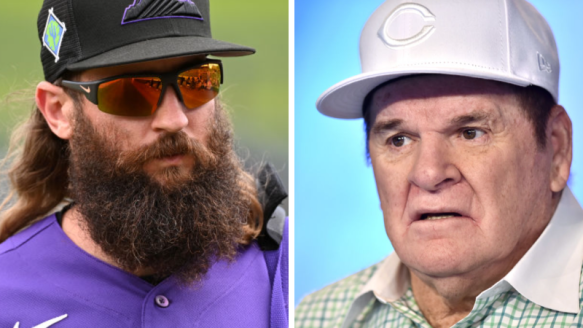
Charlie Blackmon, Pete Rose

Blackmon (left) has an endorsement deal with a legal Colorado sports book. It doesn’t mean Rose (right) comes off the permanent hook against betting on baseball. (Photo montage by Outkick.)

Almost four years ago, MGM Resorts and Major League Baseball agreed to a promotional deal, MGM Resorts owning several hotel/casinos in Las Vegas and elsewhere. Almost as if by a script, it prompted Pete Rose’s partisans to demand his “rightful” reinstatement to baseball. And it was dismissed simply enough, most profoundly by Craig Calcaterra, then an NBC Sports baseball analyst.

“While there may be the broadest, most cosmic level of discontinuity between baseball going into business with a casino given its ban on players, coaches and umpires gambling,” Calcaterra began, “there is no practical inconsistency or hypocrisy or irony or anything else about it.”

This is because baseball’s ban on gambling was never, ever about gambling being some moral abomination that cannot be countenanced in any way. It was about the manner in which gambling compromised the competitive integrity of the game and thus imperiled baseball as a going concern. Players were gambling on baseball and cozying up to gamblers to throw baseball games. That had to be stopped and it was stopped. Full stop.

What, then, to make of Rockies outfielder Charlie Blackmon signing an endorsement deal with a Colorado sportsbook, MaximBet? Does the first known endorsement deal between an active major league player and a sportsbook—made possible by clauses in the new collective bargaining agreement—equal the open door through which baseball’s most notorious living gambling exile returns to the game’s good graces and, thus, to the Hall of Fame?

Rose’s partisans seem to think yes. Post haste. So does Rose himself. The bad news for them is that they are wrong, on more than one ground. Ground one: As ESPN writer David Purdum noted, MLB policy enjoins Blackmon from promoting baseball betting specifically. Blackmon can promote MaximBet itself as a company but he can’t promote or encourage anything the company does that involves betting on his own sport.

Ground two: Baseball has had promotional partnerships with brewers and distillers in the past. It didn’t and still doesn’t mean that a player, a coach, a manager, or an umpire can get bombed out of their skulls before or during a game. Just let Shohei Ohtani walk out to the mound or check in at the plate with a bottle of sake and a glass in his hand and see if he goes unpunished.

Ground three: If Blackmon were foolish enough to think his MaximBet deal gives him an opening to bet on baseball himself, you can, ahem, bet on it. MaximBet would be obligated to blow the whistle at once, thus subjecting Blackmon to discipline under Rule 21(d), the punishment depending upon whether Blackmon bet on games not involving his Rockies or whether he bet on Rockies games for which he was in the lineup.

Bet on games in which your team isn’t playing, the punishment is one year’s ineligibility to be part of organised baseball. Bet on teams in which your team is playing, and you’re in the lineup, coaching, or managing, and the punishment in plain language is permanent ineligibility.

Do you need one further reminder? Rule 21(d)’s language does not distinguish between whether you bet on your own team or against your own team. The rule also extends to off-field, non-playing personnel from the most obscure ballpark ticket taker to the most visible team owner to the commissioner of baseball himself.

Just because MLB has a promotional deal with MGM Resorts, it doesn’t mean Rob Manfred himself can belly up to the nearest sports book and drop a bet on tonight’s Dodgers-Padres game. Just because Charlie Blackmon has an endorsement deal with a sports book now up and running in Colorado but planning (according to Purdom) to expand to Iowa and Indiana, it doesn’t mean he’s allowed to drop a bet even on whether the Tigers’ future Hall of Famer Miguel Cabrera will nail career hit 3,000 in his first, second, third, or fourth plate appearance against the Rockies tonight.

“I just came up at the wrong time,” Rose said to USA Today when the Blackmon deal with MaximBet became known. “I was thirty years too early. Baseball is pretty much in bed with gambling now.”

Look, I [fornicated] up. I messed up when I did what I did, ok? I can’t bring it back. However, I would wish baseball would just give me an opportunity to be on the [Hall of Fame] ballot. Not, put me in, let the writers decide. I’ve been suspended since ’89, 33 years ago. That’s a long time. And to be honest with you, it probably cost me $100 million. I’m not complaining, I’m just saying I’ve been punished pretty severely.

Baseball is “pretty much in bed with” legal gambling. Rose seems to forget that one of the most powerful pieces of evidence against him is a notebook recording a considerable volume of his baseball bets—made and kept by Michael Bertolini, a bookmaker outside the lines of legal gambling, through whom Rose bet on baseball including on his Reds while he was still an active player as well as the team’s manager.

Blackmon’s MaximBet deal isn’t necessarily a great look, depending upon your point of view, even if it’s major relief that Blackmon will be on a very tight leash that keeps him away from just promoting baseball betting, never mind betting on the game himself. But the deal doesn’t quite open the door for Rose’s return from baseball’s Phantom Zone, either. And it still isn’t up to MLB to put him on a Hall of Fame ballot.

The Hall itself, not governed by MLB, passed a rule denying those permanently ineligible from appearing on Hall ballots. Rose seems almost as forgetful of that distinction as he and his remaining partisans seem of the distinction between “lifetime” and “permanent.”

Brothers in baseball and bereavement

Jose Iglesias, Freddie Freeman

Iglesias mourned his father after his first hit of the season Friday; Freeman hugged and empathised with him.

José Iglesias signed with the Rockies in March. For the first ten seasons of his career, his father, Candelario, who’d played professionally in Cuba, saw over three thousand of his plate appearances. The elder Iglesias died a few weeks before Opening Day; the son still grieves even as he plays the game father and son loved together.

The son tagged his first base hit against Dodgers starter Walker Buehler in the bottom of the second Friday. He couldn’t fight his emotion as he arrived, nor could he resist a gesture heavenward. And the Dodgers’ new first baseman, Freddie Freeman, wouldn’t let him fight or resist either.

Freeman asked what was wrong. The Rockies shortstop acknowledged his grief over losing his father. Freeman—the defending World Series MVP with last year’s Braves, who has never been shy about his own grief following his mother’s death when he was ten—hugged Iglesias by his head, leaned it against his shoulder a moment, then gave him a few fraternal pats on the shoulder and head before play continued.

Iglesias had just knocked a run home to stake the Rockies to an early 2-0 lead (he went 1-for-4 on the day) that would turn into a 5-3 Dodgers win, with no small help from Freeman, who struck out, was hit by a pitch, then had a hand in the Dodgers’ five-run fourth by walking, going first to third on an RBI base hit, and scoring on a wild pitch, before he beat out an infield hit in the sixth (he was stranded) and looking at a third strike in the eighth.

But in the second inning, Freeman and Iglesias weren’t opponents but brothers in parental bereavement. “There’s nothing harder than losing a parent,” Freeman said to Iglesias before the game resumed.

“He was everything to me,” Iglesias said of the father who’d once played shortstop, too,  but would come home to play ball with his son after long post-baseball days labouring in a factory for $10 a day in Castro’s Cuba. [The younger Iglesias defected in 2008.] “His dream was to watch me in the big leagues. He told me once ‘If I can watch you play for one day, I’ll be good to go after that.’ He watched me play for ten years . . . he’s in a better place now, watching me play every day.”

“We’ll never know what any of us are going through in life,” Freeman told reporters postgame.

I think it just kind of reminds you to just have some compassion, some humility, and just be kind to others. That’s what’s so special about baseball too is you get to be around so many great people and so many people that just care about and love the game of baseball. His father was shining down on him to be able to get that single.

“You never forget your dad. All I could do is give him a hug. You know, when you lose a parent, all you can do is just give that person a hug. There are no words. No word is really going to be enough. Just let that person know you care about him.

“It was a beautiful moment,” Iglesias said, “beyond baseball, we’re human beings. That was very nice of Freddie.”

Freeman’s mother, Rosemary, died of melanoma in 2000. The son who was ten at that time can never forget climbing aboard her hospital bed despite his size for his age just to stay close to her, believing to his ten-year-old soul that she’d recover.

“Her pain was a twenty out on a scale of ten and she never said one word,” Freeman told ESPN’s Buster Olney for a profile a year ago. “She let us crawl in bed and she tried to be as much as she could to us, even though she had to lay there. And she was more than that, a mom, even in those times. We obviously thought she was going to beat it . . . She did everything she could to beat that disease.”

So Freeman eventually held on to his father. Now, an opponent pulling up to first base let his grief over his father’s death, over his father no longer seeing him play except from a heavenly perch, overcome him. Freeman more than most understands such loss, no matter what age parental bereavement comes, and cares. He cares enough not to give a damn who’d object to his comforting a stricken opponent.

“We have different uniforms on,” Freeman said, “but you take the uniforms off and we’re all friends in this game. That’s the key. That’s the beauty of this sport. We all switch teams throughout our careers so you get to come across a lot of amazing people. From the looks of it, [Iglesias’s] family loves baseball just as much as we do, so I’m just glad to be able to be a part of anything I could do for him.”

Bet that Rosemary Freeman and Candelario Iglesias sat together in the Elysian Fields exchanging hugs and agreeing that there’s one word for what Rosemary’s son did for Candelario’s in the second inning. The word is class.

Rockiegate v. Astrogate? Try Our Gang v. the James Gang

Colorado Rockies

The Rockies lined up on the foul line on Opening Day 2019. A former Brewer reserve says the 2018 Rocks were aspiring Astrogate-like sign stealers . . . but . . .

No one with a modicum of intellgence ever suggested the 2017-18 Astros were baseball’s only high-tech off-field-based sign-stealing cheaters. They were just the most sophisticated, top-down, and apologetically unapologetic of the known lot. Not to mention that they either altered a real-time-delay center field camera or installed a second non-delayed one to make their Astro Intelligence Agency work.

Now, former Brewers reserve catcher Eric Kratz has pointed a flying fickle finger of fate at the Rockies. The Rockies, who’ve seen enough of their best players leave for greener pastures administered by less brain-damaged administrations. The Rockies, now accused of being some of baseball’s more inept cheaters.

A couple of days ago, Kratz told the YES Network’s Curtain Call podcast (Kratz also did time with the Yankees, who own the YES Network) the Brewers caught the Rockies banging to relay signs stolen “from a television” in 2018. What were the Rockies banging? Kratz said it was—wait for it—a massage therapy gun.

“I can tell you that a team that has been to the World Series, often, recently, we caught them doing something almost similar,” said Kratz to Curtain Call hosts John J. Filipelli and Kevin Sullivan. Kratz didn’t specify that team, but then he dropped the quarters on the Rockies.

And I can also tell you, because I don’t really care, I don’t know anybody over there, the Colorado Rockies were doing the exact same thing in 2018, and we caught them, and we played them in the playoffs. You know how many runs they scored in a three-game playoff series in 2018? Not many people watched the NLDS. They scored two runs in the ninth inning of Game 2. They used to take a Theragun and bang it on their metal bench. And they were doing the exact same thing, from the TV.

So, there you go. If you think no one else was doing it, you are wrong. The difference is, the Astros may have taken it a little too far. Maybe a little bit too far. Maybe continued to do it. Or maybe it’s just the fact that they won the World Series and everybody’s pissed about that.

Theragun

The Theragun. The ball extension does the rapid-movement massaging at the push of a button. This is what the 2018 Rockies used to send batters stolen signs, reputedly. They only massaged themselves out of that postseason early.

Take careful note of all Kratz’s phrasings. “From the TV” can mean the Brewers caught onto the Rockies likely trying to steal signs the same way the Red Sox were caught doing the same year: deciphering signs from the video replay rooms provided to home and road teams in all major league ballparks, then relaying them forward.

The 2018 Rogue Sox relayed them by hand signs to baserunners to send to the batters. It was a slightly more sophisticated version of the kind of gamesmanship played on the basepaths for over a century. Unlike the Astros, they didn’t install a new camera somewhere in Fenway Park to set up a new underground television network.

Nobody’s yet accused the Rockies of fostering the kind of win-at-all-costs culture that came top down from the former Jeff Luhnow administration in Houston. There, what began as a conscious front-office effort to apply elaborate algorithims on behalf of sign-stealing continued with the development of the AIA Network, the altered/installed camera to the clubhouse monitors to the trash can bangs sending the stolen signs forward.

If you think that inspired rounds and rounds of can gags and signs since, what would the Rockies’ Theragun ineptitude inspire? “If Theraguns are Outlawed, Will Only Outlaws Have Theraguns?”

Kratz has a further point. If the 2018 Rockies really were using that massage gun for such a sign-stealing variant, it didn’t bring them a happy ending. They finished tied with the Dodgers for the National League West but lost a single-game playoff for the title, and the Brewers rousted the Rockies out three straight in the division series to follow.

Kratz mis-remembered the Rockies scoring in the set, though: they scored two in the Game One ninth (on an RBI single and a sacrifice fly) to tie the game at two, before the Brewers won in the tenth inning. Then the Brewers shut them out despite allowing them ten hits over Games Two and Three; the Rockies went 4-for-19 with men in scoring position without a single cash-in in those games.

If the Brewers caught the Rockies stealing signs in that division series, they’d caught one of the most inept bands of bandits since the wiseguys Jimmy Breslin satirised in The Gang That Couldn’t Shoot Straight. It’s almost not even worth calling the Rockies to account.

Almost.

Break into a bank with larceny on your mind, come away with nothing because you and/or your confederates didn’t have a clue about how to dismantle the alarms and decipher the vault’s combinations.You’re still going to face federal charges when you get caught red-handed and flat-footed. Even if you have la policia laughing their fool heads off because they’d just busted Our Gang, not the James Gang.

Just because the Rockies got slapped out of the 2018 postseason fast enough to equal a blink, just because they were the apparent Maxwell Smarts of sign-stealing, it doesn’t make them any less guilty if Kratz is right. The Rockies being petty criminals doesn’t acquit or mitigate the Astros’ grand theft felonies, either. Neither did the 2018 Rogue Sox.

You might not have been the only high-tech cheaters on the block, but you’re not off the hook just because they weren’t as sophisticated or successful as you. Especially when your gang might yet have won a World Series because of it.