

The real story of Herb Score and Gil McDougald isn’t as simple as you might still think.
When Anthony Rizzo lined a base hit off Jameson Tallion’s head Monday, there must have been those who’ve watched baseball since before I was born who had two names in the center of their minds: Herb Score and Gil McDougald. As you might imagine they pop into those minds any time they’ve seen a pitcher drilled by a liner back to the box, in the head or otherwise.
Because, well, everybody knows that when McDougald, the Yankee jack-of-all-trades of the 1950s, caught hold of Score’s heater and drilled it right into the face of the Indians lefthander, that 7 May 1957 afternoon, that was it, kiss it goodbye for Score’s promising career. Right?
Wrong. Stop saying that, once and for all. Because that wasn’t quite it for the popular, talented pitcher who eventually became an even more popular Indians television broadcaster with a Yogi Berra-like flair for malaprops. (A classic: He makes the catch for the final out. And after three, the score, Cleveland 4 and the Indians 2.) And, a reputation as a gentleman who wouldn’t harm the proverbial fly.
“He’s such a nice guy,” one-time Indians third baseman Buddy Bell said of him, “that I’ll bet he makes the bed in his hotel when he wakes up in the morning.”
This is what is true: Until that afternoon, Herb Score was, essentially, Sandy Koufax before Koufax became Koufax. He’d just led the majors in strikeouts back-to-back, the 245 he punched out shattering Grover Cleveland Alexander’s record for a rookie pitcher and standing as the rookie record until Dwight Gooden broke it in 1984. His 9.7 strikeouts-per-nine rate led the majors, and he won the American League’s Rookie of the Year award pretty handily.
Score struck out 263 in 1956, again leading the majors as did his 9.5 strikeouts per nine and his 2.78 fielding-independent pitching rate. (ERA minus defense behind you.) He was also a 20-game winner in ’56. His rookie wins above a replacement-level player were 5.6, considered All-Star level or better; in ’56, he had 7.3, just shy of what WAR considered a Most Valuable Player-caliber season. He was an All-Star both those seasons, and his only blemishes seemed to be walks and wild pitches; he led the majors in the latter both years.
“Herb Score is the toughest pitcher I’ve faced,” Hall of Famer Mickey Mantle was quoted once as saying. “I just can’t hit him.” (Not entirely true: Mantle hit .250 against Score lifetime, with two homers, five runs batted in, and an .859 OPS.)
Score was in his fifth game of the 1957 season when McDougald’s liner flattened him. He had 39 strikeouts, a 9.8 strikeouts-per-nine rate, and a nifty 2.00 earned run average against his 2.50 FIP, not to mention 39 strikeouts in 36 innings.
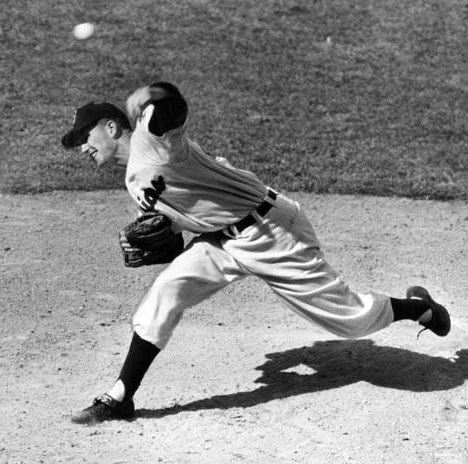
Score in motion, long before the fateful line drive . . .
Score was pitching in the top of the first and had just gotten rid of Hank Bauer on a ground out to third base when McDougald, playing shortstop that day, came up. On 2-2 he caught hold of a low fastball and drilled it, and Score hit the mound in a heap with his hands over his face after the ball ricocheted.
But every eye in Cleveland’s old Municipal Stadium (a.k.a. the Mistake on the Lake) was on the stricken Score. Indians outfielder Rocky Colavito, Score’s roommate and best friend, hustled in and slid his glove under Score’s head after Score turned in agony from his left side to his back.
Score was taken by ambulance to a hospital. Hall of Famer Bob Lemon relieved Score and finished the game, the Indians winning, 2-1, with Colavito himself pushing both Indian runs home: in the seventh, when his sacrifice bunt attempt turned into a throwing error to third allowing Vic Wertz to score the tying run (Bauer had an RBI single in the top of the seventh); and, in the eighth, when he worked out a bases-loaded walk.
McDougald finished the game, but couldn’t contain his grief, either.
“I heard the thud of the ball hitting his head,” he remembered in 1994, to New York Times columnist Ira Berkow, “and then saw him drop and lie there, bleeding, and I froze. Someone hollered for me to run to first. When Score was taken off the field on a stretcher, I was sick to my stomach. I didn’t want to play anymore.”
Yankee manager Casey Stengel insisted McDougald stay in the game. McDougald obeyed his manager but added, “If Herb loses his eye, I’m quitting baseball.”
Score didn’t lose his eye as things turned out happily enough, but McDougald incurred a truckload of fan abuse over the liner, fans often yelling “Killer” at him when he batted during Yankee road games. Score wasn’t one of his judges, though. Indeed, when the two men met for the first time after Score’s hospitalisation, as Score himself told a reporter, “I talked to Gil and told him it was something that could happen to anyone. It’s just like a pitcher beaning a batter. He didn’t mean it.”
Score’s sister, Helen, was living in Florida at the time and didn’t know what happened to her brother until after the game ended and she returned home from her government job. “When I got home, a lady said my mother had been calling,” she told the Palm Beach Post in 2018. “I got in touch with her and Mom said, ‘It’s bad, but he’s got the finest doctors in the world and they will do everything that they can. You need to go down to the church and say your prayers for Herb, but more than that to pray for Gil McDougald. That man is a hurting man’.”
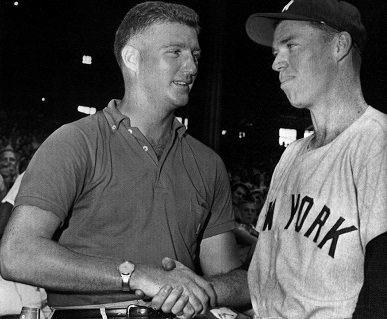
It wasn’t for publicity alone when Score shared this handshake with McDougald later in 1957.
McDougald tried to get updates from the hospital but personnel claimed they were ordered not to say a word to him or even to let him visit Score. (The only visitor Score was allowed, the Post said, was his fiancee, Nancy; the couple moved their planned 1957 wedding date up from October now that Score’s season was over.)
The versatile Yankee’s only reported solace came from Score’s mother, who told him likewise it wasn’t his fault. (A grateful McDougald visited Mrs. Score for years after their careers ended, whenever he was in Florida, the Post said.) But without losing his sight Score recovered and returned to the Indians in 1958.
After a pair of rough starts to open, he had a scoreless relief appearance to earn a save, then threw a shutout at the White Sox which included thirteen strikeouts, very much vintage Score. In his next game Score suffered a loss from an eight-and-a-third inning start in which he was tagged for three earned runs, but he suffered something a lot worse.
As Score himself would remember long after his career ended, it was a cold and wet night and he started feeling forearm soreness. In the seventh inning, he said, he bounced a pitch in front of home plate and his elbow flared on him.
Told he’d torn an elbow tendon, Score sat it out on doctor’s orders for thirty days, then took a relief turn against the Senators in Washington, where he’d first incurred the injury. The game started well, with Score striking out five of his first eight batters, until with two out in the ninth he “felt like someone stabbed me in my left arm.” He got a pop out to end the game on a lob of a pitch, but only pitched on and off the rest of 1958 hoping an off-season’s rest would resolve the elbow.
It didn’t. The theories began abounding; you can get the drift just from broadcaster Jimmy Dudley: “I still insist Herb never got over the effect of that blow to the eye. That would change anyone, and he changed his motion so he would protect his eye. I firmly believe that.”
Score firmly rejected that theory for the rest of his life. The evidence—you know, that pesky evidence—backs him completely. The elbow tendon tear, not the McDougald liner, was the injury that ultimately finished him as a pitcher. His pitching motion changed trying to overcome any lingering elbow issue. Put down all the juicy speculations and lamentations and let Herb Score tell it himself:
Before I hurt my arm, I could go through an entire season and never scuff the toe plate [of his spiked shoe]. Later, I was ripping up a toe plate every game because I was dragging my foot . . . I couldn’t get out of the habit of dragging my foot, and that wrecked my entire motion to home plate . . . The reason my motion changed was because I hurt my elbow, and I overcompensated for it and ended up with some bad habits.
Score was never again the pitcher he was in 1955-56. After a very down 1959 and a 7.61 spring training ERA in 1960, there were those who believed the Indians gave him special coddling, including a few teammates, with only Rocky Colavito standing up for him.
Score actually had the infamous Colavito-for-Harvey Kuenn trade to thank for getting a trade of his own to a place he dearly wanted to go if the Indians’ infamous then-general manager, Frank Lane, wanted to be rid of him almost as badly as he wanted Colavito out of his sights. To the White Sox, whose manager Al Lopez was Score’s first Indians manager, and whom Score believed could help him get back on the right pitching track.
According to Terry Pluto, in The Curse of Rocky Colavito, when Indians vice president Nate Dolin asked Score if he’d like to go to the White Sox, Score didn’t flinch:
I told him that it would be the best thing that could happen at this point in my career. Al Lopez had caught more games than anyone in major league history until Bob Boone broke his record . . . Al Lopez had had as much success with pitchers as any manager ever. I knew if anyone could help me, it was Al Lopez.
If it wasn’t for Dolin, Score and Lopez wouldn’t have their reunion. Lane was only too willing to deal Score—but not to Lopez, who’d resigned as the Indians manager after the 1956 season. Lopez accused the team’s management of not standing up for injury-addled third base star Al Rosen, who’d played through injuries down the stretch to furious booing from the stands and criticism in the press.
Pluto also wrote that Lane may have feared that Lopez could indeed revive Score, and that a revived Score could haunt the Indians for seasons to come. But in the heat over the Colavito trade, Dolin confronted Lane:
[Dolin] said something like, “If you have just one ounce of compassion in that bucket of venom you call a heart, you’ll send Herb to the White Sox.” Lane knew that because of the Colavito trade, Dolin still wanted to tear his limbs off and feed them to a family of hungry grizzlies.
For his part, Lane couldn’t let Score go to the White Sox without taking a gratuitous and nasty slap at the clean-living, forthright pitcher:
Herb’s troubles are more psychological than physical. Maybe a change of scenery will help him. Lopez won’t be any more sympathetic toward Herb than [Indians manager Joe] Gordon was. But Herb will think he is and that may make a difference. Herb has a great imagination.
Colavito’s annual tangles with Lane over contracts, to say nothing of Colavito believing and telling the GM to his face that he was a proven liar (Pluto has cited chapter and verse), made him trade bait. But Score though there was another reason Lane was so anxious to be rid of the pair: “Part of it,” he said, “was that Lane believed ballplayers should be rowdy, hard-living, hard-drinking guys. But that wasn’t Rocky or myself.”
Lopez couldn’t help Score as things turned out, and Score spent the rest of his career between the White Sox and the minors until he bottomed out at Triple-A Indianapolis in 1963.
People asked me why I went to the minors to pitch. I still believed that my arm might come back. I was only thirty. I didn’t want to be sitting somewhere when I was sixty and wondering, ‘What if I had pitched one more year, would I have found it?’ Now I know. I have no doubts. I tried everything, and I pitched until they pretty much tore the uniform off my back.
The only place Herb Score sat at sixty was the same place where he began sitting in 1964, in the broadcast booth doing Indians games on television, until the end of the 1997 World Series. Voices of the Game author Curt Smith quoted a friend thus: “So what if he’s never been a Hall of Fame announcer? Look at it this way. Wouldn’t the city of Cleveland have turned somersaults over the last twenty years just to have ball clubs as decent as their announcer?”
Gil McDougald wouldn’t be quite the same player after the line drive, either. After a pair of very down seasons in 1959 and 1960, the Yankees left McDougald available for the expansion draft that created the second Washington Senators and the Los Angeles Angels. But McDougald elected to retire before that draft, exhausted, he said eventually, of the travel “and the attitude of the baseball people . . . they acted like they owned you and that they were giving you the moon and the stars.”
In fact, his own fate was hit by a line drive two years before his own nailed Score. McDougald was hit behind his left ear by a batting practise liner, in a genuine freak accident, as he eventually told Berkow, while he was behind a screen at second base talking to Yankee coach Frank Crosetti.
I saw a ball lying on the ground nearby and reached to pick it up, my head going just beyond the screen. Just then Bob Cerv hit a ball that hit me in the ear. I collapsed and everyone came running over. They carried me off the field, and I was out of action for a few games.
The doctors told me I’d be all right. Well, I wasn’t. The blow had broken a hearing tube. At first it just affected one ear, my left. One time I’m getting needled by some fan at third base, and I turned to [Phil] Rizzuto . . . and said, “Too bad I didn’t get hit in the right ear, then I wouldn’t have to hear this guy.”
A father of four, McDougald already had a dry cleaning business doing well. He eventually became Fordham University’s baseball head coach—until his right ear went deaf as well, ending his coaching career and forcing him to sell his dry cleaning and building maintenance business.
Berkow told McDougald’s story in 1994 with sad grace in “McDougald, Once a Quiet Yankee, Now Lives in Quiet World.” That, plus the happy followup Berkow wrote after McDougald underwent a successful cochlear implant to restore his hearing enough to allow him to function again, are collected in Berkow’s Summers in the Bronx: Attila the Hun and Other Yankee Stories.
If you think Herb Score spent the rest of his life lamenting what Gil McDougald didn’t take away from him, after all, think again, as Score told Pluto in 1993:
People tell me that I was unlucky. Me? Unlucky? I started with a great team in the Indians and played under a great manager in Al Lopez. Then I went from the field to the broadcasting booth at the age of thirty, and thirty years later I’m still doing the games. If you ask me, that’s not unlucky. That’s a guy who has been in the right place in the right time.
McDougald spent the last years of his life advocating for the hearing-impaired and for the manufacturer of his cochlear implant. After the implant surgery, during an office visit to the audiologist who programmed it after he healed from the procedure, with his wife and one of his children at his side, McDougald wept for joy.
As he told Berkow later, while his home bustled with children and the grandchildren “who came to see Grandpa hear,” as his wife put it, he found the words to describe the gift: “They’ve turned the music on.”
Score retired after the 1997 World Series. He survived a near-fatal 1998 road accident, but then suffered a stroke in 2002, and died in 2008. McDougald died of prostate cancer two years later.
 It’s difficult to feel sorry for a franchise whose history includes fifteen trips to the postseason, ten pennants and five World Series championships, even if they’ve spent the past five seasons in the pits of the National League Central. Difficult, but not impossible.

