Ladies and gentlemen, your Chicago Blight Sox

2024 Chicago White Sox

The Blight Sox, on the threshold of possessing the American League’s longest losing streak, depending upon what they can or can’t do with the Athletics, of all people, Tuesday night.

The number twenty-one has meanings profound (a winning hand at blackjack; the legal age of consent in most places), historical (a fabled New York restaurant and Prohibition-era speakeasy), and disgraceful alike. (The 1956-58 television game show that ignited the infamous quiz show scandal.) It was also the uniform number of 29 White Sox players over the team’s history.

As of Monday night number 21 became something more sinister. In Chicago, that is. The White Sox lost their 21st consecutive game. Somewhere in this favoured land, the sun is shining bright, the band is playing somewhere, but the White Sox are under a massive cloud with the threat of funeral marches sounding too clear.

The Athletics, of all people, dropped it upon the Blight Sox. The team so reduced by their ten-thumbed, brain-challenged owner that it was thought the A’s would bury themselves a live in what’s still their farewell season in Oakland beat the White Sox 5-1 in the A’s rambling wreck of a ballpark.

Once upon a time, the White Sox tied the game at one. The A’s said, don’t even think about it, scoring four more. And there was no joy back in Windville when the mighty Senzel (Nick, that is) struck out to end consecutive loss number 21.

This is the longest such streak of sorrow since the Orioles opened 1988 0-21; the 21 losses are an American League record now shared. The streak followed the 27-67 record the White Sox amassed from Opening Day through 5 July. They have only to lose three straight more to pass the 1961 Phillies and six straight more to pass the 1889 Louisville Colonels of the antique American Association. And, unlike those 1988 Orioles, these White Sox may have lost their sense of humour along the way.

Says White Sox manager Pedro Grifol, whose seat may resemble a stovetop burner, “Everybody knows what it is. It’s 21 in a row. It sucks. It’s not fun. It’s painful. It hurts. You name it. However you want to describe it.”

Said 1988 Orioles manager Frank Robinson, installed after Cal Ripken, Sr. skippered them to the first six straight losses, “Nobody like to be the joke of the league, but we accept it”—after showing a visiting reporter a button he kept in a desk drawer saying, “It’s been lovely, but I have to scream now.”

Says White Sox left fielder Corey Julks, who managed a highlight-reel catch to save a run, “Don’t dwell on the losses. Try to learn from them and get better each day.”

Said Hall of Fame shortstop Cal Ripken, to a reporter new on the Oriole beat when that 1988 streak hit the big Two-Oh, “Join the hostages.”

Said Grifol, “It’s not for lack of effort. Nobody wants to come out here and lose. We’ve just got to put a good game together and put this behind us.”

Said Robinson, “Nobody’s really gone off the deep end. All except one game, there’s been a real effort.”

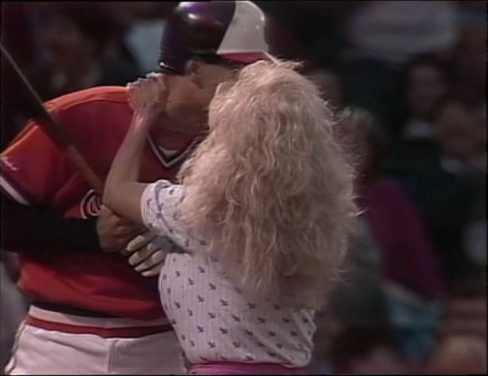
Cal Ripken, Jr.; Morganna. the Kissing Bandit

When the ’88 Orioles needed a little extra mojo after losing two straight following the end of their epic losing streak, Morganna the Kissing Bandit planted one on Hall of Famer Cal Ripken, Jr.—and they battered the Rangers for her trouble.

Said former White Sox manager Ozzie Guillen to Athletic reporter Jon Greenberg, after Greenberg suggested White Sox owner Jerry Reinsdorf and general manage Chris Getz were waiting for Grifol to manage one more win before executing him, “That means Pedro is 100 games under .500 since he got the job. Hoo, hoo boy.”

Said Robinson, told of a radio personality who promised to stay on the air until those Orioles finally won a game, “We’re gonna kill the poor guy.”

Come 29 April 1988, Baltimore’s old and long-gone Memorial Stadium was sold out, the crowd broke out the ancient championship-aspiring chant “O-R-I-O-L-E-S” . . . and the Orioles won at last, 9-0. Their opponent then? A different collection of White Sox. Out of whose starting pitcher Black Jack McDowell they pried five runs (four earned), out of whose bullpen they banged four more, in a game featuring two Hall of Famers on each side, with the Oriole Hall of Famers—Ripken and Eddie Murray—each hitting home runs and the whole team pounding eleven hits to the White Sox’s four.

After two straight Oriole losses to follow, Morganna the Kissing Bandit showed up to plant a wet one upon Ripken . . . and they battered the Rangers, 9-4. Ripken hit one out that day, too. It wasn’t enough to salvage an Oriole season in which they played below .500 ball in each month. (Morganna wasn’t about to become a single team’s attitude adjustment mascot, either.) But it might have kept the sting of 0-21 cauterised awhile.

Now, the White Sox don’t have someone else to confront them trying to end a losing streak. This time, the White Sox have to try again. They’re not finding laughs, they’re hearing that their own Hall of Fame legend Frank Thomas  is scolding them: “I don’t want to hear no more: ‘We’re trying.’ No more: ‘They’re working hard every day.’ No, it’s time to snap. It’s time to kick over the spread.”

The 1961 Phillies were managed by Gene Mauch, a man to whom kicking the postgame food spread over came as naturally as song to an oriole. Grifol doesn’t yet impress as a man ready to turn a table full of food and drink into a Jackson Pollock floor painting. Yet. But if the White Sox don’t escape Oakland with at least one win, don’t bet against the homecoming spread in Guaranteed Rate Park being served under armed guards.

Don’t look for Morganna to bring a little mojo. She’s been retired a quarter century and has no known intention of making a comeback. But upon whom would anyone suggest she plant one, if she did? Maybe upon Grifol, when he brings out the lineup card. If nothing else, it might loosen the manager up to the point where he can say, “It’s been lovely, but I have to scream now.”

Is the Orioles’ reign of error ending?

Is a new day really dawning at Camden Yards?

You thought the National League West ogres in Los Angeles had a long World Series title drought? The Orioles haven’t won a World Series since over a week following the premiere of the first Hooters restaurant. (In Florida.) And, since a decade before Peter Angelos bought the team out of bankruptcy court.

“Bankrupt” has been a polite way to describe the Angelos reign of error. Oriole fans celebrated, then cringed too often for comfort after Angelos bought the team from Eli Jacobs. Now they may have cause to celebrate something sweeter than the Orioles’ slightly unexpected return to competitiveness last year. May.

Once upon a time Angelos swore the Orioles would be pried from his literal cold, dead hands, as in upon his death. Now, his son John, who’s been running the Orioles since his father was diagnosed with dementia, plans to sell to two equity billionaires, David Rubenstein (the Carlyle Group) and Mike Arougheti (Ames Management Corp.). The price: $1.73 billion.

This, writes The Athletic’s Ken Rosenthal, whose career as a baseball writer began by covering the Orioles for the Baltimore Sun, could portend the turn toward a new direction.

The Rubenstein-Arougheti group won’t take complete control of the team right away. They’re beginning with a minority investment but intend to take complete control upon  Peter Angelos’s death, allowing the Angelos family a tax benefit by waiting to give the group full ownership. (Rosenthal observes they’d have faced a capital gains tax levy on the difference between the team’s 1993 and current valuations.)

Rubenstein is known to have Baltimore ties and to be a significan philanthropic presence in the region. His personal worth is said to be $3.8 billion, while Arougheti’s is said to be $1.8 billion. Rosenthal also cites a Baltimore Banner report saying Hall of Fame shortstop and Orioles icon Cal Ripken, Jr. is going to be part of the new ownership group. Could the future look any sunnier for Oriole fans?

Well, they once thought it was sunny days ahead when the elder Angelos bought the team, too.

Two years later, in the wake of (let’s call it as it really was) the owner-provoked and pushed players’ strike, Ripken made it safe to love baseball again when he passed Lou Gehrig for consecutive games played and marked the occasion with a hefty home run off Angels pitcher Shawn Boskie in the fourth inning.

The Orioles have been to a few postseasons and through a lot more losing in the Angelos era. The elder Angelos became too hands-on despite a lack of common baseball sense. Tom Verducci of Sports Illustrated once described his style as slash-and-burn management, as in burning eleven managers in eighteen seasons before the comparative stability of Buck Showalter (8.3 seasons) and incumbent Brandon Hyde (entering season six).

From 1998-2011 the Orioles endured what was once believed unfathomable for a franchise with a history proud enough: a fourteen-season losing streak. The elder Angelos also dithered on creating an international Orioles scouting operation and presence and let his already chaotic front office mistreat valued players.

Things once hit so far bottom that Verducci reported in 2001 that agents with Oriole clients found those clients telling other free agents, “You don’t want to come here.” That sentiment was inconceivable in the era between their first World Series title (1966) and their last.

Last year’s Orioles surprised the world by reaching the postseason at all. They saw enough of their young talent start coming of age, and they saw a farm system looking plenty good enough for the seasons to come. Right?

Oops. Along the way, John Angelos was stupid enough to suspend his lead television broadcaster Kevin Brown over information on a team-provided graphic comparing last year’s O’s against the Rays to previous seasons in which the Rays seemed to own them. Oriole fans can’t be blamed if enough of them think they can’t have nice things without something nasty along with them.

Barely had the news sunk in about the Rubenstein-Arougheti group agreeing to buy the Orioles when bing!the team swung a trade for former Cy Young Award-winning Brewers pitcher Corbin Burnes for a shortstop on the cusp of Show readiness but with a few warning signs, a pitcher who might project as a useful reliever, and the 34th pick in the 2024 draft.

Further warning signs, though: Burnes has lost some hop on his signature sinkerball, his strikeout-to-walk ratio has dipped, and big boppers had a finer time with him last year than two years earlier. (2021: seven homers allowed. Last year: 22 homers allowed.) But he’s still Corbin Burnes and he’s still formidable enough. For a season to come at least. They hope.

Thus far the apparently glandular adulation thrown the new ownership group seems to be precisely what NBC Sports-turned-independent Craig Calcaterra calls it: “he’s not John Angelos, therefore he’s perfect, and if you suggest otherwise, blogger boy, you’re a hater.”

But Oriole Nation has been there/done that in the past, a little too often. The Angelos Era may be over, but then Mets fans threw champagne parties over the end of the Wilpon Era and the advent of Steve Cohen, too.

Cohen has been through more than a few growing pains thus far. Met fans whose patience rivals that of the piranha at mealtime (they are legion) think one bad inning equals grounds for summary executions—in April. Oriole fans may be far more patient, but the Angelos reign of error wore that patience to the thickness of a sheet of paper.

The Rubenstein-Arougheti (-Ripken) Group has quite a job ahead, assuming the rest of baseball’s owners approve their advent and their purchase deal. It’s not simple being viewed en masse (and perhaps prematurely) as saviours. Once upon a time America thought (really) that even Richard Nixon had to be an improvement over Lyndon Johnson. How did that work out?

Oriole fans may (underline that) be wise to consider what investigative journalism giant Sidney Zion used to advise: Trust your mother, but cut the cards.

Diminishing the one whose record you break?

If Joe DiMaggio didn’t think Cal Ripken, Jr. diminished Lou Gehrig, neither should anyone else. Unfortunately . . .

You become accustomed to absurdity when loving, following and writing about a game. You see and hear it from those who love and follow it, those who play it, those who manage or administer it, and those who write about it. But then comes a remark that should win the ultimate Howitzer Prize for Extinguished Commentary.

I saw it in the context of late-spring observations on the health of certain Yankees, aboard a Facebook baseball group to which I belong, mindful that for almost three years The New England Journal of Medicine could be the Yankee yearbook. I saw concurrent references to Lou Gehrig and Cal Ripken, Jr., Hall of Famers both, one setting the consecutive games played streak the other broke.

Both Gehrig and Ripken played through assorted injuries to reach their milestones, perhaps foolishly. Gehrig ended his streak only under orders from the insidious disease that would kill him shy of two years after removing himself from the Yankee lineup. Ripken was able to play 501 consecutive games more following the night he passed Gehrig and 870 more games total before retiring with 3,001 major league games played.

Aboard that group, I couldn’t resist noting Gehrig’s plaque in Yankee Stadium’s Monument Park still calls him “a great ball player whose amazing record of 2,130 consecutive games should stand for all time.” Just as it did when it was first erected in the old Yankee Stadium on the Fourth of July in 1941.

The night Ripken said “not quite,” one of Gehrig’s Yankee teammates was in Camden Yards to see it happen. “Well,” said Joe DiMaggio to Ripken and the crowd after the game ended, “that goes to prove even the greatest records are made to be broken. And . . . wherever my former teammate Lou Gehrig is today, I’m sure he’s tipping his cap to you, Cal Ripken.”

Another group member thought not. “I still wish Cal would have stopped at 2130,” he wrote. “He would have been even more of a media darling if he said something along the lines of the memory of the man and the streak is too great to be broken therefore I am content to tie it and to hopefully be mentioned in the same breath as he in future conversation.”

Have I finally seen everything?

Well, I know better. But for abject absurdity if not sheer foolishness, that gets as close as possible. It only begins with Ripken having been a media target as much as a media darling the closer he got to meeting and passing Gehrig. For every one that marveled at his endurance, there was another who marveled that the Orioles put up with his “selfishness,” with putting his potential place in baseball history ahead of the team’s good.

My first response in the space of the group itself was to suggest such thinking as wishing Ripken stopped equal to Gehrig made it a wonder that any record would be broken. I remembered Henry Aaron saying, “I don’t want people to forget Babe Ruth, I just want them to remember Henry Aaron.”

I also wondered whether Ruth himself would have said, in 1919, “Gee, I think I’ll stop at 27 [home runs] because I don’t want to ruin Ned Williamson’s memory.” (Ruth’s 29 homers that year broke Williamson’s 1884 single-season record.) I didn’t dare add that I was pretty sure Pete Rose in 1985 didn’t think for a single minute, “Jeez, I can’t do this to Ty Cobb, can I?” before slashing his Tying and passing career base hits.

Guess I should have described myself as a hopeless romantic instead of an idealist but i really do wish that was the way it went down,” said the group member in question who thinks and wishes Ripken had stopped at 2,130. “Everyone would have known Cal could have easily surpassed Gehrig and I can’t foresee anybody breaking or even coming close to 2130 again. Your point though is certainly well taken.”

What manner of “hopeless romantic” goes ballistic at the mere idea of anyone challenging Ruth’s former single-season home run record in 1961? Which one has kittens over the likelihood of plainspoken, charisma-challenged Roger Maris and not glib, charisma-loaded Mickey Mantle breaking it?

Idealists don’t send aspiring record breakers hate mail. Hopeless romantics don’t write venomous newspaper columns or throw things at them. Then-commissioner Ford Frick wasn’t hopelessly romantic, he was cynically selfish—as a one-time Ruth ghostwriter and permanent Ruth acolyte—demanding separation between 154-game and 162-game seasons the better to be damn sure ruthsrecord (yes, they said it that way then) couldn’t really be erased.

(P.S. You asked for it. Maris needed five fewer plate appearances to hit 61 in ’61 than Ruth did to hit 60 in 1927. If you re-set Maris’s clock to start his season the game in which he hit his first homer of ’61, it took him 152 games to hit 61. Take that, Edsel Frick.)

I wondered further about such “idealists” as the brain-dead and the racists (who are their own kind of brain dead) threatening Aaron every step of the way as he approached, met, and passed Ruth on the career home run list.

I resisted the temptation to ask my fellow group member if he was one of those ready to wear black arm bands when Sandy Koufax smashed two of Bob Feller’s records in one 1965, Feller’s major league single-season strikeout record and his career record three no-hitters. (Koufax really hit Feller where it hurt, too: his fourth no-hitter proved that practise makes perfect.)

Then I reminded myself no milestone passer or record breaker could possibly erase the memory or the legacy of the one whose milestone he passed or record he broke. I learned that early from Ted Williams himself, a man who was nothing if not obsessed with his own legacy. “The other day,” Williams said at his own Hall of Fame induction, “Willie Mays hit his five hundred and twenty-second home run. He has gone past me, and he’s pushing, and I say to him, ‘go get ‘em Willie’.”

Williams didn’t think Mays diminished him. Teddy Ballgame, of course, probably believed nobody could diminish him. While whacking balls during batting practise he was once heard to say, “Jesus H. Christ Himself couldn’t get me out!”

Was Ruth diminished by Maris and Aaron? Was Feller diminished by Koufax? Was Cobb diminished by Rose? Was Walter Johnson diminished by Nolan Ryan breaking his lifetime major league strikeout record? Was Gehrig really diminished by Ripken?

DiMaggio didn’t think so. “He’s a one in a million ballplayer, who came along to break [Gehrig’s] record,” the Yankee Clipper told that cheering Camden Yards throng, “and my congratulations to you, Cal, you certainly deserve this lasting tribute.”

On the silver anniversary of the night he passed Gehrig (and whacked a home run while he was at it), I reminded anyone who cared to read it that Ripken didn’t (and doesn’t) live by 2,131 alone. He’s the arguable greatest all-around shortstop who ever played the game. Says who? Says 3,000+ hits and 400+ home runs (the only such middle infielder to do both) and +181 fielding runs (third only behind Mark Belanger and Ozzie Smith), says who.

You should be half afraid to ask whether Casey Stengel managing five consecutive World Series winners diminished the John McGraw who’d once managed a mere four. Or whether Tom Seaver striking out a record ten straight to consummate a nineteen-strikeout game diminished the Steve Carlton who’d struck out nineteen in a game previously without ten straight punchouts to finish.

Carlton wasn’t accused of diminishing the Koufax who struck eighteen out in a game twice or the Feller who did it once.

Tomorrow is Opening Day. The Show will be back and with a full season to come, even. Last year’s pan-damn-ically shortened, irregular season will recede a little further into the ranks of the aberrations. There may be a few milestones reached and passed this year, if not exactly all-time records of all-time idols.

Miguel Cabrera needs a mere 134 hits and thirteen home runs to become the only player who ever reached 3,000 lifetime hits and 500 lifetime home runs in the same season. At least nobody—whether fan group member or professional writer—can accuse Cabrera diminishing someone else’s achievement if he makes both.

Nobody can predict, of course. The likelihood isn’t that great, either, but imagine if the aging Cabrera’s thirteenth home run this year becomes his 3,000th hit, somehow. He’d be only the third man in Show history to do it. Hands up to anyone foolish enough to think he shouldn’t even think about trying to go long for 3,000 because it might “diminish” the only two men whose 3,000th hits were bombs—Derek Jeter (who did it first, in 2011) and Alex Rodriguez (who did it in 2015).

At September 2019’s end, just about, Justin Verlander struck Kole Calhoun out twice in a game. The first time nailed Verlander’s 3,000th career strikeout, the second time his 300th strikeout of that season. No pitcher ever delivered that trick before. The only thing that diminished Verlander even slightly was what happened after he punched Calhoun out for 3,000: Andrelton Simmons hit the pitch immediately following the punchout over the center field fence.

Entering 2021 Max Scherzer, Zack Greinke, and Clayton Kershaw have over 2,500 lifetime strikeouts each. Suppose one of them endures long enough that his 3,000th strikeout-to-be might also become his 300th strikeout of the season in question. Would it really diminish Verlander if one of them pulls it off? Should he just try throwing grounders the rest of the way? Should his manager relieve him on the spot? The better not to soil Verlander’s glory?

God help Mike Trout, Ronald Acuna, Jr., Mookie Betts, Francisco Lindor, Juan Soto, Fernando Tatis, Jr., or Christian Yelich if any of them should stand on the threshold of breaking Joe DiMaggio’s 56-game hitting streak. Some bonehead somewhere is liable to suggest he should take a dive for game 57 on the grounds that it’s too great a record to be broken and, by the way, he shouldn’t ought to want to diminish DiMaggio’s memory.

Both Ripken and myself will probably be in the Elysian Fields before somebody else breaks Ripken’s streak, if somebody else actually does. But I’ll be there watching when Ripken and Gehrig holler down to the man, “Way to go, kiddo!” They won’t be screaming bloody murder with demands not to be diminished.

When Johnny Bench broke Yogi Berra’s record for lifetime home runs as a catcher, Berra wired him: “I always thought that record would stand until it was broken.” Funny how Bench didn’t exactly diminish Berra. Funny how Berra didn’t exactly feel diminished. Funny, too, how nobody who’s since passed Bench —for the record, they’re Carlton Fisk and Mike Piazza—diminished Yogi, either.

The only one diminished by suggesting that breaking venerated records diminishes the original record setter is the one making the suggestion in the first place.

Ripken does not live by 2,131 alone

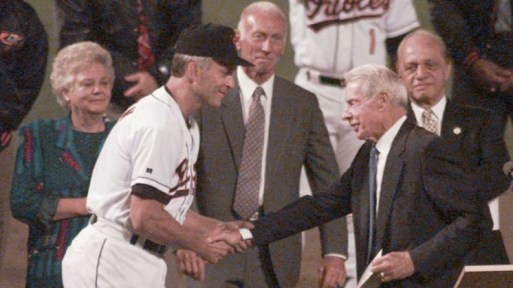
With his parents Vi and Cal, Sr. behind them, Cal Ripken, Jr. accepts congratulations from Joe DiMaggio, whose teammate’s streak Ripken had just broken 25 years ago.

After the game in which Cal Ripken, Jr. passed Lou Gehrig for consecutive major league games played, Joe DiMaggio—Gehrig’s teammate from 1936-39—spoke to the jammed Camden Yards crowd. He opened his on-field tribute by quoting Gehrig’s Yankee Stadium monument.

“A man, a gentleman, and a great ball player whose amazing record of 2,130 consecutive games should stand for all time,” the monument still reads, beneath a bronze impression of Gehrig’s face beneath his Yankee cap. DiMaggio finished quoting the sentence, then tilted his head a bit to his right.

The Clipper arched his right eyebrow, as if in slightly bemused disbelief. He pursed his lips into a half-mischievious, half-astonished look on the face age softened into a kind of regal handsomeness. As the crowd began to cheer again, he continued.

“Well, that goes to prove even the greatest records are made to be broken,” said the man whose own record 56-game hitting streak was once thought more likely to fall before Gehrig’s consecutive game streak. “And . . . wherever my former teammate Lou Gehrig is today, I’m sure he’s tipping his cap to you, Cal Ripken.”

Ripken’s father, Cal, Sr., an Oriole legend in his own right as a longtime minor league manager and teacher, stood behind DiMaggio beaming as DiMaggio turned to the son who’d just “reached the unreachable star,” as ESPN broadcaster Chris Berman said the moment 2,131 became an official game.

Ripken himself smiled in both relief and a little bit of awe as DiMaggio continued, “He’s a one in a million ballplayer, who came along to break [Gehrig’s] record, and my congratulations to you, Cal, you certainly deserve this lasting tribute.”

DiMaggio was 6’2″ in his playing days. Ripken was 6’4″ as he remains today, so far. Thanks to age, DiMaggio now stood a full head shorter as he shook hands with Ripken’s parents. He hadn’t just come forth to give a formal scripted tribute. The Clipper had watched the entire game (so had fellow Hall of Famers Frank and Brooks Robinson, the latter in the Orioles broadcast booth), including Ripken’s hefty drive halfway up the left field seats in the bottom of the fourth.

In game terms the Orioles’ 4-2 win meant almost nothing in their American League East standings, headed as they were for a third-place finish fifteen games behind the eventual East champion Boston Red Sox. The California Angels, in first place in the AL West that night, ended up finishing a game behind the champion Seattle Mariners after they couldn’t force a playoff game against Hall of Famer Randy Johnson.

But in baseball terms, of course, Ripken’s achievement meant more than the outcome of any pennant race or World Series. In the aftermath of a players’ strike that disillusioned the country, abetted no end by a sporting press two thirds of which at least bought into the owners’ insistence that the players stop them before they overspent yet again, Ripken told his country and the world it was more than okay to love the game all over again.

“My favorite piece of memorabilia of my years playing is the lithograph of him hitting that home run off me that he had signed for me the next year,” says Shawn Boskie, the Angels pitcher who surrendered that fourth-inning bomb, as part of The Athletic‘s remarkable oral history of the record night. “The biggest thing that can be said is that the electricity and the anticipation for that game, building up to that moment, is something that I would expect I’ll never see again.”

Ripken wasn’t always understood so well until he finally did pass Gehrig. For months he’d had to put up with notions from intelligentsia and fans alike that he was putting himself ahead of his team. The consummate team player, who’d been raised to believe that being an everyday player meant just that so long as you could play, must have bristled under that unwarranted lash.

He turned 35 shortly before he consummated the streak. He wasn’t having a classic Ripken year in a season shortened to 144 games by the hangover of the strike. To this day, he doesn’t buy the selfishness argument.

“I always thought my job was (as) a player. My job was to come to the ballpark ready to play, and the streak was not created because I dictated I was going to play,” he said for The Athletic‘s oral history.

It was created because I brought value to each and every day. The manager chose me . . . It was more about being there for the team and you could even make the case that it was a little bit more unselfish than selfish. But I endured the criticism. People enjoyed taking that position when it happened. And I always thought your best protection against that was to get out of your slump. As soon as you got out of your slump, all of that stuff went away.

Ken Rosenthal, today an Athletic writer and Fox Sports broadcaster but then covering the Orioles for the Baltimore Sun, understands well. “Whether it was a worthwhile endeavor or not, whether he could have had an even better career,” he said for the oral history, “we can debate that until we’re blue in the face.”

His point always was, ‘Hey, if my manager feels that I’m the best guy to be out there, well, that’s it.’ It wasn’t always that simple, of course, because managers felt afraid, I think, to (not start him). But I remember (former Orioles manager) Johnny Oates always saying, ‘Hey man, two outs in the ninth, that’s where I want the ball hit.’ And even when he wasn’t hitting, that was always the case. It was just a remarkable accomplishment. … It was a testament to his toughness, his mental strength, all of the physical attributes, everything. Just to do it was unreal.

Ripken would finish his career with 431 home runs, hitting 353 of them as a regular shortstop—ahead of Alex Rodriguez (345 as a regular shortstop) and fellow Hall of Famer Ernie Banks (298 as a regular shortstop). Remember: he was the prototype of the big man who could play a field position formerly governed by not-so-big men with spaghetti bats. Eight men have finished careers with 3,000+ hits and 400+ home runs; Ripken’s the only mostly middle infielder in the pack.

Baseball Reference defines fielding runs as the number of runs saved above the league average based on how many plays you make. Ripken’s 181 lifetime are behind only two shortstops, ever: his Oriole predecessor Mark Belanger* (238) and his fellow Hall of Famer Ozzie Smith (239). Belanger’s Oriole predecessor, Hall of Famer Luis Aparicio (who did most of his best work for the White Sox previously), is 27 behind Ripken.

For those willing to set aside Alex Rodriguez’s baggage, know that A-Rod isn’t even among the top 24 shortstops for fielding runs. He’s barely among the top one hundred. (His career total: +18.) We now know that those Seattle seasons during which he was hyped as possibly the greatest all-around shortstop of all time in the making was just that, hype.

Without the complete defensive numbers for Hall of Famer Honus Wagner (fielding runs weren’t even considered in his time, and Wagner’s only eleventh all-time in range factor, 23rd in career assists, and 79th in double plays turned, if that helps), we may or may not be able to say Ripken is the greatest all-around shortstop who ever played the game in any era. But it’s very safe to say he’s the absolute best all-around shortstop of the post-World War II/post-integration/night-ball era. No questions asked.

Would Ripken have done even better, after his throwing arm finally began resigning after all those years and games, had he been moved to second base instead of third for his final five and a half seasons? Would he have been healthy enough to hit 500+ if he had taken time off when injured? We’ll never know. We don’t have to know, either.

Once upon a time, reviewing DiMaggio’s war-interrupted career, Bill James suggested that times come when we shouldn’t measure a player “by what he could have done, by what he should have done, by what he would have done, but what he did done.” Ripken did done an awful lot more than just put on a two-decade show of physical and mental endurance.

He earned the right to be measured by far more than just what proved to be 2,632 consecutive games played before he finally took himself out of the lineup. He shakes out on the evidence as the number three shortstop ever to play the game. (A-Rod and the Flying Dutchman are ahead of him only because of their bats; Ripken has more defensive wins above replacement-level than a) the pair of them and b) any shortstop other than Belanger and Smith.) He didn’t get there only by showing up to work every day.

Twenty-five years later, Ripken doesn’t have to apologise to anyone or justify himself for hanging in tough and proud enough to break Lou Gehrig’s streak. He did it in honest competition; he came out of far fewer games than Gehrig actually did. It wasn’t Gehrig’s fault that an insidious disease ended his streak and career at once; it wasn’t a black mark against Ripken that his health allowed the Iron Bird to pass the Iron Horse.

Joe DiMaggio was right—Gehrig probably did tip his cap from the Elysian Fields to Ripken that night. Today, from those same Elysian Fields, Gehrig and DiMaggio will both tip their caps. So will every Oriole in uniform at Camden Yards this afternoon—when the Orioles play the Yankees.

The only shame in either the streak itself or its silver anniversary is that the coronavirus world tour continues keeps fans out of the ballparks. The idea of canned noise of a standing ovation celebrating Ripken this afternoon somehow seems as fraudulent as Ripken’s achievement wasn’t.


* So why isn’t Mark Belanger—clearly Ozzie Smith’s near-equal as a defensive shortstop—in the Hall of Fame, despite the Hall more recently taking defense, preventing runs, far more seriously than it had during his era? Three reasons, I suspect:

1) He couldn’t hit even compared to Ozzie Smith, who laboured to improve as a hitter as his career went on. 

2) His Hall of Fame teammate, Brooks Robinson, was overwhelming at third base and charismatic in the bargain, that even the World Series audiences who watched them play together gravitated toward the accessible Robinson first and, perhaps, took Belanger for granted, even if Oriole fans didn’t.

3) Belanger was such a terrible hitter that not even eight Gold Gloves at shortstop prevented the Orioles from trying to trade up during his career, looking for shortstops who could hit . . . but finding none who could field the position as well as he did.

Silver anniversary of a platinum night

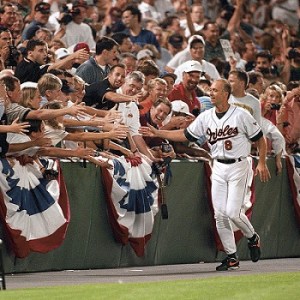
Cal Ripken, Jr.  takes his victory lap after his 2,131st consecutive game became official.

Just how old are we getting? One Sunday, Tom Seaver, the arguable greatest pitcher of his generation, loses a cruel battle against Lewy body dementia with a little help from the coronavirus. The following Sunday, tomorrow, baseball in general and Baltimore in particular celebrate the silver anniversary of the record everyone thought couldn’t be broken.

Until it was.

If you don’t count his sort-of cup-of-coffee 1981, Cal Ripken, Jr. and Seaver played the same number of major league seasons. (Twenty.) Ripken’s place in baseball lore would have been secured even without besting Lou Gehrig’s consecutive games played by 502, thanks to being the guy who proved tall, powerful men could play an infield position once thought the domain of bantamweights while hitting ike heavyweights.

Do you remember consecutive game 2,131 in Camden Yards? Baltimore won’t forget, but a lot of people with no skin in the Orioles’ game might need a refresher.

Ripken played consecutive game 2,129 and hit one out. He equaled Gehrig the next night . . . and hit one out. On the night he passed the Iron Horse, the Iron Bird turned on a 3-0 pitch from California Angels righthander Shawn Boskie in the bottom of the fourth—and sent it halfway up the left field seats.

“I gave him a great gift,” said Boskie after the game, with no malice aforethought. “I gave him the best gift he could get. It was three balls and no strikes. I felt like I had no outs. I didn’t want to walk a guy and get things started that way. At the same time, I felt like he might be swinging, but I felt like, Hey, I’ve got to take a chance of him popping it up or hitting a grounder. But he didn’t, so . . . Cal Ripken Day.”

The Orioles beat the Angels in that money game, 4-2. The sellout audience of 46,272 went at least as nuts at that blast as they’d go when the game became official at around 9:20 p.m. Eastern time. When Chris Berman, calling the game for ESPN, declared, “Cal Ripken, Jr. has reached the unreachable star.”

That was before then: We thought someone had a better shot at breaking Joe DiMaggio’s 56-game hitting streak than Lou Gehrig’s consecutive games. This has been since then: We think someone will have a better shot at DiMaggio’s streak than Ripken’s 2,632 consecutive games.

It took them over 22 minutes to calm down to mere cheering and applause after that point. The Camden audience included two Hall of Famers, one of whom was Ripken’s manager for a spell (Frank Robinson) and the other of whom just so happened to have had Gehrig himself as a living, breathing teammate. (DiMaggio.)

They celebrated the elite middle infielder who’d retire as the only one among the game’s eight greatest shortstops ever to nail three thousand hits or more and four hundred home runs or more. (Alex Rodriguez, love him or loathe him, moved to third base when he joined the Yankees and fell short of the milestones as a shortstop.)

The elite shortstop who never acted like anything more than the ordinary working stiff, from the dock or the line or the shop or the store to the boardroom and the penthouse and the Lear jet, showing up to work every day, few if any questions asked, never thinking of delivering less than the best of whatever he had.

Unknown, uncountable millions of such working stiffs showed up to work every day for eons before Ripken and continue doing so. How many of them don’t just show up but excel and even transcend their jobs?

“People who don’t know baseball as big leaguers experience it,” wrote George F. Will, “say: How lucky for Ripken that he was never hurt. Actually, he has been hurt every year, but not hurt enough to justify, in his mind, taking a day off. What defines Ripken is his defintion of ‘enough’.”

How many of them did it regardless of such interruptions as the 1994-95 strike for which the players took an unwarranted public relations beating thanks to a two-thirds-cowed press buying all the way into the owners’ insistence that the players stop them before they overspent, mis-spent, or mal-spent yet again?

No single player decided his brethren should spend the final third of 1994 and a sliver of 1995 on the picket instead of the field. Fools who think Ripken’s streak should be asterisked because of the strike ought to be asterisked themselves.

When White Sox owner Jerry Reinsdorf—the owner who pushed the hardest to force the strike—celebrated its end by insisting he wouldn’t leave Albert Belle’s domain until Belle kindly signed a three-year contract paying him three million a year more than the previous highest single-season player salary, he exposed himself and every other owner who pushed hardest to force that strike as hypocrites.
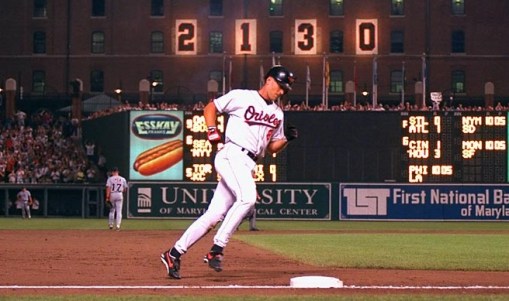
Ripken running out the home run he hit an inning before 2,131 became official.

The Camden crowd almost couldn’t have cared less about such not-so-fine details on the Big Night. But they celebrated an awful lot more than just their own baseball icon passing the record of a past baseball icon.

Shirley Povich, the arguable dean of deans among Washington baseball writers for what seemed a couple of centuries, a man who covered Walter Johnson saving the Washington Senators’ only World Series triumph and the Iron Bird leaving the Iron Horse behind, nailed it best:

By acclamation, Ripken has won approval as a hero and role model. In Gehrig’s day there were heroes, like himself and Babe Ruth, but folks didn’t talk of role models and, anyway, they would have been hard to find. So many, like Ruth, were flawed, so many like Gehrig were nice guys but absorbed mostly in baseball with little time for the community.

For all his fame, Cal Ripken is homespun. On the morning of the day he would go for the record he said it was important, too, that he take his daughter Rachel, 5, to her first day in school. When the cheers in Camden Yards were at their loudest—”We want Cal!”—he asked for his mom and dad to come onto the field to share them. When he got those eight curtain calls and he took that victory lap around the park, he tried to shake every hand offered him. He was being more than cheered. This was adoration.

Indeed, as Thomas Boswell recorded, Ripken wore a unique T-shirt beneath his Oriole uniform on the record night. It said on the back, “2130-plus. Hugs and Kisses for Daddy.” The audience saw it when Ripken removed and handed his jersey and hat to his first wife and their two small children after the game became official and the thunder began. Rachel Ripken, whom Daddy drove to school that morning, couldn’t resist crowing, “See, Daddy’s wearing my shirt!”

It happened after Ripken lined out to end the bottom of the fifth, after the game became official in the books. He donned a fresh jersey post-haste. Rarely a man of show, Ripken took about thirty curtain calls. Then he let teammates push him into taking that long victory lap around the park. Fans shook his hand. Umpires embraced him. Every Angel within reach who didn’t shake his hand bear-hugged him instead. Among the small sea of banners in the park read one particularly telling one:

We consider ourselves the luckiest fans on the face of the earth. Thanks Cal.

“My dad taught that ‘being an everyday player’ is literally every day,” Ripken told Boswell after he passed Gehrig. “My rookie year reinforced it. We tied the Brewers after 161 games. But we lost the last game of the season.”

Ripken’s devotion to his father’s devotion sometimes created issues. When the Orioles canned Cal, Sr. as their manager early in that notorious season-opening 21-game losing streak, Ripken was sorely tempted to leave the only organisation he’d known from his childhood to his major league playing career. He didn’t leave. His father probably wouldn’t have let him even think about it, but Ripken’s loyalty to the Orioles was the only thing equal to that for his family.

He led the Orioles in developing a gallows humour as that sad streak proceeded forward and successor manager (and fellow Hall of Famer) Frank Robinson did what he could with whatever he did or didn’t have. When a brand-new reporter covering the Orioles arrived in the clubhouse for the first time, Ripken beckoned him over. “Join the hostages,” the shortstop deadpanned.

“Ripken runs the risk,” Will observed, “of being remembered more for his work ethic than for the quality of his work.” Well. Ripken won two Most Valuable Player awards and both came in seasons described modestly as earth-shaking. His first MVP came in a season he helped the Orioles win their last-known World Series rings. His second, eight years apart (not quite enough to pass Hall of Famer Willie Mays for the greatest spread between MVPs), shows him earning the highest wins above replacement level (11.5) that year for any infielder, corner or middle, since . . . Gehrig (11.8) in 1927.

Only five position players in the post-integration era have two or more 10-WAR seasons, in fact. Cal Ripken, shake hands with Carl Yastrzemski (two), Barry Bonds (three), Mickey Mantle (three), and Mays (six). Ripken also became the first position player to beat Ty Cobb in percentage of Hall of Fame votes (98.5 percent to Cobb’s 98.2). Tom Seaver was the first any player to beat Cobb (98.8 percent), and his vote record stood until Ken Griffey, Jr.’s 99.3 percent.

Ripken led his league’s shortstops in assists seven times (he’s number eight all-time), putouts six, and double plays eight. (He’s number three all-time there.) Would you like to know the shortstop who’s hit the most home runs in major league history as a shortstop? It isn’t A-Rod. (345 as a regular shortstop.) It isn’t Ernie Banks. (298 as a regular shortstop.) The fellow who took that victory lap passing Gehrig for workplace attendance hit 353 of his lifetime 431 home runs as a regular shortstop.

Tomorrow, Ripken’s Hall of Fame credentials won’t bat as high in the order as the magnitude of what he achieved a quarter century earlier. If you think Baltimore won’t forget, you should listen to Ripken himself. YouTube’s made the game available to a fare-thee-well, but the Iron Bird himself couldn’t bear to watch it again until last month, says the Baltimore Sun.

“For the longest time,” he told Sun writer Mike Klingaman, “I wanted to preserve the memories I had with my own eyes. I was afraid that if I saw the game as it was, that experience would ruin it. The night was so special that I wanted it to be my memories — and I don’t regret having done that.”

Ask him as Boswell did to name his greatest baseball moments, Ripken—a prostate cancer survivor now who works to raise awareness of preventative checkups, and whose foundation named for his father builds a hundred or more Youth Development Parks in Washington and in 26 states so far—will tell you without hesitation.

“Catching the last out of the World Series in ’83 is my biggest moment,” he says. “There’s a finality, a fulfillment that just hits you in that instant. But the lap around the park was the biggest human moment.”

It’s not that Ripken’s life has lacked for sorrow. He and his family endured his widowed mother’s kidnapping and swift enough return in 2012; his first marriage ended shy of thirty years in 2016. But his son Ryan has become a professional baseball player in the Orioles’ now-on-hold minor league system. And Rachel—the daughter who put hugs and kisses for Daddy on his record night’s T-shirt—is now the director of community service for Colorado University’s athletics department.

Two years after his divorce, Ripken married Anne Arundel County (Maryland) Circuit Court Judge Laura Kiessling. Her Honour changed her name to read the Hon. Laura S. Ripken. Her husband’s long-legendary longevity proves that, unlike some of those appearing before her bench, she won’t have to teach him how to avoid being ruled out of order or held in contempt.