Henry Aaron, RIP: Inimitable

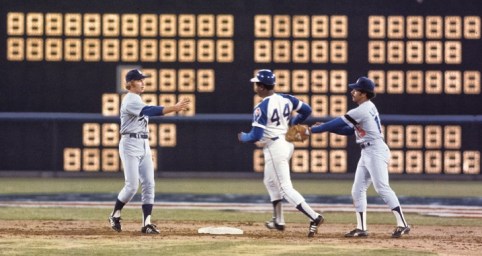
As “715” blasted in neon on the scoreboard way behind them, the entire Dodger infield—including shortstop Bill Russell (left) and second baseman Davey Lopes—shook hands with Henry Aaron rounding the bases and past Babe Ruth at last.

“I don’t want people to forget Babe Ruth,” the man once said. “I just want them to remember Henry Aaron.” Among many other things, we now get to remember that Henry Aaron won’t be on this island earth to celebrate with us what he deserved to celebrate untroubled.

Aaron died at 86 this morning, almost three and a half months before the anniversary of his own Shot Heard ‘Round the World. The idiot brigades robbed him of the pleasure of his original triumph, but Aaron’s dignitas robs them of their ability to keep a quietly proud man in what they only think is his place.

He may have been gracious hoping another would break the record he yanked from Ruth, but only one man can claim to have pushed Ruth out of the all-time Show home run record book. The man whose childhood poverty compelled him to teach himself baseball by hitting bottlecaps with sticks eventually hit 755 baseballs over fences, past foul poles, into bullpens, and into the seats.

That childhood in the deep South compelled among other unwarranted disgraces that Aaron’s mother had to tell him and his seven siblings to hide under beds whenever the Ku Klux Klan was on the march in the neighbourhood. A visit to his native Mobile, Alabama by Jackie Robinson in 1948 compelled him to live by learning first and baseball second.

Oops. Aaron skipped school to see Robinson and ended up expelled for truancy and moved to a private school. “Jackie was speaking at a drugstore, and I said, ‘I’m not going to get this opportunity again, so I better take my chances and listen to Jackie Robinson now.’ Little did I know, I got front row seats, and next to me was my father.” Double oops.

Like his fellow Hall of Famer Yogi Berra, who once said the only way he liked school as a boy was “closed,” Aaron was on a baseball or nothing mission from almost the outset.

He signed and lasted only a month with the Indianapolis Clowns, one of the last of the Negro Leagues teams hanging in. He lasted only the month because Show scouts were on his trail and Boston Braves owner Lou Perini had to have him, outbidding any other comer to sign him. After a short spell in Eau Claire, Wisconsin, Aaron helped integrate the old and hostile Sally League (the South Atlantic League) and won its Most Valuable Player Award.

He became a Brave at twenty after the team moved to Milwaukee. He finished fourth in the 1954 National League Rookie of the Year award. He joined white teammate/future manager Eddie Mathews as the Show’s best pair of power teammates since Ruth and Lou Gehrig, whom they surpassed in due course. (Ruth and Gehrig as Yankees: 1,150 home runs between them. Aaron and Mathews as Braves: 1,226 home runs between them. Note: Gehrig as a Yankee and Mathews as a Brave hit the same number of home runs: 493.)

He played quietly, almost stoically through continuing racial growing pains, and finally swung against Cardinals pitcher Billy Muffett with one on in the bottom of the eleventh on 23 September 1957—and hit it over the center field fence to clinch a Braves pennant.

Those Braves would win the World Series and Aaron would be named the National League’s Most Valuable Player. It was the only major league MVP he’d actually win, but from then through almost all his career to follow every season he played looked like an MVP season.

The Braves moving to Atlanta for 1966 didn’t thrill him, and well he might have been un-thrilled at returning to the South of his youth that still fought bitterly enough through its racist ways. Neither did a painful 1970 divorce. He resolved his fears the best ways he knew: he joined the civil rights movement quietly and continued playing baseball likewise.

Such contemporaries as Ernie Banks, Harmon Killebrew, Mickey Mantle, and Willie Mays so often loomed more immediately and larger in the public eye and mind. The outwardly composed Aaron didn’t hit outrageous punt-like bombs; his once-fabled quick wrists produced howitzer-like line drives, even after he began to think of home runs more consciously in 1963.

He had his ways of brushing the racists to one side. “I never doubted my ability,” he once said, “but when you hear all your life you’re inferior, it makes you wonder if the other guys have something you’ve never seen before. If they do, I’m still looking for it.”

With Mantle retired and Banks, Killebrew and Mays beginning to show their age, 1970 was also the year Aaron became noticeable as the man most likely to pass Ruth’s career home run record. It was the year after Aaron’s Braves won the National League West in the Show’s first season of divisional play but got flattened in three straight by the Miracle Mets in the first National League Championship Series despite Aaron’s efforts. (He had a 1.500 OPS for the set with three home runs, five hits, and seven runs batted in.)

Aaron’s days of postseason baseball were over. He’d just have to settle for becoming a legend. A legend who played and swung through the vilest racists bent on stopping the black man from knocking the Sacred Babe to one side, to the point where police and the FBI had to stay close to the man whose career to date was less bigness than sustained high excellence.
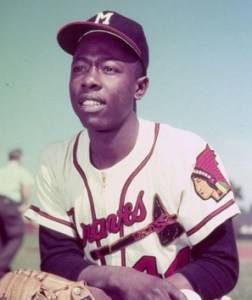
A portrait of the artist as a young Brave.

He knew excellence when he saw it, too. When the late Hall of Fame pitcher Tom Seaver introduced himself to Aaron at his first All-Star Game and one of Aaron’s 25, Aaron said it straight: “Kid, I know who you are. And before your career is over, I guarantee you everyone in this stadium will know who you are, too.”

(Let the record show Aaron once said Seaver was the toughest pitcher he faced. Lifetime against Seaver, Aaron hit a mere .205 with a .281 on-base percentage, with four home runs and sixteen hits overall in 89 plate appearances. His guarantee was hardly unfounded.)

The man Hall of Fame pitcher Sandy Koufax nicknamed Bad Henry also played and swung through the most ignorant of the non-racists who yet believed nobody had any business swinging past the Sacred Babe. And, past the manipulators on his own team who wanted nothing less than the Hammer hammering his way to meet and pass Ruth before the home audience when 1974 opened for business.

The Braves were to open in Cincinnati for a set before opening at home. Aaron entered the season needing one home run to meet Ruth and one more to pass him. If then-Braves owner Bill Bartholomay could have gotten away with it, Aaron wouldn’t have poked his nose out of the Braves dugout until they were finished with the Reds and back in Atlanta.

Word of that plan reached three New York sportswriters, Dick Young of the New York Daily News; Dave Anderson of The New York Times; and, Larry Merchant of the New York Post. They said not so fast, post haste. They denounced the plan without softening their prose or apologizing for their stance, ramping up a drumbeat on behalf of convincing then-commissioner Bowie Kuhn to head the Braves off at the pass.

It turned out Kuhn didn’t need much convincing. He told Bartholomay, Braves manager Mathews, and anyone else listening that the Braves better not even think about sending a lineup to the plate in Riverfront Stadium without H. Aaron on the card. A fourth New York writer, Red Smith of the Times, nailed the point emphatically:

He explained to Bartholomay what self-interest should have told the Braves’ owner, that it is imperative that every team present its strongest lineup every day in an honest effort to win, and that the customers must believe the strongest lineup is being used for that purpose. When Bartholomay persisted in his determination to dragoon the living Aaron and the dead Ruth as shills to sell tickets in Atlanta, the commissioner laid down the law. With a man like Henry swinging for him, that’s all he had to do.

The Atlanta Journal-Constitution‘s Furman Bisher might have been Atlanta’s sportswriting dean in that time and place, but he placed himself squarely on the wrong side of the line. Bisher led an equally passionate counterattack, denouncing the New York writers as “meddling Manhattan ice-agers” who would do better to demand the cleanup of Times Square before criticizing the sainted Braves one of whom was about to blast the Big Fella out of the books without wearing a uniform from New York.

Aaron had spent his entire career to that point helping to prove further that black men belonged in the Show and were perfectly capable of competing and winning with honour and talent, and Bisher and his like spent their own credibility defending a team determined to cheapen true competition so a black man could break a sacred sports record on home grounds.

Aaron squared off in the top of the first against the Reds’ Jack Billingham, a pitcher against whom he’d already hit four major league home runs. He hit a three-run homer to put the Braves up, 3-0. After he rounded the bases his congratulators included Kuhn himself. Mathews sat Aaron out of the second game in the three-game set, gaining a direct order from Kuhn to put him in the third-game lineup.

He struck out twice and grounded out once, fairly and squarely, but Kuhn’s protection of his and the game’s integrity made him wary of going to Atlanta to see Aaron get the Big One. He looked and sounded clumsy saying he’d had a previous engagement. If he’d only said honestly that he didn’t want to distract from Aaron’s achievement, it would have been better.

Every racist, every shill, every manipulator, everyone who thought a quiet guy who didn’t want to eat, drink, or fornicate the world out of house and home had no business busting the record of the loud lout who set it in the first place got it jammed right back down their throats when Aaron squared off against Dodgers lefthander Al Downing with one aboard and nobody out opening the bottom of the fourth.

Nobody described what happened next better than Dodgers broadcast virtuoso Vin Scully:

He means the tying run at the plate now, so we’ll see what Downing does . . . Al at the belt now, and he delivers, and he’s low, ball one. And that just adds to the pressure, the crowd booing. Downing has to ignore the sound effects and stay a professional and pitch his game . . . One ball, no strikes, Aaron waiting, the outfield deep and straight away. Fastball — and a high drive into deep left center field, Buckner goes back, to the fence, it is gone!!! . . . (long pause during crowd noise and fireworks) . . .

What a marvelous moment for baseball, what a marvelous moment for Atlanta and the state of Georgia, what a marvelous moment for the country and the world. A black man is getting a standing ovation in the deep South for breaking a record of an all-time baseball idol. And it is a great moment for all of us, and particularly for Henry Aaron, who was met at home plate not only by every member of the Braves, but by his father and mother . . . It is over, at 10 minutes after nine in Atlanta, Georgia, Henry Aaron has eclipsed the mark set by Babe Ruth.
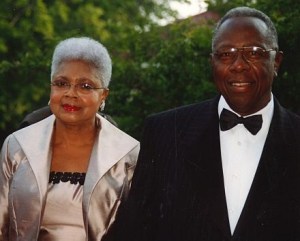
Henry and Billye Aaron, circa 2002.

Two young fans hit the field to run the bases with the new home run king; Aaron’s bodyguard sat in the stands with a hand on his pistol until he was sure the two young white men were there to love, not kill him. Aaron plunged across the plate into a crowd of teammates through which his parents managed to plow before his mother, Stella, hugged him to plant a big kiss on her son’s face.

“I don’t remember the noise,” Aaron said later. “Or the two kids that ran on the field. My teammates at home plate, I remember seeing them. I remember my mother out there and she hugging me. That’s what I’ll remember more than anything about that home run when I think back on it. I don’t know where she came from, but she was there.”

He’d retire two years later with 755 home runs and a truckload of further black ink on his resume. He remains baseball’s all time champion for total bases and runs batted in. He was a four-time single-season home run champion, he led his league in slugging four times, OPS three, and total bases eight. His Real Batting Average (RBA)—total bases + walks + intentional walks + sacrifice flies + hit by pitches, divided by total plate appearances—is .624. It’s also the second-best RBA among any Hall of Fame right fielder who played all or most of his career post-integration/post-World War II/night-ball. (Number one: Hall of Famer Stan Musial.)

Aaron wasn’t entirely wrong when he once wondered whether baseball truly appreciated who and what he was. He’d become the Show’s first African-American farm director but bristled quietly over how slow it was to embrace integrating front offices. Yet he was an annual Hall of Fame presence since his own election in 1992, and people of all races in and out of the game sought him out to pick his mind and savour his presence.

They often discovered Aaron belied his public image of composure with a fine, dry wit. “It took me seventeen years to get three thousand hits in baseball,” he once said. “I did it in one afternoon on the golf course.”

Whether squaring off against the best pitchers in the league yet giving his teammates the bigger credit for team conquests, or taking a COVID-19 vaccination shot, Aaron saw the bigger picture. “I feel wonderful,” he said as he took the needle on 5 January. “It makes you feel like you are doing something not only to help yourself, but to help your community.”

When his former Brewers boss Bud Selig became baseball’s commissioner, Selig’s mistakes may have been legion but it was no mistake that Selig went out of his way to celebrate Aaron. He created the Hank Aaron Award handed since 1999 to the best offensive player in each league—its birth was on the silver anniversary of Aaron passing Ruth.

Aaron re-married happily in 1973; he and his wife, Billye, a former television journalist, had the fourth of Aaron’s children. He enjoyed business success after his playing days, too, building a successful group of BMW dealerships in Georgia. When he played, he kept a book of Christian inspiration in his locker, Thomas a Kepmis’s The Imitation of Christ. Appropriate choice, that. Nobody could imitate either the saviour in whom Aaron believed devoutly or Aaron himself.

Lord, our grief on earth is too profound that a third Hall of Famer who defeated all who’d deflate him is brought home in just this year’s first month. But our comfort is that You have brought him home to be serene, happy, and swinging for the fences in the Elysian Fields, and that Your forgiven servant Ruth received him with a cold beer, a hearty embrace, and a garrulous “That’s the way to do it, kiddo.”

——————————————————-

A very few portions of this essay have been published previously.
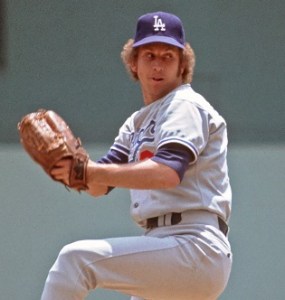
Don Sutton, RIP: Craftsman (har, har)

Don Sutton only looked like a surfer dude.

Last year’s sad parade of Hall of Famers going to the Elysian Fields waited at least until spring to begin. This year’s began with the year a mere seven days old and the nation battered by the Capitol riot a day earlier. Tommy Lasorda died of heart failure on 7 January; one of his pitchers, Hall of Famer Don Sutton, died of cancer Tuesday night.

Sutton got to the Hall of Fame by way of his unique durability. In 23 major league seasons he didn’t miss a starting assignment until his last season, 1988. He earned credit for 324 wins despite having a 20-win season only once (in 1976, winning 21). He led his league three times in strikeout-to-walk ratio and four in walks/hits per inning pitched but never led in strikeouts while leading his league in earned run average only once.

That’s despite spending his career in pitcher-friendly home ballparks. Sutton wasn’t too gapingly different on the road; enemy batters hit .247 against him on their home turf and .226 against him on his home turf, with a .606 OPS on his grounds and a .678 OPS on theirs. His forte was workman-like speed changing, smarts, and guile, heh heh heh.

As of this morning, Baseball-Reference lists Sutton as the number 73 starting pitcher of all time with the most-similar pitcher being fellow Hall of Famer Gaylord Perry. Most similar doesn’t exactly mean equal value, of course; Perry is slightly above the peak and career value averages for Hall of Fame pitchers and Sutton is somewhat below those averages.

All aboard for fun time? Like Perry, Sutton was suspected very frequently of, shall we say, extracurricular craftsmanship on the mound. Like Perry, Sutton knew how to ride the suspicions well enough, even if he wasn’t half as dedicated to psychological warfare as Perry was.

Both men had mischievous senses of humour about the suspicions versus the actualities. If Perry titled his memoir Me and the Spitter and went through a famous series of motions from head to torso when he wanted hitters just to think he was going to grease them, Sutton didn’t have any particular trademark suspect gestures.

Perry looked like the Carolinas peanut farmer he was in the off-season; Sutton, despite his Alabama sharecropping roots, resembled the classic California surf rat from his rookie season to his Hall of Fame induction speech. Perry preferred to live rent-free in a hitter’s head; Sutton preferred tweaking the powers that were.

Sutton took to leaving tiny notes in the fingers of his glove for umpires to discover when they or a protesting manager thought it wise to have him patted down and frisked on the mound. A classic: “You’re getting warmer. But it’s not here.”

After frequent enough accusations that “I ought to get a Black & Decker commercial out of it,” Sutton actually got just that. “The only fun I get now,” he once said to Thomas Boswell of the Washington Post, “is hiding dirty notes in my uniform pockets for the umpires to find them when they search me.”

“Sutton has set such a fine example of defiance,” longtime Orioles pitching coach Ray Miller told Boswell, “that some day I expect to see a pitcher walk out to the mound with a utility belt on—you know, file, chisel, screwdriver, glue. He’ll throw a ball to the plate with bolts attached to it.”

Nobody expected Sutton to sue longtime respected umpire Doug Harvey when the latter ejected him over a “defaced” ball in 1978. While pitching against the Cardinals and leading 2-1 in the seventh on 14 July, Harvey gave Sutton the ho-heave. “I’m not saying Sutton was defacing it,” Harvey told reporters. “I’m saying he was pitching a defaced baseball and the rules state that anyone pitching a defaced ball shall be ejected from the park.”

United Press said the “defacement” may have involved Sutton scratching a mark into the ball with his fingernail. “I have one thing to say and then no questions,” he told reporters. “On the advice of my attorney, I’m to say nothing about this. I’m filing suit against Doug Harvey, the National League and whoever runs the umpiring.”

Said Lasorda, who played the game under protest: “[Harvey] is judge and jury, and depriving Sutton of his right to pitch. It’s the first time I’ve ever seen that; it’s the first time he’s ever been ejected.”

“It was not the first confrontation over doctored balls between Harvey and Sutton,” UPI noted. “At other times in his twelve‐year career, the pitcher has been accused of scratching the ball with his fingernail to rough the surface for a better grip.”

Sutton’s lawsuit didn’t exactly set new legal precedent. It didn’t exactly get far enough to set one, let us say. Since the only verified implement he used was his fingernail, you certainly couldn’t accuse him of applying a foreign substance. (“I don’t use foreign substances,” one-time Yankee pitcher George Frazier snarked. “Everything I use is made in the U.S. of A.”)

But about a decade later, when Sutton was an Angel after some traveling from the Dodgers to the Astros, the Brewers, and the Athletics, he squared off in Anaheim Stadium against Tommy John, a former Dodger teammate then with the Yankees, and a pitcher Boswell described as able “to turn a tiny scratch into a double play grounder.”

Sutton during his years as a popular Braves broadcaster.

Yankee owner George Steinbrenner, watching from his Tampa home, decided Sutton was being a little too blatant about things, calling the Yankee dugout and manager Lou Piniella. Steinbrenner demanded Piniella have Sutton frisked, arrested, arraigned, bound over, tried, convicted, and executed on the spot. Piniella tried to reason with The Boss.

“George, do you know what the score is?” Piniella asked, according to Bill Madden and Moss Klein’s Damned Yankees, referring to the early 1-0 Yankee lead. “George, if I get the umpires to check Sutton, don’t you know that the Angels are going to check TJ? They’ll both get kicked out. Whatever they’re doing, TJ’s doing it better than Sutton. So let’s leave it alone for now.”

John was lifted after six and a third innings; Sutton pitched seven full. Each man surrendered a pair of earned runs, including Sutton surrendering a bomb to Hall of Famer Dave Winfield. After the 3-2 Yankee win, Madden and Klein recorded, a scout in the press box said, “Tommy John against Don Sutton. If anyone can find one smooth ball from that game, he ought to send it to Cooperstown.”

Sutton may have been puckish about his reputation for baseball carpentry but he often admitted candidly that he took baseball to be serious work perhaps too often. He was described often enough as a kind of blithe spirit but it seems to have been his way of protecting himself against the contradictions of the jock shop.

“[M]ost of us have similar abilities,” he once said, of fellow ballplayers and of people in general. “The differences are mental and emotional and the big thing is mental preparation. That’s where everything starts: the poise, the confidence, the concentration.” It didn’t hurt that Sutton’s rookie 1966 saw him the number four man behind a pair of Hall of Famers named Sandy Koufax and Don Drysdale and a stolid number three in Claude Osteen, either.

Raised a devout Christian, Sutton didn’t buy into Lasorda’s Big Dodger in the Sky routines or the manager’s celebrity style, probably because his first manager Walter Alston was the polar opposite and a man Sutton respected deeply for rejecting celebrity and respecting his players as men. Sutton often called Alston the most secure man he’d ever met in baseball and praised the manager for keeping problems and questions with his players behind closed doors.

Sometimes, Sutton discovered the hard way that a little honesty can get you into a nasty spat. When he was an Astro and admitted he hoped he could finish his career on the West Coast where his wife and children still lived, it provoked Astros general manager Al Rosen—who once ended his playing career early due to injuries and a desire to be more a family man—to spar with him in the press.

When still a Dodger in 1978, Sutton said candidly and somewhat benignly that similarly quiet outfielder Reggie Smith was the actual most valuable Dodger, praising the talented and silent Smith because he wasn’t “a facade or a Madison Avenue image.” Taken as the thinly-veiled poke at popular first baseman Steve Garvey that it was, it triggered a clubhouse argument turned brawl between Sutton and Garvey.

John once said that during the worst of the brawl, an unidentified Dodger hollered to break it up because they might kill each other—to which catcher Joe Ferguson replied, “Good.” The problem was that Sutton was actually right. Garvey’s OPS was .843 and his OPS+ for 1977-78 was 130. For the same two seasons, Smith’s OPS was .974 and his OPS+ was 165. Garvey also hit into 22 more double plays than Smith in that span, too. Garvey was worth 8.5 wins above replacement-level for those two seasons, but Smith was worth 10.6.

“I’ve tried over and over to figure out why this had to happen,” Sutton told reporters subsequently. “The only possible reason I can find is that my life isn’t being lived according to what I know, as a Christian, to be right.” That from the pitcher who once ruffled feathers, especially Lasorda’s, by saying unapologetically, “I believe in God, not the Big Dodger in the Sky.”

“It took a big man to say what Don said,” said Lasorda himself, who didn’t always see eye-to-eye with Sutton, “and it took God to inspire him to say it.”

Sutton’s post-pitching life was mostly as a popular Braves broadcaster, where their fans reveled as much in Sutton’s easygoing repartee as in the turnaround of the Braves from the gutter to greatness. (The Braves elected him to their team Hall of Fame in due course.) He was also an enthusiastic Hall of Fame presence following his own election in 1998.

As a rookie during the once-fabled Koufax-Drysdale joint contract holdout of spring 1966, Sutton took the long view in due course. “Baseball players today,” he told Koufax biographer Jane Leavy, “owe a lot to Curt Flood and Andy Messersmith and Dave McNally. But Flood, Messersmith, and McNally owed a lot to Koufax and Drysdale. Because they were the first guys who really took a stand. This was the first challenge to the structure of baseball.”

At the Hall of Fame Sutton let himself be plain human. In the same speech in which he thanked Koufax for teaching him how to act like a baseball professional, he began by saying, “I’ve wanted this for forty years. Why am I now shaking like a leaf?” Then, he answered his own question: “I think part of it is because I’m standing in front of some of the people who were the greatest artists in a wonderful business that I’ve ever seen before.”

The man who often called himself a journeyman hack appreciated the art of the game, and of his own craft, after all. May the Lord in whom his faith was profound enough have welcomed Sutton home with the same appreciation.

Phil Niekro, RIP: Great pitcher, better friend

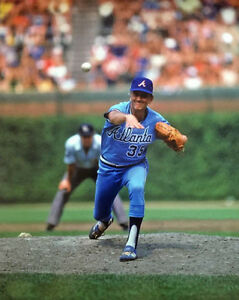
Hall of Famer Phil Niekro, pitching for the Braves in Wrigley Field.

When Lou Piniella first managed the Yankees in 1986, he was handed an order in spring training that he didn’t want to obey. Owner George Steinbrenner convened a meeting of Piniella and his coaches plus others in the Yankee high command to discuss final roster cuts.

The name Phil Niekro came up. The vote was 11-1 in favour of keeping Niekro, who’d electrified both the Yankees and Toronto Blue Jays fans when he landed his 300th career pitching win with a season-ending, 8-0, complete game shutout in October 1985. The only thing amiss was Niekro not landing it for the Braves with whom he’d been a fixture for two decades.

Then The Boss asked his son, Hank, “What do you say?” The younger Steinbrenner might as well have said, “Off with his head,” because his father said, “I agree. That makes the vote 12-11.” Rather conveniently handing himself ten votes. As he would in due course arguing with many an umpire, Piniella exploded.

“What are you even bothering to ask our opinion for? You know what you’re gonna do anyway.” Then Piniella made the long walk to the spring clubhouse, called Niekro in, and told him with the utmost reluctance that he was being released.

“Piniella’s anger over having to release Niekro was understandable,” wrote Bill Madden and Moss Klein in Damned Yankees, from whence the story of the execution springs. “There was no finer person to pass through the Yankees in the ’77-to-’89 period than ‘Father Time’.” (The writers covering the Yankees referred to Niekro that way, affectionately.)

The amiable Ohioan with the knuckleball that inspired some of baseball’s finest wisecracks, and the personality and presence that made you feel he was liable to invite you to a barbeque at any moment, lost a battle against cancer at 81 on Saturday night.

That makes it seven Hall of Famers going to the Elysian Fields this cursed year, including one hell of a pitching rotation if you think about it. Niekro, Whitey Ford, Bob Gibson, and Tom Seaver. How many pennants could you win if your rotation was Knucksie, the Chairman of the Board, Hoot, and The Franchise?

The seven set a record they’d surely rather not have set. Their deaths made 2020 a record year for Hall of Fame passings. If the Modern Era Committee elects the late Dick Allen when it meets in 2021, it’ll make for eight. (Allen died earlier this month.) Not nice.

I couldn’t resist looking it up and then imagining Allen giving Niekro a little good-natured grief upon their Elysian reunion. Allen faced Niekro 65 times, picked up nine hits including a double and a home run, walked nine times, but struck out fourteen times. Making the slash line .161/.277/.268.

“Trying to hit Phil Niekro,” Bobby Murcer once said, “is like trying to eat Jell-O with chopsticks.”  “It actually giggles at you as it goes by,” said another outfielder, Rick Monday, which may have been more appropriate considering Niekro’s birth on April Fool’s Day in 1939. Said longtime catcher Bob Boone, who only ever had to try hitting the Niekro knuckler, “There were times I needed a tennis racquet to hit him.”

Trying to catch Niekro’s signature pitch may have made trying to hit it child’s play. “Catching Niekro’s knuckleball was great,” cracked Bob Uecker, Niekro’s flaky Atlanta Braves catcher. “I got to meet a lot of important people. They all sat behind home plate.”

Dale Murphy started his major league career as a catcher before he moved to the outfield. As a rookie behind the plate he had the signature honour of catching what threatened to be a no-hitter by Niekro against the Big Red Machine, until Cesar Geronimo managed to float a shuttlecock into left in the ninth.

“We had one out in the ninth, and I mean, I was scared to death,” said Murphy to The Athletic’s David O’Brien. “I mean, I’m trying to keep that ball in front of me. I don’t know what I’m calling. He had said, ‘Just give me a knuckleball sign every pitch; I’ll shake you off if I don’t want to throw it.’ And we ended up with a no-hitter until one out in the ninth, and then Geronimo dunked one in, just flared one over [Jerry] Royster’s head at third base.”

Rarely at a loss, Niekro once remembered Uecker giving him sound counsel early in his Braves career. “Ueck told me if I was ever going to be a winner,” Knucksie once said, “to throw the knuckleball at all times and he would try to catch it. I led the league in ERA and he led the league in passed balls.” That would have been 1967, when Niekro led the entire Show with a Koufaxian 1.87 ERA and wasn’t even a topic in the National League’s Cy Young Award voting.

Throwing a pitch that places minimal strain at worst on the arm and shoulder, Niekro pitched major league baseball from Lyndon Johnson’s through Ronald Reagan’s presidencies, until he was 48 and the Braves—surely in tribute to the man as well as the pitcher—brought him back to let him suit up for one more start before he finally retired.

The un-straining knuckleball allowed Niekro to pitch 5,404 major league innings. The only pitchers who threw more were Hall of Famers Cy Young, Pud Galvin, and Walter Johnson. No pitcher since the dead ball era spent as much time as Niekro did on a major league mound. No knuckleballer struck out as many as Niekro’s 3,342.

Yet there was always the sense that, no matter how good and successful he was, no matter how he endured pitching long and well for teams that weren’t always as good as he was, Niekro was baseball’s Rodney Dangerfield, getting no respect, because he threw a pitch that was tough to master but still seen somehow as a gimmick. “Niekro wasn’t looking to master it,” says another Athletic writer, Joe Posnanski. “It was more like he and the knuckleball were friends.”

“I’ll tell you,” Niekro once told an interviewer, “I’ve been asked that question lots of times, you know, why does a knuckleball does what it does, and what makes it do it, and I have no idea.” It was also more like Niekro and baseball were kindred. The kid from Ohio whose coal-mining father taught the knuckleball to him and his late younger brother, Joe, really did seem as though you’d have to tear the uniform off him at last.

Phil Niekro chatting with Braves fans at a Hall of Fame event. (National Baseball Hall of Fame photo.)

“Warren Spahn will never get into the Hall of Fame,” Stan Musial once cracked. “He won’t stop pitching.” Spahn threw his last major league pitch four years younger and 160 innings short of Niekro’s final jacket.

As a 1964 rookie Niekro’s teammates included Spahn. When he got his wish to throw his last major league pitch as a Brave, his teammates included a rookie lefthander bound for Cooperstown likewise. Tom Glavine joked to O’Brien that he saw Niekro and thought for one moment he’d mixed up his own schedule and arrived at a fantasy camp.

Glavine was only kidding. “It was fun to watch. I mean, look, we all knew Knucksie and what he was and how much he loved being a Brave,” he told O’Brien.

That was a big deal for him to be able to end his career as a Brave. At the time I may not have understood it, but getting to know Knucksie as I did in the years after that, and certainly these last few years in the Hall of Fame, I understand why it was important to him. It was a neat thing to be able to watch him go out there and do that, and kind of have that closure.

Many players following the greats on their teams call them mentors. Niekro didn’t just make disciples, he made friends.

You were a great example for what athletes should aspire to be,” tweeted former Braves infielder Brian Jordan. “Phil had a huge heart to bring joy to others. He cared so much for kids and had a fantastic foundation. Continue to bring the joy in heaven my friend.”

[H]eartbroken!” tweeted incumbent Braves first baseman and National League Most Valuable Player Freddie Freeman. “An amazing pitcher but an even better man! Thank you Phil for all the laughs and wonderful memories over the years!”

“Phil was a man with a perpetual smile and always overflowing with jokes and nice things to say,” wrote pitcher Mike Soroka on his Instagram page. “I will miss seeing him around the stadium as well as getting calls from him after games.”

“[I]n a world where athletes, celebrity, however you want to deem it, there’s always going to be somebody that just doesn’t like you,” Glavine said. “And I never heard anybody say anything like that about Knucksie. And the people who were privileged to know him — I mean, really know him — understand why.”

Niekro’s affection for younger players didn’t stop with the Show. From 1994-1997 he managed the Colorado Silver Bullets, an exhibition team of young women baseball players who toured the United States playing against men’s amateur and semi-professional players. Niekro brought several former Showmen—including his knuckleballing brother Joe plus Al Bumbry, Johnny Grubb, and Joe Pignatano—to the coaching corps.

The Silver Bullets folded in 1997, after the Coors breweries ended their sponsorship of the team, but their skipper gave them their due when—with most of the Bullets present—he saluted them during his Hall of Fame induction speech.

Phil Niekro, not long after the Braves moved from Milwaukee to Atlanta. (Atlanta Braves photo.)

Niekro also served on the board of directors of Kiz Toys, a Georgia toymaker whom Niekro advised closely on the making and selling of its KizSport line of baseball toys and equipment. He also hosted an annual Ohio Valley golf tournament that raised funds for the high school for whom he pitched, Bridgeport High School. He lost only once as a high school pitcher—when a kid from Tiltonsville High named Bill Mazeroski hit one out.

Eons ago, Braves manager Brian Snitker caught a spring training bullpen session for Niekro. Snitker never got anywhere near the Show as a player but he made a lifelong friend in the genial knuckleballer. He told O’Brien Niekro’s least favourite topic of conversation was his health or himself.

“He’d never let on if anything was bad, that’s for sure,” Snitker said. “He’d always call, and I’d always tell the guys, the coaches and everybody, ‘Knucksie’s calling and just checking on everybody.’ I said there wasn’t a bigger Braves fan in the world than Phil Niekro . . . Knucksie, he was a big fan of them guys (the current players) and us and everybody. He was an awesome, awesome man. I’ve never seen a guy that sucked the life out of every day like that guy did.”

Niekro’s reputation for geniality even extended to fans. Stories abound of Niekro meeting fans at the ballpark, at various team events, and even away from the park, and talking to them as if they were his long-lost friends.

The coronavirus pandemic put the brakes on Niekro’s presence with the Braves this year, but it didn’t keep him isolated entirely. Snitker said Niekro would call him every few days to check in on him and the team. Previously, Niekro would bring his wife, Nancy, and their grandchildren to the Braves’ facilities where he’d also pitch batting practise. “If you needed help,” Snitker said, “all you’d have to do is call, and Knucksie would be there, loving it.”

Niekro thought himself a caretaker of a game that belonged to everyone beyond those who play and administer it. “This is America. America is baseball,” he said during his Hall induction speech, pointing to the Cooperstown crowd as the only player inducted in 1997. “This game is owned and it belongs to you. The fan. Cherish it and take care of it.”

Nancy Niekro was a young flight attendant when she first caught her husband’s eye, while he boarded his first flight as a member of the Braves organisation. Niekro told a teammate that so help him he’d marry her soon enough.

He did. They raised three sons together, and became grandparents twice. She, their sons, and their grandchildren lost something even more precious than baseball lost, when Niekro died in his sleep Saturday night. It was as gentle a passing as you could ask for a cancer-stricken man who made life a playground. Surely the Lord welcomed home not just a great pitcher but a better friend.

Go easy, Braves Republic

Dansby Swanson, unable to elude Superman in a single step. Swanson tried to correct a mistake on the spot and got tagged and bagged for his trouble.

No sport’s history is as thick and hydra-headed as baseball’s, and that includes its chapters on heart-crashing loss. Few sports fans are as addicted as baseball fans to the idea that the other guys can’t win so much as the teams to which they plight their troths can only choke.

It’s one thing to marry your rooting passion to teams that seem forever mired in mediocrity. It’s one thing to marry that passion to teams that struggled to make the journey, finally got their periodic pass to the October ball, and found the queen of the ball laughing in their faces when they asked her to dance.

But marrying your passion to teams who get to the top of Mount Nebo as regularly as the Atlanta Braves and the Los Angeles Dodgers and get kicked to the rocks below when they thought they’d cross to the Promised Land at last, just as regularly?

The Braves haven’t won the World Series since NASA lost contact with Pioneer 11. The Dodgers haven’t won it since the birth of Donald Trump’s fourth White House communications director (Hope Hicks). For a little perspective, the Milwaukee Brewers, the San Diego Padres, the Seattle Mariners, the Tampa Bay Rays, the Texas Rangers, and the Colorado Rockies have never yet reached the Promised Land.

The Braves have eighteen division titles since 1991, including that staggering (if you disallow the season disruption of the 1994 strike) fourteen straight, with five pennants and that one World Series win. The Dodgers have thirteen division titles since 1988, including the incumbent eight straight, with two pennants (back-to-back) and no World Series wins.

The demigods of the Elysian Fields being who they are, naturally the Braves and the Dodgers played for the pennant in this pandemically arrayed season almost straight out of Bizarro World.

Commissioner Rob Manfred’s pandemic-inspired short irregular season inspired his too-far-expanded postseason experiment that actually allowed two teams with irregular season losing records (the since-vanquished Brewers and the Houston Astros with identical 29-31 records) to enter in the first place. Perhaps with exemplary and extraterrestrial justice, the World Series will feature nobody whose butts weren’t parked in first place at irregular season’s end.

But I digress. Too many teams lose because someone does what he knows is wrong and nobody else has the presence or the authority to stop him. Too many more teams lose because someone doing the right thing has it blow up in his face courtesy of the unexpected countermove or glitch.

Too many fans, too, cling tighter if their teams’ histories feature too deep a canon of falling short when it was time to stand the tallest. It’s never the other guys who were just that much better, it’s their guys who can only and always dissemble. Even if they didn’t dissemble. Even if the parallel to the law that somebody has to lose is that everybody gets to play again tomorrow or next year.

Braves fans are starting the choke memes already, if they didn’t start them right after Dansby Swanson and Austin Riley ran them out of a possible game-out-of-reach rally in the top of the fourth inning in National League Championship Series Game Seven.

Well, maybe they waited until Mookie Betts fleeced Freddie Freeman with a staggering, solo home run-stealing catch that would have fattened a Braves lead back to two runs in the top of the fifth Sunday night. Maybe they waited until pinch hitter Enrique Hernandez tied the game at three with a leadoff solo home run in the bottom of the sixth.

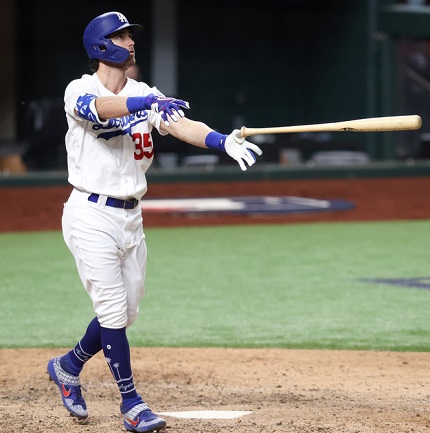
Maybe they waited until Cody Bellinger broke the tie with a solo bomb in the bottom of the seventh and Julio Urias finished what he started, three innings’ shutout relief.

Maybe.

Swanson didn’t cut his Braves off at their own pass by going rogue, exactly. He tried turning a mistake into a virtue and learned the hard way that the other guys administer justice but not mercy.

When Nick Markakis grounded one sharply to Justin Turner right of the third base line, Swanson probably should have stood fast forcing Turner to take the sure out at first keeping two runners in scoring position. But he ran on contact.

Swanson tried for the textbook play when Turner threw home right on the button, getting himself into the rundown starting maybe fifteen feet from the plate, the better to leave Austin Riley—whose RBI single busted the tie to set up first and second, which became second and third on a wild pitch—room to take third and keep at least one insurance run ninety feet from the plate with two on and one out for on-deck batter Cristian Pache.

What Swanson didn’t expect was Riley at second hesitating before breaking for third. Maybe Riley saw no chance to advance at first no matter how well Swanson handled things on the rundown track. When Riley broke for third at last, Turner tagged Swanson with a Superman-like dive and threw from his knees to shortstop (and eventual NLCS MVP) Corey Seager hustling to cover third just before the dive.

Riley dropped into his slide the split second Turner threw. He was D.O.A. It turned out that so were the Braves from there, but they still had five innings to atone. They didn’t bargain on the Dodgers’ relief pitching keeping them to one measly walk the rest of the night.

Neither did they bargain on the Dodgers’ Game Six starter Walker Buehler flicking away the bases loaded and nobody out in the second inning by striking out the next two batters before inducing an inning-ending ground out. Never mind Betts robbing Marcell Ozuna with that likewise back-to-the-wall-scaling, extra base hit-stealing catch in the fifth.

Neither did they bargain on their pitching staff that became a shutout machine in the earlier postseason rounds suddenly proving human, after all. Or, on the Dodgers shaking off manager Dave Roberts’ day-late/dollar-short lift of Clayton Kershaw with Game Four tied at one to win three straight elimination games for the pennant.

It would have been mad fun to see the Braves tangle with the Rays in the World Series. The Scrum of the Southeast. But there wouldn’t necessarily have been a guarantee for the Braves. Not against a team that got out-hit by both the Empire Emeritus and the Houston hulks and still found ways to beat them both. Not against a team that hit .171 with men in scoring position all postseason long—and still won the American League pennant.

But I have a personal message for Braves Republic. Go easy on the choke label. The cumulative differences between the Braves and the Dodgers are half a pencil thin. The Dodgers only out-hit the Braves by nine points and only out-pitched the Braves by 1.26 in the ERA column. Makes perfect sense when you remind yourselves as the broadcasters did too often: including the NLCS, the Dodgers scored exactly one more run than the Braves all year.

Timing often has the bigger hand, unfortunately. That and, as good as you are, the other guys proving to be just that little bit better. It’s not as though the Braves were taken down by a fluke team. They didn’t fall to the 1944 St. Louis Browns, the 1945 and 2006 Detroit Tigers, the 1959 Chicago White Sox, or even the 2002 Anaheim Angels. It’s also not as though the Dodgers had to beat a bunch of pushovers to win the National League pennant.

Think about this, too, Braves Republic. What you have now is a team with at least one potential future Hall of Famer on the assumption that a 30-year-old Freeman isn’t on the threshold of his decline phase, and a lot of good-to-great-looking youth on the mound, at the plate, in the field. You have a steady manager and a smart enough front office.

What those fourteen-straight Braves division winners had was as many as four Hall of Famers at once—three top-of-the-line pitchers (Tom Glavine, Greg Maddux, John Smoltz) and the arguable number five third baseman of all time (Chipper Jones)—and still had only one World Series ring to show for it.

Even as this year’s Braves go home from this season that will be remembered as Alfred Hitchcock Presents The Inner Sanctum of the Outer Limits of the Twilight Zone, well, Lucy, who got more splainin’ to do?

Ask not for whom the Bellinger tolls

You call that a bat flip??

If Cody Bellinger’s going to be the long distance October hero, he’s going to have to work on those bat flips. The billiards cue-like toss he offered up in the bottom of the seventh Sunday night would get him laughed out of the parlours of our Jose Bautistas and Willson Contrerases.

Hit what proves to be the pennant-winning home run in the bottom of the seventh? C’mon, bro, don’t hold back. Give us the real deal. Give us that flip that needs a meal and a stewardess on board. Show Contreras his upper deck-high flip was just a little ring toss by comparison. Trust us, Cody, it won’t hurt.

Especially not after Mookie Betts, who thought nothing of breaking into the happy dance after scaling back-turned up the right field wall to snatch a possible triple from Marcell Ozuna Saturday, forgot to bust a move or ten after he flat robbed Freddie Freeman of a home run with another running, back-scaling, up-the-wall catch in the fifth Sunday night.

It wouldn’t have hurt, annoyed, angered, or outraged anyone any deeper than the Atlanta Braves wounded themselves when they TOOTBLANned* their way out of a fourth-inning rally that might have put them beyond the Los Angeles Dodgers’ reach in National League Championship Series Game Seven.

Bellinger’s eighth-pitch drive into the right field seats off Atlanta reliever Chris Martin was at least as dramatic as the seventh-inning blast he launched in Game Seven of the 2018 NLCS. It won’t supplant Kirk Gibson’s legless Game One-winning launch in the 1988 World Series. Bellinger has an entire World Series to come to show he has that kind of drama in him.

Nobody would put it past him. Yet. He picked the perfect moment to shake off a season during which he waged war with his own plate mechanics and an NLCS during which it looked like he’d spend his entire time running into the same kind of hard outs that drove Houston’s Alex Bregman out of his gourd in the American League Championship Series.

Be very afraid, Tampa Bay Rays. These Dodgers have a few boppers to match your own Randy Arozarena. They hit a staggering sixteen home runs as a team in the entire NLCS. That’s as many as some teams hit in an entire month.

Bellinger was preceded by Enrique Hernandez, pinch hitting for Joc Pederson to lead off the bottom of the sixth, against A.J. Minter, the rookie Brave who opened so magnificently in Game Five (striking out seven of nine batters). Hernandez worked Minter to an eighth pitch and sent it over the left center field fence to tie Game Seven at six.

You Rays may also need all of your band of defensive aerialists, acrobats, high-wire walkers, and human cannonballs to counteract one all-in-one Betts. The Dodgers can slap and flap the leather with the best in the business, but they’re not exactly the Flying Wallendas or even the 1969 Mets. Except for the guy wearing number 50 patrolling right field.

Who will offer absolution to the left side of the Braves infield that got themselves caught on the wrong side of a two-for-the-price-of-one baserunning mishap that may have been Sunday night’s true game-turner?

If it comforts Dansby Swanson and Austin Riley any, their fraternal flop didn’t exactly put paid to this NLCS the way Babe Ruth’s beyond-insane, out-by-five-miles stolen base attempt ended the 1926 World Series in the St. Louis Cardinals’ favour. Close enough but not quite the coffin nailer enough will try to secure it.

Swanson and Riley are the guys you really feel for after the Dodgers’ nerve-exposing 4-3 win. They picked the absolute wrong night to become two Lonnie Smiths for the price of one. No, I rescind that, right here and now.

In that 1991 World Series, inside the Richter-scale-busting racket of the old, gone, distinctly unlamented Metrodome, Smith got fooled just long enough by Minnesota Twins keystone Chuck Knoblauch and Greg Gagne, catching Smith’s sight running from first and performing a pantomime double play . . . when Terry Pendleton ripped a rocket into the left center field gap that should have sent Smith home with a scoreless tie-breaking Game Seven run.

Corey Seager pronounces Austin Riley and the Braves’ fourth-inning rally DOA.

Unfortunately for Swanson, Riley, and the Braves, the Dodgers weren’t trying any trickery Sunday night. They were down 3-2 in the fourth and trying merely to hang in and find a way to revive and prosper. They weren’t even expecting Swanson and Riley to be on second and third in the first place.

They got there because Dodger reliever Blake Treinen—in to clean up a small mess left behind by Tony Gonsolin that resulted in the third Braves run—wild pitched them from their original first and second stations. And they’d gotten those courtesy of Gonsolin serving Ozzie Albies an RBI single.

Now Treinen got Braves left fielder Nick Markakis to ground one to Dodger third baseman Justin Turner playing well enough down the line. Turner fired home and caught Swanson dead about six feet from the plate. Catcher Will Smith threw back to Turner, who took a flying leap like Superman taking off in flight to tag Swanson—with Riley, perhaps insanely, trying for third anyway after initial hesitation.

The problem was Dodger shortstop Corey Seager backing up the Swanson rundown. Trying to take the base under guard that heavy might get you points for chutzpah but DOA otherwise. As Riley was when he got tagged and bagged. As the Braves were from that point forward.

“It was huge,” lamented Braves manager Brian Snitker post-game. “It’s hard to score runs in the postseason. The infield’s back so you see the ball up the middle. That’s where normally we’re a really good baserunning team. We just did the fundamental things wrong.”

How can you say the Braves died with a 3-2 lead? Center fielder Cristian Pache grounded out to shortstop to finish killing that fourth-inning rally. Then Dodger relievers Treinen in the fifth, Brusdar Graterol in the sixth, and Julio Urias in the seventh through ninth kept the Braves to one lonely baserunner (a sixth-inning walk to Albies) the rest of the game.

The Braves will too often note and too long remember that they slapped an early 3-0 lead out of Dodgers opener Dustin May and then Gonsolin. They’ll remember May walking Ronald Acuna, Jr. and Freeman on eight consecutive pitches and Marcell Ozuna singling Acuna home in the top of the first. They’ll remember Swanson greeting Gonsolin rudely by hitting a 1-1 pitch over the left field fence leading off the second.

But they’ll also remember the Dodgers solving starter Ian Anderson’s changeup early enough to lay off it and start hitting some hard balls around, just biding their time until they could pry through. They’ll remember Smith hitting Anderson’s inside curve ball for a two-run single in the third. They’ll never forget Hernandez and Bellinger ringing the bells.

“It’s just the mentality we have,” Seager said postgame. “Show up that day, win that day. This team does a very good job being in the moment. You gotta stay in that moment, be in the moment and let the chips fall where they may. Right now, they’re falling our way.”

Entering Game Seven the Braves scored one less run all irregular year long than the Dodgers scored. Exiting Game Seven and the postseason they still ended up scoring one less run overall—but six less in the NLCS. They may remember trading Game Three and Four blowouts and reaping the sweet fruits of Bryse Wilson shaking off an irregular season’s 4.02 ERA to pitch like a Hall of Famer starting Game Four.

They may also remember they’ve been pushed out of postseasons with far heavier blows than they took Sunday night. But they might also want to remember that they shook off that nasty 13-1 blowout by the Cardinals in last year’s division series to take a second consecutive possession of first place in the National League East, no matter how bizarrely truncated 2020 was.

The Braves will be back. Count on it. They may even have forged the beginnings of a beautiful postseason rivalry with the ogres from the National League West. It’ll just have to keep until next season. Sure it would have been lovely to see the Braves tangle with the Rays in the World Series. Southeast rising.

But won’t it be a little more fun to think that the Tampa Bay Davids might have a shot at taking down the Los Angeles Goliaths? With or without these Dodgers’ recent snakebitten history, that ought to be fun, fun, fun—until or unless Daddy takes the slingshot away.

——————————————————————————

* TOOTBLAN—Thrown out on the bases like a nincompoop. Invented originally for former Chicago Cubs infielder Ryan Theriot, whose baserunning skills were described politely as less than average.