Dark are baseball’s video rooms

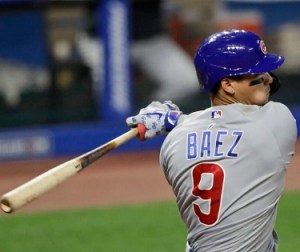
Javier Baez wants his and other players’ in-game television back.

The following program is not brought to you in living colour, on NBC or elsewhere around the Show. Javier Baez, Chicago Cubs shortstop, is not amused.

Baez is having less than an exemplary season at the plate as it is without being frustrated because a valuable tool he and most players use during games is denied them this year.

They can’t duck into the video room during games this season to review their prior plate appearances or pitching turns during games, spot mistakes, and adjust accordingly when they check in at the plate or on the mound next.

“To be honest, it sucks because I make my adjustments during the game,” Baez told ESPN writer Jesse Rogers Monday, and that was after he picked up three hits while his Cubs beat the St. Louis Cardinals, 5-1. “I watch my swing. I watch where the ball went, where the contact was. I’m mad. I’m really mad about that we don’t have it.”

Baez thinks, not without reason, that it simply wasn’t right for baseball’s government to put the entire Show on video restriction simply because of the malfeasance of two known teams at least. Think of Mom and Dad grounding all the kids because one broke into the liquor cabinet while the others were nowhere within two miles of the scene of the crime.

As Rogers writes, “In-game video was taken away this season in the wake of the Houston Astros sign-stealing scandal.” But the culprit wasn’t Astrogate alone.

Bad enough: the Astros either adjusted an existing camera illegally or installed another one just as illegally to enable off-field-based sign stealing. Nowhere near as bad, though enough Astro fans think otherwise, of course: the Boston Red Sox didn’t adjust or install cameras, but they did develop off-field-based sign-stealing reconnaissance by way of their existing video room.

Video rooms are in all ballparks behind both dugouts. The Rogue Sox Replay Room Reconnaissance Ring involved someone deciphering pitch signs on existing screens, then signaling a baserunner to send the sign to the hitter. The Rogue Sox exercised a sophisticated if sneaky variation of old-fashioned gamesmanship, but doing it by way of the video room was a major no-no.

Unlike the Astros’ extracurricular installations or adjustments, whichever they were, MLB itself installing the video rooms handed the Red Sox and every other team surrendering to similar temptations the keys to the liquor cabinet expecting they’d be good little boys and not even think about drinking unlawfully.

“[P]rotocols put in place during the coronavirus pandemic all but assured that there would be no way to monitor usage properly,” Rogers writes. “Now players can’t watch their at-bats until after games.”

The old-school old farts would remind you, of course, that once upon a time, in the dark days before technology advanced at warp speed to destroy Life As We Knew It When the Going Was Good, coaches and managers observed batters and pitchers and suggested adjustments accordingly, if not necessarily astutely, all by their own selves. With no subversive help from God or those subversive technocrats from General Electric, RCA, Bell & Howell, IBM, Wollensak, or others.

(Oops. Wollensak’s and other hand-held spyglasses and telescopes ended up in the hands of such off-field sign-stealing cheaters as the 1940 Detroit Tigers, the 1948 Cleveland Indians, and—especially—the 1951 New York Giants, to name a few.)

What brass balls on early 1950s Brooklyn Dodgers manager Charley Dressen, then. Dressen once helped Gil Hodges break out of a ferocious batting slump by commissioning a filmmaker to shoot hours of footage of the beleaguered first baseman at the plate. Then, he showed Hodges on extensive film the backward mis-step he’d take in the box—his back foot pulling himself and his swing off line—and gave a successful suggestion on how to keep that step from hurting his swing. Career saved.

The nerve of such people as the now-late Lou Brock. In the mid-1960s, he first took up the practise of filming enemy pitchers to study everything he could about their mound  tendencies and how he might exploit them for more efficient basepath crime. (I don’t want to be in your goddam movies, Brock!—Hall of Fame pitcher Don Drysdale.) From Kodak to Cooperstown.

The gall of such people as the late Hall of Famer Tony Gwynn. In the early-to-mid 1980s, Gwynn started carrying a video recorder and player around with him, at home and on the road, while his wife shot and captured his plate appearances so he could study them as a rabbinical scholar studies the Talmud, during and after games alike, and correct any mistakes or flaws he happened to catch.

Today’s baseball player can normally survive a tough plate appearance or turn on the mound, duck into the video room at next opportunity, and observe and adjust on the fly. Or, have a successful turn, then study and retain what he did right. Argue against such legitimate helpmates? You might as well argue the American family never had it so good as when they had to beat the dust and dirt of the rugs and slipcovers hanging on clotheslines, instead of reaching for the Electrolux.

This is not to suggest that a batter or a pitcher has lost the capability to think hard enough on their own and figure necessary adjustments. Minds greater than baseball minds rarely say no to all the sound help they can get from all the sound sources they can find, technological or otherwise.

Try to convince yourself that even such a Hall of Famer as Ted Williams would have said no to seeing some film of himself at the plate and catching the occasional kink or further refining the betters. When he met and befriended Gwynn late in life, Teddy Ballgame surely approved of Captain Video’s private television production operation on behalf of (the horror) improving himself at the plate.

Set to one side the temptations that manifest because boys will be boys, in Houston, Boston, and anywhere else, and video lacks what even the best managers and coaches have no matter how well they train themselves or get themselves trained otherwise. Video doesn’t lie, or at least surrender to coaches’ biases based on how they swung or pitched back in their Good Old Days.

(How many coaches ruined how many players by trying to bend them to their own former playing ways or toward presumed styles? Possible racial considerations to one side, the Cubs traded Lou Brock after they couldn’t make him into the pure slugger he really wasn’t. The Mets once thought their phenom pitcher Dwight Gooden needed to stop trying to miss bats and add off-speed pitches he couldn’t throw comfortably though their pitching coach Mel Stottlemyre once did. Hall of Fame talent ruined: Gooden’s confidence and in due course his shoulder and his career were compromised.)

After the Astrogate/Soxgate kerfuffles, baseball’s government decided the video room’s future would include specially hired and trained security the better to keep the game’s grand theft felons from even thinking about future replay room reconnaissance cheating. Baez doesn’t exactly object to the idea. He just didn’t think the future wouldn’t be right now.

“We didn’t cheat. We’re not cheating, and we got to pay for all this,” he told Rogers. “It’s tough . . . but a lot of players are struggling, too. A lot of stars are struggling, and I’m just one more. The way that it is is not the way we play baseball. And I need video to make adjustments and during the game. It doesn’t matter who is there to watch us. It doesn’t matter if we have all the police the MLB wants to send over here.”

In this pandemically truncated season played in conditions unheard of in previous seasons, many players aren’t struggling but many players are. The reasons are varied widely. And it isn’t as though Baez is crying out from the subterranean depths. His Cubs at this writing have the best record in the National League Central and the fourth-best in the entire league. Somehow.

Once upon a time, in 1980, the hits on the music charts included a ditty called, “Video Killed the Radio Star.” The lack of video in this Quiet, Please! Geniuses Playing with Mental Blocks season isn’t going to kill the baseball star. (Shane Bieber, Jacob deGrom, Yu Darvish, Zack Greinke, Clayton Kershaw, Juan Soto, Fernando Tatis, Jr., and Mike Trout, call your offices.)

But it’s not making their serious work of play simple, either.

“It’s never going to be good enough”

“They’re continuously advocating for this head-hunting season of the Astros.”–Lance McCullers, Jr.

At this writing, this season’s Houston Astros have been hit by pitches twelve times for fourth among American League teams. The on-field administration of that Astrogate justice denied by the commissioner produces a disturbing sidebar. Quick: Name the Astro who’s been hit by the most pitches since the pandemic-truncated season began.

The answer is Abraham Toro, reserve third baseman/designated hitter. He’s the only Astro to be hit by pitches three times thus far, and he wasn’t even a member of the 2017-18 Astrogate teams. His reasonable responses to such embryonic team plunk leadership might include thoughts of first-degree manslaughter.

Toro’s position is much like that of a bright young financial whiz, freshly graduated from a prestigious university, freshly hired by a brokerage firm that faced sanctions, fines, imprisonments, and in-the-toilet public relations a year before bringing him into their tattered ranks, and who now feels the stings and fastballs of guilt by association.

This year’s Astros include nine from the 2017-18 teams: their entire starting infield—Jose Altuve, Alex Bregman, Carlos Correa, Yuli Gurriel; two outfielders—Josh Reddick, George Springer; and, three pitchers—Chris Devenski, Lance McCullers, Jr., Justin Verlander. Gurriel and Springer have been hit by pitches twice this year; Altuve, Bregman, and Correa, once each. Reddick as of this writing has escaped thus far.

Toro is one of two non-2017-18 Astros to take one for the team with which they had nothing to do in the first place. Last year’s American League Rookie of the Year, Yordan Alvarez, possibly out for the season with a knee injury, got it once before his injury.

Exactly why Toro and Alverez should be taking balls to their ribs or other assorted anatomy is anyone’s guess aside from opponents believing that, if you wear an Astro uniform, the deets don’t matter, you’re fair game. That’s as patently unfair as would be a prosecutor taking one look at the aforementioned, hypothetical new brokerage recruit and filing an arrest warrant because, well, “That’s for even thinking about joining that cesspool house.”

You got why it seemed about seven-eighths if not more of the rest of the Show’s players wanted to administer the justice commissioner Rob Manfred didn’t in handing 2017-18 Astro players immunity in return for their spilling about the Astro Intelligence Agency. And you get why pitcher McCullers, one of the more thoughtful Astros, is just a little bit fed up with that desire.

McCullers thinks “they” continue advocating for the Astros to suffer the brushbacks, knockdowns, and beanballs over Astrogate’s perfidy. “They,” of course, are that majority of non-Astros players and enough press and fans who think the Astros’ players got away with murder over their 2017-18 illegal electronic sign-stealing operation. And “they,” of course, are wrong, as McCullers sees it.

“[S]peaking to players was probably the least part of [MLB’s] whole investigation,” McCullers told The Athletic‘s Jayson Stark and Doug Glanville (himself a former major league player) on the Starkville podcast.

I can’t go into it because I don’t know how much I am or am not allowed to say. But I’ll say that … the notion that, oh, players negotiated immunity, players then were interviewed and rolled on everyone just to save themself, isn’t the case. And that’s as much as I can say. That’s not what happened. That’s not how this went down. So if that’s what people are upset about, then I guess we can all move on because that’s not how it happened.

Manfred also suspended now-former general manager Jeff Luhnow, now-former manager A.J. Hinch, and now-former bench coach Alex Cora for the whole of 2020. Cora–who went on to manage the 2018 Boston Red Sox to a World Series title a year after the Astros’ now-tainted title—subsequently lost that job for his Astrogate involvement, too.

Manfred didn’t suspend the Astros’ 2017 designated hitter, Carlos Beltran, considered a key Astrogate operative himself, but his role cost him his freshly-minted job managing the New York Mets—before he had the chance to manage even a spring training exhibition game.

“And it’s never going to be good enough,” McCullers told Stark and Glanville. “The whole franchise could be dismantled, and it wouldn’t be good enough.”

Toro taking three plunks and Alvarez taking one gives a shard of credence to McCullers’s remark. There were observers and analysts, yours truly among them, who said early during the unfurling of the Astrogate revelations that it might indeed require a complete turnover of even the current roster before the stain dissipates from the franchise.

The 2020 Red Sox have enough trouble of their own on the field as it is. They’re collapsing like a rickety folding chair after losing their franchise face Mookie Betts in a lopsided, money-nourished trade to the Los Angeles Dodgers. But they’ve been scored by Manfred over their Replay Room Reconnaissance Ring of sign-stealing. And this year’s Red Sox have had nine players hit by pitches and ten such hits total, seventh in the American League.

At least four of the replay reconnaissance ring team members have been drilled thus far: Mitch Moreland, Rafael Devers, Kevin Pillar, and J.D. Martinez. But nobody huffed, puffed, or threatened to blow the house down over the Red Sox. If that bewilders McCullers, the Astros as a whole, and the Astros’ and Red Sox’s fan bases that continue coming to terms with their world champion cheaters, it’s both understandable and unfathomable.

The reasons may be simple. Cora was cashiered when Manfred’s Astrogate report came forth, well before the commissioner finished and released his Red Sox reconnaissance findings. Accurately or incompletely, the Red Sox looked far more decisive doing so, and there remained the prospect that Cora got his not just because of Astrogate but because the Red Sox brass suspected he had at least a fingertip on the reconnaissance ring.

More to the point, the Rogue Sox simply used what was handed to them and every major league team at home and on the road. They didn’t have to alter an incumbent camera’s mandatory eight-second delay or install a separate real-time camera. All they had to do, and did, was read the replay room monitors and signal their baserunners who’d send the pilfered intelligence to their hitters.

Neither the AIA nor the Rogue Sox Replay Room Reconnaissance Team had anything to do with their pitchers, whether McCullers in Houston or Joe Kelly, now with the Dodgers, who dropped Bregman and Correa on 28 July but was a Red Sox pitcher in 2017-18.

The whatabout argument doesn’t pass muster, either. Just because others did it, and we don’t really know yet whom and when in recent seasons (other than the New York Yankees, perhaps), it doesn’t mean the Asterisks or the Rogue Sox do or should get off the hook.

Just when you thought McCullers earned your stubborn admiration for trying to defend his team, however edgily, he had to spoil it. Alluding to Kelly’s recent podcast dismissing the Astro players accepting immunity to spill as “snitches,” McCullers huffed, “By the way, there was only one snitch. And that’s the person who spoke to The Athletic.”

So Astrogate is still all Mike Fiers’s fault. Never mind that he and others (including the Oakland Athletics administration) couldn’t persuade the Show’s government or reporters to convince their editors to investigate or publish, until Fiers finally blew the Astrogate whistle last November. Never the cheaters’ fault, always the whistleblower’s

Well, to this day there may well remain people who think New York’s police corruption scandal of the early 1970s was all the fault of the two clean cops, Frank Serpico and David Durk, who took it to The New York Times after they couldn’t persuade their own department to clean up and wise up, too. Never the crooked cops’ fault, always the whistleblowers’.

What was a terrible look for New York’s Finest then is still a terrible look for the Astros now. McCullers may want to ponder that further and deeper while he laments with some justification how little seems good enough to sate Astrogate critics.

But Kelly at least sent his messages to a pair of actual Astrogaters. Holding Toro, Alvarez, and any other Astro answerable for baseball crimes they didn’t commit and weren’t there to commit is a terrible look, too.

“They [screwed] it up twice”

2020-08-14 AJHinchAlexCors

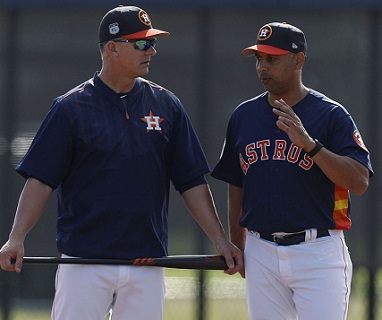
Former Houston Astros manager A.J. Hinch and bench coach Alex Cora. Los Angeles Dodgers relief pitcher Joe Kelly fumes that Astro players tainted Hinch’s and Cora’s names to save their own.

With everything else buffeting major league baseball before delayed “summer camp” and the truncated season, it was easy enough to miss. But Alex Cora—considered an Astro Intelligence Agency co-mastermind and unproven shepherd of the Red Sox Replay Room Reconnaissance Ring—spoke out in June.

And Los Angeles Dodgers pitcher Joe Kelly, one of Cora’s Red Sox charges during their run to the World Series title in 2018, spoke up likewise in a podcast by Dodger teammate Ross Stripling days before his suspension—for throwing at Alex Bregman and Carlos Correa, the latter drawing Astros and Dodgers alike out of dugouts in social-distance violation—was cut from eight to five games.

Between them comes an alteration of the former Astrogate narrative, and it’s not likely to mitigate the AIA stain on the 2017 world champions. If anything, it’s liable to make the stain deeper. Upon the 2017-18 Astros’ players and upon commissioner Rob Manfred, who handed those players blanket immunity in return for spilling about the AIA’s off-field-based, electronic pitch sign espionage.

“The people who took the fall for what happened is nonsense. Yes, everyone is involved,” said Kelly aboard Stripling’s podcast.

But the way [the AIA] was run over there was not from coaching staff . . . They’re not the head boss in charge of that thing. It’s the players. So now the players get the immunity, and all they do is go snitch like a little bitch, and they don’t have to get fined, they don’t have to lose games.

Kelly’s remarks hark among others to Cora telling ESPN writer Marly Rivera in early June that he didn’t object to shouldering his own responsibility for the 2017 Astros’ chicaneries, having been their bench coach before becoming the Red Sox’s manager, but also wanting one and all to know that neither himself nor 2017 Astros designated hitter Carlos Beltran were the sole drivers.

When Manfred dropped his Astrogate hammer earlier this year, he fined owner Jim Crane the maximum-allowable $5 million, virtual tip money. He suspended general manager Jeff Luhnow and manager A.J. Hinch for all 2020. Crane fired the pair almost at once.

Then the Red Sox more or less forced Cora out as their manager before the Rogue Sox sign-stealing report emerged. And the New York Mets more or less forced Beltran out as their newly-hired manager—before Beltran got to manage even a single exhibition game for the team he once starred for as an outfielder.

“When you take someone’s livelihood . . . to save your own ass, that’s what I don’t like,” Kelly continued.

Cheating? They cheated. Everyone knows they’re cheaters. They know they’re cheaters. It’s over. That’s done with. But now they mess it up by ruining other people’s lives, so they [screwed] it up twice . . . When you taint someone’s name to save your own name, this is one of the worst things that you could probably do . . . That really friggin’ bugs me. I think I’ll be irritated forever.

In other words, the Astros players accepting Manfred’s immunity to throw Cora, Beltran, and even Hinch and Luhnow under the proverbial bus isn’t even close to being Mike Fiers—frustrated that attempts by himself and others in the know to get reporters to push for exposing the AIA previously—finally blowing the Astrogate whistle to The Athletic‘s Ken Rosenthal and Evan Drellich last November.

Kelly may have missed Cora telling Rivera it wasn’t only players who might have made himself and/or Beltran sacrificial lambs. “There has been a narrative out there of what happened,” Cora said.

Ever since mid-November until the commissioner announced the results of the Red Sox investigation, I have read many things that are true and many others that are not.Out of this whole process, if there is one thing that I completely reject and disagree with is people within the Astros organization singling me out, particularly Jeff Luhnow, as if I were the sole mastermind. The commissioner’s report sort of explained, in its own way, what happened. But the [Astros players] have spoken up and refuted any allegations that I was solely responsible.

If there is one thing I am absolutely sure of, it is that it was not a two-man show. We all did it. And let me be very clear that I am not denying my responsibility, because we were all responsible.

Manfred’s subsequent report on the Rogue Sox determined—after the commissioner handed 2018-19 players the same immunity to spill as he handed the Astros—that their replay-room sign-stealing scheme was actually executed without Cora’s direct knowledge of the operation.

Remember: The AIA involved either installing an illegal real-time camera or altering an existing camera off mandated eight-second transmission delays to send opposition pitch signs to a clubhouse monitor, where someone deciphered them and signaled them to hitters by way of banging a can slowly next to that monitor.

The Rogue Sox didn’t go that far. They married old-fashioned on-field sign-stealing gamesmanship to new-fashioned technology all but gift-wrapped for them. MLB itself handed them and anyone else so inclined the keys to the kingdom when it installed multiple-monitor replay rooms in both clubhouses in all ballparks.

Someone deciphered opposition signs on one of those monitors and transmitted them to a Red Sox baserunner who’d send it on to a batter. The key is that the Red Sox needed a man on base to execute the reconnaissance operation in the first place. They couldn’t and didn’t have stolen signs for every man in the lineup.

The AIA didn’t need baserunners to do its dirty work, though it could only operate in Minute Maid Park. Which made the scheme even more bizarre, never mind unnecessary, since the 2017-18 Astros actually won sixteen more games total on the road than at home.

Cora, remember, once made himself a Dodgers folk hero thanks to an epic eighteen-pitch plate appearance against Chicago Cubs pitcher Matt Clement that ended in a two-run homer into Dodger Stadium’s right field bullpen. Now he’s a pariah for being the bench coach of the ’17 Astros and the manager of the ’18 Red Sox, both of whom beat the Dodgers in back-to-back World Series.

Unlike those Astros who met the press as spring training opened (pre-coronavirus shutdown) and sounded as unapologetic as men offering apologies can sound, outraging about seven-eighths of MLB players, Cora did apologise for both the AIA and the Rogue Sox. “I understand why people think that our championship is not valid, and it’s our fault that they think that,” he told Rivera.

I am being honest and I apologize for what happened and for the mistakes we made as a group. I understand why people are disappointed. I am disappointed in myself. At the time, one doesn’t think about the consequences. It was something that kept growing and growing, and in the end, it was wrong. We made a mistake and I must pay for the consequences of my actions.

Kelly pondered aloud whether those Astros who spilled to Manfred called Beltran, Cora, Hinch, and even Luhnow—whose administration was controversial enough before Astrogate’s exposure, and whose departure may have been mourned the least—“and said, ‘Hey, I’m sorry’ . . . If they had said, ‘Hey, I’m super scared, I didn’t know what to do, I didn’t want to lose money, I had to rat’ . . . Grow a pair of balls and say that.”

Would that make any difference to Beltran, Cora, and Hinch now?

Beltran lost a job he’d barely begun to do but one for which he seemed qualified enough. Cora lost a job in which he’d become only the fifth rookie manager ever to win a World Series, after Bucky Harris (the 1924 Washington Senators), Eddie Dyer (the 1946 St. Louis Cardinals), Ralph Houk (the 1961 New York Yankees), and Bob Brenly (the 2001 Arizona Diamondbacks).

The hapless Hinch, who’d shown himself mostly as an ideal managerial marriage between smarts and sensitivity, was exposed as powerless to stop his charges from plunging deeper into baseball crime or to stop his superiors from fostering such an atmosphere in the first place.

Before you return to the false narrative of Kelly’s “hypocrisy” for scoring the Astros while being a member of the Rogue Sox, remind yourself: Red Sox pitchers catching on to baserunning teammates sending stolen enemy signs to hitters probably thought the runners got the signs the old fashioned way, catching on to and exploiting an enemy catcher’s inadvertent tells.

The Red Sox fell to the ’17 Astros in a division series but beat the Astros in five—abetted especially by Andrew Benintendi’s Game Four-ending, three-run-saving, series tie-thwarting catch in left field—in the ’18 American League Championship Series.

Six Astros regulars on the 2017-18 team remain with them today. How long before the AIA stain dissipates is anyone’s guess, never mind that there were those from the scandal’s birth who suggested the stain wouldn’t leave the Astros until all the 2017-18 players had either moved on or ended their career.

There’s little enough comfort for Astro and Red Sox fans still coming to terms with having rooted for two great teams who, obviously enough, lost enough faith in their own greatness. There’s also the distinct possibility that the bad blood between the Astros and the Dodgers won’t dissipate too soon, either. They meet again in Dodger Stadium in September.

“Just to say, ‘Oh, it’s done, it’s over with, move on,’ I don’t think is a reality for anyone,” Dodger third baseman Justin Turner told a Fox Sports pre-game show. “I think around the league, there are a lot of guys upset, who kind of feel like the punishment didn’t really fit the crime. I don’t know if that’ll ever go away for me.”

Millions of fans and an awful lot of players don’t know, either.

Five for Kelly, not eight, but . . .

Syndication: Phoenix

Joe Kelly’s suspension is now five, not eight games. Some say that’s still too excessive.

The good news, such as it is, is that Los Angeles Dodgers pitcher Joe Kelly’s suspension for throwing at Houston Astros Alex Bregman and Carlos Correa, triggering a bench-clearing, safety protocols-defying debate, was reduced from eight to five games. Enough might say that’s still too much.

The bad news is that there remain enough, aboard social media especially, to whom Kelly didn’t go far enough in administering Astrogate justice. Much like rioters and looters turning peaceful if grief-stricken demonstrations into war zones, they would cross the line between demanding justice for the guilty and destroying the innocent.

Asstros [the poster’s spelling] need to be assaulted, often and viciously,” said one such social media poster, perhaps too typically, not specifically about Kelly but about the protocol-defying near-dugout scrum into which Astros coach Alex Cintron goaded Oakland outfielder Ramon Laureano last Sunday afternoon.

“Bean balls, mound charging, spiking, spitting, fighting, punches, headlocks, punches to the face hard and often,” the poster continued. “Umpires should call every pitch against them a strike.” And then we should get really mad?

Such outrage is far more comprehensible than the same poster going forward from there to say violence has deeply therepeutic benefits. For whom? For those whose rage over the lack of Astrogate discipline against the cheating players simply will not be satisfied by one pitcher throwing beanballs?

Or, by one Athletics outfielder fuming over being hit by Astro pitches thrice in one weekend and twice that Sunday while, coincidentally, not one Astro batter saw so much as a brushback all weekend?

Social media hounds such as that demand retribution above and beyond the bounds of the game policing itself, no matter how wanting commissioner Rob Manfred proved to be when he handed Astro players from 2017-18 blanket amnesty in return for spilling about the Astro Intelligence Agency’s illicit electronic sign-stealing operation.

And, no matter how wanting fans and about seven-eighths of major league players found both that amnesty and the Astros’ subsequent unapologetic apologies as spring training opened.

Kelly himself suggested distinctions for which right reason demands acknowledgement as well. That otherwise fine 28 July saw him send a pair of fastballs upside and behind Bregman’s head and—a few batters later, before striking Correa out for the side—a pair of breaking balls making Correa dance in the batter’s box.

Bregman and Correa are two of only six 2017-18 Astros regulars remaining in those positions on this year’s edition. Kelly made a point of send the messages strictly via them when the opportunity arose.

Doing it to that pair made things obvious enough, since no pitcher customarily would think of decking a Bregman on a 3-0 count with one out. Nor would he think normally of putting runners at second and third as happened when one of Kelly’s dusters to Correa sailed past to be ruled a wild pitch officially.

Kelly probably didn’t have to be reminded that justice demands a line between the guilty held to account and those having nothing to do with the crimes in question left unscathed. If he’d elected to deck, say, Michael Brantley, who didn’t become an Astro until 2019, and was the only non-2017-18 Astro he faced in the inning, he would have crossed that line and maybe earned not one degree of the acclaim he received.

When Kelly struck Correa out, Correa and Kelly jawed a little as Kelly strode from the mound and approached the third base line returning to his dugout. Kelly then sent mock crybaby gestures including a pronounced pout to Correa. From there the dugouts emptied, health and safety protocols be damned. Not too bright on either side’s account.

But it combined with the Bregman knockdowns and Correa dustings to make Kelly a folk hero in Los Angeles, where they’d still like to send the Astros to the guillotine over the 2017 World Series the Dodgers lost to the Astros and, quite possibly, to the AIA as well.

In other places, considering Kelly’s membership on the 2017-18 Boston Red Sox (vanquished by the Astros in the ’17 division series, vanquishers of the ’18 Astros en route their own World Series triumph against the same Dodgers), Kelly’s “hypocrisy”—considering the subsequent revelation of the Red Sox Replay Room Reconnassance Ring sign-stealing—was denounced almost as furiously.

At least, it was until right reasoning people reminded themselves that neither the AIA nor the Rogue Sox operation involved the teams’ pitching staffs specifically. And, that Kelly, who became a Dodger last year, might well have gotten enough of the skinny from his mates to comprehend a significant distinction between the AIA and the Rogue Sox.

The AIA involved either altering an existing off-field camera off mandatory eight-second transmission delay or installing a furtive real-time camera to send the stolen intelligence to a clubhouse monitor for transmission to hitters. The Rogue Sox’s Four Rs involved using screens already installed in replay rooms league wide to decipher signs and signal them to baserunners who’d signal them to the hitters.

In simpler terms, the AIA went off the grid and over the barely-consecrated official line, while the Rogue Sox simply behaved like a teenage boy finding the keys to the hooch hutch unable to resist temptation until he was of legal drinking age. Especially since MLB handed them the hutch in the first place.

When Kelly’s pair of fastballs went upside Bregman’s head, there was a lot of jawing about them showing a lack of “professionalism.” Mostly from people—like Astros pitcher Lance McCullers, Jr.—who called those pitches unprofessional but couldn’t explain why illegal high-tech cheating wasn’t.

In the immediate wake of Kelly’s messaging, the word came unimpeachably that Manfred now has a hammer to drop on future such Astrosoxgate espionage: not only can those players caught taking or transmitting electronically stolen signs be suspended without pay, they lose the days of their suspensions in MLB service time, too.

The poster I cited earlier also demands the Astros’ 2017 World Series title be vacated. So has half the world, seemingly. Good luck with that. Vacate that title and you’ll have to try vacating a host of pennants (the 1940 Detroit Tigers, the 1951 New York Giants, the 1961 Cincinnati Reds) and/or World Series titles (the 2018 Red Sox, perhaps; the 1948 Cleveland Indians, possibly) past.

What the 2017-18 Astros and at least the 2018 Red Sox did was bad enough, even if you agree the Asterisks went over the line while the Rogue Sox were clever if warped enough to use what was handed to them gift wrapped.

But it would be just as wrong to compel those Astros and Red Sox people who weren’t there to pay for the crimes of those who were. Those demanding aboard social media and elsewhere that the innocent in essence must suffer with the guilty can put a sock in it.

Houston, you still have a problem

2020-08-10 RamonLaureano

Drilled once Friday night and twice Sunday afternoon, Ramon Laureano (22) also wasn’t thrilled an Astros coach called him something that gets people up to and including shot if aimed at Latino men.

The question before the house to begin is, which was the worst look of the weekend now done. The answer may depend on a fiddling commissioner’s disciplinary response.

Until Sunday afternoon’s rumble by the Bay, the worst look might have been otherwise-touted Los Angeles Angels rookie Jo Adell channeling his inner Jose Canseco, letting a fly ball bounce off his upraised glove (alas, not his head) and over the fence.

Was the worst look now Houston Astros pitchers hitting a pair of Oakland Athletics batters five times total during the three-game A’s sweep? Was it Astros hitting coach Alex Cintron goading A’s outfielder Ramon Laureano into a safety protocols-violating dugout charge and brawl after his third such plunk and second on Sunday alone?

Sunday’s story should have been the A’s winning their ninth straight game with a 7-2 triumph following a one-run extra-inning win Friday and a two-run win Saturday. Thanks to the Astros, at this writing the main story’s likely to be Laureano’s punishment for deciding he’d had enough of being used for apparent Astro target practise.

Fellow A’s outfielder Robbie Grossman got hit twice on Friday night, once by well-established veteran Zack Greinke and once by rookie Enoli Paredes. Laureano got it once Friday night, from rookie Humberto Castellanos, and twice Sunday, the second from Castellanos and the first from another Astro rookie, Brandon Bailey.

The tales will include whether Laureano’s fed-up hollering from first base Sunday—he’d gestured previously to Castellanos in a way suggesting he had more to learn about pitching, indicating Laureano allowed that rookies will be rookies, sort of—didn’t turn into Cintron’s throwing an expletive to the outfielder that’s considered grounds for a beatdown at minimum in Laureano’s world.

We’ll know more soon,” tweeted former Astros beat writer Jose de Jesus Ortiz after Sunday’s skirmish, “but a person I respect has been told that the A’s Ramón Laureano charged toward Alex Cintron because Cintron mentioned Laureano’s mother in a bad way. In Latino culture, those are fighting words.”

Ramón doesn’t go there unless something completely offensive came out of the dugout,” said A’s manager Bob Melvin to reporters after the game. “And I think the league knows who that is. And that person should be suspended. So hopefully that’s the case.”

It probably wasn’t brilliant for Laureano to charge the Houston dugout in his outrage, a charge that provoked no few Astros to pour forth and mill and holler and violate the Show’s protocols on health and safety distancing and against brawling on those grounds.

But it was far less brilliant if indeed Cintron threw Laureano the crude expletive for maternal fornicator. Throwing that toward most Latino men (and no few Latino women, for that matter) usually means you come away fortunate if all you got was beaten into a pulp. People have been stabbed or even shot for it.

Cintron also resembled a craven coward for all but telling the outraged Laureano to bring it only to jump to one side when Laureano brought it. Even as Astros catcher Dustin Garneau tackled Laureano in a peacemaking bid for his former teammate.”I was just trying to stop the situation before punches were really thrown and stuff got out of hand,” Garneau told reporters. “That’s really what my whole goal was for that incident.”

“Cintron shouldn’t be suspended for being a coward; that’s just something he’ll have to live with,” writes an outraged enough San Jose Mercury-News columnist Dieter Kurtenbach.

[Laureano] had a right to be mad at Houston, and that’s beyond the sign-stealing stuff.

But the coaches are supposed to be the “adults in the room” and this “adult” was challenging a kid to a fight.

The sidebars are liable to include a little speculation as to whether even the rookie Astros pitchers who did most of the drilling weren’t counseled toward a little payback over a lot of lingering resentment that an A’s pitcher (veteran Mike Fiers) finally blew the Astrogate whistle last November.

Rookies want to impress their teams. They’re sensitive to orders or at least strong suggestions from their elders and superiors, even those that might get them into a little hot water. Even if acting on them tells their elders and superiors that they’re reliable, dependable guys who’ll go to the mattresses for the team right or wrong if need be.

Don’t discount the prospect that Castellanos, Bailey, and Paredes might have been following orders or taking strong suggestions strongly, too. Might. Managers and coaches will still deny to their deaths that they gave the orders, but they’ve been giving such orders or at least hinting very strong such suggestions as long as there’s been organised baseball.

There’s also the prospect that the trio picked up enough from their more established teammates that they might, even for mere moments, have thought about sending the A’s messages regarding Fiers. Might.

They do have rather well enough established control issues among them. In four minor league and winter league seasons Castellanos hit seventeen batters. In three college and four minor league seasons, Bailey hit 21 batters. And, in four minor league seasons, Paredes hit thirteen batters.

The Astros aren’t alone in having to lean upon still-shaky rookies in this truncated season. But five plunks in three games, two against one A’s outfielder and three on another one including two in one game, does. not. look. kosher. whether the plunkers are a trio of shaky rookies, a trio of veterans experienced enough to know better, or a combination of the two.

Unfortunately, the Astros haven’t looked kosher for long enough, either.

Their passionate enough fan base has wrestled since with the revelation that the genuinely great team they rooted for turned out to be high-tech cheaters in the season of their otherwise so-far greatest triumph. That fan base has also wrestled with knowing that it isn’t just other fan bases who think the current generation of Astros is tainted, even if only six regular position players remain from the 2017 roster.

Commissioner Rob Manfred let off the hook every Astro player who partook of the Astro Intelligence Agency’s illegal electronic sign-stealing espionage in return for spilling what they knew. Come spring training, the Astros weren’t exactly apologetic about their high crimes and misdemeanors, provoking what seemed seven-eighths of Show players who didn’t wear Astros fatigues to demand where the justice was or threaten to administer what Commissioner Nero wouldn’t.

Los Angeles Dodgers relief pitcher Joe Kelly answered those calls a fortnight ago. He decked Alex Bregman and dusted Carlos Correa twice each, in the same inning. It made him a Los Angeles folk hero and a nationwide object of empathy when he was hit with a severe suspension. (It’s still under appeal.) Even those Astro fans admitting their heroes were grand theft felons may think Kelly got burned a little too deep.

Astro batters have been hit nine times since this truncated season finally began. (Third in the league, incidentally.) Of those batters, five were 2017-18 Astros including 2017 World Series MVP George Springer getting it twice. In case you’re curious, A’s batters have been hit fourteen times on the season so far. Grossman’s been drilled four times, Laureano five. There isn’t a jury on the planet who’d say either was unjustified for harbouring lustful thoughts of murder.

The Astros’ new manager, Dusty Baker, has tried playing peacemaker with the rest of the game while trying to shepherd his Astros past the Astrogate stain. Elder though he is it’s not as though Baker has an easy time of such things, all things considered. In a managing career that has taken him to great enough heights and equivalent disaster, Baker this season must surely think there are times when hell would seem a tropical vacation by comparison.

But he’s old school enough to provoke speculation. Would you be shocked upon seeing any speculation, specious though it might be, that Baker or another coach ordered their rookie lancers to give those snitch-sheltering A’s a little something to think about?

(Codicil: Fiers—who actually faced death threats over his whistleblowing—didn’t face the Astros all weekend; he pitched against the Texas Rangers last Thursday and his next scheduled start is tonight against the Los Angeles Angels. The A’s assuredly were not trying to keep him from facing his one-time team over the weekend.)

On the other hand, of course, you wouldn’t necessarily be shocked if Baker knew or was told reliably that Cintron had indeed leveled at Laureano a phrase virtually guaranteed to raise a Latino temperature to nuclear level, and that Baker decided thus that there was no place in an already self-bedeviled Astro clubhouse for such a provocateur.

Especially when the provocation put both sides afoul of the safety protocols the Show tightened up after the Miami Marlins and, especially, the St. Louis Cardinals wrestled en masse with COVID-19 crises canceling games and throwing this Hitchcockian season into further reasonable doubt.

Baker says he doesn’t know if Alex Cintron mentioned Ramón Laureano’s mother while yelling at him before Laureano charged him,” Ortiz tweeted. “But Baker says he learned the hard way how different it is when you mention a Latino’s mother. He vowed to check on the matter.”

Baker might also be reminded that the A’s didn’t get anywhere near hitting a single Astro all weekend long, even when Astro arms hitting Grossman twice on Friday and Laureano once Friday and twice on Sunday might have given any A’s pitcher all the reason on earth to return the disfavour.

Trusty Dusty can be forgiven if he starts wondering just what the hell he signed up for in the first place.