The Sixty Special

Aaron Judge

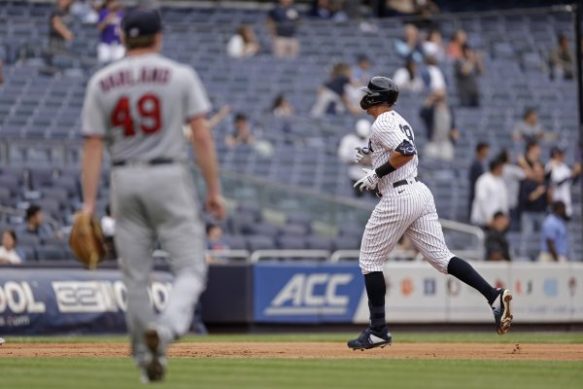
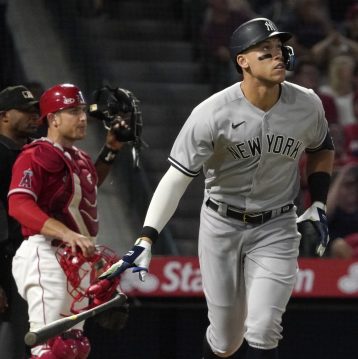
“Slide over, Babe, you’ve got some company!” So hollered announcer John Sterling as Aaron Judge hit number 60 Tuesday night.

If nothing else, it might have been the only time a solo home run that started a ninth-inning comeback win could possibly upstage the grand slam that finished it. That’s what happens when your teammate’s chase of baseball history precedes you.

On any other night, Yankee designated hitter Giancarlo Stanton’s ultimate grand slam, off Pirates reliever Wil Crowe, would have put a vise grip on the headlines. Even on a night the crosstown Mets came from behind against the Brewers in Milwaukee to take a lead they wouldn’t relinquish on a Francisco Lindor grand slam in the seventh.

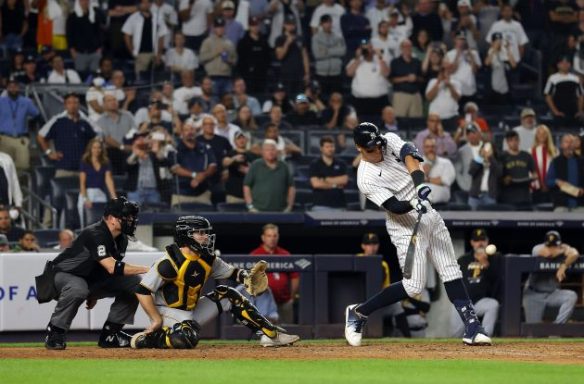
Stanton’s launch suffers a fate almost worse than that suffered by Crowe leading the inning off, when he fed Aaron Judge a 3-1 sinker that didn’t quite sink and was enough to send three-quarters of the way up the left field bleachers. “Slide over, Babe, you’ve got some company!” Yankee announcer John Sterling hollered as Judge rounded second.

Cadillac once called a variant of its top-of-the-top-of-the-line Fleetwood model the Sixty Special. The marque’s Fleetwood line is long gone, of course. But what Judge did Tuesday night made it resemble a Trabant.

Not just because the Yankees went from there to win without the Pirates recording a single out. Not just because Anthony Rizzo followed Judge by reaching for a down and away changeup and doubling to center. Not just because Gleyber Torres walked on five pitches to follow. Not just because Josh Donaldson singled to right to load the pads. And, not just because Stanton turned on a 2-2 changeup and drilled it to roughly the same real estate as Judge’s milestone, if not quite as far back.

From the moment it appeared Judge really would chase the ghosts of Babe Ruth and Roger Maris for the American League’s single-season home run championship at minimum, the old 154-vs.-162 game shibboleth instigated by then-commissioner Ford Frick’s capricious conflict of interest (he was, of course, a Ruth ghostwriter once upon a time) was revived a little too often by the idiot brigades of today’s social media swamp.

With Maris’s sons Roger, Jr. and Kevin among the Yankee Stadium crowd, Judge connected to finish a night on which it looked as though he might go hitless. He’d grounded out twice, struck out once, and walked once, before he launched the milestone that began the overthrow of an unlikely four-run Pirate lead. He did it in the Yankees’ 147th game, seven sooner than Ruth in 1927 and twelve sooner than Maris in 1961.

His chances of going past Ruth and Maris in the Yankees’ Sixty Special Club are overwhelming. He may or may not get to the Seventy Society populated by two men, Mark McGwire and Barry Bonds. But would you really bet heavily against a man who’s hit more into the ether since the All-Star break than any individual on four known teams (the Athletics, the Pirates, the Giants, the Nationals) has hit all season?

Now that Judge has met and stands on the threshold of passing Ruth, and is likely to meet and pass Maris posthaste from there, Judge may also have wrapped up the American League’s Most Valuable Player award. May.

Shohei Ohtani remains in the conversation, and the Angels’ two-way unicorn won’t go gently into the proverbial good gray night no matter how far out of contention the badly misadministered Angels are. It might not be out of bounds to ponder whether it ends up with Judge and Ohtani sharing the award. May.

It isn’t always the rule that a league MVP should play on a postseason contender. It isn’t always the rule that he shouldn’t, either. But pursuing history has its call upon MVP voters, too. Ohtani’s already made his history, with his Rookie of the Year 2018 and his MVP 2021; anything else he does merely augments it, unless he becomes crazy enough to bust a single-season home run record while winning a Cy Young Award.

Judge is doing his level best not to think about things such as that, or about things such as the ginormous free agency payday into which he’s swinging himself when the Yankee season finally ends, whenever that may be. It’s about as simple as having to face far more and far different pitching with near-guaranteed freshness every day than Ruth and Maris had to face in the conditions of their time.

“I don’t think about the numbers,” Judge told reporters postgame. “We talk about Ruth and Maris and Mantle and all these Yankee greats, you never imagine as a kid getting mentioned with them. It’s an incredible honor and something I don’t take lightly at all. But we’re not done. We’ve still got a couple of games left in this season, and hopefully more wins come with it.”

His Yankee teammates are another proposition. “Having a front seat from the on-deck circle for most of this,” says Rizzo, “has been amazing.

“He hit 60 tonight and it’s like nothing happened,” Stanton said. “He’s got more work to do, and that’s the mindset. This is just fun to be a part of.”

“The craziest thing,” said pitcher Gerrit Cole, “is that he’s gonna hit so many more. If we play baseball another six weeks, through the postseason, he’s gonna hit like 12, 13 more home runs. He’s just getting started.”

“I want him to hit a home run in every at-bat,” said catcher Kyle Higashioka, “and I think that’s the same sentiment amongst everybody else in this clubhouse, too. As good as he’s playing on the field, he’s the best teammate you could ever imagine. So there’s nobody in here who doesn’t wish for the absolute best for him.”

Judge had to be all but forced out of the dugout for a quick curtain call that amounted to nothing much more than a small wave. He tried to wave it off as nothing much and somewhat out of proportion. “I really didn’t want to do it,” he said. “Especially, we’re losing. It’s a solo shot.”

He had to know he wasn’t going to get away with that. With or without the overthrow he ignited. “I’m trying to enjoy it all, soak it all in,” he said, “but I know I still have a job to do out on the field every single day and I just have to keep my head down, keep preparing and stay mentally focused.”

Maybe forget 60. Or 61. Maybe start thinking about a Seventy Special. Even lifelong, hard credentialed, card-carrying Yankee haters are enjoying this. Lifelong, hard credentialed, card-carrying Yankee fans, of course, may petition to have the stadium’s Judge’s Chambers renamed the Supreme Court.

He can drive 55

Aaron Judge

Judge runs it out after driving 55 at Twins rookie Louie Varland’s expense Wednesday.

If you consider a sixty home run season the Promised Land for a power hitter, Aaron Judge awoke Thursday morning five bombs from crossing the Jordan River. And yet . . . and yet . . . the philistine contingencies continue asking the wrong questions about whether Judge will have done it, ahem, “legitimately.”

The Leaning Tower of 161st Street parked number 55—a fourth inning, leadoff blast off Twins starter Louie Varland—in the first game of a Yankee doubleheader sweep of the Twins Wednesday. Among the first notes on the blast was that it gave Judge two more homers after 136 games than Roger Maris in 1961.

If that’s among the only thing that impresses you about what Judge is trying to accomplish, so be it. If it’s second to whether and if Judge hits 60 or more by game 154, since Babe Ruth did that in 1927, so be it, too. The length of season factor was settled long enough ago. It remains far less relevant than other things.

Some of those things have been broken down and analysed splendidly by an MLB.com writer, Mike Petriello. Like me, Petriello has the audacity to look at the deepest data available, refusing to accept that the thinking person’s sport, which is also the deepest sport, should be allergic to thinking and depth.

Petriello goes above and beyond the primary truth that still discomfits enough even today,  Ruth never having faced the truly best available competition in official league play, through no fault of his own and all fault of (ahem) Organised Baseball of the era. (The biracial Judge would have been persona non grata in Ruth’s game.) But Petriello makes the parallel note that in 1927 only five players were born outside the United States, while 2022 includes 418 such players.

The Babe also didn’t face a third of the volume of pitchers Judge has faced, fresh or otherwise. In 1927, Ruth faced 67 pitchers all season long; Maris in 1961 faced 101. Judge faced 224 entering Wednesday and 232 by the time the twin bill ended. The rookie Varland was 225. The poor guy had the honour of being welcomed rather rudely to the majors by a seven-year veteran advancing upon history with a roundhouse punch into the left field seats.

“With series remaining against two teams he’s not seen yet (Milwaukee and Pittsburgh) and the usual September roster shenanigans,” Petriello writes, “Judge might get up to around 240 or so pitchers faced, all with their own arm slots, repertoires and approaches. It will be nearly four times what Ruth saw, and more than twice what Maris saw.” Variety is the life of spice, and a challenge to the bombardier.

In Ruth’s day, too, the idea of relief pitching as we came to know it barely took hold, if at all, above and beyond the Washington Senators’ Firpo Marberry and maybe one or two more. That was then: most relievers not named Marberry were brought in only upon injury or disaster. (Sometimes both.) This is now: relief pitching is a long-sanctioned, time-enough-honoured element in baseball’s art and craft.

Ruth got to enjoy a privilege about which Judge can only fantasise now, seeing a pitcher for a third or even fourth time in a game. Petrillo then sees and raises himself: Ruth got to face a pitcher for a third time or more 35 percent of the time in 1927; Maris, 30 percent in 1961. Judge? Seventeen percent.

Even Mark McGwire, Sammy Sosa, and Barry Bonds among the 60+ home run club got to face pitchers a third time around more often, from Sosa’s 20 percent in 2001 to his (1998), Bonds (2001), and McGwire’s (1998) 22 percent, then to McGwire’s and Sosa’s 24 percent (1999).

It gets a little more bizarre, Petriello notes: Judge has seen only one starter a fourth time around this year, twice—and both times, it was Max Scherzer. Judge does have one bomb off Scherzer, a third-inning blast on 22 August, but he flied out the third time he faced Scherzer that day. Almost a month earlier, Judge faced Scherzer in a 6-3 Yankee loss, and Max the Knife struck him out thrice after surrendering a first inning fly out.

Petriello’s deep dive also exhumed that Ruth in 1927 hit nine home runs off relievers he got to see a second time in a game, and over half his home runs came at the expense of either starters he saw a third time or more or relievers he saw a second time around or more. Judge should be so lucky: it’s only happened to him 19 percent of the time this year.

“If [Judge] saw starters being used the same way the Babe did,” Petriello writes dryly, “he might be looking at an 80-homer season at this point.” The flip side to the coin is that if Ruth saw the volume of quality pitching Judge sees, he might have been lucky to break his own original record of 29 in 1919. (For all you 154-game season chauvinists, 1919 was a 140-game season. Shall we declare Ruth the original “illegitimate” record-breaker because he had a 154-game season to hit 54 for a new record in 1920?)

Judge has 25 games to go to pass Ruth, Maris, and the rest. His season’s average is one bomb every 2.5 games. If he stays on the pace, he might hit 65. It would be one short of Sosa’s best, five short of McGwire’s, eight shy of Bonds, and all alone atop Yankee history. For now, the Leaning Tower of 161st Street is the most prolific single-season righthanded home run hitter ever to wear the Yankee pinstripes.

“The baseball world has changed considerably since 2001, or 1961, or 1927,” Petriello writes, blissfully unconcerned for the philistine contingency which persists in thinking that the game had no business changing at all, never mind that some changes over all those decades have been nothing but beneficial to baseball’s health while others amount to calling repairmen to fix what wasn’t actually broken.

Almost all of it has changed in a way to make hitting more difficult, for any number of reasons, most revolving around velocity, pitch movement, and the endless streams of high-octane arms who don’t worry about pacing themselves to go deep into games. This, above all else, is why the strikeout rate keeps going up; the next time a batter from a half-century ago complains about today’s hitters, remember that their task is immeasurably more difficult than his was. (Emphasis added.)

Remember, too, that Judge is playing in a season in which nobody’s still really dead certain whether he’ll get to swing on a rabbit ball or a miniature medicine ball. But it almost doesn’t matter. (Almost.) You can throw Judge a ball of seaweed, and he can hit it into the upper deck.

But he might hit more than ten more homers, too. Continuing to put the lie to manager Trey Wilson (in Bull Durham) telling his stumbling team, “This—is a simple game. You throw the ball, you hit the ball, you catch the ball.” If it was that simple, Judge’s height would be the only large thing about him.

“I can’t drive 55,” rocker Sammy Hagar once sang for a top-thirty hit. Judge can drive 55, and maybe a lot more before the regular season ends. There won’t be a traffic cop or highway patrolman alive who can stop him.

An epic Yankee fall?

Aaron Boone

Aaron Boone—how often does a four-game division lead feel like the next rung down of a collapse?

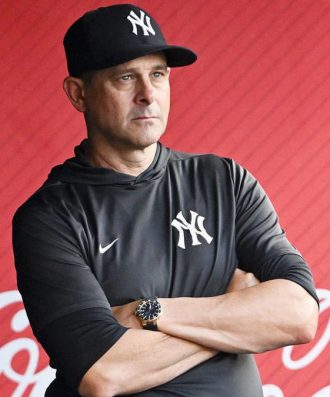
“If we don’t dig ourselves out,” Yankee manager Aaron Boone told reporters after the Yankees lost to the Rays 2-1 Saturday night, “you’ll have a great story to write.” Sometimes, greatness is in the eye of the beholder. If the beholder is a typical Yankee fan, this kind of greatness is the last thing the Yankees need.

There’s always been a trunk full of cliches about the Yankees. The two most significant have been a) they don’t like to lose; and, b) their fans consider no postseason legitimate unless the Yankees are in it. (The third most significant, at least since a certain man bought the team in 1973: To err is human; to forgive is not Yankee policy.)

Even the terminally optimistic Boone feels the weight. If he’s telling reporters they’ll have a “great” story to write unless the Yankees find a way out of their current spinout, there’s no joy in half of New York. The other half is hanging with the Mets, who may have a mere two-game lead in the National League East but whose fans aren’t exactly ready to call for summary executions despite their team having ended May 10.5 games ahead of their divisional pack.

The Mets’ faithful learned from the crib that there’s no such thing as an entitlement to success. (Quick: Name any Yankee team ever called a miracle team.) The Yankee faithful were spoiled so rotten by their 20th Century success that their descendants still think the World Series trophy is fraudulent unless it has the Yankee name on it.

Maybe the Yankees will dig themselves out of their present funk. But maybe they won’t. They’re 15-16 in the second half so far and went 10-18 in August alone, but they awoke Sunday morning having lost six of nine. Dropping the first pair of a weekend set with the second-place Rays is one thing, but entering that set splitting four with the sad-sack Athletics and two of three to the equally sad-sack Angels is not the look the Yankees wanted going in.

Their toughest opponents the rest of the way will be those same Rays for a three-game set in Yankee Stadium starting 9 September. They return home from Tampa Bay to host the Twins for four, and the Twins are no pushovers, but they’re not exactly up to the Rays’ performance level just yet. They’re also not quite up to the level of the suddenly-amazing Orioles, whom the Yankees host to end September and open October.

The Orioles—who looked as though they’d surrendered their heart and soul when trading Trey Mancini at the trade deadline, which could have threatened their unlikely sightline to the wild card picture. While almost nobody was looking, the Orioles not only finished July with a 16-9 month but they consummated a 17-10 August and opened September with three straight wins—one against the AL Central-leading Guardians and two against the A’s. Once upon a time the victims of a miracle team (in 1969), these Orioles may yet <em>become</em> a miracle team themselves.

They were as deep as 23 games in the AL East hole as of 2 July. They were 35-44. They’ve since gone 36-25. This regular season may yet finish with a debate over which was greater, the Yankees’ collapse from a one-time 15.5 game AL East lead or the Orioles’ resurrection from a 23-game divisional deficit to a postseason berth.

Yankee and other eyes concurrently train upon Aaron Judge’s pursuit of the 60 home run barrier across which two Yankees have gone (Hall of Famer Babe Ruth’s 60 in 1927; Roger Maris’s 61 in ’61) and—after a healthy leadoff belt in the top of the ninth off Rays reliever Jason Adam Saturday night—Judge himself is only eight shy of meeting. Some think Judge is so locked in he may even meet the 70-bomb single-season barrier head-on before the regular season expires. He’d be the first player to reach it without being under suspicion of actual/alleged performance-enhancing substances, anyway.

But Yankee cynics make note that, for thirty days including Saturday night, the Yankees’ team slash line of .213/.289/.325 is only that high with Judge, himself the possessor of a .279/.446/.593 slash for the same span. Without him, they’d be .208/.268./.295. Their Lost Decade of 1965-75 looked better than that.

How on earth did the Yankees get here? Easy enough. Hal Steinbrenner isn’t the man his father was, good and bad. The good side: Prince Hal isn’t exactly the type to decide one bad inning is enough to demand heads on plates, and if he fires a manager he wouldn’t have the gall to say, “I didn’t fire him. The players did.” The bad side: He doesn’t like to invest half as much as his father did.

Say what you will about George Steinbrenner, but the man didn’t care how much he had to spend, either on the free agency market or on keeping the farm reasonably fresh. Prince Hal’s running the most profitable franchise in the American League as if they were a minor league outlier or the A’s, whichever comes first. Nobody wants the bad side of The Boss resurrected, no matter how often Yankee fans demand it now. But nobody wants the good side buried interminably, either.

Which means general manager Brian Cashman, the longest-tenured man in his job in baseball, had little choice but to cobble a roster with one proverbial hand tied behind his back. But that acknowledgement goes only so far. Cashman’s eye for diamonds in the rough has failed him long enough. The present Yankee roster makes some rebuilding teams (the Orioles, anyone?) resemble threshing machines.

Which also means Boone—the only man in Yankee history to manage back-to-back 100-game winners in his first two seasons on the bridge—looks a lot larger for his faltering in-game urgency managing and getting less than the best of the men not named Judge or (relief pitcher) Clay Holmes on his roster. So do the three Yankee hitting coaches who can’t seem to shake the non-Judge bats out of what one of them is quoted as calling the wrong case of the “[fornicate]-its.”

The definition to which those coaches hold is translated admirably by strongman designated hitter Giancarlo Stanton: “We’ve just got to give whoever is on the mound a tough at-bat, even if we get out. We’ve just gotta wear ’em down a little bit. Just be a little tougher on them.” The definition to which the Yankee bats have held mostly of late seems to be unintentional surrender.

Yes, the Yankees have been injury-addled. Yes, they’ve been playing a curious chess game with minor leaguers brought up to the club to the point where they had to send two promising pitchers back down because the roster was about as flexible as an iron gate. But the lack of urgency the Yankees seemed to feel when they looked like AL East runaways hasn’t been resolved just yet with the team looking as though they can be overtaken before this is over.

Once upon a time, New York was rocked by a Brooklyn Dodgers team that looked as though it was shooting the lights out in the National League but found itself overtaken into a pennant tie by a New York Giants team that was 13 games out at one point. That tie and subsequent playoff, of course, turned out to be as tainted as the day was long. (The Giants stole the pennant! The Giants stole the pennant!)

To the best of anyone’s knowledge, nobody’s cheated their way back into the AL East race. If the Yankees keep up their current malaise, nobody would have to. Collapsing entirely from a 15.5 game lead would stand very much alone on the roll of Yankee infamy.

The spirit of 74

Aaron Judge

Hitting number 51 against the Angels Tuesday, Aaron Judge may yet break the single-season home run record. May.

We’re well enough past the point where looking at the scores to see how the Yankees are doing has nothing to do with a certain Yankee’s performance. If you turn to see the latest in any Yankee game without checking first on Aaron Judge’s in-game doings to that point, you’re going to flunk a polygraph hooked upon that question.

The Leaning Tower of River Avenue (how the mind’s eye produces fantasies of him squaring off against such lamp post-tall pitchers as Hall of Famer Randy Johnson and the late J.R. Richard) is having his best unimpeded (yet) season since his Rookie of the Year campaign five years ago. But nobody cares a whit about anything other than what he hits over the fence.

This year, the baseballs may still come having been consciously deadened but Judge couldn’t care less. He’s sent 51 of the miniature medicine balls into the seats through this writing. Those who care will note that he did that fourteen days before Babe Ruth reached 51 in 1927 and four days after Roger Maris reached it in 1961.

That’s talking purely about single-season home run record held by Yankees, about which there was once and still often enough not always cheerful insanity. Yankee chauvinists insist that and just about any other slugging record lack legitimacy unless set or held by Yankee batters. Which is almost (underline, please) as obnoxious as their (frequent enough) insistence that the postseason is illegitimate without a Yankee team in it.

Judge is one of the most likeable players on a team with which baseball fans not roosted in New York (and enough who are) have had, shall we say, a mixed relationship. The Yankees’ history is respected and even admired, however grudgingly, but the team is not always beloved. What’s true of several other teams is true exponentially about them.

But now and then even such parochial rooting or anti-rooting steps to one side when an individual Yankee threatens to launch himself into the precincts of the gods. That polygraph’s needles will jump right off the machine and onto the floor the moment you say that you don’t care if Judge hits a hundred home runs by the time this regular season ends just as long as the Yankees don’t win.

He’s not going to hit a hundred, of course. Seventy isn’t an unrealistic expectation at his pace. Seventy-four, which is what Judge would need to become the undisputed all-time single-season home run champion, may not be as much of a pipe dream as you think.

Judge doesn’t play under the witless lash of a commissioner who insisted without true authority to do so that the record would be illegitimate if broken after 154 games. He does play under the eye of a considerable crowd praying he gets to 74, the better to knock a suspect player out of the way. The incumbent record holder was a) not a Yankee and b) suspected of using actual or alleged performance-enhancing substances to get there.

And that record holder took the record from another who was not a Yankee and suspected of actual or alleged PEDs. The point that they were quite the outliers, in a generation where numerous players using or suspected of using such substances actually saw statistical dips instead of spikes (and, yes, you can look it up), usually escapes the usually self-appointed arbiters of sports morality.

It won’t condone those users or elevate those accusers if and when Judge parks number 74. But it would be nice to remember that baseball government did nothing about the plague until that government bumped into the government government. And the government government seemed far more interested in leading players on the perp walk than they were in sending swell if hypocritical messages to kids.

Without all that, we might be allowed to watch the Judge pursuit with more joy. Without all that, we might have nothing more grave to consider than this: If Judge can send baseballs that might as well be miniature medicine balls into earth orbit, what incentive does the sport’s administration have to iron up, remove its blinders, and insist upon a uniformly made baseball that allows both pitchers and hitters a fair shake?

The only blemish I can think of that attaches to Judge was his extremely rare attack of hubris in trolling Red Sox fans after the Yankees tied their 2018 American League division series, blasting Frank Sinatra singing “New York, New York” (a staple in Yankee Stadium after Yankee wins) from his boom box as he departed Fenway Park.

That’d teach him. In New York, the Red Sox destroyed the Yankees in the third division series game (16-4) and hung in despite a Craig Kimbrel meltdown in the bottom of the ninth to take it with a 4-3 Game Four win. Yankee fans were grateful that, to the best of anyone’s knowledge, none of those Red Sox (who went on to win the World Series) trolled them with boom boxes blasting the Standells’s garage band classic “Dirty Water.” (Boston, you’re my home . . .)

If that’s the only crime against common sense Judge has committed in his career, it’s not exactly a rap sheet on which to hang a man. Facing his first free agency this coming off-season, Judge stands to reap a payday equal to the value of some companies and a few tiny nations. He couldn’t have made a more powerful case in his dreams.

But this is the same player who was made aware of a Blue Jays fan handing one of his mammoth-blasted balls to another Rogers Centre fan who’d made no secret of Judge being his baseball idol and hoping to have a ball hit by Judge himself.

“That’s what’s special about this game, man,” he told reporters, after learning video of the moment went viral. “It doesn’t matter what jersey you wear, everybody is fans, everybody appreciates this game. That’s pretty cool. I’ve got to check out that video. That’s special.”

He did more than check the video out. The following say, before the game, he made a point of meeting the boy and his family and the fan who handed the ball to the boy, signing the home run ball for him and giving him the batting gloves he wore while hitting it.

Judge still resembles an eager nine-year-old boy himself when he flashes his familiar snaggle-toothed grin. But in the batter’s box he resembles the Jolly Green Giant when he pumps his bat and turns a pitcher’s mistake into another long bomb. Where he does it from hardly matters. His 199 OPS+ through this writing indicates he could clear several zip codes from the Grand Canyon or the last known surviving telephone booth.

If the Leaning Tower of River Avenue does it 23 more times between this writing and the regular season’s conclusion, there shouldn’t be a single baseball fan (even of the Yankee-hating variety) declining to stand up and cheer. If he doesn’t make it, stand up and cheer, anyway. Between his pursuit of 74 and Albert Pujols’s renaissance pursuit of career number 700, they’ve made the home run fun again.

Mr. Commissioner, meet the real faces of the game

Rob Manfred, Liam Hendriks

Commissioner Rob Manfred with White Sox relief pitcher Liam Hendriks before last year’s Field of Dreams game. (The Athletic.)

Having a read of ESPN writer Don Van Natta, Jr.’s profile of commissioner Rob Manfred, I was almost convinced that maybe, just maybe, there really was more to Manfred than met the eye. Or, more than what comes forth in his stiff presence and often clumsy remarks.

Just maybe, the man isn’t the baseball-hating or baseball-illiterate Rube Goldberg-like abecedarian the caricatures so often portray. He did, after all, grow up a Yankee fan in upstate New York and can say proudly enough that he’s the only baseball commissioner ever who played Little League baseball. “All glove, no bat,” he remembers of being a Little League infielder.

My parents received a set of classic Revere copper-bottom cookware as a wedding present eight years before Manfred was born. (I still remember the fragrance of that special powder used to clean the copper bottoms, too.) Who knew Manfred (three years my junior) was the son of Revere’s production supervisor at their home plant in Rome, New York? An hour’s drive from Cooperstown, as it happens.

Born in 1958, Manfred took in his first live major league game at Yankee Stadium with his sports-obssessed father, sitting between the plate and first base on an Old Timers’ Day. Come game time, Hall of Famer Mickey Mantle crashed a pair of home runs and the Yankees beat the Twins, 3-2. When he finally became the game’s commissioner, he handed his father the first baseball with his stamp upon it.

“This is really an unbelievable thing,” Manfred, Sr. told his son. “I can’t say I disagree,” Manfred, Jr. told Van Natta.

A couple of hundred fathoms down, though, Van Natta noted that “more than once” Manfred told him what few baseball commissioners have dared to admit, that being the buffer absorbing the heat that should go to his bosses, the owners, is part of his job. Even if it’s about as pleasant as your private parts being caught in the vacuum cleaner’s handle.

And then it came.

“Every time it’s me, it ain’t one of those 30 guys—that’s good,” Van Natta quoted Manfred as saying. “Look, who the hell am I? I don’t have $2 billion invested in a team. I’m just a guy trying to do a job. I mean it. [The owners] deserve that layer. I believe they deserve that layer of protection. I’m the face of the game, for good or for bad.”

Mr. Manfred, unless it’s to boo and hiss your heads off over this or that piece of mischief, you may rest assured that no baseball fan anywhere in this country is paying his or her hard-earned money to head for the ballpark to see you or your bosses.

But I’m going to do you a small favour, as if you know me from the greenest bat boy on any professional baseball team. I’m going to introduce you to the true faces of the game. The ones whom those fans do pay their hard-earned money to see at the ballpark regardless of the machinations and deceptions of your bosses and theirs.

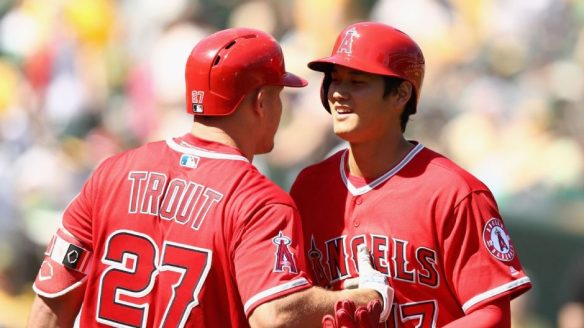
Mr. Manfred, meet Mike Trout. This is the guy you blamed once upon a time for not being baseball’s face, based upon his committing no crime more grave than letting his play and his clubhouse presence and his agreeability with fans before and after games speak for themselves, with no jive about the magnitude of being him.

Meet Shohei Ohtani. This is the two-way star who lights up the joint just by flashing that thousand-watt grin of his, never mind when he strikes thirteen out on the mound one night and belts baseballs onto the Van Allen Belt the very next. Between himself and Mr. Trout, you should be asking what on earth is wrong with the Angels that they still can’t find quality pitching enough to keep them in a race after they start in one but sputter unconscionably.

Meet Aaron Judge. This is the Leaning Tower of River Avenue who sends baseballs into the Delta Quadrant one moment and then, when made aware, goes out of his way to meet a Canadian kid to whom he’s number one among baseball men and who was handed one of his mammoth home run balls by an adult fan who knew the boy wanted nothing more than to catch one Judge hit out.

Meet Joey Votto. This is the future Hall of Fame first baseman who got himself tossed from a game early last year, but—after he learned his ejection broke the heart of a little California girl to whom he’s a hero above heroes—sent her a ball with his handwritten apology and autograph on it, prompting his team to drop game tickets and a little extra swag upon her the very next day.

Meet Bryce Harper. This is the guy who never apologised for being on board with letting the kids play. The guy now on the injured list with a thumb fracture and surgery to repair it after getting hit by a pitch thrown with one of the baseballs you and yours still can’t see fit to manufacture uniformly and with allowance for fairness on both sides of it, fairness for the pitchers and for the hitters alike.

Meet Vladimir Guerrero, Jr. and Bo Bichette. One is the son of a Hall of Famer who did last season what even his old man never did: led his league in on base percentage, slugging percentage, OPS, and OPS+, and led the entire Show in total bases. The other is the son of a respected major league slugger, has quite a lethal bat in his own right when his swing is right, and currently leads his league in trips to the plate. Together they’ve put some zip back into the Blue Jays.

Meet Oneil Cruz. The bat has yet to come to full life but the footwork, the glove, the throwing arm, have shown so far that you can be as tall as Frank Howard, J.R. Richard, and Randy Johnson and still play shortstop as though the position was created for you and not the Little Rascals in the first place. They’re falling in love with him in Pittsburgh, which needs all the love it can get, but they ought to fall in love with him all around the Show—except when he’s going so deep into the hole grabbing a grounder or a hopper that an enemy batter loses his lunch when he’s had a base hit stolen from him.

Meet Clayton Kershaw. He’s been around the block a few times. He’s a Hall of Fame lock as maybe the best pitcher of his generation. He’s still a quality pitcher and a class act. They still buy tickets on the road when they know he’s going to take the ball for the Dodgers. He’s faced his baseball aging curve with grace under pressure. And, for good measure, he’s the one active player who was seen fit to be part of the ceremony when the Dodgers unveiled that statue of their Hall of Fame legend Sandy Koufax this month, and you know (well, you damn well should know) what a class act Koufax was on the mound and has been in the decades since off it.

(You’re not still P.O.ed that Koufax waxed your Yankees’ tails twice while his Dodgers swept them in the 1963 World Series when you were seven, are you?)

Meet Justin Verlander. Missed a year plus recovering from Tommy John surgery. He has a 2.23 ERA and a 3.53 fielding-independent pitching rate so far this season. For any pitcher that’d be a remarkable return so far. For a future Hall of Famer who’s still suiting up at Jack Benny’s age (that’s a joke, son), it’s off the chart so far.

Meet Verlander’s 25-year-old Astros teammate, Yordan Álvarez. He’s leading the entire Show with his .667 slugging percentage, his 1.081 OPS, and his 206 OPS+. If there’s one untainted Astro who’s must-see viewing whenever he checks in at the plate, it’s him.

Meet Xander Bogaerts and Rafael Devers. The left side of the Red Sox infield is a big reason why the Olde Towne Team yanked themselves back up from the netherworld into second place in that rough and tumble American League East. Did I mention that Devers currently leads the entire Show with 177 total bases?

Meet José Ramírez. The Guardians’ third baseman is giving Devers a run for his money in the All-Star balloting that closes today. That thumb injury has put a crimp into his bat for now, and it’s had its role in the Guardians’ sudden deflation at the plate, but this guy just may be the face of his franchise right now. He ought to be one of the faces of this game.

Meet Mark Appel. This is the guy who went from number one in the draft to injuries as well as pressures and even to an exit from the game only to try giving it one more try—and finally coming up with the Phillies, nine years after that draft, and tossing a scoreless inning . . . at age 30. That’s as feel good a story as it gets for the oldest former number one to make his Show debut, no matter what happens with the rest of what remains of Appel’s career. They don’t all go to hell and back.

Those are only some of baseball’s faces, Mr. Commissioner. They’re the ones the fans want to see and pay through the nose to see. Despite your tinkerings. Despite your often erroneous readings of the room. Despite your inability or unwillingness to demand the same accountability of umpires that you do of players, coaches, and managers.

Despite your inability to let your professed deep love of the game come through without tripping over itself because, as an improvisor, well, if you were a musician the consensus would be that Miles Davis you ain’t.