The tip of the week

Aaron Judge

Judge shot this glance toward the Yankee dugout Monday night. On the next pitch—thrown by a Blue Jays reliever who admitted he’d handed the Yankees invaluable intelligence—the Leaning Tower of River Aenue hit the most powerful glancing blow of all time.

Say what you will about the Aaron Judge sideways glance Monday night in Toronto. You’re going to say it anyway, of course. But catcher-turned-Blue Jays broadcast analyst Caleb Joseph is way out of line suggesting that, if Judge was looking for a sign based on Blue Jays relief pitcher Jay Jackson tipping his pitches, the Yankee bombardier needs one thrown at his head post haste.

Because, you know, sign stealing the old-fashioned way—picking up on tipped pitches or signs from the field or the dugout, as opposed to an Astro Intelligence Agency off-field based espionage operation—is still a crime against nature. Never mind that that kind of sign stealing is almost as old as professional baseball itself. It may be a little unethical, but it doesn’t rise to the level of felonious grand theft.

Judge’s original response to questions after that game was that he’d heard more than a little chirping from the Yankee dugout, based on manager Aaron Boone being tossed over objections to plate umpire Clint Vondrak’s strike call on a low Jackson service. That bad call ran the count to 1-2.

That’s when Judge shot his now-infamous sideways glance toward the Yankee dugout. Before hitting a subsequent pitch 462 feet into the second deck behind the center field fence.

“I feel like after the manager does his thing, it’s like, ‘Fellas, our pitcher has still got to go out there and make some pitches’,” Judge said postgame. “We’ve got the lead, let’s just go to work here.’ I said a couple of things to some guys in the dugout and especially after the game. Hopefully it won’t happen again.”

The issue became compounded after Jackson admitted in due course that, yes, he just might have been tipping his pitches, a very common occupational hazard in his line of work. Players have sought little “tells” from pitchers from time immemorial. Even the greatest of pitch-shielding pitchers can be prone to giving one up from time to time without even realising it.

So what was with Judge speaking about Yankee dugout chirping? Easy enough. You don’t think he’s really going to give away how his mates picked up on Jackson’s tips, do you? Neither Judge nor the Yankees are going to commit treason if they can help it.

“From what I was told, I was kind of tipping the pitch,” Jackson told The Athletic. “It was  . . . the time it was taking me from my set position, from my glove coming from my head to my hip. On fastballs, I was kind of doing it quicker than on sliders. They were kind of picking up on it.”

Jackson didn’t sound even a fragment as outraged that the Yankees picked up on that tell as Joseph did during a pre-game show advancing Tuesday’s Yankees-Blue Jays contest.

“Everybody’s doing this, folks. Every team in the big leagues, they’re taking what’s handed to them,” Joseph began, giving what amounts to a confession that, yes, boys will still be boys and, so long as they’re not committing 2017-18 Astros-like black bag jobbing, it’s not exactly a call for outrage or vengeance.

Until it is, apparently.

“And it’s only bad until you get your hand caught in the cookie jar,” Joseph continued. “If I’m a mom or dad when I see my kid with their hand in that cookie jar, I’m slapping that hand. So I’m trying to send a message. And there was a time earlier in my career when, yes, messages were sent to me too. Right at my head when it wasn’t good. I would like to see Kevin Gausman come out and send a message.”

Gausman didn’t send any message Tuesday because none was called for. What he did do was get Judge to ground out and strike him out twice. The bad news for the Jays was Gausman’s relief Erik Swanson hanging a 1-0 slider that hung enough for Judge to send it almost as high past the center field fence as his glancing blast traveled Monday night.

Joseph was far less admirable demanding retribution than Jackson (optioned back to Triple-A afterward) was gracious when learning he’d handed the enemy a big break. “If they knew it was coming and he clipped me,” the righthander said, “he clipped me. I’m glad he hit it as far as he did.” The Yankees certainly were.

Jays manager John Schneider didn’t seem to think the Yankees committed Astrogate-style embezzlement, either. Even if he’d prefer his pitchers save their tipping generosity for the restaurant.

“If you’re doing things in plain sight,” Schneider said, “I think that you have to be able to correct them and you have to be willing to have the consequences be what they are. If it’s done fairly, yeah, that’s part of the game, everyone’s looking to help their teammates, everyone’s looking to pick up on tendencies, so anything that’s happening on the field in the right way, totally fair game.”

“In a very real sense,” wrote Paul Dickson in The Hidden Language of Baseball, “responsibility for tipping pitches or plays rests with the team, especially its coaching staff, so it amounts to a team error.” An unforced error at that. Something Mr. Joseph might want to ponder, before the next time he decides a tipped pitch caught, mugged, numbered, and murdered, deserves decapitation.

So what did Yankee pitcher Domingo German do on Tuesday night? He flunked a pre-inning sticky stuff test administered by umpire James Hoye and got himself tossed post haste and suspended ten games. This was after he’d already been warned, earlier in the season, about overdoing that good new fashioned medicated goo, and after he’d promised to use the rosin on the mound more.

“We all had the same opinion,” Hoye said of his umpiring crew about German’s suspect paw. “Shiny, extremely sticky, and it’s the worst hand we’ve ever felt during a game.” Worse than a busted flush.

Not brilliant, when the Yankees had to press Ian Hamilton into quick duty . . . and Hamilton ended up on the fifteen-day injured list after having to warm up too hastily. And when the Yankees just finished convincing those not disposed to believe them the root of all evil that there was nothing sneaky about catching and clobbering a tipped pitch.

26 minutes and other Opening Day salvos

Rafael Devers

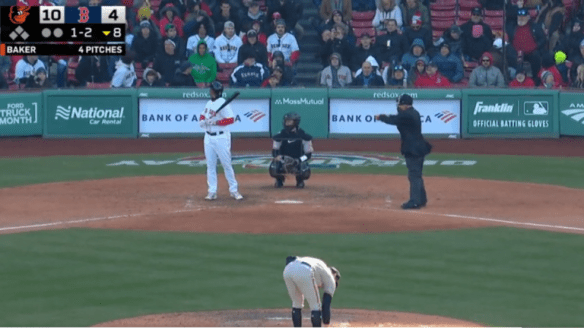
Rafael Devers (Red Sox), the Show’s first ever to strike out without a pitch thrown, taken, or swung on and missed—on a pitch clock violation.

So. After encyclopædic volumes worth were said and done, the average shortening of games on Opening Day was a whopping . . . 26 minutes. The new rules, don’t you know?

I may be on board with the pitch clock, but I’m not on board with cheers about the shortening when a fourth grade math student can tell you they’d have been shortened more by eliminating half the broadcast commercials. That’s accounting for the spots before each half inning and during any inning jam in which a pitching change was made.

But it didn’t stop the Blue Jays and the Cardinals needing three hours and 38 minutes to finish with a 10-9 Blue Jays win, paced by George Springer’s five hits for the Jays and opened with Cardinals pitcher Adam Wainwright warbling “The Star Spangled Banner” to just about everyone’s surprise in Busch Stadium.

Two players made history under the new rules. Rafael Devers (third baseman, Red Sox) became the first in Show to strike out on a pitch clock violation. Marcus Stroman (pitcher, Cubs) became the first in Show to be assessed a ball on a clock violation.

Leading off the eighth, Devers was rung up on 2-2 with Bryan Baker on the mound for the Orioles and the Red Sox in a 10-4 hole. “This doesn’t make sense to me,” said an announcer, “because he’d already looked at the pitcher. The pitcher’s not even ready to throw.”

Devers had checked back into the box with a few seconds remaining after stepping out to knock dirt out of his cleats. Even as Baker wasn’t quite ready to throw, plate umpire Lance Barksdale bagged him. It didn’t stop the Red Sox from posting a three-spot in the inning. “There’s no excuse,” said manager Alex Cora. “They know the rules.”

Knowing them and being able to maneuver within them for the first time in regular-season play are not exactly common. But it’s entirely possible that Devers not being dinged might have made a small difference. Led by Adley Rutschmann becoming the first catcher in Show history to have a five-hit Opening Day, the Orioles out-lasted the Red Sox, 10-9, after almost handing the game all the way back to the Olde Towne Team in the bottom of the ninth.

Remember: I’m also on board with turning the damn clock off in the eighth and later. Devers may yet prove evidence on behalf of that.

Stroman got his while checking Brewers runner Brice Turang at second with Christian Yelich at the plate in the third. The pitch clock expired about a hair before Stroman turned to pitch from the stretch. “It’s tough, this pitch clock,” Stroman told reporters postgame. “It’s a big adjustment. I don’t think people really realize it. It just adds a whole other layer of thinking.”

Yelich finally worked a walk out. The Brewers didn’t score then or the rest of the game. The Cubs won it, 4-0.

Jeff McNeil became the first Met to be hung with a pitch clock violation strike—for waiting for Pete Alonso to get back to first on a foul ball. Oops. Manager Buck Showalter was unamused that the clock began to tick before Alonso returned to the pad. McNeil remained mad just long enough to nail a base hit.

That was in an Opening Day game the Mets won, 5-3, beating the Marlins, but they might have had one more, at least, if not for someone whacking Brandon Nimmo with the stupid stick in the third. With first and third, Nimmo dropped a bunt—and hit into an inning-ending double play despite the run scoring. Thus the risk the wasted out, which is exactly what the sac bunt is, carries against defenders alert enough.

The good news there was Max Scherzer holding on despite all three Miami runs charged to his account and the Mets making simple enough work against a still not quite ready Sandy Alcantara. The bad was Justin Verlander having to miss a week while dealing with a muscle strain in his upper back near his throwing shoulder.

Perhaps it was miraculous that Aaron Judge picked up right where he left off from last season and hit one out in his first plate appearance against the Giants. That launched a 5-0 Yankee win that saw both starting pitchers, Gerrit Cole and Logan Webb, nail eleven and twelve strikeouts, respectively—the first opposing Opening Day starters to do that since Max the Knife (then a National, with twelve) and Jacob deGrom (then a Met, with ten) in 2019.

Speaking of deGrom, alas, the good news was, the Rangers got him a small truckload of runs. The bad news was that deGrom, still not all the way ready after a spring training disrupted by a side strain, also surrendered five before the Rangers unloaded for a nine-run fourth and held on to win, 11-7. They became the first Opening Day team to have a nine run-or-better inning since the Padres dropped 11 in the sixth against the Mets in the 1997 opener.

And Shohei still gonna Shohei. The Angels’ two-way unicorn struck ten Athletics out before his day’s work was finished. He even ripped a 110 mph base hit and threw a 101 mph pitch before he was done. And what did it prove worth in the end? Squatski. The Angels lost, 2-1. It put Ohtani onto a dubious record book page: the only pitcher to punch ten out and surrender no runs in his team’s Opening Day loss.

Meanwhile, the Rockies are still gonna Rockie, alas, even when they win. With a pair of home runs by first baseman C.J. Cron leading the way, the Rockies battered the Padres for seventeen hits—despite striking out at the plate seventeen times against four Padres pitchers. Making them the first team since 1900 to deliver that dubious 1-2 punch in a nine-inning game. Ever.

I’ve said it before, but I’ll say it once more. This is baseball. Where anything can happen—and usually does. With or without rule changes running the bases from the sublime to the ridiculous and back to the absurd. And wish though Commissioner ADD and his minions might, 26 minutes isn’t exactly that big a difference from even last year’s average.

Three-ball blues

The Ball

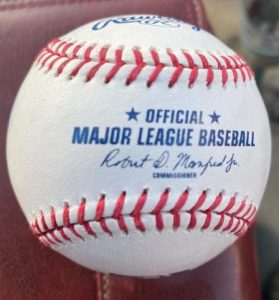
This is the baseball I landed during batting practise before Opening Day at Angel Stadium this year. (I gave it to my son who attended with me.) Who knew if it was juiced or drained?

Signing with the Mets for two years and $86 million was good with and for Justin Verlander. But it may not be the most important thing he did outside pitching the decisive World Series Game Six. The most important thing the future Hall of Famer did this year was buttonhole a baseball official before a game against the Yankees in June and demand, “When are you going to fix the [fornicatin’] baseballs?”

It’s not the first time he complained. In 2017, Verlander was just one of several who noticed and complained that balls used that postseason were a little too smooth for comfort. And it got worse instead of better. By 2021, Major League Baseball had two kinds of baseballs, one slightly heavier than the other, and thus containing a little more life than the other.

With a lot of help from Meredith Wills, an astrophysicist and baseball fan whose passion is examining the makeup of baseballs and who’s discovered the Show can’t get it straight or consistent, Insider exposed 2021’s two-ball tango. The Insider reporter who delivered Dr. Wills’s discoveries and alarms, Bradford William Davis, has now seen and raised: in 2022, baseball played its own version of “Three Ball Blues.”

That vintage blues song discussed pawn shops, the traditional sign for which is three golden balls. The lyrics include the old joke inside the pawn business: “It’s two to one, buddy, you don’t get your things out at all.” Baseball’s three-ball blues may mean it’s two to one on getting its integrity back after engaging its own kind of cheating—still inconsistent and often juiced balls.

Not necessarily in the final game scores. Davis and Wills suggest powerfully that baseball’s government wanted a little more oomph on behalf of a lot more hype, with certain events such as the Home Run Derby, the postseason, and maybe even Aaron Judge’s chasing and passing Roger Maris as the American League’s new single-season home run king.

Verlander was far from the only player to complain. Davis says Giants outfielder Austin Slater fell upon that 2021 Insider story, sought to collect balls to send Wills for analysis, and was ordered by “a top executive in the commissioner’s office” to back off.

“The warning,” Davis says, “sent in the form of text messages that Insider reviewed, came via a [Major League Baseball Players Association] official who was relaying the league executive’s displeasure.” Displeasure over what? Being caught red-handed delivering inconsistently-made baseballs about which the game’s own commissioner seems distinctly under-alarmed?

Rob Manfred told reporters before the All-Star Game that, yup, we had two balls in 2021, but it was the fault of a pandemic-times issue in Rawlings’s Costa Rica manufacturing plant: closues and supply chain issues, as Davis translates, meant MLB’s plan to stay with a new, lighter, deader ball was compromised when it had to “dip into a reserve stock of the older, heavier, livelier balls for some 2021 games.”

MLB claimed random distribution between the two 2021 balls. Davis’s 2021 reporting via Dr. Wills brought forth suspicions that MLB wasn’t just doing it randomly, that at times they were sending balls to certain places for certain series depending on what they thought might be the gate: say, a game between a pair of also-rans might get the deader ball but a game between a pair of big rivals or contenders might get the livelier ball.

Now Manfred told that July conference think nothing of it, we’ve got it knocked, we’re sticking to the deader ball, and every ball made for 2022 will be consistent. Not so fast, Dr. Wills discovered, according to Davis: “Major League Baseball did not settle into using a single, more consistent ball last season, Wills’ research suggests: the league used three.”

By the time Manfred made that statement in July, Wills had already found evidence that at least a handful of those older, livelier, “juiced” balls — the ones that the “new manufacturing process” purportedly replaced — were still in circulation. Though these juiced balls are from 2021 or earlier, according to manufacturing markings, they were in use in 2022; Insider obtained two of them from a June 5 Yankees match against the Tigers.

Over the next few months, Wills and Insider—with whom Wills exclusively shared her research—worked together to collect game balls for her to painstakingly deconstruct, weigh, and analyze. What she found was striking: In addition to that small number of older juiced balls and the newer dead balls, Wills found evidence that a third ball was being used at stadiums across the majors.

Davis says Wills’s data indicates production on the third ball began six months before Manfred promised 2022 as a single-ball season. “This new third ball’s weight,” Davis writes,

centers somewhere between the juiced ball the league phased out last season and the newly announced dead ball: It is, on average, about one-and-a-half grams lighter than the juiced ball and one gram heavier than the dead ball. According to the league’s own research, a heavier ball tends to have more pop off the bat, meaning the third ball would likely travel farther than a dead ball hit with equal force.

Aaron Judge

Aaron Judge had no clue whether he’d be pitched a dead, lead, or Super Ball while chasing Roger Maris this year.

Wills calls it “the Goldilocks ball: not too heavy, not too light—but just right.” But this isn’t the Three Bears we’re talking about here. This is about the possibility that hitters didn’t know going in when one hefty swing would send a ball over the fence but another such hefty swing with the same square, powerful contact might result in a sinking line drive, a dying quail, or a long out.

In other words, Judge—who’s just signed a nine-year/$360 million deal to remain a Yankee, after betting big on himself during his contract walk year—had no clue just what he was going to hit, and I don’t mean fastball, curve ball, slider, cutter, or sinker. Nobody knows for certain whether or how many such Goldilocks balls Judge sent into the Delta Quadrant. And that’s allowing for him being strong enough to hit a clump of seaweed into the second deck.

“But we do know,” Davis writes, “that the league keeps track of information that would permit it—if it wanted—to know which balls get used in each game. According to two sources familiar with MLB’s ball shipment process, the league not only directs where its balls are sent, it also knows which boxes its game compliance monitors–league employees tasked with ensuring each team adheres to league rules–approve and use before each game starts.”

Baseball government people were handed the net results of Dr. Wills’s reseach and all but waved it away with an all but run-along-girlie-you-bother-me statement:

The 2022 MLB season exclusively used a single ball utilizing the manufacturing process change announced prior to the 2021 season, and all baseballs were well within MLB’s specifications. Multiple independent scientific experts have found no evidence of different ball designs. To the contrary, the data show the expected normal manufacturing variation of a handmade natural product.

Rawlings itself, co-owned by MLB since 2018, issued a similar statement:

This research has no basis in fact. There was no ‘3rd ball’ manufactured and the ball manufactured prior to the 2021 process change was fully phased out following the 2021 season. All balls produced for the 2022 season utilized the previously announced process change.

While storage conditions during research can easily impact ball weight measurements, a one-gram difference in ball weight would be within normal process variation. We continue to produce the most consistent baseball in the world despite the variables associated with a handmade product of natural materials.

Davis demurs. “While lighter and less bouncy than the balls used before Rawlings switched up its manufacturing in 2021,” he writes, “the Goldilocks balls have a weight profile that makes them livelier and more batter-friendly than the dead balls that the league says it now uses exclusively.”

To which Manfred says, essentially, Integrity of the game? Shut up and get back to shortening the times of games without even thinking about cutting down the broadcast commercials. Any time Manfred comes up with something reasonable—the universal designated hitter, slightly larger bases, the advent of Robby the Umpbot—he comes up with or allows about five or more unreasonable things to counteract.

Differing baseballs aren’t just “unreasonable.” They strike at the very core (pun intended) of competition at least as profoundly as something like Astrogate did, on both sides of the ball. Pitchers who don’t know whether they’ll be given a grippable ball to pitch have just as much skin in this game as hitters who don’t know whether they’ll square up a dead, lead, or Super Ball.

The men who play the game, the fans who pay to see them play, the team builders  tasked with putting the teams on the field, and the managers who have to run the games and make the moves that mean distinction or disaster, deserve as level a field as possible.

The era of actual/alleged performance-enhancing substances was considered criminal for undermining the level playing field. Tanking teams are considered criminally negligent for providing something less than truly competitive product. Likewise, when it comes to honest competition, inconsistently-made baseballs should be considered weapons of mash  destruction.

AL dragons vs. NL dragonslayers

Houston Astros

The Astros celebrate winning the AL pennant Sunday night in New York. The AL’s dragons get to tangle with some NL dragonslayers from Philadelphia in the World Series.

Maybe the Astros would have found ways to beat the Yankees yet again regardless. Maybe it wouldn’t have mattered if Aaron Judge could have tied Game Four of the American League Championship Series with one intercontinental ballistic launch and sent it to extra innings.

The Astros won their third American League pennant at the Yankees’ expense Sunday night in Yankee Stadium. They did it in 2017, 2019, and now this year. But if Game Four proves to be free agent-in-waiting Judge’s final game as a Yankee, it couldn’t have ended more ignominously for him and for them.

The engaging, still-young man who pushed Roger Maris aside as the AL’s single-season home run champion, already 1-for-14 in the ALCS when he checked in against Astros reliever Ryan Pressly with two out in the bottom of the ninth, swung on a slider somewhat outside on 1-2.

The guy who can hit a ball of yarn past the Van Allen Belt grounded it right back to Pressly, who speared it one-handed coming off the mound toward first base. Pressly trotted a few steps further before underhanding it to Astros first baseman Yuli Gurriel for game, set, sweep, and the Yankees heading home for the winter.

It continued the second-longest Yankee pennant drought since 1979-1994. It made the Leaning Tower of 161st Street resemble the giant who’d carried an entire town on his shoulders from one end of the hemisphere to the other only to collapse under its weight at long enough last.

“I could sit here and make excuses about if a ball falls this way, a ball drops that way or a pitch is made here and there,” Judge lamented after Game Four ended. “But what it comes down to is they just played better than us.”

The Yankees spoiled themselves leaning on Judge as their in-house extraterrestrial. The Astros, say what you still will about them, didn’t make that mistake. They didn’t lean too heavily upon any single big man, either winning the second-most games in the regular season or sweeping their way to the coming World Series.

Leaning that heavily upon one big man merely held the Yankees’ other issues aloft too high. Their bullpen was injured and inconsistent. They lost key secondary elements such as D.J. LeMahieu and Andrew Benintendi to injuries. Anthony Rizzo and Giancarlo Stanton weren’t consistent second bananas to the Judge Show. If Harrison Bader proved a pleasant surprise at the October plate, it wasn’t enough to overcome Judge and Stanton combining to go 6-for-32 the entire postseason.

Oh, the Astros had some heroics of their own, of course. Yordan Alvarez looked like Paul Bunyan earlier in the postseason, enough so that enough thought he alone might be the one to blast the Astros forward. But he was awful quiet in the ALCS. There lay the Astros’ real secret weapon this time, though: if one guy falters, there are others too happy to pick up the slack.

Rookie Jeremy Peña said, “Sure, no problem-o.” A kid whose regular-season on-base percentage fell well enough short of just .300 tied Game Four in the top of the third, with two on aboard back-to-back inning-opening walks, when an ailing Yankee starting pitcher Nestor Cortes hung a cutter and Peña hung it down the left field line and over the fence fair past the foul pole.

“It’s surreal,” said Peña postgame, after he was named the ALCS’s Most Valuable Player. “You dream about this stuff when you’re a kid.” Nobody among his teammates cared two pins that he was a rookie stealing the thunder.

“If you’re in this clubhouse, you’re one of us,” said Lance McCullers, Jr., the Astros’ Game Four starting pitcher. “You don’t need to earn your stripes with us. You don’t need service time. If you’re in this clubhouse and you’re wearing this uniform, you’re one of us. It doesn’t matter if you’re here for a day or you’re here for seventeen years.”

“It’s been a blessing to play with this group,” said third baseman Alex Bregman, who’d sent Peña home with what proved the insurance run in the seventh, after yet another fielding mishap that came to define the Yankees’ postseason collapse the way their deflation from 15.5 games atop the AL East to a 10-18 August defined their regular-season descent from surreal to mere division champion.

Alvarez may not have provided strategic bombing in this ALCS, but after Yankee second baseman Gleyber Torres flipped what should have been a seventh inning-ending double play-starting toss past shortstop Isiah Kiner-Falefa, he re-tied the game at five each by swatting Peña home with an RBI single off Yankee reliever Jonathan Loaisaga.

Just like that, the Yankees handed the Astros the means to end the lead Bader handed his team in the bottom of the sixth, when the former Cardinal caught hold of Hector Neris’s first two-out pitch to him and sent it into the left field seats.

When Gurriel clutched Pressly’s underhand toss for the final series out, it handed baseball its first day with both pennants clinched since 1992. It handed the Astros yet another chance to give manager Dusty Baker yet another chance at the one thing that’s eluded him in his long and mostly distinguished managing career—a lease to the Promised Land.

Baker took on the Astros after Astrogate cost them A.J. Hinch, whose failure to put the brakes on the Astro Intelligence Agency’s illegal, off-field-based, electronic sign-stealing operation could have broken both the game and the organisation in half when it was exposed after the Astros fell to the Nationals in the 2019 World Series.

He might be the sentimental favourite come Series time—individually. The Astros will be up against a Phillies team that electrified their city and maybe most of the country with their own pennant conquest at home Sunday afternoon. Baker may be America’s manager but the Phillies may be America’s team this time. And Bryce Harper just may be America’s man within America’s team, if that’s the case.

No Astro delivered quite the transcendent blow Sunday that Harper did in the bottom of the eighth. Judge’s record-breaking 62nd home run merely broke a hallowed AL and Yankee team record and guaranteed his coming free agency riches. Harper’s deficit-overthrowing two-run homer held up to mean the pennant, in a rainy game that looked as though the Phillies and the Padres did more mud wrestling than ball playing.

The pitchers couldn’t grip properly or resist their landing feet sliding more than single inches on the muddy mound. The hitters changed batting gloves as often as they could. Batting helmets shone with rain water on top. New York wasn’t exactly paradise but Philadelphia’s Citizens Bank Park was practically a swamp. And no fan dared leave until it was done.

Harper stunned the Padres first by taking a tumbling Robert Suarez changeup on which he might have swung otherwise, once upon a time. He anticipated Suarez bringing a fastball soon enough, hoping only to find an outfield gap into which to send one, enough to bring J.T. Realmuto home from first with a tying run.

He got and did better than he hoped. He got a cutter hovering over the outer half of the plate and swung. The ball traveled about three or four rows the other way into the left field seats. The city that once hosted a record label proudly calling its brand of soul music The Sound of Philadelphia now had a new sound: bedlam.

The Biblical admonition goes that the last shall be first. The Phillies entered the postseason aboard the new three wild card system with the weakest regular season record of any postseason entrant and the eleventh-best record in the Show.

They’d survived an early season hump prompting their front office to throw out the first manager of the year. They’d survived injuries, including the two-month loss of Harper who needed the rest of the regular season to get his groove back. Both the Phillies and the Padres hit a partial re-set button at mid-season and burrowed their ways to their wild cards.

The Padres slew the NL dragons out of New York and Los Angeles. The Phillies slew those out of St. Louis and Atlanta. Then the Phillies won the pennant by taking four of five from the Padres. They ground, pushed, thumped, slashed, and thundered their way to the Series.

They reminded you that, when the dragonslayers meet each other, one of them gets fried.

They’re going to go up against an Astro team that still isn’t America’s favourite team thanks to the continuing taint of Astrogate. Never mind that only three position players from those 2017-18 cheaters remain with the team. Never mind mind that one (Jose Altuve) actually rejected being part of it. I say again, sadly: the taint won’t dissipate until the last member of the Astrogate teams no longer wears their uniform.

The Phillies haven’t won a World Series ring since the final months of the second George W. Bush administration. The Astros still hunt their first un-stained World Series rings. If the Astros think the Phillies can be taken as readily as the Yankees, the Astros may be in for a Series that’ll only feel as long as the Yankee winter now begun.

The Yankees rock and troll

Yankee Stadium

A spent champagne bottle placed on home plate after the Yankees won a trip to the ALCS Tuesday night. The Yankees had to celebrate their win in a hurry—they open against the Astros Wednesday night.

The good news is, Year One of Comissioner Rube Golberg’s triple-wild-cards postseason experiment isn’t going to have an all also-ran World Series, after all. It still yielded a pair of division-winning teams getting to tangle in the American League Championship Series.

The bad news is, those two division winners are still the Yankees and the Astros, after the Yankees sent the AL Central-winning Guardians home for the winter with a 5-1 win Tuesday that wasn’t exactly an overwhelming smothering.

What it was, though, was the game for which the Guardians shot themselves in the proverbial foot. Specifically, two Guardians, one of whom is old enough to know better and the other of whom needs a definitive attitude adjustment.

Guardians manager Terry Francona has more World Series rings this century (two) than Yankees manager Aaron Boone (none). Francona is considered by most observers to be one of the game’s smartest managers who’s made extremely few mistakes and learned from one and all; Boone is one of those skippers about whom second-guessing is close enough to a daily sport in its own right.

But when push came to absolute shove for rain-postponed AL division series Game Five, Boone proved willing to roll the dice Francona finally wasn’t.

After Gerrit Cole held the Guards off with a magnificent Game Four performance Sunday but the rain pushed Game Five from Monday to Tuesday, Boone was more than willing to throw his original Game Five plan aside—Jameson Tallion starting and going far as he could to spell the beleaguered Yankee bullpen—and let Nestor Cortes pitch on three days’ rest for the first time in his major league life.

Francona wouldn’t even think about changing his original Game Five plan, opening with his number-four starter Aaron Civale, who hadn’t even seen any action this postseason until Tuesday, then reaching for his bullpen at the first sign of real trouble. He wasn’t willing to let his ace Shane Bieber go on three days’ rest for the first time in his major league life.

Mother Nature actually handed Francona one of the biggest breaks of his life when she pushed Game Five back a day. Either he missed the call or forgot to check his voicemail. “I’ve never done it,” said Bieber postgame Tuesday, about going on three days rest. “But could I have? Sure.”

“It’s not because he can’t pitch,” said Francona after Game Five. “It’s just he’s been through a lot. You know, he had [a shoulder injury in 2021] and he’s had a remarkable year, but it’s not been probably as easy as he’s made it look.”

It might have been a lot easier on the Guardians if Francona handed his ace the chance to try it, with reinforcements ready to ride in after maybe three, four innings. Even year-old-plus shoulder injuries deserve appropriate consideration, of course. But Bieber surrendered a mere two runs in five-and-two-thirds Game Two innings. Francona’s hesitation when handed the chance helped cost him a shot at another AL pennant.

Civale didn’t have it from the outset. He had as much control as a fish on the line jerking into death out of the water. Giancarlo Stanton slammed an exclamation point upon it when he slammed a hanging cutter the other way into the right field seats with two aboard and one out.

The Guards’ pen did surrender two more runs in the game, including Aaron Judge’s opposite field launch the next inning. But they spread those runs over eight and two-thirds innings’ relief while otherwise keeping the Yankees reasonably behaved. They gave the Guards every possible foot of room to come back and win it.

That was more than anyone could say for Josh Naylor. The Guards’ designated hitter had already raised temperatures among enough Yankees and around a little more than half of social media, when his Game Four home run off Cole resulted in him running the bases with his arms in a rock-the-baby position and motion.

Naylor intends the gesture to mean that if he hits you for a long ball he considers you his “son” in that moment. It wasn’t anything new for him or for those pitchers surrendering the 20 bombs he hit on the regular season. And Sunday’s blast was the third time Naylor has taken Cole into the seats in his major league life. He was entitled to a few bragging rights.

Cole himself thought the bit was “cute” and “a little funny.” He wasn’t half as offended as that half-plus of social media demanding Naylor’s head meet a well-placed fastball as soon as possible. Yesterday, if possible. The Yankees found the far better way to get even in Game Five than turning Naylor’s brains into tapioca pudding.

“We got our revenge,” Yankee shortstop Gleyber Torres all but crowed postgame. Torres even did a little rocking of the baby himself in the top of the ninth, after he stepped on second to secure the game-ending force out. “We’re happy to beat those guys,” he continued. “Now they can watch on TV the next series for us. It’s nothing personal. Just a little thing about revenge.”

Naylor was also serenaded mercilessly by the Yankee Stadium crowd chanting “Who’s your daddy?” louder with each plate appearance. Every time he returned to the Guards’ dugout fans in the seats behind the dugout trolled him with their own rock-the-baby moves. And his most immediate postgame thought Tuesday was how wonderful it was that he’d gotten that far into their heads.

Some say it was Naylor being a good sport about it. Others might think he was consumed more with getting into the crowd’s heads than he was in getting back into the Yankees’ heads. The evidence: He went 0-for-4 including once with a man in scoring position Tuesday.

Oh, well. “That was awesome,” he said postgame of the Yankee Stadium chanting. “That was so sick. That was honestly like a dream come true as a kid—playing in an environment like this where they’ve got diehard fans, it’s cool. The fact I got that going through the whole stadium, that was sick.”

Josh Naylor

Rock and troll: Yankee fans letting Josh Naylor have it on an 0-for-4 ALDS Game Five night.

Did it cross his mind once that his team being bumped home for the winter a little early was a little more sick, as in ill, as in not exactly the way they planned it? If it did, you wouldn’t have known it by the way he continued his exegesis. “If anything, it kind of motivates me,” he began.

It’s fun to kind of play under pressure. It’s fun to play when everyone’s against you and when the world’s against you. It’s extremely fun.

That’s why you play this game at the highest level or try to get to the highest level: to play against opponents like the Yankees or against the Astros or whoever the case is. They all have great fanbases and they all want their home team to win, and it’s cool to kind of play in that type of spotlight and in that pressure.

Wouldn’t it have been extremely more fun if the Guardians had won? Did Naylor clown himself out of being able to play up in that spotlight and its pressure this time? Those are questions for which Cleveland would love proper answers.

So is the question of how and why the Guards didn’t ask for a fourth-inning review that might have helped get Cortes out of their hair sooner than later, after a third inning that exemplified the Guards’ hunt-peck-pester-prod limits.

They went from first and second and one out in the top of the third—one of the hits hitting the grass when Yankee shortstop Oswaldo Cabrera collided with left fielder Aaron Hicks, resulting in a knee injury taking Hicks out of the rest of the postseason—to the bases loaded and one out after Guards shortstop Amed Rosario wrung Cortes for a four-pitch walk. They got their only run of the game when Jose Ramírez lofted a deep sacrifice fly to center.

Now, with two outs in the top of the fourth, Andres Giménez whacked a high bouncer up to Yankee first baseman Anthony Rizzo, who had to dive to the pad to make any play. The call was out, but several television replays showed Giménez safe by a couple of hairs. Perhaps too mindful of having lost three prior challenges in the set, the Guardians’ replay review crew didn’t move a pinkie. Francona seemingly didn’t urge them to do so.

Never mind that it would have extended the inning and given the Guards a chance to turn their batting order around sooner, get Cortes out of the game sooner, and get into that still-vulnerable Yankee pen sooner. Francona’s been one of the game’s most tactically adept skippers for a long enough time, but not nudging his replay people to go for this one helped further to cost him an ALCS trip.

These Yankees don’t look proverbial gift horses in the proverbial mouths. An inning later, with Torres on first with a leadoff walk and James Karinchak relieving Trevor Stephan following a Judge swinging strikeout during which Torres stole second, Rizzo lined a single to right to send Torres home. That was all the insurance the Yankees ended up needing.

Especially when these so-called Guardiac Kids, the youth movement whose penchant for small ball and for driving bullpens to drink with late rallies, forcing the other guys into fielding lapses, winning a franchise-record number of games at the last minute, had nothing to say against three Yankee relievers who kept them scoreless over a final four solid shutout innings.

Especially when they actually out-hit the Yankees 44-28 and still came up with early winter. The trouble was, the Guards also went 3-for-30 with men in scoring position over Games One, Two, Four, and Five, and had nobody landing big run-delivering blows when needed the most. Their ability to surprise expired.

Now the Yankees have a chance for revenge against the Astros who’ve met them in two previous ALCSes and beaten them both times. They had to hurry their postgame celebration up considerably—the ALCS opens Wednesday night.

The Guardians could take their sweet time going home for the winter and pondering the season that traveled so engagingly but ended so ignominiously.

“Winning the division was the first part,” Hedges said postgame. “Wild-card round. Put ourselves in position to beat the Yankees. And we wanted to win the World Series, but that’s a good Yankees team. The cool thing is, now we have a bunch of dudes with a ton of playoff experience in the most hostile environment you can imagine.”

The Guards were bloody fun to watch for most of it. Then Cole, Stanton and Judge rang their bells in Games Four and Five, and they had nothing much to say in return. The Guardiac Kids were the babies who got rocked. There was nothing much fun about that.