The Angel of Doom dooms a no-no

Brandon Bielak, Maikel Franco, Angel Hernandez

If this was ball one, I have X-ray vision. Even with a bad framing job that pitch crossed the plate under the strike zone’s ceiling.

Angel Hernandez sued MLB and lost when he tried claiming his race alone denied him postseason umpiring assignments. That was about at the end of spring training. Then, the Angel of Doom went out and continued proving you don’t have to be white to be among the top three to five reasons Robby the Umpbot will soon have major league employment.

Two things especially have stood out. Which may be saying something, depending on your experience.

Thing One: Hernandez called balls and strikes in Anaheim, in April, with the Angels playing the Astros, and blew a verified 24 pitch calls for an 83.2 percent rate of correct calls.

Thing Two: Hernandez may have cost the Astros a combined no-hitter Monday, when he blew an 0-2 strike from Astro righthander Brandon Bielak to Oriole third baseman Maikel Franco on the upper outside corner, still well within the zone, in the eighth inning.

What should have been strike three was ball one. And, with one out and one aboard on a walk, it was enough of reprieve for Franco to hit the next pitch over the left center field fence. Goodbye no-hitter, goodbye shutout.

Never mind the Astros going on to finish what they started otherwise, a 10-2 drubbing of the Woe-rioles. There was and remains no way strike three should have been called ball one.

It was a breaking ball that broke above the zone line but crossed the plate well inside the upper zone, even with Astros catcher Jason Castro trying to frame the pitch lower in the zone.

Unfortunately, it was Hernandez behind the plate. Putting pitchers into Hernandez’s hands is like putting skyjackers in charge of air traffic control.

“It’s the Astros, so I don’t care,” said Tortilla Fats on a face-time call.

“Let me guess,” I said. “You forgot there are only five members of the Astrogate team left on the roster.”

“It’s still the Astros, and I still don’t care,” Fats harrumphed back. “Cheaters once, cheaters always.”

“I bet you would have been an absolute alegria if you were a White Sox fan,” I said. “After all, game fixers once, game fixers always, right?”

“It’s still the Astros, so I don’t care,” Fats doubled down.

“So what if it was Jacob deGrom working the no-no in the eighth with one out, one aboard, Hernandez behind the plate, Endier Inciarte on the Mendoza Line at the plate, and it’s 0-2,” I said. “What if deGrom throws that breaking ball that climbs upstairs and drops right into the upper zone? What if Hernandez calls that ball one, and Inciarte hits deGrom’s next pitch over the fence?”

“He’s not on the Astros,” Fats tripled down. “He’s also Jacob deGrom. Even Angel Hernandez knows that. DeGrom’s not gonna lose a strike and then serve the murcielago espaugeti a meatball.”

“OK, bad example,” I admitted. “Suppose it was Shohei Ohtani. Jacob deGrom he ain’t. Suppose he has Franco 0-2 with one out, one on, and Hernandez behind the plate? Suppose Ohtani throws that breaker starting upstairs and falling right into the zone? Suppose the Angel of Doom blows that strike into ball one? Suppose Franco hits him over the left center field fence?”

“Ohtani’s not an Astro,” Fats quadrupled down. “So I still don’t care. Anyway, the Astros won the game, didn’t they? So what the hell do they have to complain about?”

I reminded Fats that losing a no-hitter—solo, combined, whatever—isn’t exactly celebration fodder. There are those fans who’d rather go to funerals than see no-hitters broken up in the latest innings.

“It’s still the Astros,” Fats quintupled down. “So I still don’t care.”

This was getting worse than Pedro Baez stopping to shop Amazon Prime between pitches.

“Fats, you’re the guy who agreed with me that the human element needs help,” I said. “You’re the guy who said the umpires have gotten so human that Roberto el arbitro roboto can’t come too soon. You said it because you said I was right. You agreed the blown calls have gone pandemic enough. You agreed—blown calls need to be reduced to just the occasional honest mistake and not a goddam habit. With Hernandez its more than a habit, it’s a way of life, apparently.”

“It’s still the Astros,” Fats sextupled down. “So I still don’t care.”

He has this much in common with the Angel of Doom. Sometimes, there’s just no reasoning with Fats.

Stickum up!

Jacob deGrom

Jacob deGrom sets an unexpected precedent: first pitcher searched under baseball’s new rulebook crackdown against that new-fashioned medicated (and otherwise) goo . . .

History won’t quite record Jacob deGrom as the first pitcher in baseball history to be patted down on or departing the mound. Rare as it’s been, it’s happened before. Still-living Hall of Famer Gaylord (K-Y) Perry, the late Hall of Famer Don (Black & Decker) Sutton, and the late Hall of Famer Whitey (The Chairman of the Board) Ford could tell you from experience.

But on Monday afternoon, deGrom was the first to be stopped, stood for inspection, and also ordered to open his belt as though he was a holding-cell suspect about to be placed on suicide watch.

The fact that he beat the Braves in game one of a doubleheader seemed incompetent, irrelevant, and immaterial.

Welcome to Day One of the Show’s official crackdown on that new-fashioned medicated goo. Purely by an accident of timing, deGrom’s Mets were due to host the Braves in the first of Monday’s games. Purely by the same accident, deGrom himself had the dubious honour of first come, first frisked.

It almost seemed a by-the-way kind of thing when the tall righthander spent the rest of his working hours deGromming as usual. He struck six Braves out in five innings, surrendered one two-out double in the fifth inning that was good enough to let him lure Pablo Sandoval, that early-season pinch-hitting sensation, into a pop out to third for the side.

While he was at it, deGrom speared a leadoff line drive back up the pipe in the third with a swipe of his glove that looked so effortless he might as well have been swatting a pestiferous fly.

It makes you wonder how insect repellant escaped entry on baseball’s contraband list.

“I’m only surprised the umps didn’t think about having his glove checked for Krazy Glue right then and there,” said my friend Kenny Keystone, long-retired sub-minor league infielder, who rang my cell phone right off—well, I can’t say the hook with a cell phone, can I?

Kenny blew up my phone the moment home plate umpire Ben May flagged deGrom down as he strode off the mound after punching two out of three Braves out in the first.

“You seeing this?” he hollered wildly.

“I’m seeing it, Ken,” I replied. “I’m not exactly believing it, but I’m seeing it.”

“Whaddya mean, you’re not exactly believing it?”

“Easy,” I said as the frisking began. “How many times has baseball government threatened a crackdown on this, that, or the other thing? How many times have those crackdowns amounted to, ‘If we catch you doing that again, we’re going to be . . . very, very angry at you’?”

Ken was about to answer when I cut him short. “Wait,” I said. “Here it is.”

There it was. DeGrom strode off the mound, and May flagged him down. It looked at first as though May tossed the last ball deGrom pitched in the inning to either one side or to third base umpire and crew chief Ron (Mea) Kulpa, whichever came first.

May said something illegible to lip readers watching on television. DeGrom waved his right arm away, flashing the kind of grin that in another time and another place might have been the grin of a guy whose well-timed hotfoot was about to explode right up the victim’s heel—not to mention his Achilles tendon and his calf.

Then Kulpa arrived. “Never mind the dental work, buster,” he seemed to say, “hand over the glove.”

Kulpa had his back on the camera view, but we’ll give him the benefit of the doubt that too many indignant fans wouldn’t know the meaning of when real cheaters get caught on the spot and then cuffed and stuffed. He inspected deGrom’s glove almost as though he’d found the tape that fell off the lock at the Watergate.

The only thing missing was the Citi Field P.A. people cuing up and playing the famous theme from The Pink Panther.

“Glove, hat, and belt,” is what turned out to be the instructions to deGrom from the men in blue-black and gray. In the moment, if you weren’t in the ballpark, a half educated guess might have the exchange like this as deGrom handed his gear over:

DeGrom: Here. Nothing to see here, Ron.

Kulpa: Don’t tempt me to say you had nothing upstairs.

DeGrom: You’d have laughed your head off saying it.

Kulpa: Then you’d have been tempted to throw one at me upstairs!

DeGrom: Where it has plenty of room to bounce around?

I did say half educated. DeGrom’s not one of those guys who’s going to let a little thing like baseball’s government imposing and enforcing on-the-spot inspections and searches kill the mood.

For all anybody knows, behind that prankish looking grin of his deGrom was humming the theme to CSI: Crime Scene Investigation: “Who are you? Who? Who? Who? Who?”

Next, Kulpa moved a little to his right. Then, deGrom moved his right hand to the front of his almost non-existent stomach. And the next thing anybody saw, deGrom loosened his belt.

“Are you seeing that?” Kenny whooped. “Why the hell don’t they just have him drop his drawers right then and there while they’re at it?”

At the same moment, May moved left and deGrom had his hat back. After re-fastening his belt and accepting his glove back, too, deGrom moved to his own left, toward the dugout, and never once stopped grinning big and wide—except when he was laughing his own not-so-fool head off.

I had to laugh, too.

“Kenny,” I said, “You know better than me that if they drop his drawers there, it’s going to be tough to decide which is worse—the umps strip-searching a player right there on the field, or that Citi Field audience going you-know-what-shit nuts. And nobody will be able to tell if they’re going you-know-what-shit nuts because of the outrage of the strip search or because the women in the park think deGrom’s got the best legs in baseball.”

“If they were gonna frisk him and search him,” Kenny replied, “why the hell didn’t they just march him into the dugout, move him up against the wall, and pat him down the old fashioned way?”

“Because they were making history, too.”

“History?”

“Purely by an accident of timing,” I said, “deGrom’s the first pitcher to get searched for syrup, stickum, SpiderTack, or other kinds of blends we don’t even know were invented yet. Even if half of baseball world thinks half or better of the pitchers out there today spend as much time in their private laboratories as watching the videos of their most recent pitching turns.”

“Yeah?”

“Well,” I said, “May and Kulpa have become the first umpires to perform searches for syrup, stickum, SpiderTack, and other kinds of blends we don’t even know were invented yet.”

“Who cares about those guys” Kenny asked indignantly.

“I’ll name you two,” I said. “I’m willing to bet half deGrom’s salary that Joe West and Angel Hernandez are steaming mad because the Elysian Fields gods couldn’t bring themselves to arrange it so that one of them would be the first to approach some pitcher with a search warrant.”

Rookie Braves pitcher Kyle Muller was stopped and frisked likewise after working the bottom of the first. Over in Texas, Rangers starter Kyle Gibson and Athletics starter Frankie Montas got stopped and frisked after working each half of the second.

By then it was about as funny as a strip search warrant for a nudist colony. And who cared about them, anyway? They didn’t get to make history. The guy with the 0.50 ERA on the season after his day’s work was done did. He passed inspection with flying colours. Who says deGrom isn’t leading a charmed life this season?

“You can’t bet half deGrom’s salary,” Kenny shot back.

“It’d be the easiest $17.75 million I ever made.”

“I’m coming to Vegas on the morning plane,” he said. “I’ve got two words for you and I’m saying them to your face.”

“And what might those two words happen to be?”

“Stickum up!”

The dog ate his homework

Baltimore Orioles

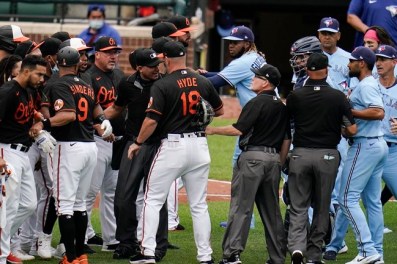
Manager Brandon Hyde and his Orioles after one of their own got drilled following back-to-back bombs in Camden Yards Saturday night. They know damn well Blue Jays pitcher Alek Manoah didn’t just slip a runaway fastball inside.

Here’s the Saturday night scenario in Baltimore: A rookie pitcher surrenders back-to-back home runs. He hits the next man up squarely on the bicep with the first pitch. He gets ejected post haste, then speaks to the press post-game.

“I tried to get that fastball in and it slipped away,” said Alek Manoah, the Blue Jays righthanded rook who drilled the Orioles’ Maikel Franco in the fourth inning, right after Ryan Mountcastle hit the first one-out, one on service over the left field fence and D.J. Stewart hit a 2-1 pitch over the right field fence.

The dog ate his homework.

And the Blue Jays overthrew the 5-2 lead Mountcastle and Stewart provided to gorge on the Orioles with a six-run ninth and a 10-7 win. It’s gotten that bad for this year’s Woe-rioles. They can’t even claim safety in a three, then a four-run lead.

But Franco looked distinctly unamused after he got that very pronounced plunk, and as Manoah stepped down from the mound walking toward the plate area. He looked as though he couldn’t decide whether he’d like to have Manoah for dinner or have him crucified on the warehouse behind the yard.

“I was confused by his reaction,” Manoah said. “I was questioning ‘What’s going on? What’s wrong?’ Those were my hand gestures as I was walking toward him. I didn’t understand the frustration there.”

“Even rookies don’t usually have to be told that a guy who can’t hit with a telephone pole this season doesn’t understand why he’s being made to pay because you just surrendered long distance back-to-back on your dollars,” said my long-distance pitching acquaintance, Sticky Fingers McSpidertack, on the phone this morning.

“So you’re telling me the dog ate his homework?” I asked, without a single thought of being a wisenheimer.

“Dig,” McSpidertack replied. “That Mountcastle guy took him out over the center field fence with one out in the second. And who’s that guy, Cedric Mullins? Took him out over the right field fence with two out in the third.”

“So Manoah’s a little on the frustrated side,” I replied. “Didn’t anybody in the minors teach him even for a few minutes that the best pitchers in the business are going to have days where they’re going to get slapped silly? Happens even to the Hall of Famers, Stick.”

“He spent, what, three games in Triple-A,” McSpidertack answered. “Maybe that’s not long enough to teach a few baseball life lessons, maybe it is. I’m the wrong guy to ask. I didn’t get much past Single A, you know.”

“I know, but you don’t have corn flakes for brains, either. I don’t think I ever saw you try putting a hole in the next guy’s anatomy after you got hit for a skyrocket shot.”

“Of course not,” McSpidertack said. “And Franco’s not the one who hung that slider, kept that fastball’s feet tied at the ankles, or threw him a melon even a guy below the Mendoza Line could have given a ride.”

“A ride? OK, Mountcastle’s shot in the fourth just barely made it out, hit the rail behind the fence or something. Got a fastball to hit for that first shot in the second, this time he gets the breaking ball and breaks it because it didn’t really break.”

“Right”

“Then Stewart turns on 2-1 and hits it right onto the Camden Yard promenade. Maybe it landed a few feet from where Boog Powell used to have and run that great barbeque pit.”

“Oh, yeah. I remember that pit, too. There wasn’t one single healthy thing coming off that pit, thank God.”

“Now it’s Franco. Compared to him this year, Mario Mendoza looks like Monster Mashup. The last guy on the planet, or at least on the Orioles, who’s going to take him into the ether. And Manoah throws one right up and into the poor guys’ upper bicep.”

“Or lower shoulder ball.”

“Well, let’s not get technical.”

“Fair enough,” McSpidertack said. “So when it’s all said and done, what’s the take?”

“What the hell do you think it is, Stick?”

“You’re gonna make me say it, aren’t you.”

“That’s my job, Stick.”

“Yeah, I know. OK, here it is. Manoah was full of manure last night.”

“I had to open my big mouth, didn’t I?”

“Your fault, buddy,” McSpidertack said, laughing. “Now tell me what all that was when skipper Hyde comes out of the dugout looking like he wants to take someone in a Toronto uniform apart but also looks like he doesn’t want his guys to do anything of the kind.”

“You need me to tell you that? I don’t think he wanted to take someone apart himself. I think he just wanted Manure—sorry, Manoah—thrown out of the game post haste. Which is exactly what he got. After he returned a few, shall we say, vulgar mash notes from Charlie Montoyo.”

“The Blue Jays manager.”

“Yeah.”

McSpidertack excused himself a moment to refill his morning coffee. I needed another coffee jolt myself while he was at it. When he came back, I said, “Did you see Manure–sorry, Manoah again—talking to the press after the game?”

“Yeah.”

“Did you hear him say he tried to slip that fastball in and it got away?”

“Yeah,” McSpidertack said. “And if I had a dollar for every time I tried to get a fastball in that got away, I could buy that Antarctican beach club of yours.”

“No you couldn’t, Stick,” I said. “You said yourself your career was over before it really began. You didn’t really have time to learn how to slip runaway fastballs inside. At most you’d have had enough to buy me a new set of guitar strings.”

“Then the dog ate his homework.”

This is a crackdown?

Liam Hendriks

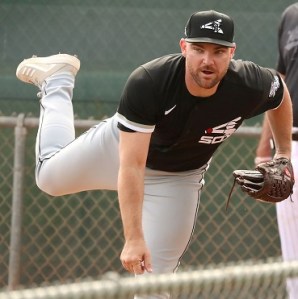
If MLB’s worried about near-universal foreign substances while still monkeying around with baseballs, why doesn’t MLB develop and approve its own new fashioned medicated goo, as White Sox pitcher Liam Hendriks suggests? Easy—it makes too much sense, and it’s probably way above Rob Manfred’s pay grade.

Does baseball’s government really prefer the symbolic slap on the wrist over the far more symbolic realistic discipline? Did anybody really think a game administration that can’t bring itself toward realistic suspensions of headhunting pitchers was going to bring itself toward a realistic approach to the pitching stickums, sauces, and syrups?

This is baseball government’s idea of a crackdown: ten-day suspension, with pay. For a relief pitcher that could hurt a little bit more, since he usually pitches a short spell on three, maybe four days out of seven. For a starting pitcher, it could cost one start at minimum, two maximum, depending on when he was frisked, busted, and booked.

“This pitcher shakedown,” Thomas Boswell told an online chat with readers Monday, “is going to be a hoot.”

“One objection raised by some players and managers was the league’s listing of rosin as the only substance permissible for pitchers who want to create additional tackiness on the ball,” writes Ken Rosenthal of The Athletic. ” . . . A combination of rosin and sunscreen can be more effective in enhancing grip without producing the massive jumps in spin rates that occur with pine tar and especially advanced substances such as Spider Tack. But the [MLB crackdown] memo explicitly lists sunscreen as a prohibited substance.”

“Don’t think everything is going to be perfect,” says umpire Joe West, a man about whom it could be said in that context that it takes one to know one. “It doesn’t happen that way.”

Indeed. And then there was the little matter of Rays pitcher Tyler Glasnow suffering a partially torn ulnar collateral ligament Monday night—after he quit using mere sunscreen to help him grip this year’s dubiously made baseballs and changed his normal motion to accommodate.

“Injuries already are a major problem in 2021,” Rosenthal writes. “It’s possible some pitchers will stay healthier if they adjust to the diminishment of their stuff by throwing with less effort to gain more command. It’s also possible others, perhaps trying to make up for lost spin, will suffer a fate similar to Glasnow, who is one of the top pitchers in the sport.”

The memo says the only acceptable substance helpmate for putting a little more friction on the ball is rosin, but Athletics manager Bob Melvin told Rosenthal not so fast: “Rosin on a cold night doesn’t work.”

One of Boswell’s Monday chatters posted a real money question: “Would severely restricting pitchers’ ability to doctor balls be as simple as requiring them to pick up and deposit a cap into a bucket before and after each inning?” Would it? And maybe a better question might be, if the pitchers are stripped of their syrups, will that mean automatically that the hitters are going to abuse them all over again?

These days pitching can be problematic enough. Too many hard-throwing pitchers with speed to burn and no clue of exactly where to put their pitches. With 861 hit-by-pitches as of this morning, one batter’s getting drilled every twenty innings pitched on average. There’s one wild pitch every twenty innings played, too.

And, with the three-batter minimum still in force for relief pitchers, unless they came into a jam and finished the previous inning, managers are throttled from getting a particularly wild pitcher out when it’s obvious he has no control but might inflict serious damage with a ball. Even a de-juiced baseball can cause serious injuries.

Padres reliever Austin Adams leads the Show with eleven hit batsmen. With 24 innings pitched as of this morning, that’s 46 percent of the time a batter’s taking one for the team against him. Numerous position players have told several writers in recent weeks that if the syrups are keeping pitchers from wildness the syrups don’t really bother them. Not even if they’re looking as though they swing pool noodles instead of bats.

That’s the pitchers who aren’t trying to put holes in hitters’ heads. But baseball hasn’t exactly been that firm on the genuine headhunters, either.

If the Show’s government isn’t willing to send stronger messages against the real headhunters—suspending starting pitchers ten starts instead of ten days; or, suspending such relief pitchers according to their average weeks’ work assignments—what made anyone think it was going to do something truly substantial against pitchers brewing syrups not to handle the ever-monkeyed-around-with baseball more reasonably but to get every last little subversive edge they can get?

Where do you draw the line? It doesn’t appear Manfred and his crew have so far. If blending rosin and sunscreen alone improves a pitcher’s grip without giving a shot of rocket fuel to his pitch spin rate, as Rosenthal observed, why on earth did the anti-syrup memo show the crew decided sunscreen should be on the verboten list?

Manfred’s critics often enough accuse him of knowing about as much about baseball as a butcher knows about neurosurgery. This crackdown, such as it might be, is liable to get him as many further such accusations as it might damnation with faint praise.

There was already a rule in the book against foreign substances on the ball. What took Manfred and his crew this long to decide to enforce it, when the new syrups were around before this season? But then you’d have to ask such questions as why Manfred and his crew can’t order umpires to call and enforce the written strike zone and knock it off with their individual zoning laws.

Regardless of such conditions as the balls themselves, or the actual or alleged approaches and attitudes of batters at the plate, there’s one thing that’s as much a baseball tradition as the ballpark hot dog—pitchers will look for any break they can get against batters, whether it’s actual subterfuge or just planting the ideas into the batters’ heads that they’re up to something subversive on the mound.

Even the mere allegation that this pitcher or that pitcher has something more than his fingers on a pitch can knock points off a hitting average and an earned run average alike. Hall of Fame Gaylord Perry once claimed he had extracurricular help almost any place he could think of around his uniform, but he wasn’t above putting the spitter on the brain first and foremost, either.

Maybe you won’t believe this, and maybe I can’t blame you, but when Candy Cummings first came up with the curve ball baseball’s overseers actually debated whether it was a newly-discovered skill or a deceitful trick. Imagine what they must have debated when the first knuckleball performed its first salsa on the way to the plate.

To this day, though maybe this coming “crackdown” might change it just a fragment (and that could be a big maybe), managers are as Boswell told his Monday online chatters: “Managers never ask—the guy could be on another team the next day, so why would he tell you his secrets. But managers always protect their pitchers—because there are so many skeletons in closets.”

That’s usually the main reason why managers aren’t in that big a hurry to swear out a search warrant for the other guys’ pitchers, too. The guy you had frisked, arraigned, cuffed, and stuffed today might be the guy joining your pitching staff at the trade deadline if not sooner.

Don’t forget: managers and their designated partners in crime (grounds crews and so forth) haven’t been immune to a little tricking and treating themselves. “Freezing the balls overnight to help your bad pitching staff, sloping the foul lines to help or hurt bunts (as suits your team) and turning the base path between first and second into a swamp with overwatering to inhibit base stealing have been around forever,” Boswell wrote sixteen months ago. “That slippery slope from brainy to gamesmanship to cheating exists in every sport.”

It also happens when the criminal mind spots an opportunity provided with the best of intentions. MLB installed replay rooms in both dugouts at the ballparks mostly because it was embarrassed by the blown Jim Joyce call at first base that denied Armando Gallaraga his perfect game. It turned to using the replay rooms as helpmates for old-fashioned sign-stealings (they still depended on baserunners sending the purloined numbers to the batters), and in due course to the flagrant extremities—the illegally-used computer algorithms, the illegal additional cameras, clubhouse monitors, and trash cannings—of Astrogate.

There’s a point to be taken when White Sox relief pitcher Liam Hendriks says, well, if MLB is concerned that mere grip enhancement on constantly monkeyed-around-with baseballs is turning into a few pitchers crossing the line to cheating, why doesn’t MLB do something substantial about it—and develop and distribute its own acceptable grip goop?

“I still think a universal substance needs to be added,” said Hendriks, who applauds the crackdown-to-be, to yet another Athletic writer, James Fegan. “Because if you’re coming into the ninth inning of a game, these balls have been sitting down for however long and they’re just pretty much dust. It’s interesting how everything is kind of ‘follow the rules, this way, this way, this way,’ but the balls are kind of left out the entire time and it’s controlled by the home team.”

There’s only one problem with Hendriks’s call. It makes too much sense. Of course, it would make a lot more sense if Manfred hadn’t misapplied his sacred pace-of-the-game crusade and decided the balls themselves have needed remaking/remodeling the past few seasons. Among other steps that make a klutz resemble Joe DiMaggio.

Manfred also doesn’t get that pitchers looking for edges with foreign substances (where have you gone, George Frazier: I don’t use foreign substances—everything I use is made in the U.S. of A.) have been around since the days of pitching underhand departed major league baseball.

“Only now, as the sport returns to its first full 162-game season since 2019, with a new baseball, does MLB find itself in hot water for years of feigned ignorance and not enforcing its own rules,” wrote yet another Athletic writer, Brittany Ghiroli, earlier this month.

This time though, the league hasn’t just been slow to stop the sticky substances, it has — perhaps inadvertently — made the problem worse.

Consider this: The players don’t get a say in the constant tinkering to the baseball, the latest version of which has higher seams and — as early as spring training — was already being buzzed about for its ability to favor pitchers with movement . . . [W]ho enabled the system that allowed these pitchers to cash in? Who decided to ignore the sticky stuff for years? Was the initial hope that the entertainment value—like performance-enhancing drugs — would perhaps translate into more eyeballs and excitement for the sport? Does anyone think asking professional athletes to police themselves and follow the rules when there are millions of dollars and livelihoods at stake would work?

. . . Here we are in early June, with the league moving quickly to resolve things, preparing to give umpires the power to inspect all pitchers without warning in order to not show any favoritism toward certain players or teams. The onus now, all of a sudden, is on upholding the integrity of the game. But what took so long?

Whatever new rules or regulations are put in place will be to enforce an existing rule. And while it’s easy to pile on the pitchers and pitching coaches and teams who knowingly broke the rules, the blame should not start there.

It should start with the league that allowed it, which — again — has waited and waited until a problem blew up to actually address it. Just like steroids. Just like the video review room.

How did we get here? By the sport closing its eyes and looking away from the problem, game after game, year after year.

Commissioner Nero thinks a ten-day suspension with pay is really going to fix the problem? I’d like to be proven wrong, but I have the feeling I got the first three words of that sentence wrong. Especially since, to most of us mere saps, there’s a word for ten days off with pay—vacation.

Mudcat Grant, RIP: Motivation

Mudcat Grant

Mudcat Grant shook a nagging cold and short rest to beat the Dodgers in the ’65 Series on the mound . . .

Jim (Mudcat) Grant, the first African-American credited with 20+ pitching wins in an American League season, was also only the second American League pitcher to hit a World Series home run. But he wasn’t sure how far he’d go starting Game Six of the 1965 World Series.

The righthander pitched on two days’ rest and a cold that nagged at him for a couple of weeks. Then, with deuces really wild—two out, two aboard, and his Twins holding a 2-0 lead against the Dodgers—Grant swung on Dodger reliever Howie Reed and drove one into the left center field seats, dancing his way across the plate.

The Twins held on to win Game Six, but it proved just a holding pattern until Hall of Famer Sandy Koufax could beat them with his second Series shutout in as many days. But it still wasn’t bad for a thirty-year-old pitcher who once had to, shall we say, clean up his act.

The Mudcat was said to have rubbed the inside front of his uniform with soap, waited for the daily sun to warm up enough to produce a little foam, then scoop a little onto his hand to apply to the ball. He got away with it until the day he overdid the soap inside his gray road uniform and the foam became too visible to ignore.

Hall of Famer Don Sutton once bragged that he was accused of throwing doctored balls so often he should get a Black & Decker commercial out of it. In due course, Sutton did get just that. It’s a shame nobody thought to offer the Mudcat—who died Saturday at 81—a commercial for Dial. Or at least Lifebuoy.

Just picture the friendly-looking Grant holding a bar and purring, with that power failure-defying smile of his, “Aren’t you glad I stopped using Dial? But don’t you wish nobody else would?” Or, “Take it from a stinker on the mound—use Lifebuoy so you won’t be a stinker anywhere.”

Behind that friendly face and somewhat extroverted personality, there bristled a man who’d once gotten into racial trouble he didn’t ask for as a young Indian. In the bullpen one day, singing along with “The Star Spangled Banner,” Grant sang “this land is not so free/I can’t even go to Mississippi.” He claimed he did it for fun, but bullpen coach Ted Wilks was not amused.

“Wilks heard me and called me a (racial) name,” the Mudcat told the Cleveland Plain Dealer. I got so mad I couldn’t hold myself back. I told him that Texas [Wilks’s home state] is worse than Russia. Then I walked straight into the clubhouse.”

Manager Jimmy Dykes had no clue of the source after Grant walked into the clubhouse, changed clothes, and left the ballpark entirely without a further word. The skipper suspended Grant without pay for the rest of the season and refused to rescind it even after Grant called the following day to apologise. Wilks apologised, too, but Grant understandably refused to accept that at face value; the coach would be gone after the season.

Dykes didn’t hold it against Grant, however. He settled Grant into a starting role in 1961. Grant led the Indians with 244.2 innings pitched and three shutouts and was second with 146 strikeouts behind Gary Bell’s 163. Since pitching wins then were considered the alpha and omega, though, Grant’s team-leading fifteen have to be measured against his 3.86 ERA and his 4.45 fielding-independent pitching.

Still, he made himself an Indians fixture, even working in the team’s off-season ticket office and with their community relations department, until a hard 1964 start got him dealt to the Twins that June, for pitcher Lee Stange and infielder George Banks. Twins manager Sam Mele was convinced the trade was a winner for both sides.

Mudcat Grant

. . . and with the insurance runs off his own three-run homer in the bottom of the sixth.

It was for Grant. As a 1964 Twin he posted his lowest ERA (2.82) over twenty or more starts in a season. In 1965 he parlayed 5.4 runs of support per start into those 21 wins that season. (In due course, Grant would write a book about the so-called Black Aces, the African-American pitchers who’d enjoyed 20+ win seasons including himself.) He also posted a 2.74 World Series ERA in three starts with two credited wins. (He beat Hall of Famer Don Drysdale in Game One, lost to Drysdale in Game Four, then beat Claude Osteen in Game Six.)

The Mudcat also swore he got his biggest 1965 help from pitching coach Johnny Sain, the one-time Boston Braves pitching standout, who’d taught him a way to throw his curve ball faster. “I’ve never had a real good fast curve before,” he told writer Jim Thielman.

I’ve always had a good fastball, a change of pace and a slow curve. They said I needed to change speeds. I’ve always been able to change off my fastball, throw a straight slow ball up there. But until this year, I never thought in terms of spinning the ball. That’s where Sain helped me.

Grant shook off a hard first half in 1966 to pitch a strong second half. Then two things happened in 1967. First, he was struck on the forearm as spring training was about to end, costing him the season’s first two weeks. Then, Mele—who’d already dumped Sain as pitching coach at 1966’s end—faced his own firing squad, replaced by Cal Ermer.  Between injuries (knee and arm) and Ermer’s inability to define his role, Grant began looking for a way out of town.

He got it when the Twins traded him and their 1965 American League Most Valuable Player award-winning shortstop Zoilo Versailles to the Dodgers for 1968. The Mudcat loved the idea—the Twins atmosphere in parts had become intolerable to him.

“It was a problem between the Minnesota manager and management and myself,” he told the Los Angeles Times. “Some of it was racial, too. They made me feel as though I wasn’t even a man. I’d pitched only 95 innings and it isn’t because of my knees, either. I have lived with the knee trouble for years. But I told them I couldn’t remain with them and wanted to be traded.”

Now a full-time reliever, Grant pitched brilliantly enough as a 1968 Dodger: a 2.08 ERA, a career-low 2.57 FIP, and—even more remarkably, considering his proneness to it in the past and even allowing Dodger Stadium’s difficulties for hitters—he surrendered only one home run all season long.

The Montreal Expos adopted the Mudcat in the expansion draft, then dealt him to the Cardinals in early June. A somewhat lost season turned into a sale to the Athletics, and Grant flashed one more brilliant season in relief, with a 1.86 ERA for the year even with the A’s selling him to the Pirates that September. But after a 1971  for the Pirates and (sold back to) the A’s, and his failure to make a return to the Indians stick in spring 1972, the Mudcat called it a career.

Grant’s concern for black ballplayers didn’t end when his career did. In due course, the righthander who once led a musical group named Mudcat and the Kittens became an active and vocal presence encouraging African-American youth toward baseball.

It certainly took in his own family. (Grant was also the grandfather of 34.) Domonic Brown—who looked like a Phillies comer until an assortment of knee and leg injuries diminished him as an outfielder, then a hitter, until he finally made his way through three seasons in the Mexican leagues—is Grant’s nephew.

“We just gotta motivate them to play and we’ve got to be around,” said Grant in 2008, after he’d been an Anheuser-Busch distributor and, before that, a television analyst for the Indians and the A’s and a pitching coach for the Triple-A Durham Bulls. Not to mention the author of The Black Aces.

“We haven’t been around enough,” he continued. “Now, part of that is the African-American ex-players’ fault, too, because we haven’t been there. Even though we see tons of children, we haven’t been in the inner city like we should.” He probably helped awaken others like him to get there.

Unlike some of the pitches he Dialed in once upon a time, there was no soft-soaping it for the Mudcat there.