Once again: Injuries are not character flaws

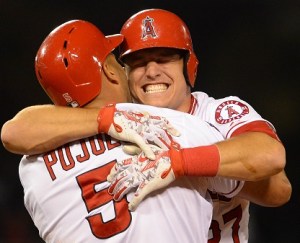
Albert Pujols, Mike Trout

Mike Trout and Albert Pujols—some idiots call Trout a “puss” and others called Pujols a “thief” . . . for the heinous crimes of being injured on the field.

Sometimes it seems as though when a player is injured in the line of duty, he or she becomes a kind of criminal in Joe and Jane Fan’s eyes. Far as they’re concerned, such players are any one of a number of unflattering things. Especially when an injury keeps them out of action for more than, say, a week or two.

It’s as if injury belongs with defeat among moral shortcomings and aren’t covered by simple, irrefutable laws of sports. In a game, somebody has to lose. On the field, someone’s liable to be injured. They’re plain facts of life. They don’t expose the defeated as degenerates or the injured as gutless.

I’ve been steaming over it ever since I saw one social media snit dismissing Mike Trout, who’s dealt with season-disrupting/ending injuries the past couple of full seasons, as “a puss.” Last year, a torn calf muscle incurred running the bases put paid to his season after 36 games.

You’d think that with everything we’ve long since learned we’d quit condemning the wounded as weenies because they were just so much “tougher” in the Good Old Days. News flash: The good old days weren’t so good when it came to athletes’ health. And the next time you look at the numbers of careers you think should have lasted longer or been better than brief flashes of brilliance, stop to think about those players’ injury histories.

They used to say Roger Maris merely proved himself a lamer because he never again had a career spell such as 1960-62. They said the pressure of that 61-homer 1961 took him down. Those people forget that a series of injuries beginning in ’62 began sapping Maris’s formidable power and reducing him to journeyman level by 1965.

The Yankees falling into a lost decade of 1965-75 needed as much box office power as they could still wring out of ancient (and very often injured) Mickey Mantle, Whitey Ford, and Maris. They even forget that that generation of Yankee movers kept the true seriousness of a wrist injury from Maris unconscionably, in order to keep him on the field—at the time the Yankees collapsed due to age on the field and parching in the farm system.

Gene Mauch and Leo Durocher were known to denounce the injured as quitters. Between that and foolish trades, no wonder the post-1964 Phillies wouldn’t be competitive again for almost a decade to come. No wonder the 1969 Cubs were too spent down the stretch to keep up with the surging Mets and take back the National League East that first looked like those Cubs’ for the taking.

They used to call Jim Palmer anything from a prima donna to a hypochondriac when the slightest hint of an injury sent him shuddering over the prospect that his pitching career was over. It came from mishandling an injury he incurred after his rookie splash and out-lasting arthritis-addled, overmedicated Hall of Famer Sandy Koufax in Game Two of the 1966 World Series. Well, now.

Maybe Palmer was onto something after all, no matter how exasperated Earl Weaver and his teammates got with his health concerns—which was plentiful enough, no matter how much they liked him as a person. That’s Palmer reposing in the Hall of Fame as one of the absolute best pitchers of his generation and with three World Series rings to show for it, too.

Forget about the idiot dismissing Trout—who’d be a Hall of Famer and the fifth-best all-around center fielder ever to play the game if his career ended this instant—as a puss. Think of all the idiots who believe to this day that Albert Pujols “stole” that $240 million he earned as an Angel . . . and forget that his lower body, particularly a plantar fasciitis-addled heel and numerous other leg injuries was the real reason he collapsed after a respectable first season in Anaheim.

Ill-fated Jacoby Ellsbury’s reasons for not even thinking about re-signing with the Red Sox when he hit free agency included whispers that he took “too long” to recover from injuries his full-out playing style incurred. He signed big with the Yankees—and the injury parade continued apace, right down to his missing 2018 with a torn labrum and 2019 with foot and shoulder injuries.

It was hell if you do and hell if you don’t for Ellsbury. Return too soon from any injury and you risk re-injury; return not soon enough for teammates’ or managements’ or fans’ tastes, and you risk exactly what Ellsbury put up with, unfairly and unconsionably, a reputation as a fragile goldbrick.

The late Mark (The Bird) Fidrych tried too many premature returns from injuries and re-injuries after his sensational rookie 1976. Career in the toilet and done swiftly enough. Still think he merely “disappeared?”

Often as not the teams themselves don’t help. Last year, Phillies manager Joe Girardi said it was perfectly acceptable to keep injury information out of the press. He was thinking of keeping the other manager from getting a little advantage, but he forgot that a) opposition managers tend to know when an opponent is hurting; and, b) Joe and Jane Fan are ignorant enough about injured players without being lied to even further while they’re lying to themselves.

Basketball people have spent all this season listening to whispers-to-screams denunciations of Brooklyn Nets guard Ben Simmons, missing an entire season because of back trouble. Most of them didn’t want to hear it. He backed out of the fourth game of the Nets’ playoff round against the Boston Celtics with his back still bothering him.

The talking heads went nuclear; some of them called Simmons the same kind of thief that people called Pujols the Angel. Even ex-NBA supermen like Shaquille O’Neal called backing out of the game “a punk move.” That “punk move” turned into back surgery Simmons underwent Thursday.

“The notion that Simmons was faking it, that he was just scared to play in the game because the Nets were down in the series, made no sense,” wrote a furious Deadspin writer named Rob Parker. “And the back is a tricky thing to put a handle on. A back issue could be so bad that a person can’t even tie their shoe, let alone play basketball on the NBA level.”

Reminder: Injuries on the field aren’t the same thing as chasing Jill St. John down a ski slope and turning your knee into bone meal (Jim Lonborg), doing a slam-dunk move and catching your ring in an awning mechanism to shred your hand ligaments apart (Cecil Upshaw), staying too long without the sun screen on a tanning bed (Marty Cordova), or dozing off with an ice bag on your foot to incure frostbite—in August. (Hall of Famer Rickey Henderson.)

I’ve said it before, but I’ll say it again and again if need be. Big money contracts don’t immunise you from the same injuries to which merely mortal players can be susceptible. Nine figures don’t turn Clark Kent into Superman. They also don’t heal a player in ten minutes or less. Anyone who doesn’t get that should never be taken seriously as a fan, a coach or manager, or a professional analyst.

Unless a player was injured doing something stupid off the field, or you have heretofore undetected deep medical knowledge, you have only one recourse whenever a player—from the most modest bench player to the most obvious Hall of Famer in waiting—is injured in the actual line of duty.

That recourse is to shut the hell up and stop treating real sports injuries as evidence of fragility or cowardice. Because the only one resembling a fragile coward in my eyes when you dismiss this injured player as a puss or that injured player as a goldbrick is you.

Listen up, Bleacher Creatures

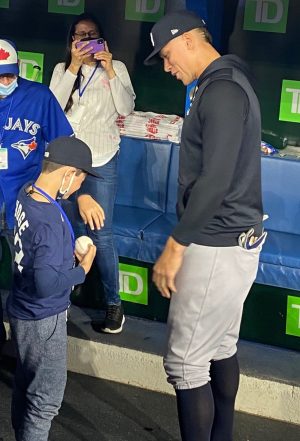
Derek Rodriguez, Mark Lanzillotta

Derek Rodriguez (in his Yankee hat and Aaron Judge T-shirt) hugging Mark Lanzillotta gratefully, after Lanzillotta handed the boy a sixth-inning bomb Judge hit in Rogers Centre.

Recall if you will that I went to Opening Day in Anaheim with my 28-year-old son. From the moment he became a baseball fan in earnest at age six, his dreams included catching or otherwise obtaining one bona-fide major league baseball at the ballpark. On said Opening Day, 22 years later, I managed to make his wish come true.

An Astro lined a foul into our section during batting practise. Thanks to a small but clustered group of fans standing up adjacent to us, neither Bryan nor myself could see which Astro hit the ball. No matter. It bounded around a few times before making its way beneath my seat, where I snatched it and handed it to him.

Neither Bryan nor I cared that it came off an Astro bat, even if he (and I) might have preferred it courtesy of an Angels bat. It was a baseball, major league regulation, a simple but profound little prize of fandom that you can go a lifetime without obtaining, regardless of how often you’re at the ballpark.

My son’s gratitude was boundless, of course, even at age 28. “You gotta be a man to play baseball for a living,” Hall of Fame catcher Roy Campanella once said, “but you gotta have a lot of little boy in you, too.” Savouring and rooting and appreciating this game means the same thing when you’re watching at home or at the ballpark. Even professionally.

So imagine easily how it felt for a nine-year-old boy in Rogers Centre Tuesday, wearing a Yankee T-shirt with Aaron Judge’s surname and number 99 on his back, praying to God and His servants in the Elysian Fields that maybe, just maybe, he might catch a ball hit by his hero. He got the absolute next best thing.

A Blue Jays fan named Mike Lanzillotta sat in the second deck behind young Derek Rodriguez and his father, Cesar, Venezuelan natives living in Toronto the past five years.  Somehow, the boy’s eagerness got to Lanzillotta throughout the game. He didn’t have to imagine when lo! Judge batted a third time in the top of the sixth inning, against Jays pitcher Alek Manoah, who’d struck him out twice earlier in the game.

Not even Mark Harris, W.P. Kinsella, Ring Lardner, Bernard Malamud, or John Updike could have sketched this one. I’m nowhere in their league so I’m not sure I’m doing it right.

Judge caught hold of a fastball sailing a little inside and drove it . . . right into Lanzilotta’s hands. As Judge rounded the bases, Lanzillotta kept the promise he made to himself and handed Derek the ball. The boy’s gratitude poured into a hug around the older man’s neck and shameless tears of joy. Television cameras caught the moment and it went viral almost at once.

“I almost started crying,” Lanzillotta admitted to reporters. “For real, I almost started crying.” The father soon enough faced a question from his son: “I said, ‘If you were young, and the same thing happened to you, but with a home run off of Derek Jeter, what would you do?’” the boy revealed. “And he said I would cry the same. And fun fact, I was named after Derek Jeter.”

Aaron Judge, Derek Rodriguez

Derek got to meet his Yankee hero before Wednesday’s game.

Funner fact: The tale of Derek Rodriguez, Mike Lanzilotta, and Aaron Judge’s blast reached Judge himself after the Yankees demolished the Jays, 9-1. Reporters told Judge of the Kodak moment. (Oops! Today we’d call it an iPhone moment.) Known for being as fan friendly as the day is long, Judge himself seemed almost overcome by the revelation.

“That’s what’s special about this game, man,” the Yankees’ Leaning Tower of River Avenue told reporters, after grinning and observing you’ll find Yankee fans around the world. “It doesn’t matter what jersey you wear, everybody is fans, everybody appreciates this game. That’s pretty cool. I’ve got to check out that video. That’s special.”

He did more than just check out that video. Before today’s game, Derek got to meet his Yankee hero, who signed the home run ball for him. The still boyish-looking Judge looked as though he’d been taken back to his own boyhood for a few shining moments.

The Blue Jays didn’t exactly appreciate being blown away by the Yankees Tuesday, but it didn’t stop the team from giving more than a tip of the beak to Lanzillotta. They dropped a special team gift package on him for his sportsmanship. Cesar Rodriguez called him a friend for life. His cell phone was all but nuked with texts and calls following his gesture.

“I spilled my beer” retrieving the Judge home run ball, Lanzillotta said, “but it was worth it.”

Now listen up, all you Bleacher Creatures around the Show. You, the mental midgets who think it’s funny as hell throwing the opposition’s home runs back onto the field, pouring  abuse upon an opposition pitcher known to struggle with clinical depression, thinking it’s funny as hell throwing garbage and other debris on the field when an opposition fielder is injured on a play.

You should be made to watch that Judge bomb, that Lanzillotta gift to nine-year-old Derek Tuesday, and the boy’s meeting with Judge today. You might learn or re-learn a few things about sportsmanship. About real baseball rooting and caring. About plain human decency.

The Mets eat nada DFA’ing Canó

Robinson Canó

Canó’s days as a Met are over. His Hall of Fame case ended well before that, unfortunately.

We can dispense early with this: In designating Robinson Canó for assignment Monday, the Mets aren’t “eating” the $37 million they still owe him. They dined on it the moment they agreed to take on the bulk of the $96 million the Mariners still owed him for the coming four years, the price paid for bringing relief pitcher Edwin Diáz to the Mets at the end of 2019.

As Keith Law wrote in The Inside Game, recalling the Diamondbacks “eating” $22 million still owed imploding pitcher Russ Ortiz in 2006, “That salary was already somewhere in Arizona’s GI tract, likely causing indigestion but there nonetheless. Major League Baseball player contracts are guaranteed; there is no way to un-eat that meal.”

And there’s no way to un-eat the already-eaten $37 million the Mets will still pay Canó, though now it’s to not show his face at second base or occupy a designated hitter’s slot for the remainder of the deal. It was probably just a pinch of pepper on owner Steve Cohen’s breakfast when he bought the team in the first place.

Today’s the day MLB teams had until noon eastern to trim their active rosters back to 26. The lately torrid Mets (16-7 on the season thus far, tops in the National League East, and 7-3 in their last ten games) had fans fearing other players with remaining minor league options might get the push back.

If Dominic Smith and J.D. Davis especially had gotten the push, Met fans would have thrown things at the nearest available front office heads. If it were Luis Guillorme or Travis Jankowski, they might have settled merely for a noisy protest and maybe some nasty Citi Field chanting.

The least-kept secret prayer among them was let it be Canó, considered the millstone that’s also the last big mistake of the Wilpon generation and their last general manager, Brodie Van Wagenen. Smith’s the only viable first base backup and can also DH; Davis is one of their critical bench rats and can also play third base; Guillorme’s the only true shortstop stand-in whenever Francisco Lindor might need a breather; and, Jankowski is an outfield defense standout in the making who also has speed to burn.

Cutting them would have been a baseball equivalent of solving a simple steering problem by replacing half the drive train. Cutting Canó was a critical portion of the 5,000 mile checkup.

The 39-year-old who made his bones as a Yankee should be looking forward to a pleasant retirement and a Cooperstown berth. Until his age began to catch up to him, he was well enough on the track that the JAWS system of Jay Jaffe, author of The Cooperstown Casebook, has him as the number seven second baseman, ever, with a peak value slightly above the average Hall of Fame second baseman and a career value all but dead even with the average Hall second baseman.

“Cano appears well on his way to a bronze plaque,” Jaffe wrote in that 2017 book, in the “Further Consideration” portion for second basemen. “He’s already above the peak score at second—the seventh-best, with everyone else but him and [Chase] Utley from among the top ten already enshrined. It’s not out of the question he pushes his way higher in that category, either. He’s got a good chance at 3,000 hits, needing to average just 113 per year until his contract runs out in 2023. The bet here is that he winds up around seventh in JAWS here.”

Jaffe had the seventh-in-JAWS part right. But then Canó trainwrecked his own self in May 2018. He got an eighty-game suspension for furosemide, a diuretic that isn’t an actual/alleged performance-enhancing substance but is banned as a likely masking agent under MLB’s PED protocols. He got plunked with that two days after a hand injury when he was hit by a pitch in a May game.

Then, after leaving Seattle for the Mets and having one last hurrah in the pan-damni-ically shortened 2020 season, Canó was handed a suspension for all 2021 after he tested positive for stanozolol, an actual anabolic steroid, in November 2020. A second PED ding means an automatic 162-game suspension.

It’s one thing to argue on behalf of the Cooperstown enshrinement of those players who have no-questions-asked Hall credentials but were either known or suspected of actual/alleged performance-enhancing substances during the era before baseball saw the light/felt the heat and began earnest, honest-to-God testings.

But it’s something else to argue on behalf of enshrining a player either ignorant enough, careless enough, or foolish enough to dip into the PED after testing became established and widespread and widely-reported.

Canó could plead ignorance the first time around. It’s entirely possible he had no idea a doctor’s prescribed medication included furosemide, known commonly as Lasix. But he couldn’t quite plead ignorance the second time around. Just as with Manny Ramírez and his two PED-related suspensions well after testings began, Hall voters won’t exactly jump to acquit Canó and pass him in.

He was an excellent defensive second baseman before age and injuries started taking their toll. At this writing he’s number twelve at the position for defensive runs above his league average (+69) on the career list. He also threatened Jeff Kent’s record for lifetime home runs as a second baseman; he has 316 to Kent’s 351. And if you put excess stock in such things, he’s only 368 hits shy of the Magic 3,000.

He lacks black ink but he’s an eight-time All-Star. Without the two dings for actual/alleged PEDs, you could call Canó the sleeper Hall of Famer. But how does he look according to my Real Batting Average metric? (RBA: Total bases + walks + intentional walks + sacrifice flies + hit by pitches, divided by total plate appearances.) Let’s insert him into the ranks of the post-World War II/post-integration/night ball-era Hall of Fame second basemen. You’re going to be shocked:

Second Base PA TB BB IBB SF HBP RBA
Jackie Robinson 5804 2310 740 61 30* 72 .550
Robinson Canó 9489 4274 618 112 62 85 .543
Joe Morgan 11329 3962 1865 76 96 40 .533
Ryne Sandberg 9282 3787 761 59 71 34 .507
Roberto Alomar 10400 4018 1032 62 97 50 .506
Craig Biggio 12504 4711 1160 68 81 285 .504
Rod Carew 10550 3998 1018 144 44 25 .496
Red Schoendienst 9224 3284 606 30 38* 21 .431
Nellie Fox 10351 3347 719 30 76* 142 .417
Bill Mazeroski 8379 2848 447 110 70 20 .417
HOF AVG WITH CANÓ .490

You’re not seeing things. Robinson Canó would have been number two in RBA among the Hall’s post-WWII/post-integration/night ball-era’s second baseman if his career ended today (Chase Utley would be right behind him, by three points, by the way) if he hadn’t shot himself in the foot for a second PED suspension. He also would have been 53 points above the average such Hall of Fame second baseman.

It’s impossible to say whether another team may yet pick Canó up once he clears the DFA waivers, or whether one might deal for him first. (He’d have to accept a role on the bench, either way.) But it’s not impossible to say that Canó may be seeing the final sunset of a career that should have sent him to Cooperstown.

Bauer outage: suspended two years

Trevor Bauer

Bauer’s two-year suspension won’t ease his victims’ pain or his way back to baseball—and in that order.

In considering Trevor Bauer’s unprecedented two-season suspension Friday for violating MLB’s domestic violence protocols, under which he won’t be paid and the Dodgers will be off the hook for the rest of his salary, I can’t help harking back to something pointed out last August. That’s when Los Angeles County Superior Court Judge Dianna Gould-Saltman lifted a temporary restraining order against the pitcher.

During the hearings preceding that lift, the victim in the case testified for twelve hours. Bauer’s legal team may have drawn some inconsistencies from her regarding secondary items, but as Cup of Coffee writer and former NBC Sports analyst Craig Calcaterra wrote then, they never discredited “the central claim that he assaulted her in horrible ways.”

Maybe that makes it harder for the accuser to recover any money from him in a civil suit. Maybe that makes a prosecutor less likely to bring a criminal claim against Bauer for fear of the case being difficult. But the central truth of this entire affair—the stuff that Major League Baseball will look to regarding Bauer’s behavior, irrespective of whether charges are brought—points pretty clearly to Bauer doing exactly what his accuser said he did. Everything else is secondary.

After 12 hours of testimony, his accuser said, under oath, “I did not consent to bruises all over my body that sent me to the hospital and having that done to me while I was unconscious.” There was zero evidence presented which explained how those bruises appeared in a way that was benign or refuted the idea that the woman was unconscious when Bauer inflicted them. That, in my mind, is all that matters. (Emphasis added.)

This past February the 31-year-old righthander found himself off the purely legal hook, after Los Angeles County prosecutors decided not to press criminal charges against him. “Those words don’t say the evidence is false,” I wrote at the time, “as much as they say getting a criminal conviction at trial would be tougher than hitting an outside slider over the center field fence.”

The Dodgers knew Bauer was a mere misogynist when they signed him as a free agent in February 2021. “The Dodgers didn’t know Bauer would be accused of sexual assault,” writes Los Angeles Times columnist Dylan Hernández. “However, they knew he was always in some sort of trouble.

They knew how respected baseball people such as Kevin Towers and Terry Francona wanted nothing to do with him. They knew he sliced open his pitching hand repairing a drone.

They knew he threw a ball over the centerfield wall instead of handing it to the manager when he was taken out of a game. They knew of his online harassment campaign against a female college student . . . The question was never about whether Bauer would get into trouble; the question was about what kind of trouble he would get into.

But almost from the moment Bauer’s suspension was announced, defenders sprang up all around the social media universe to decry justice denied. He was cleared of all wrongdoing by a court of law! Well, not exactly. Wrongdoers aren’t always compelled to answer for their wrongdoing in the courts.

Employees from the most obscure clerk, warehouse worker, or line worker, to the highest-powered executives do get suspended and even fired from their jobs over wrongdoings that won’t get them into legal trouble at all, never mind prison time or fines. They are no less wrongdoings for lacking the weight of the law’s punishments.

Why would baseball suspend Bauer two full seasons if prosecutors decided they couldn’t get a criminal conviction against him? ESPN writers Alden Gonzalez and Jeff Passan asked and answered:

The standards in criminal and civil cases differ from those of a private business. The judge dissolving the temporary restraining order and declining to issue a permanent one does not absolve Bauer of liability within the joint policy. Neither does a prosecutor passing on pressing charges.

MLB’s imposed discipline is based on its own investigation, separate from the criminal proceedings. The league’s investigation into Bauer’s case lasted 10 months. Details about MLB’s findings have not been released, but the league’s investigators considered more than just the sexual assault allegations of the San Diego woman from last year. They looked into at least one other allegation, from an Ohio woman who sought a temporary restraining order against Bauer in June of 2020, details of which were reported by the Washington Post.

Hours after Bauer’s suspension was announced, the Post published a story about another Ohio woman who accused Bauer of choking her unconscious without consent during sex on multiple occasions over the course of a relationship that dated back to 2013. Bauer strongly denied those allegations, as he did the allegations by the other women. But the two Ohio women told the Post they cooperated with the league’s investigation, and we don’t know if others were involved as well.

What kind of sex you enjoy is irrelevant so long as it’s with a fellow human and under mutual, conscious consent. What you do while your partner is unconscious and thus unable to consent any further is very relevant when you’re being investigated formally after accusations of sexual assault, whether it’s a legal investigation or one by your employer.

There are those among Bauer’s defenders who raise the question as to why it should have been Bauer and not other known domestic violence violators to be hit with a hammer as heavy as the one with which he’s been hit. (Bauer said at once he’d appeal the suspension.) That’s not an unfair question.

Among others, Yankee relief pitcher Aroldis Chapman was suspended thirty games in 2016 for choking his girlfriend and possessing a firearm he fired into a wall. Then-Cubs infielder Addison Russell was suspended forty games in 2018—after the Cubs lost the National League wild card game—for beating his now-former wife. Braves outfielder Marcel Ozuna was suspended twenty games retroactively in November 2021 over what proved to be trying to choke his wife before throwing her against a wall and hitting her with the cast on his broken left hand.

Those were letting such crimes off the hook too easily, even allowing that those players “accepted responsibility” for their acts. But then free agent reliever Sam Dyson was suspended for the entire 2021 season after his former girlfriend accused him of rape, battery, and psychological abuse.

Some of Bauer’s defenders think commissioner Rob Manfred came down heaviest upon Bauer because Bauer’s been an outspoken critic of of Manfred’s administration in the past, before his sexual assault issues came forth. A very few of those defenders even implied Bauer’s entire domestic violence issue might have been ginned up as a way to try shutting him up.

Even Manfred isn’t that foolish. You’d have to have precisely the imaginative mind Manfred lacks to forge that kind of plot just to push a particulaly outspoken critic to one side. Even if you’re a commissioner who can be accused of abuse of power. But there is a way for Manfred to show he doesn’t care what his in-game critics say or think when it comes to certain very grave matters.

Get with the Major League Baseball Players’ Association and adjust the domestic violence protocol to allow for suspending any player found violating baseball’s domestic violence policy for one full season’s worth of games minimum from now on. I phrase it that way because they won’t all come forth before a season begins, as Dyson’s did.

The bad news is that even that won’t ease their victims’ pain. But it would send forth a more powerful affirmation that baseball suffers no domestic violence benignly and that, no, Bauer wasn’t just singled out for particular punishment, for any corresponding reason.

The Bronx Boneheads

This is what the Yankees were afraid of being exposed? After two years, accidentally turning up during a lawsuit’s discovery phase, and a few legal contortions on behalf of blocking it from anyone else’s sight, this is what the Yankeegate letter was all about? Their own 2015-2017 replay-room reconnaissance ring, a la the 2018 Rogue Sox?

No, we’re not going to argue that electronic cheating isn’t so terrible even if it doesn’t rise quite to the Astrogate level. Agree that neither those Yankees nor those Red Sox were behaving themselves, even if the Yankees didn’t get far enough in the postseason to try it in a World Series the way the ’18 Rogue Sox probably did.

But someone, anyone. Please.

Tell me the Bronx Boneheads aren’t that deeply full of themselves that they couldn’t have withstood whatever minor slings, arrows, brickbats, and bashings would have confronted them over mere replay room reconnaissance. Tell me they’re not that ridiculous about preserving the Yankee image no matter how little their sneaky little shoplifters resemble the grand theft felons.

About the only thing the Yankee prankees seem to have done a little differently than the Rogue Sox was use their dugout phone on the road to get the stolen signs from the road replay room and then transmit it to a baserunner to send home to the batter.

Cheating is cheating? Please. This was comparable only to teen comedians ordering pizzas for deliveries to unsuspecting chumps across town. It didn’t exactly amount to seizing the pizzeria and taking hostages.

Since there were unconfirmed numbers of other teams doing likewise with their free presents from MLB, those other teams are probably laughing their fool heads off over the lengths to which the Yankees spent time and money trying to keep the Yankeegate letter from escaping into the public eye.

Yes, I said free presents from MLB. It was MLB itself that laid the replay rooms on both clubhouses in all ballparks starting in 2014. They did it with the best intentions. Perhaps naively, they forgot that boys will be boys, and presents such as those were probably bound to inspire a little extracurricular chicanery.

Since Astrogate and Soxgate’s exposure in 2019-20, the rules now involve security personnel posted at all replay rooms. Before the December-March owners’ lockout, both sides were close enough to agreeing, too, on more stringent measures such as no one but a team’s designated operator plus an MLB security worker allowed in the rooms, and even blacking out catcher’s pitch signs on the replay room monitors.

But while you have your laughs-and-halves over the Yankees resembling the siblings scrambling to Watergate coverup lengths to keep Mom and Dad from learning one of them accidentally smashed the crystal pilsner glass, causing it to shatter into a trillion shards, try to remember that this does not and will not get the 2017-18 Astros off the hook.

The Yankees, the Rogue Sox, and other teams who merely turned the replay rooms into their versions of Spy vs. Spy didn’t go to even half the lengths those Astros did for intelligence gathering and transmitting.

Their general managers, so far as anyone knows, didn’t sanction sign-stealing algorithms developed by low-level interns and ignore the warnings that using them in-game was illegal. Now-former Astros GM Jeff Luhnow thought of that with the Codebreaker algorithm.

Their bench coaches and designated hitters didn’t dream up either an independent high-speed real-time camera or alter an existing delayed camera into illegal real-time transmission to deliver opposing signs to clubhouse monitors next to which a transmission person could signal Astro batters by banging the trash can, slowly or otherwise. Then-Astros bench coach Alex Cora and DH Carlos Beltran did. (Smile—you’re on Candid Camera!)

“These are different things. Very, very different things,” tweeted ESPN’s Jeff Passan after the Yankeegate letter was obtained by SNY.

Players have been trying to steal and relay signs from second base forever. That doesn’t excuse the Yankees and Red Sox, but context matters. Relaying pitches with such specificity as the Astros did was entirely new.

Now, if MLB comes down harder on the Yankees or Red Sox in 2017, does that change things? Perhaps. Maybe the Astros are scared straight. But let’s remember: Manfred warned the Red Sox in 2017 after using the Apple Watch. And they won the World Series in 2018 while cheating . . .

Using technology to steal signs was rampant in baseball. The Yankees, Red Sox and Astros — and others whose indiscretions have not been proven publicly — did it. It’s simply facile to treat them as the same. It’s factual to say that there are different levels of cheating.

The one true revelation in the Yankeegate letter is that commissioner Rob Manfred actually fined the Yankees $100,000 after they were caught using their dugout phone in September 2017. Seriously?

They spent two years and who knows how much money in legal costs to try to suppress . . . that their mere replay room reconnaissance ring of 2017-18 wasn’t even half the Astro Intelligence Agency and cost them in the end slightly less than half what they pay pitcher Gerrit Cole per day?

The Yankees feared “significant and reputational harm” if the letter was made public. That fear may have been well founded. But not for the reasons the Bronx Boneheads thought.