Are Hal Chase’s statistics “meaningless?”

Hal Chase

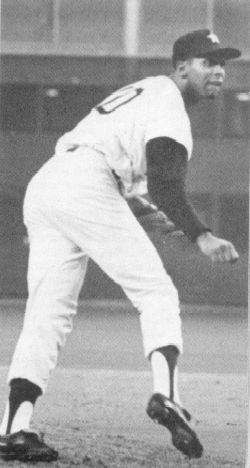
Hal Chase—The talent said a great defensive first baseman; the corruption says otherwise. (Sporting News photo.)

If there’s one thing that baseball itself will debunk somewhere, some time, somehow when you least expect it, it’s the idea that you’ve seen everything on or off the field. The moment you satisfy yourself that you have, the game has a way of replying in a split second, “Pants on fire!”

That doesn’t work with great hits or great plays alone. You think you hear it all (over again) whenever Pete Rose’s dwindling supporters burp up yet another mealymouth argument on behalf of putting him into the Hall of Fame despite what Rule 21(d) and the Hall’s own rule about ballot eligibility say? Brace yourselves.

For whatever reason, the subjects of the day a few days ago, on a Society for American Baseball Research (SABR) social media group thread, included Hal Chase, whom history still treats as perhaps the poster boy for baseball’s gambling infestation from the late 1800s through the end of the Dead Ball Era.

A thread opener cited Babe Ruth’s once-famous observation, when asked to name those he thought the best at their positions:

[T]he Prince was also a very fine hitter who played his entire career before the ball was juiced up. He couldn’t run, he could fly. And aside from Ty Cobb, he was the best baserunner I ever saw. Fielding, are you kidding? Prince Hal was the greatest fielding first baseman that ever played. He was worth the price of admission just to watch him toe-dance around first base and pick those wild throws out of the dirt.

Funny, but that’s not exactly what Chase’s statistics say. When I pointed that out in the thread, among the replies was, “And that’s what makes the stats on him useless,” which was dubious enough. But then came the real corker: “Just goes to show how much stats are useless.” Not the stats on Chase himself but stats overall. On a SABR group thread, no less.

Just about all accounts of Chase affirm that what Ruth saw in him was there. But add that it tended to happen only when Chase was of a mind to exercise it. You don’t even have to read Donald Dewey and Nicholas Acocella’s The Black Prince of Baseball to comprehend. The record was long enough in place attesting that, in baseball’s arguable most corrupt era, Chase was its arguable most corrupt figure.

“Chase’s talents,” wrote SABR director of editorial content Jacob Pomrenke in a 2013 essay, “were legendary: He made one-handed catches with astonishing ease, played farther off the bag than anyone had ever seen and charged sacrifice bunts with speed and agility. He also earned the reputation of being the best hit-and-run batter in the American League and frequently ranked among league leaders in batting average, RBI and stolen bases.”

There is, of course, an ocean’s worth of distance between one’s talents and one’s development and exercise of them. In this instance Pomrenke’s reminder is vivid enough:

His career in the major leagues from 1905 to 1919 was checkered with accusations of game-fixing. Two of his managers with the New York Highlanders (later the Yankees), George Stallings and Frank Chance, accused him of “laying down” on the team. He missed signs frequently (especially on the hit-and-run, causing base runners to be hung out to dry) and dropped balls from his infielders in such a subtle way that it made their throws look like errors. But whenever a stink was raised about his play, club owners Frank Farrell and Big Bill Devery sided with their star first baseman—and even made him the manager once, a decision that satisfied no one. Chase lasted just one full season in the role.

We’re not going to run down the entire record of Chase’s corruption here. We know that the Dead Ball Era could also have been called the Dubious Ball Era considering how many players were involved in gambling-inspired game fixing and how many owners and managers lacked clean hands themselves. (It only begins with remembering New York Giants manager John McGraw owned a piece of a pool hall belonging to and run by eventual 1919 World Series financier Arnold Rothstein.)

We won’t even go into the complete details about how Christy Mathewson—pitching star (and charter Hall of Famer) turned manager of the 1916 Reds, where Chase landed after a two-season term in the upstart/outlaw Federal League—caught Chase dead to right bribing teammates and opponents to help him fix games and suspended him, only for Chase to be let off after Mathewson entered the Army during World War I and was unable to testify at a league hearing.

Let’s hark back to the Ruthian recollection of Chase’s abilities. Far from being meaningless, Chase’s actual major league statistics do portray him the way the stats so often portray outsize talents that don’t turn them into performance at the plate or on the field:

A very fine hitter. Well, Chase won a batting title in 1916 and had four other top-ten finishes. That might speak well of a player with a short career, but Chase played fifteen major league seasons. He finished third in the batting race once, eighth once, and tenth once. For eleven major league seasons (including his Federal League years) he wasn’t a top-ten guy for batting average.

Aside from Ty Cobb, he was the best baserunner. This one’s tricky, because the stats are incomplete on how often Chase was caught stealing while he did steal 363 bases and finished in the lower third of his league’s top ten three times.

He was worth the price of admission just to watch him toe-dance around first base and pick those wild throws out of the dirt. Ruth’s hardly the only Chase contemporary or semi-contemporary to praise Chase as a fielder. But considering the full story, isn’t it possible that Chase flashed that amazing ability selectively, delivering the goods just as Pomrenke observed, when he bloody well felt like it or when it was in his personal as opposed to his teams’ interest?

Think of this, too: Forgot for the moment how dubious “errors” are (think deep and ponder that an “error” is some official scorer’s notion of what should have happened on a play no matter how tough) and consider that Chase led his league eight times (it’s the most black ink on his record), finished second three times, third twice, fourth twice, fifth once, and seventh once. All fifteen major league seasons he played show him with top ten finishes including eight league leaderships in fielding errors.

Christy Mathewson

Christy Mathewson—the charter Hall of Fame pitcher turned manager may have been the only man in pre-Landis baseball willing to challenge and try purging Chase and other gambling-corrupt elements in the game before the Black Sox scandal forced the game’s hand.

The final stats show Chase shaking out as the 124th best first baseman who ever played the major league position. I think the entire body of evidence shows that he didn’t just hurt his teams and his game with his game-fixing actions.

Writing The New Historical Baseball Abstract, Bill James ranked him number 76, but that was published in 2001. “[W]hat greatness as a baseball player comes down to is, ‘What did he do to help his teams win?’ If you were trying to win a pennant, how badly would you want this guy? Hey, this is not Joe Jackson that we are talking about here. This is not the corrupted. This is the corrupt.”

As James pointed out further, Chase never played on a pennant winner, “and most of the teams he played for declined precipitously when he joined them and improved dramatically after he was gone.” Let’s look at that all the way. Was James right? The following table shows where Chase’s teams finished the year before he joined, right after he joined, and the year after he left:

Joined Before After Left Year After
New York (AL) 1905 2nd 6th (-) 1913 6th (push)
Chicago (AL) 1913 4th 5th (-) 1916 3rd (+)
Cincinnati (NL) 1916 7th 7th (push) 1918 1st (+)
New York (NL) 1919 2nd 2nd (push) 1919 2nd (push)

Two Chase clubs finished farther out of the race after he joined them than they finished the year before. Two finished exactly the same after he joined, but one (the 1916 Reds) won the pennant the year after he left. One (the 1919 Giants) finished the same before, with, and after Chase.

What we have is a baseball talent who elected to undermine his own skills on behalf of the worst elements in baseball during the era that climaxed with the disgraces of the Black Sox scandal. (Chase had no part in the 1919 World Series fix attempt himself, but it’s on the record that he made $40,000 betting against the White Sox.) He was avariciously corrupt enough to undermine his own abilities and thus his own final statistics.

You can run down baseball history and find scores of players who had all the talent but none of the final results that equaled the talent. Many were undermined by injuries, many squandered or eroded their talents by themselves. For every truly talented player who worked concurrently on the team-first ethic, there’s another who placed himself well beyond the team need.

Chase was a team player in the sense that he enlisted teammates and even opponents to be part of a game-tanking for profit fraternity whose purpose was to continue undermining the very essence of honest competition for his and their own profit.

Ruth and other contemporaries praising Chase’s skills so extravagantly begs the question of just how far they were willing to look the other way. How far were they willing to ignore the dark side leaving Chase with a statistical record on both sides of the ball that’s nowhere near what you expect or hope of a ballplayer that gifted who exercises and advances his talent.

You’d be as hard pressed to find a player as simultaneously gifted and corrupt as Chase as you’d be to understand what about him (other than equally corrupt or corrupted officials) enabled him to skate on numerous attempts to run him out of the game. Except perhaps his personal popularity.

Rose’s gambling issues traced back at least to the mid-1970s. But as John Helyar wrote, in The Lords of the Realm, “baseball let him get away with it. GMs wouldn’t mess with a gold-plated gate attraction. Writers had no need to expose the best quote in the business. And baseball’s security director then, Henry Fitzgibbon, limited himself to Dutch-uncle talks with Rose.”

Only when it became too flagrant to dismiss did baseball finally take steps forward. But in Peter Ueberroth’s final days as commissioner he called Rose in, listened to Rose’s flat denials, then told a reporter, “There’s nothing ominous, and there won’t be any follow-through.” Not so fast, we came to learn the hard way soon enough.

Chase was insulated similarly long enough. He was popular, according to most accounts from his time; in fact, he was the first homegrown star of the Yankee franchise. (They were known as the Highlanders when he came up; the name changed in 1913.) A game that deep in gambling corruption wasn’t that anxious to make an example of Chase, no matter how earnest the equally popular Mathewson was—and he might have been the only man in pre-1920 baseball willing to stand up to the gambling cancer—in trying to purge him and similar elements.

Only in 1919 as a Giant did Chase’s major league career come to a halt. Technically, he suffered an injured wrist, but even McGraw couldn’t look the other way anymore when he’s said to have caught Chase and third baseman Heinie Zimmerman trying to bribe teammates to tank a few games.

The following spring, Chase was home on the west coast playing semipro ball when his old Reds teammate Lee Magee blew the whistle: Magee and Chase conspired to throw games in 1918. Chase was also caught trying to bribe players in the Pacific Coast League in 1920. The only thing knocking those out of the headlines was the slowly revealing scandal of the 1919 World Series.

The PCL banned Chase for life. (Chase came to the Highlanders/Yankees attention originally when he starred for the PCL’s Los Angeles Angels.) Incoming baseball commissioner Kenesaw Mountain Landis didn’t ban Chase formally from the rest of organised ball, but the hammer upon the Black Sox plus Chase’s age (37), injuries, and flagrant corruption meant he wasn’t going to be seen in the majors again.

Chase didn’t inaugurate baseball’s gambling corruption. That was established before he emerged as a major league first baseman. He merely found himself at home on the corrupt side. His major league statistics aren’t meaningless. They’re the outcome for a genuinely talented player who embraced instead of rejecting the game’s pre-1920 corruption.
Mr. Commissioner, meet the real faces of the game

Rob Manfred, Liam Hendriks

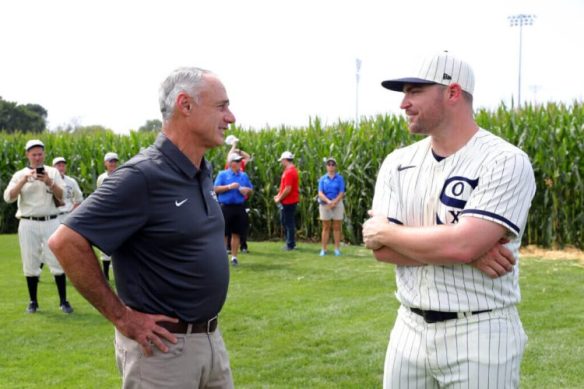
Commissioner Rob Manfred with White Sox relief pitcher Liam Hendriks before last year’s Field of Dreams game. (The Athletic.)

Having a read of ESPN writer Don Van Natta, Jr.’s profile of commissioner Rob Manfred, I was almost convinced that maybe, just maybe, there really was more to Manfred than met the eye. Or, more than what comes forth in his stiff presence and often clumsy remarks.

Just maybe, the man isn’t the baseball-hating or baseball-illiterate Rube Goldberg-like abecedarian the caricatures so often portray. He did, after all, grow up a Yankee fan in upstate New York and can say proudly enough that he’s the only baseball commissioner ever who played Little League baseball. “All glove, no bat,” he remembers of being a Little League infielder.

My parents received a set of classic Revere copper-bottom cookware as a wedding present eight years before Manfred was born. (I still remember the fragrance of that special powder used to clean the copper bottoms, too.) Who knew Manfred (three years my junior) was the son of Revere’s production supervisor at their home plant in Rome, New York? An hour’s drive from Cooperstown, as it happens.

Born in 1958, Manfred took in his first live major league game at Yankee Stadium with his sports-obssessed father, sitting between the plate and first base on an Old Timers’ Day. Come game time, Hall of Famer Mickey Mantle crashed a pair of home runs and the Yankees beat the Twins, 3-2. When he finally became the game’s commissioner, he handed his father the first baseball with his stamp upon it.

“This is really an unbelievable thing,” Manfred, Sr. told his son. “I can’t say I disagree,” Manfred, Jr. told Van Natta.

A couple of hundred fathoms down, though, Van Natta noted that “more than once” Manfred told him what few baseball commissioners have dared to admit, that being the buffer absorbing the heat that should go to his bosses, the owners, is part of his job. Even if it’s about as pleasant as your private parts being caught in the vacuum cleaner’s handle.

And then it came.

“Every time it’s me, it ain’t one of those 30 guys—that’s good,” Van Natta quoted Manfred as saying. “Look, who the hell am I? I don’t have $2 billion invested in a team. I’m just a guy trying to do a job. I mean it. [The owners] deserve that layer. I believe they deserve that layer of protection. I’m the face of the game, for good or for bad.”

Mr. Manfred, unless it’s to boo and hiss your heads off over this or that piece of mischief, you may rest assured that no baseball fan anywhere in this country is paying his or her hard-earned money to head for the ballpark to see you or your bosses.

But I’m going to do you a small favour, as if you know me from the greenest bat boy on any professional baseball team. I’m going to introduce you to the true faces of the game. The ones whom those fans do pay their hard-earned money to see at the ballpark regardless of the machinations and deceptions of your bosses and theirs.

Mr. Manfred, meet Mike Trout. This is the guy you blamed once upon a time for not being baseball’s face, based upon his committing no crime more grave than letting his play and his clubhouse presence and his agreeability with fans before and after games speak for themselves, with no jive about the magnitude of being him.

Meet Shohei Ohtani. This is the two-way star who lights up the joint just by flashing that thousand-watt grin of his, never mind when he strikes thirteen out on the mound one night and belts baseballs onto the Van Allen Belt the very next. Between himself and Mr. Trout, you should be asking what on earth is wrong with the Angels that they still can’t find quality pitching enough to keep them in a race after they start in one but sputter unconscionably.

Meet Aaron Judge. This is the Leaning Tower of River Avenue who sends baseballs into the Delta Quadrant one moment and then, when made aware, goes out of his way to meet a Canadian kid to whom he’s number one among baseball men and who was handed one of his mammoth home run balls by an adult fan who knew the boy wanted nothing more than to catch one Judge hit out.

Meet Joey Votto. This is the future Hall of Fame first baseman who got himself tossed from a game early last year, but—after he learned his ejection broke the heart of a little California girl to whom he’s a hero above heroes—sent her a ball with his handwritten apology and autograph on it, prompting his team to drop game tickets and a little extra swag upon her the very next day.

Meet Bryce Harper. This is the guy who never apologised for being on board with letting the kids play. The guy now on the injured list with a thumb fracture and surgery to repair it after getting hit by a pitch thrown with one of the baseballs you and yours still can’t see fit to manufacture uniformly and with allowance for fairness on both sides of it, fairness for the pitchers and for the hitters alike.

Meet Vladimir Guerrero, Jr. and Bo Bichette. One is the son of a Hall of Famer who did last season what even his old man never did: led his league in on base percentage, slugging percentage, OPS, and OPS+, and led the entire Show in total bases. The other is the son of a respected major league slugger, has quite a lethal bat in his own right when his swing is right, and currently leads his league in trips to the plate. Together they’ve put some zip back into the Blue Jays.

Meet Oneil Cruz. The bat has yet to come to full life but the footwork, the glove, the throwing arm, have shown so far that you can be as tall as Frank Howard, J.R. Richard, and Randy Johnson and still play shortstop as though the position was created for you and not the Little Rascals in the first place. They’re falling in love with him in Pittsburgh, which needs all the love it can get, but they ought to fall in love with him all around the Show—except when he’s going so deep into the hole grabbing a grounder or a hopper that an enemy batter loses his lunch when he’s had a base hit stolen from him.

Meet Clayton Kershaw. He’s been around the block a few times. He’s a Hall of Fame lock as maybe the best pitcher of his generation. He’s still a quality pitcher and a class act. They still buy tickets on the road when they know he’s going to take the ball for the Dodgers. He’s faced his baseball aging curve with grace under pressure. And, for good measure, he’s the one active player who was seen fit to be part of the ceremony when the Dodgers unveiled that statue of their Hall of Fame legend Sandy Koufax this month, and you know (well, you damn well should know) what a class act Koufax was on the mound and has been in the decades since off it.

(You’re not still P.O.ed that Koufax waxed your Yankees’ tails twice while his Dodgers swept them in the 1963 World Series when you were seven, are you?)

Meet Justin Verlander. Missed a year plus recovering from Tommy John surgery. He has a 2.23 ERA and a 3.53 fielding-independent pitching rate so far this season. For any pitcher that’d be a remarkable return so far. For a future Hall of Famer who’s still suiting up at Jack Benny’s age (that’s a joke, son), it’s off the chart so far.

Meet Verlander’s 25-year-old Astros teammate, Yordan Álvarez. He’s leading the entire Show with his .667 slugging percentage, his 1.081 OPS, and his 206 OPS+. If there’s one untainted Astro who’s must-see viewing whenever he checks in at the plate, it’s him.

Meet Xander Bogaerts and Rafael Devers. The left side of the Red Sox infield is a big reason why the Olde Towne Team yanked themselves back up from the netherworld into second place in that rough and tumble American League East. Did I mention that Devers currently leads the entire Show with 177 total bases?

Meet José Ramírez. The Guardians’ third baseman is giving Devers a run for his money in the All-Star balloting that closes today. That thumb injury has put a crimp into his bat for now, and it’s had its role in the Guardians’ sudden deflation at the plate, but this guy just may be the face of his franchise right now. He ought to be one of the faces of this game.

Meet Mark Appel. This is the guy who went from number one in the draft to injuries as well as pressures and even to an exit from the game only to try giving it one more try—and finally coming up with the Phillies, nine years after that draft, and tossing a scoreless inning . . . at age 30. That’s as feel good a story as it gets for the oldest former number one to make his Show debut, no matter what happens with the rest of what remains of Appel’s career. They don’t all go to hell and back.

Those are only some of baseball’s faces, Mr. Commissioner. They’re the ones the fans want to see and pay through the nose to see. Despite your tinkerings. Despite your often erroneous readings of the room. Despite your inability or unwillingness to demand the same accountability of umpires that you do of players, coaches, and managers.

Despite your inability to let your professed deep love of the game come through without tripping over itself because, as an improvisor, well, if you were a musician the consensus would be that Miles Davis you ain’t.

Another year, ejection, and autographed ball

Jesse Winker

Jesse Winker (27) triggering a bench-clearing brawl after taking a leadoff pitch on the can in the second Sunday . . .

When pondering how to attract and keep today’s youth bound to baseball, I’m pretty sure a bench-clearing brawl depriving a particular young fan from southern California of seeing a favourite player all game long isn’t exactly what we should have had in mind. It’s hard enough being a Reds fan anywhere these days without that.

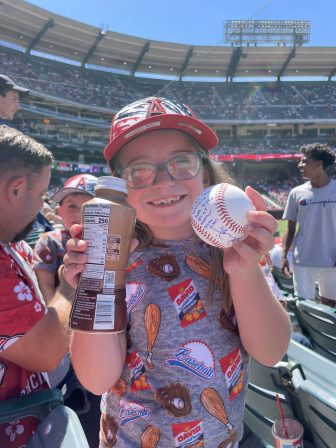
Last year, a little California girl named Abigail Courtney got to see her first live major league game when her beloved Reds hit town to play the Padres. She really wanted to see her personal favourite, first baseman (and future Hall of Famer) Joey Votto. Except that Votto got tossed from the outset after arguing a nebulous pitch call.

The girl’s heartbreak went viral, enough so that it reached Votto himself. He promptly sent her a ball that he signed, “I am sorry that I didn’t play the entire game. Joey Votto.” The next day, Votto granted Abigail a personal audience when the Reds blew her family to tickets for that game.

Abigail’s Reds rooting includes sticking with players after they move on, as several did when the Reds decided to push the plunger on 2022 before the lockout-threatened season even began. And there the Courtneys were in Angel Stadium Sunday afternoon, where Abigail wanted to see two of her now-former Reds heroes, Mariners left fielder Jesse Winker and infielder Eugenio Suárez.

If the little girl has been taught anything about Hall of Fame catcher/malaproprietor Yogi Berra, don’t be shocked if it includes one of the most fabled Berraisms flashing in neon before her pretty eyes in the second inning: It’s déjà vu all over again.

She either didn’t know or didn’t quite comprehend that there might be a little bad blood between the Angels and the Mariners after the Angels’ future Hall of Famer Mike Trout was almost decapitated in the ninth inning Saturday night. She didn’t know Angels opener Andrew Wantz was going to send a return message or two, zipping one past Julio Rodriguez’s head in the top of the first before drilling Winker on the right butt to open the top of the second.

She certainly didn’t know Winker would slip the umpires trying to restrain him and charge the Angels’ dugout on the third base side of the ballpark, luring the rest of the Mariners to pour over for a rumble against the dugout rail after the Angels—who looked to have been chirping at the Mariners after Winker took it on the cheek—came out to defend themselves.

Nor could she know yet that the umpires’ crew chief Adrian Johnson would tell a pool reporter, “I’m not aware of the incident with Trout from last night. You’re talking about the pitch that went over his head. That was nothing for us to issue warnings today. What happened today was a guy got hit. We had warnings in.”

A week earlier, while the Angels took four of five from the Mariners in Seattle, Angels pitcher (and yet another former Red) Michael Lorenzen reeled in horror after a pitch coned former Angel Justin Upton upside the head. Post-game, Lorenzen thundered over the inconsistent baseballs that pitchers were having numerous issues gripping properly including the ones they couldn’t grip well enough to control.

Abigail Courtney

. . . meant a second broken heart over an early ejection of a current or former Reds favourite for Abigail Courtney in slighty over a year . . .

Maybe for the Mariners the Upton splat meant beware. Maybe they didn’t necessarily accept Lorenzen’s post-game commentary as sincere. Maybe both sides pitching inside and tight this weekend was a little bit of mutual messaging. But just how Johnson could have figured that that didn’t mean buzzing Trout’s tower in the ninth Saturday merited pre-game warnings Sunday escapes.

A pre-game warning would have dispatched Wantz post-haste after he’d zipped Rodriguez’s head. It also would have knocked into the proverbial cocked hat any suspicion that Angels manager Phil Nevin elected to go with an opener just to have him take one or two for the team and send the Mariners messages without costing himself too heavily.

Considering the Angels’ usual wounding flaw of inconsistent-to-insufferable pitching rearing its head yet again this season—and contributing well enough to that fourteen-game losing streak that deflated their earlier-season success—Nevin was playing with matches if that was really his plan.

Abigail Courtney knew none of that going in. All she knew in the moment in the top of the second was that here she was at the ballpark to watch a couple of her favourite former Reds (we presume Votto remains her number one man in Cincinnati) and one of them got a shot in the ass, triggered one of the wildest brawls of the season, if not the wildest, then got thrown out of the game.

So did Winker’s fellow Mariners Rodriguez and J.P. Crawford, not to mention Mariners manager Scott Servais. So were Nevin and Angels Wantz, Raisel Iglesias, and Ryan Tepera. (Iglesias had a message of his own to send after his ejection, throwing a large tub of sunflower seed bags out towars the third base line in protest. Brilliant.)

Winker didn’t exactly go gently into that good not-so-grey afternoon. Before he disappeared into the Mariners clubhouse, he flipped the double bird to a section of the seats behind the dugout.

“The only thing I’m gonna apologize for is flipping the fans off,” the left fielder said after the game. “That’s it . . . They pay their hard-earned money to come and see a game, and they didn’t deserve that, so I apologize to the fans, especially the women and children.”

Lucky for Abigail that her mother is a psychologist by profession. “One of the first things I said was, ‘Honey, everybody’s fighting, but they’re all going to be OK’,” Kristin Courtney told Athletic writer Stephen J. Nesbitt. “‘Nobody’s going to get seriously injured. But Jesse’s not going to be playing anymore today’. So, there were more tears.

Abigail Courtney

. . . and, a second apologetically-autographed baseball to Abigail from a chastened player.

“She has a sensitive heart, and she really cares about baseball,” the lady continued. “She feels for everybody, and I know she was disappointed for herself because she’s been waiting to see Jesse. I kept telling her, ‘I don’t think Eugenio is going to get thrown out. I think he’ll be OK. You can cheer for Eugenio’.”

Concurrently, someone made Winker aware of Abigail’s second such broken heart in a year and eight days. And he did something about it.

When Votto got tossed in San Diego last year, he sent her the ball and made a point of meeting her before the next day’s game. When Winker was made aware Sunday, before the game ended in a 2-1 Angels win, he sent Abigail a ball he signed, “Sorry I was ejected! I hope to see you at another game soon.”

If Votto’s precedent is any indication, it’s a consummation devoutly to be wished. Before his ejection broke Abigail’s heart in San Diego, Votto was in something of a 41-game slump. After redeeming himself with her the following day, he went nuts enough to hit 19 home runs with a .674 slugging percentage over the following 52 games.

Winker could use a little of that kind of mojo. Even more than he could have used the pizza an Arkansas fan named Sofie Dill sent to him in the clubhouse. (When Winker texted her thanks, she texted back, “Thank you for being awesome, Jesse! There’s a ton of people on Twitter who love you right now man.”)

The bad news: Winker has a respectable .353 on-base percentage thus far this season, but he’s slugging 153 points below his career percentage. The next time the Mariners might have a chance to see Abigail will be the Fourth of July, when they visit the Padres on her home turf.

I suspect it’s very safe to say that, while she might appreciate the balls she got from Votto and Winker after their ejections broke her heart, Abigail would much rather watch them play baseball when she gets to the ballpark. Autographed baseballs aren’t half as much fun as baseballs diving for line drive hits or flying for home runs.

Rookie no-nos don’t always mean long-term success

Reid Detmers

Detmers pumps a fist after finishing his 10 May no-hitter. Subsequenty struggles earned him a trip back to the minors this week.

Reid Detmers didn’t exactly throw the prettiest or the most efficient no-hitter in early May, not with two strikeouts, eleven ground outs, and fourteen fly outs, while his Angels blew the Rays out 12-0. But a no-hitter it was, while Detmers still had rookie status. The no-hitter won’t change, but Detmers’s status has.

The Angels optioned the lefthander to Salt Lake (AAA) Wednesday. Allowing eight home runs and issuing thirteen walks over 27 innings to follow the no-no does that for you. The second and youngest Angels rookie to pitch a no-hitter is now the youngest Angel to earn a trip back to the minors a month and a half after pitching his gem.

What sealed Detmers’s trip back to Salt Lake was three fives against the Royals Tuesday night: five hits, five earned runs, five innings, en route a game the Angels lost 12-11 in eleven innings.

It showed the Angels only that he needs more seasoning after all, while they return to their sadly usual path of trying to find reasonably competent starting pitching, after what they had that isn’t named Shohei Ohtani contributed their fair share to the team’s 7-22 collapse following a 27-17 start.

Detmers still has time to re-horse and return as a worthy major league pitcher. He’s also in the record books permanently as the 25th major league rookie to throw a no-hitter while still a rook. Not all of those rooks went on to deliver reasonable careers, unfortunately.

“Late success is quieter,” said Hall of Fame pitcher Sandy Koufax. But too-early success can leave the noise of might-have-been behind for too long after it dissolves, too. These are Detmers’s 24 fellow no-hit rookies, and how they fared after delivering those goods:

Bumpus Jones (Reds; 22), 15 October 1892—The only game of Jones’s season was the final day of the season, and he kept the Pirates hitless while they scored one run without benefit of a hit. Jones only got to pitch in one more major league season, 1893 . . . posting a 10.19 ERA for the Reds and the New York Giants with a 6.80 fielding-independent pitching (FIP) rate. He pitched a few more seasons in the minors before calling it a career after the 1900 season.

Christy Mathewson (Giants; 20), 15 July 1901—He struck four out and walked four but kept the Cardinals hitless as his Giants beat them, 5-0, in St. Louis. It brought his ERA down to 1.64 with a 2.64 FIP. I think there’s a plaque with his name and likeness on it in Cooperstown somewhere.

Nick Maddox (Pirates; 20), 20 September 1907—Slightly younger than Mathewson when Mathewson delivered his jewel, Maddox kept the Brooklyn Superbas (the future Dodgers) hitless despite a run scoring in the fourth inning. This righthander posted two more fine seasons for the Pirates as a starter, a fourth season as a starter and reliever, but returned to the minors to stay until retiring after the 1914 season.

Jeff Tesreau (Giants; 24), 6 September 1912—Tesreau would finish his season leading the National League with a 1.96 ERA. (His FIP: 3.41.) His big game came at the expense of fellow rookie (and Hall of Famer) Eppa Rixey and the Phillies, with his Giants beating them 3-0 on ten hits and helping him big in the field while he walked two and struck two out.

He went on to pitch seven major league seasons (and in three World Series) before becoming Dartmouth College’s baseball coach and winning 346 games there before he died in 1946.

Charlie Robertson (White Sox; 26), 30 April 1922—The only one of the Rookie 25 whose no-hitter was a perfect game, Robertson did it in his fourth start of the season, beating the Tigers 2-0. He struck out six batters and got all the runs he’d need to work with when Earl Sheely whacked a two-run single to left in the second inning. Dogged by arm trouble afterward, Robertson pitched seven full seasons before retiring after 1928.

Robertson remains the only rookie ever to pitch a perfect game. But he’s also in the trivia books for another reason: his single pitching appearance in April 1919 left him as the last living member of that tainted White Sox team when he died in 1984.

Paul (Daffy) Dean (Cardinals; 21), 21 September 1934—Seeing and raising his Hall of Fame brother Dizzy in the second game of a doubleheader against the Dodgers in Ebbets Field, Dean topped the opening shutout with a six-strikeout, one-walk no-hitter as the Cardinals won, 3-0. Dean himself scored the first run on a Pepper Martin base hit in the sixth; Ripper Collins sent Hall of Famer Joe Medwick home twice with singles in the seventh and the ninth.

The opposite of his garrulous brother, Dean (whose nickname was coined by a reporter simply because he thought both brothers needed related nicknames) would be part of the Cardinals’ World Series triumph against the Tigers that year. But he was injured while having a slightly better 1935 and would never pitch effectively again after that.

Vern Kennedy (White Sox; 28), 31 August 1935—Kennedy was a somewhat late Show arrival when he no-hit the White Sox, 5-0 . . . helping his own cause by whacking a three-run triple in the bottom of the sixth. He should have credited his teammates for the no-no (including veteran Hall of Famer Al Simmons making a diving catch of Milt Galatzer’s line drive in the ninth): he struck nobody out.

Kennedy managed a twelve-season major league career, but he finished with a 4.57 FIP against his 4.61 ERA and actually pitched nine more minor league seasons before retiring to life as a Missouri driving instructor. He died at 85 in a terrible home accident–he was dismantling his smokehouse when the roof collapsed upon him and killed him at once.

Bill McCahan (Athletics; 26), 3 September 1947—McCahan, too, should have credited his mates for his rookie gem, considering he struck only two Senators out as his Philadelphia A’s won, 3-0. His career was ruined when, working off-season for an oil company, he suffered a shoulder injury lifting barrels. He got to pitch 24 more games for the A’s over 1948 and 1949, before being traded to the Dodgers in whose system he tried three more years before retiring.

While with the Dodgers’ Fort Worth farm team, he met a local woman, married her, and retired to a career at General Dynamics before cancer claimed him at 65 in 1986.

Bobo Holloman

Holloman (fourth from left) swarmed by Browns teammates after his 1953 rookie no-hitter.

Bobo Holloman (Browns; 30), 6 May 1953—It took seven years plus in the minors before the flaky Holloman saw major league action with the 1953 Browns. After four relief appearances to open the season, Holloman got the start against the A’s and prevailed in a  6-0 win. The bad news: Holloman struck only three out while walking five. It took the Browns thirteen hits to hang up single runs in the second, third, fifth, and sixth, plus two in the seventh when Holloman himself singled a pair home.

“It was,” Browns owner Bill Veeck would write in Veeck—as in Wreck, “the quaintest no-hitter in the history of the game.” (Veeck obviously forgot or was unaware of Kennedy’s rookie no-no.)

It was also the highlight of Holloman’s career. He proved so ineffective in his next 22 games (managing somehow to earn wins in three) that he was shipped back to the minors  that 19 July, where he stayed for the rest of that season and all 1954 before retiring to become a trucker, an ad agency leader, and even an Orioles scout.

Sam Jones (Cubs; 29), 12 May 1955—The first black pitcher to throw a Show no-hitter, he helped his Cubs flatten the Pirates, 4-0. He struck six out, walked seven, and could have said “This is so Cubs!” considering the Cubs’ fifteen-hit attack—including Ted Tappe’s RBI single in the first and solo home run in the seventh—delivered only four runs.

Jones—whose curve ball Hall of Famer Stan Musial admired—would lead the National League in strikeouts and walks in the same three seasons, 1955, 1956, and 1958. He was intimidating but often wild. In 1962 he was diagnosed with neck cancer, undergoing surgery and radiation to beat it, but his major league career skidded to a finish by 1964 (a leg fracture in one off-season auto accident didn’t help) and he, too, pitched three more minor league seasons before retiring.

He returned to his boyhood home Monongah, West Virginia, and opened the town’s first drive-through car wash before his neck cancer returned and killed him in 1971.

Bo Belinsky (Angels; 25), 5 May 1962—After bouncing around the Oriole system and being taken by the Angels in a minor league draft, the rakish Belinsky sent Hollywood wild when his fourth major league start and win was his no-hitter against his former parent club, 5-0. It was the high point of a career to be eroded by too much taste for the demimonde and the high life.

His name would become synonymous with a lifestyle that was cool and slick and dazzling, one that was to be a trademark of those athletes who appeared later in the ’60s—Joe Namath, Ken Harrelson, Derek Sanderson. But, in time, the name Belinsky would mean something else. It would become synonymous with dissipated talent.

Pat Jordan, Sports Illustrated, 1972.

Belinsky managed to pitch in all or parts of eight Show seasons, his best being 1964 (2.86 ERA; 3.25 FIP) before an overnight brawl with and provoked by a Los Angeles sportswriter got him suspended and later traded by the Angels. He sank further into alcoholism (and three failed marriages) after his pitching career ended before finally sobering up, moving to Las Vegas, becoming a born-again Christian, and working for a car dealership before his death at 64 in 2001.

Don Wilson

Wilson had a second no-hitter in him two years after his rookie no-no.

Don Wilson (Astros; 22), 18 June 1967—The first MLB no-hitter pitched in an indoor stadium. Behind Wilson’s fifteen-strikeout, three-walk pitching, his Astros beat the Braves, 2-0. The Astros got the runs in the fourth inning, when Jimmy (The Toy Cannon) Wynn doubled Sonny Jackson home and Hall of Fame third baseman Eddie Mathews—finishing his career in Houston after so many years shining for the Braves themselves—pushing Wynn home on a ground force out at second base.

Wilson became a mainstay of the Astros’ starting rotation for several seasons to come, including a second no-hitter and an All-Star selection in 1971, his arguable best season. But his career ended in tragedy: he parked his Thunderbird in his garage, passed out as the garage door closed by automatic closing mechanism, and died at 29 of carbon monoxide asphyxiation. (As did his son, Donald, age five, whose bedroom was directly above the garage.)

Vida Blue (Athletics; 20), 21 September 1970—In his second cup of coffee before knocking the American League and the country alike over (he was even a cover story—in Time) as its 1971 Cy Young Award and Most Valuable Player winner, Blue struck nine Twins out, walked one, and his A’s beat them, 6-0. The final blow: Bert Campaneris’s three-run homer in a five-run eighth.

The promise of that no-no and his 1971 season (league-leading 1.82 ERA and 2.20 FIP) was broken bitterly after A’s owner Charlie Finley–fuming that Blue obtained an agent and asked for a $100,000 salary (this was pre-Messersmith)—insulted him during contract talks for 1972:

Well, I know you won twenty-four games. I know you led the league in earned-run average. I know you had three hundred strikeouts. [Actually, 301, but let’s not get technical.—JK.] I know you made the All-Star team. I know you were the youngest to win the Cy Young Award and the MVP. I know all that. And if I was you, I would ask for the same thing. And you deserve it. But I ain’t gonna give it to you.

Vida Blue

A year before he became a Time cover star, Blue joined the ranks of rookie no-hit pitchers.

The stunned Blue threatened retirement and needed the unlikely intercession of commissioner Bowie Kuhn come April 1972 to get a $63,000 salary for the season. But the Finley insult scarred him; he’d never truly be the same pitcher again (not even striking 200 out in any season to follow, never mind 300 or more) despite managing to post a seventeen-season career including being part of the A’s three straight World Series winners from 1972-74.

“He was bitter and withdrawn,” noted John Helyar in The Lords of the Realm, “eventually developing a drug problem that landed him in court.”

Indeed. Blue would be one of four Royals jailed on drug charges after the 1983 season. Aafter his pitching career finally ended, he cleaned up in due course and became a San Francisco Bay Area philanthropist, arranging numerous charitable events to benefit children including baseball promotion and specific charities.

Burt Hooton (Cubs; 22), 16 April 1972—The knuckle-curve specialist became only the second rookie (after Holloman) to pitch a no-hitter in his first career start. But like Jones before him, Hooton could only do his job on the mound–kind of: he struck seven out and walked seven—while his Cubs whacked twelve hits with only four runs to show for it while beating the Phillies in Wrigley Field.

Nicknamed Happy because his natural facial expression suggested the opposite, Hooton went on to a fine fifteen-season career (including a second-place finish in the 1978 Cy Young Award voting), especially after his 1975 trade to the Dodgers), before making a long career as a coach in both the minor leagues and his alma mater the University of Texas.

Steve Busby (Royals; 23), 27 April 1973—The tall righthander turned in his gem against the Tigers in Detroit. It wasn’t pretty—four strikeouts, six walks—but the Tigers couldn’t buy a base hit while solo homers from Ed Kirkpatrick and Amos Otis plus a run-scoring error made for the 3-0 Royals win.

Busby pitched a second no-hitter the following year (against the Brewers) while posting his best (and only All-Star) season, but fate moved its hand when he came up with a rotator cuff tear in 1976. He became the first pitcher to undergo repair surgery for the injury, but he could pitch only part of 1978, all of 1979, and part of 1980. (He missed being part of the Royals’ trip to the World Series.)

His pitching career lasted only eight seasons, but Busby went on to become a longtime Rangers broadcaster before that ended after the 2016 season.

Jim Bibby (Rangers; 28), 30 July 1973—Another late bloomer, after a spell in the Mets’ minor league system and a couple of cups of coffee with the Cardinals before a trade to the Rangers. (Rangers manager Whitey Herzog pushed the team to deal for him, remembering his talent when he was the Mets’ player development director.)

He threw the franchise’s first no-hitter at the A’s in Oakland. He struck thirteen out—including Hall of Famer Reggie Jackson (I didn’t see [his fastball], I just heard it)—but walked six. The game also made Bibby the first rookie no-hit pitcher to beat a pitcher who’d also thrown a rookie no-hitter: his opponent was Vida Blue. The final: 6-0.

Much like Busby, though, Bibby struggled with control issues much of his career to come. He’d move on to the Indians, the Pirates (where he pitched very well despite earning no decisions in their postseason run to the World Series championship), and—after missing 1982 with a shoulder injury—one more try each with the Rangers and the Cardinals before he retired following his July 1984 release. He enjoyed a post-pitching career as a longtime minor league pitching coach until his 2000 retirement, but bone cancer claimed him in 2010.

Mike Warren (Athletics; 22), 29 September 1983—Up and down with the A’s until injuries smashed into their rotation late season. Pitched his no-no in his final start of 1983, a 3-0 triumph over the White Sox. He, too, wasn’t pretty (five punchouts, three walks); the A’s got the runs courtesy of former Dodger mainstay Davey Lopes’s RBI double in the first and former Ranger and Brave Jeff Burroughs’s two-run homer in the third.

Warren’s 1984 began with poor run support and, when the bats began coming alive, control issues that returned him to relief pitching and, in short enough order, out of the Show after portions of three seasons. He tried pitching on in the minors three more seasons before retiring.

Wilson Álvarez

Álvarez started with a bang but ultimately became part of a surprise mid-season fire sale.

Wilson Álvarez (White Sox; 21), 11 August 1991—Traded to the White Sox mid-way through that season, Alvarez’s second major league pitching appearance rang the bell and then some: he no-hit the Orioles, 7-0, the Sox getting a little more bang for fourteen hits. The bad news: Alvarez walked five while striking seven out.

It was a sign of things to come, unfortunately. The Venezuelan lefthanded struggled all career long with inconsistency, abetted soon enough by injuries and his not-so-great conditoning. He had a fine fourteen-year career that might have been better, finishing with a flourish as a Dodger long reliever and spot starter: in his next-to-last season, Alvarez reeled off nine straight starts with a 1.06 ERA over the nine.

Alvarez may be remembered better as one of the key pieces in the infamous White Flag Trade of 1997, when White Sox owner Jerry Reinsdorf—trading Alvarez and fellow veterans Danny Darwin and Roberto Hernández to the Giants for a pack of prospects—elected to tank the season, despite the team being only 3.5 games out of first in the American League Central at the time, rather than deal with the threesome’s free agent payday possibilities.

José Jiménez (Cardinals; 25), 25 June 1999—The Cardinals’ rookie had it tougher than most when he pitched his no-hitter: his mound opponent was Hall of Famer Randy Johnson. Small wonder his Cardinals could only win 1-0: Johnson struck out fourteen batters to Jiménez’s eight, and it took two walks plus an RBI single to get that run home in the top of the ninth.

As a matter of fact, Jiménez faced Johnson again two starts later and shut the Diamondbacks out again. They were the only two shutouts of Jiménez’s seven season career. He was moved to the bullpen after his trade to the Rockies for1999 and became evidence for the dubiousness of the save rule even with Coors Field a factor: he became the Rockies’ all-time saves leader (102) . . . with a 4.13 ERA/3.98 FIP.

After joining the 2004 Indians’ bullpen, Jiménez flopped so profoundly (8.42 ERA; 5.53 FIP), he was given his release. He eventually went to the 2007 Pan-American Games but was banned from them when he tested positive for an unidentified anabolic steroid.

Bud Smith (Cardinals; 21); 3 September 2001—It took seven strikeouts and four walks when Smith no-hit the Padres, 4-0. He got immediate help from future Hall of Famer Albert Pujols’s first-inning two-run homer; he got another run when Placido Polanco stole second and came home on a throwing error in the fifth, before Polanco whacked an RBI double in the seventh.

Smith would make a further splash with a splendid National League division series start. But he collapsed so profoundly in 2002, his pitching mechanics completely disarrayed, that he was out of the Show to stay.

He was dealt to the Phillies and signed with the Twins in due course, but he spent the rest of his brief career in those organisations’ farm systems before pitching for the independent Long Beach (CA) Armada two years. He retired to a life of coaching high school baseball at 27.

Aníbal Sánchez (Marlins; 22), 6 September 2006—He’d finish ninth in that year’s National League Rookie of the Year voting. Sánchez struck six out and walked four while his Marlins mustered only a five-hit attack against the Diamondbacks—but Joe Borchard’s second-inning home run and future Hall of Famer Miguel Cabrera’s leadoff bomb in the fourth took care of the 2-0 score.

Sánchez would post a fifteen-season career in which his best regular season was with the 2013 Tigers (2.57 ERA; 2.39 FIP) but—by then almost purely a junkballer—he’d pitch a gem in Game One of the 2019 National League Championship Series—taking a no-hitter into the eighth against the Cardinals. It put him into unique company with his teammate Max Scherzer, who took a no-no into the Game Two seventh: they’re the only pitchers to take no-hitters into the fifth or beyond back-to-back in a postseason, and they also did it with the Tigers in the 2013 ALCS.

After sitting 2021 out in search of an incentive-packed deal, he signed a minor-league deal with the Nats this past March.

Clay Buchholz

Buchholz’s rookie no-no became a broken promise when inconsistency and injuries began to hit harder than they should have.

Clay Buchholz (Red Sox; 22), 1 September 2007—Brought up that August, Buchholz’s second major league start was a no-hitter against the Orioles in Fenway Park. While he struck nine out and walked three, his Red Sox smothered the Orioles with a ten-run, fourteen-hit assault that included a three-run double by Hall of Famer David Ortiz in the fourth.

It made Buchholz both the first Red Sox rookie to pitch a no-hitter and the fourth pitcher in Show history (with Holloman, Hooton, and Álvarez) to do it in his first or second major league start. The bad news: Inconsistency abetted by numerous injuries and illnesses checkered what turned out a thirteen-year career, four-team career that included a World Series ring with the 2013 Red Sox.

Chris Heston (Giants; 27), 9 June 2015—Seasoned by six minor league seasons, Heston remained a rookie when he no-hit Noah Syndergaard and the Mets 5-0. He struck eleven out and walked nobody, but he spoiled his shot at perfection by plunking three batters along the way. Still, he struck three out in the ninth to finish—earning him a signed ball from Sandy Koufax, who did the same thing finishing his 1965 perfect game.

Heston even pitched in on the Giants’ scoring with a two-out, two-run single in the fourth.

But with the Giants signing free agent starters Johnny Cueto and Jeff Samardzija after that season, Heston was moved to the bullpen, where he struggled with consistency and then suffered injuries. He pitched for the Mariners and the Twins subsequently (two gigs for the Mariners, one for the Twins), attempted a 2018 comeback with the Giants, but called it a career in 2020. He now works in real estate in Florida.

Tyler Gilbert (Diamondbacks; 27), 14 August 2021—He was seasoned by five years in the minors (missing 2020 with the minor-league shutdown during the COVID pan-damn-ic) before he made the Diamondbacks in August last year. After three relief gigs he got a start against the Padres . . . and no-hit them in the second, 7-0.

Gilbert struck five out, walked three, and benefited from a fifteen-hit Snake attack including  Drew Ellis’s three-run homer in a five-run first. Making him the fourth rookie to toss a no-hitter in his first major league start and the first since Holloman. He also pitched the record-tying eighth no-hitter of the 2021 season while he was at it.

He’s having an up-and-down season thus far this year. Perhaps the book on his career has a few more chapters yet to go.

There you have it. Out of those 25 no-hit rookies, six struck nine batters or more out; seven enjoyed careers of five seasons or more; ten enjoyed careers of ten or more seasons; one pitched a perfect game; and, only one made a career worthy of enshrinement in the Hall of Fame.

The squirrel and the blowout

PNC Park squirrel

This little fellow (or gal, who knew?) cops a proud squat on the PNC Park left field grass before leading three groundsmen on a warning track chase in the bottom of the second—and the Pirates into blowing out the Cubs Monday night.

Believe in the power of the Rally Squirrel? After Monday night’s doings, the Pirates may want to think about it. Hard.

The bushy-tailed rodent showed up to run around the PNC Park outfield and warning track as the bottom of the second got under way. After he disappeared at last, the Pirates dropped three in that inning, four the next, five in the seventh, and a 12-1 smothering of the further-sputtering Cubs.

For too long the Pirates have lived in the place where the nuts hunt the squirrels. It was lovely to see them upend things for an evening.

With Daniel Vogelbach on first, nobody out, and a 1-1 count on Michael Chavis against rookie Cubs starter Caleb Kilian, the bushy-tailed rodent scampered out onto the field from somewhere in the region of PNC Park’s third base seats.

The creature galloped toward the left field corner in a jagged route with three grounds crew in hot pursuit. One of the groundsmen carried a large washing bucket. A second carried a net whose weave was big enough to allow a human suspect to escape the moment it might be dropped over him.

The squirrel himself (or herself, who knew?) wasn’t exactly a model of precision running at first. Certainly not as swift or sure as the one who ran down the third base line as if stealing home in Coors Field eight years ago.

“[W]hat was his sprint speed?” Pirates manager Derek Shelton asked of the PNC squirrel  after the game. “We had to get that in the Statcast era. Definitely one of the worst rundowns I’ve seen. And I’ve seen a couple bad ones.”

After the three groundsmen chased him toward the deepest left field corner, the squirrel ran back and forth from the foul line to the mid-left field piece of the warning track, finally making for a passway under the center field seats’ edge and into the Cubs bullpen with the bucket man in hotter pursuit.

The Pirates in their dugout watched with bemusement. The Cubs’ relief corps looked uncertain as to whether the game was going nuts. Little did they know.

Chavis walked on five pitches. Touted Pirates rookie Oneil Cruz, all 6’7″ worth of him,  reached on a fielding error to load the pads. Fellow rookie Bligh Madris ripped a two-run single to right and stole second before Tyler Heineman struck out, but Hoy Park sent Madris home on a long sacrifice fly.

One inning later, the Pirates struck a lot more swiftly, loading the pads on Kilian with nobody out (back to back walks and an infield hit) before Kilian wild-pitched Bryan Reynolds home. Chavis waited out a four-pitch walk before Cruz sent a three-run double to the absolute rear of center field.

That ended Kilian’s evening but not the Cubs’ miseries. After the Cubs managed to sneak a run home in the top of the seventh on back-to-back singles, then an RBI single which followed back-to-back strikeouts, the Pirates got squirrely again in the bottom of the frame: a two-run double (Vogelbach), an RBI single (Cruz), an RBI double (Heineman), and a sacrifice fly (Park again).

Madris swung his way into the Pirates’ history books with his three-hit evening, the first Pirate to do it in his Show debut since Jason Kendall did it in 1996. He also became the first Pirate since Andrew McCutchen (2009) to debut with a hit, a run batted in, and a stolen base in a single game.

“That was a lot of fun and everything I could ask for,” he grinned postgame. “With [batting practice] getting canceled today, when I stepped in the box, it was really my first at-bat in the big leagues. The game threw a little bit of everything at me today. Thankful for the opportunity. It was awesome.”

Cruz, already the tallest shortstop in major league history, and ranked the Pirates’ number three prospect, got called up from Indianapolis (AAA) with Madris Monday. Madris has nothing but good to say about his Indy teammate, who poked his nose out of his hole at last season’s end and hit a home run almost from his knees.

“The guy’s unreal,” Captain Bligh told reporters. “He has tools that come around once every 100 years. He can hit pitches out of the ballpark that some guys are lucky to get out of the infield. Being here now is going to propel him to greater things.”

“What I can promise you,” said Cruz before Monday night’s game, “is you’re going to see it a lot more frequently. You’re going to see a lot of balls hit hard and a lot of balls traveling very far.” He kept the promise, too—his double was estimated to fly 112.9 mph off his bat. But he also has a howitzer of a throwing arm, throwing one grounder over to first at 96.7 mph.

Players like these are what the Pirates need to continue wrenching themselves out of tank mode and navigate the rash of injuries and illness that’s struck them of late. Not just because of their skills and prospective production, but because of . . . shall we say . . . no, let Chavis say it, as he did before Monday’s game.

“The quality guys that we’ve called up has been pretty significant,” the first baseman told reporters. “We’re not having those, um . . . we don’t have those assholes. There’s no better way to say it. You don’t have a guy with an attitude problem. Guys come up, ask questions, try to be good, stay out of the way of the older guys and are just happy to be here. I can’t say enough about all of them.”

For a team that’s just followed a ferocious nine-game losing streak by winning their next three of five including Monday’s massacre, that’s as large a light as you can ask to see facing the still-elongated end of their tunnel.

Just in case, though, the Pirates might not want to let the squirrel escape too soon. If at all.