The end of an error?

Arte Moreno, Mike Trout

Angels owner Arte Moreno and future Hall of Famer Mike Trout were ecstatic when Trout became a wealthy Angel for life. But Moreno’s failure to reconstruct a team his and their greatest player can be proud of will be Moreno’s legacy if he sells the Angels.

For the first time since their team won their only World Series championship thus far, Angel fans have reason to believe there’s light at the end of a painfully long tunnel. Owner Arte Moreno exploring options to sell the franchise must resemble the liberation promise of Dwight Eisenhower telling Allied forces, “You are about to embark on the great crusade”—the night before D-Day.

Just months after Darin Erstad clutched Kenny Lofton’s fly out to center to finish their staggering seven-game 2002 Series conquest, Moreno bought the team from the Disney Corporation. He swelled with pride as the first Mexican-American major league owner. Angel fans swelled likewise over what seemed to be swelling as an era of dominance after what seemed a preceding snakebitten eternity.

It was too good to be true. The team finally shattered a near-forever of extraterrestrial collapses, failures, and tragedies that inspired things from a shortstop driving his bats through a cemetery to purge their evil spirits to a pitcher pondering a sage burning in the clubhouse and a general manager pondering engagement of a priest to exorcise their ballpark.

Now the Angels held the lease to the Promised Land and a new owner with pockets deep enough to rival a team (the Yankees) they beat three out of four in the division series that launched their championship run. Who knew? Two decades later, the Angels are a six-letter synonym for disaster. And Moreno has come to resemble the worst of the man who once owned those division series victims than he or his dwindling allies would ever admit.

From 2003 through 2009, the Angels won the American League West five out of seven tries. The team went from the second-most snakebitten AL franchise to powerhouse in what now seems a blink in time. In thirteen seasons since, the Angels have won the West once but finished the past five of six in fourth place in the five-team division.

Moreno’s Angels have gone from signing and continuing to win with Hall of Famer Vladimir Guerrero, Sr. to drafting the transcendent Mike Trout and signing the transcendent enough Shohei Ohtani . . . and becoming the team their future Hall of Fame center fielder and must-see-television pitcher/designated hitter can be anything but proud of.

With the uber-loyal Trout locked down in a gigabucks deal that makes him an Angel for life, baseball eyes knowing the Angels need a transfusion as drastically as a leukemia patient saw dealing Ohtani at this year’s trade deadline as the donor who’d deliver particularly rich blood.

“The greatest two-way player in baseball history will be eligible for free agency in the fall of 2023,” writes ESPN’s Buster Olney, “so some other teams communicated to the Angels that they would be open to trades—and willing to include their very best prospects . . . Word quickly reached the interested parties that Arte Moreno, the Angels’ owner, wouldn’t sign off on any Ohtani deal. No one was surprised.”

No one who’s watched the Angels in the Moreno era should have been.

Moreno made his fortune as an advertising executive who turned the Outdoor Systems ad operation into an enterprise that fetched billions when Moreno and his partner sold it to Infinity Broadcasting in 1998. His forte was and remains marketing. It didn’t exactly translate to baseball as opposed to Angel Stadium box office success.

Trout himself says he learned of Moreno exploring a team sale the same way the press did Tuesday, when the Angels made their formal announcement. And he hinted that, however grateful he is for Moreno believing in him and making him rich, it’s not exactly enough anymore. Some things matter more than money to competitors.

“I think once you find out who buys it, whenever that is,” Trout told the Orange County Register, “there are definitely conversations we’re going to have to have. Obviously, I want to win.”

Like many owners who ride the wild surf of their teams’ successes in the beginning, Moreno began to believe in his own baseball genius. Unlike many such owners, Moreno behaved as though his role model for baseball ownership was the 1980s version of George Steinbrenner without half the summary executions and humiliations with which that Steinbrenner tortured Yankee fans for a generation.

The 1980s Steinbrenner loved “name guys who put fannies in the seats.” Moreno has been much like that, particularly when it comes to hitters. So much so that he reeled in one after another name hitter but ignored his team’s real pitching needs, which have been somewhere between drastic and desperate for just about the whole of Trout’s career to date.

Fairness requires we acknowledge that not all those deals for all those hitters who ended up hurting far more than helping the club were bad going in. It wasn’t Moreno’s fault that Albert Pujols’s legs and feet reduced him to a barely-serviceable DH after that Hall of Famer-in-waiting’s first Angels season. It wasn’t Moreno’s fault that Josh Hamilton and Anthony Rendon were/would be throttled by injuries.

Nor was it Moreno’s fault that two prize pitchers he signed big enough, C.J. Wilson and Zack Cozart, would be hit hard enough with injuries that 1) Wilson would retire after a couple of good if not spectacular Angel seasons; and, 2) Cozart would pitch well for a third of a season before a) a torn labrum fielding a grounder cost him the rest of that season and b) shoulder and neck surgery would cost him 2019—and his career, after he was traded away.

And it’s certainly not as though Moreno anticipated Trout’s first decade worth of such play as to have him baseball’s fifth-best all-time center fielder at this writing, still, would turn into an injury-plagued second decade beginning. Say what you will about the owner’s clumsiness and hubris, but he’s not exactly the cause of Trout’s and others’ time-robbing injuries. Even Moreno isn’t that kind of jinx.

But it was Moreno’s ugly doing to run Hamilton out of town on the slickest rail he could find, after Hamilton incurred a drinking relapse while watching a Super Bowl, manned up and went right to baseball’s drug policy administration with it, but discovered his Angel bosses had different thoughts about manning up.

It was Moreno’s ugly doing, a couple of years before Trout came into his own, to gut the Angels’ scouting system almost completely. “First,” I wrote over three years ago, “they made international scouting director Clay Daniels the scapegoat for bonus skimming shenanigans by some of his subordinates; then, they pinked overall scouting chief Eddie Bane—one of whose last achievements was urging the Angels to sign a kid named Trout in the first place—as the scapegoat for a series of bad drafts and worse free agency signings and trades.”

Shohei Ohtani, Arte Moreno

The Angel Stadium faithful booed Moreno as he presented Shohei Ohtani his 2021 AL MVP award. Last month, Moreno blocked deals that would have brought serious prospects back for Ohtani (a free agent after next year) and further cemented Moreno’s reputation for putting box office too far above baseball.

It was Moreno’s ridiculous doing to order his then-general manager Tony Reagins—who couldn’t persuade Hall of Famer in waiting Adrian Beltre to sign with the Angels as a free agent—to make a deal for Toronto outfielder/basher Vernon Wells post haste and or else! Then the Angels discovered the hard way that Wells was damaged goods. And the guy they sent the Blue Jays for him, bat-first catcher Mike Napoli, was going on to pitch in big for a pair of World Series teams in Texas and Cleveland and help a Red Sox team win their third Series ring of the century.

It was Moreno’s ridiculous further doing to address the Angels’ dire pitching needs over several years, ignoring quality pitching on the markets in favour of one after another reclamation project that failed in Anaheim but found either revival or retirement elsewhere. Which points to another wounding Moreno flaw. Loving and enriching the name guys putting fannies in the seats is one thing. His budgets otherwise have been tighter than James Brown’s rhythm sections without yielding comparable fruit.

“Like a lot of billionaires before him,” Olney writes, “Moreno seemed to believe he knew more about building a baseball team than the folks he hired. But the strengths that made him an extraordinary success before he bought the Angels became a weakness once he stepped into a sport that has become increasingly competitive.”

Two former Angel GMs (Jerry Dipoto, now with the second-place Mariners; Billy Eppler, now running the National League East-leading Mets) found success enough after they escaped Moreno’s all-thumbs touch. The incumbent, Perry Minasian, likewise hamstrung enough, may or may not survive this season’s disaster.

Olney reminds us that Moreno selling the Angels would be baseball’s biggest sigh of relief since Frank McCourt was forced to sell the Dodgers to the Guggenheim Group and the Wilpon family finally elected to sell the Mets to Steve Cohen. The sigh’s breeze will be felt from sea to shining sea.

The timing may be telling enough. Moreno’s attempt to buy Angel Stadium and its surrounding land from Anaheim collapsed three months ago, after Mayor Harry Sidhu resigned amid an FBI investigation into whether Sidhu shared “privileged and confidential information” with the team while they negotiated with the city. (The FBI didn’t accuse Moreno or the Angels of wrongdoing.)

The Angels are also not off the hook just yet over the accidental overdose death of painkiller-addicted pitcher Tyler Skaggs in 2019. They face two wrongful death lawsuits by Skaggs’s family—one by his parents, the other by his widow—in the wake of former Angels communications director Eric Kay’s conviction in federal court for providing the fentanyl-containing drug that killed the popular lefthander.

It’s worth remembering, too, that only when George Steinbrenner was suspended for his nefarity in digging up dirt on his Hall of Fame outfielder Dave Winfield did the Yankees finally have room to rebuild themselves back to greatness. An end to the Moreno era might well produce likewise for an Angels franchise that’s had only one now-brief spell of greatness even if it has only one World Series trophy to show for it.

“Many executives,” Olney continues, “believe that the Angels have not come close to exploiting the potential of their market. ‘”Because that place might be the best to work in in baseball,’ one official said. ‘The weather is perfect. The conditions are perfect. You can live on the beach. Nobody bothers them. The fans are good’.”

With the best intentions but the worst approaches, Moreno’s Angels ownership made it possible to believe paradise was hell in disguise. By comparison, the freeway traffic chokes that so often stand between the Pacific Ocean and Angel Stadium are walks on the beach.
A tale of two front office executions

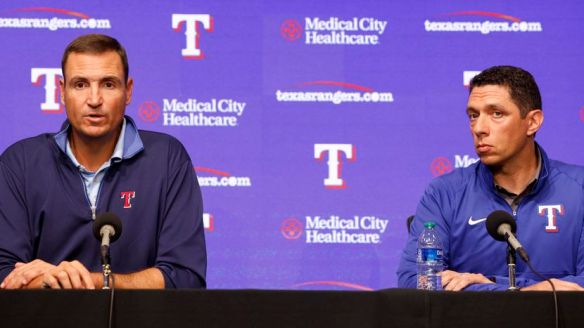
Chris Young, Jon Daniels

Pitcher-turned-MLB executive-turned-Rangers executive Chris Young (left) now succeeds Jon Daniels (right) as the Rangers’ GM . . . but the move’s timing days after Daniels was made to fire manager Chris Woodward was strange to be most polite.

When the Rangers executed manager Chris Woodward and general manager Jon Daniels, it looked at first as though the organisation simply decided too much was too little and enough already. Likewise when the Tigers decided several days earlier that there was a guillotine with general manager Al Avila’s name on it.

Avila’s dispatch wasn’t exactly likely to generate much in the way of sympathy or empathy.   Tigers owner Chris Illitch probably starting drawing up the warrant after Avila made a pair of 2017 deals that sent away future Hall of Fame pitcher Justin Verlander and ace designated hitter J.D. Martinez and brought back what proved no major league help.

Both those players went from there to help make World Series wins possible with their new clubs, back-to-back even: Verlander helped pitch the Astros to the 2017 Series rings and Martinez helped swing the 2018 Red Sox to the rings a year later.

Never mind how tainted both Series triumphs are, though it’s possible to make the case that Verlander (and his fellow Astros pitchers) wasn’t exactly among the conspirators that birthed and bred Astrogate. And we don’t know for dead last certain whether or how often Martinez himself benefitted from the Rogue Sox’s replay room reconnaissance ring.

From Avila’s first season on the job his Tigers, as Defector notes, were baseball’s second-worst hitters and second-worst pitchers on a team level, not to mention the second-worst in the Show for winning and losing—behind the Orioles, who’ve spent this year going remarkably and maybe inexplicably from the tanks to within a half game’s reach of the wild card picture.

“Then again,” observes Defector writer Ray Ratto (once a longtime San Francisco Bay Area sportswriter), “[Orioles GM] Mike Elias didn’t guarantee a quarter billion dollars in current and future salaries to players who have amassed a 43-68 record, worse than every team in baseball save Oakland and Washington, who have shed payroll to be bad. Spending more to be just as bad is, well, spectacularly contraindicated.”

That was the Avila legacy in an envelope. He gave them his son Alex as a catcher and in exchange steered the team into a ditch. His best year was his first, and that’s never a good way to keep the boss from snarking you up on your way out the door. The current team is on pace to have its second-lowest runs per game output in franchise history (and since we know you’re going to ask, 1904) and the fewest homers in a full season since 1954. We’d call them God-awful, but God has lawyers.

. . .The Tigers just . . .  faded away. Neither hated nor condemned, they just eased into the Phantom Zone and stayed there. They’re not even appreciated for playing the fastest games in the majors, which is the one blessing you can provide your fans when you stink on a daily basis.

Al Avila

Al Avila, watching the Tigers work out the day before Opening Day, seeded his demolition with two 2017 trades.

In other words, if Avila was actively and consciously tanking, he had a mad genius for doing it as far away from deep scrutiny as the current Cubs, Reds, Royals, Pirates, and Nationals have drawn. (“Even the Angels get more condemnation,” Ratto writes wryly, “but that’s because unlike the Tigers, they kept their best players and still failed.”)

So the rebuilding Tigers have to start their rebuild all over again. So, apparently, do the Rangers, whose owner Ray Davis announced Daniels’s firing by saying, “Bottom line is we’re not good, and we haven’t been good for six years. To be competitive going forward, I felt that we needed to make a change.”

It was the way Davis made the change that left more than a few eyes rolling and jaws falling. He made Daniels announce Woodward’s wiring into the electric chair just a couple of days before he threw the switch on Daniels himself, whose contract was due to expire at season’s end.

Saying the decisions were brewing for several months before last Monday’s Woodward execution leaves Daniels with what The Athletic‘s Rangers beat writer Levi Weaver calls “a bad look.” That’s like saying the deal with Adolf Hitler to swap Czech freedom for “peace in our time” left Neville Chamberlain with nothing more than the proverbial egg on his face.

Except that the Czechs knew exactly what was coming, even if portions enough of the world around them still couldn’t believe it. As Weaver writes, Daniels was sent to face the press explaining Woodward’s dispatch with no knowledge that his own hemlock cocktail was being mixed.

What troubles Weaver is that, for all that dispatching Daniels might have been necessary at last, it was done not only underhandedly but a couple of years too late:

After all, as Davis made sure to point out, the Rangers haven’t had a winning season since 2016. In retrospect, the rebuild that began in earnest in 2020 probably should have begun in 2017 — never mind that one source familiar with proceedings said that Daniels intended to do just that, but was pressured into putting a better product on the field for the first season of the new ballpark. Still, Nomar Mazara, Rougned Odor, Chi Chi Gonzalez and a passel of other home-grown talent didn’t turn out to be the next core of stars that fans hoped. Those decisions land at Daniels’ feet and maybe warranted a parting of ways.

But if that were the case, it should have been done back in 2020, when it was clear that plan hadn’t worked.

Those are purely baseball considerations. They fall under such headings as the Rangers’ farm yielding negligible crops; the front office’s unique stability in the Daniels era meaning a lack of fresh blood; and, a lot of circumstantial misfortune such as a pitching staff bedeviled with injuries over too long a period.

But Weaver isolates another problem with the manner in which Daniels was handled now. Reporters so often speak to a man’s peers in a business and Weaver learned things about Daniels from fellow GMs and their underlings that might make him an exception rather than a rule in a sport whose business is as cutthroat and duplicitous as its play is ennobling.

“Daniels cared about his people,” Weaver writes. “Sometimes, in the opinion of those around the league, he cared too much, seeing the best in his employees and keeping them around when others might have pulled the plug.”

Sure, he would make a hard decision when he had to — occasionally, the fit between employee and organization just wasn’t working and it was time to part ways. But the only times Daniels ever took me to task for my reporting was when I wrote those stories. Every time, the message was the same: if you need to blame someone, blame me. I don’t want this guy’s family to read him getting ripped in the press. I’m front-facing; I can handle it.

With [Daniels’ sudden firing] it’s clear that loyalty didn’t work its way up to the ownership level . . .

. . . Choosing one’s employees is an owner’s prerogative. But to fire Daniels publicly after such a long tenure showed a lack of common courtesy or decency. Even if Davis had decided not to renew Daniels’ contract at the end of the year, keeping him around to help with the transition would have accomplished two things. One, it would have given some well-deserved dignity to Daniels, allowing him to quietly step down at the end of the season. He has earned that, and to surprise him with a firing now — just two days after he was the face of a managerial firing — is disrespectful at best.

Secondly, allowing Daniels to finish the year could have potentially been beneficial to [pitcher turned MLB vice president in charge of discipline to Daniels understudy Chris] Young. In an advisory role, Daniels could have helped to prepare Young for the remainder of the responsibilities he was inheriting. We’ll never know now: Davis didn’t run the idea by Young before making the move, opting to act now and let Young deal with the fallout.

Respected for brains on the mound and as a baseball executive in the making, Young doesn’t exactly have people worrying about whether he’ll crack. But Daniels had almost two decades on the job and shepherded the last two (and back-to-back while they were at it) Rangers World Series entrants. (They lost decisively to the Giants in 2010; they were two outs from winning the 2011 Series when they ran into a Cardinals buzz saw named David Freese.)

Daniels and Young enjoyed a close relationship for a very long time, going back to Young’s initial major league seasons pitching for the Rangers. Surely Young knows that being a people person was one of Daniels’s above-average strengths. And the Rangers have had small improvements this year even if they weren’t obviously making more better promises for next year.

How Young balances himself between people personhood and making the hard assessents of the Rangers’ roster and front office should provide interesting observations. But if he assesses the depth of the handling and timing of his former boss’s sentence to the Phantom Zone and finds himself compelled to keep one eye over his shoulder, you can’t necessarily blame him.

Fernando’s pride away

Fernando Tatis, Jr.

Tatis drydocked for actual/alleged PEDs the rest of this year and part of next. Did he really get it unknowingly?

Whether you saw it happen live or you had only to read about it, you couldn’t get it out of your head. Manny Machado—who’d been suspect of immaturity often enough in his Baltimore years—being the adult in the Padres’ room when Fernando Tatis, Jr. still couldn’t or wouldn’t shake off a pitch he thought was a ball but plate umpire Phil Cuzzi called a strike last September . . . correctly.

It wasn’t enough for Tatis that he gestured with pronouncement, though he faced away from Cuzzi, while his then-manager Jayce Tingler hustled out of the dugout to protect him and take up the argument and get himself tossed from the game. Tatis kept it up in the dugout, banging a bench a few times, grumbling all inning long while Jake Cronenworth’s one-out double ended up fruitless.

Finally Machado had enough. The wealthy veteran third baseman could be heard loud enough bawling the kid outGo play baseball! You play baseball. You can’t worry about that sh@t! You go play baseball! [Fornicate] that sh@t! At that point, Tatis must have tried pleading about the disputed pitch. Machado didn’t bite. No, it’s not. It’s not about you! It’s not [fornicating] about you! Go [fornicating] play baseball.

The Padres ended up losing to the Cardinals, some of whom were almost as frustrated with Cuzzi’s shifting strike zone as Tatis. But the Cardinals didn’t let it cave them in, either. In the eighth, Tyler O’Neill smashed a 2-2 cutter from Padres reliever Emilio Pagan into the left field bullpen. Two innings earlier, O’Neill was frustrated visibly over a Cuzzi pitch call or two. He just didn’t melt down over them.

He also earned Adam Wainwright’s admiration while he was at it. “That was a great job by him not getting too animated there,” the veteran Cardinal righthander said postgame. “If we lose him right there, we probably lose the game . . . That was a lot of maturity by him to not get thrown out right there on some tough calls.”

Maturity. The word’s being thrown around a lot in San Diego now, since Tatis—who’s missed all season so far rehabbing a shoulder injury—was handed a mandatory eighty-game suspension after a routine required drug test turned up positive for clostebol.

After the Padres hogged the trade deadline headlines by landing outfielder Juan Soto from the Nationals and relief ace Josh Hader from the Brewers, but still looking like paper tigers after getting manhandled by their up-freeway National League West rivals in Los Angeles, this was the last thing they needed when they thought they were on the threshold of Tatis’s return.

The shortstop who can and so often did electrify crowds with his bat and his derring-do on the left side of the infield said he discovered the hard way that a medication he took to fight a case of ringworm had clostebol in it.

“I should have used the resources available to me in order to ensure that no banned substances were in what I took. I failed to do so,” he said in a formal statement Friday, after pondering but choosing not to appeal his suspension. “I am completely devastated. There is nowhere else in the world I would rather be than on a field competing with my teammates.”

Once you shook off the shock of Tatis being drydocked for the rest of this season, the postseason if the Padres get there, and part of next season, your first question—other than, perhaps, what on earth this kid was thinking or not thinking—had to be just what the hell clostebol is.

A former professional bodybuilder named Greg Doucette was more than happy to discuss that, as he has on YouTube: Clostebol is a synthetic, anabolic/andreogenic steroid “that essentially mimics testosterone.” Several countries use it medically to treat ringworm, a common fungus in professional athletes, but neither the United States nor Canada are known to prescribe ringworm relief with medications including the substance.

By itself, says the San Diego Union-Tribune, clostebol is “[a]lso known as 4-cholortestosterone [and] is a synthetic derivative of the muscle-building steroid the body naturally produces in larger amounts in men than women.” Blended with another substance, as the former East Germany did under state sponsorship to create then-undetectable Oral Turinabol, it becomes potent enough to turn athletes into record breakers.

“The doping advantage of injectable clostebol,” says U-T writer Mark Zeigler, “is that, while less potent, it mimics the muscle-building properties of testosterone without the estrogen buildup that counteracts them.” You’d have to make a very assumptive stretch to determine that Tatis knew any of that about what was in his ringworm medicine.

Doucette accepts that somebody did indeed prescribe something with clostebol in it when Tatis complained about ringworm. Bear in mind that, during last off-season’s owners’ lockout, Tatis and the Padres lacked much direct communication between the club’s staff and Tatis’s home in the Dominican Republic. Was he prescribed the now-suspect medication there, in a country that may allow clostebol’s prescription to treat ringworm?

“Either somebody needs to get fired,” Doucette says emphatically, “or Fernando Tatis needs to be the picture boy for Major League Baseball . . . How do you know, when getting medications, whether or not [they include] a banned substance or not? You don’t. So what do you do? Ask an expert.”

Tatis didn’t ask. Prideful youth that he still is, it didn’t cross his mind to ask. Maybe this will prove the blow that trims his pride down to the level where it’s a virtue more than a vice.

Essentially, Doucette says, Tatis trusted his doctor and didn’t think to question what he was prescribed. He’d be far from the only human being who goes in with the assumption that his doctor knows it all and wouldn’t hand him something believed to be harmful medically or otherwise.

Baseball may have its list of banned substances, and enough of those substances may not do what they’re thought (feared) to do for a player, but even veterans aren’t likely to visit their doctors carrying that list to ask whether their forthcoming prescriptions include any of those.

Sports medicine has long been a dubious proposition in the first place. Even today, with so much more known about sports injuries now than in the so-called Good Old Days, too much sports medicine remains meatball medicine to get them back on the field as soon as possible regardless. (Preferably, yesterday often enough.) And athletes are not always trusting of team doctors, with reason enough.

Likewise, for all we know now that we didn’t decades ago, Joe and Jane Fan continue believing injuries equal character flaws and fragility. Who really knows what a cocktail of dubious meatball medicine plus a public that thinks getting hurt exposes a player as weak does to an athlete’s thinking when he has a real injury or another medical issue, never mind one while rehabbing from another?

Padres general manager A.J. Preller, whose wheeling and dealing to bring Soto and Hader aboard made him the star of the trade deadline, sounded as though he didn’t necessarily want to know. “I haven’t had a chance to talk to him yet about it,” he told reporters after the Padres squashed the Nationals Friday.

I think the biggest thing just from our standpoint, just from (MLB’s) standpoint, there’s a drug policy in place. He failed the drug screen, and ultimately he’s suspended, he can’t play, and that’s the biggest thing. It’s the player’s responsibility to make sure that he’s within compliance of that. He wasn’t, and ultimately we’re supportive of that.

Tatis can be called for not quite being mature enough to ask questions of his doctor before accepting any kind of prescription? It’s not exactly unfair to call Preller and other Padres staff for just such a dismissal, without being mature enough to keep real communication lines clear with their player, asking questions of their own when a medical issue arises even during rehabilitation for a different issue.

Practical baseball terms tell us Tatis was on the threshold of finishing his shoulder rehab (this wasn’t the first time he dealt with shoulder issues in his career) and providing the postseason-aspirant Padres a truly incendiary plate threat joining Soto, Machado, and Brandon Drury in the lineup. The kind of deep threat that often makes the difference between a mere postseason aspirant and a prospective World Series champion.

Now the threat is to Tatis’s eventual baseball legacy and to the Padres’s World Series aspirations. (They’ve been there twice without winning since they were born the year man first walked on the moon.) The previous weekend, they were swept in style by those ogres from Dodger Stadium, losing three straight and being outscored 20-4 including surrendering eight Dodger runs each in the first two games.

“He hasn’t been part of the team all year,” said Machado after the 10-5 win over the hapless Nats Friday. “We’ve gotten to this point so far without him. We were waiting to get him back and hopefully be a spark plug for the team.”

“You hope he grows up and learns from this and learns that it’s about more than just him right now,” said pitcher Mike Clevinger, echoing last year’s Machado-Tatis confrontation over the third-strike call. “It would be nice to have somebody else, but we don’t need anybody else. We’ve got everyone we need right here.”

Without Tatis, and until they can really hang with the big boys, the Padres sitting seventeen games out of first in the NL West may not have everyone they need right there now. What they have can get them to the postseason. It can’t necessarily get them to a World Series the likely path to which runs through Los Angeles.

“Friday’s stunning revelation,” writes The Athletic‘s Dennis Lin, “did not paint anyone in a positive light.”

Tatis had been busted for, at best, gross negligence or, at worst, cheating and dishonesty. If the Padres fail to make the postseason, he will end up missing more than half of his first 578 opportunities to play a major-league regular-season game. The team, meanwhile, has suffered a thorough embarrassment just eighteen months after characterizing Tatis’ [fourteen-year, $340 million contract] extension as a slam dunk. Preller has long prided himself on knowing the makeup of players, but his most prized asset has joined James Shields, Will Myers, and [now-departed] Eric Hosmer on a list of questionable contracts.

Tatis is now the biggest name in baseball to have drawn a suspension for actual or alleged performance-enhancing substances since Álex Rodríguez’s war against baseball over the Biogenesis scandal turned into a 211-game suspension. (It proved ultimately to be a 162-game suspension, since A-Rod appealed the original starting in August 2013.)

Whether he walked into it eyes wide shut or just made a reputation for self-centricity a little less small remains to be seen, in full and in final.

Some dream

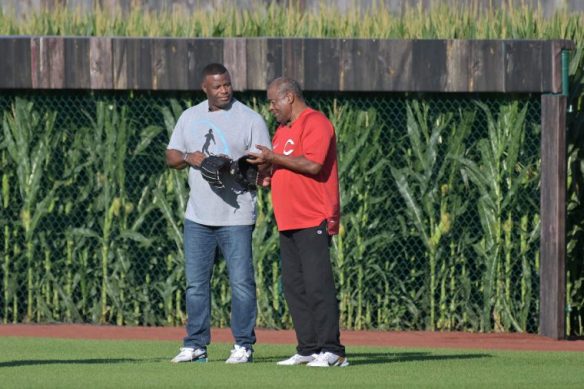
Ken Griffey, Jr.; Ken Griffey, Sr.

The Griffeys—Hall of Fame outfielder Ken, Jr., respected outfielder Ken, Sr. (right)–after entering through the corn, slip their gloves on for a father-son catch.

Maybe the best part of this year’s Field of Dreams Game was what happened before the game was played. Two generations of outfield-playing Griffeys, Ken Sr. and Hall of Famer Ken Jr., both Reds once upon a time, entered the field through the corn when Junior looked at Senior and said, only partly puckishly, “Hey, Dad, you want to have a catch?”

Dad did. Father and son tossed a ball back and forth in the outfield, joined soon enough by other such parents and children playing catch from center to right field. And, by Reds manager David Bell, himself a third-generation Show player, with Athletic writer C. Trent Rosecrans, a longtime Reds beat writer for the Cincinnati Enquirer.

Rosecrans’s father once longed for a certain nine-dollar baseball glove growing up and finally got it by saving for it. The glove was a model for Bell’s grandfather, 1950s Reds All-Star outfielder Gus Bell. It went in due course to someone else, Rosecrans writes in a lyrical ballad about his own relationship with his late father, but it found its way back to his parents in due course.

In Dyersville, Iowa before Thursday’s game, Rosecrans writes, “Gus’ grandson looked at me and told me he was thinking of me and my dad. I told him I brought my glove. He asked me, ‘Want to have a catch?'”

That was far better to ponder than such doings as commissioner Rob Manfred present, accounted for, and even signing autographs at the fabled field. Or enough of the Twittersphere demanding to know why Pete Rose wasn’t invited for the pregame hoop-de-do. You’d have had a hard time pondering which would have been more absurd.

It could have been Rose’s presence in the immediate wake of his disgraceful dismissal of a Philadelphia reporter’s question about his ancient dalliance as a thirtysomething with a short-of-legal-age girl. Not to mention his well-deserved banishment from the game and from Hall of Fame candidacy for violating the rule written and imposed in the wake of the 1919 World Series gambling scandal tainting that year’s Reds’ Series triumph.

It could have been Manfred, whose love of the game is questioned often enough and with justification enough. Bleacher Nation on Twitter asked respondents, “Fox shows Rob Manfred signing baseball at the Field of Dreams Game. What is he writing as his personalised message? Wrong answers only.” One wag, mindful that Rose’s autographed baseballs often include small gag apologies such as “I’m sorry I shot J.F.K.,” replied, “I’m sorry I shot R.F.K.”

Manfred seems to have done everything except think about the one thing tied to the game that would have made him seem a baseball statesman. Apparently, it never crossed his mind to declare, once and for all, that the 1919 Reds were (are) legitimate World Series champions who could have and just might have beaten the Black Sox if the latter had played the entire set straight, no chaser.

Assorted Reds and Cubs past and present took in the locale, its history, and the penultimate message of the film lending the event its name. (The Cubs’ Hall of Fame pitcher Ferguson Jenkins threw a ceremonial first pitch to the Reds’ Hall of Fame catcher Johnny Bench.) Particularly Reds star Joey Votto, remembering to Rosecrans how the film bonded him to his father even further.

“I wish he was here,” Votto said. “I wish I could bring him to tonight’s game, we go out on the field and do something that we did from when I was eight or nine years old. It’s really eerie how much the movie allowed me to look back on that experience.”

If you build it, he will come, whispered the Voice of the late Ray Liotta’s disgraced-turned-romanticised Shoeless Joe Jackson to Kevin Costner’s Ray Kinsella in the 1989 film. They built it. (Actually, Chris Krug, once a Cubs catcher, built the original, with his Athletic Turf outfit.) But it cost a minimum $501 to be there Thursday. Fans in Iowa and some surrounding areas who couldn’t come couldn’t see the game at all, either, thanks to baseball’s arcane and insane broadcast blackout rules. Some dreams.

Putting the Reds into replicas of their 1919 uniforms should have been cathartic considering the 1919 Reds’ Series triumph was tainted too long by the disgrace of the Black Sox bent on throwing the Series for gamblers’ payoffs. Unfortunately, the catharsis wasn’t to be thanks to what the Reds couldn’t do Thursday evening.

Putting the Cubs into replicas of their 1914 hats and late-1920s uniforms, a mismatch not unlike many a Cub loss from 1909 through 2015, said little more than “That’s just so Cubs” before the game began. So, naturally, they went out and beat the Reds, 4-2. Only the Cubs could display a fashion fail and win regardless.

That was a century plus three years ago: Black Sox pitcher Eddie Cicotte hit Reds second baseman Morrie Rath with Game One’s second pitch to let the gamblers know the Series fix was on. This was Thursday, opening the Field of Dreamers Game: Reds starter Nick Lodolo got two quick enough outs before hitting Cubs third baseman Patrick Wisdom with the fourth pitch on a 1-2 count.

That’d teach him. Neither this year’s Reds nor this year’s Cubs are going to finish the season anyplace near the postseason. But after Wisdom took his base, the Cubs behaved like contenders for a change. Seiya Suzuki whacked an 0-1 pitch to the rear of left field to send Wisdom home, Nico Hoerner singled to more shallow left and took second as the Reds tried futilely to keep Suzuki from scoring, Ian Happ doubled to center to send Hoerner home, and just like that the Cubs had a 3-0 lead that proved just enough to count.

Cubs starter Drew Smyly could have seen and raised when he plunked Reds second baseman Jonathan India on a 2-1 pitch. Instead, he like India shook it off, survived a one-out base hit, then consummated five innings of four-hit, nine-strikeout ball before handing off to his bullpen

“The first couple of innings,” Smyly told reporters after the game, “it took me a little bit to kind of get into, like catch my sights. Just a whole different feel than pitching in your usual major league baseball stadium. But I caught a little groove there at the end and that’s just a lot of fun. It just was so unique and different than what we’re used to.”

These days winning is unique and different for a Cubs team stripped of almost all the last remnants of their 2016 World Series conquest. They may be in third place in the National League Central but they have a 46-65 record after Thursday’s win. The Reds are in the division’s rock bottom at 44-67 with the fans they have left still smarting over last winter’s before-and-after-the-lockout final tear-down.

This game didn’t have a fragment of the pennant race significance last year’s Field of Dreams Game—with the White Sox’s Tim Anderson winning an 8-7 triumph over the Yankees with a bottom of the ninth home run into the corn.

But it couldn’t hurt to watch. Not really. Not even when the Reds got just frisky enough against the Cubs bullpen to open the bottom of the seventh with a double (Jose Barrero), a walk (pinch hitter Jake Fraley), and a two-run double (Mark Reynolds), before Cubs reliever Michael Rucker got the next three Red batters out in order.

Not when the Cubs threatened to actually blow the game wide open in the top of the fourth, with back-to-back inning-opening singles setting first and third up for Nick Madrigal to send Nelson Velazquez home with the fourth Cub run.

Then Willson Contreras—the veteran catcher who may not be a Cub after this off-season, and who had a scare an inning earlier when he dinged his left leg running around second on Wisdom’s base hit, tumbling to the ground as he was thrown out at third—flied into a double play when Reds right fielder Aristides Aquino caught his opposite-field drive and gunned Cubs first baseman P.J. Higgins down as Higgins dove futilely into third.

Meanwhile, somebody had the bright idea to plant a hologram of longtime Cubs broadcaster Harry Caray in the booth for the seventh-inning stretch, from which emanated Caray’s once-familiar bellowing of “Take Me Out to the Ball Game.” The crowd in the stands sang along but they all but ignored Harry the Hologram. Except perhaps to shudder.

“Creepy,” tweeted another Athletic writer, Eno Sarris, uttering perhaps the most polite way to put it. “Please don’t make a hologram out of me when I’m dead.” Sarris probably has no worries on that score. But if anyone gets the bright idea to do a Vin Scully hologram for a future Field of Dreams Game (it won’t be played next year thanks to adjacent youth sports complex construction), there’s liable to be a war broken out.

Party like it’s 1919?

1919 Cincinnati Reds

The 1919 Reds’ threads . . .

Remarkable. Today’s Field of Dreams Game will feature the Reds vs. the Cubs, each wearing throwback replica uniforms. The Cubs will mix it up a bit: their jerseys will be replicas of their later 1920s jerseys while their hats will reproduce their 1914 hats. The Reds will wear reproductions, hats and jerseys alike, of the uniforms they wore in 1919.

On the Iowa field across which the fictitious Shoeless Joe Jackson (played by the late Ray Liotta) trod in the film after which the game is named, the true victims of that tainted World Series will wear the uniforms in which they became the game’s most tainted Series winners through absolutely no fault of their own. Cincinnati baseball doesn’t have it tough enough this year?

“Party like it’s 1919!” the Reds tweeted when the threads were revealed. Some party. And they’re going to play the game against a team so legendary as putzes between World Series championships that, whomever chose their threads, they couldn’t even get the eras coordinated. Their 1914 hats above their late-1920s jerseys? Is that so Cubs, or what?

For now let’s forget that both teams elected to, shall we say, rebuild last year. The Cubs pushed the plunger on their 2021 at the trade deadline; the Reds re-pushed one during the off-season before and after the notorious owners’ lockout. Let’s ponder instead whether the geniuses behind today’s Field of Dreams throwback uniforms really comprehend how the 1919 Reds were robbed.

Yes, it does sound strange to think of a World Series winner as a victim. Especially since it managed to go to fifteen postseasons, win ten pennants and five World Series, over the decades to follow without scandal attached. (The 1990 Reds had one in their rear view mirror, namely Pete Rose the previous year, but there was nothing like sweeping an American League behemoth to ease that pain.)

But for a century plus three years, and despite the best efforts of people to whom history has its proper truthful claims, the Reds have lived with the notion that their 1919 edition would have been squashed like house pests if the White Sox had played it straight, no chaser. I wrote of it approaching the centenary season and on the anniversary of Game Eight of that Series: those Reds weren’t the poor souls portrayed too often.

Contradictorily, the Reds approached the 1919 Series as 8-5 favourites to win the set overall but 2-1 underdogs in the first two games at Cincinnati’s Redland Field. While White Sox manager Kid Gleason trumpted loud and long his squad full of battering rams, Reds manager Pat Moran made a prediction that proved only too chilling: the Reds had a shot at winning the set if they could beat White Sox starting pitcher Eddie Cicotte in Game One.

Going into the Series the Reds actually had the better pitching picture, five healthy and solid pitchers who hadn’t been overworked: Hod Eller, Ray Fisher, Jimmy Ring, Dutch Reuther, and Slim Sallee. The White Sox had two great starters (Cicotte and Lefty Williams) but a rookie named Dickey Kerr who was considered promising but a bit of a wild card. Injuries left their Hall of Famer Red Faber out of the Series picture entirely.

There was also the little matter of the Reds actually out-pitching the White Sox on the regular season. The Reds entered the Series with a team 2.23 ERA and 2.81 fielding-independent pitching (FIP) rate; the White Sox, a team 3.04 ERA and 2.88 FIP. The opposition averaged 2.8 runs against the Reds but 3.8 runs against the White Sox. I still have a tough time with arguments that the White Sox were that much of a 1919 powerhouse.

The 1919 Reds finished the regular season with a .686 winning percentage, the best single-season win percentage in the Show that decade except for the 1912 Red Sox’s .691. The 1919 White Sox finished with a .629 win percentage. Those Reds also went 47-19 in the second half of the season compared to those White Sox going 41-26. On the full season, the Reds went 38-22 against other National League pennant contenders while the White Sox went 35-25 against other American League contenders.

Down the stretch? The Reds faced other NL contenders ten times and won eight; the White Sox faced other AL contenders twelve times and went 6-6. Now you should have a tougher time hearing arguments that those White Sox, who did out-hit the Reds but weren’t that much better at scoring (4.8 runs per game to the Reds’ 4.1), were so formidable as to have the Reds reaching for the tranquilisers.

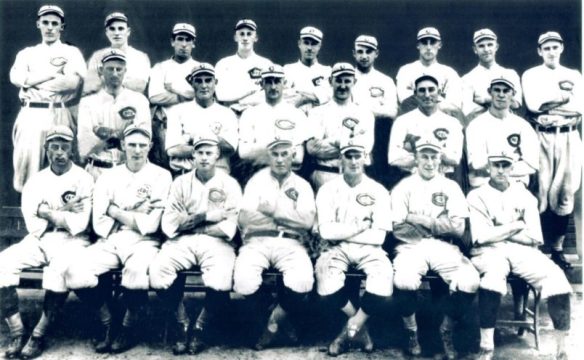
1919 Cincinnati Reds

. . . and the actual 1919 Reds, whose World Series title remains unfairly tainted.

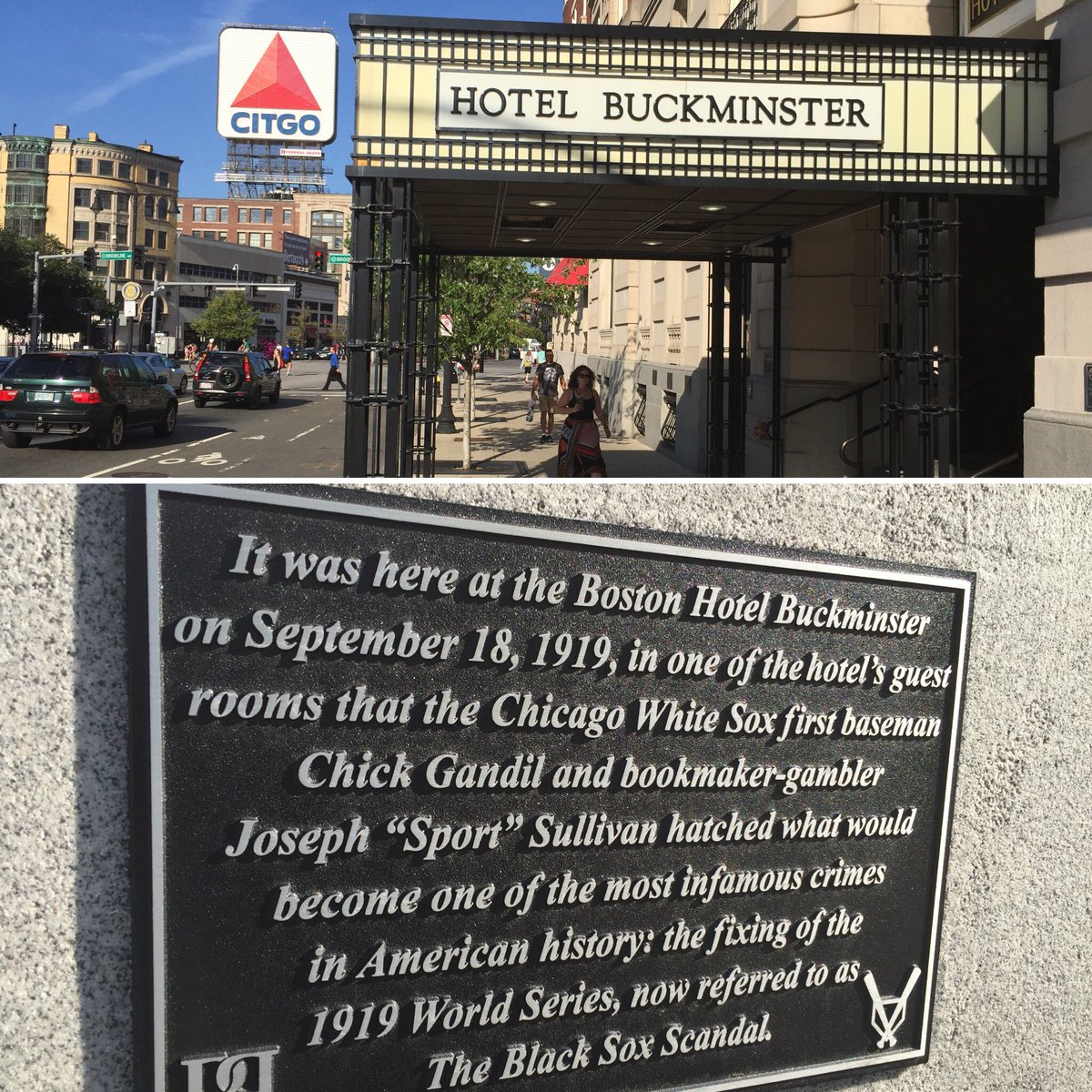
Cicotte, of course, hit Reds second baseman Morrie Rath with the second pitch of Game One, the tipoff to the gamblers that the fix was on. He would have been suspect even if he hadn’t thrown in with Chick Gandil to seek financial backing for the Series fix from bookie Sport Sullivan and pitcher-turned-gambler Sleepy Bill Burns before bringing in more teammates: Cicotte entered the Series with a barking shoulder and arm thanks to a 306.6 inning regular season.

Two years ago, I wrote elsewhere having as close a look as possible at Jackson’s 1919 Series performance. There remain those who say his .375/.394/.563 Series slash line is evidence that he didn’t take a dive with assorted mates in the Series. It is if you don’t look deeper. If you do look deeper, you’re going to find more question marks than exclamation points.

I looked. And, as I wrote then, Jackson batted seven times in that Series’s first five games with men on base. He had one base hit and reached on an error in those situations, for a .167 batting average with men on base. By the end of Game Five, the Sox were in a 4-1 Series hole and Jackson factored in that win by scoring the first of three Sox runs after he led off with a base hit.

I continued: “Then the White Sox played three straight elimination games and won the first two. Jackson batted ten times with men on base in those three games, got five hits, and reached on an error once. But in [Game Eight]—the absolute last chance for the White Sox to stay alive—he went 1-for-4 with men on base and drove in two runs with that hit when the game was still far enough beyond reach.”

Nine years ago, former New Jersey prosecutor Bill Lamb published Black Sox in the Courtroom: The Grand Jury, Criminal Trial, and Civil Litigation. “That Joe Jackson was a likable fellow and persistent in his claims of innocence does not change the historical record,” he wrote therein.

On the evidence, the call is not a close one . . . As he admitted under oath after first being confronted, Jackson was a knowing, if perhaps unenthusiastic, participant in the plot to fix the 1919 World Series. And damningly, Jackson was just as persistent in his demands to be paid his promised fix money as the Series progressed as he would later be in his disavowals of fix involvement. In the final analysis, Shoeless Joe Jackson, banished from playing the game that he loved while still in the prime of his career, is a sad figure. But hardly an innocent one.

If you seek those for whom the gamblers’ promises and shenanigans meant little to nothing, be reminded if you will that the Reds shook one off near the end of the Series. According to his granddaughter Susan Dellinger, Ph.D., in Red Legs and Black Sox, the Reds’ Hall of Fame center fielder Edd Roush told Moran he’d heard whisperings that gamblers tried getting to one or more Reds prior to Game Eight. Oops.

No oops, Dellinger exhumed. Moran called a team meeting before the game and the scheduled Reds starting pitcher, Eller, spoke up. A gambler tried to buy him off, but he’d told the gentleman firmly enough to go jump in the lake, or the Ohio River, whichever one was closest. Then, Eller went the distance for the Reds while his mates trashed Williams in the opening rumble of their 10-5 blowout.

“A nation whose citizens empathise with victims real or imagined should hark heartily to the real victims of baseball’s two most notorious gambling scandals,” I wrote in 2018. “The first compromised the integrity of the Reds’ first World Series winners through no fault of their own. The second cost the Reds a franchise icon and manager through all fault of his own.”

Surely I asked too much when I suggested the commissioner’s office might issue at least a proclamation that the 1919 Reds were (and should remain) legitimate World Series champions on the centenary of that event. I’d probably ask too much, too, if I ask for one today, before today’s Reds tangle with today’s Cubs in the Field of Dreams game. (It’s probably asking even more to ask how on earth the game can sell—so help me God—“tickets as low as $501.”)

As the teams walk onto the field across which the fictitious Black Sox were romanticised without warrant in an otherwise charming film, it would be nothing less than their due, for a Reds franchise that’s suffered enough self-inflicted indignity as well as several equally grand triumphs. It won’t help the team’s prospects for the rest of this season, but it might give Cincinnati itself a hard-earned gift.