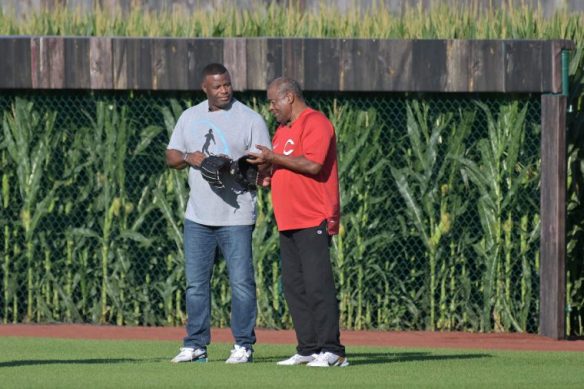
The Griffeys—Hall of Fame outfielder Ken, Jr., respected outfielder Ken, Sr. (right)–after entering through the corn, slip their gloves on for a father-son catch.
Maybe the best part of this year’s Field of Dreams Game was what happened before the game was played. Two generations of outfield-playing Griffeys, Ken Sr. and Hall of Famer Ken Jr., both Reds once upon a time, entered the field through the corn when Junior looked at Senior and said, only partly puckishly, “Hey, Dad, you want to have a catch?”
Dad did. Father and son tossed a ball back and forth in the outfield, joined soon enough by other such parents and children playing catch from center to right field. And, by Reds manager David Bell, himself a third-generation Show player, with Athletic writer C. Trent Rosecrans, a longtime Reds beat writer for the Cincinnati Enquirer.
Rosecrans’s father once longed for a certain nine-dollar baseball glove growing up and finally got it by saving for it. The glove was a model for Bell’s grandfather, 1950s Reds All-Star outfielder Gus Bell. It went in due course to someone else, Rosecrans writes in a lyrical ballad about his own relationship with his late father, but it found its way back to his parents in due course.
In Dyersville, Iowa before Thursday’s game, Rosecrans writes, “Gus’ grandson looked at me and told me he was thinking of me and my dad. I told him I brought my glove. He asked me, ‘Want to have a catch?'”
That was far better to ponder than such doings as commissioner Rob Manfred present, accounted for, and even signing autographs at the fabled field. Or enough of the Twittersphere demanding to know why Pete Rose wasn’t invited for the pregame hoop-de-do. You’d have had a hard time pondering which would have been more absurd.
It could have been Rose’s presence in the immediate wake of his disgraceful dismissal of a Philadelphia reporter’s question about his ancient dalliance as a thirtysomething with a short-of-legal-age girl. Not to mention his well-deserved banishment from the game and from Hall of Fame candidacy for violating the rule written and imposed in the wake of the 1919 World Series gambling scandal tainting that year’s Reds’ Series triumph.
It could have been Manfred, whose love of the game is questioned often enough and with justification enough. Bleacher Nation on Twitter asked respondents, “Fox shows Rob Manfred signing baseball at the Field of Dreams Game. What is he writing as his personalised message? Wrong answers only.” One wag, mindful that Rose’s autographed baseballs often include small gag apologies such as “I’m sorry I shot J.F.K.,” replied, “I’m sorry I shot R.F.K.”
Manfred seems to have done everything except think about the one thing tied to the game that would have made him seem a baseball statesman. Apparently, it never crossed his mind to declare, once and for all, that the 1919 Reds were (are) legitimate World Series champions who could have and just might have beaten the Black Sox if the latter had played the entire set straight, no chaser.
Assorted Reds and Cubs past and present took in the locale, its history, and the penultimate message of the film lending the event its name. (The Cubs’ Hall of Fame pitcher Ferguson Jenkins threw a ceremonial first pitch to the Reds’ Hall of Fame catcher Johnny Bench.) Particularly Reds star Joey Votto, remembering to Rosecrans how the film bonded him to his father even further.
“I wish he was here,” Votto said. “I wish I could bring him to tonight’s game, we go out on the field and do something that we did from when I was eight or nine years old. It’s really eerie how much the movie allowed me to look back on that experience.”
If you build it, he will come, whispered the Voice of the late Ray Liotta’s disgraced-turned-romanticised Shoeless Joe Jackson to Kevin Costner’s Ray Kinsella in the 1989 film. They built it. (Actually, Chris Krug, once a Cubs catcher, built the original, with his Athletic Turf outfit.) But it cost a minimum $501 to be there Thursday. Fans in Iowa and some surrounding areas who couldn’t come couldn’t see the game at all, either, thanks to baseball’s arcane and insane broadcast blackout rules. Some dreams.
Putting the Reds into replicas of their 1919 uniforms should have been cathartic considering the 1919 Reds’ Series triumph was tainted too long by the disgrace of the Black Sox bent on throwing the Series for gamblers’ payoffs. Unfortunately, the catharsis wasn’t to be thanks to what the Reds couldn’t do Thursday evening.
Putting the Cubs into replicas of their 1914 hats and late-1920s uniforms, a mismatch not unlike many a Cub loss from 1909 through 2015, said little more than “That’s just so Cubs” before the game began. So, naturally, they went out and beat the Reds, 4-2. Only the Cubs could display a fashion fail and win regardless.
That was a century plus three years ago: Black Sox pitcher Eddie Cicotte hit Reds second baseman Morrie Rath with Game One’s second pitch to let the gamblers know the Series fix was on. This was Thursday, opening the Field of Dreamers Game: Reds starter Nick Lodolo got two quick enough outs before hitting Cubs third baseman Patrick Wisdom with the fourth pitch on a 1-2 count.
That’d teach him. Neither this year’s Reds nor this year’s Cubs are going to finish the season anyplace near the postseason. But after Wisdom took his base, the Cubs behaved like contenders for a change. Seiya Suzuki whacked an 0-1 pitch to the rear of left field to send Wisdom home, Nico Hoerner singled to more shallow left and took second as the Reds tried futilely to keep Suzuki from scoring, Ian Happ doubled to center to send Hoerner home, and just like that the Cubs had a 3-0 lead that proved just enough to count.
Cubs starter Drew Smyly could have seen and raised when he plunked Reds second baseman Jonathan India on a 2-1 pitch. Instead, he like India shook it off, survived a one-out base hit, then consummated five innings of four-hit, nine-strikeout ball before handing off to his bullpen
“The first couple of innings,” Smyly told reporters after the game, “it took me a little bit to kind of get into, like catch my sights. Just a whole different feel than pitching in your usual major league baseball stadium. But I caught a little groove there at the end and that’s just a lot of fun. It just was so unique and different than what we’re used to.”
These days winning is unique and different for a Cubs team stripped of almost all the last remnants of their 2016 World Series conquest. They may be in third place in the National League Central but they have a 46-65 record after Thursday’s win. The Reds are in the division’s rock bottom at 44-67 with the fans they have left still smarting over last winter’s before-and-after-the-lockout final tear-down.
This game didn’t have a fragment of the pennant race significance last year’s Field of Dreams Game—with the White Sox’s Tim Anderson winning an 8-7 triumph over the Yankees with a bottom of the ninth home run into the corn.
But it couldn’t hurt to watch. Not really. Not even when the Reds got just frisky enough against the Cubs bullpen to open the bottom of the seventh with a double (Jose Barrero), a walk (pinch hitter Jake Fraley), and a two-run double (Mark Reynolds), before Cubs reliever Michael Rucker got the next three Red batters out in order.
Not when the Cubs threatened to actually blow the game wide open in the top of the fourth, with back-to-back inning-opening singles setting first and third up for Nick Madrigal to send Nelson Velazquez home with the fourth Cub run.
Then Willson Contreras—the veteran catcher who may not be a Cub after this off-season, and who had a scare an inning earlier when he dinged his left leg running around second on Wisdom’s base hit, tumbling to the ground as he was thrown out at third—flied into a double play when Reds right fielder Aristides Aquino caught his opposite-field drive and gunned Cubs first baseman P.J. Higgins down as Higgins dove futilely into third.
Meanwhile, somebody had the bright idea to plant a hologram of longtime Cubs broadcaster Harry Caray in the booth for the seventh-inning stretch, from which emanated Caray’s once-familiar bellowing of “Take Me Out to the Ball Game.” The crowd in the stands sang along but they all but ignored Harry the Hologram. Except perhaps to shudder.
“Creepy,” tweeted another Athletic writer, Eno Sarris, uttering perhaps the most polite way to put it. “Please don’t make a hologram out of me when I’m dead.” Sarris probably has no worries on that score. But if anyone gets the bright idea to do a Vin Scully hologram for a future Field of Dreams Game (it won’t be played next year thanks to adjacent youth sports complex construction), there’s liable to be a war broken out.


 Throneberry Fields Forever