Danger, Will Callaway

2019-04-16 MickeyCallaway

Mickey Callaway, after the Mets beat the Phillies the hard way Monday night.

If you don’t ask your best bullpen bull for a four-out save in April, it doesn’t normally matter. Don’t want to burn a reliever too early, too often, right? But it might be just a little different if you’re trying to stake an early claim upon your division, as the Mets were against the Phillies Monday night.

It’s smart long-term strategy to be sure your bulls stay healthy enough for a stretch drive and then a postseason. But now and then you just have to ask for a four-out save. Especially, when the guy you want most to give it to you—unless you were foolish enough to warm him up a few times in the interim without using him—hasn’t pitched in a game in three days.

And if you don’t do it against one of your top division rivals now and then before the stretch drive, there’s a fair chance you may not do it when it might mean the last barrier between triumph or disaster down the stretch or in the postseason if you get there.

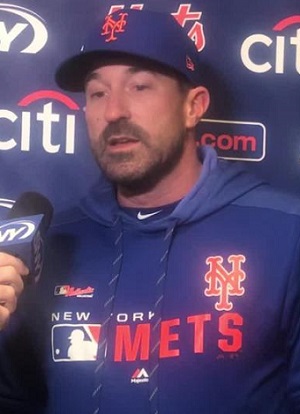
Mets manager Mickey Callaway, formerly a respected pitching coach who should know better, didn’t do it Monday night, when his Mets had a grand chance to bump into first in the National League East at the Phillies’ explicit expense. And unless he’d warmed Edwin Diaz up over the three days prior during which Diaz didn’t see game action, he had a fresh enough resource to do it.

Callaway says he won’t ask Diaz for a four-out save or bring him into a tie game unless it is the postseason. That’s not exactly unsound thinking, but it’s not exactly unwise to test it now and then before the stretch and be absolutely sure Diaz can handle it at all. He didn’t get the chance in Seattle last year, but then last year’s Mariners weren’t exactly like this year’s early-season threshing machine.

Not testing it Monday almost cost Callaway a game he could have won without having to escape a gasoline fire. Oops. The fire was burning already in the bottom of the eighth, after the Mets wrestled back to a 6-5 lead, but prodigal erstwhile closer Jeurys Familia allowed a hit, a walk, then lured a double play ball—before two more walks to set up Philadelphia ducks on the pond.

Callaway instead reached for Robert Gsellman, his 4.00 ERA, and his 1.66 walks/hits per inning pitched rate. And with Bryce Harper on deck, Gsellman walked Jean Segura unintentionally on four straight pitches to tie the game at six. Gsellman was probably lucky to catch Harper off guard swinging into an inning-ending pop out to shortstop.

But he did get through the ninth unscathed to send the game to the extra innings that might have been avoided if Callaway had reached for Diaz instead. And the Mets yanked the lead back in the top of the eleventh with a little derring-do aided by a little Phillies derring-don’t: Juan Lagares, atoning for an earlier baserunning blunder on an earlier Phillies error, shot home on a Rhys Hoskins error for the seventh and ultimate winning run.

Then Callaway reached for Diaz. And Diaz struck out the side to save it for Luis Avilan, who’d pitched a scoreless but slightly bumpy tenth. It brought Avilan’s 2019 ERA down to 10.80.

“They kept trying to give us the bleepin’ game,” said Larry Bowa, the former Phillies shortstop and manager who now works as a senior advisor to the team. And every time the Phillies tried giving it back, the Mets tried giving it back again, when they didn’t have to.

Fair is fair: the game did get to that 6-5 lead in the first place thanks to both starting pitchers, the Mets’ Noah Syndergaard and the Phillies’ Aaron Nola, playing with matches before five innings were in the books. And the Mets should have heard some alarm bells there, too, considering Syndergaard complained after the game that he couldn’t grip the ball properly.

But it was hard to escape the feeling that Callaway played with a little fire himself. Especially when he reiterated after the game that Diaz wouldn’t be a topic until the ninth inning. “I think we’ve said this before,” Callaway told one reporter. “He’s not going to get four outs.”

Congratulations, Elliot Ness. You’ve just sold the Mob some explosives.

Callaway should be reminded that a lot of baseball’s grounds are scorched, and still have debris from, similar late game reluctance by managers who could have or should have known better than to cling to The Book in their hours of deepest need:

Tony La Russa—Twice in the 1990 World Series his Athletics led in the eighth inning. Neither time did he think of bringing in his Hall of Fame closer, Dennis Eckersley, who’d had more than one outing of more than three outs on the year. (And, was notoriously stingy with inherited runners when he entered with them.)

They led Game Two 4-3 in the eighth . . . and lost. They led Game Four 1-0 in the eighth . . . and lost. Guess what both games had in common? La Russa didn’t bring in Dennis the Menace to start the eighth. And instead of the Series being tied at two games each, the upstart Reds swept the Series.

Grady Little—He stayed with Hall of Famer Pedro Martinez’s heart while ignoring Martinez’s tank, on which the needle was past E. Trouble was, it was Game Seven of the 2003 American League Championship Series.

Little had Mike Timlin and Alan Embree ready in the pen after Martinez surrendered a one-out RBI single. Staying with Martinez cost him Jorge Posada’s game-tying two-run double. Then Little went to Embree for one out and Timlin for a pair, interrupted only by a walk for which Aaron Boone entered the game as a pinch runner.

And it ended up in an extra-inning thriller with Timlin and then Tim Wakefield going scoreless against Hall of Famer Mariano Rivera. Until Wakefield’s first knuckleball of the bottom of the eleventh flew into the left field seats off Boone’s bat with a Yankee pennant attached.

Dusty Baker—Bad enough he’d sent a hard-ridden and now spent Mark Prior out to start the eighth of Game Six, 2003 National League Championship Series, with the Cubs six outs from the World Series.

Worse: Leaving Prior to surrender a one-out double, throw a wild pitch, endure the infamous Bartman Foul, give up a walk, give up an RBI single, and watch in horror when the double play ball bounced off shortstop Alex Gonzalez’s chest, before serving the two-run double that tied the game.

Then Baker reached . . . for Kyle Farnsworth; for a sacrifice fly, an intentional walk, and a three-run double; and, for Mike Remlinger, and for an RBI single. And, an eight-run Marlins eighth.

Far worse: Baker’s closer Joe Borowski, the one Cub bullpen bull he could have and should have trusted that year, wasn’t even a topic. Especially since Borowski hadn’t seen game action since Game Three. The Cubs might have returned to the World Series fourteen seasons before they finally did if Baker asked Borowski to start the Game Six eighth.

Mike Matheny—Bottom of the ninth, Game Five of the 2014 NLCS, the game tied at three as the inning began. The Book told him don’t bring in your closer unless there’s something to save. So Matheny stayed with Michael Wacha with one out and two on but still rusty after a late-season injury layoff. His then circuit-breakers-off closer Trevor Rosenthal wasn’t even a subject.

Not until the postgame interviews. Because Travis Ishikawa couldn’t have cared less what The Book said. And Ishikawa backed up his disdain with the noisiest three-run homer in Giants history since Bobby Thomson in 1951. The ball and the National League pennant landed atop Levi’s Landing.

Buck ShowalterHis power-station closer Zach Britton, the best in the business in 2016, nowhere to be found in the bottom of the eleventh, that year’s American League wild card game. Ubaldo Jimenez, normally a starter but now the fifth Orioles reliever of the night, staying in the game much to everyone’s surprise—including his own, he said later.

“We wanted to have a strong Zach and have him there in case the game goes to extra innings,” Showalter said. With two on and one out the thought that he needed a true stopper right then, no matter how well Jimenez had pitched of late, didn’t cross his mind.

Not until Edwin Encarnacion drove the first pitch Jimenez threw him so far into the Rogers Centre second deck it said there goes that idea on its way out.

You’re not necessarily going to have to think about things like that two straight nights, and that’s probably a good thing. And there’s no written guarantee that the move won’t blow up in your face. But you’ve got to try it now and then. Better to lose if the other guys overcome your best weapon than if they don’t.

Last October Dodgers manager Dave Roberts asked Kenley Jansen for six-out saves in consecutive World Series games. The first one Jansen surrendered the homer Jackie Bradley, Jr. hit to send Game Three to its eighteen-inning marathon; the next, he got two quick outs before Steve Pearce began his Series MVP destruction in earnest with a shot into a fan’s glove in the left field bleachers.

Both times Roberts made his best move. The first one he came up roses even if it took almost to sunrise for Max Muncy to hand him the bouquet; the second, he got nuked. But he went down playing his best prospective hand. And Jansen in fairness was pitching with offseason heart surgery on his calendar, too.

But Callaway may have been lucky that the Mets pulled Monday night’s game out. And luck is something these Mets haven’t had for a few years. The next time he has a prime need for more than a single-inning save from his man Diaz, but stays by his Book even on the road and even in an eighth-inning tie, his and the Mets’ luck may run out.

“We got away with stuff,” Callaway said after the Mets banked the 7-6 win the hard way. “But we still came up with a win. That says a lot.” It’ll say even more if and when Callaway’s luck runs out at the wrong time while clinging to The Book too hard.

All he has to do is remind himself about La Russa, Little, Baker, Matheny, and Showalter. And learn not to sell explosives to the Mob.
Bombs, away

2019-04-14 JacobDeGrom

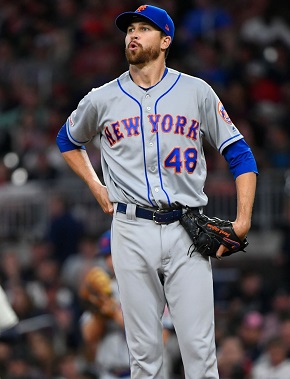
Jacob deGrom, who shouldn’t worry about surrendering five bombs in his first four 2019 starts . . .

The defending National League Cy Young Award winner isn’t starting as strong out of the box this season. It’s not unrealistic to suppose that Jacob deGrom may yet remain a great pitcher without having another season even remotely similar to his 2018. Some of the greatest pitchers who ever took the mound had single seasons of comparable surreality and never again got anywhere near them.

But then there seems to be a contingency worried especially that in his first four 2019 starts deGrom is particularly vulnerable to the long ball. He’s surrendered five in his four starts thus far, three in his next-to-last start and two Sunday to the Braves.

DeGrom’s early issue, by his own admission, seems to be testy control despite a National League-leading fourteen strikeouts per nine innings. It’s also not impossible that in the back of his mind he might be just a little desperate to live up to that five-year, $137.5 million extension he signed before spring training ended. Joe and Jan Fan don’t like to hear this, but deGrom wouldn’t be the first to put himself under that kind of pressure in the first year of a lucrative new deal, and he won’t be the last, either.

Now, back to the home run issue. You’re worried about deGrom being taken downtown? Don’t. The best pitchers who ever went out to the mound got taken there a lot more often than you think, and they still do. Max Scherzer won the second of his three Cy Young Awards (and his first as a National) in the same season he led the National League surrendering 31 bombs. Hall of Famer Robin Roberts lifetime surrendered one more home run than fellow Hall of Famer Eddie Murray hit lifetime.

Let’s take a look at the Hall of Fame starting pitchers whose careers were entirely or mostly of the post-World War II/post-integration/night ball era. You’re going to be somewhat surprised to see how often some of these men were hit for that kind of distance:

Pitcher (Seasons) HR Surrendered Season High 162 Game Avg
Jim Bunning (17) 372 38 23
Steve Carlton (24) 414 30 19
Don Drysdale (14) 280 30 19
Bob Feller (18) 224 22 14
Whitey Ford (16) 228 26 17
Bob Gibson (17) 257 34 17
Tom Glavine (22) 356 24 18
Roy Halladay (16) 236 20 26
Catfish Hunter (15) 374 38 26
Ferguson Jenkins (19) 484 37 26
Randy Johnson (22) 411 32 23
Sandy Koufax (12) 204 27 20
Bob Lemon (13) 180 28 15
Greg Maddux (23) 353 35 16
Juan Marichal (16) 320 34 23
Pedro Martinez  (18) 239 26 18
Jack Morris (18) 389 40 25
Mike Mussina (18) 376 31 24
Phil Niekro (24) 482 41 21
Jim Palmer (19) 303 26 19
Gaylord Perry (22) 399 34 18
Robin Roberts (19) 505 46 27
Nolan Ryan (27) 321 20 14
Tom Seaver (20) 380 27 20
John Smoltz (21) 271 23 19
Warren Spahn (21) 434 29 21
Don Sutton (23) 472 38 21
Early Wynn (23) 338 32 18
HOF AVG (postwar) (19) 342 31 20

Robin Roberts is one of only three in the group to have surrendered 40 or more bombs in a season. Roberts surrendered 40+ homers in three seasons, including the 41 he surrendered in the last of his six straight 20+ win seasons and a season in which he led the league in pitching wins. The 505 bombs he surrendered lifetime stood as a record until broken by forever young Jamie Moyer.

If you told certain fans today that Roberts surrendered 505 homers without telling them anything else about him, they’d probably question what the hell he was doing in the major leagues at all. If you told them Roberts was probably the single best pitcher in the National League for five out of six seasons from 1950-1955 (the league’s arguable best pitcher in 1952 was Sal Maglie), such fans might question your sanity.

2019-04-15 RobinRoberts

Hall of Famer Robin Roberts, who surrendered one more home run than fellow Hall of Famer Eddie Murray hit—lifetime.

In nine of his nineteen major league seasons, however, Roberts surrendered 30+ home runs on a season. He was a pitcher who lived by pinpoint control and, in his prime seasons with the Phillies (1950-56) his ERA was usually below 3.30 and his fielding-independent pitching (ERA minus defense behind the pitcher) was usually below 3.65. He also had a better fastball and threw harder than his strikeout totals would tell you.

What happened to Robin Roberts starting in 1956 was that season after season of overwork, as the Phillies came to depend far too much on his work as their pitching gradually eroded otherwise, eroded his once-formidable fastball. (One big blow came when Curt Simmons was drafted into military service after the 1950 Whiz Kids pennant.) He spent several years struggling before finally reinventing himself (some thought kicking and screaming) as a finesse pitcher.

Phil Niekro was the opposite. He lived on the knuckleball, a pitch which can be a challenge to hitters until it doesn’t dance around in the elements. That’s when it becomes entirely hittable and not just to the middle of the outfield. (Just ask Aaron Boone, who reminded Tim Wakefield the hard way to end the 2003 American League Championship Series.) Niekro didn’t get to become a regular starter until he was 28, and he was charged with a lot of losses pitching for lame teams, but he was durable enough to make near quarter-century career and last long enough to get credit for 318 wins.

And Knucksie’s highest home runs surrendered season (1979, when he led the majors in surrendering 41 bombs) is five shy of Roberts’s. (In 1955, and Roberts also led the majors that season.) Jack Morris, a very controversial Hall of Famer, is the only other pitcher on the survey to surrender 40 in a season. He did it in 1986, a season in which he was credited with 21 wins and led the Show with six shutouts.

You saw that the average among the post-war/post-integration/night-ball Hall of Famers is 20 homers surrendered per 162 games. Then you see the average of two of those pitchers is exactly at the average of the group: Sandy Koufax and Tom Seaver.

Thirteen of those Hall of Famers are below the group average for homers surrendered per 162 games; twelve are above it. Their actual overall ratings as pitchers haven’t been compromised or enhanced by their home run surrenders, although Jay Jaffe in his brilliant Hall of Fame analysis, The Cooperstown Casebook, ranks Seaver objectively as the greatest post-World War II pitcher by his peak and career value alike. Jaffe also ranks Johnson as the top postwar peak value pitcher (Koufax would give a powerful argument to the contrary), since he didn’t really establish himself as an elite pitcher until he was 29, though his career value is almost as high as Seaver’s. And he’s three above the average for homers surrendered per 162.

I don’t think you can plausibly become paranoid over any pitcher’s home run vulnerability if twelve of those Hall of Famers averaged more than 20 homers surrendered per 162 games. But in case you were still wondering, here’s how Jacob deGrom looks in his career, along with a couple of other great contemporaries:

Pitcher (Seasons) Career Season High 162 Game Avg
Jacob deGrom (6) 81 28 19
Max Scherzer (12) 238 31 24
Madison Bumgarner (11) 167 26 22

That’s right. DeGrom through today averages two per 162 below the average of that isolated group of Hall of Fame pitchers, with Scherzer averaging four more and Bumgarner two. (Sorry, MadBum, we don’t remove a home run surrendered per home run hit. Wink.) Scherzer’s the only one of the trio to get hit long distance 30 or more times in a season . . . and, remember, that was a Cy Young Award season for him.

Somehow, the idea of throwing your hands up in horror at the thought of a pitcher surrendering “too many” home runs compares to throwing your hands up in horror at the thought of a hitter walking “too much” on “hittable” pitches. Which is, by the way, an argument Phillies fans once made about Mike Schmidt, and that’s allowing for the penchant of Philadelphia fans to find fault anywhere they can find it.

But just as it’s kind of tough for Joe and Jane Fan to accept that there do come times enough when you have to ask what made pitches hittable if a Hall of Famer with 548 home runs laid off them, it’s kind of tough for them to accept that there do come times when hitters can, will, and do hit even Hall of Famers across the county line. A lot of them have been and will be Hall of Famers; a lot of them have been and will be pasta bats.

When Al Weis—a modestly-endowed Mets middle infielder with seven lifetime regular season home runs—hit one out to lead off the bottom of the seventh to tie Game Five of the 1969 World Series at three, he didn’t just square up some rag arm. He flattened Dave McNally, future free agency co-pioneer but a 20-game winner for the Orioles that season. Oops. McNally surrendered 21 bombs on the regular season, and Weis’s surprise shot was the third McNally surrendered in that Series.

Preacher Roe, the Brooklyn Dodgers semi-legend whose money pitch was a not-so-discreet spitball, was both a solid competitor and prone to the long ball. He averaged 23 per 162 games lifetime and surrendered 25+ in a season four times, including back-to-back seasons of 34 (he led the majors) and 30 despite a 3.17 ERA over the two seasons. He was also worth 10.3 wins above replacement level over the two years; or, 5.2 average between the two—which is considered All-Star level or better. (Indeed, he was a National League All-Star those two seasons.)

“Don’t see why everyone gits on my hitting,” the weak-hitting, ever chattering Roe once said. “I do it the other way. I’ve thrown some of the longest balls in major league history.”

When Robin Roberts surrendered 46 bombs in 1956, he, too, surrendered five over his first five starts, including two in the first start. When Jack Morris surrendered 40 in 1986, he surrendered ten over his first five starts.

So relax, I say to both Jacob deGrom and those alarmed over his five in his first four starts. The season still has a long way to go, deGrom still has time enough to fix his control issue, and the best pitchers in the business have had to stop worrying and learn to tolerate the bomb.

“You have to embrace it at some point”

2019-04-14 ChrisDavis

Chris Davis hitting the two-run single that broke his record hitless streak, the first hit of a 3-for-4 night.

A baseball player isn’t a pilot gone to war, and he doesn’t face the kind of death a pilot faces. But he knows the loneliness of the solo combatant in his own particular way.

In the batter’s box he is isolated from his team; it’s himself against a pitcher likewise out there alone. And baseball being the game of seventy percent failure is not a comfort if he swings, misses, or hits into another out, another time, another baseball death.

Especially if he has gone to the plate 54 times from a previous September through the second day of a new season’s third weekend, a period of 210 days without a base hit, and come up empty.

And if he has, he must learn to laugh, like Figaro, that he might not weep; dismiss the catcalls of the less intelligent or empathetic fan; dismiss the demands from the less empathetic of the sport’s intelligentsia for his head on a plate, or his contract in the fireplace; and, return to his serious work of play day in, day out, without exposing what’s surely been his quiet desperation to break the slump he fears even once may endure without limit.

Then, he has to return to his team in the dugout and the clubhouse. Praying to himself en route that they will embrace him with sympatico—even if they haul him before a kangaroo court, a former tradition not known to remain in practise too widely, for all I know—rather than join such miscreants in wishing to hang him in effigy.

It was easy for Chris Davis to be brave when he led the American League in home runs two seasons out of a particular three. It was a lot more difficult when he led the league in strikeouts two consecutive seasons. It was theoretically impossible when, last season, it was bad enough to have posted a lower OPS than the lowest such team in the American League. (Davis: .539; the Tigers: 697.)

No one including Davis could tell you authoritatively why he couldn’t buy, steal, extort, or invent a base hit, after doubling on 2-1 off James Shields of the White Sox last 14 September, until he slashed his way out of the slump in style enough in Fenway Park Saturday night, only beginning when he caught hold of Rick Porcello’s inside fastball and ripped it into right field to drive in two runs.

If you’re going to break a slump there’s no finer way. And maybe that plus even the Fenway faithful cheering him did something a little bit extra for Davis. Because after grounding out in the third, he checked in at the plate in the fifth with nobody out and two on, and tore a double to deep right center field off reliever Heath Hembree’s first pitch to him that time up, a fastball up and a little bit away.

An inning later Davis contributed to a four-run Oriole outburst with a run-scoring ground out. But two innings after that, facing Red Sox reliever Thornburg to lead the inning off, he fought back from 0-2, took one pitch above the zone and one pitch down and inside and off the zone, then caught hold of a fastball at the letters and drove it to the back of center field for another double.

If he hoped the Oriole merry-go-round would continue going ’round, his hope proved futile as he waited two consecutive outs, helped himself to third on a wild pitch, but died there upon an inning-ending ground out. The Orioles’ 9-5 win over the incredible shrinking defending world champions wasn’t even close to the story of the game.

Never mind Orioles announcer Gary Thorne hollering, “For Chris Davis, it’s over, baby! We’re not talking about it anymore!” after Davis’s two-run single. Who’s “we,” white man? you could sense the Orioles and their fans thinking to themselves. Because almost anyone in Orioles’ fatigues wanted to talk about Davis, the Davis who taught them things about grace under the unconscionable pressure of continued, merciless, despite-all-effort failure.

“He continued to show us how to be a professional,” said Orioles outfielder Cedric Mullins, almost a decade younger than Davis is, to reporters after the game. “Going through the struggles that he has, he kept his chin up no matter what. To witness that in person, it’ll help me maintain my composure when I go through the same thing.”

You notice Mullins said “when,” not “if.” Even Hall of Famers or those close enough to being one understand there’ll be times when they can’t and won’t get it right no matter how arduously they work to prevent it. Before Davis you might have to go back to 1952-53 to discover a batting slump that could have been more demoralising: the slump that began for Gil Hodges during the 1952 World Series and persisted well into the 1953 season.

For Hodges the fix proved surprisingly simple, if you take the word of The Boys of Summer author Roger Kahn: manager Charlie Dressen showed film in which Hodges developed a habit of stepping back with his back foot as he started to swing, removing its weight and balance. He convinced Hodges to move his back foot forward to where it was ahead of his front foot against the inside line of the batter’s box. “That way,” Dressen said, “ya won’t be steppin’ out of line, you’ll be stepping into it.”

But Hodges was ages 28-29 when the slump endured. Davis is 33. Hodges still had plenty of career ahead of him; Davis’s remaining career is a question mark at best. The celebration of his slump’s end can’t mask two things: 1) His 3-for-4 night was indeed just a single night; there’s no pre-ordination that he’ll continue to hit, any more than there’s one saying he’ll lapse back into persistent futility.

Hodges was so popular and respected in Brooklyn that at the absolute depth of the slump a priest who wasn’t even Hodges’s own forsook a sermon one Sunday saying it was too hot but just go home and pray for the Dodgers first baseman. A few generations later, when Mets pitcher Anthony Young finally ended a 27-decision losing streak, the ovation in Shea Stadium sounded like a hybrid of a World Series conquest and V-J Day in Times Square, and Young earned abundant empathy for his own grace under the pressure of that streak.

He also earned the empathy of Dallas Green, then the Mets’ manager, himself a former pitcher of modest abilities but still possessed of one of baseball’s most hard-bitten, bull-headed approaches, a man who thought nothing of reaming his players in the press as well as in the clubhouse, until even he couldn’t help respecting his pitcher’s perseverance, as Young never once hid from reporters or fans during the worst of the streak.

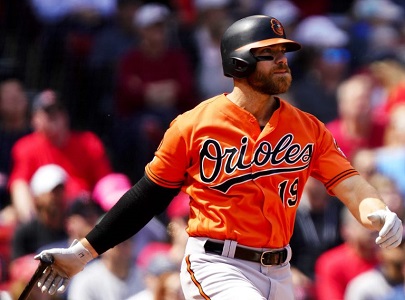
Davis has his field position in common with Hodges and his uniform number in common with Young (19), if you’re scoring at home. And, perhaps strangely enough, he did pick up two runs batted in during this season’s part of the streak, before Saturday night, working out a bases-loaded walk against the Blue Jays on April Fool’s Day, and knocking in a run with a fielder’s choice grounder against the Yankees five days later.

Some of the moral support Davis received during his slump could be described politely as sardonic. Especially considering his mammoth contract that still has four seasons to go, paying him about $92 million more to come, while the rebuilding Orioles—in third place in a suddenly weakened AL East—must navigate around the percentage of payroll he occupies.

He dropped off the proverbial table almost as profoundly as he climbed upon it in the first place. But he still moves no less than The Athletic‘s Ken Rosenthal to admonish, “Davis is a guy who has accomplished an awful lot in baseball after struggling in his early 20s, a guy who was doing extra work before games, but failing every night on the most public of stages, a guy who is deserving of sympathy, not scorn.”

His manager, Brandon Hyde, on the bridge for his first season, agrees. “You just learn about him,” Hyde told reporters after Saturday’s game. “This guy is tough. This guy is mentally tough. To persevere through that, the spotlight on him, everybody is talking about him, to see him talking about it on TV. To see him be the same guy every day and put in so much extra time . . . to see the results work out for him, it’s a great feeling.”

Dodger fans sent Hodges uncounted talismans, including a few quantities of carrot juice to help his batting eye, as well as constant letters of encouragement the first baseman cherished gratefully. Mets fans sent Young four-leaf clovers, horseshoes, and rabbit’s feet, while psychics called the Mets’ offices to offer assistance. Jay Leno invited him onto The Tonight Show and, in return for the expected gags, offered Young carte blanche to make fun of the host’s notoriously glandular chin. Even grumpy Hall of Famer Bob Feller sent an encouraging written word.

It’s not known yet whether anyone did likewise for Davis. Or, whether he received any contact or encouragement from Hodges’s family. (Young at one point received encouragement from the descendants of Cliff Curtis, the sad-sack Boston Braves pitcher whose record he broke.) At one point either he or Oriole fans must have been tempted to send a black cat his way for reverse fortune, as one of an earlier generation of Mets fans did for Roger Craig during his 18-game losing streak in 1963.

One thing that probably prevented Davis from becoming a true hate object was keeping a sense of humour during the slump, and immediately after breaking it. When he pulled up at first following his opening single, Davis called for the ball, something usually done for milestone hits. Well, you could call this one a milestone, breaking the longest known slump in major league history.

“I don’t know, but I’m going to get it authenticated,” the first baseman cracked. “You have to embrace it at some point.”

A quarter century earlier, the manager of an Orioles team that opened a season 0-22 showed a reporter a button given him by a fan: “It’s been lovely, but I have to scream now.” Someone should ask if the late Frank Robinson’s family wouldn’t mind lending it to Davis to keep alongside the ball he hit to end the slump. It just might do him some extra extraterrestrial good, no matter how the rest of his season plays.

“Tough times don’t last,” said Orioles third baseman Rio Ruiz after the game, “but tough people do. That’s all you need to know about Chris Davis.” Whether he or the Orioles will be tough enough together to face the end of his line in due course is another day’s question. Joy and Baltimore baseball have been companions estranged enough the past two seasons. For the time being, let the man and the team savour.

Calm down, Chicken Gawdsaking Little

Seattle Mariners

These days it’s kicks for the Seattle Mariners but getting kicked for baseball’s Chicken Littles . . . 

H.G. Wells and Chicken Little, call your offices. The Gawdsakers (as in, Mr. Wells’s description of those hollering “For Gawdsakes let’s do something” about, oh, every other real or imagined crisis) and the Littles (the ones succeeding the fabled chicken hollering “The sky is falling!” even on bright, sunny days) gaze upon two-week-old baseball season and have the willies. And I don’t mean Mays.

Typical is New York Post writer Joel Sherman, or at least his headline writer (one of the dirty little secrets of journalism is that writers don’t always get to write their own headlines), scrawling atop his 11 April column, “MLB’s home run nightmare worsens with no end in sight.” Sherman isn’t quite that hysterical in the actual column, but he isn’t quite temperate, either.

“The homers are part of a grouping with strikeouts, walks and hit by pitches that the Commissioner’s Office has been obsessed with lessening to get more action within the field of play and on the bases to quicken the overall pace,” he writes. “So far in 2019, MLB is seeing its nightmare worsen.

“In 2018 those four types of plays represented a record 34.8 percent of plate appearances,” Sherman continues. “It was 37 percent in 2019 through Wednesday. The sport is on a per-game record pace for homers, strikeouts and hit by pitch, and walks are at a two-decade high.

“Through the first 180 games this season, there have been 467 home runs. That projects to 6,318 for the season. The record is 6,105, set in 2017.”

So much for the wise old saying that records are meant to be broken. But why not take a look at the overall picture in a more sensible fashion?

As of Saturday morning, the American League’s teams delivered 1,687 base hits. Of those, 350 are doubles, 31 are triples, and 268 are home runs, which means 38 percent of the American League teams’ hits have gone for extra bases. The National League’s teams delivered 1,651 base hits, among which are 344 doubles, 25 triples, and 269 home runs, which means 39 percent of the National League’s hits have gone for extra bases.

You might have noticed that the National Leaguers have hit 369 non-homer extra base hits and the American Leaguers, 381. That’s 113 more non-homer extra base hits for the American League and 100 more for the National League. And it means the American League through Saturday morning hit 1,038 singles and the National League, 1,013. Put the two leagues together, and 39 percent of all base hits have gone for extra bases.

A baseball team has two jobs: 1) Put runs on the scoreboard; and, 2) Keep the other guys from putting more runs on the scoreboard. The American League teams have put 959 runs on the scoreboard so far; the National League teams, 951. American League pitching has thrown 13 shutouts so far (the Athletics lead the league with three); National League pitching, 17. (The Pirates, of all people, lead the league, also with three.)

Another wise old saying is, “Good pitching beats good hitting—and vice versa.” The problem for Joe and Jane Fan and, often enough, Joe and Jane Sportswriter, is that they can’t make up their bloody minds what they want to see. Under today’s dubious microscopes, one minute Sandy Koufax would be called a genius and the next he’d be charged with ruining the game. One minute Henry Aaron would get high praise; the next minute, he’ll be accused of helping dull the game.

Show them a flood of good pitching and they’re ready to find all kinds of contortions to give the hitters an even break. Show them a flood of good hitting and they’re ready to find comparable contortions to give the pitchers a little love. Show them nothing but the home runs, the walks, and the strikeouts, and they can’t answer at least one salient question: “You’d rather see them hitting into double plays?”

Which reminds me: American League teams have made 5,440 outs and National League teams, 5,402. Through Saturday morning, American League batters have hit into 124 double plays and National League batters, 134. Meaning five percent of each league’s outs came from double plays.

A well-turned double play is a delight to watch around the infield but hell on a hitter who’s just wasted a valuable out. I have a hard time believing those who want whatever they think is more “action” really want to see more double plays. Not even if they could put Brooks Robinson, Ozzie Smith, Bill Mazeroski, and Keith Hernandez around the infield.

Funny thing, too: As of Saturday morning, the American League’s batting average on balls in play is .290 and the National League’s, 291. And the stolen base isn’t quite as extinct as you might have been led to think, either. Through Saturday morning, the American Leaguers have tried 137 thefts and consummated 121; National Leaguers have tried 125 and consummated 86.

That’s an .883 American League stolen base percentage and a .688 National League percentage. Put them together and you have a .790 major league stolen base percentage, a mere eighteen points below Hall of Famer Rickey (The Man of Steal) Henderson’s stolen base percentage.

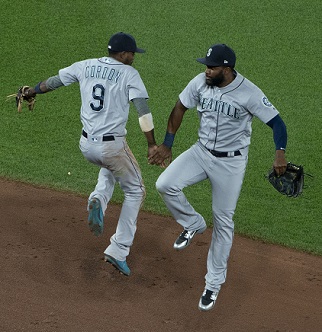
So far this season’s surprise team is the Mariners. As in, the allegedly rebuilding Mariners. They have the best record in the Show through Saturday morning, and they’re earning a reputation as a powerhouse: their 37 home runs are better than everyone else so far, with only the continuously-rebuilding Athletics (34) having hit 30+ bombs in their league and only the consistently-mighty Dodgers hitting 30+ in the National League.

But lo! The mighty Mariners have hit 43 percent for extra bases overall, and they have a .904 stolen base percentage in 21 tries. (19 steals.) (The bottom-feeding Royals, World Series champions a mere four years ago, have almost as many thefts, 16, as the Mariners.) The Mariners have 32 doubles and four triples to go with their 37 bombs, but they’ve also hit 97 singles—57 percent of their hits.

Two nights ago I sat in Las Vegas Ballpark watching the AAA Aviators tangle with and blow out the Sacramento River Cats, 11-3. The game’s most remarkable feat was the Aviators whacking four triples in five consecutive plate appearances in the third inning and the final three of them consecutively. Those triples were good for three runs. Let me reiterate: Only one team major or minor leagues, to my knowledge, ever did the triples thing better in a single inning, the 1934 Red Sox hitting four straight triples against the Tigers.

Meanwhile, the game’s first run scored while River Cats left fielder Michael Reed dialed Area Code 5-6-3 in the second inning.  The Aviators scored twice in the bottom of that inning on a wild pitch, a throwing error, and some marvelous hustle, then sent home two runs on a walk, a base hit, and an RBI double in the fourth. The fifth through the seventh were scoreless on both ends but with only five strikeouts between the two sides. Top of the eighth, Cats third baseman Zach Green hit a leadoff homer over the right center field fence and past the swimming pool onto its patio behind that fence; the Aviators scored four in the bottom on a double, an RBI single, and a two-run homer.

There were 22 hits in the game, ten singles four doubles, four triples, and three home runs. The Aviators pitchers struck out seven; the River Cats pitchers, 15. But I don’t remember anyone complaining about 22 of the game’s 51 outs coming on strikeouts. Including Reed’s double play, the only double play of the game while we’re at it, there were 23 ground outs in the game, 16 fly outs, and one runner under arrest trying to steal. Meaning 76 percent of the game’s outs didn’t come by strikeout.

Calm down, Chicken Gawdsaking Little. There’s more “action” than you think. (I can’t wait for the next kvetch over the next great pitching duel.) Baseball isn’t exactly in the dire shape you’ve tricked yourself into believing.

Gladstone: “These were my boyhood heroes”

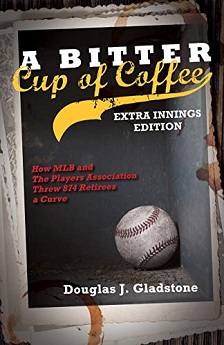
2019-04-13 BitterCupMy friend Douglas J. Gladstone—the author of A Bitter Cup of Coffee, chronicling the battle to obtain pension payments for what are now 634 still-living, short-career former major league players, frozen out of a 1980 re-alignment that changed MLB pension eligibility but excluded those players—submits a guest commentary. I’m glad to publish it here:

United States Representative Linda Sanchez, who represents California’s 38th Congressional District, once remarked, “I’m often reminded that, in baseball, as in diplomacy, you have to know when to hit, when to run and when to show grace.”

The only grace in baseball that I know of is former Chicago Cubs player Mark Grace.

If I sound jaded, I apologize. Fact is, I love the game of baseball. But the business of baseball, well, that is another matter entirely.

That is because, for the past decade, I have attempted to help the 634 men who are without Major League Baseball (MLB) pensions get the monies I and a lot of others feel they deserve.

These men are in this position because, in order to avert a threatened 1980 walkout by the players, MLB made the following offer to the union representing the players, the Major League Baseball Players’ Association (MLBPA): going forward, all a post-1980 player would need to be eligible to buy into the league’s premium health insurance plan was one game day of service; all a post-1980 player would need for a benefit allowance was 43 game days of service. At the time, the threshold was four years to be vested in the pension plan.

The problem was, the union failed to insist on retroactivity for all those players who played prior to 1980 who had more than 43 game days of service but less than four years.

So I wrote an April 2010 book that many credit with shedding a light on this topic. I recently updated the book to tell readers what has been happening since then.

One blogger for CBS.com asked me straight up, “Why do you care about these guys so much?” That’s when you start wondering whether you’re like Cervantes’ mad knight errant, Don Quixote, and you’re tilting at windmills.

These were the boyhood heroes of my youth. Whether it be listening on the radio, watching on television or attending a game in person, they gave me countless hours of entertainment growing up.

In April 2011, the league and union partially remedied this problem. Men like Tacoma’s Aaron Pointer, Ocean Shores’ Bob Reynolds, Everett’s Jim Ollom, Centralia native Bob Coluccio and Darcy Fast, the former pastor at the Centralia Community Church of God, all began receiving $625 for every 43 game days they were on an active MLB roster, up to $10,000.

Considering that, in an $11.5 billion industry, even a post-1980 player who only has 43 game days of service credit currently receives a minimum pension of $3,589 at the age of 62, many folks including myself likened the gesture to throwing the guys a bone.

Coluccio summed it up quite nicely: “To me it’s like saying we would like to invite some of our family members to dinner, but unfortunately, you will need to eat in the kitchen.”

But that message isn’t resonating at 12 East 49th Street in midtown Manhattan, where the union’s headquarters are located.

To date, the MLBPA has been loath to divvy up anymore of the collective pie. Even though the players’ welfare and benefits fund is worth more than $3.5 billion, MLBPA Executive Director Tony Clark has never commented about these non-vested retirees, many of whom are filing for bankruptcy at advanced ages, having banks foreclose on their homes and are so sickly and poor that they cannot afford adequate health care coverage.

Why do I keep at it? This might sound a bit hokey, but I was a huge fan of the television series, The Fugitive, growing up. All Dr. Richard Kimble wanted was to prove that he was the victim of a terrible error of our judicial system. As the narrator reminded us week after week, the protagonist was a victim of blind justice.

All I have ever wanted to do was tip the scales of justice back into a level playing field so that these men could get the compensation I and a lot of other folks believe they are deserving of.  After all, as Ralph Waldo Emerson once observed, “You cannot do a kindness too soon, because you never know how soon it will be too late.”