“It was a wacky war”

Yogi Berra

A colourised version of perhaps the most familiar image of Yogi Berra in his Navy uniform.

Note: Today is the eightieth anniversary of history’s largest amphibious war invasion—officially named Operation Overlord; colloquially known as D-Day from then until now, and beginning the liberation of France and in due course all western Europe from the grip of the Third Reich.

Among those of the U.S. Navy playing an active role in the invasion was a Yankee prospect who’d survive the war to become a Hall of Fame catcher against whom all to follow would be measured. I republish this essay in his honour and as a tribute to those who served with him but didn’t make it home.

Yogi Berra once gave a half-puckish beginning explanation as to how he became part of D-Day, World War II’s major Allied invasion of Europe from the Normandy beaches, as an eighteen-year-old Navy seaman. He made it sound like relief from boredom. As he so often did with his fabled Yogiisms, he had a knack for good humoured understatement.

Something still seems to be missing from America since Berra’s death almost nine years ago, which was also more than a year and a half after his beloved wife, Carmen, preceded him. And there may be worse reasons to think about the Hall of Fame catcher and personality than remembering how he got himself aboard a Navy rocket boat in time to be part of D-Day.

Berra was a Yankee prospect playing for their Norfolk, Virginia farm in 1943. Norfolk also just so happened to be the headquarters of the Fifth Naval District. Which meant it was also the governing center of the Navy’s Atlantic Fleet. Which also meant Norfolk and nearby Newport News overrun with sailors and civilian defense workers, an estimated 750,000 of them in a pair of towns whose populations combined weren’t quite as large as that of the Bronx.

His biographer Allen Barra, in Yogi Berra: Eternal Yankee, has written that the lad’s first real problems in Norfolk were long lines at the movie houses he loved and trying to stretch his $90-a-month minor league salary. “I never got too hooked on cigarettes, because I couldn’t afford them,” he once said. “Maybe starvation kept me from getting cancer.”

Once, knowing his team’s two other catchers were ailing, Yogi launched a unique version of a strike, telling his manager he wasn’t well for lack of food and the ploy worked toward getting him a $5 a month raise. His mother, Paulina, helped by slipping him a few extra dollars in the mail with instructions not to tell his father. And Berra became popular enough on the Tars that one ardent fan, a lady, provided him a full hero sandwich of salami and provolone every Sunday game.

That sandwich, Barra wrote, “was for Yogi what spinach was for Popeye.” After he received the first such gift, he smashed twelve hits and drove in 23 runs in two games against Roanoke. (This was the doubleheader that prompted Carmen Berra to remember, “When I heard about the 23 RBI day, I figured he had a future.”) He played well enough to be able to think an equal or better 1944 would get him a Yankee call-up. “Yogi was looking forward to an explosive 1944,” Barra wrote. That’s a polite way to describe the one he got.

Berra knew only two things: 1) He’d be in military service soon. 2) He had no idea where. Told his draft papers were drawn back home in St. Louis, he asked for and got them sent to Norfolk. After the Tars played an exhibition game with the Norfolk Air Station (some of the Norfolk players included such Show men as pitchers Fred Hutchinson and Hugh Casey, outfielder Dom DiMaggio, and Yogi’s future Yankee teammate/fellow Hall of Famer Phil Rizzuto), he talked to a warrant officer at Norfolk’s Navy training station and took the man’s suggestion to enlist in the Navy.

When his boot camp in Maryland ended, his mother underwent surgery; he was allowed to be with her until she could return home. After that, Yogi went to Little Creek to train for the amphibious service. The routine otherwise was so hurry-up-and-wait that the kid relieved his boredom at the base movie theater and with the comic books he fell in love with. Then one night he was watching Boomtown, the Clark Gable-Spencer Tracy film, when the film suddenly stopped and the theater lights suddenly came back up.

Berra and all the other sailors in the theater were ordered to line up. Officers asked for volunteers—for rocket boat duty. None of the young swabbies had a clue about rocket boats but when someone called them rocket ships, Yogi perked up. The idea that volunteering in military service was tantamount to being very careful what you wish for hadn’t yet been programmed into his mental data base.

The boats, as Barra noted, “turned out to be small landing craft, LCSSs (Landing Craft Support Small), whose purpose was to spray rockets on the beach before troop landings. There were duller things to train for. Some of the men got the hint that they might be participating in a major troop landing, perhaps the invasion of Hitler’s Fortress Europe that the papers were always writing about.”

The sailors called the rocket boats big bathtubs. If you played with toy boats in the bath when you were a small child, try now to imagine having a bath with 48 rockets, one twin .50-caliber machine gun and two .30-caliber machine guns. The boats affirmed the aforementioned hints: their purpose in life was to hammer the Normandy beaches and clear the way for the troops’ landing crafts. Yogi and his fellows had a name for them: “The landing craft suicide squad.”

The rocket boatmen first went to Plymouth, England. Once again it seemed to be hurry up and wait. Three weeks after they arrived, though, Berra’s LCSS was attached to what was thought to be the smallest transport ship in the Coast Guard fleet, the USS Bayfield. It made for Normandy early on 4 June. The Bayfield carried six LCSSs. “Just before dawn, on the morning of June 6, 1944,” Barra wrote, “their rocket boat was lifted on the davits and lowered over the side and, in Yogi’s words, ‘expendable as hell, we headed in for Omaha Beach’.”

The LCSSs were the tiniest boats on the waters heading into firing position.

“It was scary,” Yogi would remember, “but really something to see. I was only eighteen, and I didn’t think anything could kill me. I didn’t know enough to be scared. I had my head up over the side of the boat all the time, looking around like it was the Fourth of July in Forest Park and after the fireworks we were going to go over and get some hot dogs and Cokes.”

Bless his innocent soul, Yogi probably had no idea how vulnerable the LCSSs were. The sides of those boats weren’t exactly thick. One errant enemy shell, especially one hitting any of the boats’ rockets, would have made not the Fourth of July hot dogs but them into duck soup. Berra’s peekings over the edges to see the show ended when his lieutenant advised him to put his head down if he had plans to keep it.

The LCSSs waited for their lead boat to fire a test and see if it reached the beach. If it did, the other boats would move in close. It did. And inimitably, Yogi described the boats moving in “closer than the hitter is to the left field [wall] at Fenway Park.” One and all of them began firing. “I couldn’t see all the bloodshed that they showed in the movie [Saving] Private Ryan,” he remembered years later, “but I did see a lot of guys drown.”

Berra’s and all the LCSSs did what they were sent to do. Well enough that by D-Day’s afternoon they could actually relax, though they were under orders to remain through 9 June for cover fire in the event the Nazis had ideas about the counterattack that never came.

They had more trouble from an anticipated storm smashing in on 8 June, battering the boats and even flipping Yogi’s over. Before that they had trouble through no fault of their own—a friendly fire incident. Three fighter planes appeared above and the LCSSs were under orders to shoot down anything flying below cloud level. The LCSSs fired and hit one plane. The pilot bailed and parachuted before the plane hit the drink. Yogi ordered his boatmates to keep him covered, expecting to hear a stream of German.

What he heard was a stream of English language swearing. The crew had shot down an American plane whose markings they couldn’t see in the murk of the storm. When the storm worsened, Berra’s boat flipped over. Try to resist the temptation to say that only Yogi Berra and his boat crew could survive D-Day just to get thatclose to drowning after the artillery stopped.

They hung on until they were rescued and returned to the Bayfield. A Nazi bomb fell near the ship but no serious damage occurred, according to Barra and others. Berra said later he was too tired to be scared. Years later, when he met D-Day’s mastermind, Gen. Dwight D. Eisenhower, he couldn’t bring himself to ask Eisenhower about the invasion. “I never talked about D-Day,” Yogi remembered. “It didn’t seem right, but now I wish I had.”

With good reason. Numerous sailors believed Eisenhower was aboard one of their ships on D-Day. This was because of his soon-to-be-immortal radio message (You are about to embark on a great crusade) that was actually recorded at the 101st Airborne’s headquarters while watching the first Allied aircraft reach for the skies on that day. Even today, it sounds so clear that when you play it it sounds as though Ike’s telling it to you side by side as you’re about to hit the links.

Berra and his squadron got a break to rest at Portsmouth before going to Bizerte, the North African coastal town, and by 15 August 1944 he was part of the LCSS force hitting Marseilles and strafing hotels and other facilities co-opted by German forces. Berra’s boat was almost hit by mistake by a British shell that turned out to be a dud.

Berra himself got close enough to death when ships of the British Royal Navy behind the LCSSs fired at targets past the hotels and, while holding a rocket, one of his crew hollered to hit the deck. As he ducked under a gun mount, Yogi accidentally dropped the rocket. “It did not go off,” Barra wrote, “or you wouldn’t be reading this book.”

During a furious barrage, Berra got nicked by a bullet from a German machine gun before he manned his twin .50s and fired to cut down fleeing Nazis. As American troops landed, the locals swarmed the sailors with gifts and song. “It was a wacky war,” Yogi would remember. “A half hour after we were getting shot at by the Germans, the French were welcoming us.”

He rarely talked about his World War II experiences in the decades to follow. When he did so, even that provoked a little humour, as in the Los Angeles Times overhearing Berra talking to Hall of Fame pitcher Jim Palmer and Hall of Fame broadcaster Tim McCarver. Wrote the Times: “Yogi survived D-Day and George Steinbrenner, and all in forty years.”

He had to survive a more sensitive customer, though: his mother. After receiving a month’s leave for the Christmas holidays, Berra went home and showed his family his hard-earned decorations: a Distinguished Unit Citation, two battle stars, a European Theater of Operations ribbon, and a Good Conduct Medal.

Paulina Berra was already in tears as it was. Her boy also earned the Purple Heart when he was nicked by that Nazi bullet, but Yogi didn’t dare make the formal application for that medal. He figured that if Mama Berra knew what the Purple Heart really meant, she’d suffer a purple heart attack.

The Angel of Doom, retired

Ángel Hernández

Hernández retired effective at once. Enough fans, players, coaches, and even managers prayed the day would come far, far sooner.

It’s not impossible that last Friday’s deep dive into the wherefore of Ángel Hernández by The Athletic‘s Sam Blum and Cody Stavenhagen was the pilot fish preparing for a major development involving baseball’s arguable most controversial umpire. On Memorial Day, USA Today‘s Bob Nightengale broke it: Hernández, who hadn’t worked a game since 9 May, has retired.

Nightengale had barely posted his story to Xtwitter when all hell broke loose aboard the platform. At least 85-90 percent of it was in the happy-days-are-here-again mood. The rest was divided somewhat delicately among those who believe that the Angel of Doom hasn’t been the absolute worst of his profession despite his knack for attention-getting and those who wonder whether baseball’s umps aren’t getting even a small dollop of a bum rap.

To say that a small majority of major league umpires are reasonably competent at their jobs isn’t unfair. To say that those who aren’t make it hell-if-you-do/hell-if-you-don’t for those who are isn’t unfair, either, especially when speaking of those umps who seem anxious to make themselves the focus. To say that there are those umpires who believe to their souls that they are the game itself is both troublesome and sobering.

Over long decades of baseball’s labour struggling it became apparent to all but the witless that no fan had ever paid his or her hard-earned money to attend a major league baseball game in order to see a team’s owner.* Over much of this century and a fair portion of the previous one’s closing years, there’s come wonder over whether some umpires, Hernández and his recently-retired patron Joe West included, think Joe and Jane Fan should be paying their hard-earned money to see them prove who is the game around here.

The long-time presumption was that the umpires were the proverbial adults in the room, keeping the heat-of-the-moment tempers among players, coaches, and managers from turning a baseball game into something equivalent to today’s nursery school riot style of Congressional deliberation. But those who think too many umpires today have pioneered the concept of the ump as the game’s supreme being should know that that isn’t exactly a contemporary concept.

“I’ve heard it said that umpires are a necessary evil. Well, we’re necessary but we’re not evil,” wrote the late Hall of Fame umpire Doug Harvey. “We’re the backbone of the game, the game’s judge, jury, and executioner. Without us, there’s no game.”

Harvey’s career as a major league umpire went from the Kennedy presidency to the first Bush presidency. His professional and personal reputations remain enviable. But this is also the man who called the memoir from which I just quoted They Called Me God. Harvey’s is a splendid memoir if you don’t count one or two entries of patent nonsense. He thought the 1999 calamity—which he called a umpires strike, erroneously**—meant the arbiters “have given up all their autonomy out on the field. They have none.”

But Harvey also observed that umpires are hired to be the best and then expected to be even better. Nobody but a fool or an AI programmer believes umpires can be absolutely perfect, but there have been and there are umpires who have a difficult if not impossible time accepting that they, too, are human enough to get it wrong and ought to be adult enough to own it when they do. Such umpires are prime evidence on behalf of the advent of Robby the Umpbot. Umpires such as Hernández make Robby’s advent a question of when, not if.

Hernández has had a game-wide reputation for rejecting both his own humanness on the job and the ownership of his errors, which have been abundant enough. Once upon a time, in 2017, he even sued baseball’s government over his lack of World Series assignments and promotion to crew chief on the nebulous grounds of his ethnicity. (He is a Cuban-American, born in Havana but raised from infancy in Florida.)

He worked only two World Series prior to his ill-fated suit (2002, 2005) and only three postseason sets (division series in 2018, 2020, and 2021) after first filing it. (He once blew three calls, all overturned on review, in the first four innings of a 2018 division series game between the Yankees and the Red Sox, costing himself one World Series chance.) Named an interim crew chief on one or two occasions, he blew it in June 2019 after staying on the line to eavesdrop upon another umpire’s interview with baseball leadership over a twenty-minute game delay involving a rules dispute.

For too much of his career the Angel of Doom gave the appearance that, whenever he faltered or failed, his likely stance was that it was either God’s will or somebody else’s fault. (His broad smile, which resembled a smirk too often, probably contributed to that, too.) This was so especially over his strike zone behind the plate. You have got to be kidding me! hollered Rangers broadcaster Dave Raymond last month, after Hernández called strike three on a pitch to Wyatt Langford that was wide enough outside to let a cruise missile pass through without scraping its sides.

Yet Blum and Stavenhagen also described a side to Hernández too fully obscured by his longtime professional reputation. The side that portrays a man who came up the hard way, is a good and loyal friend, a good and loyal husband and father, heavily and sincerely involved in charity work involving disabled children. A man you’d like to call a friend so long as he’s kept away from umpiring your game.

The finest professionals can be found wanting as people, even as the finest people can be found wanting as professionals. Umpire Auditor has rated Hernández between 60 and 70 out of 85-90 umpires in any given season. That would mean Hernández wasn’t the absolute worst of his profession. But it begs the question of why he so often seemed going out of his way to engage avoidable incidents that Blum and Stavenhagen described as “paint[ing] a portrait of an umpire who’s played a major role in establishing his own villainous reputation.”

The early news of Hernández’s retirement included that he and baseball government reached a financial settlement to speed his retirement. The Angel of Doom, who’d worn out his welcome with fans, players, coaches, and managers long, long before, might finally have worn it out with baseball’s powers that be.

The social media celebrations of his departure asked, mostly implicitly but often directly, what took so long.

————————————————————————————————–
* The exceptions include 1980s Yankee fans fed up with George Steinbrenner’s tyrannically impulsive and dehumanising act, 1990s Reds fans who’d had it up to there with Marge Schott’s carelessness and bigotry, 2010s Met fans fed up with Fred and Jeff Wilpon’s malcompetence, and today’s Athletics fans wishing John Fisher would sell the team he wants to hijack to Las Vegas—when not wishing to commit manslaughter upon him.

** The 1999 calamity that destroyed the original Major League Umpires Association wasn’t the strike Harvey called it. It was an ill-conceived, brain-damaged mass resignation—and a flagrant end-run around the no-strike clause in their collective contract.

It was devised by MLUA leader Richie Phillips, when the commissioner’s office actually sought to develop a degree of umpire accountabilty. It destroyed several umps’ careers and the old union, which was decertified in favour of the umps forming what’s now the World Umpires Association. You can get the complete story here.

An ESPN writer gets religion . . .

Shohei Ohtani

Hitting the first of his thirteen Dodger home runs to date, Ohtani’s overall plate value may force the Dodgers to think of him as a one-way player—at the plate, exclusively. May. And one ESPN writer thinks it’s not a terrible thought at all.

Some of us have dared to ponder long enough whether Shohei Ohtani’s two-way viability was all that viable in the long term. Well, now. At least one ESPN writer asks and answers the same question. Sort of.

“Like [Babe] Ruth in the late 1910s, Othani might be getting so good with the bat it no longer makes sense to deal with the complications of a two-way act,” writes Bradford Doolittle.

Would Ohtani be open to giving up pitching at some point if the Dodgers ask? It’s the 21st-century version of the Babe Ruth Problem that confronted the Red Sox long ago. But if the team ever does make that request, it will be because a franchise that employs a small army of analysts has untangled some very complicated math around the decision.

Thanks to his recovery from a second Tommy John surgery performed late last year, Ohtani on the mound is a non-starter this year. Ohtani purely at the plate, as the Dodgers’ designated hitter, is something else entirely. Emphasis on something else: As of this morning, he leads the entire Show with a .646 slugging percentage, a 1.069 OPS (his on-base percentage is a solid gold .425), and 128 total bases. He also leads the National League with his 200 OPS+.

Shall we look at Ohtani’s 2024 thus far according to my Real Batting Average (RBA) metric? (Total bases + walks + intentional walks + sacrifice flies + hit by pitches, divided by total plate appearances. P.S. Ohtani as of this morning led the entire Show with his .356 traditional batting average and his 69 hits, too.)

2024 through 5/22 PA TB BB IBB SF HBP RBA
Shohei Ohtani 226 128 24 0 2 1 .686

WARriors may care to note that Ohtani’s 3.2 through this morning is behind only his Dodgers teammate Mookie Betts and a shade ahead of the Cubs’ import pitching star Shota Imanaga’s 3.0. (Imanaga is knocking the league on its can on the mound: he leads the NL with a 2.21 fielding-independent pitching rate [FIP] and leads the entire Show with an absolutely extraterrestrial 497 ERA+ so far this year, not to mention his 0.84 ERA.)

Doolittle runs down the prospects of Ohtani coming off the mound to stay and reasons why the Dodgers might want to make the move: his sick seasonal stats to date, his improved overall batting metrics, his increase in line drive hitting, even career high baserunning figures.

But it takes Doolittle a good while before he notes the injury that keeps Ohtani at the plate alone this year. And he almost brushes it to one side in order to address what he calls “the biggest consideration of all.” That would be, as he sees it:

To what extent is Ohtani’s current leap at the plate a byproduct of not having to worry about pitching? And how much better might he be doing, if that were at all possible, if he didn’t have to worry about rehabbing another pitching injury? Could his baserunning value be maintained or enhanced if he didn’t have to consider mound work?

A lot of people, myself included, wondered just how viable Ohtani’s two-way baseball life would prove in the long term. Enough of us who did so nearly had our heads handed to us. Three years ago, it happened to Ahead of the Curve author Brian Kenny, co-hosting MLB Now (MLB Network), courtesy of New York Post writer Joel Sherman, who co-hosted that day.

Kenny suggested the Angels should think of limiting Ohtani to one or the other full-time role, pitcher or designated hitter/occasional outfielder. Sherman demanded to know why. Kenny replied, “One could damage the other.” Oops. “So,” Sherman rejoined, “you would like one of the fifteen to twenty best starting pitchers in baseball to stop starting because you’re worried about something that could happen?”

Well, something that could have happened, did happen.

It’s kept Ohtani off the mound since last August, but that’s all, folks. That’s not wonderful news for the rest of the league’s pitchers, but it’s certainly wonderful news for a Dodger team sitting seven games up in the National League West while leading the entire Show in team total bases and team OPS and the NL in home runs, team slugging, and team batting bases on balls.

Once upon a time, Babe Ruth himself, the only other man to play even one season (1919) as both a starting pitcher and full-time (130 games) slugger/outfielder, thought the idea of continuing in that tandem role wasn’t too realistic even for him.

“I don’t think a man can pitch in his regular turn, and play every other game at some other position, and keep that pace year after year,” said Ruth in 1918, when he started twenty games for the Red Sox and played part-time (95 games) as a slugging outfielder. “I can do it this season all right, and not feel it, for I am young and strong and don’t mind the work. But I wouldn’t guarantee to do it for many seasons.”

Ruth had to be dragged kicking and screaming somewhat into the idea that his number-one value was and would be at the plate. But once he joined the Yankees he never again tried to be a pitcher, except for five games spread between 1920-21, 1930, and 1933. From 1920 through 1934, of course, you could say (with apologies to Casey Stengel) that Ruth was rather splendid in his line of full-time outfield work. Even if he was far more valuable at the plate (transdimensional in his time) than in the outfield (roughly league average).

It wouldn’t be untoward if the Dodgers began to think Ohtani might want to ponder Ruth’s 1918 remarks and take them seriously for the sake of his longer term baseball health. He already proved he could do the two-way job at a breathtaking level, not to mention doing it that way longer than Ruth actually did.

If the Dodgers are worried about the box office, they shouldn’t. Ohtani at the plate is still more than enough gate attraction. He’s liable to stay that way for a good number of years further. One way to ensure that as well as his real value in a pennant race just might be to keep him off the mound from now on.

The Angels star in “Forever Framber”

Nolan Schanuel

Nolan Schanuel crosses the plate after starting the Angels’ fifth-inning demolition of Framber Valdez Monday.

Framber Valdez started looking a little shaky in the fourth inning Monday. The good news was his Astros supporting him with a 4-1 lead against the Angels and padding it to 6-1 in the bottom of the fourth. The bad news was the top of the fifth.

It wasn’t just that the Angels blasted seven runs in that half inning. It was Astros manager Joe Espada leaving Valdez in to take a beating like that in the first place. Especially considering Espada’s postgame valedictory after the Angels finished what they finally started, a 9-7 win for their fourth win in five games.

“He just kind of was lost,” Espada told reporters postgame. “Started leaving some pitches in the heart of the plate and they put some really good swings on them. “His stuff was really good . . . just that fifth inning he kind of lost the feel for the zone.”

Valdez didn’t look too good in the fourth, either. After more or less cruising through the first three, he threw thirteen pitches only five of which looked genuinely good. He may have been fortunate that the Angels got only two singles in the inning while otherwise grounding into a force out and whacking into an inning-ending double play.

But after Astros left fielder Mauricio Dubón hit a two-run homer off Angels starter Reid Detmers in the bottom of the fourth to set that short-lived 6-1 Astros lead, the Angels went to work almost at once in the top of the fifth, when designated hitter Willie Calhoun smacked a two-strike single to right.

They weren’t exactly looking to detonate bombs. Nobody overswung, nobody tried to turn into a B-2 pilot. But sometimes you can just swing sensibly and discover you’ve a) still got some serious munitions in your bat; and, b) a pitcher who’s throwing you cannonballs without gunpowder behind them.

Valdez walked shortstop Zach Neto on a full count and struck second baseman Kyren Paris out to follow. Up stepped first baseman Nolan Schanuel, and Valdez hung a changeup that got hung into the right field seats. With one swing the Angels cut the Astros’ lead to two.

After a ground out right back to the box, Valdez was all over the place working to left fielder Tyler Ward before Ward finally singled up the pipe. He hung another changeup, sort of, to center fielder Kevin Pillar (he whom the Angels found in the junkyard after Mike Trout went down with a knee injury), and was lucky Pillar could only turn it into a single to left.

Espada still didn’t seem to have a bullpen option at the ready. He’d pay for it with Valdez’s next two pitches. Angels catcher Logan O’Hoppe saw a curve ball hanging deliciously enough to send well into the Crawford Boxes, and right fielder Jo Adell sent a hanging sinker the other way into the right field seats almost immediately to follow.

Just like that, the RBI single by Astros catcher Yainer Díaz and three-run homer by second base mainstay José Altuve in the bottom of the second to stake that early 4-1 lead became pleasant memories for Minute Maid Park fans and just a nuisance of mosquitoes agains which the Angels opened seven cans of Raid in the fifth.

“Things got out of hand there,” Valdez said postgame. “The game started off well and sometimes things happened.”

Unlike Valdez’s previous start, which came a day after the Astros practically emptied the bullpen following Ronel Blanco’s ejection (and subsequent suspension) for sticky stuff in the glove, and which saw Valdez take his team deep en route a 3-0 win, the Astro pen wasn’t exactly taxed for Monday.

But no relief was seen until the top of the sixth, with Rafael Montero taking over. He got a rude hello when Neto caught hold of a rising fastball and sent it to the Boxes. That was all the scoring for the Angels and all they really needed, despite some Astro friskiness in the ninth.

Adell may have broken the Astro spirit to stay for the game when he took off running after Díaz’s leadoff drive to right and took a flying leap to steal a homer from Díaz before he hit the fence padding. “He’s growing in front of your face,” said Angels manager Ron Washington postgame. “That was a big-time play and that play right there may have saved the game.”

It might have, considering Dubón singling to follow and Kyle Tucker driving him home with a base hit an out later. But Angels reliever Carlos Estevez held on despite walking Yordan Alvarez to get Alex Bregman—the veteran third baseman who was usually capable with first and second and two out, able to win it with one swing, until this year (.125/.125/.125 slash in this situation)—to fly out to not-too-deep center for the game.

The Angels set a new precedent at Espada’s and Valdez’s expense, too: this was the first time in the Angels’ history that four players 25 or under cleared the fences in the same game.

“I didn’t realize it until after the fact,” O’Hoppe told reporters. “None of us have said it out loud, but I feel like all of us internally had been waiting for a moment like that for a little while.”

“They’re growing up,” Washington observed. “They’re starting to figure things out. They really didn’t try to do too much and they ended up doing a lot. And that’s what it’s about.” Don’t look now, but they’re 7-6 in their past thirteen games including the four-of-five sealed Monday.

Maybe that thinking brings further unforeseen reward. Especially when the other guys’ manager doesn’t have an immediate bullpen answer for a starter who’s begun losing his stuff clearly enough. The Angels won’t get that lucky that often, but maybe continuing to think less-brings-more begins making their own luck.

A murder-suicide squeeze?

Pedro Pagés, Zach Neto

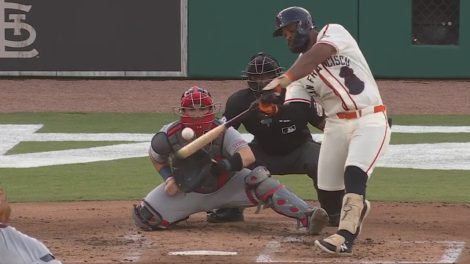
Cardinals catcher Pedro Pagés (left) must have pitied Angels shortstop Zach Neto caught cold on the suicide squeeze that wasn’t on Tuesday . . .

Ron Washington must have returned to managing with the idea that the job credentials now require he be in shape enough to throw players under the proverbial bus. Even if it wasn’t their fault his orders couldn’t be executed without at least one fatality.

The Angels manager who called for a bases-loaded suicide squeeze Tuesday had only one thought after Luis Guillorme tried to obey orders on a pitch you’d have required a door for making contact: It was all Guillorme’s fault.

Cardinals reliever JoJo Romero couldn’t find the strike zone with a search party. It took the lefthander a full count to strike the Angels’ eighth-inning leadoff man Jo Adell out. Zach Neto went to a full count before doubling down the right field line, before Romero walked Kyren Paris and Nolan Schanuel to set up the ducks on the pond.

Lefthanded-hitting Guillorme at the plate and Neto on third were given their suicide squeeze orders on a 1-1 count. Romero went into his delivery and Guillorme squared to bunt with Neto charging down the line for home. Except the pitch was well out of Guillorme’s reach, and Neto was a dead man.

Guillorme hadn’t been an Angel for a full week. Washington’s postgame comments must have made him feel as though the nearest available cave wasn’t deep enough for him to hide. “He didn’t do the job,” the manager said. “It wasn’t anything I did wrong. He didn’t do the job. I would have rather went to the ninth inning with a 6-6 lead than gone to the ninth inning the way we did.”

Aside from the brain fart that let Washington speak of a 6-6 lead, he was even more wrong about the erratic Romero: “Wild? He was throwing the ball in the strike zone,” the manager insisted. “Why are you making excuses? He was throwing the ball in the strike zone. (Guillorme) did not get the bunt down. Period.”

I’ve watched the video several times. Romero’s slider went at least two full feet or better outside the zone. Unless Washington thought Guillorme had heretofore untapped diving talent—or looked in the moment like the late behemoth Frank Howard (all 6’7″ and airplane-like arm span of him)—the only way Guillorme might have reached that pitch would have been to throw his bat toward it.

The ball was outside far enough that, even if Guillorme could have gotten the farthest end of his bat on it the ball might have ticked foul, forcing Neto back to third. In that instance, any element of surprise (perhaps the key element in executing a suicide squeeze) would have dissipated likewise. Of course, with the way Romero was throwing Guillorme might have gone from there to draw the game-tying bases-loaded walk, but we’ll never know now.

It’s only fair to say Washington’s intentions were the best. He had lefthander-vs.-lefthander with the bases loaded. He had his man facing a pitcher whose money pitch, a sinkerball, might have been ideal for dropping a suicide squeeze bunt if the pitch came to the plate in the zone. He was trying to avoid a rally-killing, inning-ending double play.

Now it’s even money who was further out of the zone, Romero and his pitches or Washington and his vision. All that’s left to determine is whether Washington turned the play into baseball’s first known murder-suicide squeeze.

With Neto heading home full speed ahead, any thought of Guillorme laying off the pitch was futile. Cardinals catcher Pedro Pagés had set up for a pitch toward the outside corner and was thus in decent position to snare a ball going as far out of the zone as Romero’s pitch went. He had only to hop up to his left and lay his mitt in front of the ball to take it. It looked almost as though Pagés pitied Neto when he stopped the Angels shortstop cold with the sorry-about-that tag.

Four pitches later—you guessed it, another Romero full count—Guillorme struck out swinging to finish the rally killing. The veteran the Angels picked up in a trade with the Braves earlier this month still took one for his manager after the Cardinals banked the 7-6 win. “He made a good pitch. What else can you say?” Guillorme said of Romero. “I tried to get the bat on it. But he made a good pitch.”

It was made good only because Guillorme tried to reach the unreachable. In further fairness it was only the exclamation point on a day when the Angels were as attractive in the field as ten head of cattle with mad cow disease.

Second inning: Angels starting pitcher Reid Detmers wild-pitched Cardinals right fielder Dylan Carson home, before third baseman Cole Tucker threw home wildly off a ground ball, enabling Cardinals second basman Nolan Gorman to score.

Third inning: Detmers let Cardinals first baseman Paul Goldschmidt and designated hitter Alec Burleson pull off a double steal with Carson at the plate. The pair of them had one stolen base between them all year until then and weren’t exactly road runners to begin with. Detmers ended up walking Carson and striking Gorman out, but then he fed Pagés a meatball good enough for Pagés to bag his first major league hit—a three-run double.

The Angels fought their way back, somehow, especially when their catcher Logan O’Hoppe blasted Cardinals starter Sonny Gray for a three-run homer in the fourth and left fielder Taylor Ward send Schanuel home with a sacrifice fly in the fifth. Burleson wrecked the five-all tie with a two-run homer off Angels reliever Amir Garrett in the top of the seventh, but Kevin Pillar—he whom the Angels picked up at the junkyard after Mike Trout went down with his knee injury—pulled the Angels back to within a run with a two-out RBI single.

That set up the 7-6 score Washington wanted Guillorme to close back up with the suicide squeeze. The one Guillorme couldn’t execute on a pitch impossible to reach. The one that prompted Washington to throw Guillorme so far under the proverbial bus he might actually have passed below another bus behind it before coming to a skidding stop.