Having a wild Wednesday

2020-06-18 NationalsPark

Nationals Park.

What a Wednesday. It only began when MLB Network’s Jon Heyman tweeted, “Breaking: MLB and players union are closing in on an agreement to play the 2020 season, via players. Deal expected to be for prorated pay and include expanded playoffs.”

Heyman kicked off what was possibly baseball’s most exciting day since the Washington Nationals shook, rattled, and rolled their way to winning Game Seven of last year’s World Series.

The difference is that the excitement had nothing to do with a gutsy pitching performance, or one manager having to hook a bold starting pitcher whose tank reached empty after surrendering a two-run homer, or another manager calling for a play review so his next pitcher might have a little more warmup time, or the first manager’s best relief option being reached for a foul-pole ringing, coffin-forming home run.

It had to do with baseball itself being exhausted of the unconscionable standoff between owners to whom the good of the game means making or saving money for it and players who don’t like people trying to renege on agreements but whose itch to play the game can be ignored for only so long before they have to scratch it.

On Tuesday came the word that commissioner Rob Manfred and Major League Baseball Players Association executive director Tony Clark met up and talked. Come Wednesday, once Heyman hit the merry-go-round switch the horsies galloped almost all over the place.

Some said the deal might be a 66-game season with a postseason expansion from ten to sixteen teams. Others said a 60-game season. Jayson Stark of The Athletic tweeted get your kicks on route 66: “12 games each vs 4 division opponents. 3 games each vs 4 interleague opponents. 6 games (home and home) vs interleague rival.”

Halt right there, tweeted NBC Sports’s Craig Calcaterra: “16 playoff teams is a joke. As it is I have made a mental distinction between the season and the postseason, considering them different things but if they go to 16 the season starts hurtling toward meaninglessness.”

Slow down, returned Stark, who ran down a quick list of teams who’d have made last year’s postseason in a 60-game season for a sixteen-team field: the Los Angeles Dodgers, the Milwaukee Brewers, the Chicago Cubs, the Atlanta Braves, the Philadelphia Phillies, the San Diego Padres, the St. Louis Cardinals, and the Colorado Rockies in the National League; the Houston Astros, the Minnesota Twins, the New York Yankees, the Tampa Bay Rays, the Texas Rangers, the Boston Red Sox, the Cleveland Indians, and the Oakland Athletics.

You may have noticed, as Stark couldn’t resist noticing, that among the missing in that scenario would have been 2019’s world champion Nats.

Then came the first chink in the chain pulling the merry-go-round in its circles, from Heyman’s fellow MLB Insider scribe Robert Murray: “Two sources with direct knowledge do not expect Major League Baseball’s latest proposal to the MLBPA to get a deal done. If a deal will be agreed upon, as [ESPN’s] @JeffPassan said, it needs to be for more than 60 games.”

Around 5 p.m. Pacific time USA Today columnist Bob Nightengale elucidated on the new proposal also including a universal designated hitter for this year and next. Shortly before that, former major league general manager Jim Bowden noted a likely deal would mean both the owners and the players foregoing grievances-to-be.

Then Heyman weighed in again, around 5:20 PDT: “The framework of the deal between Manfred and union chief Clark included: 60 games at 100% full prorated pay, waiver of grievances, 16-team expanded playoffs for 2 years, universal DH, more. Owner sources say it was agreed to pending constituency approval, meaning owners, players”

Two hours and ten minutes later, Murray slipped another chink into the merry-go-round’s motor chain: “People familiar with players’ thinking believe that they are seeking more games because they don’t feel a 60-game season is worth losing their right to file a grievance. ‘The ability to file a grievance,’ one agent said, ‘is almost worth letting the owners cancel the season’.”

What seems still to be another key is that the players don’t want a too-short season and a too-convoluted postseason but, as Athletic writer Ken Rosenthal posited, they may be willing to settle for 65 games. May. For a nation starved for major league baseball that may yet prove as good as major medical relief. May.

A day earlier, Yankee president Randy Levine, a man not necessarily renowned as a moderate among baseball administrators, struck another bull’s eye when he isolated one key issue other than dollars tied to that March agreement: “From what I’ve discovered, the holdup is not about the number of games or money at this time,” he said.

The holdup, as I understand it, is about resolving the other items in the March 26 agreement. They include final agreement on all of the health and safety protocols, deciding what happens if a season is interrupted by a second wave of the virus, which players can opt out and under what circumstances can they, and a host of issues like that.

Exactly. The owners often behave as though they forget it won’t be them at risk if baseball returns while the coronavirus’s world tour continues. The players—you know, the ones the fans pay to see play—will be at risk. So will fans once they’re allowed to return to the ballparks. So will the stadium workers, from the concession stand workers and hawkers in the stands to the grounds crews, stadium maintenance, and scoreboard personnel.

The owners also behave as though getting into baseball is a guaranteed financial bath. As though Jerry Reinsdorf didn’t buy the White Sox for $100 million in 1981 but has a team now worth $1.7 billion. As though David Glass—who’d helped Reinsdorf push for the 1994-95 strike—hadn’t bought the Kansas City Royals outright for $96 million in 2000 (he’d been the team president up to that point) and sold them for $1 billion last year. To name two.

Small wonder the players don’t want to surrender their right to a grievance without a battle, and small wonder the owners want them to agree to such a surrender.

So perhaps when all was said and done on Wednesday’s merry-go-round, the best news was the likelihood of the universal DH for this year and next. Unless there’s a codicil somewhere that isn’t yet known, bank on the universal DH remaining universal. At long enough last, the National League will have what a slightly pre-20th century Pittsburgh Pirates owner first proposed for sound reasons and last year’s collective pitchers’ batting average (.125) justifies: the end of a wasted lineup slot and too many rallies aborted in the womb.

There may be a deal to get a 2020 season, any 2020 season, played yet. Maybe by the end of this week, maybe by the end of the coming weekend. But while we’re at it, there is a suggestion we might make to the players who have, otherwise, done a better job than normal of making Joe and Jane Fan understand just who’s done the most to try hustling them.

The MLBPA’s Player’s Trust has committed $1 million to minor league players whose leagues may not play this year because of the coronavirus’s not-so-grand world tour. Yet there remain a little over six hundred former major league players who played before 1980 whose careers were short for assorted reasons—and who were frozen out of a pension plan re-alignment that year which gave full pensions to players with 43 days major league service and full health benefits upon one day’s MLB service.

Longtime MLBPA executive director Marvin Miller eventually said that not revisiting that mistake was his biggest regret. His successor once removed, Michael Weiner, collaborated with Manfred’s predecessor Bud Selig in getting those players $625 per quarter for every 43 days’ major league service.

It was a beginning, but there were two problems. One is that the players in question can’t pass those monies on to their families upon their deaths. The other is that the ill-fated Weiner—who loved baseball deeply, left no doubt about it, and earned a reputation for reasonableness even in his hardest negotiatings—died of brain cancer before he could have the chance to think about pressing the matter further.

Others have tried prodding Clark toward giving those pre-1980 short-career players a second look and building upon what Weiner and Selig began. Himself a former longtime first baseman, Clark has disinclined thus far. Even when New York Daily News columnist Bill Madden acknowledged, by way of a source inside the MLB apparatus, that Clark “isn’t gonna have any appetite for siphoning money from his rank and file. That’s why he won’t even talk to these old players.”

Legally, neither MLB nor the players’ union is obliged to send another dollar their way. (Neither, for that matter, is the separate Major League Baseball Players Alumni Association, likewise disinclined, especially after forcing three of the 600 plus—former pitchers David Clyde and Gary Niebauer, and former first baseman Eddie Robinson—off its pension services committee.) Morally is something else entirely, when you remember that those 600+ players were Players Association members who stood with their fellows during the moves and pickets that pushed open the door toward free agency and all its riches.

If the Players Trust can send drydocked minor leaguers $1 million for openers, surely the MLBPA can find a way to do further right by those 600 plus who were frozen mistakenly out of the 1980 pension realignment. Assorted current players sort-of strong-armed their teams into taking better care of their drydocked minor leaguers. Such players might want to think about their wrongly frozen-out major league predecessors a little more.

Even a commitment to revisit and readjust the pension plan for those pre-1980 short-career players when the Show gets back into business would be a serious step toward resolving Miller’s regret and finishing what Weiner and Selig started.
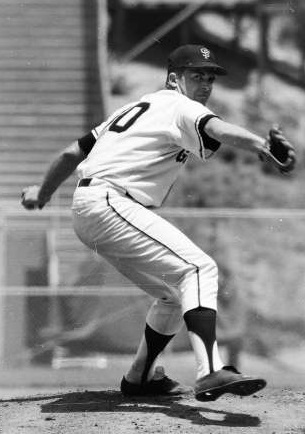
Mike McCormick, RIP: Mr. 500’s battles

2020-06-17 MikeMcCormick02

A Comeback Player of the Year-winning perseverance probably helped Mike McCormick win the first National League Cy Young Award in 1967.

Ask who was the first Giant (New York or San Francisco) to win the Cy Young Award and some might answer with either Tim Lincecum (who did win twice) or Hall of Famer Juan Marichal (who didn’t win even once).

Now, drop a hint: He’s the only pitcher in the 500-home run club. OK, we’re getting technical. But Mike McCormick did hit home run number 500 . . . by any major league pitcher.

The bad news is that he also surrendered Hall of Famer Henry Aaron’s 500th home run. So put McCormick into the membership-of-one 500-home run club on both sides of the ball.

McCormick was also the first pitcher to win the National League’s Cy Young Award, after the prize was divided for each league following Hall of Famer Sandy Koufax’s retirement, ending Koufax’s ownership (three in four seasons, the last two back-to-back) of the original major league award.

Until Lincecum won the Cy Young Award back-to-back, McCormick was also the only Giant ever to win the prize.

You’d have spotted McCormick on the road in a heartbeat if you knew some of the foregoing. His personalised license plate read “Mr. 500.” Mr. 500 died at 81 Saturday at his Cornelius, North Carolina home after a long battle with Parkinson’s disease.

Native to California, the lefthanded, hard-throwing McCormick had ideas about going to the University of Southern California with his high school all-star teammate Ron Fairly before scouts from all but one major league team began showing him the bonus money in 1956. When the New York Giants showed the 16-year-old $50,000, McCormick didn’t hesitate.

“I realized that fifty thousand dollars will buy me a lot of education,” he once told SF Giants: An Oral History author Mike Mandel, “and it’s an opportunity I may never get again, so I accepted it.”

The bonus rule of the day that required such signings to be kept on major league rosters for two full seasons before they could be farmed out. McCormick spent much of his first two in the Giants bullpen as the team moved from New York to San Francisco. Though numerous writings cite the elder Giants treating him decently, McCormick spent an awful lot of time walking the New York streets alone.

His roommate knew only too well how the kid felt: the late Johnny Antonelli, the first of the bonus babies under that old, silly rule. Antonelli was treated often enough as a pariah during his early years with the Boston Braves–until such veterans as pitcher Johnny Sain parlayed Antonelli’s fat bonus into their own salary hikes, and until Antonelli was drafted into the Army and then traded to the Giants.

In 1959 McCormick stepped forth as the Giants’ third starter. In 1960, he led the National League with a 2.70 earned run average and struck out twice as many as he walked. He fell off somewhat in 1962, but the Giants had reason to believe McCormick and Marichal were about to become the core of a youthful and powerful pitching staff.

They didn’t bargain on one little wrinkle. McCormick threw over a thousand major league innings before his 23rd birthday. At 19 he threw 178.1; at 20, 225.2; at 21, 253; at 22, 250. In 1962, his shoulder went AWOL and his manager Alvin Dark accused him of malingering.

“I couldn’t throw the ball 60 feet without getting tears in my eyes,” he once told Mandel. The pain was so serious McCormick admitted to hoping his catchers wouldn’t throw the ball back after a pitch. He spent the 1962 World Series on the bench and was traded to the Baltimore Orioles in the same deal that also made an Oriole out of relief specialist Stu Miller.

With the Orioles McCormick worked as a spot starter in 1963 but was sent to the minors in 1964—his first taste of minor league service. In the interim, Johns Hopkins doctors ruled he’d suffered a torn muscle in his shoulder that may or may not have been his rotator cuff.  Despite pitching well enough on the farm the Orioles traded him to the Washington Senators for another minor leaguer before the 1965 season opened.

Two seasons in Washington enabled McCormick to reinvent himself as a control-oriented pitcher with a lively screwball who looked and worked better than his won-lost records with the Second Nats. (He also took a single cortisone shot each spring from then on, nothing as insane a volume as other pitchers were administered far too often.)

When they traded him to the Giants for outfielder Cap Peterson and pitcher Bob Priddy in December 1966, the Giants hoped McCormick would just help balance the rotation as its only lefthander. They got better than they expected.

The 29-year-old McCormick wasn’t the National League’s most dominant pitcher in 1967 (Hall of Famer Jim Bunning actually was), but getting credit for a league-leading 22 wins and rolling a sub-3.00 ERA, after four seasons in which it looked as though he’d be another shoulder-wrecked casualty of youthful overwork, did him more than a few favours. He had above-league-average run support and his bullpen only blew one of his starts after he left the game.

McCormick probably won his Cy Young Award two ways: those 22 wins and his too-obvious Comeback Player of the Year Award-winning revival. Sometimes voters reward the effort a little more than the actual results. “He left the Giants’ employ five years ago as a fastball pitcher,” wrote then-San Francisco Chronicle writer Ron Fimrite. “He returned this year as a craftsman.”

It would be his final shining moment. In 1968—the year he surrendered Aaron’s 500th— his screwball took a powder and, despite a briefly shining 1969, McCormick’s pitching days were all but finished. Further injuries, further ineffectiveness, bounding from the Giants to the Kansas City Royals to the New York Yankees and back to the Giants, with a few minor league stops along the way.

McCormick found retiring easier said than done when he tried it first in 1972. But he finally called it a career in 1973. “I was a victim of bad pitching,” he once said. “My own.”

He wasn’t exactly left high and dry after baseball. He’d worked as a stockbroker in many offseasons and eventually became a Bay Area office equipment salesman and worked in promotions for the Giants as well. Divorced from his first wife, the father of three re-married happily, had a fourth child, and eventually retired to North Carolina.

“I loved the competing,” he told the Chronicle in 2002. “I’d play every day if I could, and that’s probably part of the reason I hurt my arm. I’d never say no. I’d say, ‘Fine, give me the ball. I’ll go get ’em.’ I loved it.” If only those who coached and managed Mr. 500 knew how to love his arm back.

This commissioner’s time should be done

2020-06-16 RobManfredBaseballsThat was last week: Baseball commissioner Rob Manfred saying there would absitively, posolutely be major league baseball in 2020. This was Monday, to ESPN: Manfred saying, “Not so fast.” Never mind that the March agreement the owners are trying to walk back gives Manfred absolute authority to order the season to go.

“I’m not confident,” he told ESPN’s Mike Greenberg for a special called The Return of Sports.  “I think there’s real risk; and as long as there’s no dialogue, that real risk is gonna continue.”

Not long from there, Manfred said . . . of course! It’s the players’ fault, for ending “good faith negotiations” that anyone with two brain cells to rub together knows really means “on the owners’ terms” coming from his lips. Anyone with the same two brain cells also knows that the owners crying “good faith” equals Donald Trump closing his Twitter account.

Want to know what the players really turned down over the weekend, with an emphatic harrumph of, “Seriously?”

The owners wanted a 72-game season at 70 percent pay per game played, 80 percent if the one-time-only (we think) expanded postseason (the owners wanted the players to say yes to 22 more such games) was played to the end. The players would get a 64.5 percent pay cut taking 100 percent of the safety risks—there’s still the coronavirus on its grand tour, you know.

Ken Rosenthal, writer for The Athletic, half the team (with Evan Drellich) who blew open the Astrogate/Soxgate illegal sign-stealing scandals, thinks plausibly that Manfred—whose powers include acting in the game’s best interest but who’s employed purely by the owners to whom the game’s best interest involves making money for them first—would rather incinerate the forest than see it for the trees.

Rosenthal also thinks Manfred is beginning to get one thing: strike a deal with the players who aren’t buying the owners’ Kickapoo Joy Juice or see his legacy as a baseball commissioner go into the tank.

The threat of a billion-dollar grievance from the [Major League Baseball] Players Association has forced Manfred to reconsider exercising his right to set a schedule for the 2020 season and return to his original mission of reaching a deal that is acceptable to both sides. What he wants now, according to sources, is to stop bickering with the union, start negotiating and reach an agreement that will bring the sport at least temporary order.

Yet for a guy who suddenly is looking for peace, Manfred sure has a funny way of showing it.

He and the owners, supposed stewards of the game, are turning the national pastime into a national punch line, effectively threatening to take their ball and go home while the country struggles with medical, economic and societal concerns.

Baseball’s better commissioners have been remembered among other things for appearing the next best thing to statesmen. Find me someone with skin in baseball’s game—a fan, a player, an owner (even), an analyst, a broadcaster, an historian—who’d call Manfred a statesman, and I’ll find you the last sworn-in government of the lost continent of Atlantis.

It’s been hard enough to think of Manfred as someone who genuinely loves the game after he made such remarks as the World Series trophy being just a piece of metal, trying to explain why it was one thing to discipline three 2017 Houston Astros while taking owner Jim Crane off the Astrogate hook but something else to strip their World Series championship.

Now Manfred has little choice other than that between finding and striking a deal with the players to get a 2020 season at all, or let it go and watch as nobody but the most stubborn among the tunnel-visioned takes Manfred or the owners seriously as stewards of the game any longer.

Remember: The owners are talking through their domes if they think anyone with an IQ higher than half (.064) the collective batting average (.128) of MLB’s pitchers last year buys their poverty cries. As Thomas Boswell pointed out early Monday, the average major league team value jumped by over $1 billion in the past six years—from $811 million to $1.9 billion.

Manfred’s contract as baseball commissioner is extended through the end of 2024. Assuming he doesn’t do anything else to implode the game between now and then—even assuming he finds a way, somehow, to be as Rosenthal describes, “the adult in the room, a leader with a sense of the game’s place in our society, the caretaker of the sport”—maybe it’s time at last to think of a better way to choose his successor.

There’s no reason on earth that the commissioner should be hired by and beholden to the owners alone. There’s no reason on earth a plausible candidate shouldn’t stand for election by the owners and by the Players Association through the thirty team player representatives. The commissioner should be beholden to neither faction but the consensus choice of both.

“Players come and go, but the owners stay on forever,” then-American League president Joe Cronin once told the late Marvin Miller, early in Miller’s tenure as the union’s executive director. Let’s just see about that. The owners stay only until they designate successors (think of the New York Yankees’ Hal Steinbrenner or the Detroit Tigers’ Chris Illitch) or sell. Fans don’t wear team jerseys with the names of owners on their backs.

The game stays on forever. And with very few exceptions the first thing you think about when you think about the game is the men who’ve played it. You don’t think of Joe Cronin as a meaner-than-a-junkyard-dog league president before you think of him as a Hall of Fame shortstop and even a manager. You don’t think of Joe Torre as baseball’s top cop before you think of him as an outstanding catcher/third baseman and a Hall of Fame manager.

You don’t always think of Bill White as the first African-American (and next-to-last) president of the National League before you remember him as an outstanding first baseman who also helped shepherd the St. Louis Cardinals through their racial growing pains. You don’t think of Nolan Ryan as a baseball executive (including a term as the president of the Texas Rangers) before you remember him as a Hall of Fame pitcher with seven no-hitters on his resume.

You don’t think of the late, ill-fated Mike Flanagan as a Baltimore Orioles executive before you remember him as a Cy Young Award-winning pitcher. You don’t think of Eddie Lopat as a snake-in-the-grass baseball executive (when a Kansas City Athletics player reminded him about a promised salary raise, Lopat the general manager shot back, “Prove it!”) before you think of him as a pitching star on five straight Yankee World Series winners.

You don’t even think of Al Rosen as the baseball executive who put a shot of rocket fuel into player salary inflation when he was the San Francisco Giants’ general manager (the once-notorious Bud Black deal), before you think of him as a powerful third baseman who swept the first-place votes as the American League’s Most Valuable Player in 1953, but whose career was torpedoed by back and leg injuries.

But you probably think Manfred wouldn’t be able to tell you any of that. You’d probably be right. He has to go. And, among numerous other lackings, the owners need to own up and agree—whether or not they’d accept that their duplicities brought us here in the first place—that baseball needs a better way to choose a better steward. A steward to whom the good of the game isn’t always the same thing as making money for it.

The owners, running out of feet

2020-06-14 CamdenYards

Oriole Park at Camden Yards. Other than frustrated Oriole fans who’d like to throw things at Peter Angelos, baseball fans don’t spend money to see their teams’ owners. The owners still don’t get the message.

But . . . but . . . not. profitable. That’s what enough of Major League Baseball’s owners kept trying to tell us while they tried to strong-arm their product (the players, in case you keep forgetting) into playing a short 2020 season and accepting less than their agreed-in-March pro-rated 2020 salaries. Right?

But . . . but . . . not. profitable. Never mind that the redoubtable Thomas Boswell once actually figured out that, over the past century’s time, baseball owners have hauled down a twelve percent compound annual rate of return: “That kind of tax-free compounding . . . is like striking an oil well that never runs dry.”

But . . . but . . . not. profitable. Baseball’s such a money loser that MLB just nailed a billion-dollar deal with Turner Sports—you may recall that its founding father once owned the Atlanta Braves—to “keep a playoff package that includes one of the league championship series on the network,” according to the New York Post. Earning MLB at least $150 million a year more than under the current deal set to expire after next season.

Philadelphia Phillies outfielder Andrew McCutchen couldn’t resist. “But baseball is dying!” he snarked. And who could blame him?

When you’re a group that pulls down the aforesaid compound annual rate of return, Boswell said three days ago, and you happen to be baseball’s stewards, “holding the sport in multicentury trust for fans who love it and support it,” you “have a duty to take the brunt of the financial hit from the coronavirus. In the long run, the owners, as a group, are always the huge winners. The players just pass through and get what they can grab — some of them a fortune but most far less.”

. . . The owners’ position appears to be: We don’t want to lose money. The whole world is. But us, no. We want players to accept additional pay cuts below a prorated level (but we won’t show you our books). In contrast, we will take a $0.00 year but not a share-the-pain loss . . .

. . . The owners are so self-protective, so oblivious to the good of the game, they even want to maximize their defenses against a second wave of the virus. Oh, we will play until the normal Oct. 31. But don’t talk to us about playing games in November because that would increase the chance of an erased World Series, lost TV money and losses for us.

That was three days before the Turner Sports deal. Now, remember, as Boswell does: The owners want the absolute maximum safety margin if the Show comes back, but if you assume the coronavirus isn’t quite finished with its grand tour guess who takes the maximum safety risk?

Hint: They’re the ones you pay your hard-earned money to see in uniform on the field, at the plate, on the mound. Accuse me as you must of flogging a dead horse, but nobody hands over anywhere from $15 to $150 or more per ticket to take themselves and their families or friends out to the ballpark to see Peter Angelos (not counting frustrated Oriole fans wanting to throw things at him), Mark Attanasio, Jim Crane, Bill deWitt, John Henry, Mark Lerner, Arte Moreno, Tom Ricketts, Hal Steinbrenner, and company.

Again assuming the coronavirus tour isn’t finished, the maximum risk takers are also the ones who guide you to your parking spot; sell you the food, drinks, souvenir hats and jerseys and other chatzkahs of rooting; post around the parks to keep the lunatics from spoiling your fun; and, run the park facilities from the gates to the scoreboards to the concession stands and back.

Show me a baseball owner and I’ll show you someone who shoots himself in the foot so often it’s a wonder he has a foot left to shoot. Of all the cliches you can attach to the so-called Lords of Baseball, and it’s been true for just about the entire life of professional baseball, the truest may be that they never miss the opportunity to miss an opportunity. (Except, perhaps, for the tax write-offs.)

Here’s the sport that could and should have dropped the big one on its competitors and gotten major league baseball back onto the field on the Fourth of July. “You get 15-games-a-day visibility before the NBA and the NHL return,” Boswell wrote, “as well as a two-month jump on the NFL.” So much for that idea.

That kind of image enhancing would have been worth more than the entire difference ($4.6 billion, roughly, if you’re scoring at home) between what Hal Steinbrenner’s late father paid to buy the New York Yankees from CBS in 1973 and what the Yankees are worth today.

The only shock, then, in the players all but walking away from the negotiating table on starting a delayed 2020 season—as The Athletic‘s Ken Rosenthal and Evan Drellich put it Saturday, “The March agreement between the parties empowers commissioner Rob Manfred to set the number of games as long as the league awards the players their full prorated salaries, with the caveat that the league make its best effort to make the schedule as long as possible”—is that anyone should be shocked.

Except, perhaps, by the owners looking for every possible way to renege on the March agreement, and the players—not always eloquently, not always with their best (unshot) feet forward—looking for every possible way to thwart them.

Remember the wisdom of the late Hall of Fame manager Sparky Anderson, again: We try every way we can think of to kill this game, but for some reason nothing nobody does never hurts it. Come Monday, when the players asked the commissioner to finalise seasonal plans, we may begin learning whether Anderson is still right.

MLB’s own Saturday statement said they were “disappointed” that the players chose not to negotiate “in good faith.” Set aside for the moment how similar that is to the classic Communist tack of claiming the invaded were the invaders. Remind yourself that, from time immemorial, the owners demanding “good faith” is like hearing Attila the Hun sing “All You Need is Love.”

The Yankeegate letter

2020-06-13 YankeeStadium

What further manner of extralegal sign-stealing Yankee panky might be brought in from the cold?

We’re about to learn the details of commissioner Rob Manfred’s 2017 written admonition to the New York Yankees about extralegal sign stealing. Federal judge Jed S. Rakoff has ordered the letter unsealed and submitted publicly and “minimally redacted” by both the Yankees and Major League Baseball no later than Monday. Very interesting.

That the Yankees used an illicit dugout telephone and may have used their own replay room reconnaissance on behalf of extralegal sign stealing in or before 2017 wasn’t exactly a baseball state secret, however often it was buried beneath the hooplas of Astrogate and Soxgate before the coronavirus turned most of that to one side.

The case involves the DraftKings fantasy baseball playing group suing MLB for fraud over the extralegal sign stealing scandals that jolted and discredited both the Houston Astros (2017-18) and the Boston Red Sox (2018). Rakoff ruled against DraftKings two months ago, but DraftKings thinks there was more in Manfred’s written Yankee spankee than both Manfred and the Empire Emeritus disclosed.

Beware the fool factor, though. Rakoff’s April ruling was comparable in its absurdity to Neville Chamberlain proclaiming peace in our time after agreeing to hand Hitler the Sudetenland 1938:

A sport that celebrates ‘stealing,’ even if only of a base, does not provide the perfect encouragement to scrupulous play. Nor can it be denied that an overweening desire to win may sometimes lead our heroes to employ forbidden substances on their (spit) balls, their (corked) bats, or even their (steroid-consuming) bodies. But as Frank Sinatra famously said to Grace Kelly (in the 1956 movie musical High Society), “There are rules about such things.”

As I couldn’t resist writing then, “The Chairman of the Board spoke to the future Princess of Monaco about love and war and what’s fair in both, not whether the Man of Steal* was really a shameless criminal for stealing as many bases as Robin Yount drove in runs. (1,406.)” Saying DraftKings didn’t have a case wasn’t the same thing as arguing choplogically that fantasy baseball players ought to go in with the presumption of guilt.

Remove for the moment the ongoing haggling over getting a major league baseball season underway at long enough last, the haggling provoked mostly by the owners trying to strong-arm the players into accepting a renege on their March agreement (full pro-rated player salaries, for openers) and the players saying, “We’ll just see about that.”

Absent all that, few baseball fans were unaffected by Astrogate and Soxgate. Fewer still were thrown more into internal turmoil than Astro fans and Red Sox fans faced with the actualities that their heroes, teams of excellence and (ahem) intelligence, who seemed to need extralegal espionage about as badly as the Flash needs a jet pack, were barely-apologetic high-tech cheaters.

Numerous players joined the fun in denouncing the Astro Intelligence Agency and the Rogue Sox Replay Room Reconnaissance Ring. No few of them were Yankees. Now the Yankees may or may not be exposed as going beyond a naughty extra dugout telephone or even their own replay room reconnaissance. No few in the social media swamp demand, too, that the hypocritical Yankees duct tape their mouths shut from this day forward.

So you thought the “what-about” style of rejoinder was limited to answering valid critiques of office holders with the comparable mischief or crimes committed by their predecessors. Must we be reminded continuously that mischief or crimes by one don’t justify those by a successor?

When I reviewed the second-edition publication of Paul Dickson’s The Hidden Language of Baseball: How Signs and Sign-Stealing Have Influenced the Course of Our National Pastime, I wrote that, just after the Rogue Sox were caught taking a bite out of an AppleWatch on behalf of espionage against the Yankees, a Yankee fan thought so well of sometimes beleaguered catcher Gary Sanchez that the fan decided to do Sanchez a huge favour at the plate. As Dickson told it:

[A] fan with a good view of the catcher and a strong set of lungs bellowed out information to . . . Sanchez while he was hitting in the eighth inning of his team’s game with the Tampa Bay Rays. Sanchez heard the voice, but so did Rays catcher Wilson Ramos and the home plate umpire, Dan Bellino, who pointed out the man to stadium security and had him removed from the stadium . . . “You could definitely hear the guy screaming, ‘Outside, outside,’ but you don’t know if it’s going to be a slider or a fastball,” Sanchez said afterward. “You got to stick to your plan, whatever plan you have, regardless of what people are screaming.”

Dickson couldn’t resist adding that that may have been the first time a fan was thrown out of the ballpark for sign stealing.

(Reminder: Sometimes fans blow the whistle on the spies. It happened in Wrigley Field in 1960, when bleacher fans caught Milwaukee Braves pitchers Bob Buhl and Joey Jay red-handed among them, training binoculars on the home plate area and relaying stolen signs to their hitters. Those fans tipped off the Cubs’ bullpen, who relayed the word to the dugout, that Buhl and Jay were jobbing them.)

We’ll know soon enough whether there is a genuine Yankeegate coverup on our hands above and beyond what we knew already about their illegal dugout phone and possible replay room reconnaissance. The Yankees would prefer the fuller disclosure of Manfred’s 2017 letter not happen, of course. Richard Nixon wasn’t exactly anxious to have the White House tapes disclosed fully, either.

“The plaintiff has no case anymore,” says a statement from Yankee attorney Jonathan Schiller to The Athletic, “and the court held that what MLB wrote in confidence was irrelevant to the court’s dismissal of the plaintiff’s case. Under established law, this supports the Yankees’ right to confidentiality required by the Commissioner of Baseball.”

This isn’t an instance of compelling public disclosure of scouting information. It’s not even an instance of compelling public disclosure of team financial value, never mind that fans can never help noticing player salaries are known publicly and to the last dollar but teams’ and their owners’ financials often seem to require extracurricular excavation.

Disheartened Astro and Red Sox fans would probably want nothing more than to know who else—aside from since-purged Astros manager A.J. Hinch, Astros bench coach-turned-Red Sox manager Alex Cora, former 2017 Astros DH-turned-New York Mets manager Carlos Beltran, and Rogue Sox replay room operator J.T. Watkins—availed themselves of those espionage operations.

Disheartened Yankee fans would probably want nothing less of their team, too. Every baseball fan probably wants to know that the line between on-field gamesmanship and off-field-based subterfuge won’t be crossed again any time soon.

The history books have long revealed those players, coaches, and managers who took up high tech cheating in their times. (It didn’t begin or end with the 1940 Tigers, the 1948 Indians, the 1951 Giants, or the 1961 Reds.) Do heartsick Astro, Red Sox, and Yankee fans really want to wait that long before knowing once and for all who was or wasn’t among their teams’ extralegal cheaters?

DraftKings may have no legs claiming deliberate fraud, but if the Astros and the Red Sox couldn’t escape disclosure Yankeegate shouldn’t be treated as a mere annoyance, either. Especially with the chance that, if nothing new might be exposed, everything known might be clarified further–and deeper. Might.


* – Hall of Famer Rickey Henderson.