Indictment in Skaggs death, but . . .

Los Angeles Angels v. Seattle Mariners

Wearing Tyler Skaggs’ jersey as his teammates did that night, Mike Trout walks in front of the center field fence displaying a memorial to the pitcher who died of an overdose in Texas last year. A former Angels media person is now indicted for giving Skaggs the drug that helped kill him.

Beckham Aaron Trout was born 30 July. His father, a baseball player of some renown, attended his son’s birth, returned to his team, and hit a 2-2 slider over the left center field fence. This morning, Jessica Trout tweeted a photograph for her husband’s 29th birthday, their new son proclaiming himself the best present ever.

In a career that would indeed qualify him as a Hall of Famer should it end after this season, and Los Angeles Angels fans aren’t the only ones who hope devoutly that that doesn’t prove the case, Mike Trout has shown among other things a genuine human decency and a penchant for rising to particularly heartfelt occasions.

Homering his first time up after fatherhood blessed him is just one. Last year, alas, Trout did it in the middle of soul-wrenching grief.

His teammate Tyler Skaggs died unexpectedly after the Angels landed in Texas to finish a pre All-Star Game road trip. When the team returned home, to face the Seattle Mariners, a wrenching pre-game memorial to the fallen pitcher was followed by Trout opening the scoring with a mammoth two-run homer in the bottom of the first.

That launched a 13-0 blowout and a combined no-hitter by Angels pitchers Taylor Cole and Felix Pena that electrified a game wracked in grief over Skaggs’s mortal demise. (“Absolutely incredible,” Houston Astros pitcher Justin Verlander tweeted. “Meant to be.”) His teammates, all of whom wore Skaggs jerseys for the game, laid those jerseys around the mound after the game, leaving only Skaggs’s number 45 behind the rubber exposed.

On the same morning Jess Trout helped her new son tell his father who was the best present ever, the news broke out of Texas that former Angels media relations employee Eric Kay was indicted by a federal court for distributing at least the fentanyl that contributed to Skaggs’s overdose death last year.

The Tarrant County, Texas coroner’s report revealed alcohol, fentanyl, and oxycodone in Skaggs’s system when he died, but, as the Los Angeles Times reports, an affidavit on behalf of the criminal complaint against Kay suggested the fentanyl presence was the likely specific cause of the asphyxiation that killed Skaggs. The Angels themselves said in a formal Friday statement that they hired a former federal prosecutor to help the team investigate their pitcher’s death.

We learned that there was unacceptable behavior inconsistent with our code of conduct, and we took steps to address it. Our investigation also confirmed that no one in management was aware, or informed, of any employee providing opioids to any player, nor that Tyler was using opioids.

As we try to heal from the loss of Tyler, we continue to work with authorities as they complete their investigation.

The statement contradicts Kay’s statement last October that team officials knew there was an opioid issue involving at least five Angels while he denied providing the fatal pills to Skaggs, a fun-loving and popular teammate who seemed to shield his issues with the drugs effectively enough until his death. (How effectively? His widow, Carli, told the Times two months ago her husband didn’t behave like an addict.)

Skaggs underwent Tommy John surgery in 2014, missing the entire 2015 season rehabbing. “Keep in mind,” wrote Halos Heaven‘s Jessica DeLine, “opioid abuse often begins after surgeries, when the drug may be prescribed to the patient. Per the Mayo Clinic, opioids are highly addictive and your risk of addiction is increased after taking the drug for just a few days.”

Two years after that rehab season, Skaggs went to the old disabled list for 98 days with a strained oblique, followed by missing three months in 2018 with hip adductor muscle problems. “If he wasn’t prescribed any opiate after his Tommy John surgery,” I wrote last October, “who’s to say the pain of those injuries instead didn’t lead him to opiates’ doors?”

Kay’s remarks in his statement last fall practically accused the Angels of covering up. “I felt and continue to feel that it is time for everyone to stand up and take responsibility for their respective roles in this,” the statement began.

Nothing anyone does will ever provide closure for the Skaggs family. I can’t, the Angels can’t, and the courts can’t, regardless of what happens there. But at least I can help them “know”‘ instead of “wonder.” My hope is that there is some peace in that for them.

Recent Angels history says the team’s administration didn’t necessarily suffer drug issues gladly or sympathetically. When talented but drug-recovering outfielder Josh Hamilton signed a big free agency deal with the Angels, but saw his Angels service and performance disrupted by injuries, he relapsed infamously while watching a Super Bowl game.

As required by MLB’s drug agreement, Hamilton didn’t waste any time reporting his relapse to the Angels. They rewarded him for his forthrightness by running him out of town before sundown on the first unoccupied rail they could find. Right back to the Texas Rangers from whence he’d come in the first place. Barely caring either that Hamilton manned up or that they looked grotesque punishing him.

Angels owner Arte Moreno paid Hamilton’s entire remaining salary just to get him out of sight. Then, insult-to-injury: then-Angels manager Mike Scioscia demanded Hamilton apologise publicly when the Rangers next came to town. Don’t think there aren’t Angel personnel fearful that, if Moreno could exile a Hamilton, he might be liable to hang those aware of Skaggs’s ultimately fatal struggle.

Kay’s attorney, Michael Molfetta, said last fall that blaming Kay alone for the Skaggs tragedy was shortsighted and misguided. “When all the facts come out,” the attorney continued, “I think that what happened is a tragedy. What happened is very sad on many levels. But to say it’s any one person’s fault is not right.”

Barring any plea bargain, Kay’s trial is liable to bring at least a few such facts forward. It won’t be pleasant. It surely won’t assuage the Skaggs family’s loss and grief. But it may not leave the Angels—to whom Mike Trout plighted his baseball troth for life, and for the equivalent of a tiny island republic’s economy—smelling pleasant, either.

“When stuff comes out,” said Trout, after the Skaggs toxicology report was made public last fall, “you want to know if it’s true.” If the Angels’ administration really does have any responsibility, even if it was mere knowledge upon which the team didn’t act, Trout may not want to know.

It’s never too late

2020-08-04 TheSoulOfAmericaCover

Is it ever too late to read and recommend a genuine lyrical ballad such as this soulful book?

When you argue as I have on behalf of putting an end to baseball’s (and all sports’) goat business, part of the argument is that to err is human, though not all err before audiences of millions on television and 55,000+ at the ballpark. The trouble is that most of us forget the part about forgiveness being divine.

Buck O’Neil, Negro Leagues legend and the first African-American coach in Show history, had enough to say about forgiveness to make a book in its own right. (He’d written one himself, his memoir I Was Right on Time.) But there’s one story above all that’s going to stick with me for the rest of a life in which I’ve had to re-learn forgiveness repeatedly.

Watching a game with O’Neil in Houston, a writer saw a man and a boy, strangers to each other, stretch for a ball tossed into the stands by an Astros outfielder named Jason Lane. The man being taller, he caught the ball, then celebrated the catch. The boy looked absolutely crestfallen.

The writer quietly denounced the man as a jerk. O’Neil counseled him gently, “Don’t be so hard on him. He might have a kid of his own at home.” The writer, admitting he’d learned to try seeing things through O’Neil’s eyes, thought about it. Then, he asked, “Wait a minute. If this jerk has a kid, why didn’t he bring the kid to the ball game?” Smiling, O’Neil replied, “Maybe his child is sick.”

The writer was Joe Posnanski, now a senior writer for The Athletic but then a columnist for the Kansas City Star. Their travels together delivered The Soul of Baseball: A Road Trip Through Buck O’Neil’s America, published the year following O’Neil’s death at 94.

If you haven’t read it yet—as I hadn’t, until this week—put baseball’s Hitchcockian  coronavirus season to one side and buy it. Read it. What began when O’Neil asked Posnanski how he fell in love with baseball became maybe the single most lyrical epic ballad ever written about one man’s love affair with a game that didn’t always treat O’Neil and his fellow Negro Leaguers, legends and scrubs alike, with the same love.

What Pete Rose merely thinks he’s been, O’Neil really was: baseball’s possible greatest ambassador, from the moment Ken Burns reached him to speak of the Negro Leagues generations for Burns’s mid-1990s documentary series, Baseball.  From there, O’Neil spread the words, the stories, the achievements of the Negro Leagues as if anointed by the God in whom he believed deeply to be that messenger.

Other baseball legends taking their stories on the road win fans. O’Neil made friends. But God wouldn’t have had to do anything more than just nudge the line drive-hitting, longtime Kansas City Monarchs first baseman turned manager. (Among others, he played with and managed Hall of Famer and colour line breaker Jackie Robinson.) Getting Buck O’Neil to shut up about baseball, Negro Leagues and otherwise, would have been like taking the alto saxophone out of Charlie Parker‘s mouth.

If you think that’s a stretch, be advised or reminded that the only thing that ever animated O’Neil more than baseball was jazz. This sunny man who meant every word when he said nothing in his experience could ever force him to hate any human being of any colour once said, in Posnanski’s earshot, answering whether he had fun playing baseball when black men such as him were barred from the Show, “People feel sorry for me. Man, I heard Charlie Parker!”

O’Neil’s passion for music equaled that for baseball, and he linked them unapologetically.

Music can’t be racist. I don’t care what. It’s like baseball. Baseball is not racist. Were there racist ballplayers? Of course. The mediocre ones . . . They were worried about their jobs. They knew that when black players started getting into the major leagues, they would go, and they were scared.

But we never had any trouble with the real baseball players. The great players. No, to them it was all about one thing. Can he play? That was it. Can he play?

“For five seasons,” Posnanski wrote, meaning nature’s and not baseball’s, “I would watch Buck look at the bright side. He had every reason to feel cheated by life and time—he had been denied so many things, in and out of baseball, because of what he called ‘my beautiful tan.’ Yet his optimism never failed him. Hope never left him. He always found good in people.”

2020-08-04 BuckONeil

Buck O’Neil running the bases for the Monarchs: “I wasn’t no power hitter. I hit those line drives.”

Part of O’Neil’s reason for going on the road with Posnanski was knowing he wouldn’t write just another clinical analysis of Negro Leagues baseball. “The books . . . mostly read like encyclopedias,” Posnanski wrote, “and that was no way to get people interested.” O’Neil put it more directly: “Somebody needs to write that book—the one that tells what it was really like. You’ll do it.”

Poring through the morgues of the old black American newspapers such as the Pittsburgh Courier and the Chicago Defender wasn’t enough. Interviewing O’Neil’s fellow living former Negro Leaguers wasn’t enough. Then O’Neil mentioned an appearance in Nicodemus, Kansas, one of O’Neil’s inumerable stops to promote Negro Leagues baseball and the Negro Leagues Baseball Museum. Posnanski asked to join him. “Be on time,” O’Neil replied.

O’Neil asked Posnanski inumerable questions instead of the writer doing the questioning. From there was birthed a portrait of an elder gentleman who wanted the world to know and remember just how good, exciting, and even transcendent Negro Leagues baseball, and those who played it before the disgraceful colour line broke, could be and usually were. And, its role helping America try to grow up in due course.

He was a player/manager for the Monarchs in the final decade of their existence and the Negro Leagues’s existence. As the Monarchs’ manager and then a Cubs coach, O’Neil could (and did) claim to have turned Hall of Famer Ernie Banks from a shy kid to the effervescent icon for whom every day was beautiful enough to play two.

“I learned how to play the game from Buck O’Neil,” Banks would say. Buck said no, Ernie Banks knew how to play, but what he did learn was how to play the game with love.

If he missed becoming one of the infamous Cubs’ experiment of rotating leaders known as the College of Coaches because of his race, since black men weren’t thought  managerial material still in the 1960s, O’Neil also missed being remembered as a cog in a laughing-stock experiment that didn’t change the Cubs’ losing ways. As a major league scout before and after his coaching days, O’Neil’s finds included Hall of Famer Lou Brock and, in due course, 1993 World Series winner Joe Carter.

When seventeen Negro Leagues figures were elected to the Hall of Fame by the Committee on African-American Baseball in 2006—including Effa Manley, the longtime co-owner of the Newark Eagles—O’Neil was on the same ballot but missed election by two votes. He would have been the only living person in the group if he’d made it. We can only marvel at what his induction speech might have been.

The country that once enabled his and dozens of his peers’ exclusion from the Show now wept that this soulful, effervescent, accessible man would see Cooperstown only as a visitor or guest. I’m not ashamed to say I was one of them. From the moment I saw O’Neil on Burns’s Baseball, my lone regret about the man is that I never had the honour of meeting him.

If O’Neil’s actual playing record isn’t as glittering as those of Satchel Paige, Josh Gibson, Monte Irvin, or Double Duty Radcliffe (Radcliffe died over a year before O’Neil), marry it to his self-appointed ambassadorship and his work on behalf the Negro Leagues Baseball Museum and you should have had a Hall of Famer.

Speculation ran rampant that O’Neil’s exclusion rooted in a feud between the impossible-to-dislike O’Neil and Larry Lester, the Negro Leagues Baseball Museum’s original research director, who’d battled with O’Neil—who’d been the museum’s chairman and face—over policy issues.

The winners included Eagles legend Biz Mackey, who managed them to the 1946 Negro Leagues World Series championship (future Show Hall of Famer Roy Campanella was his catcher) and Cum Posey, the longtime owner of the Homestead Grays. And, Willard Brown, an O’Neil teammate on the Monarchs who owned a pocketful of Negro National League home run titles and became the first black player to homer (off Hall of Famer Hal Newhouser) in the American League. (It was Brown’s only major league homer.)

Characteristically, O’Neil could only bear to look on the bright side. This son of a Florida whose segregation included denying him high school in his youth saw his mere presence on the ballot at all as a sign America was growing up and getting better all the time, even if the growing pains remain profound. “I was on the ballot, man! I was on the ballot!”

God’s been good to me. They didn’t think Buck was good enough to be in the Hall of Fame. That’s the way they thought about it and that’s the way it is, so we’re going to live with that. Now, if I’m a Hall of Famer for you, that’s all right with me. Just keep loving old Buck. Don’t weep for Buck. No, man, be happy, be thankful.

Graciously, O’Neil accepted the Hall of Fame’s invitation to introduce those seventeen new Hall of Famers. His speech was as memorable for its affection as for its evocation of living history, not to mention his getting everyone present, from the Hall of Famers on the podium to the crowd of all colours holding hands and singing a line from his favourite gospel song: The greatest thing in all my life is loving you.

O’Neil had humane ways of putting in their place people who only think they know the “way it was” in his generation. “I wondered,” Posnanski wrote. “What did they know about his day?”

They knew nothing about riding from one dot on the map to the next—one town named for a former president to one named for an old explorer—and playing baseball on dusty infields against furious dreamers on town teams. They were not there when Buck worked for the post office during the winters, and when he stepped outside for his five-minute break, he would smoke a cigarette, close his eyes against the chill, and think of sun and grass and spring training. And yet Buck never stopped them. He gently corrected them . . .

“I remember catching batting-practise home runs,” [a television reporter] said. “That was when baseball was still baseball.”

“I don’t mean to interrupt,” Buck O’Neil said, “but baseball is still baseball.”

Posnanski cited a verse fashioned out of one of O’Neil’s recollections about those Negro Leagues years, when the men who played the Negro Leagues game could only fantasise about being allowed to play with and against white men to whom they felt at least equal in talent if not yet in station.

People used to tell me
How they thought it was
Way back then.
Used to tell me
How they imagined it.
And I tried to say
It wasn’t like that.
We were men
Flesh and blood
And we played baseball in the sunshine.
We hit doubles off the wall,
Slid hard into second base.
We had fights, and we made love.
We sang songs and prayed on Sundays.
Before games.
We were real. Yeah. We laughed and cried.
There was a lot wrong with the world.
But we weren’t sad, man.
We had the times of our lives.
I told them that for fifty years.
They heard. But they didn’t listen.
They listened. But they didn’t hear.

When Posnanski asked O’Neil to identify his greatest day, ever (“I’d heard him tell it a hundred times. I wanted to know if he was awake”), the old first baseman/manager/coach/scout didn’t flinch. Easter Sunday, 1943, in Memphis. The Monarchs played the Memphis Red Sox. O’Neil hit for the cycle. In his hotel later that evening, a friend introduced him to some local schoolteachers.

“I walked downstairs and walked right up to one of those teachers. I said, ‘My name’s Buck O’Neil, what’s yours?’ That was Ora. And we were married for fifty-one years. Easter Sunday, 1943. I hit for the cycle and met my Ora.”

O’Neil’s only regret was that his baseball life kept him from his Ora far too often. She died eight years before her husband did. After you read The Soul of America, you’ll believe more powerfully that they were reunited serenely and happily in the Elysian Fields, where she grins as he reminds those who preceded him how to see the good through the bad, the beauty on the other side of the dark side.

You’ll also believe that Ora O’Neil—as should we who remain on earth, where he made America make him its friend—just keeps on loving Old Buck, as he keeps loving her and the game to which he gave more than it deserved.

If it’s never too late to read and recommend such a lyrical ballad to a man who was a gift to a country that didn’t always appreciate him and his generation, then Posnanski made one of my baseball wishes come true. I’ve finally met and gotten to know Buck O’Neil.

They stink the body electric

AlfredHitchcockMets

Some say this season came out of Stephen King. Others might think the Mets are Alfred Hitchcock Presents The Outer Limits of The Twilight Zone.

Dysfunctional organisations are about as alien to baseball as a pack of cigarettes rolled into a T-shirt sleeve once was to a 1950s greaser. But then there are the New York Mess—er, Mets—whose 58-year history has had several administrations that could give lessons in chaos to any given White House.

On Sunday, the Mets’ game against the Atlanta Braves had just gotten underway, seemingly, when a statement from the Mets hit the ground running like the Flash: Yoenis Cespedes, who’d homered for their only run in an Opening Day win against the same Braves, was AWOL.

As of game time, Yoenis Céspedes has not reported to the ballpark today. He did not reach out to management with any explanation for his absence. Our attempts to contact him have been unsuccessful.

In due course Sunday it transpired that Cespedes opted out of the rest of 2020. For COVID-19 reasons? For dwindling plate appearance opportunities as the Mets’ number one designated hitter this year? For both? Inquiring minds wanted to know and, seemingly, almost didn’t want to know, at the same time.

The only thing everyone in Mets Land and elsewhere seemed to agree with for long enough on Sunday was that Cespedes’s absence scared the Mets and their observers alike.

When Yoenis Cespedes didn’t show up today, the Mets sent security to his room,” tweeted ESPN writer Jeff Passan later Sunday afternoon. “They found it empty. He had taken his belongings, just up and left, and through his agent informed the team mid-game that he was opting out, according to Mets GM Brodie Van Wagenen.”

UPDATE: Yoenis Céspedes has decided not to play the remainder of the season for COVID-19 related reasons,” tweeted MLB.com writer Anthony DiComo around the same time as Passan’s tweet.

The Mets-inclined Twittersphere wavered between wondering whether Cespedes’s none-too-glittering stats since that opening day home run were one factor, whether Cespedes possibly losing interest was another factor, and whether the Mets not exactly burning up the league was a third. One or two even contemplated aloud whether the injuries that originally took Cespedes down and cost him all 2019 were legitimate after all.

Already rehabbing on his Florida ranch after surgery to remove calcification on both his heels, Cespedes suffered multiple ankle fractures last May when he hit a hole on his grounds—revealed in due course to have happened while tangling with a wild boar he tried releasing from a trap.

Sure it sounded absurd on the surface. Haven’t enough baseball players and other professional athletes gotten themselves injured in some of the craziest, most hare-brained ways? Yes, they have. They’re funny to everyone except the injured.

A Hall of Famer, George Brett, once suffered a toe fracture . . . because, on a day off, he was just that anxious to get back to the television set to watch his buddy Bill Buckner take a turn at bat and smashed the toe against a door jamb. Another Hall of Famer, Rickey (The Man of Steal) Henderson, fell asleep with an ice bag on his ankle and woke up with a nasty case of frostbite. In August.

Once upon a time, last year’s World Series MVP Stephen Strasburg might have had murder in his heart if you’d known he struggled through a rough outing after getting a little Icy Hot balm on his family jewels accidentally. His method of your execution would have depended on whether you serenaded him with a certain Jerry Lee Lewis oldie.

Cespedes fracturing both ankles in multiple places after a tangle with a wild boar is nothing in the absurdity department compared to those. And that’s without remembering that freshly-crowned Cy Young Award winner Jim Lonborg, of the 1967 “Cinderella Red Sox,” tore up the knee on his landing leg when he was or wasn’t chasing movie star Jill St. John down the ski slopes that winter.

Lonborg’s mishap compromised his pitching career; when he returned, he inadvertently altered his motion to go easy on the landing knee and caused himself shoulder issues for the rest of his pitching days. It also inspired adding the “Jim Lonborg Clause” to the universal players contract enabling teams to bar players from “dangerous” off-field activities.

Whether the Mets looked askance out of the public eye about Cespedes’ battle of the boar is anybody’s guess. But the New York Post‘s Mike Puma and Joel Sherman say that, twice during this truncated regular season’s first nine games, Cespedes complained that he may have been kept out of the lineup a few times the better to block him from reaching certain incentive bonuses.

One of those came Saturday, when Cespedes first talked to [manager] Luis Rojas and then [general manager] Brodie Van Wagenen about his playing status and bonuses. Then Cespedes knew before the buses left for Truist Park on Sunday he was not in the starting lineup and he never showed for the game against the Braves, triggering a bizarre day even for the Mets.

Cespedes might have been struggling since his Opening Day launch, but this wouldn’t exactly be the first time a team has tried playing cute with a player over performance bonuses. It probably won’t be the last, either. But it doesn’t often happen when the team’s general manager just so happens to be the player’s former agent, either.

That same Saturday just so happened to be the fifth anniversary of the day Cespedes first arrived in New York and flipped the switch all the way up on the Mets’ season turnaround, the turnaround that took them all the way to the World Series they lost—thanks mostly to the porous defense they finally couldn’t out-hit—to the Kansas City Royals.

Cespedes may be rolling glandular dice with his opt-out. He becomes an unrestricted free agent at season’s end. It’s difficult if not impossible to fathom him getting even the kind of money he agreed to take for this year, after he and the Mets negotiated it from $20 million down to six. Even the Mets’ apparent dysfunction doesn’t leave him with a great look now.

“There is no way to defend Cespedes on this, at all, if we are to believe multiple sources,” writes another Post columnist, Mike Vaccaro, “and on two levels: Not just using the COVID opt-out as cover—think about that one for a minute—but also, given how much of a fiasco his four-year contract . . . has been, that he would make this kind of stand over money.”

Fair play: Cespedes’s mother is ill and at-risk. He does have legitimate health concerns. He also did say goodbye to several Mets teammates Saturday night, but he told his agency, Roc Nation, about his decision, and either Cespedes or the Roc Nation group didn’t tell the Mets’ brass right away. Is that so Mets, or what?

This coronavirus-truncated and mishap of a season has already been described by yet another writer as something straight out of a particularly literary Red Sox fan named Stephen King. I’m more convinced it’s Alfred Hitchcock Presents . . . The Outer Limits of The Twilight Zone. With the Mets’ latest mess (or is that the Mess’s latest mets?) as the episode called “I Stink the Body Electric.”

Quit the nonsense, Commissioner

2020-08-02 RobManfred

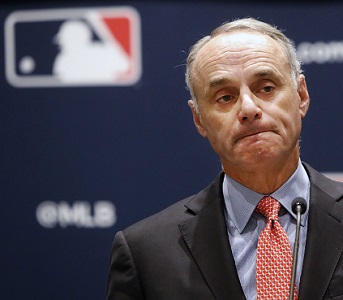
Rob Manfred, who doesn’t seem to grok the distinction between quitting and a strategic retreat.

The incumbent World Series most valuable player, who will hold that distinction until the next World Series is played, dealt with a nerve problem in his pitching hand, costing him one start but amplifying his sense of perspective. The long view matters as much to Stephen Strasburg as do such small details as whether to bust a fastball or a slider in on a hitter.

“To be frank,” the Washington Nationals righthander told reporters after his scratch against the New York Yankees, “this season is kind of a mess to begin with, so I got to think big picture here. It’s my career. I know that in the long run it’s important to try to make as many starts as you can, and by putting yourself in a compromising position now, I don’t really know if it’s the best way moving forward.”

A hand nerve issue in a normal regular season doesn’t cost a pitcher or his team as much as the issue does in a truncated, sixty-game season. Strasburg, however, isn’t an ordinary pitcher. He’s not just the defending World Series MVP, but he got to the career point where it became possible thanks to that “Strasburg Plan” that shut him down well before 2012 ended, in his first full season back from Tommy John surgery.

With the Nats headed for that postseason it seemed most of the world demanded they man up, compel Strasburg to do likewise, because who knew when they’d get another shot, right? Strasburg and his team decided a) they weren’t going to die if they didn’t go to the Promised Land then, and b) they’d get there sooner or later and they’d kinda sorta like Strasburg along for the ride.

Now it may turn out to be that Strasburg missing a little more 2020 time because of that nerve issue is the least controversial portion of this Twilight Zone of a season. Submitted for your further consideration, in case you began considering before I sat down to write:

Since last weekend, twenty-one Miami Marlins and four St. Louis Cardinals have tested COVID-19 positive, while a few Philadelphia Phillies may or may not have returned false positives. The real positives stranded the Marlins in Philadelphia after last weekend’s series, until a bus delivered the Fish to their Miami home waters at last.

They also provoked fifteen to seventeen scheduled games canceled, including this weekend’s set between the Cardinals and the Milwaukee Brewers. The latter’s outfielder Lorenzo Cain joined the list of the opting-out during the week while we were at it. So did Marlins second baseman Isan Diaz on Friday. Diaz wasn’t a COVID-19 positive Marlin but seeing so many told him some things really do come before baseball, after all.

“This has been a decision that I have discussed with my family, and I feel it’s the best one for me and my overall well-being,” he said in an Instagram post. “I will deeply miss my teammates and competing on the field. I wish my brothers the best and look forward to taking the field again with them soon!!”

Meanwhile, commissioner Rob Manfred, who rarely misses the proverbial opportunity to miss an opportunity, has channeled his inner Richard Nixon and harrumphed against quitting on whatever’s passing for this truncated major league season. “We are playing,” Manfred told ESPN’s Karl Ravech on Saturday. “The players need to be better, but I am not a quitter in general and there is no reason to quit now. We have had to be fluid, but it is manageable.”

In one sweep of his tongue Manfred implied the players who opted out of playing this season as they were granted the right to do were a bunch of quitters and implied players were to blame for the COVID-19 outbreaks among the Marlins and the Cardinals. As if the players scheduled the Fish for that final exhibition game in Atlanta, a city in a state where the coronavirus now is about as rare as oppressive July heat in Las Vegas.

Yes, a few Marlins went out on the town while in Atlanta. Not too bright if they weren’t masked and sanitising, but who put that game on the schedule and didn’t even think about calling it off when Georgia’s coronavirus presence metastasised? And who are the bubbleheads who couldn’t even think about finding an appropriate “bubble” in which to play major league baseball this year?

(Not to mention, who couldn’t even think about taking better steps to assure the Toronto Blue Jays wouldn’t have become the Show’s first strictly road team.)

For a couple of decades the Show has strained to get into what it thinks must be step with other leagues such as the National Basketball Association. The problem has been that it’s paid closest attention to the wrong things (championship-diluting, everyone-a-cookie playoffs) and ignored the right ones.

Once upon a time, knowing he’d be impeached over Watergate if he did otherwise, Nixon announced he’d resign the presidency by saying, among other things, “I have never been a quitter.” Which was jarring enough coming from the man who accepted his defeat in the 1962 California gubernatorial race by quitting politics altogether (so we thought), saying, “Gentlemen, you won’t have Nixon to kick around anymore.”

Manfred’s in no position to proclaim himself a non-quitter. He quit on the off-field-based, illegal electronic sign-stealing scandal, baseball’s biggest running story until the coronavirus world tour arrived in America in earnest, giving the cheating Houston Astros and Boston Red Sox players immunity to spill instead of ordering them to spill or be spilled no matter what Players Association grievance might have been filed.

He suspended two managers (one who’d been the Asterisks’ 2017 bench coach before managing the 2018 likewise World Series-winning Rogue Sox) and a general manager, and fined one owner what amounted to tip money. He might have bagged the Astro Intelligence Agency co-masterminds, as also the replay room operator in the Rogue Sox Reconnaissance Ring, but he still let the cheaters skate.

Maybe he thought public outrage—from victimised opponents to Astro and Red Sox fans alike who had to come to terms with their heroes being exposed as high-tech cheaters— would be punishment enough. Then the coronavirus world tour knocked Astrogate and Rogue Soxgate both into the yesterday’s news morgues.

Until Manfred dropped an eight-game hammer on Los Angeles Dodgers pitcher Joe Kelly for doing in spirit if also extreme action what the commissioner failed to do, a quarter of brushback pitches holding at least Alex Bregman and Carlos Correa to account. You don’t have to agree with Kelly throwing near Bregman’s head to get that.

The commissioner still hasn’t pressed the New York Yankees to obey a judge’s ruling that the detailed letter of reprimand over the illegal dugout phone and possible network camera sign-stealing be made public, either.

Manfred also quit on the people whom the fans normally buy tickets to see at the ballpark when, under the impetus of his bosses, the unimpoverished owners, he tried to strong-arm the players out of agreed-upon fully pro-rated 2020 salaries, for whenever a season might begin, then failed to help develop a far more reasonably safe way for the season to be played.

He quit on the game’s integrity with his bread-and-circuses rules experiments such as the free runner on second to open each extra half inning and the three-batter minimum for relief pitchers. When both collide in the extras, it can be (and has been, here and there) murder for the poor sap on the mound and his manager who can’t do a thing to stop the execution until after batter three.

Meanwhile, Commissioner Nero keeps fiddling while the health of the game—in the game’s actual playing terms and the physical health of enough of its players—keeps burning. No wonder Dodgers pitcher David Price, who opted out of pitching in 2020 before the truncated season began, fumed last week:

Now we REALLY get to see if MLB is going to put players health first. Remember when Manfred said players health was PARAMOUNT?! Part of the reason I’m at home right now is because players health wasn’t being put first. I can see that hasn’t changed.

If player health was paramount, Manfred and whatever’s passing for his brain trust—if canceling the 2020 season outright wasn’t to their taste—would have found a healthier mileu than just regionally based games where certain areas in the Show are COVID-heavier than others. And he wouldn’t have slapped even by implication those players who opted out of the season for the sake of their health and their families’ health as quitters.

Manfred may want to revisit his rhetoric if not necessarily reconfigure his mind. He may not have a choice but to cancel this truncated, surrealistic, Twilight Zone-meets-penny arcade season. There’s a difference between quitting outright and making a strategic retreat, which is exactly what canceling the rest of this loopy but risky season would be.

The moment Manfred sees and understands that distinction, the less he’ll look like the  man who misread the signposts up ahead. Less like the commissioner who fiddles while baseball burns, in . . .

DumbassZone01


Clueless Crane

2020-08-01 JimCrane

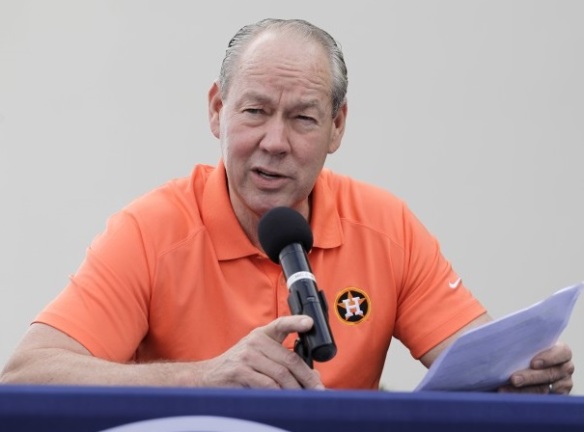
Astros owner Jim Crane—Playing what-about-ism, implying everyone else’s fault, possibly sorry only that his boys got caught, talking to USA Today’s a still-bad look for him.

In a 1964 novel about Navy fliers in World War II, Richard Newhafer’s The Last Tallyho, a fresh group of pilots assigned to a carrier performs a target hop. One of the young men overshoots the tow plane target and hits the plane, instead, flown by their squadron lieutenant. Forcing the lieutenant to a fatal water landing.

The tow pilot happened to be the squadron skipper’s best friend. When the skipper and their air group commander face questioning by the task force commander flying his flag aboard their carrier, the latter asks the skipper why they were called in. “We’re here,” the skipper replies, “because we are responsible for what happened.”

“I don’t see it that way,” the CAG practically snaps. “No matter who did what,” the skipper rejoins, “[CAG] and I are in positions of command. When you command you accept the responsibility for what is done by your subordinates.”

Maybe Houston Astros owner Jim Crane should have read The Last Tallyho. He might have learned something about command responsibility and avoiding mealymouthed avoidance of it, the latter of which he availed himself in an interview with USA Today columnist Bob Nightengale.

Astrogate returned to the otherwise coronavirus-dominant baseball news last week after Los Angeles Dodgers pitcher Joe Kelly threw fastballs twice behind Astros third baseman Alex Bregman and breaking balls twice making their shortstop Carlos Correa skip rope. They got Kelly an eight-game suspension and the Astros on the receiving end of fresh rounds of fury.

Remember: Commissioner Rob Manfred handed Astro players on the 2017-18 teams immunity to spill about the Astro Intelligence Agency’s off-field-based electronic sign stealing those seasons, instead of bringing the powers of his office to bear and ordering one and all to spill or be spilled. Even if the players’ union filed countering grievances, Manfred would have sent a far stronger message than a few brushback pitches.

The outrage over Kelly’s suspension was, basically, “He gets eight games for doing in essence what Manfred wouldn’t, but those guys still get off scot free?” Nobody’s justifying throwing at Bregman’s head, but the outraged are right. As a matter of fact, Nightengale asked Crane the same question, phrased a little differently. The answer may or may not surprise you.

“People are aggravated the players didn’t get suspended,’’ said the owner, “but I didn’t have anything to do with that. That was Rob’s call. Listen, it’s always going to be whatever you want to call it. A black mark. An asterisk. It happened. It’s not good for anybody. It’s not good for the game. We broke the rules. We got penalized. We were punished. There’s no doubt it weighs on all of us every single day.”

Crane seemed to say it as though he hoped that would be the end of the story. Except that it wasn’t, quite. After apologising for sounding like a fool at the infamous February spring training press conference, the subject detoured briefly toward the Boston Red Sox and the New York Yankees, both of whom have been reprimanded for a little espionage of their own, though not quite performed the way the Astros developed it.

“I think (MLB) had a bigger problem than everybody realized,’’ Crane told Nightengale, playing the what-about-ism card. “[The Yankees and the Red Sox] were doing things and got caught, but we’re the ones who took the bullet. That’s the way it works. I’m not trying to blame anyone else. It was our problem. We dealt with it.”

Except that, after a little talk about things such as revelations about the Astros’ less than honourable front office “culture,” Crane tried to blame, well, something close enough to everyone else as well as the Yankees and the Red Sox.

“I just think everybody was paranoid that everybody was doing it,” he said. “The technology was right in front of you. We already know two others teams were doing it and got caught. But the way we were doing it, that was pretty (stupid). I mean, banging on trash cans? You could have found a better way to do it.”

“Crane’s take . . . seems to be that he and the Astros are the real victims here, and everyone else should leave them alone already,” writes NBC Sports’s Craig Calcaterra. “Really. That’s the vibe he gives off on all of this. Crane seems to believe that the Astros sign-stealing fallout is overblown and that the public’s anger mostly has to do with how Crane himself bungled the P.R.”

Crane seems indeed clueless that, except for the Red Sox’s AppleWatch incident late in the 2017 season and an extra Yankee dugout phone the same time, the AIA didn’t stop at just the technology just being “right in front of you.” Not even close.

The Red Sox’s Replay Room Reconnaissance Ring didn’t involve anyone altering a real-time monitor feed to decipher opposing pitch signs to signal to their baserunners who’d then send the pilfered intelligence to their hitters. Needless to say by now, it also didn’t depend upon having a man on base to receive the stolen signs in the first place.

It would have shocked nobody to learn that the Rogue Sox weren’t the only team to operate a similar reconnaissance ring out of the replay room. And, yes, MLB handed them the keys to the hooch hutch with the replay rooms at home and on the road. Boys will be boys, alas, and asking them to resist such temptation would have been like asking Donald Trump to give up Twitter.

But the replay room reconnaissance ringers didn’t alter ballpark cameras off their  mandatory eight-second delays or install second cameras not on the delay to send signs to a clubhouse monitor in front of which someone, several someones perhaps, decoded the signs and then banged the can slowly for the benefit of Astro hitters.

Using what’s there for a little chicanery is one thing. Altering it or supplementing it illegally is something else entirely. When a team as genuinely great as the 2017-18 Astros were takes up such subterfuge—and if you need proof they were great without the AIA (which operated in Minute Paid Park and wasn’t portable), remember that those Astros had better road than home winning percentages in both seasons—it’s well past boys being boys.

Some accuse Kelly of hypocrisy because of his membership on the 2017 AppleWatch Red Sox. Well, now. Their replay room reconnaissance ring apparently began in 2018—after they hired, what do you know, the Astros’ 2017 bench coach and (we’ve known since the Manfred Report on Astrogate) AIA co-mastermind Alex Cora to manage them. All the way to a World Series ring.

Before Manfred released his Rogue Sox findings, Kelly wondered aloud, “Whenever the investigation is done I’m interested in seeing what is in the investigation.”

If there is cheating involved with how good our team was we should have won every single out. We should have not even lost an inning if there was some good cheating involved, which would have been a lot more fun because we would have won in four. We would have swept through the playoffs and made it really, really fast and been able to go to Hawaii or go to Mexico and go on vacation a lot sooner than we did.

Known to be an erratic pitcher who isn’t shy about a little headhunting when he thinks it’s called for, Kelly inverted the old observation, “If you can’t beat them, join them,” and became a Dodger last year.

The Astros’ mealymouthed responses to Astrogate questioning as spring training opened outraged the Dodgers more than most, and enough players around the Show were outraged, because they’d been the team the Astros beat in seven to win the ’17 Series. It’s not impossible that Kelly had in mind both Astrogate and what was subsequently revealed about his former Rogue Sox when he decked Bregman and Correa.

If the Dodgers weren’t playing this year’s pandemic-inspired regional season schedule, they might have faced the Red Sox. And, inspired perhaps by a few revelations in Manfred’s Rogue Sox report and his Dodger teammates, Kelly might have sent a few messages to those 2018 Sox still on the team for tainting those ’18 Series rings.

Astroworld’s been buffeted harshly by Astrogate. It’s still tussling between those of its citizens who think the AIA was a reasonable defense against whomever else was doing illegal sign stealing and those who think their faith in their team’s greatness was misplaced or abused.

Crane hasn’t said much if anything about that yet.

Meanwhile, note once again Crane’s choice of phrasing to Nightengale: [T]he way we were doing it, that was pretty (stupid). I mean, banging on trash cans? You could have found a better way to do it. Is he saying the AIA itself was stupid? Is he saying he’s sorry only that the Astros got caught committing high crime?

“We’re sorry. We apologized. But no matter what happened, it wasn’t going to be enough,” Crane told Nightengale. “People wanted me out of baseball. They wanted players to be suspended. They wanted everything.” Setting aside that those February apologies were as non-apologetic as apologies can get, what did he expect people to want? A whitewash?