They stink the body electric

AlfredHitchcockMets

Some say this season came out of Stephen King. Others might think the Mets are Alfred Hitchcock Presents The Outer Limits of The Twilight Zone.

Dysfunctional organisations are about as alien to baseball as a pack of cigarettes rolled into a T-shirt sleeve once was to a 1950s greaser. But then there are the New York Mess—er, Mets—whose 58-year history has had several administrations that could give lessons in chaos to any given White House.

On Sunday, the Mets’ game against the Atlanta Braves had just gotten underway, seemingly, when a statement from the Mets hit the ground running like the Flash: Yoenis Cespedes, who’d homered for their only run in an Opening Day win against the same Braves, was AWOL.

As of game time, Yoenis Céspedes has not reported to the ballpark today. He did not reach out to management with any explanation for his absence. Our attempts to contact him have been unsuccessful.

In due course Sunday it transpired that Cespedes opted out of the rest of 2020. For COVID-19 reasons? For dwindling plate appearance opportunities as the Mets’ number one designated hitter this year? For both? Inquiring minds wanted to know and, seemingly, almost didn’t want to know, at the same time.

The only thing everyone in Mets Land and elsewhere seemed to agree with for long enough on Sunday was that Cespedes’s absence scared the Mets and their observers alike.

When Yoenis Cespedes didn’t show up today, the Mets sent security to his room,” tweeted ESPN writer Jeff Passan later Sunday afternoon. “They found it empty. He had taken his belongings, just up and left, and through his agent informed the team mid-game that he was opting out, according to Mets GM Brodie Van Wagenen.”

UPDATE: Yoenis Céspedes has decided not to play the remainder of the season for COVID-19 related reasons,” tweeted MLB.com writer Anthony DiComo around the same time as Passan’s tweet.

The Mets-inclined Twittersphere wavered between wondering whether Cespedes’s none-too-glittering stats since that opening day home run were one factor, whether Cespedes possibly losing interest was another factor, and whether the Mets not exactly burning up the league was a third. One or two even contemplated aloud whether the injuries that originally took Cespedes down and cost him all 2019 were legitimate after all.

Already rehabbing on his Florida ranch after surgery to remove calcification on both his heels, Cespedes suffered multiple ankle fractures last May when he hit a hole on his grounds—revealed in due course to have happened while tangling with a wild boar he tried releasing from a trap.

Sure it sounded absurd on the surface. Haven’t enough baseball players and other professional athletes gotten themselves injured in some of the craziest, most hare-brained ways? Yes, they have. They’re funny to everyone except the injured.

A Hall of Famer, George Brett, once suffered a toe fracture . . . because, on a day off, he was just that anxious to get back to the television set to watch his buddy Bill Buckner take a turn at bat and smashed the toe against a door jamb. Another Hall of Famer, Rickey (The Man of Steal) Henderson, fell asleep with an ice bag on his ankle and woke up with a nasty case of frostbite. In August.

Once upon a time, last year’s World Series MVP Stephen Strasburg might have had murder in his heart if you’d known he struggled through a rough outing after getting a little Icy Hot balm on his family jewels accidentally. His method of your execution would have depended on whether you serenaded him with a certain Jerry Lee Lewis oldie.

Cespedes fracturing both ankles in multiple places after a tangle with a wild boar is nothing in the absurdity department compared to those. And that’s without remembering that freshly-crowned Cy Young Award winner Jim Lonborg, of the 1967 “Cinderella Red Sox,” tore up the knee on his landing leg when he was or wasn’t chasing movie star Jill St. John down the ski slopes that winter.

Lonborg’s mishap compromised his pitching career; when he returned, he inadvertently altered his motion to go easy on the landing knee and caused himself shoulder issues for the rest of his pitching days. It also inspired adding the “Jim Lonborg Clause” to the universal players contract enabling teams to bar players from “dangerous” off-field activities.

Whether the Mets looked askance out of the public eye about Cespedes’ battle of the boar is anybody’s guess. But the New York Post‘s Mike Puma and Joel Sherman say that, twice during this truncated regular season’s first nine games, Cespedes complained that he may have been kept out of the lineup a few times the better to block him from reaching certain incentive bonuses.

One of those came Saturday, when Cespedes first talked to [manager] Luis Rojas and then [general manager] Brodie Van Wagenen about his playing status and bonuses. Then Cespedes knew before the buses left for Truist Park on Sunday he was not in the starting lineup and he never showed for the game against the Braves, triggering a bizarre day even for the Mets.

Cespedes might have been struggling since his Opening Day launch, but this wouldn’t exactly be the first time a team has tried playing cute with a player over performance bonuses. It probably won’t be the last, either. But it doesn’t often happen when the team’s general manager just so happens to be the player’s former agent, either.

That same Saturday just so happened to be the fifth anniversary of the day Cespedes first arrived in New York and flipped the switch all the way up on the Mets’ season turnaround, the turnaround that took them all the way to the World Series they lost—thanks mostly to the porous defense they finally couldn’t out-hit—to the Kansas City Royals.

Cespedes may be rolling glandular dice with his opt-out. He becomes an unrestricted free agent at season’s end. It’s difficult if not impossible to fathom him getting even the kind of money he agreed to take for this year, after he and the Mets negotiated it from $20 million down to six. Even the Mets’ apparent dysfunction doesn’t leave him with a great look now.

“There is no way to defend Cespedes on this, at all, if we are to believe multiple sources,” writes another Post columnist, Mike Vaccaro, “and on two levels: Not just using the COVID opt-out as cover—think about that one for a minute—but also, given how much of a fiasco his four-year contract . . . has been, that he would make this kind of stand over money.”

Fair play: Cespedes’s mother is ill and at-risk. He does have legitimate health concerns. He also did say goodbye to several Mets teammates Saturday night, but he told his agency, Roc Nation, about his decision, and either Cespedes or the Roc Nation group didn’t tell the Mets’ brass right away. Is that so Mets, or what?

This coronavirus-truncated and mishap of a season has already been described by yet another writer as something straight out of a particularly literary Red Sox fan named Stephen King. I’m more convinced it’s Alfred Hitchcock Presents . . . The Outer Limits of The Twilight Zone. With the Mets’ latest mess (or is that the Mess’s latest mets?) as the episode called “I Stink the Body Electric.”

Quit the nonsense, Commissioner

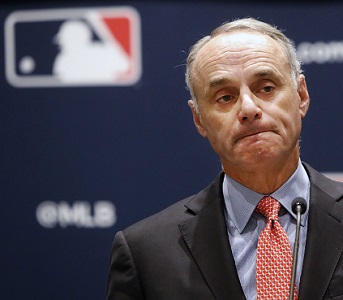
2020-08-02 RobManfred

Rob Manfred, who doesn’t seem to grok the distinction between quitting and a strategic retreat.

The incumbent World Series most valuable player, who will hold that distinction until the next World Series is played, dealt with a nerve problem in his pitching hand, costing him one start but amplifying his sense of perspective. The long view matters as much to Stephen Strasburg as do such small details as whether to bust a fastball or a slider in on a hitter.

“To be frank,” the Washington Nationals righthander told reporters after his scratch against the New York Yankees, “this season is kind of a mess to begin with, so I got to think big picture here. It’s my career. I know that in the long run it’s important to try to make as many starts as you can, and by putting yourself in a compromising position now, I don’t really know if it’s the best way moving forward.”

A hand nerve issue in a normal regular season doesn’t cost a pitcher or his team as much as the issue does in a truncated, sixty-game season. Strasburg, however, isn’t an ordinary pitcher. He’s not just the defending World Series MVP, but he got to the career point where it became possible thanks to that “Strasburg Plan” that shut him down well before 2012 ended, in his first full season back from Tommy John surgery.

With the Nats headed for that postseason it seemed most of the world demanded they man up, compel Strasburg to do likewise, because who knew when they’d get another shot, right? Strasburg and his team decided a) they weren’t going to die if they didn’t go to the Promised Land then, and b) they’d get there sooner or later and they’d kinda sorta like Strasburg along for the ride.

Now it may turn out to be that Strasburg missing a little more 2020 time because of that nerve issue is the least controversial portion of this Twilight Zone of a season. Submitted for your further consideration, in case you began considering before I sat down to write:

Since last weekend, twenty-one Miami Marlins and four St. Louis Cardinals have tested COVID-19 positive, while a few Philadelphia Phillies may or may not have returned false positives. The real positives stranded the Marlins in Philadelphia after last weekend’s series, until a bus delivered the Fish to their Miami home waters at last.

They also provoked fifteen to seventeen scheduled games canceled, including this weekend’s set between the Cardinals and the Milwaukee Brewers. The latter’s outfielder Lorenzo Cain joined the list of the opting-out during the week while we were at it. So did Marlins second baseman Isan Diaz on Friday. Diaz wasn’t a COVID-19 positive Marlin but seeing so many told him some things really do come before baseball, after all.

“This has been a decision that I have discussed with my family, and I feel it’s the best one for me and my overall well-being,” he said in an Instagram post. “I will deeply miss my teammates and competing on the field. I wish my brothers the best and look forward to taking the field again with them soon!!”

Meanwhile, commissioner Rob Manfred, who rarely misses the proverbial opportunity to miss an opportunity, has channeled his inner Richard Nixon and harrumphed against quitting on whatever’s passing for this truncated major league season. “We are playing,” Manfred told ESPN’s Karl Ravech on Saturday. “The players need to be better, but I am not a quitter in general and there is no reason to quit now. We have had to be fluid, but it is manageable.”

In one sweep of his tongue Manfred implied the players who opted out of playing this season as they were granted the right to do were a bunch of quitters and implied players were to blame for the COVID-19 outbreaks among the Marlins and the Cardinals. As if the players scheduled the Fish for that final exhibition game in Atlanta, a city in a state where the coronavirus now is about as rare as oppressive July heat in Las Vegas.

Yes, a few Marlins went out on the town while in Atlanta. Not too bright if they weren’t masked and sanitising, but who put that game on the schedule and didn’t even think about calling it off when Georgia’s coronavirus presence metastasised? And who are the bubbleheads who couldn’t even think about finding an appropriate “bubble” in which to play major league baseball this year?

(Not to mention, who couldn’t even think about taking better steps to assure the Toronto Blue Jays wouldn’t have become the Show’s first strictly road team.)

For a couple of decades the Show has strained to get into what it thinks must be step with other leagues such as the National Basketball Association. The problem has been that it’s paid closest attention to the wrong things (championship-diluting, everyone-a-cookie playoffs) and ignored the right ones.

Once upon a time, knowing he’d be impeached over Watergate if he did otherwise, Nixon announced he’d resign the presidency by saying, among other things, “I have never been a quitter.” Which was jarring enough coming from the man who accepted his defeat in the 1962 California gubernatorial race by quitting politics altogether (so we thought), saying, “Gentlemen, you won’t have Nixon to kick around anymore.”

Manfred’s in no position to proclaim himself a non-quitter. He quit on the off-field-based, illegal electronic sign-stealing scandal, baseball’s biggest running story until the coronavirus world tour arrived in America in earnest, giving the cheating Houston Astros and Boston Red Sox players immunity to spill instead of ordering them to spill or be spilled no matter what Players Association grievance might have been filed.

He suspended two managers (one who’d been the Asterisks’ 2017 bench coach before managing the 2018 likewise World Series-winning Rogue Sox) and a general manager, and fined one owner what amounted to tip money. He might have bagged the Astro Intelligence Agency co-masterminds, as also the replay room operator in the Rogue Sox Reconnaissance Ring, but he still let the cheaters skate.

Maybe he thought public outrage—from victimised opponents to Astro and Red Sox fans alike who had to come to terms with their heroes being exposed as high-tech cheaters— would be punishment enough. Then the coronavirus world tour knocked Astrogate and Rogue Soxgate both into the yesterday’s news morgues.

Until Manfred dropped an eight-game hammer on Los Angeles Dodgers pitcher Joe Kelly for doing in spirit if also extreme action what the commissioner failed to do, a quarter of brushback pitches holding at least Alex Bregman and Carlos Correa to account. You don’t have to agree with Kelly throwing near Bregman’s head to get that.

The commissioner still hasn’t pressed the New York Yankees to obey a judge’s ruling that the detailed letter of reprimand over the illegal dugout phone and possible network camera sign-stealing be made public, either.

Manfred also quit on the people whom the fans normally buy tickets to see at the ballpark when, under the impetus of his bosses, the unimpoverished owners, he tried to strong-arm the players out of agreed-upon fully pro-rated 2020 salaries, for whenever a season might begin, then failed to help develop a far more reasonably safe way for the season to be played.

He quit on the game’s integrity with his bread-and-circuses rules experiments such as the free runner on second to open each extra half inning and the three-batter minimum for relief pitchers. When both collide in the extras, it can be (and has been, here and there) murder for the poor sap on the mound and his manager who can’t do a thing to stop the execution until after batter three.

Meanwhile, Commissioner Nero keeps fiddling while the health of the game—in the game’s actual playing terms and the physical health of enough of its players—keeps burning. No wonder Dodgers pitcher David Price, who opted out of pitching in 2020 before the truncated season began, fumed last week:

Now we REALLY get to see if MLB is going to put players health first. Remember when Manfred said players health was PARAMOUNT?! Part of the reason I’m at home right now is because players health wasn’t being put first. I can see that hasn’t changed.

If player health was paramount, Manfred and whatever’s passing for his brain trust—if canceling the 2020 season outright wasn’t to their taste—would have found a healthier mileu than just regionally based games where certain areas in the Show are COVID-heavier than others. And he wouldn’t have slapped even by implication those players who opted out of the season for the sake of their health and their families’ health as quitters.

Manfred may want to revisit his rhetoric if not necessarily reconfigure his mind. He may not have a choice but to cancel this truncated, surrealistic, Twilight Zone-meets-penny arcade season. There’s a difference between quitting outright and making a strategic retreat, which is exactly what canceling the rest of this loopy but risky season would be.

The moment Manfred sees and understands that distinction, the less he’ll look like the  man who misread the signposts up ahead. Less like the commissioner who fiddles while baseball burns, in . . .

DumbassZone01


Clueless Crane

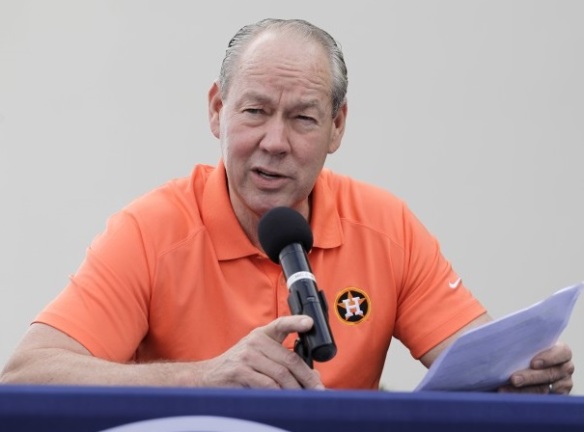
2020-08-01 JimCrane

Astros owner Jim Crane—Playing what-about-ism, implying everyone else’s fault, possibly sorry only that his boys got caught, talking to USA Today’s a still-bad look for him.

In a 1964 novel about Navy fliers in World War II, Richard Newhafer’s The Last Tallyho, a fresh group of pilots assigned to a carrier performs a target hop. One of the young men overshoots the tow plane target and hits the plane, instead, flown by their squadron lieutenant. Forcing the lieutenant to a fatal water landing.

The tow pilot happened to be the squadron skipper’s best friend. When the skipper and their air group commander face questioning by the task force commander flying his flag aboard their carrier, the latter asks the skipper why they were called in. “We’re here,” the skipper replies, “because we are responsible for what happened.”

“I don’t see it that way,” the CAG practically snaps. “No matter who did what,” the skipper rejoins, “[CAG] and I are in positions of command. When you command you accept the responsibility for what is done by your subordinates.”

Maybe Houston Astros owner Jim Crane should have read The Last Tallyho. He might have learned something about command responsibility and avoiding mealymouthed avoidance of it, the latter of which he availed himself in an interview with USA Today columnist Bob Nightengale.

Astrogate returned to the otherwise coronavirus-dominant baseball news last week after Los Angeles Dodgers pitcher Joe Kelly threw fastballs twice behind Astros third baseman Alex Bregman and breaking balls twice making their shortstop Carlos Correa skip rope. They got Kelly an eight-game suspension and the Astros on the receiving end of fresh rounds of fury.

Remember: Commissioner Rob Manfred handed Astro players on the 2017-18 teams immunity to spill about the Astro Intelligence Agency’s off-field-based electronic sign stealing those seasons, instead of bringing the powers of his office to bear and ordering one and all to spill or be spilled. Even if the players’ union filed countering grievances, Manfred would have sent a far stronger message than a few brushback pitches.

The outrage over Kelly’s suspension was, basically, “He gets eight games for doing in essence what Manfred wouldn’t, but those guys still get off scot free?” Nobody’s justifying throwing at Bregman’s head, but the outraged are right. As a matter of fact, Nightengale asked Crane the same question, phrased a little differently. The answer may or may not surprise you.

“People are aggravated the players didn’t get suspended,’’ said the owner, “but I didn’t have anything to do with that. That was Rob’s call. Listen, it’s always going to be whatever you want to call it. A black mark. An asterisk. It happened. It’s not good for anybody. It’s not good for the game. We broke the rules. We got penalized. We were punished. There’s no doubt it weighs on all of us every single day.”

Crane seemed to say it as though he hoped that would be the end of the story. Except that it wasn’t, quite. After apologising for sounding like a fool at the infamous February spring training press conference, the subject detoured briefly toward the Boston Red Sox and the New York Yankees, both of whom have been reprimanded for a little espionage of their own, though not quite performed the way the Astros developed it.

“I think (MLB) had a bigger problem than everybody realized,’’ Crane told Nightengale, playing the what-about-ism card. “[The Yankees and the Red Sox] were doing things and got caught, but we’re the ones who took the bullet. That’s the way it works. I’m not trying to blame anyone else. It was our problem. We dealt with it.”

Except that, after a little talk about things such as revelations about the Astros’ less than honourable front office “culture,” Crane tried to blame, well, something close enough to everyone else as well as the Yankees and the Red Sox.

“I just think everybody was paranoid that everybody was doing it,” he said. “The technology was right in front of you. We already know two others teams were doing it and got caught. But the way we were doing it, that was pretty (stupid). I mean, banging on trash cans? You could have found a better way to do it.”

“Crane’s take . . . seems to be that he and the Astros are the real victims here, and everyone else should leave them alone already,” writes NBC Sports’s Craig Calcaterra. “Really. That’s the vibe he gives off on all of this. Crane seems to believe that the Astros sign-stealing fallout is overblown and that the public’s anger mostly has to do with how Crane himself bungled the P.R.”

Crane seems indeed clueless that, except for the Red Sox’s AppleWatch incident late in the 2017 season and an extra Yankee dugout phone the same time, the AIA didn’t stop at just the technology just being “right in front of you.” Not even close.

The Red Sox’s Replay Room Reconnaissance Ring didn’t involve anyone altering a real-time monitor feed to decipher opposing pitch signs to signal to their baserunners who’d then send the pilfered intelligence to their hitters. Needless to say by now, it also didn’t depend upon having a man on base to receive the stolen signs in the first place.

It would have shocked nobody to learn that the Rogue Sox weren’t the only team to operate a similar reconnaissance ring out of the replay room. And, yes, MLB handed them the keys to the hooch hutch with the replay rooms at home and on the road. Boys will be boys, alas, and asking them to resist such temptation would have been like asking Donald Trump to give up Twitter.

But the replay room reconnaissance ringers didn’t alter ballpark cameras off their  mandatory eight-second delays or install second cameras not on the delay to send signs to a clubhouse monitor in front of which someone, several someones perhaps, decoded the signs and then banged the can slowly for the benefit of Astro hitters.

Using what’s there for a little chicanery is one thing. Altering it or supplementing it illegally is something else entirely. When a team as genuinely great as the 2017-18 Astros were takes up such subterfuge—and if you need proof they were great without the AIA (which operated in Minute Paid Park and wasn’t portable), remember that those Astros had better road than home winning percentages in both seasons—it’s well past boys being boys.

Some accuse Kelly of hypocrisy because of his membership on the 2017 AppleWatch Red Sox. Well, now. Their replay room reconnaissance ring apparently began in 2018—after they hired, what do you know, the Astros’ 2017 bench coach and (we’ve known since the Manfred Report on Astrogate) AIA co-mastermind Alex Cora to manage them. All the way to a World Series ring.

Before Manfred released his Rogue Sox findings, Kelly wondered aloud, “Whenever the investigation is done I’m interested in seeing what is in the investigation.”

If there is cheating involved with how good our team was we should have won every single out. We should have not even lost an inning if there was some good cheating involved, which would have been a lot more fun because we would have won in four. We would have swept through the playoffs and made it really, really fast and been able to go to Hawaii or go to Mexico and go on vacation a lot sooner than we did.

Known to be an erratic pitcher who isn’t shy about a little headhunting when he thinks it’s called for, Kelly inverted the old observation, “If you can’t beat them, join them,” and became a Dodger last year.

The Astros’ mealymouthed responses to Astrogate questioning as spring training opened outraged the Dodgers more than most, and enough players around the Show were outraged, because they’d been the team the Astros beat in seven to win the ’17 Series. It’s not impossible that Kelly had in mind both Astrogate and what was subsequently revealed about his former Rogue Sox when he decked Bregman and Correa.

If the Dodgers weren’t playing this year’s pandemic-inspired regional season schedule, they might have faced the Red Sox. And, inspired perhaps by a few revelations in Manfred’s Rogue Sox report and his Dodger teammates, Kelly might have sent a few messages to those 2018 Sox still on the team for tainting those ’18 Series rings.

Astroworld’s been buffeted harshly by Astrogate. It’s still tussling between those of its citizens who think the AIA was a reasonable defense against whomever else was doing illegal sign stealing and those who think their faith in their team’s greatness was misplaced or abused.

Crane hasn’t said much if anything about that yet.

Meanwhile, note once again Crane’s choice of phrasing to Nightengale: [T]he way we were doing it, that was pretty (stupid). I mean, banging on trash cans? You could have found a better way to do it. Is he saying the AIA itself was stupid? Is he saying he’s sorry only that the Astros got caught committing high crime?

“We’re sorry. We apologized. But no matter what happened, it wasn’t going to be enough,” Crane told Nightengale. “People wanted me out of baseball. They wanted players to be suspended. They wanted everything.” Setting aside that those February apologies were as non-apologetic as apologies can get, what did he expect people to want? A whitewash?


Closing the Show?

2020-07-31 RobManfredIt’s hard to say whether Commissioner Nero has really put his fiddle away all the way. But a coronavirus outbreak among too many Miami Marlins, a couple of St. Louis Cardinals, and perhaps a few more as yet unidentified, has Rob Manfred preparing to shut down a delayed major league season that maybe shouldn’t have been tried in the first place.

Manfred has told Major League Baseball Players Association chief Tony Clark that baseball better do a better job managing its heeding of the protocols or else. Another Marlins-like outbreak, Nero said, and we’re sending the cardboard cutout fans home, turning off the canned crowd noise, shutting down the free runners on second to open extra innings, and turning off the echo chambers on the field.

Memory recalls a television drama on which an indignantly embarrassed father sent his wisenheimer-beyond-her-years teenage daughter to her room. The girl didn’t skip a beat. “The ultimate punishment,” she snickered. “If you only knew what goes on in our rooms.” If and when Nero sends his players home for the year, it’s not as though that’s going to deprive them of anything.

For a lot of players whose early returns in the truncated season aren’t exactly the kind they’re used to delivering, it’ll be a kind of sweet relief. For them and everyone else, it’s not as though getting early return to their loved ones equals the ultimate punishment. Unless, of course, they’re in one of those baseball marriages that won’t survive all that  togetherness.

(Once upon a time, when legendary executive George Weiss was canned as the New York Yankees’ general manager, and before he was engaged to be the president of the newborn New York Mets, his wife, Hazel, proclaimed, “I married George for better or for worse, but not for lunch.”)

The Marlins have had a week’s worth of games postponed. They finally got a bus to take them from Philadelphia home to Miami. The nostalgically inclined may care to note that they may not necessarily spend the journey swapping tales of their days in the real bus leagues.

Stories arose that the Marlins outbreak began not when they spent last weekend in Philadelphia, not when they played an exhibition in Atlanta before the season started, but when a couple of Marlins players in Atlanta decided a night on the town was just what the doctor not named Fauci ordered.

A night on the town isn’t inherently a criminal act, depending on what you do on the town. A night on the town in pandemic without masking and sanitising, if that’s what they didn’t, is infection’s invitation in a state infected heavily enough. You’re thinking, yes, if those players went partying unsafely and got infected, that’s their business until or unless they bring the bugs to their teammates and possibly their opponents.

Boys will be boys and ballplayers will be ballplayers, and they’re always dreaming up new and sneaky ways to get up on the competititon.

But Hall of Fame broadcaster Bob Uecker was only kidding when he said the 1964 Cardinals wanted to inject him with hepatitis to make room for calling up a promising prospect. If a couple of partying players shunning appropriate coronavirus masking and sanitising thought bringing the bug back to their team and maybe their opponents meant mirth and profit, it’d be a truly tasteless joke.

If they thought it might help get them, their teammates, their opponents, and the rest of the Show off for the rest of the season, though, that’s a slightly extreme (and prospectively dangerous way) to get vacation started early.

Considering what the short season has brought, though, you might have a hard time blaming them. If any of them has heard a replay broadcast of one of their home runs, or a tight play on the bases, or a homer-stealing catch above the fence, or an acrobatic leap on a play in the infield, they probably laughed that they might not weep when they heard the announcer holler, “And the cardboard goes wild!”

Call it penny arcade baseball if you must. Never mind that it betrays your age, assuming the penny arcade has gone the way of the typewriter. (If it hasn’t, whatever’s worth a penny now costs $10, anyway.) When Atlanta’s Adam Duvall homered off the snoot of New York’s Jeff McNeil’s Alaskan malamute puppy in cutout, it reminded old-timers of the arcades and midways where the fun included shooting metal ducks or knocking down voodoo dolls or steel milk bottles.

So far as I know, no broadcaster or writer has been tempted to holler, “Everyone’s a winner! Step right up! Everyone’s a winner! Knock down the doggies, win your sweetie a prize!” Yet.

The free runner on second to open extra half-innings has caused a few people joy and a lot of other people indigestion—especially when it collides with the experiment of requiring relief pitchers to face three batters at minimum. By temporary law, managers can’t get those poor saps out of there before they get killed. Sometimes, they’ve forgotten to get them out after batter three and after they’ve been piledriven, mugged, or shot on sight.

Until now, Commissioner Nero, I think I never really gauged the reckless cruelty that baseball had room for premeditated murder.

As radio legend Gabriel Heatter liked to open his nightly commentaries, “There’s good news tonight.” The good news is that, so far, no PA system operator has made the fateful (and possibly fatal) mistake of cranking up the wild cheering when the home team’s batter gets hit by a pitch. The bad news, unfortunately, is something baseball’s proven for almost two centuries: there’s a first time for everything.

If Commissioner Nero decides the coronavirus is still too formidable a pest to continue this truncated season safely, the good news would be that the foregoing experiments be declared failures never allowed to darken the sport’s doorstep again.

But that raises the further bad news: If it isn’t broken, this commissioner calls the repairman. If it is broken, this commissioner says, “Remain calm! All is well!” And, if he breaks it, it’s either God’s will or someone else’s fault.

Suffer Merkle’s children no more

2020-07-31 FredMerkle

Fred Merkle, the patron saint of baseball goats.

“Sports, especially pro sports,” Thomas Boswell wrote in 1989, “is not a morality play, much as it suits our national appetite to act as if it were. Even some athletes, perhaps including [Donnie] Moore, seem to crush themselves under a burden of self-imposed guilt in areas of life where no cause for guilt exists.”

Moore, the former California Angels relief pitcher, surrendered a shocking home run to Dave Henderson of the Boston Red Sox when the Angels were a strike away from nailing the 1986 American League pennant. Three seasons later, he shocked baseball and the world by shooting his wife before turning the gun on himself and killing himself.

A haunted man as it was before the pitch, Moore couldn’t bear its added weight. It wasn’t a mistake pitch, either. He threw Henderson a forkball that snapped down and away and was as shocked as anyone else in old Anaheim Stadium when Henderson sent it over the left field fence.

The game went to extra innings and the Angels lost the game. (Henderson’s sacrifice fly made that difference.) Two games later, they lost the pennant. To the Red Sox. Who suffered even worse miseries when they were a strike away from winning that World Series. Their bullpen melted down in the Game Six bottom of the tenth against those tenacious New York Mets, right down to allowing the tying run home on a wild pitch that should have been ruled a passed ball.

Then Mets outfielder Mookie Wilson whacked a ground ball that skipped impossibly between the feet of stout but ankle-dissipated Red Sox first baseman Bill Buckner, allowing the winning run home to Buckner’s and his team’s horror. A Red Sox Nation that already suffered from too many decades of surrealistic calamity on the threshold of triumph could bear no more.

Buckner, who died on Memorial Day 2019, turned out to be made of stronger stuff than Donnie Moore, and Buckner endured far worse than Moore did. And just as Moore’s Angels had two more chances to win that American League Championship Series but failed, Buckner’s Red Sox had a Game Seven yet to play in that World Series—and lost.

Buckner had no business even being in the game by then, but Red Sox manager John McNamara—loyally wanting his warrior standing at the end in triumph—failed to pinch hit for him in the eighth inning. We cherish loyalty, mourn its absence, and rarely think that there do come times when it backfires drastically.

McNamara died at 88 Tuesday, prompting such thoughts all over again. Especially after his widow, Ellen, pleaded to the Boston Globe‘s Dan Shaughnessy that her husband didn’t deserve to have his entire life judged by one game. She’s right.

Boswell was hardly the only one to say after Moore’s suicide that the goat business wasn’t funny anymore. It didn’t stop those so inclined to look for goats wherever they could be found, and to try making their lives a nightmare forever after.

The worst of Red Sox Nation got to Buckner’s son, born two years after that Series, as Buckner learned the hard way playing catch with the boy when a low throw sailed past. “That’s okay, Dad,” said the hapless kid, who eventually played baseball for the University of Texas, “I know you have trouble with grounders.”

Buckner was so aghast he moved his family the hell out of New England all the way to Idaho. He made a new life of success in real estate before Lewy body dementia took hold of him and finally killed him.

A well-syndicated Washington Post sports columnist for eons now, author of several best-selling anthologies of his work especially about baseball, Boswell was probably roundly ignored when he pleaded to put the goat business out of business by addressing the “goats” with forgiveness they shouldn’t have had to beg in the first place:

Many of us wish that, just once, we could be in your shoes and have a chance to fail so grandly. Although, if we really had to live the experience and its aftermath, which sometimes lasts a lifetime, maybe we would not. 

Boswell opened the essay with a small roll of “goats,” but—perhaps unwittingly—he omitted their equally unwitting progenitor. Baseball’s goats have long since been Fred Merkle’s children.

That hapless New York Giants rookie was blamed for costing his team the 1908 pennant, running toward the clubhouse before touching second after a key game-winning run scored down the stretch of that contentious race. When Chicago Cubs second baseman Johnny Evers called for the ball, got it, and touched second. When Merkle was thus ruled out, and the run was ruled null, forcing a single-game playoff if the Giants and the Cubs tied for the pennant, which they ultimately did.

What everyone denouncing Merkle as a bonehead didn’t know and wouldn’t have cared about was Evers—whose Cubs were burned on a similar play earlier in the season, a play on which the out then was almost never called—taking the ball first taken by a fan, who threw it to Cubs pitcher Rube Kroh, who threw it to Evers. A ball touched by a fan is supposed to be ruled dead.

Not even Merkle’s own manager John McGraw absolving him mattered to those who saw only what they wanted to see. Never let the facts get in the way of outraged fans and writers looking for one man to blame for blowing a game the team absolutely, without question, should have won. Including, as McGraw himself pointed out, that there may have been at least twelve other losses the Giants could and should have won that could and would have made the difference.

Never tell people like that that two laws are inviolable: No game can be won by both sides, and Berra’s Law (It ain’t over until it’s over) has yet to be ruled inoperative or unconstitutional.

Merkle’s children have suffered under the ridiculous belief Boswell outlined, that losing a game or making a mistake in a game isn’t just a question of a mistake or a defeat but, rather, a question of sin. “The unspoken assumption,” Boswell wrote, “is that those who lose must do so because of some moral flaw.”

Babe Ruth wasn’t exactly the epitome of morality off the field, but in Game Seven of the 1926 World Series—with Bob Meusel at the plate, Hall of Famer Lou Gehrig on deck, and two out in the ninth—Ruth bolted for second. Everyone on earth knew a one-armed man could throw him out stealing.

Amoral? Not a chance. Self-involved? Surely. Anyone else making a mistake like that facing a managerial and sporting press tongue lashing? What do you think? But . . . he was The Babe. Thus being, he got away with what a rook or a journeyman would have been crucified for even thinking about.

Hall of Fame catcher Ernie Lombardi didn’t have Ruth’s kind of cred in Game Four of the 1939 World Series. The gentle giant was clearly morally flawed when Yankee outfielder Charlie (King Kong) Keller blasted into him at the plate, knocking him out cold, as Keller and Hall of Famer Joe DiMaggio behind him scored the game and Series-winning runs in the tenth.

It couldn’t possibly have been Keller being built like a tank and nailing the likewise-built Lombardi’s cupless groin in the crash—toward finishing a World Series sweep.  “Lombardi,” Bill James wrote in The New Historical Baseball Abstract,” was now the Bill Buckner of the 1930s, even more innocent than Buckner, and Buckner has plenty of people who should be holding up their hands to share his disgrace.”

So should have had Johnny Pesky, the Red Sox shortstop who supposedly held the ball while Enos Slaughter made his fabled mad dash in Game Seven of the 1946 World Series. The fact that Pesky took a too-high throw in from late-game center field insertion Leon Culberson before turning to try throwing home proved entirely beside the point, to those who insisted that Pesky was obviously the devil’s spawn.

Too many Brooklyn fans thought Ralph Branca was on the wrong side of morality when he surrendered the now-tainted Shot Heard Round the World to Bobby Thomson, ending the 1951 National League pennant playoff. Branca’s own priest thought otherwise and got to him fast enough.

The priest told Branca God chose him because He knew he’d be strong enough to bear the burden. Branca proved stronger than those who wanted him drawn, quartered, and hung in the public square. And, in due course, what was too long rumoured was finally proven: The Giants stole the pennant! The Giants stole the pennant!

Was it moral lacking that caught 1964 Phillies pitcher Art Mahaffey by as much surprise as it caught anyone else in late September, in Connie Mack Stadium, when Cincinnati  rookie Chico Ruiz stole home for the game’s only run—starting the infamous Phillie Phlop?

Was Willie Davis prosecutable for terpitude when he lost a pair of fly balls in a too bright sun, and committed a third error off one of them, in Game Two of the 1966 World Series? (A game that turned out to be Hall of Famer Sandy Koufax’s final major league game.) Did sunblindness mean its victim required an exorcism?

When B.F. Dent hit the three-run homer over the Green Monster to overthrow a Red Sox lead for what turned out keeps in the 1978 American League East playoff game, did it expose Red Sox pitcher Mike Torrez as a moral idiot? (Come to think of it, was Hall of Famer Carl Yastrzemski morally suspect when, with two on and two out in the bottom of the ninth, he popped out to end the game?)

I guess Tom Niedenfeuer was plain degenerate when his manager Tommy Lasorda, that devilish apostate, decided it was safe for him to pitch to Jack Clark with two on, first base open and the Dodgers one little out from going to the 1985 World Series. I guess that made Jack the Ripper the epitome of morality when he hit a home run that may have traveled to Pasadena, and those Dodgers couldn’t score a lick in the bottom of the ninth.

Maybe Don Denkinger was really degenerate when—in the bottom of the ninth, with Clark’s St. Louis Cardinals themselves three outs from a World Series championship—he mistakenly called Jorge Orta leading off safe at first when every camera angle showed him out by a step and a half.

Never mind that the Cardinals still had the chance to keep the Royals from overthrowing their lead. And, that nobody put a gun to their heads and told them to implode entirely in Game Seven, with or without Denkinger himself rotated behind the plate. In St. Louis and elsewhere, Denkinger became Beelzebub incarnate.

Time healed a few of Merkle’s children, of course. Sometimes it was a short volume of time; other times, it took a generation or two. Sometimes one or two of Merkle’s children shook it off almost immediately.

Maybe it was easy for Ruth to go on with his Hall of Fame career because, well, he was The Babe, The Big Fella, getting away with blunders (and misbehaviours) that harry mere mortals to the rack of their regrets. Maybe it was easy for Lasorda to shake off one miscalculation because he’d already won three pennants and a World Series.

Maybe it was easy for Mariano Rivera to go on with his Hall of Fame career after surrendering a World Series-losing base hit to Luis Gonzalez in 2001 because he, too, had been there, done that, had four World Series rings on his fingers going in.

Maybe Tim Wakefield being to four previous postseasons built up a survival mechanism to call upon after he saw his first eleventh-inning pitch to Aaron Boone, in Game Seven of the 2003 American League Championship Series, fly into the left field seats with a meal, a stewardess, and the pennant on board.

From whence the perennially star-crossed, snake-bitten Red Sox picked themselves up, dusted themselves off, started all over again in 2004, and delivered four straight wins against their eternal tormentors from the south Bronx, after being down to the final three outs of what would have been a sweep . . . before sweeping the Cardinals—Enos Slaughter’s descendants—in the World Series.

Every so often those who get ruined as spectacularly as the ’03 Red Sox get a chance at immediate redemption and pounce on it. But maybe we don’t really know what goes through the minds of human men playing human games who come up short in the worst possible moments of such games.

Before Astrogate cost A.J. Hinch his job, he had to try explaining why he didn’t bring in Gerrit Cole when Zack Greinke ran out of gas in Game Seven of the 2019 World Series. Cole being a starting pitcher had never come into an inning in the middle of it and the plan was to bring him in fresh to start an inning if and when need be.

Washington’s Howie Kendrick wrecked that plan when he rang the foul pole and the Houston Astros’ bells on reliever Will Harris’s dollar. Until it turned out that Hinch merely told his boys to knock off the Astro Intelligence Agency without putting some weight behind it, other than smashing a couple of swiftly-replaced clubhouse monitors, it looked as though he’d survive Game Seven well enough.

Sometimes Merkle’s children healed in unexpected ways. Branca and Thomson forged a sweet friendship in the years that followed, soiled only by the final proof that the 1951 Giants made their staggering pennant comeback (from thirteen games out of first place, forcing the playoff) the (then) high-tech cheating way.

Buckner and Wilson forged a comparable friendship in the years following their rendezvous with baseball’s often cruel destiny. Visiting Shea Stadium during the Aughts, Buckner spotted then-Mets coach Wilson on the field, and hailed him: “Mookie, what do you say you hit me some grounders?”

So have Mitch (Wild Thing) Williams and Joe Carter. Already having a blown save in Game Four of the 1993 World Series, Williams pitched into infamy in the bottom of the ninth, Game Six, when Carter hit a Series-ending three-run homer that turned what was still called the SkyDome into bedlam.

Known now to have taken the ball after a sleepless night following death threats, Williams never flinched post-game, answering even the most ridiculous questions without once trying to pass responsibility on. In the worst defeat in the Phillies’ own tortured history to that point, Williams proved a better man than his critics including a teammate or two who wanted him run out of town.

He also accepted a near-immediate reaching-out from Carter himself. “Really, since the home run, we’ve been tied at the hip,” Carter once told the Toronto Star, when he and Williams hooked up for an event to help Canadian at-risk children.

Over the years I’ve seen him at MLB Network, but I’ve always known what type of guy Mitch is. He’s a great guy and the great thing about baseball is not just the sport itself, but the people you meet. Lives are going to be crossed, paths are going to be crossed a lot. It just so happens we’re kind of intertwined now and I thought it would be a great gesture to bring him back here because he is a fun guy to have around . . . he really is.

What pounds the minds of fans who can’t resist smoking out goats when their heroes lose, or doing their level best to make life miserable for those poor souls? Ask cautiously. You might be afraid of the answers.

“The right to a raspberry comes with the price of a ticket,” Boswell wrote, “and the right to an opinion goes with the First Amendment. Still, before we boo or use words like ‘choke’ and ‘goat,’ perhaps we should think sometimes of Donnie Moore.”

Don’t be afraid to say it’s well past time to stop letting single failures define entire careers. Joe and Jane Fan would both give their left ventricles to have the chance those players had in those moments. They’d be lying through their teeth if they say they’d have done no questions asked what Merkle’s children couldn’t do in those moments.

So this, as Boswell led off in 1989, is also for Bill Buckner, Ralph Branca, John McNamara, Tom Niedenfeuer, Don Denkinger, Johnny Pesky, Gene Mauch, the 1964 Phillies, the 1978 Red Sox, the 1987 Blue Jays, the 2007 Mets, every Cub from World War II until 2016, and Donnie Moore.

It’s also for Ernie Lombardi, Cal Abrams, Ralph Terry, Art Mahaffey, Willie Davis, Mike Torrez, Mitch Williams, Byung-Hyun Kim (and he became the goat of a Series his team won), Dusty Baker, Grady Little, Nelson Cruz, Buck Showalter, Ken Giles (like Kim a goat in a Series his team won*), Yu Darvish, and A.J. Hinch.

It’s also for every St. Louis Brown, San Diego Padre, Milwaukee Brewer, Montreal Expo, and Seattle Mariner ever, every Washington Senator since Calvin Coolidge’s only election to the White House, every Ranger since the Watergate burglary, and every Indian since the Berlin Airlift.

Suffer Merkle’s children no more.