It’ll take more than winning . . .

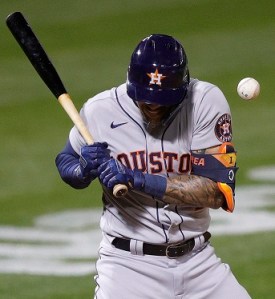
What Carlos Correa took on the shouhlder from Chris Bassitt on Opening Night isn’t likely to be the last such drill—not until the absolute last Astrogater isn’t an Astro anymore.

“Got to hear some boos, finally,” said Astros righthander Zack Greinke after Opening Night in Oakland. “That wasn’t fun to listen to, I didn’t think, but we played good so it didn’t matter. Hopefully we’ll keep playing good and it won’t be as big of an issue.”

Greinke wasn’t a member of the Astros in 2017. The season-opening roster now has only five remaining from that World Series-winning team: second baseman Jose Altuve, third baseman Alex Bregman, shortstop Carlos Correa, first baseman Yuli Gurriel, and pitcher Lance McCullers, Jr.

But there’s a reasonable enough suspicion that the Astros won’t stop hearing boos and catcalls until every last member of the 2017-18 team is gone, either to other teams or from the game itself. The pan-damn-ically truncated, fan-less, irregular 2020 season kept the Astros shielded from anything beyond fans outside the parks serenading their team bus.

Lucky them. Until now. With fans returning even in limited numbers this season, the Astros won’t be immune to road fans letting them have it. If Greinke thinks wins will neutralise them—wins such as their 8-1 Opening Night win over the Athletics—he may be guilty of wishful thinking.

That’d be a far less grave offense to be guilty of than the one over which the Astros remain convicted by the evidence and in the eyes of the rest of the game and its fans. The stain won’t leave for a long enough time. The pan-damn-ic didn’t really amputate the long arm of Astrogate after all.

Fair? Probably not to the 89 percent of the Astro roster who weren’t there and had nothing to do with Astrogate. More than fair to the eleven percent remaining.

Limited though it was by safety protocols, the Oakland crowd wasted no time. During pre-game introductions they booed the Astros loudly, accompanied by a few who carried assorted trash cans to bang just as loudly. The Astros should consider themselves lucky if lusty booing and can banging on the road are all they get.

“That’s fine,” said outfielder/designated hitter Michael Brantley of the Oakland crowd. “This is a veteran team. We’ve been in the World Series, we’ve been in the playoffs. The guys know how to compete day in and day out. They can boo, they can yell, they can do whatever they want. But at the end of the day we have each other’s backs, and that’s all that matters.”

Having each other’s backs is one thing. Genuine contrition for the worst cheating scandal major league baseball saw since the at-long-last-affirmed exposure of the 1915 New York Giants as pennant race comeback telescopic cheaters seems not to be Astro policy. That non-apologetically apology at last year’s spring-opening presser, pre-COVID shutdown, was no act, apparently.

They still don’t seem to get it so far. They still don’t seem to get just how terrible a look it was when commissioner Rob Manfred handed all 2017 players blanket immunity from discipline in return for spilling the deets about the Astro Intelligence Agency—the ones who either took an existing center field camera off its mandatory eight-second delay, or installed a new and illegal real-time camera, to steal signs from a clubhouse monitor and signal the stolen intelligence to their hitters with bangs on a large vinyl trash can nearby.

They still don’t seem to get, so far, that the AIA went a lot farther than went any team (the 2018 Boston Rogue Sox for certain, others quite possibly) who merely used existing video rooms at home and on the road to steal signs and relay them to baserunners to send the batters.

They still don’t get what then-Dodger pitcher Alex Wood meant when he said he’d rather face a batter using actual or alleged performance-enhancing substances than an AIA-like sign stealer, because the former still doesn’t know what’s coming and lacks the 50 percent or better chance of hitting it before he even sees the pitch.

They still don’t get why Astrogate team member Correa inspired lusty cheering when A’s starter Chris Bassitt drilled him in the fourth inning despite a runner being aboard. Or why Correa, Altuve, Bregman, and Gurriel are liable to be ongoing targets for brushbacks and knockdowns so long as they’re Astros.

Former Astrogater George Springer, now a Blue Jay, opened the season on the injured list. Will he face the catcalls from Blue Jay opponents unable to forget he was one of the Astrogate team? Time will tell, though other former Astrogaters haven’t really felt it in the hips or on opposing fans’ lips. Yet.

Remember: When Astrogate exploded from mere revelation in November 2019 to Manfred’s final report and limited discipline—the team fined and stripped of draft picks, general manager Jeff Luhnow and manager A.J. Hinch suspended for the season, then Luhnow and Hinch fired by owner Jim Crane who seemed himself barely able to grok the outrage—it wasn’t just fans outraged by the AIA.

Long ago, the father-in-law of convicted killer Jeffrey MacDonald, fearing his son-in-law might yet remain free on appeal in the deaths of his pregnant wife and two young daughters, proclaimed publicly, “If the courts of this country won’t administer justice, I most certainly will.” More players than you may remember said much the same thing about administering to the Astros the justice Manfred truly denied, though they didn’t quite have murder in their hearts for the unjudged.

Dodger relief pitcher Joe Kelly showed such players weren’t kidding, late last July, when he got his chance and sailed ball four past Bregman’s shoulder and subsequently threw one behind Correa’s head. For every one soul a little put-off by Kelly’s dusters, there were probably three who thought he didn’t go far enough administering Astrogate justice.

Too many fans would love nothing better than to see every last being in Astro fatigues pay such prices as Bregman and Correa. I observed one social media poster writing, and probably speaking for too many “Bean balls, mound charging, spiking, spitting, fighting, punches, headlocks, punches to the face hard and often. Umpires should call every pitch against them a strike.”

And then we should get really mad?

Actually, we should have Wednesday night—at home plate umpire Brian Gorman. He called strike on a wide outside pitch to Brantley early in the game, called balls on two more strikes so obvious Helen Keller could have seen them, and then Brantley slashed a single more or less into center field on one of the upper strikes that Gorman might have called a ball if taken. Brantley should have been out on strikes in that plate appearance.

Gorman was an equal opportunity offender. He called strike three on the A’s Matt Olson on a pitch that was far enough off the outside corner to slide a bat through without it touching either side. All night long Gorman’s strike zone was more improvisational than music legends John Coltrane, Cream, and Miles Davis. Robby the Umpbot may be closer to arriving at last than people think or might like.

You can search the archives of this journal and see precisely where I stood (and continue to stand) on Astrogate. So you know I’m not just looking to take the culprits off the hook when I say there’s a limit to how much Astrogate justice their opponents can administer and road fans can demand.

I get the urge and itch to send messages to Altuve, Bregman, Correa, and Gurriel. (McCullers being a pitcher won’t be batting unless he’s in the game and the Astros are playing a National League team on the road, thanks to Commissioner Nero forcing the absence of the universal designated hitter for this season at least.) They were members of the Astrogate team and they got away with murder.

But Brantley didn’t join the Astros until 2019. The rest of the roster had nothing to do with Astrogate. Joe and Jane Fan don’t always draw the proper distinctions, but the players can, do, and should. Save the return messages for the real culprits. Right?

Sort of. Nobody held a gun to the Astros’ heads to compel them to extend Gurriel another year with an option for next year. Nobody held guns to their heads to compel them to try for an extension for Correa, who now says he’s looking forward to the free agency market he’ll hit after this season.

Altuve and Bregman are locked in as Astros until 2024. Nobody will hold guns to the Astros’ heads and force the team to extend or re-sign them further. If any team reads the appropriate tea leaves and decides to make a trade play for either one, nobody will hold the Astros hostage until they agree to retain the pair.

It’s not fair to blame the entire 2021 Astro roster for the crimes of the eleven percent remaining Astrogaters. But it’s entirely understandable. The Astros will have to live with the continuing ramifications of their cheating and the continuing outrage of opponents and fans until the absolute last Astrogater no longer wears their fatigues.

Opening Day: Snow fooling

There was nothing wrong with your television set. Do not attempt to adjust the picture. The snow took control of the transmission when Miguel Cabrera hit this Opening Day home run . . .

Just because the expected Opening Day marquee battle between Jacob deGrom (Mets) and Max Scherzer (Nationals) had to be postponed (COVID-positive Nats players and a team staffer to quarantine), that didn’t mean Wednesday was going to lack for the good, the bad, and the bizarre. This is baseball. Where anything can happen—and usually does.

Especially if Opening Day is also April Fool’s Day. The part that wasn’t a gag—fans in the stands again, at long enough last. The sound was glorious, even if reduced from most normal capacities thanks to the continuing if only slightly receding pan-damn-ic.

Comerica Park should have been playing “Winter Wonderland” Wednesday. The Tigers’ aging star Miguel Cabrera shouldn’t be blamed if he was singing “Let it Snow, Let It Snow, Let It Snow.” Especially when he more than a little hard on the Bieber, turning on the Indian ace’s rising snowball, hitting a two-run homer, and . . . sliding into second base, unable to tell through the snow that the ball flew out.

I don’t know if the Coors Field public address people had it cued up, but they could and should have sounded “Don’t Pass Me By” after Dodger first baseman Cody Bellinger hit an RBI single . . . off Rockies left fielder Raimel Tapia’s glove and over the left field fence. The problem: Justin (Who Was That Unmasked Man) Turner not seeing the ball reach the seats and retreating to first, compelling Bellinger to pass him on the basepath.

Oops. On a day the Rockies thumped Clayton Kershaw and managed to squeeze a win out after doing what Rockies usually do in the off-season—in this case, unloading their franchise player and all but reveling in front office dissembly and mission abandonment—Turner was the gift that . . . added insult to injury for the defending World Series winners.

The sleeper star in waiting in Blue Jays silks might have thought about singing an ancient  T. Rex number called “The Slider.” Gerrit Cole’s was just too juicy for Teoscar Hernandez to resist in the sixth. He sent it into earth orbit or 437 feet and into the left field bleachers at Yankee Stadium—whichever came first. Who needed Bo Bichette and Vladimir Guerrero, Jr.?

Just one thing was wrong. Hernandez needs to work on his bat flips. He didn’t have one. A blast like that was just begging for him to go Willson Contreras. Hernandez just ambled up the base line carrying his bat, then kind of nudged it away to the grass. He’s young, with plenty of time to learn, though. And his blast tied the game the Jays went on to win, 3-2.

Which is the score by which the Phillies beat the Braves in ten innings—after Bryce Harper began the inning as the free cookie on second base, took third on J.T. (Nothing Is) Realmuto’s ground out, waited patiently as Didi Gregorius was handed first on the house, then came home with the winner when Jean Segura sliced a single to left.

The game got to the tenth in the first place because Phillies manager Joe Girardi decided he wasn’t quite ready to trust the National League’s leading arsonists with taking over from certified innings-eater Aaron Nola with a 2-0 lead in the seventh. The Braves were far more ready to trust Pablo Sandoval—erstwhile Giant, one-time World Series hero, all-time poster child for Slim Slow—to pinch hit for Max Fried’s relief Tyler Matzek with a man on.

. . . and slid into second unable to tell at first whether the ball or the snow cleared the fence.

Kung Fu Panda turned out to be more than ready to hit Nola’s 0-2, slightly down and slightly in fastball into the right field seats. Girardi is many things but a crystal ball operator isn’t one of them. If he had been, he could have lifted Nola safe and sound because the Phillies’ bullpen apparently forgot to refill the gasoline cans for a change. Not even a bases-loaded jam in the eighth could keep Archie Bradley, Jose Alvarado, Hector Neris and Conner Brogdon from keeping the Braves scoreless over the final three and a third.

Does Philadelphia believe in miracles? Don’t ask too quickly, folks. Remember: this is the baseball town in which a typical wedding concludes with the minister pronouncing the newly-married couple husband and wife—then addressing the gathering with, “You may now boo the bride.” As much as I hate to drop a cliche so worn you see more holes there than in an oil field, the Phillies have 161 games left to play. Ruh-roh.

That was last year’s pan-damn-ically irregular season: Twins center fielder Byron Buxton, who sometimes evokes Willie Mays when he’s not on the injured list, walked twice all year long. This was Opening Day: Buxton should have had “Cadillac Walk” as his entrance music—he walked twice. He also blasted a two-run homer to the rear end of American Family Field in the seventh and had his arm calibrated so well that the Brewers didn’t dare to even think about running wild on him.

Buxton’s blast made it 5-3, Twins. Proving that no good deed goes unpunished, the Twins undid their own sweet selves with a badly timed error, making room for a ninth-inning, three-run, game-tying comeback that turned into a 6-5 Brewers win on—wait for it!—a chopped ground out that left just enough room for Lorenzo Cain to score the winner from third. (A transplanted Minnesotan of my acquaintance thinks, only, “That’s so Twins!”)

The Twins were saved from Opening April Fool’s Day ignominy by the Reds, alas. The Cardinals spotted Jack Flaherty a six-run lead in the first—abusing Reds starter Luis Castillo with an RBI infield hit, a bad error by Reds third baseman Eugenio Suarez playing shortstop, and Dylan Carlson ringing a three-run homer off the foul pole—before he had to throw a single competitive pitch in the game.

Flaherty didn’t quite have his A game. A C+ might be more like it. Lucky for him and the bullpen that the Cardinals felt in the mood to abuse the Reds the rest of the way: An RBI single and a run home on a wild pitch plus a two-run homer in the fifth, and it didn’t matter if the Cardinal arms let the Reds have all six of those first-inning runs back. Let the Cardinals’ song for the day be “The Eleven,” as in the 11-6 final.

The bad news for the Angels opening at home against the White Sox: the lineup struck out ten times. The good news: only four of them came in the final six innings. Meanwhile, they beat the White Sox 4-3 like pests instead of power drivers: walking here, working counts there, game-tying single here (Justin Upton), solo homer (Max Stassi) there, RBI single (Mike Trout) and RBI ground out (Albert Pujols) yonder, the bullpen keeping the White Sox quiet the final three.

Not to mention the Still Best Player in the Game ending his Opening Day with a .750 on-base percentage: that RBI single plus a pair of well-worked walks in four plate appearances. Trout could also point proudly to something not usually associated with the Angels the last couple of years: they didn’t let the game get away early, and they nailed it late with a two-run eighth and a shutdown ninth by reliever Raisel Iglesias.

Unfortunately, time will tell if a triumph like that proves an April Fool’s joke that wasn’t half as funny as Miguel Cabrera’s home run slide.

But here’s no joke: There were 222 hits on Opening Day and a mere 35 percent of them went for extra bases, including a measly thirteen percent being home runs, while fifteen percent of the day’s hits were infield hits. The games produced a .311 batting average on balls in play. There were even nineteen tries at grand theft base and 79 percent of them succeeded.

Maybe the rumours of the all-around game’s death are more than slightly exaggerated for now. When there’s a slightly higher percentage of infield hits than home runs on a day, the small ballers should take their victories where they can find them. But you wonder if Cabrera will inspire more than a few players to think it’s time to work on their home run slides.

Lindor gets his lucre

341 million more seasons to smile than Lindor already had making himself a Met.

The night before Opening Day, Francisco Lindor went from prospective off-season free agent to a Met for life. The morning after Lindor became a $341 million Met, the anticipated enough Opening Day duel between Jacob deGrom and the Nationals’ Max Scherzer got postponed thanks to five Nats players and one team staffer testing positive for COVID-19.

Lindor was already the catch of the offseason when the Mets reeled him in from the Indians with pitcher Carlos Carrasco in exchange for Amed Rosario, Andres Gimenez, and two prospects. That one showed things stood a fine chance of being far different under the Steve Cohen regime than they were under the former Wilpon government.

But would the gigarich Cohen be willing to open the vaults deep to keep Lindor beyond his walk season? Turns out that he would, after a little tussling and a few hiccups. Especially after Lindor turned spring training into his personal coming-out party as a Met.

All Lindor wanted, it turns out, was for someone—preferably his new bosses—to acknowledge that, sure, Fernando Tatis, Jr.’s hot stuff and liable to stay that way, and sure, the Padres weren’t stupid to lock him down and make him a Padre for life, but there was someone else playing shortstop on the baseball street who’d shown and proven a little bit more (well, a lot more) than Tatis had just yet.

When the Mets first offered Lindor $325 million, Lindor—whose smiling style can provide alternative power in the event of a major blackout—said nice, but not so fast. He’d have had to be willfully blind not to notice the Padres invested $340 million in a shortstop who’s played just shy of a full season’s worth of games in two years. He wanted just a little bit more—$1 million more as things turned out.

A little nudge here, a little tug there, a little bump yonder, and Lindor got what he wanted. Just $1 million more worth of evidence that he’d done already what the Padres hope Tatis continues doing. Even if the tradeoff for getting just that much more acknowledgement meant Lindor also looks at $50 million deferred money.

“When it came to negotiating his contract, Lindor was comparable to Tatis only in the sense they play the same position,” writes Ken Rosenthal of The Athletic. “Lindor, 27, was one year away from free agency. Tatis, 22, was four years away. And in terms of career accomplishment, Lindor had produced five seasons of at least 4.0 Wins Above Replacement, according to FanGraphs, and Tatis had yet to produce one.”

The thing they have in common otherwise is how much plain fun both Lindor and Tatis are to watch. They’re studies in controlled incendiaries at the plate; they’re studies in acrobatics at shortstop. So far. Barring catastrophic injury or other unforeseen unforced troubles, they’re likely to be that for a long enough time to come.

Lindor’s played six Show seasons; Tatis has played 143 Show games so far. This is how they compare in terms of my Real Batting Average metric: total bases (TB) x walks (BB) x intentional walks (IBB) x sacrifice flies (SF) x hit by pitches (HBP), divided by total plate appearances (PA):

Player PA TB BB IBB SF HBP RBA
Francisco Lindor (6 yrs, per 162) 732 319 59 27 8 5 .571
Fernando Tatis, Jr. (143 games) 629 325 57 2 4 10 .633

Tatis is equivalent to the hot first-season wonder. Lindor’s a six-year veteran. If Tatis after six years shows an RBA of .571 or better, he belongs at Lindor’s level. But Tatis isn’t just going to have to keep it up at the plate. He’s going to have to step it up major bigtime in the field. For that equivalence of one season, Tatis has saved 18 runs below his league average. For six seasons, Lindor has saved 56 runs above his league average.

Tatis is the prodigy, the work in progress. Lindor’s the established positional model. If he’s aware that he’s proven himself a top-of-the-line all-around shortstop, you can’t blame him for believing the Mets—or his next employer, should he have chosen to play 2021 out and hit what might be a crowded offseason market throttled by dependence on the next CBA negotiations and outcome—should pay him just so.

Without Lindor’s presence the coming shortstop division of the next free agent class is going to be formidable enough. Unless one of these players lands himself an extension to his liking before the 2021 season finishes playing out, here they are, according to RBA so far:

Player PA TB BB IBB SF HBP RBA
Javier Baez 2708 1201 128 30 12 22 .504
Carlos Correa 2583 1089 272 17 27 15 .550
Corey Seager 2301 1034 207 15 12 16 .558
Trevor Story 2541 1228 213 10 9 21 .583
Francisco Lindor 3510 1531 284 27 36 25 .542

Story, of course, benefits from the Coors factor; neutralised and his RBA might be somewhere more between Lindor and Correa. Now, put them all in the field, see who’s saving runs how far above his league average, and it’s no contest:

Player TZR
Javier Baez +11
Carlos Correa +30
Corey Seager +23
Trevor Story +41
Francisco Lindor +56

With Lindor off the market, Story is the best all-around shortstop in the coming free agents’ class by the raw numbers, but that Coors factor may or may not factor likewise into whether his payday might come that close to Lindor and Tatis.

Tatis landing his Padres lifetime meant that Lindor’s market would take a big leap flying high. Now Lindor’s jumped the coming shortstop market up, of course. But—assuming the CBA negotiations don’t put any kind of crimps into the real market values of players—Baez, Correa, Seager, and Story may see better dollars than they thought they’d see without getting close to Lindor’s bank account to come.

Assume a fair market and intelligence to match coming for argument’s sake. Story and Correa should see larger lucre than Seager and Baez. But that’s only on assumption. We don’t know yet what the coming CBA will deliver.

The bad news is that I’m pretty sure of one thing the coming CBA won’t deliver. The Major League Baseball Players Association isn’t likely to even think about revisiting the player pension plan and giving a reasonable shake to the class that was frozen out of the plan’s 1980 re-alignment capriciously and unfairly: short-career major league players from 1949-80.

Those players include a small handful of one-time Mets. Players such as Bill Denehy, the pitcher traded to the Washington Senators after a single injury-disrupted season as a Met, so the Mets could bring Gil Hodges from Washington to manage them.

Players such as Bill Wakefield, whose lone major league season was as a Met reliever in 1964 when he set a team record for appearances. Players such as outfielder Rod Gaspar and infielder Bobby Pfeil of the 1969 Miracle Mets. Players such as 1970s outfielders George (The Stork) Theodore and Leon Brown. And more.

The 1980 re-alignment changed pension vesting to 43 days major league service and health care vesting to a single day’s major league time. But it excluded players with short careers who played between 1949 and 1980. Some who follow the issue believe one reason was that they were seen as little more than September call-ups, though most of the players frozen out made teams right out of spring training.

The sole redress those players have received since comes from a 2011 deal between then-commissioner Bud Selig and then-players union director Michael Weiner: they have the pre-1980 short-career players $625 per quarter for every 43 days major league service, up to four years worth. The bad news: it doesn’t allow the players to pass those dollars to their families upon their deaths. The worse news: Weiner’s own death, taking further chances for better redress off the table so far.

Cohen has shown he wasn’t kidding when he said he was willing to spend and invest reasonably in reviving the Mets and securing them as a competitive Show team. Perhaps if the players union continues refusing to do better by the short-career players frozen out of the full pension realignment, Cohen—like me, a Met fan since the day they were born—might think about doing something better just for his own former Mets.

I’ve said it before, but I’ll say it again: It’s worth considering, and doing. Think about the props Cohen would earn if he, an owner, starts with his own team what the union still won’t think about with all 614 remaining un-pensioned short-career major leaguers. Maybe he’d inspire other owners with comparable dollars and love of the game to do likewise for theirs.

Denehy, Wakefield, Gaspar, Pfeil, Theodore, Brown, and other such short-term former Mets were among the players who supported the union during their major league lives, walking pickets, surrendering small incomes otherwise, the better to see the days when a Francisco Lindor could count before taxes on $341 million going into the bank thanks to a far more fair and open market than that in which they played.

Someone needs to make a serious move. If the union can’t or won’t, why not an owner? Especially one who’s been as unapologetic in his love for his team and the game as Cohen has been?

Diminishing the one whose record you break?

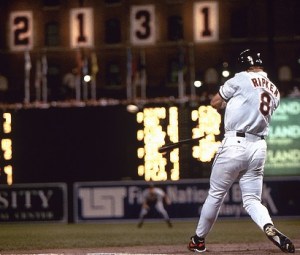
If Joe DiMaggio didn’t think Cal Ripken, Jr. diminished Lou Gehrig, neither should anyone else. Unfortunately . . .

You become accustomed to absurdity when loving, following and writing about a game. You see and hear it from those who love and follow it, those who play it, those who manage or administer it, and those who write about it. But then comes a remark that should win the ultimate Howitzer Prize for Extinguished Commentary.

I saw it in the context of late-spring observations on the health of certain Yankees, aboard a Facebook baseball group to which I belong, mindful that for almost three years The New England Journal of Medicine could be the Yankee yearbook. I saw concurrent references to Lou Gehrig and Cal Ripken, Jr., Hall of Famers both, one setting the consecutive games played streak the other broke.

Both Gehrig and Ripken played through assorted injuries to reach their milestones, perhaps foolishly. Gehrig ended his streak only under orders from the insidious disease that would kill him shy of two years after removing himself from the Yankee lineup. Ripken was able to play 501 consecutive games more following the night he passed Gehrig and 870 more games total before retiring with 3,001 major league games played.

Aboard that group, I couldn’t resist noting Gehrig’s plaque in Yankee Stadium’s Monument Park still calls him “a great ball player whose amazing record of 2,130 consecutive games should stand for all time.” Just as it did when it was first erected in the old Yankee Stadium on the Fourth of July in 1941.

The night Ripken said “not quite,” one of Gehrig’s Yankee teammates was in Camden Yards to see it happen. “Well,” said Joe DiMaggio to Ripken and the crowd after the game ended, “that goes to prove even the greatest records are made to be broken. And . . . wherever my former teammate Lou Gehrig is today, I’m sure he’s tipping his cap to you, Cal Ripken.”

Another group member thought not. “I still wish Cal would have stopped at 2130,” he wrote. “He would have been even more of a media darling if he said something along the lines of the memory of the man and the streak is too great to be broken therefore I am content to tie it and to hopefully be mentioned in the same breath as he in future conversation.”

Have I finally seen everything?

Well, I know better. But for abject absurdity if not sheer foolishness, that gets as close as possible. It only begins with Ripken having been a media target as much as a media darling the closer he got to meeting and passing Gehrig. For every one that marveled at his endurance, there was another who marveled that the Orioles put up with his “selfishness,” with putting his potential place in baseball history ahead of the team’s good.

My first response in the space of the group itself was to suggest such thinking as wishing Ripken stopped equal to Gehrig made it a wonder that any record would be broken. I remembered Henry Aaron saying, “I don’t want people to forget Babe Ruth, I just want them to remember Henry Aaron.”

I also wondered whether Ruth himself would have said, in 1919, “Gee, I think I’ll stop at 27 [home runs] because I don’t want to ruin Ned Williamson’s memory.” (Ruth’s 29 homers that year broke Williamson’s 1884 single-season record.) I didn’t dare add that I was pretty sure Pete Rose in 1985 didn’t think for a single minute, “Jeez, I can’t do this to Ty Cobb, can I?” before slashing his Tying and passing career base hits.

Guess I should have described myself as a hopeless romantic instead of an idealist but i really do wish that was the way it went down,” said the group member in question who thinks and wishes Ripken had stopped at 2,130. “Everyone would have known Cal could have easily surpassed Gehrig and I can’t foresee anybody breaking or even coming close to 2130 again. Your point though is certainly well taken.”

What manner of “hopeless romantic” goes ballistic at the mere idea of anyone challenging Ruth’s former single-season home run record in 1961? Which one has kittens over the likelihood of plainspoken, charisma-challenged Roger Maris and not glib, charisma-loaded Mickey Mantle breaking it?

Idealists don’t send aspiring record breakers hate mail. Hopeless romantics don’t write venomous newspaper columns or throw things at them. Then-commissioner Ford Frick wasn’t hopelessly romantic, he was cynically selfish—as a one-time Ruth ghostwriter and permanent Ruth acolyte—demanding separation between 154-game and 162-game seasons the better to be damn sure ruthsrecord (yes, they said it that way then) couldn’t really be erased.

(P.S. You asked for it. Maris needed five fewer plate appearances to hit 61 in ’61 than Ruth did to hit 60 in 1927. If you re-set Maris’s clock to start his season the game in which he hit his first homer of ’61, it took him 152 games to hit 61. Take that, Edsel Frick.)

I wondered further about such “idealists” as the brain-dead and the racists (who are their own kind of brain dead) threatening Aaron every step of the way as he approached, met, and passed Ruth on the career home run list.

I resisted the temptation to ask my fellow group member if he was one of those ready to wear black arm bands when Sandy Koufax smashed two of Bob Feller’s records in one 1965, Feller’s major league single-season strikeout record and his career record three no-hitters. (Koufax really hit Feller where it hurt, too: his fourth no-hitter proved that practise makes perfect.)

Then I reminded myself no milestone passer or record breaker could possibly erase the memory or the legacy of the one whose milestone he passed or record he broke. I learned that early from Ted Williams himself, a man who was nothing if not obsessed with his own legacy. “The other day,” Williams said at his own Hall of Fame induction, “Willie Mays hit his five hundred and twenty-second home run. He has gone past me, and he’s pushing, and I say to him, ‘go get ‘em Willie’.”

Williams didn’t think Mays diminished him. Teddy Ballgame, of course, probably believed nobody could diminish him. While whacking balls during batting practise he was once heard to say, “Jesus H. Christ Himself couldn’t get me out!”

Was Ruth diminished by Maris and Aaron? Was Feller diminished by Koufax? Was Cobb diminished by Rose? Was Walter Johnson diminished by Nolan Ryan breaking his lifetime major league strikeout record? Was Gehrig really diminished by Ripken?

DiMaggio didn’t think so. “He’s a one in a million ballplayer, who came along to break [Gehrig’s] record,” the Yankee Clipper told that cheering Camden Yards throng, “and my congratulations to you, Cal, you certainly deserve this lasting tribute.”

On the silver anniversary of the night he passed Gehrig (and whacked a home run while he was at it), I reminded anyone who cared to read it that Ripken didn’t (and doesn’t) live by 2,131 alone. He’s the arguable greatest all-around shortstop who ever played the game. Says who? Says 3,000+ hits and 400+ home runs (the only such middle infielder to do both) and +181 fielding runs (third only behind Mark Belanger and Ozzie Smith), says who.

You should be half afraid to ask whether Casey Stengel managing five consecutive World Series winners diminished the John McGraw who’d once managed a mere four. Or whether Tom Seaver striking out a record ten straight to consummate a nineteen-strikeout game diminished the Steve Carlton who’d struck out nineteen in a game previously without ten straight punchouts to finish.

Carlton wasn’t accused of diminishing the Koufax who struck eighteen out in a game twice or the Feller who did it once.

Tomorrow is Opening Day. The Show will be back and with a full season to come, even. Last year’s pan-damn-ically shortened, irregular season will recede a little further into the ranks of the aberrations. There may be a few milestones reached and passed this year, if not exactly all-time records of all-time idols.

Miguel Cabrera needs a mere 134 hits and thirteen home runs to become the only player who ever reached 3,000 lifetime hits and 500 lifetime home runs in the same season. At least nobody—whether fan group member or professional writer—can accuse Cabrera diminishing someone else’s achievement if he makes both.

Nobody can predict, of course. The likelihood isn’t that great, either, but imagine if the aging Cabrera’s thirteenth home run this year becomes his 3,000th hit, somehow. He’d be only the third man in Show history to do it. Hands up to anyone foolish enough to think he shouldn’t even think about trying to go long for 3,000 because it might “diminish” the only two men whose 3,000th hits were bombs—Derek Jeter (who did it first, in 2011) and Alex Rodriguez (who did it in 2015).

At September 2019’s end, just about, Justin Verlander struck Kole Calhoun out twice in a game. The first time nailed Verlander’s 3,000th career strikeout, the second time his 300th strikeout of that season. No pitcher ever delivered that trick before. The only thing that diminished Verlander even slightly was what happened after he punched Calhoun out for 3,000: Andrelton Simmons hit the pitch immediately following the punchout over the center field fence.

Entering 2021 Max Scherzer, Zack Greinke, and Clayton Kershaw have over 2,500 lifetime strikeouts each. Suppose one of them endures long enough that his 3,000th strikeout-to-be might also become his 300th strikeout of the season in question. Would it really diminish Verlander if one of them pulls it off? Should he just try throwing grounders the rest of the way? Should his manager relieve him on the spot? The better not to soil Verlander’s glory?

God help Mike Trout, Ronald Acuna, Jr., Mookie Betts, Francisco Lindor, Juan Soto, Fernando Tatis, Jr., or Christian Yelich if any of them should stand on the threshold of breaking Joe DiMaggio’s 56-game hitting streak. Some bonehead somewhere is liable to suggest he should take a dive for game 57 on the grounds that it’s too great a record to be broken and, by the way, he shouldn’t ought to want to diminish DiMaggio’s memory.

Both Ripken and myself will probably be in the Elysian Fields before somebody else breaks Ripken’s streak, if somebody else actually does. But I’ll be there watching when Ripken and Gehrig holler down to the man, “Way to go, kiddo!” They won’t be screaming bloody murder with demands not to be diminished.

When Johnny Bench broke Yogi Berra’s record for lifetime home runs as a catcher, Berra wired him: “I always thought that record would stand until it was broken.” Funny how Bench didn’t exactly diminish Berra. Funny how Berra didn’t exactly feel diminished. Funny, too, how nobody who’s since passed Bench —for the record, they’re Carlton Fisk and Mike Piazza—diminished Yogi, either.

The only one diminished by suggesting that breaking venerated records diminishes the original record setter is the one making the suggestion in the first place.

On legally mandating the anthem before the games

If ten Texas state senators and its lieutenant governor have their way, it’ll be Texas law to play “The Star Spangled Banner” before all games in the Lone Star State including at the Houston Astros’ home.

Among many things, in his farewell address this nation’s first president hoped his thoughts and suggestions would move his countrymanpersons “to guard against the impostures of pretended patriotism.” The Father of His Country might have had legislating as well as posturing patriotism in mind. Even though Texas wasn’t even a gleam in the new nation’s eye just yet.

A tentet of Texas state senators wants “The Star Spangled Banner” as required playing, listening, and posturing before every sports contest hosted in the Lone Star State—preseason, regular season, and postseason. For openers. As reported by Reason‘s deputy managing editor, Jason Russell, the tentet would like to tell one and all playing games in the state, “or else!”

Or else, among other things, no government entity state or local can make deals “that require a financial commitment” with any sports team “unless the agreement includes written verification the team will play the anthem before all games,” Russell writes. “If a team fails to comply, it would be in default of the agreement.”

Apparently, the Texas Ten took their cue from Lt. Gov. Dan Patrick, who is no known relation to the longtime ESPN SportsCenter anchor now hosting his own show on Premiere Radio Networks. In February, Patrick was not amused to learn the NBA’s Dallas Mavericks weren’t playing “The Star Spangled Banner” before their pre- and regular-season home games.

It’s not that anybody noticed until the final such game, because thanks to the pan-damn-ic there were no fans present until that final game. Then the NBA decided, not so fast, it’s time to re-enforce the league’s rule that the national anthem will be played before all NBA games, whether or not the Mavericks or their owner Mark Cuban likes it.

What has this to do with baseball? Well, two American League teams hail from Texas. So do four minor league teams even under the dubious new minor league realignment. If Patrick and the Texas Ten get their way, they’ll be spanked, too.

Russell observes that if the bill passes and is signed into law, major sports teams that let teams dispense with “The Star Spangled Banner” would find such decisions “affect[ing] stadium subsidies, any kind of government-funded tourism sponsorship, and possibly even arrangements where local law enforcement provides security.” The good news: the bill isn’t likely to cut the mustard in the courts, possibly all the way to the Supreme Court.

It’s one thing for the NBA or the NFL (which has mandated it since after World War II) as essentially private organisations to require it. It’s something else entirely for any government at any level to do so.”This legislation already enjoys broad support,” Patrick harrumphed last month. “I am certain it will pass, and the Star Spangled Banner will not be threatened in the Lone Star State again.” (He meant the flag as well as the song.)

Threatened?

“Patrick’s proposal that the Texas Legislature pass a state law requiring the national anthem be played represents state action,” writes attorney and journalism professor Amy Kristin Sanders in an e-mail to the Website of televisions Law & Crime. “As a part of its speech protections, the First Amendment also bars state actors from compelling others to speak—and requiring someone to play the national anthem is just that.”

We can surmise with little fear of contradiction that that isn’t exactly what an ancient Red Sox third baseman named Fred Thomas had in mind during the 1918 World Series.

On leave from the Navy to play in the Series, with the Navy’s full blessing, Thomas heard a Navy band (it was common in those times for military bands to provide music at sports events) strike up “The Star Spangled Banner” during the seventh-inning stretch and saluted spontaneously, as he might have been expected as a Navy man himself.

Thomas’s salute prompted other players in both dugouts (the Red Sox played and would beat the Cubs in that Series) to stand and salute, not to mention the already-standing crowd to salute likewise. This, by the way, was thirteen years before “The Star Spangled Banner” became America’s official national anthem.

Red Sox owner Harry Frazee decided that for the rest of that Series two things would happen: 1) For all games played in Fenway Park wounded war veterans would have free admission. 2) “The Star Spangled Banner” would be played in their honour before the start of those games. As with Thomas’s spontaneous salute, Frazee’s gesture did not come to him at the wrong end of a gun, actual or rhetorical.

It inspired other sports teams and leagues to do likewise, gradually, and entirely on their own, in the years to follow before and after the anthem became official. Baseball has never had a formal rule mandating either “The Star Spangled Banner” or “God Bless America” (which became an unofficial but consistent tradition in the wake of the 9/11 atrocity), but neither has it rejected the tradition of it.

When kneeling protests emerged a few years ago among black athletes spearheaded by long-former NFL quarterback Colin Kaepernick over rogue police brutality against black suspects, the passions both ways soared like a grand slam. They still do when the anthem issue arises, with or without the kneeling protests, as with Cuban and the Mavericks.

And you can’t always interject that kneeling is as much a gesture of respect and genuflection as it might be a gesture of protest. Even if you argue that kneeling protesters might appeal as much to a higher authority as against a particularly abusive temporal one. Even if you agree without taking a knee that there should be no place for rogue police in any diligent such department.

I’ve gone on record about it before, but Patrick’s harrumph compels it one more time: Is it absolutely necessary to sound “The Star Spangled Banner” before every damn last sports contest played all year long? If we believe patriotism must originate and remain in the heart, doesn’t the day-in, day-out pre-game playing erode rather than enhance the patriotic impetus by making it formal obligation instead of free and organic?

My past thoughts haven’t changed. I have no wish to eliminate the National Anthem from sporting events entirely. I also have no wish that Patrick and the Texas Ten should prevail and inspire other states to likewise. I remain in agreement with National Review senior editor Jay Nordlinger, who wrote almost three years ago, “I’m not sure that patriotism is compatible with compulsion,” to which George Washington himself might have answered with a resounding if quiet “it isn’t.”

And, I remain convinced that, on behalf of removing only too much of the compulsory factor from an impetus that must come purely from the heart and soul, playing “The Star Spangled Banner” ought to be limited to the following sports events:

* Opening Day for major sports leagues’ regular seasons or, in the case of non-team sports, major tournaments. (The U.S. Open in tennis and golf; the Masters’ tournament; the PGA Championship; etc.)

* Any games played on major national holidays. (Since I’m a baseball writer, let’s start from there: Memorial Day, Flag Day, the Fourth of July, Labour Day. Also, Veterans Day, Thanksgiving, New Year’s Day, Martin Luther King, Jr.’s Birthday, Presidents Day.)

* All-Star Games in major sports leagues.

* The Super Bowl.

* Game One of each major sports league’s final round: the World Series (first things first!) NBA Championship, the WNBA Championship, the Stanley Cup Final (if Game One begins in the American team’s arena).

* Game Seven of such championship rounds, if they go that far.

And, in the immortal words of Porky Pig, eba-dee, eba-dee, eba-dee, eba-that’s all, folks.

I won’t expect the commissioners or governing bodies of major sports to stop and ponder, never mind enact the foregoing. They’re many things, but bold isn’t necessarily among them. Not the sort of bold that enhances and advances their games, anyway.

The eyes of the nation should be upon Texas, if only to see that the way to patriotic wisdom is more often than we think to travel the road assuredly not taken. Certainly not by the Lone Star State’s second in command plus ten lawmakers unaware that they wish to make dubious and unconstitutional law.