Uh, no. These guys aren’t everything fans should be.

Mookie Betts

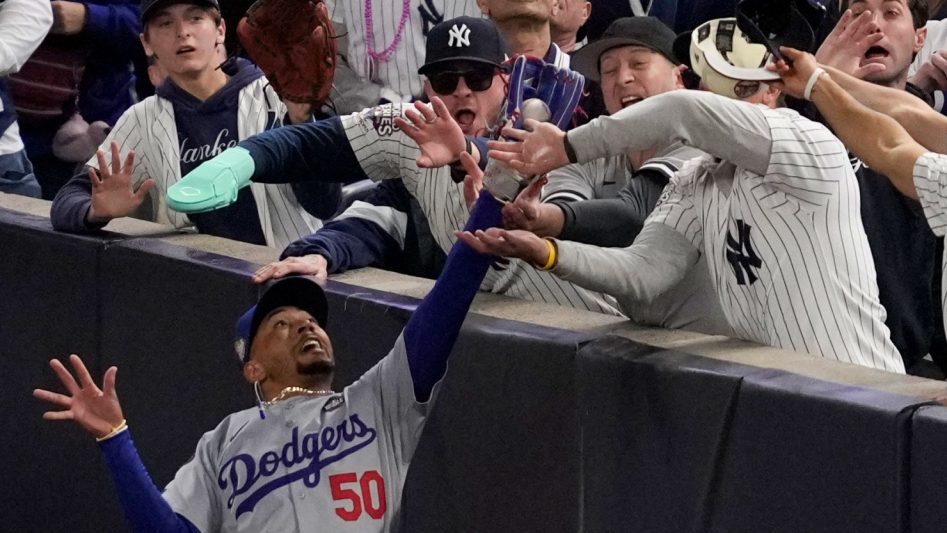
Interfering with Mookie Betts’s bid to haul Gleyber Torres’s Game Four-leadoff foul to the right side for out number one got two Yankee fans thrown out of Yankee Stadium on the spot, and now banned “indefinitely” from everything MLB.

It goes like this: If you have a problem with a pair of Yankee Stadium jerks getting banned indefinitely for interfering flagrantly with a player in the World Series, I have a problem with you. And I don’t care if the player with whom you interfered was Mookie Betts or Moe Baloney.

Austin Capobianco and John P. Hansen were banned indefinitely last week “from major league stadiums, offices, and other facilities.” MLB sent the pair a letter banning them concurrently “from attending any events sponsored by or associated with MLB. Please be advised that if you are discovered at any MLB property or event, you will be removed from the premises and subject to arrest for trespass.”

The play in question happened in the bottom of the first, Game Four, last October’s World Series. Betts ran Yankee leadoff hitter Gleyber Torres’s drive to the wall and took a flying leap, his glove hand stretched upward, trying for the ball. He had the ball in his glove squarely enough. That’s when Capobianco and Hansen reached out, one grabbing Betts’s wrist and the other trying to grab the ball out of Betts’s glove.

Outfielders are taught to steal home runs back from over fences. They’re also taught to turn foul flies into fly outs if they can get gloves on them and yank them back. I’m not sure if they’re taught how to defend themselves against overzealous fans who think they have the right to obstruct players from making plays at or over the fences by hook, crook, or anything else short of mutilation they can think of.

Which wasn’t exactly the sentiment Capobianco expressed after they were ejected from Yankee Stadium. As he told ESPN, “I patrol that wall and they know that.” That sounded as though someone in the Yankee organisation died and left Capobianco to play fence field in the will.

But the pair changed their stance when interviewed subsequently by Barstool Sports. Capobianco acknowledged they’d “crossed the line” taking hold of Betts’s wrist. Betts may have waved the play away postgame himself, but come December he wasn’t having it.

“I get them trying to get the ball. Cool,” the Mookie Monster told  2024 Back That Year Up with Kevin Hart and Kenan Thompson on the Peacock network. But, like, you tried to grab my s–t. I was in the moment. So I thought about throwing a ball at them. And then I realized, ‘Mook, you ain’t gonna do s–t. Go back to right field’.”

When the incident actually happened, Barstool Sports writer Tommy Smokes didn’t exactly feel all that sympathetic to Betts or all that outraged by Capobianco and Hansen, Capobianco in particular. “This guy is everything that a Yankee should fan be,” Smokes wrote. “A loud, passionate, Italian greaseball who will do anything it takes to help the team win.”

We just did a full interview with him linked above that’ll be out everywhere else soon and as he told us, ‘I wasn’t trying to get the ball or to hurt him, I was just trying to extend the at-bat.’ And if you can’t respect that, then I don’t respect you.”

If you can’t look at that video and objectively find it hilarious, then I know everything I need to know about you as a person. I know what you stand for . . . It’s such a clear divide between people who laugh at that and people who want this guy thrown in prison. Even Mookie Betts after the game last night seemed to not care. People are acting like they decapitated him. He acknowledged to us that the friend probably shouldn’t have grabbed his hand, and that’s true, but let’s not pretend like he tried to [fornicating] decapitate him. All the main fan was trying to do was the get the ball out of the glove and extend the at-bat. The Yankees were down 3-0 in the World Series and you do whatever it takes to extend the at-bat for your guy at the plate.

Who is “you?”

Fans in the stands are permitted to “do whatever it takes” to extend the home player’s plate appearance? Betts is to blame because Torres swung late on a 1-0 pitch and sent it foul to the right side? Fans in the stand wearing the home team’s jerseys are thus auxiliary players entitled to make or break plays? Thank God and His servant Col. Ruppert that most fans, even most Yankee fans, would answer all the above with a resounding “You’re kiddin’, Spike.”

“This is just a classic baseball moment that had no real consequences other than bringing the Yankee crowd alive and keeping their season alive,” Smokes wrote further. “Anthony Volpe[‘s grand slam in the third] helped too. But if the Yankees come back and win the series, then this man deserves a parade float and a spot in Monument Park.” Let me guess. Smokes would have been ready to hand Jeffrey Maier the keys to the city and maybe his own private New York subway car.

I’m reasonably certain that there were and are others who think classic baseball moments such as that provoke not monuments but karma.

Just ask every Yankee fan who in the ballpark for Game Five. You know—the game after the Yankees won Game Four, 11-4. The game following the only Yankee win of a set in which they just did out-hit, out-run, out-slug, and out-pitchd the Dodgers. The game they thought the Yankees had in the bag with Gerrit Cole on the mound and a 5-0 lead, until the Bronx Boneheads ordered up an on-field sando* in the top of the fifth.

The game the Yankees lost after reclaiming the lead briefly enough with Giancarlo Stanton’s sixth-inning sac fly, a lead lasting only long enough for the Dodgers to overthrow it with a pair of eighth inning sac flies the Dodger bullpen made stick.

Capobianco and Hansen were probably lucky that being ejected from Game Four, and now banned indefinitely from anything MLB from the ballpark to the back lot of spring training to possibly the team stores, too, are all they’ve received.

Yankee fans who believe karma the bitch as which she’s so often advertised would probably like to give them a parade, all right. Preferably, onto and off the Triborough Bridge and into the East River.

—————————————————————————————————

* “Sando”—Slang for “s–t sandwich,” created and popularised online (and, on lots of merchandise) by Las Vegas slot machine YouTube star Vegas Matt.

————————————————————————————————–

* This essay published originally at Sports Central.

2024: Taking the Fifth, and Other Lamentations

Aaron Judge

This is not what was meant when the phrase, “I’ve got the drop on you,” was coined . . .

Hands up to everyone who can’t wait for 2024 to depart. Now, hands up to everyone who thinks 2024 was just the most wonderful year of the decade. My, but that’s a barren sea of hands over that second suggestion.

Much like its home country, baseball’s 2024 was . . . well, why don’t we let some of the signature moments, doings, and undoings of baseball’s year speak for themselves. The new flimsy uniforms sucked. The All-Star Game uniforms didn’t suck that badly, but still. Meanwhile, I’m thankful to folks such as Jayson Stark and a few other intrepid sleuths of BBW—that’s Baseball Bizarro World, you perverts—who either unearthed or reminded us about . . .

Take the Fifth—Please Dept.—“Come an’ see my amazin’ Mets,” their manager Casey (I Lost With This Team What I Used to Win with the Yankees) Stengel liked to say of his maiden squad. “I been in this game a hundred years but I see new ways to lose I never knew were invented yet.”

That was the Ol’ Perfesser gazing down from the Elysian Fields, watching the team with whom he won ten pennants and seven World Series perform the single most splendid imitation of the 1962 Mets since . . . the 2024 White Sox finished their sad, sad, sad regular season.

Pace George F. Will, look to your non-laurels, White Sox—the Bronx Bumblers captured 21st Century baseball’s booby prize. You White Sox only out-lost the 1962 Mets this season. You probably never did in one regular season game what only began in a World Series game . . . with a Yankee center fielder who does a credible impersonation of the Leaning Tower of Pisa approaching the plate and Frank Howard at the plate committing his first error playing center field after 538 fly balls hit his way in his entire career to date became outs.

Then . . .

* A Gold Glove-finalist shortstop threw for a force play at third base and saw the ball ricochet off the base instead of reach his third baseman’s glove.

* The arguable best pitcher in the American League got thatclose to escaping a bases-loaded, nobody-out jam when he suffered the brain fart heard ’round the Bronx and the world: he forgot to cover first when Mookie Betts hit a screwdriving ball toward Anthony Rizzo. Oops.

* The Yankee anti-party included a balk and catcher’s interference.

* The Dodgers became the only team in baseball history to score five runs in a World Series game after they were in the hole 5-0.

* The Yankees became the only team in baseball history to serve up five unearned runs in a World Series game since they started counting earned and unearned runs as official statistics. (When did they start? In the same year during which premiered Ford’s moving assembly line, the first newspaper crossword puzzle (in the New York World), and Louis Armstrong’s first cornet. In the New Orleans Home for Coloured Waifs.)

* And the fifth-inning party actually started with everyone from the television announcers to the fans and back pondering whether Gerrit Cole might, maybe, consummate a no-hitter to keep the Yankees alive.

Your Reality Check Bounced Dept.—Too many Yankee fans continue infesting social media with proclamations that the Yankees still have the dynastic history of dynastic histories. And too many baseball fans steeped in reality and not fantasy keep reminding them, Your damn dynasty is just soooooo 20th Century!

Juan Not-So-Small Step for Met World—That’s $765 million the Mets will pay Juan Soto over the next fifteen years. This may or may not mean the end of Pete Alonso’s days as a Met, which may or may not mean . . .

Out with a Bang Dept. . . . that Polar Bear Pete’s final act as a bona-fide Met was the biggest blow on their behalf this century: the three-run homer he blasted in the ninth inning that proved the game, set, and National League division series winner against the Brewers. Which was also the only home run hit by any Met in the set.

Did I Do That Dept.—Alonso’s division series-winning blast came off Devin Williams . . . who’d never allowed a ninth-inning lead-changing bomb in his major leaguer life until then. Then, after some time passed, the Brewers let the Yankees talk them out of keeping Williams, sending them pitcher Nestor Cortes, infielder Caleb Durbin, and cash to take Williams. We still don’t know if the deal was Milwaukee payback for surrendering Alonso’s game-changing/game-swiping bomb.

Out with a Bigger Bang Dept.—That would be Walker Buehler, pitcher. One minute, locking down the Dodgers’ World Series win with a spotless Game Five ninth including two swinging strikeouts. The next, practically (well, give or take a few hours): Signing for one year and $21 million with the Red Sox. Anyone remember the Dodgers making Buehler a qualifying offer for that money and Buehler turning it down? He’s rolling serious dice on himself with this deal.

Shohei-hei Rock and Roll Dept.—You might think anyone can become a member of the 50 home run/50 stolen base club. But you won’t be able to predict who might do it the same way Shohei Ohtani did in September against the Marlins: 6-for-6 at the plate; three home runs; five extra base hits; two stolen bases; ten runs batted in. His own planet? Try realising Ohtani exists in his own quadrant.

A Cut Below Dept.—Pete Fairbanks, Rays reliever. He missed a game in 2024 because of a finger cut. He cut the finger opening a bottle of spring water. Considering his bizarre 2023 injury (incurring a black eye while trying to dunk against his toddler son through a water basketball net), it seems as though Fairbanks just couldn’t cut it anymore.

On Your Knee Dept.—Presented for your consideration: Miguel Sanó, Angel. Aleady on the injured list with an inflamed knee. He put a heating pad over it. He forgot about it just enough to burn the knee and place himself for another month on the IL. Miguel Sanó, who proved he certainly could stand the heat in . . . the Angels’ continuing Twilight Zone.

The King of Pop Dept.—Mookie Betts performs amazing feats at the plate and on the field. At the plate, they usually involve baseballs shot on lines into the outfield, or driven like ballistic missiles over fences. They didn’t involve him popping out for the cycle . . . until 25 September, when, in order, he popped out to: second baseman, third baseman, first baseman, and shortstop.

Don’t do it. Don’t Google “MLB players who’ve popped out for the cycle.” It won’t even call up the Mookie Monster, yet, never mind anyone else who might have had that kind of a day—whether a Hall of Famer, a Hall of Famer in the making, or a guy who’s destined to be forgotten outside such a single singular feat.

Rickey Henderson, RIP: Baseball’s grandest larcenist

Rickey Henderson

The Man of Steal gets the jump in a 1990 game, as then-Angels infielder Johnny Ray looks as though the right move was premeditated surrender.

“To me,” Hall of Famer Rickey Henderson once said, “the most important thing was stirring things up and scoring some runs so we could win a ballgame.” In more ways than one, he was a virtuoso at both. He made a cliché of the maxim that when he led off his team had a man on second going in. He also had to have the uniform torn off his back after slightly more than a quarter century of professional baseball.

On Friday night, at age 65, pneumonia plus asthma tore the Man of Steal from earthly life. Rest assured that even the Elysian Fields might be hard pressed to contain him, though God and His servant Stengel might be entertained above and beyond expectations.

Once upon a time, the Yardbirds’ drummer Jim McCarty wrote in an album liner note, “It’s been said that Jeff Beck is one of the world’s leading guitarists and I’m inclined to agree with him.” Well, now. It was (and is) said (and how!) that Henderson is the greatest leadoff hitter in major league history, and I’m inclined to agree with him.

So was just about all of baseball world, and it didn’t wait until his death to say it, either. But with the news of his death, here was Howard Bryant, a Henderson biographer, writing for ESPN: “He wasn’t as good as he said he was. He was actually better.”

“Rickey Henderson,” said Hall of Fame catcher Mike Piazza, “was a dream to hit behind as teammate and a nightmare for a catcher as an opponent.” And, a joy to fans who loved watching him turn baseball games into Olympic track and field meets.

Henderson was so prolific at reaching base you almost thought he’d become the first to steal first legitimately. Once he did get aboard, you could pretty much bank the run scoring by hook, crook, and anything else Henderson could think of, short of shooting the infielders and the catchers with tranquiliser darts.

The basics would be his 3,118 major league hits, his 1,406 stolen bases, his 298 major league home runs, scoring fifty runs more than Ty Cobb, and stealing about five hundred more bases than Hall of Famers Cobb, Lou Brock, or anyone else making his living with basepath theft. Not to mention the batting stance—damn near a catcher’s crouch, prompting baseball writing legend Jim Murray to suggest his strike zone was the size of Hitler’s heart.

This wiry guy who sometimes checked into hotels using Negro Leagues legend and Hall of Famer Cool Papa Bell’s name as an alias is thought of first for breaking both the single-season and lifetime stolen base records, each held then by Brock. But neither Brock nor anyone else walked 796 times leading off any inning.

The Man of Steal’s 394 game-opening walks is staggering enough. You can think of players who didn’t or won’t walk that often in their entire baseball lives. But 796 walks leading off innings? That’s as surrealistic as a Dali painting, a Kafka novel, or an extremely early Pink Floyd composition. Cobb did it a mere 153 times.

“I’m 69 years old,” dance and film legend Bill (Bojangles) Robinson told an Ebbets Field crowd on Jackie Robinson Day in 1947, “but never thought I’d live to see the day when I’d stand face-to-face with Ty Cobb in Technicolour.” Mr. Bojangles should have lived to see Henderson. He’d have beamed about standing face-to-face with Funkadelic in spikes.

Henderson’s 81 lifetime game-opening home runs and his 293 bombs batting first in the order were (and remain) impressive enough. His 142 inning-opening home runs might be even more so. Whomever else Henderson had behind him in the lineup, it might have been most true that to beat those teams you had to get through him first, last, and always.

He went to eight postseasons with five teams and posted an .831 OPS. You guessed it: there have been and there are players thought to be heftier hitters who didn’t and won’t post .831 OPSes in their whole careers. By any measure, his 1989 postseason was his personal best, winning the American League Championship Series MVP and posting a 1.514 OPS over that ALCS and the (Earthquake) World Series.

The intentional walk is usually handed to a fellow whose bat should be registered as a lethal weapon. Henderson had 61 free passes in 25 major league seasons, an average of three per year. He didn’t lack long ball power, of course, but neither was he guaranteed to lead off every inning he checked in at the plate beyond the first inning.

Simple enough answer: No pitcher who hadn’t yet lost his marble (singular) wanted to hand Henderson a premeditated base because they knew it meant guaranteeing him three bases on the house before the inning ended. Henderson had 5,356 plate appearances in which he led off an inning and he was never handed an intentional walk in those.

He got his walks the old fashioned way: he earned them. No player was better at reading pitchers and catchers preparing for a day’s larceny. He averaged only 89 strikeouts a season at the plate but 115 walks. Keeping the Man of Steal off base and off the top of baseball’s ten most wanted grand theft suspects compared to keeping a politician from putting his or her foot in his or her mouth.

Rickey Henderson

Henderson was more than a base thief—he hit 81 lifetime game-opening home runs, 142 inning-opening homers, and 293 bombs when listed in the lineup at the number one spot.

No player or man is perfect, and Henderson’s imperfect sides could and did drive players and managers on his own teams as well as the opposition to drink or thoughts of manslaughter, whichever came first. His tendency to whine and fume when he thought he was being underpaid steamed his front offices. His tendency to think of sitting it out when he wasn’t feeling a hundred percent physically caused too many to think he was a born goldbrick or worse.

Just ask Tony La Russa, the Hall of Fame manager who managed against him before getting to manage him. Once when managing the White Sox the first time around, La Russa had to bear Henderson getting in his face and telling him the next time his White Sox decided to brawl with Henderson’s A’s, Henderson was coming for him first.

“Rickey knew his body better than anybody else,” La Russa later told Bryant. “I have to admit I was wrong about him.”

As a manager, I would ask him how he felt and he would tell me, ’70 percent.’ Seventy percent wasn’t good enough for him to play, but I’d tell him 70 percent of Rickey Henderson was better than 100 percent of anybody else I had on the bench. There were times he did not play even when that 70 percent, I thought, could have benefited the team, but when you look at the end results of what he did, the totality of his career achievements cannot be argued.

When Henderson re-joined La Russa, re-joining the A’s for a third tour after winning a World Series with the 1993 Blue Jays, the A’s team bus passed a Toronto billboard showing Joe Carter’s jubilant tour around the bases after hitting the ’93 Series-winning three-run homer. (Henderson and fellow Hall of Famer Paul Molitor were on base when Carter connected.) Bryant wrote that only one voice came from the rear of the bus.

The voice was Henderson’s. “I was on second base!” the Man of Steal crowed.

Yes, he was as funny as he could be infuriating. But as Hall of Fame pitcher Dennis Eckersley told Bryant, “Rickey was great, sure, but when Rickey put his nose in it—those days when he really wanted to play —there was nobody better.”

“It ain’t bragging if you can do it,” the ancient saying goes. Henderson on the field was the braggart who backed it up. When he spoke to the crowd after busting Brock’s record, he made people fume as well as cheer when he said, “Lou Brock was the symbol of great base stealing. But today I am the greatest of all time.” It turned out that Brock himself helped Henderson write his day’s remarks. Well.

Henderson even proved at least once that one Hall of Famer had to one-up another Hall of Famer to set an all-time record as unlikely (at this writing) to be broken as his 1,406 stolen bases. He proved it when he turned up as Nolan Ryan’s 5,000th strikeout victim, with then-commissioner A. Bartlett Giamatti in the house, “ticking off at least one Oakland player who thought he detected Giamatti rooting for Ryan.” (So said the New York Times‘s George Vecsey.)

That was the summer in which the bulk of Giamatti’s too-brief term in office was consumed with the Pete Rose investigation, which didn’t allow him as much time at the ballparks as he would have loved. But bank on this: Had Giamatti lived to be in the house the day Henderson stood to pass Brock, two years later, there’d have been a Brewer or three carping that they thought they detected Giamatti rooting for Henderson.

Even the larger-than-life need anchorage. Henderson had his wife. “Pamela Henderson never received the credit,” wrote another ESPN scribe, Bradford Doolittle. “While he was building his masterpiece, some players didn’t even know Rickey was married, but she was both the anchor and the captain of the yacht.” You don’t stay together since high school and stay married 41 years without a captain and an anchor. It was as if Henderson’s wife and the mother of his three children reassured herself, “Let him have his fun. When he gets home, we’ll remind him who’s on this bridge.”

Maybe one of Henderson’s true problems was that he really did love the game too much to let it go. After a quarter century plus, most players are long retired to their post-playing lives. At age 45, he was busy stealing 37 bases for the independent Newark Bears. When it all shook out, he probably deserved more than two decades plus a near-year more of life after the batter’s box and the basepaths.

He died five days before his 66th birthday. Somehow, it’s appropriate that he should have been a Christmas baby. At his best, the Man of Steal made every game he played feel like Christmas to his teams.

First published at Sports Central.

A rainy day memorial for Rose

Pete Rose Memorial

Cincinnatians still mourning the late September death of Pete Rose file past his urn hoisted in Great American Ballpark Sunday. (The photo on top: Rose pointing skyward on first base after breaking Ty Cobb’s career hits record in 1985.) The Reds enabled them to say farewell to the late legend over fourteen hours—in honour of Rose’s uniform number 14. 

From 7 AM through 9 PM Central Standard Time, Cincinnati was handed the chance to visit Great American Ballpark and pay their respects to Pete Rose. Dreary with the rain though it was, several thousand people did just that.

They came to say goodbye to a hometown baseball legend who died September 30 at 83. A hometown legend whose wounding flaws and the sickness that got him banned from baseball and from election to the Hall of Fame many among them still seem to struggle with comprehending.

“As West Siders,” said Molly Good, who teaches at Western Hills High School, which Rose attended, to Cincinnati Enquirer writer Erin Crouch, “we’re like a big family, and he’s one of our family.” (They should have named an alley after me, the way I acted in school, Rose said, memorably, when Cincinnati dedicated Pete Rose Way.)

That wasn’t quite the way a West Sider who contributes to the Enquirer, Jack Greiner, put it the day after Rose’s death. “[M]y sadness is mixed with a heavy dollop of ambivalence,” he began.

I’ve already seen the platitudes from pandering politicians. The theme seems to be that Pete was the living embodiment of Cincinnati’s west side — tough, gritty and hard-working. I can’t argue with that. My ambivalence stems from the fact that in every other facet of his life, Pete in no way embodied the values I consider synonymous with the West Side.

Westsiders are rule followers. With very few questions asked. Pete was not. And while that had its charms, the fact is that he lived his life as though the rules didn’t apply to him. Whether it was gambling on baseball, IRS regulations, or wedding vows, Pete apparently felt unburdened.

The visitation included passing by the urn containing Rose’s ashes, which his family seems not to have finalised concerning burial or scattering. Atop the container sat a copy of the fabled photograph of Rose pointing skyward as he stood on first base, tipping his batting helmet, the night he broke Ty Cobb’s career hits record in 1985 Cincinnati.

Those attending were clad in one or another red garment, under assorted red or red-and-white umbrellas, including Reds jerseys with Rose’s old uniform number 14. Many stopped by the statue of Rose captured in one of his fabled head-first slides into base outside the ballpark. Within a very short time, the figure of Rose hitting the ground hands first was surrounded by assorted Reds paraphernalia tied to Rose explicitly or other objects expressing feelings about him.

Most of the mourners were older Cincinnatians who grew up watching Rose with the 1963-1978 Reds, including the height of the legendary Big Red Machine teams. Reds officials told the press that at least 1500 people turned out for the visitation over its first seven hours; the visitation was scheduled for fourteen hours as a nod to Rose’s old number. Wreaths of roses appeared at various spots, including at least one displaying his number 14.

Pete Rose statue

Mourning Reds fans didn’t let Sunday rain stop them from surrounding the landing hands on Pete Rose’s statue (he’s captured in one of his fabled headfirst slides into base) with assorted paraphernalia, inscribed baseballs, and roses.

The rainy weather may well have kept more from attending the first half, but those first seven hours may have had more attending than the Reds had counted just yet. As I sat down to write, I had no idea what the final turnout would prove to be. The mourners didn’t just pass by Rose’s ashes, they paid respects personally to Rose’s two daughters, Fawn and Kara, who’d cooperated with the Reds and with the team’s hall of fame to bring the event to pass.

“We wanted to do something like this,” said Reds Hall of Fame executive director Rick Walls. “You could see from the turnout, it means a lot to the people here. It’s a moving experience.”

“He was a guy you thought was going to live forever,” said one longtime Reds fan, Bob Augspurger, to Associated Press writer Jeff Wallner. “When I heard the news, obviously it was sad. Baseball lost its greatest ambassador.”

“Westsiders tell the truth. Pete lied for thirteen years about betting on baseball,” Greiner had written. “He did it so naturally that he seemed to believe the lie. Westsiders are accountable. Pete’s ultimate confession was done in a book from which he reaped profits. He continued to deflect, citing to others who in his mind behaved worse than him.”

Let it be said, then, that Queen City people came out to pay their respects to a native son whose greatness on a baseball field was as impossible to forget as the clay feet on which he walked off the field proved impossible to replace or re-shape. A man whose professional achievement and the penultimate honor it should have received could be and was blocked and soiled by only one man.

Somehow, Sunday’s rain seemed a little more appropriate.

This essay was published originally at Sports Central.

Mystique and Aura, kidnapped by the Dodgers

Walker Buehler

Walker Buehler (21, far left) about to be swarmed by fellow Dodgers after he locked the Bronx Bumblers down for keeps to finish World Series Game Five.

Has it really sunk in yet that the Dodgers are full-season, no-doubt, take-no-quarter World Series champions? Has it really sunk in yet that the Yankees aren’t just another group of also-rans but a team as fully able to implode at the wrong time as any team in major league history?

Both teams needed the best they had available for Game Five Wednesday night. The Dodgers to win it, the Yankees to stay alive long enough to force a cross-country trip to Los Angeles for Game Six at minimum. When the Dodgers needed reinforcements, they found them, sometimes in places unexpected outside their portal.

Anyone remember Mystique and Aura? The Dodgers kidnapped them with no known ransom demand turning up at this writing. The Yankees needed Mystique and Aura but they got Wobbly and Rickety.

Just one night after showing serious enough life by blowing the Dodgers out of Game Four, the Bronx Bumblers self-dismantled in ways almost unheard-of by any previous World Series contestant. The Series-clinching, Game Five final was 7-6. It was a close game only if you ignore the way the Yankees helped the Dodgers close an early 5-0 Yankee lead.

The Game Five Dodgers almost didn’t need stout innings from their bullpen, a shutdown ninth from projected Game Seven starter Walker Buehler, and too-timely hits enough to matter. If you didn’t know better, you’d be swearing the Yankees were handing it to the Dodgers on a platinum platter.

The 161st Street Stumblers lost the Series to a Dodger team that found ways not to let little things like too many injured pitchers and a half-effective bullpen keep them down for very long. bullpen half of which would be effective keep them down for very long. But Game Five night just might have been the single most surrealistic game of this Series, if not any Series.

Trust me when I say that that’s saying something.

The top of the fifth challenges such sad Series mishaps past as Fred Snodgrass’s glove turning into a trampoline, Freddie Lindstrom’s pebble, Ernie Lombardi being dismantled at the plate, Mickey Owen’s passed ball, Willie Davis losing two Oriole flies in the sun in the same inning, Curt Flood losing Jim Northrup’s drive in the sun, or Bill Buckner’s horror seeing the slow grounder skip beneath his downstretched mitt.

Does anyone remember that the 11-4 Game Four beatdown the Yankees dropped on the Dodgers actually had people predicting with straight faces that the sleeping giants were awakening enough to do the unheard-of and take the next three straight to teach those ornery louts from Los Angeles a lesson in manners and championship?

There went those ideas. Above and beyond the Yankees waiting fifteen years to get back here only to tumble away this time, above and beyond the Dodgers winning eleven out of twelve National League West titles with only one World Series conquest to show for it until now, this is what everyone will remember about this Series in general and Game Five in particular:

They’ll remember Series MVP Freddie Freeman’s Game One-winning ultimate grand salami as the first salvo toward his reaching the seats in the first four games, which marries to his bombs in Games Five and Six in 2021 (when he was still a Brave) to tie George Springer for the longest Series home run streak (six games).

They’ll even remember Freeman overcoming a balky ankle keeping him somewhat calm in the earlier postseason rounds. Somewhat. Because by the time Freeman got finished with his bombing in Game Four, Yankee fans were holding up signs pleading, “Freddie, Please Stop!” As if Freeman had any intention of obeying.

Aaron Judge

First, Judge was the sleeping giant coming wide awake . . .

They’ll remember Shohei Ohtani jamming his shoulder on a failed Game Two stolen base attempt, leaving himself all but useless for most of the Series, but insisting upon staying in the lineup just in case. If only for the presence.

They’ll remember Dodger starting pitcher Jack Flaherty keeping the Yankees to two runs starting Game One but getting flogged for four before he could get out of the Game Five second—including Aaron Judge, heretofore the Yankees’ first among the sleeping giants, awakening himself and Yankee Stadium with a two-run homer in the bottom of the first, followed immediately by Jazz Chisholm, Jr.’s solo bomb . . . until . . .

They remember the Yankees leading 5-0, and Yankee starter Gerrit Cole striking Gavin Lux and Ohtani out swinging back to back, and not one Dodger hit thus far.

Until . . . come the fifth . . .

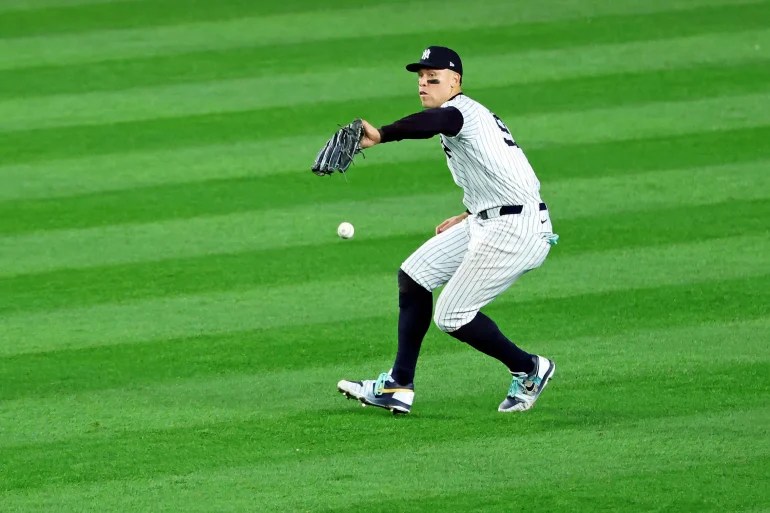
* With Kiké Hernandez aboard on a leadoff single, busting any shot Cole had at a no-hitter, Tommy Edman lined one that Judge—who committed only one error all year to that point—normally catches in his sleep. This time, the ball hit the web of Judge’s glove and bounced away.

* Five pitches later, Will Smith grounded one to Yankee shortstop Anthony Volpe’s right. Volpe picked it clean the way a Gold Glover does. Then he threw an awkward short-hopper to Chisholm at third the way a Cold Glover does. Chisholm couldn’t get the handle on that throw. The Dodgers had the bases loaded and nobody out.

* The Mookie Monster singled Hernandez home, on a squibber first baseman Anthony Rizzo had to step back to snag because it was spinning like a gyroscope, practically . . . leaving Cole not covering first because the pitcher took a bad route to the ball, leaving both men resembling raw rookies with signals crossed and knotted.

* Freeman singled Edman and Will Smith home and set up first and third.

* Teoscar Hernández doubled Betts and Freeman home.

* And every last one of those five runs in the Dodger fifth was unearned.

Aaron Judge

. . . but, then, his unlikely error began handing the Dodgers the fifth inning and beyond.

“This is as bad as it gets,” Cole said postgame. “It’s the worst feeling you can have. You have to keep sometimes willing yourself to believe and give yourself a chance. You keep pushing and pushing, and ultimately, you fall short. It’s brutal.”

“You can’t give teams like that extra outs,” said Judge, who’d made what threatened to be the play of the night when he stole an extra-base hit from Freeman by scaling the left center field fence in the fourth. “They’re going to capitalize—their 1-2-3 at the top of the order, they don’t miss. You give them a chance with guys on base, they’re going to capitalize. You gotta limit the mistakes.”

Then, everyone will remember Blake Treinen, the man who usually gets the final three outs of a Dodger win, coming in a little bit sooner than usual to clean up a mess and keep the Yankees at bay from there. As in, the bottom of the sixth, with the Yankees back in the lead 6-5 but threatening to put the game back out of reach with first and second, two out, and Volpe due at the plate.

The same Volpe who really started the Yankees’ Game Four mayhem—when they were down 2-1 in the third thanks to yet another Freeman flog two innings earlier, but with the bases loaded on two out—by hitting Daniel Hudson’s first service into the left field seats.

Treinen got Volpe to ground out to second for the side this time. Then he retired the Yankees in order in the seventh and squirmed out of a first-and-second jam with a fly out by Giancarlo Stanton and a swinging strikeout on Anthony Rizzo.

Somewhere in the middle of all that, Buehler ambled down to the Dodger bullpen. Just call me if you need me, boss. He’d only told any Dodger personnel, from teammates to front office people, that he was available to work in Game Five if need be. He made for the Dodger bullpen after the bottom of the fifth.

Then, Buehler started loosening up. Then, he started warming up in earnest. He may well have thrown the equivalent of the first two and a half innings worth of a quality start by the time he got the call to handle the bottom of the Game Five ninth.

He got Volpe to open with a sharp ground out to third base. He struck Austin Wells out swinging on a full count. He struck former teammate Alex Verdugo out swinging on 1-2. Buehler then spread his arms like an old-time nightclub singer inviting applause for the big finish and his mates began pouring onto the Yankee Stadium infield to start the party.

They survived the early bombs by Judge, Chisholm, and Giancarlo Stanton. They survived their Game Four bullpen game plan getting vapourised, going into sacrificial lamb mode the better to keep their six best relief arms available for Wednesday night. They survived their own recent past of, manager Dave Roberts admitted postgame, losing games that handed them what Game Five had before the fifth inning.

They didn’t stop to ask questions when the Yankees began passing out early Christmas presents one botched out after the other in the top of the fifth. They knew the answers going into the Series.

Their knowledge only began with Betts working on playing caroms off the wall almost as incessantly as he does on his batting swing. It only continued with every Dodger no matter how wounded attacking basepaths rather than just running them. The Dodgers scouted the Yankees and determined they were über talented but fundamentally lacking. They didn’t have to advertise it. They simply exposed it.

The Yankees didn’t pay close enough attention to any reports telling them the Dodgers could match them talent for talent even with their MIAs. The Dodgers, for all their star and firepower, were too grounded fundamentally to let the Yankees treat them like just another poor-relations team.

Freddie Freeman

To absolutely nobody’s surprise, Freddie Freeman was named the Series MVP. (A home run in each of the first four games, plus tying a Series record with twelve RBIs, does that for you.) Now named for the late Willie Mays, the trophy depicts Mays making his fabled 1954 World Series catch against Vic Wertz.

Most of all—unlike the title they won at the end of the surrealistic, pan-damn-ically shortened season and under-isolation postseason—nobody so inclined can hang any kind of asterisk on this one. These Dodgers went the distance no matter whose interpreter swindled him out of millions to cover debts to a bookie, no matter who hit the injured list, no matter who lost a season to an injury. No matter that they tied and took what proved the winning lead on a pair of eighth-inning sacrifice flies.

The last man standing? A pitcher who once resembled a mound terror until two Tommy John surgeries and other ailments kept him limited this regular season, only to show up in October looking as close to his former self as his age and body allowed and hell bent on doing something, anything, to secure his team the Big Prize.

“This is the only reason I play,” Buehler said postgame, “for games like this. The whole year—the offseason, spring training, the regular season—it doesn’t matter. Well, it matters, but not like these games. To win championships is why I play. It’s the best feeling in the world. I live for this.”

He pitched the ninth to prove it. A ground out and back-to-back swinging strikeouts. Followed by stepping down from the rubber, holding his arms out like a vintage nightclub singer delivering the Big Finish, and being mobbed by a swarm of Dodgers. They all lived for this.