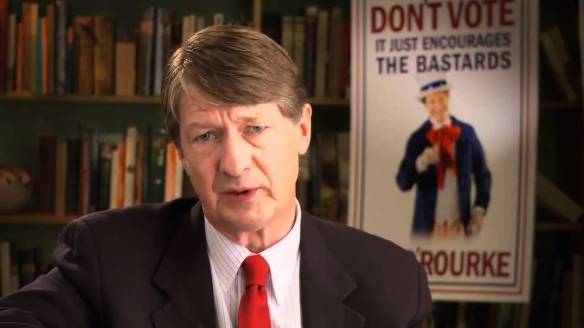
P.J. O’Rourke, RIP: He bowed to my superior mastery, once

P.J. O'Rourke

P.J. O’Rourke promoting one of his many books: “If government were a product, selling it would be illegal.”

I wasn’t even aware he was suffering. Maybe I’d simply fallen awhile out of that cheerful loop in which the spinning was tolerable because he’d been there to make you laugh, the better to prevent you from wishing to commit murder, manslaughter, mayhem, mincemeat, or My Mother, the Car.

P.J. O’Rourke, the funniest non-sportswriter in America, lost his fight against lung cancer Tuesday at 74. Back in 2008 he’d announced he was diagnosed with treatable, survivable rectal cancer. It almost figured, sadly. Fifteen years after he beat one pain in the ass—very different from the ones he beat with scolding joy sticks regularly in his writings—he couldn’t find a way not to run out of breath.

I suppose if he had any sporting passion, it was cars, if not necessarily NASCAR. (He seems to have liked shooting golf and ducks once upon a time, as well, but we’ll forgive him for now. For  the ducks. You get dinner out of that and it doesn’t cost you club memberships and green fees.) He once gathered up a passel of essays about cars into a splendid anthology. Its title alone could have been a single paragraph:

Driving Like Crazy: Thirty Years of Vehicular Hell-bending Celebrating America the Way It’s Supposed to Be—With an Oil Well in Every Backyard, a Cadillac Escalade in Every Carport, and the Chairman of the Federal Reserve Mowing Our Lawn.

Most writers would kill, maim, or demand the American return of the Smart Car in return for receiving the ability to write one actual paragraph half as springy or funny as that single book title. Though I wouldn’t go so far as to wish a Cadillac Escalade in every carport. I’d wish every carport a 1959 Mercedes-Benz fintail sedan.

Why? Because my beloved Aunt Beatsie owned one. In midnight blue. She owned and drove it for almost thirteen years, I think. She kept that car in immaculate running, looking, seating, and driving condition. Then she traded it in for a 1972 Chevrolet Impala. That was like trading Willie Mays for Willie Montañez. And America needs consistent reminders that baseball teams aren’t the only ones prone to the fart of the deal.

Actually, I take something back. O’Rourke was something of a NASCAR fan. “Oh, Jesus,” he wrote (in “NASCAR is Discovered By Me,” republished in Driving Like Crazy),

that stupendous noise, that beautiful and astounding sound—not the flatulent blasting of the drag strip or the bucket-of-puppies squeal of tiny Grand Prix engines, but a full-bore iron-block stroked-out American symphony of monster pandemonium. Exhaust notes so low they shake the lungs like rubber bell clappers in the rib cage and shrieks of valves and gears and push rods wailing in the clear ands terrifying soprano of the banshee’s wail—I could not leave my earplugs in, it was too beautiful.

Well, that didn’t make him a terrible person.

David Harsanyi, a senior writer for National Review, remembers a conversation with O’Rourke the only time the two ever met. He remembers it because he didn’t raise as a subject the time O’Rourke turned him down for a book promotional blurb in an e-mail reply to his request. “This has nothing to do with high standards of personal integrity,” O’Rourke began. “It’s just that I live in fear that I’ll lavish praise upon a work that somewhere, deep in its unread-by-me manuscript, claims that Pope John Paul II headed the conspiracy to murder Natalie Wood—or some such.”

The elegies I’ve read from those who knew him well enough touched invariably on his personal charm, kindnesses, and in-person wit that was at least equal to his written wit. In writing, of course, O’Rourke evolved from a National Lampoon semi-libertine (he edited that once-august repository of ribald ruckus once upon a time) to the kind of libertarian who suffered no fools gladly regardless of their side in the ideological zoo’s subdivisions.

He roasted left and right on behalf of the simplest political philosophy: Keep your meathooks to yourself and mind your own business. He also phrased it with a little less of the equivalent of a ball-peen hammer in an address to the libertarian Cato Institute where he served as its H.L. Mencken Research Fellow: There is only one basic human right, the right to do as you damn well please. And with it comes the only basic human duty, the duty to take the consequences.

But I had the honour of receiving a small brush of his kindness a little over three years ago, by way of American Consequences, the online journal he co-founded and edited until his death. It was my only exchange with the man, ever, and he didn’t even have to fear any claim about any actress’s murder by any pontiff or anyone else.

After the 2018 mid-term elections, in a “Letter from the Editor” he titled “Demented Politics, Lunatic Markets,” O’Rourke wrote, “If the 116th Congress were the World Series and Trump was the umpire, he’d send both teams to the showers so that he could be the pitcher and the batter and throw every strike and hit every home run. And he’d also want to be the only hot dog vendor in the stadium.”

I couldn’t resist sending him an e-mail comment about that. And, as things turned out, O’Rourke couldn’t resist publishing my comment in the journal’s next issue.

My comment: “Longtime fan, first time writing about an AC article. Reality check: If Congress were the World Series and President Tweety the umpire, the Series would have been the Baltimore Orioles against the San Diego Padres in Ebbets Field. And Tweety would have pitched, caught, homered, owned the concessions, named himself the Series MVP, and declared the Giants and the Dodgers had damn well better move back to Harlem and Flatbush and start building Edsels again. Yours cordially . . . “

“Jeff,” O’Rourke replied in print, “I bow before your superior mastery of the sports metaphor!”

Well. I never drove fast on drugs while getting my wing-wang squeezed without spilling my drink. But I was handed high praise from the man who still drove fast when (his words) the drugs were mostly Lipitor, the wing-wang needed more squeezing than it used to before it got the idea, and spilling his drink was no problem since he kept the sippy cups from when his kids were toddlers and left the baby seat in the back seat so that, when he got pulled over, he looked like a perfectly innocent grandparent.

“Without sports metaphors,” O’Rourke once wrote, “American journalism would experience, as it were, sudden death.” Based on twenty-one books collecting around a thousand essays (I could be short there) that instructed while amusing and delighting, the man who bowed to my superior mastery of the sports metaphor should be recognised as American sociopolitical satire’s all-time home run champion.
Some silly arguments against the universal DH

Designated Hitters

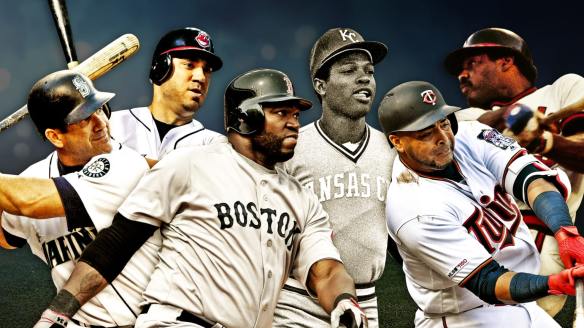
The DH is neither the end of the world nor restricted to the big bombers alone. (Left to right: Hall of Famer Edgar Martinez, Travis Hafner, Hall of Famer David Ortiz, Hal McRae, Nelson Cruz, Don Baylor.)

It’s not that I expected universal acclaim over the coming of the universal designated hitter.  But some of the arguments you see against it continue to jam traffic across the bridge from the merely ridiculous to the patent nonsense. Presented for your consideration, this jewel, from social media: “been coaching baseball for 35+ years the DH has created prima donna pitchers who have no clue how to hit and change the strategy of the game since pitchers don’t have to bat [sic] they have no issue throwing a McRib!”

Translated from the gobbledegook: The writer (I use the term very liberally) thinks pitchers became clueless about hitting only with the original advent of the American League’s designated hitter. He thinks further that only in the DH era have pitchers thought nothing of knocking down or hitting batters. The second is almost not worth the effort or the ink, when you remember that pitchers prior to the DH’s advent thought nothing of knocking down or hitting batters, either. I did say almost.

Suppose I told you there was a decade in which there were 7,923 hit batsmen, an average  792 per season, across the majors? That decade would be 1901-1910. Since the Show then included a mere sixteen teams, it means each team averaged 495 men hit by pitches over the decade and about 50 plunked per season. Let’s look now at the past ten seasons, shall we?

For that decade, there were 16,537 hit batsmen. Seems like a drilling epidemic at first glance, right? But remember that the Show has had thirty teams since just before the turn of the century. Now it looks different. It means an average 264 men per team hit by pitches over the decade and an average 26 a team plunked per season. That tells me that, for assorted reasons, not the least of which might be formal, official crackdowns on throwing at batters, pitchers in our century have a lot more issues against throwing McRibs, Sledge-o-Matic sliders, Conehead curve balls, and faceplant fastballs than pitchers in the pre-designated hitter era did.

As a matter of fact, during Season One B.D.H. (Before Designated Hitter) the American League’s pitchers hit only seven fewer batters than in Season One A.D.H. (Arrival of Designated Hitter.) I’m not entirely convinced you can make a case for that badly heightened a headhunting spree off that. “As the [twentieth] century wore on,” wrote Peter Morris in A Game of Inches: The Story Behind the Innovations That Shaped Baseball, which should be considered half of the game’s Bible (the other half is Baseball Reference, silly), “beanballs became increasingly unacceptable.”

This trend is often attributed to the fatal beaning of Cleveland shortstop Ray Chapman in 1920, and yet this conclusion is difficult to justify. Bill James has noted that hit batsmen declined steadily during the first two decades of the twentieth century, then actually increased briefly after the Chapman tragedy. Totals of hit batsmen again dropped steadily from the mid-1920s until the mid-1940s, then increased dramatically over the next two decades, before beginning to drop in 1968.

The causes of these tendencies are more difficult to determine, because no single reason predominated. Instead, a number of factors contributed, including changing interpretations of the strike zone, new approaches by batters, and the introduction of the batting helmet.

In 1968. Known as well for our purpose here as 4 B.D.H. The 1973 American League averaged 33 hit batsmen per team—seventeen fewer than the eight-team AL average in 1901-1910, and only seven more than the 2012-2021 per team average.

The modern day record for hit batsmen by a pitcher in a single season is 32, held by Chick Fraser of the 1901 Philadelphia Athletics. On the career plunk list, Fraser (219) happens to be numero duo behind Gus Weyhing (277). Only three of the top ten all-time pitched after the dead-ball era, and only one of those (Hall of Famer Randy Johnson) was a power pitcher. The other two (Tim Wakefield, Charlie Hough) were knuckleball pitchers who usually got their plunks without malice aforethought, since the knuckleball isn’t exactly renowned for being simple to command or control.

As for the DH creating prima donna pitchers who have no clue how to hit, well, I hoped I wouldn’t have to repeat that from the end of the dead-ball era’s final decade through the end of last season, pitchers as a class have hit a glandular .162. As a class, pitchers never. could. hit. Unless you think a lineup full of .162 hitters is going to put a lot of runs on the scoreboard, that is. (They might if facing a defense of nine Dick [Dr. Strangeglove] Stuarts only.) Those who could were (and remain) outliers.

But our gobbledegookworm goes further:

Managing with a DH most any idiot can do this put your best [eight] out in the field your best nine up to bat and get your bullpen ready I don’t have to burn players I don’t have to SacBunt, I don’t actually have to play baseball.

Do I really need to say a smart manager doesn’t burn his players? Do I really need to say a smart manager doesn’t waste the most precious resource his team has at the plate, outs to work with? Do I really need to say a smart manager—who does most of his “managing” before the game begins and always has—knows going in that a sacrifice bunt wastes one-third of his outs to work with while leaving him a 50-50 chance or better of a run scoring after a sac bunt in only one out of six known situations in which he might deploy it?

Allow me to share with you the table Keith Law (in his 2017 book Smart Baseball) drew to demonstrate. He examined the six situations: man on first, nobody out; man on first, one out; man on second, nobody out; man on second, one out; first and second, nobody out; and, first and second, one out. Then, he noted the run-scoring likelihood from each situation before the bunt and the run-scoring likelihood from each situation after the bunt.


Situation

Pre-Bunt Probability

(1 run or more)

Post-Bunt Probability

(1 run or more)


Better/Worse Off

On 1st, 0 out 0.499 0.447 Worse
On 1st, 1 out 0.362 0.255 Worse
On 2nd, 0 out 0.656 0.666 Push
On 2nd, 1 out 0.447 0.271 Worse
1st & 2nd, 0 out 0.649 0.695 Better
1st & 2nd, 1 out 0.447 0.264 Worse

Think about that. In four out of six bunt situations you’re worse off for a shot at scoring a run afterward than you would be letting your batter hit away. In only one of them are you better off for scoring a run afterward; in only one of them do you have an even chance of scoring afterward.

Pay attention, class. The foregoing does not mean I want to see the bunt go entirely to the extinction for which we should pray go cancer, COVID, the federal debt, and the ballpoint pen. In fact, if I were a baseball manager, I’d deploy the bunt in the following situations:

If I have the next Brett Butler on my team. That comparatively pint-sized center fielder loved to bunt and hated to waste outs. (George F. Will once called Butler the Human Bunt, in fact.) Butler dropped 337 bunts in his long major league career, and only fifteen percent of them involved sacrifices. You read right: 85 percent of Butler’s bunts were dropped to become base hits. (In 1992, Butler had 171 hits, 42 of which were bunts.)

If I see an infield playing far enough back or chock full of stone hands, and I need a baserunner like two minutes ago with less than a power hitter at the plate. Of course, if I see an infield I know to be chock full of stone hands, I’d wonder whether their general manager was kidnapped and replaced by Mr. Magoo.

If I see the opposition infield positioned in one of those overweighted-to-one-side defensive shifts. And I wouldn’t even care if the other guys’ pitcher has a no-hitter in the making, either. (Let the other guys explain why they thought it was smart to protect their man’s no-hit bid by handing my batter free territory.) Show me all that delicious free real estate to work with on one side of the infield, I’m going to show you my man on first base on the house. I’m even going to blow him to a filet mignon dinner with all the trimmings, if he waits for a pitch on the outside and just bunts or taps it onto that frontier. Because my man’s playing smarter baseball than you, and he won’t be wasting one-third of my inning’s resources playing it.

Just the way my DH won’t be the big bomber alone. The slot can do wonders for bombers who can still bomb but from whom age is robbing their fielding mobility. But I can also use the DH slot to give my regulars a little breather from their defensive toil often enough to have them fresh for a stretch drive. I can use the slot to give valuable plate appearances to those on my bench who aren’t quite yet ready to be regulars but who can swing the bat with authority, anyway.

I can even use the slot to decide whether I’d like the number nine lineup berth to be filled by a second cleanup-type hitter or a second leadoff-type hitter.

But I’ll no longer have to agonise over watching the other guys pitch around my good-enough number eight batter so he can strike my pool noodle-swinging pitcher out ending my inning with a duck or three stranded on the pond. I won’t have to agonise over whether to lift my effective pitcher for a pinch-hitter when he might give me another couple of innings so I don’t have to open my bullpen too soon. And I won’t feel robbed of opportunities for “strategy,” either. I repeat: the smart managers—from John McGraw to Casey Stengel, from Whitey Herzog to Bruce Bochy—deployed about 95 percent of “strategy” before the game actually began.

Baseball’s problems are many enough. Making the DH universal at last, and sending the sacrifice bunt further toward oblivion, won’t be two of them.

The deeper issue at play in the Kay trial

Matt Harvey

Harvey admitting on the witness stand that he did coke as a Met shouldn’t be bigger than Harvey suggesting too many players still feel desperate to return to action despite not being recovered fully from injuries.

The Eric Kay trial—in which the former Angels communications director faces up to twenty years in prison on drug charges if convicted, stemming from the unexpected overdose death of pitcher Tyler Skaggs in 2019—seemed the sleeper of the week. Until it suddenly wasn’t, after sworn testimony from one-time Angels pitcher Matt Harvey.

Harvey, once a star in New York but still trying to rebuild a career compromised less by his once-notorious night life than by the aftermath of thoracic outlet syndrome surgery. Harvey, once the Dark Knight, but since struggling to find any semblance of the form that once made him what his old rotation mate Jacob deGrom has become.

You had to strain yourself, though, to hear anyone discussing what ESPN writer T.J. Quinn  tweeted Tuesday morning from the trial. “[Matt] Harvey is describing culture of MLB,” Quinn wrote, “guys desperate to stay on field and play through injuries.”

That was about as cryptic as a sledgehammer blow. Harvey wasn’t exactly revealing classified information he’d formerly flushed down the nearest precious-metal commode, either.

But for every one who got what Quinn described him saying during his testimony, there were probably a few hundred more interested in Harvey copping to doing coke as a Met and how many Angels were getting and gulping assorted painkillers from Kay directly or by way of others.

Joe and Jane Fan would rather just dump on the druggies than admit a big reason they get their meathooks on assorted painkillers and other naughty pills and powders in the first place is that too many team medical staffs—even today, even with everything we know about sports injuries that wasn’t known or ignored for generations preceding—could still be tried by jury for medical malpractise.

The Twitterpated are more titillated that the former Dark Knight had a few too many off-field nights partying than that he, too, felt all but forced to perform despite his body’s inner warnings. The talk about the “drug culture” on those Angels (and don’t think it doesn’t exist on other teams) seemed to override talk about the pressures placed upon the injured to get back onto the mound or onto the field like yesterday—no matter how fully they’ve recovered from their injuries.

Harvey wasn’t the only one of Skaggs’s teammates looking for pain relief. Pitcher Mike Morin, an Angel from 2014-2017 now with the Marlins, testified he sought Kay’s help after Skaggs mentioned Kay as someone who could provide painkillers like oxycodone to help Morin, too, deal with what turned out thoracic outlet syndrome. Former Angels relief pitcher Cam Bedrosian (now with the Phillies) and first baseman C.J. Cron (now with the Rockies) also said they got painkillers from Kay.

Harvey also copped to giving Skaggs one Percocet. Why? He thought he was doing his teammate in pain a favour and wanted to be a good teammate. That may still be enough to get him suspended under baseball’s drug policy. Now a free agent, after an up-and-down 2021 that ended almost a month early due to a knee injury, Harvey may have a harder time catching on when the current lockout ends.

In case you forgot or didn’t know in the first place, Skaggs himself had an injury history. He underwent Tommy John surgery after returning to the Angels in a trade from Arizona and starting eighteen games in 2014. Missing all 2015 recovering and rehabbing, he subsquently incurred oblique, adductor, and ankle injuries. And it’s not impossible that he was given something powerful enough coming out of TJ surgery to hook him.

When the Texas coroner’s report revealed fentanyl may have caused Skaggs’s accidental overdose death, USA Today columnist Bob Nightengale wrote of him as a young man in pain.

“Perhaps more physical than even the doctors and trainers knew,” he wrote. “Maybe more mental than even any team therapist knew. It will be a bigger tragedy if we never understand why. Prescription painkillers are a scourge in this country, and professional sports—with catastrophic injuries and the expectation to play through the pain they cause—are ripe for potential abuse.”

It’s not just a particular contingent among current players talking these things, on a witness stand or elsewhere. Hall of Famer Pedro Martinez is talking about those pressures, too. His freshly-published memoir, Pedro, includes a portion where Martinez says that, as a Met, then-chief operating officer Jeff Wilpon forced him to pitch despite a toe injury that affected either his push off the rubber or his landing as he threw—in September 2005, despite the Mets being out of the pennant race.

Before Joe and Jane Fan start barking ohhhhhh, he was forced to earn his keep when his itty bitty toesy hurt, they should try to remember Dizzy Dean. That Hall of Fame pitcher once forced himself to alter his delivery to compensate, after suffering a broken toe courtesy of an Earl Averill batted ball in the 1936 All-Star Game. Dean ruined his shoulder with the new motion, turning the second half of his career from Hall of Fame great to nothing special.

Maybe if Dean had been allowed to recover completely from the toe fracture it would have been a different story? “I was unable to pivot my left foot because my toe hurt too much,” the ever-locquacious Dean was quoted as saying, “with the result I was pitchin’ entirely with my arm and puttin’ all the pressure on it and I felt a soreness in the ol’ flipper right away. I shouldn’ta been out there.”

When the 1969 Cubs burned out and faded down the stretch as the Miracle Mets heated up to take the National League East en route their championship series sweep of the Braves and World Series conquest of the Orioles in five games, it turned out that manager Leo Durocher cowed too many of his players into not disclosing injuries for fear he’d denounce them—in the press as well as in clubhouse reamings—as quitters.

Now retired, Jacoby Ellsbury was oft injured even in his Red Sox years . . . and accused of malingering when he tried his best not to return prematurely. After shining in his contract walk-year during the Red Sox’s 2013 World Series conquest, Ellsbury signed big with the Yankees—and ran into the injury bug again.

And again. And again. Knee injuries, concussions, hip injuries, setbacks rehabbing. Joe and Jane Fan wrote him off as a waste of Yankeebucks. Some even called him a quitter, never mind that his injuries came from playing the game as hard as he could with what he had.

Was it Ellsbury’s fault he’d been injuried on the job, in honest competition? Maybe we should wonder that, so far as anyone knows, Ellsbury didn’t seek the kind of extracurricular pain relief others have, clearly enough.

Skaggs’s death at 27 “shines a harsh spotlight on the dark underbelly of playing professional sports,” writes FanSided‘s Gabrielle Starr. “Many players feel forced to go to extremes to be able to compete, and we’re now witnessing the worst possible outcome of that desperation.”

What is it with the Angels’ organisational culture that compelled several players including Skaggs to seek extracurricular pain relief? Were they, too, being pushed beyond reasonable expectation to come back from injuries? Do you really think they’re the only team who’d be guilty of that?

Could those Angels have been pushed unreasonably compared to the team’s Hall of Famer-in-waiting Mike Trout, who’s been injured often enough but was never pressured improperly so far as anyone knows to return before he was healed completely? As in were the Angels’ administrators sending the message Trout himself would never send, that, well, he’s Mike Trout and . . . you’re not?

Don’t dismiss the Kay trial as just another sports drug trial. It’s easy to denounce the druggies. It’s a lot harder to remember that a lot more of them than we might have thought went there not for kicks but for genuine pain relief. It didn’t have to take the death of a still-young major league pitcher, whose death provoked game-wide grief, to mean those issues might finally be addressed with the seriousness they deserve.

Unless you’re diffident or soulless, it makes you stop to ponder that maybe we shouldn’t be too swift to worship the players or teams who “grit” or “gut” or “grind” it out through various injuries of all dimensions. (The 2019 Yankees, the Broken Bombers, using 53 different players and sending thirty to the injured list that season, come to mind as a recent example.)

Maybe, instead, we should question the sanity lost when they push themselves or are pushed to play injured—with the reward now barely worth what might be lost to their futures. Think about that before you denounce the injured as gutless, heartless, useless quitters. Again.

The sounds of silence, ushered in by a lie

MLB lockout

Today was supposed to see pitchers and catchers reporting to start spring training. There went that idea, thanks to the owners and their Pinocchio. (CBS Sports photo.)

Say what you will about the Major League Baseball Players Association, but they haven’t pleaded poverty yet at all, never mind with the thought that they could say it without their noses growing. On the day pitchers and catchers would have reported to spring training but for the owners’ lockout, a five-day old lie by commissioner Rob Manfred still rattles through baseball’s sounds of silence.

George Burns once said of his logically illogical wife Gracie Allen, “All I had to do was ask, ‘Gracie, how’s your brother,’ and she talked for 38 years.” All you have to do is ask a question, and Manfred will talk out of so many corners of his mouth you’ll suspect it resembles a martial arts throwing star, while his nose grows long enough to cross the Verrazano Narrows Bridge.

Last Thursday, as an owners meeting concluded, somebody asked Manfred whether owning a baseball team was a sound investment. All Commissioner Pinocchio had to do was speak what’s not exactly a badly kept secret. He chose to play the poverty card, as the owners often enough have done during baseball labour disputes. This time, however, the joker in the deck isn’t very funny

“If you look at the purchase price of franchises,” Manfred began, citing what he’d been told by investment bankers without identifying just whom, “the cash that’s put in during the period of ownership and then what they’ve sold for, historically, the return on those investments is below what you’d get in the stock market, what you’d expect to get in the stock market, with a lot more risk.”

Hello, darkness, my old friend.

Commissioner Pinocchio knows very well that baseball franchises, even those mired out of the races and even those accused plausibly of tanking, increase in value as investments up to ten percent annually. Yahoo! Sports writer Hannah Keyser wasn’t going to let him get away with that kind of lie.

“Let’s get something out of the way: The owners cried poor during the negotiations to start the pandemic-suspended season in 2020 to justify demands that the players take a pay cut,” Keyser began.

And although the owners have been quieter about it during the current collective bargaining negotiations, the implicit entrenched position is the same — on the broadest scale, they don’t want to make all the economic concessions that the union is asking for and one of the reasons they’re citing is that they can scarcely afford it.

That’s why Manfred said what he did. It’s not that he’s stupid (he’s just hoping you are) or confused. It’s strategic. To concede on the record that the current economic system is working fabulously for owners—and increasingly so in recent years—would be chum to a union that’s angry, energized and determined to push the pendulum in the other direction.

Baseball and other sports teams’ owners, according to ProPublica, whom Keyser cited, and who managed to get IRS records to probe, “frequently report incomes for their teams that are millions below their real-world earnings, according to the tax records, previously leaked team financial records, and interviews with experts.” Tax code provisions and creative amortization use, Keyser noted, “allows owners to negate gains or claim losses, substantially reducing their tax obligations and saving them millions of dollars.”

If you still believe baseball’s owners are really going broke, that Antarctican beach club for sale is now a couple of hundred thousand less expensive. They want to continue playing the poverty card despite it being about as legitimate as Astrogate? Here’s what the players should say in return: nothing. Not one proposal, not one further concession, not even a syllable, until the owners open their books completely, honestly, and without further smoke blowing, sand throwing, or shuck jiving.

It wasn’t the players who elected to strike over the owners’ three-card monte games this time. There wasn’t any legitimate reason for the owners to lock the players out after the CBA expired instead of letting the game carry forth while they sat down to honest negotiations.

Fair play: the players aren’t exactly without dubious issues. Their proposal for a mere twelve-team postseason instead of the owners’ reputed push for a fourteen-team postseason is still an idea whose time should be put out of its misery. The already-expanded postseason has diluted championship meaning and created saturation to the point where the World Series becomes a burden to watch for too many fans, not the penultimate baseball pleasure.

The seeming sounds of silence thus far on Manfred’s shameful insistence that minor league spring campers remain unpaid because the “life skills” they gain is more important than earning their keep is deafening.

So are the continuing sounds of silence on redressing what their late union leader Michael Weiner only began to redress, the now-525 pre-1980, short-career major leaguers denied pensions in the 1980 re-alignment. Weiner plus then-commissioner Bud Selig gained those players $625 per 43 games’ major league roster time, up to $10,000 a year, in 2011.

The bad news further is that they can’t pass those monies on to their families should they pass away before collecting their final such dollars. Nor did they receive any cost-of-living adjustment in the last CBA. No less than Marvin Miller himself subsequently said the 1980 pension freeze-out for them was his biggest regret. Weiner at least began a proper redress.

But when Commissioner Pinocchio and his employers the owners look you in the eye and claim owning a baseball team isn’t profitable, you should be very tempted to demand polygraphs, if not sobriety tests.

“Do you know how else I know Manfred isn’t telling the truth?” Keyser asks, before answering. “Because if he were, he wouldn’t be a very good commissioner. If it was true, he would be failing in his de facto fiduciary duty to the owners. Say what you will about Bud Selig, but under his commissionership, team valuations skyrocketed. He made being a baseball owner into a very lucrative proposition. So Manfred is saying that during his reign, that has ceased to be the case. Or he’s lying.”

Once upon a time, a Brooklyn Dodgers pitcher caught by his wife en flagrante with a woman other than said wife ran down the stairs, pointed upward to where he’d been caught, and said, “It wasn’t me!” It’s not exactly unrealistic to suggest the owners and their wooden puppet are that kind of honest.

Jeremy Giambi, RIP: What broke him?

The Flip

Jeremy Giambi’s brief major league career was defined too powerfully by The Flip, but he was an on-base machine in Oakland until he was traded under dubious circimstances.

Sad enough that Jeremy Giambi was reported dead at 47 two days ago. Sadder still was the Los Angeles County coroner affirming what Giambi’s former Athletics teammate Barry Zito hinted in a text message to San Francisco Chronicle writer Susan Slusser.

Giambi, Zito texted, “was an incredibly loving human being with a very soft heart and it was evident to us as his teammates that he had some deeper battles going on. I hope this can be a wake up call for people out there to not go at it alone and for families and friends to trust their intuition [w]hen they feel somebody close to them needs help. God bless Jeremy and his family in this difficult time.”

At his best, Giambi was an on-base machine with a little power and a preternatural ability to wear pitchers out comparable to his brother, Jason. He wasn’t particularly swift afoot and he was defensively challenged, but in two and a third full seasons in Oakland he posted a .369 on-base percentage, including .391 in 2001, his seond and last full season there.

The bad news was that year’s American League division series and Giambi getting nailed at the plate famously, when the Yankees’ Hall of Fame shortstop Derek Jeter executed The Flip, running down from his cutoff position and across the lower infield, over the foul line, to grab an errant throw toward the plate and back-flip to catcher Jorge Posada to get Giambi a second before his foot hit the plate.

Giambi would have tied the game at one each if he’d scored. Depending upon the angle you see, there are those who argue he might actually have been safe on the play. But the play cemented Jeter’s image as a game-changer and thwarted the A’s from tying the game at one each at minimum. (The Yankees went on to win, 1-0.)

For years to follow Giambi was questioned over going home standing up instead of sliding on the play. (A’s catcher Ramon Hernandez could be seen raising and lowering his hands adjacent to the play, the signal for urging a runner to slide.) Most likely he—and maybe everybody else in the Oakland Coliseum—didn’t see Jeter coming at all, never mind having a prayer of getting him out.

As I write I’ve seen no published indication that the play, the aftermath, and even the questioning affected Giambi in any negative way. The 2001 A’s manager, Art Howe, told Slusser on Wednesday, “I know how hard Jeremy played every single day. I know our fans remember him for that non-slide, but I think it’s a shame anyone even thinks about that. He was a good kid, he was well liked, and he gave me everything.”

A’s GM-turned-president Billy Beane now remembers Giambi as “a fun guy, a good guy, and an underrated player, particularly an underrated hitter. He was quite frankly an important piece of probably the best team we’ve had since I’ve been here, that 2001 team.”

This is now, but that was then, as Michael Lewis recorded in Moneyball: The Art of Winning an Unfair Game: Beane sent three-eighths of his starting lineup “and a passel of pitchers” out of town by 23 May 2002, including Giambi, after Beane became “erratic” in his behaviour and steaming mad with his front office and the team’s coaches following a mid-month sweep by the Blue Jays in Toronto.

Just before the Toronto series the team had been in Boston, where Jeremy Giambi had made the mistake of being spotted by a newspaper reporter at a strip club. Jeremy, it should be said, already had a bit of a reputation. Before spring training he’d been caught with marijuana by the Las Vegas police. Reports from coaches trickled in that Jeremy drank too much on team flights. When the reports from Boston reached Billy Beane, Jeremy ceased to be an on-base machine and efficient offensive weapon. He became a twenty-seven-year-old professional baseball player having too much fun on a losing team. In a silent rage, Billy called around the league to see who would take Jeremy off his hands. He didn’t care what he got in return. Actually, that wasn’t quite true: what he needed in return was something to tell the press. “We traded Jeremy for X because we think X will give us help on defense,” or some such nonsense. The Phillies offered John Mabry. Billy hardly knew who Mabry was.

. . . After he’d done the deal, he told reporters that he traded Jeremy Giambi because he was “concerned he was too one-dimensional” and that John Mabry would supply help on defense. He then leaned on Art Howe to keep Mabry out of the lineup. And Art, occasionally, ignored him. And Mabry started to swat home runs and game-winning hits at a rate he had never before swatted them in his entire professional career. And the Oakland A’s began to win.

The 2002 A’s were 20-25 before the Giambi-for-Mabry trade, including losing fourteen out of their prior seventeen games. Giambi was hardly to blame; at the time of the trade, he was hitting .274 with a .390 on-base percentage and a .471 slugging percentage. Two months after the trade, the A’s stood at 60-46.

Maybe Beane really wanted to send the message that even a .390 on-base percentage was expendable if he was the same fellow in losing as he was in winning.

Maybe Giambi didn’t go into black-band mourning after losses often enough for Beane’s taste. Maybe Beane didn’t grok that it doesn’t always do any favours to insist you must sink into a vale of tears following a loss. Maybe he forgot it’s often best to just shake off the loss because you get to play another day, another season, after all.

“Everyone,” Lewis noted, called Beane a genius for seeing Mabry’s heretofore hidden abilities, never mind that the deal was anything but comparable to a lab experiment: “It felt more as if the scientist, infuriated that the results of his careful experiment weren’t coming out as they were meant to, waded into his lab and began busting test tubes.”

Giambi with the 2002 Phillies hit a mere .244 but posted a .435 on-base percentage and—with twelve homers and ten doubles among his 38 hits—a .538 slugging percentage. Mabry’s line with the 2002 A’s: .275/.322/.523, with eleven home runs and thirteen doubles among his 53 hits. But Mabry went 0-for-2 in the 2002 postseason while Giambi and the Phillies didn’t quite make it there.

Both men moved on after that season, the Phillies trading Giambi to the Red Sox and Mabry signing with the Mariners as a free agent. Giambi incurred injuries and was finished as a major leaguer after 2003. He was the first incumbent or former major leaguer to cop to using actual/alleged performance-enhancing substances, but 52 homers in six major league seasons (17 per 162 games, average) doesn’t exactly make a case for their doing him any favours.

(That Vegas pot bust—at a McCarran Airport checkpoint while he was traveling to Phoenix —ended up a big nothingburger: Giambi’s pot was confiscated, he was issued a simple citation, and released to continue his travel.)

Who knows whether some heretofore undetected combination of criticism over The Flip and the true reason behind his trade out of Oakland didn’t start puncturing part of the younger Giambi’s psyche?

The former’s easily discarded; Giambi wasn’t the 2001 division series goat, and Jeter was a division series hero coming from nowhere to make an unlikely play. Giambi said in a 2020 interview that “maybe I should have slid” but he didn’t necessarily commit to that thought even two decades later.

Those are things we can’t analyze. Obviously, I think about it. I don’t dwell on it, but I think about it. I think that’s part of our competitive nature. I mean, we were going to win a World Series. I know that was the first round, but we always felt like we had to go through the Yankees, and if you got through the Yankees, you had a pretty good chance, at that time. They were the team to beat.

The trade issue may or not be discarded or defined so easily just yet.

Who knows, either, whether it was too difficult not being able to post anything close to his older brother’s major league numbers and compensation? (Tainted or not, Jason Giambi per 162 games hit almost twice as many homers, and finished his career with 388 more home runs and $130 million more career earnings.)

We don’t, yet. Nor do we know what in his post baseball life piled onto the issues his former teammate Barry Zito—himself a haunted man as a pitcher in both grand success and bewildering failure—referenced.

For now, we know only that an apparently likeable, fun-loving fellow with an apparent heart of gold saw fit to end his life with a gunshot into his chest. Whatever drove Jeremy Giambi to end his life, may the Lord have mercy upon his apparently haunted soul and grant him peace.