Unknown's avatar

About Jeff Kallman

Member, Internet Baseball Writers Association of America and the Society for American Baseball Research.

Hey, Joe, where you goin’ with your head in your hands?

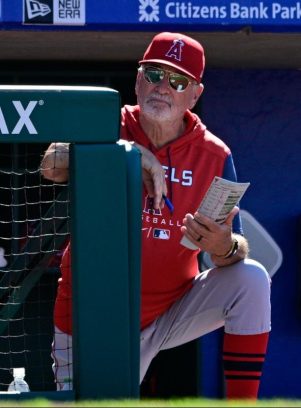
Joe Maddon

The Angels’ lack of true depth wasn’t Maddon’s fault, but . . .

Let’s see. The Phillies dumped manager Joe Girardi last Friday morning. They went on a prompt five-game winning streak under interim Rob Thomson that began with three straight against the Angels. The Angels went from there to a 1-0 loss against the resurgent (we think) Red Sox and padded their losing streak to twelve.

It meant the Angels becoming the first team in Show history to go from ten games above .500 at 27-17 to a twelve-game losing streak. It also meant manager Joe Maddon, in the final year of a three-year deal, didn’t live long enough to finish the third year beyond which the Angels hadn’t even begun talking extension or new deal.

That’s what two straight sub-.500 season finishes plus the incumbent morass does even to a three-time Manager of the Year. The Angels executed Maddon Tuesday. Third base coach Phil Nevin, formerly a twelve-year corner infielder who spent one season as an Angel before becoming a longtime coach, was handed the job on an interim basis.

“Maddon appeared to have few answers” to the Angels’ sudden twelve-game cratering after such a staggering season’s start, writes The Athletic‘s Andy McCullough.

He praised the effort of his group, though his praise grew fainter in the wake of so many defeats. Maddon never found the footing he held in prior stops in Tampa Bay and Chicago. He was hailed as a pioneer with the Rays and adored for ending a curse with the Cubs. With the Angels, though, he was just another ineffective skipper unable to get a team with Mike Trout and Shohei Ohtani into the postseason. It wasn’t really his fault; the team lacked pitching depth and has been hurt by injuries. Even so, he wasn’t able to stop the skid, so the team stopped relying on him. It might not make a difference. It still shouldn’t come as a shock.

Once serving long-term as Mike Scioscia’s bench coach with the Angels, Maddon says he’d like to manage again. He won’t lack for those taking a deep look at the Angels and concluding he’s become the sacrificial lamb for a continuing failure above and beyond even still-freshman general manager Perry Minasian. Another Athletic writer, Marc Carig, has isolated the point:

Stop me if you’ve heard this before: what about the owner’s role in all of this? Arte Moreno has spent a ton of money on the big league roster in an effort to make his team a contender. That’s awesome. It’s what all of the owners should be doing. But Moreno has yet to find the right formula for building a winning culture . . . Front office turnover and, now, the firing of manager Joe Maddon shows that Moreno doesn’t seem to be any closer to building a sustainable winner. All managers know that being fired is part of the deal. This remains true even though skippers no longer occupy the same lofty perches that they once did within organizations. In this case, the Angels dismissed a manager with a World Series championship on his résumé in addition to a lengthy history with the organization. But all that experience wasn’t going to negate a dearth of arms and a banged up roster. Those issues could have only been overcome with depth, and that kind of thing falls outside of a modern manager’s purview.

There may also have been an increasing sense that Maddon was prone humanly enough to egregious mistakes but bent over in prayer at once hoping his players would bail him out. He got away with it the day he walked Corey Seager of the Rangers with the bases loaded and the Angels down; his Angels overcame a wider deficit to win at the eleventh hour. He still looked foolish for doing so.

More than all that: Maddon may have written his own execution order before last winter’s owners’ lockout ended, according to ESPN’s Buster Olney: The Angels’ administration had an idea on how to keep Trout healthier, and Maddon—whether inadvertently or carelessly—killed the idea in the proverbial crib.

The Angels wanted to talk Trout into moving from his longtime center field roost to one of the less-demanding corner outfield positions. They planned to talk to him about it once the lockout ended. The idea made sense. Trout’s past three seasons have been injury marred or injury-ended, and though he’s been a better than plus defender in center field (55 defensive runs above his league average) in his twelve-season career, those injuries have taken their toll. He’s also played 124 games in left field during his career and he’s been worth seven defensive run above league average for them.

The bad news, Olney writes: “Maddon changed the trajectory—telling reporters about it before anyone in the organization said anything to Trout. When Trout balked at the suggestion—he learned about it on Twitter, he said—that possibility was scrapped for 2022 out of respect for Trout, a future Hall of Famer.” If Trout heard it from the team first, the story might be different.

Did the Angels—who already declined to talk contract extension with Maddon—decide the manager simply couldn’t be trusted any longer to know how to mind his players’ health? Did they decide he couldn’t be trusted to keep certain key decisions from leaking before they’d had the chance to present them to the affected parties? Did they decide both? Will it mean Maddon may not get another chance to manage again too soon?

The injuries weren’t Maddon’s doing, of course. Neither was the lack of pitching depth, the Angels’ most constant and wounding flaw for just about as long as Trout’s been an Angel. But if the organisation came to see Maddon as even a tiny degree untrustworthy coming into the season, seeing him looking lost for ways to help the team snap that losing streak probably sealed the un-deal.

Nevin was the Yankees’ third base coach until after last fall’s American League wild card game. He took an inferno of heat for sending Aaron Judge on his way home, trying to score a tying run all the way from first on a ball that banged off the top of Boston’s Green Monster. Nevin misjudged a strong throw in to Red Sox cutoff man Xander Bogaerts, who fired a strike home so perfectly the diving Judge was out by two feet.

The Yankees ended up going home for the winter very early. Nevin ended up with a pink slip and a not too slow hiring to do the same job for the Angels. Now’s he’s the manager. Minasian says Nevin will hold the bridge for the rest of the season.

Tuesday night, Nevin watched his new Angels charges take a game to the tenth inning after blowing lead in the seventh inning or later for the sixth time during their now thirteen-game losing streak, a franchise record.

Trout continued coming out of his horrid slump and opened the night’s proceedings with a first-inning, two-run homer, but then had to leave with left groin tightness after he doubled in the third. The morning after, Trout said he felt something like a cramp leaving the batter’s box on the double but “a little achy” when he pulled up to second.

He came out for pinch runner Jo Adell, who came home on Max Stassi’s ground rule double to snap an early three-all tie, then doubled Luis Rengifo home to make it 5-3, Angels in the fifth. But the Red Sox made it 5-4 with a sixth-inning RBI single and tied it with an RBI infield hit—Trevor Story’s grounder bounding off Angel reliever Ryan Tepera’s glove—in the seventh. Making the sixth time in a now thirteen-game losing streak that the Angels let a lead disappear in the seventh or after.

Christian Vásquez sent what proved the winning run home when he drove tenth-inning-opening free cookie-on-second runner Story home with a single through the hole at second, and the Angels had nothing to say in the bottom of the tenth against Red Sox reliever Matt Strahm.

Trout and Shohei Ohtani said the morning after it was up to the players to re-horse themselves. Nevin said after the 6-5 loss that whatever else went wrong for the Angels during the franchise-record losing streak, morale wasn’t part of it. “I’m not worried about morale at all,” the new skipper told reporters. “You saw the effort from everyone. We had good at-bats. I thought there was a lot of great things. It was just a game where we ended up on the wrong side.”

From 27-17 after beating the Rangers on 24 May to 27-30 as of Wednesday morning, the Angels can’t afford to continue staying on the wrong side. It’s helped cost them one skipper this season already.
The Phillies throw out the first manager

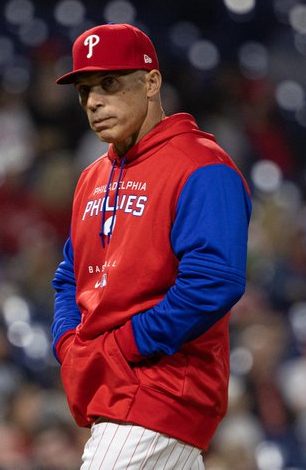
Joe Girardi

Girardi’s Philadelphia nightmare ends with his execution Friday morning.

Stop me if you’ve heard this one before: A front office builds a team with money no object and no other cohesive object in mind. They front-load the team with sluggers, leaving little room for defensive fortification, overtaxing a fine starting rotation, and discover they can’t out-slug the wasted defensive outs or the bullpen’s arson.

All of which leaves their third-year manager half lost for finding ways to prevent late-inning collapses, early-inning slaughters, and solving the riddle of how he could have been handed what amounts to a desperation roster built with no forward thinking and not even a nod toward replenishing the farm or delivering mid-season fortification.

Then, seeing that uncohesive, porous mess deliver a 22-29 season-opening record, they reach into their heart of hearts, pray hard, and decide it’s time answer all the last fortnight’s speculation and throw out the first manager of the season.

Ladies and gentlemen, your 2022 Phillies. Sitting twelve games behind the division-leading Mets in the National League East. Unlikely to improve even to a shot at one of the NL’s wild cards unless their fielders patch up the holes in their gloves and their defensive routes and their bullpen discovers more than just bull.

For openers. It’s not that Joe Girardi is any sort of managerial genius. He’s been a fairly overrated manager in his entire skippering career. But this one’s on that front office, led by Dave Dombrowski, an executive with a too-well-known tendency to sacrifice a future for a today that doesn’t always strike platinum. Not to mention the classic mealymouthed style of explaining why Girardi should have become the sacrificial lamb.

It has been a frustrating season for us up until this point, as we feel that our club has not played up to its capabilities. While all of us share the responsibility for the shortcomings, I felt that a change was needed and that a new voice in the clubhouse would give us the best chance to turn things around. I believe we have a talented group that can get back on track, and I am confident that [interim manager] Rob [Thomson], with his experience and familiarity with our club, is the right man to lead us going forward.

Translation: We still thought this team could slug more than enough to out-fly fielders who might as well be scrubwomen wearing oven mitts and save the asses of relief pitchers who forget to check the gasoline cans at the gates. And if you think we’re going to execute the people responsible for building that mess in the first place, you don’t know us vewwy well, do you?

Except that four of the Phillies’s sluggers (Nick Castellanos, Rhys Hoskins, J.T. Realmuto, and Kyle Schwarber) haven’t been slugging quite to the extent they were expected to slug, even if three of them dialed long distance during that ten-inning fall to the Giants last Monday.

The slugger who’s been hitting like the defending MVP he is and who just so happens to be their best defender, Bryce Harper, has a torn UCL in his throwing elbow that’s limited him to a DH role for long enough now. He’s been around the league average in right field when he played before the injury; he’s posting a .943 OPS/.166 OPS+ so far that are not too far under the numbers (1.044/181) with which he led the entire Show last year.

The Phillies have achieved the surrealistic feat of outscoring their opposition yet awakening this morning seven games below .500. The big reasons, as ESPN’s Bradford Doolittle reminds us, are a 4-10 record in one-run games and a fourth-highest-in-Show fourteen losses in games during which they held a lead at one or another point.

“Measures such as these are never wholly on the manager,” Doolittle writes, “but they are certainly not data points in his favor. The best embodiment of Girardi’s struggles is probably an early-May loss to the Mets in which Philadelphia blew a 7-1 lead it carried into the ninth inning. It sure seems the heat under his seat kept rising after that game.”

The Phillies also continued leaning upon Corey Knebel to close out games—but why? He spent May picking up four nebulous saves and earning very nebulous credit for one win during which he surrendered the game-tying run in the top of the ninth and was bailed out in the bottom by a two-run infield error.

Meanwhile, Seranthony Domínguez has been an assassin out of the pen through today: he has a 1.83 ERA and a 1.92 fielding-independent pitching rate in 19.2 innings’ work thus far. Knebel: 3.27 ERA/4.01 FIP. You tell me who should be getting the work when the games are squarely on the line—and screw the “save situations,” the real moments when a game needs saving aren’t limited to the ninth inning.

So maybe continuing to assign “roles” to his dubious-enough pen instead of training his eyes upon the best of the group falls on Girardi. He’s hardly the only manager who might still believe in “roles” instead of what the game moment and the records as they are tell him. Maybe his long-time associate Thomson will pay closer attention and move accordingly, even with the continuing dubious straitjacket of the three-batter minimum for relievers.

But everyone with eyes to see looked upon the stockpile of designated hitter-types Dombrowski and company assembled when the lockout ended and that hurry-up spring training began and said, with no sarcasm intended, just what Jayson Stark asked aloud in The Athletic: “Can a team as defensively challenged as the Phillies win anything?”

In one way Dombrowski did work with a hand tied behind his back. Last winter’s free agency market—rudely interrupted by the ridiculous owners’ lockout—offered him little enough chance to fix a dead-last defense (the 2021 Phillies were the Show’s worst for defensive runs saved) at all, never mind in one grand sweep. But there remains the sense that he didn’t have to go all the way the wrong way.

Fair play: There have been teams who could and did hit their way to even the World Series despite having defenses helpless even against a division of babies in carriages. Just ask the 2015 Mets, whose porous defense enabled them to lose a World Series in five games despite taking leads into the ninth inning in three of their four losses.

Maybe these Phillies have done their notoriously negative-think fan base a big favour. (Remember the Philadelphia wedding. Clergyman to the happy couple: I now pronounce you husband and wife. Clergyman to the gathering: You may now boo the bride.) Not by firing Girardi but by collapsing early and often under the weight of their slug-now/defend later construction. They’re not likely to make the postseason even as an outside entrant in the expanded wild card picture. They won’t be able to break the hearts the 2015 Mets broke.

But Girardi isn’t exactly innocent. Another Athletic writer, Britt Ghiroli, isolates the point. Again, stop me if you’ve heard this before, as in when his days managing the Yankees came to a halt, but make note of where Ghiroli places the core responsibility:

Two things seem to have sunk Girardi: recent bullpen-management moves that came under fire and players telling The Philadelphia Inquirer that it didn’t look like they were having any fun on the field. (They aren’t very fun to watch on the couch, either.) Girardi is known as a no-nonsense guy, and although clubhouse culture can be overrated, once players start mentioning it, it almost always spells doom for the manager. This is still a mess Dombrowski created, a defense far worse than anyone envisioned and a bullpen problem that just never seems to go away. Firing Girardi doesn’t make the Phillies a playoff team, or even a competitive unit. But it does quell the masses, at least temporarily.

The only thing missing now is Dombrowski saying, “I didn’t fire Joe. The players did.” The questions now include just how long before the Phillies’s administration gets what previous team regimes finally got and sends Dombrowski on his not-so-merry way, too, in favour of a builder whose materials aren’t limited to collapsible shelves.

Guest column: Gladstone—Pension shock for Shockley

Costen Shockley

Costen Shockley as a Phillie. After his trade to the Angels for 1965, he left baseball rather than return to the minors, fearing for his family’s discomfort.

By Douglas J. Gladstone

If you grew up rooting for the 1964 Philadelphia Phillies—and even if you didn’t, you’ve probably heard or read about the team because, by now, the story of that squad’s heartbreaking collapse over the last week of the season is etched in history—you probably remember Costen Shockley.

To countless Delawareans, Shockley was a legend. Not because he was one of the “Whiz Kids,” and not because he was all that great a player, but because he valued family first: he quit the game after being traded to the West Coast* so he wouldn’t have to abandon his wife and small child. He found jobs in construction and, by all accounts, never looked back or regretted his decision to place his family ahead of his career.

In a Society of American Baseball Research publication entitled The Year of Blue Show: The 1964 Philadelphia Phillies, the love Shockley had for his family was clearly in evidence. Authorr Mel Marmer quotes Shockley as having said the following:

In June (1965), when I approached (manager) Bill Rigney and asked if I was going to stay with the Angels, he said yes. So I moved my wife and baby out to California (from Delaware). Then (on June 12) they asked me to go to the minors instead, to Seattle. I wasn’t going to have my wife drive to Seattle. She didn’t know anything about the city. I never really adjusted to the big-league atmosphere. I wasn’t making any money then, only $1,000 a month. It cost me $600 to rent an apartment; I was using up my bonus money ($50,000); the major league minimum was only $6,000. . . So, I quit. I took my family over baseball. Do I think I could have played in the big leagues? Sure, I think I would have done well.

A resident of Georgetown, Shockley, who died on May 30, had his priorities straight.  Too bad neither Major League Baseball nor the union representing current players, the Major League Baseball Players’ Association, do.

See, Shockley was one of the ever dwindling group of retired men not receiving an MLB pension. As of this writing, there are only 511 left.

All these retirees don’t receive a traditional pension for having played the game they loved because the rules for receiving MLB pensions changed over the 1980 Memorial Day Weekend. None of these men accrued four years of service credit, which was what ballplayers who played between 1947–1979 needed to be eligible for a pension.

Instead, effective this past March, for every 43 game days of service a pre-1980 player accrued on an active MLB roster, all he receives is a yearly payment of up to $11,500.  That’s $718.75 for every 43 game days. By the way, that payment went up a whopping 15 percent. It used to be $625 for every 43 games on an active roster.

But now that he’s dead, Shockley’s loved ones won’t even get the $2,872 for his approximately four months of service; and that’s before taxes are taken out. Because if you’re a non-vested, pre-1980 player, the bone the league and union are throwing you cannot be passed on to a surviving spouse or designated beneficiary.

In rejecting the $300 million deal his former club, the Washington Nationals, offered him before signing with Philadelphia, current National League Most Valuable Player Bryce Harper famously rationalized that he didn’t want $100 million deferred on the back end of his contract. “What does that do for me?,” he asked. “What does that do for my family?”

Family means different things to different people, I suppose. The Pittsburgh Pirates embraced the concept of family when the team won the World Series in 1979. That is why MLB and MLBPA—Costen Shockley’s baseball family—need to do right by the remaining non-vested retirees now. Before it’s too late.

Douglas J. Gladstone is the author of A Bitter Cup of Coffee; How MLB & The Players Association Threw 874 Retirees a Curve.

* On 3 December 1964, Shockley was traded with pitcher Rudy May to the California Angels for notorious pitcher-playboy Bo Belinsky. May went on to enjoy a fine sixteen-season career for four major league teams, including the Yankees’ 1981 pennant winner.

Short-career pre-1980 players to whom I have spoken have attested that one reason for their freeze-out is that they were seen mostly as September call-ups. For the record, Shockley played his first major league game for the Phillies in July 1964; and, he made the Angels out of spring training 1965, playing in forty games before electing to leave baseball rather than go to the minors for his family’s sake.—JK.

If we must retire one more Yankee number . . .

Gil McDougald

Gil McDougald, the infield jack-of-all-trades for the 1950s Yankees. If we must have yet another retired Yankee uniform number, let it be his. 

My rejoinder to Dr. Paul Semendinger’s argument to co-retire Yankee uniform number 9 in honour of Hank Bauer (it’s already retired for Roger Maris) provoked a pleasant enough debate, when Dr. S. republished it on his Yankee blog Start Spreading the News a couple of days ago. Well, it was pleasant until some comments.

Nobody attacked me, but some of the arguments addressing retired Yankee uniform numbers went from the ridiculous to the more ridiculous. Now there came calls from one or another place to think about retiring the numbers of such Yankee ghosts as Spud Chandler, Tommy Henrich, Graig Nettles, Willie Randolph, and Roy White.

Let’s just say for openers that the Yankees have so damn many retired uniform numbers that they’ve made the honour almost meaningless. I’ll say it again: Be not surprised if you live long enough to see the middle of this century featuring all active Yankees wearing triple digits on their backs.

But let’s say, too, that in the cases of Chandler and Henrich, there’s more than one number to ponder. Presumably, Chandler’s likeliest target for uniform retirement would be 21, which he wore for the bulk of his Yankee career. Oops. Paul O’Neill’s getting the honour of number 21 retired.

Henrich wore four numbers in his career. Of those, he wore 7 from 1939-42, when he went into World War II service; and, 15 from 1946 until his retirement after the 1950 season. Ol’ Reliable’s 7 was taken in due course by Mickey Mantle. And 15 is retired already—for Thurman Munson. Whoops.

Semendinger has no apparent issue with co-retiring uniform numbers as it is. He thinks (erroneously) that there’s nothing wrong with declaring 9 co-retired between Maris and Bauer, not to mention Nettles who wore it as a Yankee. I’ll answer that again soon, promise. But I’d like to see him come right out and argue that Chandler ought to be part of O’Neill’s number retirement or, even better, that Mantle should share 7’s retirement with Henrich or Munson should share 15 likewise.

Not even the most casual of the casual among Yankee fans would stand for that without a rip-roaring fight. (Or would they?)

Chandler was a tough righthanded pitcher for three Yankee World Series winners (1941, 1943, 1947). Much of his reputation rests on a fluke 1943, when he posted both the lowest ERA (1.64) and fielding-independent pitching rate (FIP: 2.54) of his major league career. Credited with a league-leading 20 pitching wins, Chandler was named the American League’s Most Valuable Player even though the award probably should have gone to Cleveland’s Hall of Fame shortstop Lou Boudreau. (Boudreau: 8.1 wins above replacement-level, leading the league; Chandler: 7.3.)

Why call Chandler’s 1943 a fluke? Easy: 1) Baseball was already depleted of enough prime talent by World War II. (The Yankees themselves lost Henrich, Joe DiMaggio, Phil Rizzuto, and Red Ruffing, not to mention a catching prospect named Yogi Berra.) 2) His ’43 ERA was 1.20 below his career mark. 3) His ’43 FIP was 75 points under his career mark. He did get a late major league career start thanks to several minor-league injuries, and the injury bug also kept him out of a few World Series pre-1941.

Chandler himself was pulled into the Army after the ’43 Series, though his injury history kept him from combat. He returned near the end of the 1945 season, posted two more solid seasons in 1946 and 47, but age and injuries compelled the Yankees to release him at 39 in April 1948.

He was a good pitcher who was probably held back by his minor league injuries in the 1930s (he didn’t throw a major league pitch until he was 29) and a few more injuries as a Yankee, where he was respected for a toughness that sometimes bordered on recklessness. But if you’re even thinking about retiring or co-retiring the uniform number of the 377th starting pitcher of all time, who isn’t even one of the ten best Yankee pitchers ever, you should quell that thought post-haste.

Henrich was a terrific player whose travel over the top of the mountain toward his decline phase was rudely interrupted by World War II—Ol’ Reliable lost three seasons to the war. He was one of the solid men when he returned, too; somehow, he remained much the same player after the war as he’d been before it.

As a matter of fact, my Real Batting Average places Henrich (.558) just behind Paul O’Neill (.565 as a Yankee) and way ahead of Hank Bauer (.500), while the defensive metrics show Henrich pretty much a match for both those men, whom Dr. Semendinger think deserve equal uniform retirement. Well, now. Henrich is ranked as the 58th best right fielder ever; Bauer, the 88th best. Case closed.

But you’re not even going to think about compelling Munson or Mantle to share a uniform retirement even with Henrich. You’re not going to compel a shared uniform retirement between the second-best catcher in Yankee history, the arguable greatest all-around player ever to wear the Yankee uniform, and the guy who isn’t quite one of the Yankees’ top ten right fielders. Not unless you require psychiatric evaluation.

Think of Monument Park as the Yankees’ team Hall of Fame. That’s where you honour the Chandlers, the Henriches, the Bauers. Strike their Monument Park plaques. (While we’re at it, do likewise for Nettles and White; Randolph already has his plaque there.) That’s it. They don’t quite deserve uniform number retirements.

Co-retired numbers are also unwarranted insults. Yogi Berra didn’t deserve to be co-retired with Bill Dickey; Berra was ten times the catcher Dickey was and he’s a hair’s breadth ahead of Johnny Bench as the greatest all-around catcher who ever strapped it on. And Roger Maris was insulted without warrant more than enough in his Yankee career without handing him one more by compelling him to share retired number 9, even with Hank Bauer.

You want to think about a Yankee uniform retirement that a) hasn’t been done yet (believe it or not) and b) would do honour to a truly underrated Yankee great? I’ll give you one. Number 12. It’s the only number Gil McDougald wore in his entire Yankee life. Of all the not-quite-Hall of Famers to play for Hall of Fame manager Casey Stengel under his platoon-and-multiples system, McDougald was the best of the group.

He was a fair hitter (he led the league with nine triples in 1957) and a 1951 American League Rookie of the Year. (Even though Minnie Miñoso really deserved the award.) But he was a defensive virtuoso at the three toughest infield positions, finishing his career in double figures on the positive side for defensive runs above his league average at all three. (Second base: +46. Shortstop: +16. Third base: +13.)

Maybe McDougald gets short shrift even among Yankee fans because he wasn’t exactly one of the most glittering Yankees of his time. Maybe, too, he gets such short shrift because of Cleveland pitching legend Herb Score.

You know, the line drive McDougald cracked off Score’s face in 1957 that people to this day believe ruined the Cleveland lefthander’s career. False. Score returned in 1958, had a shaky season’s start before he began to find his proper form again . . . then blew his left elbow out pitching eight innings on a damp night. That, and not the McDougald liner, ultimately put paid to Score’s effectiveness and, soon enough, his pitching career.

McDougald tried to visit Score in the hospital but was blocked by hospital personnel. Yet Score’s sister disclosed decades later that their mother told her, “It’s bad, but he’s got the finest doctors in the world and they will do everything that they can. You need to go down to the church and say your prayers for Herb, but more than that to pray for Gil McDougald. That man is a hurting man.”

Indeed. McDougald wouldn’t quite be the same player after the Score incident, even though Score’s mother herself reached out to him as her son did to tell him the injury was nobody’s “fault.” (McDougald in gratitude visited the older woman regularly for the rest of her life as well as swapping holiday cards with Score himself.) The Yankees left him open to the American League’s first expansion draft but he elected to retire, instead.

“The way that Stengel used him,” Bill James has written of him (in The New Historical Baseball Abstract), “kept him from becoming a star . . . But then, Gil McDougald wasn’t born to be a star. He was born to be a Yankee.”

The sad irony is that McDougald suffered an almost Score-like injury in spring training two years earlier, when a batting practise line drive caught him behind his ear while he was chatting with coach Frank Crosetti. The ball fractured a hearing tube; in his baseball retirement, successful with a dry cleaning business and a building maintenance business, as well as coaching Fordham University baseball, McDougald went completely deaf by the mid-1970s.

New York Times writer Ira Berkow told the story in “McDougald, Once a Quiet Yankee Star, Now Lives in a Quiet World” in 1994. Not long after, McDougald received a cochlear implant that restored his hearing. (“They’ve turned the music back on,” he said happily.) Both Berkow’s original story and the happy followup (“For McDougald, the Miracle of Sound”) were republished in 2009’s Summers in the Bronx: Attila the Hun and Other Yankee Stories.

McDougald got to live another fifteen years with his restored hearing until his death at 82 in 2010. Like too many honours it should have been done while he was still alive to appreciate and accept. But if there’s one more Yankee who really does deserve his uniform number retired, McDougald does.

On Kapler, the Anthem, and the atrocity that provoked him

Gabe Kapler

Kapler’s intended National Anthem protest hasn’t provoked a flood of outrage—yet.

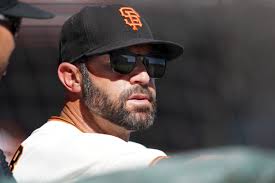
This time, a funny thing happened after Giants manager Gabe Kapler said the atrocity in Uvalde, Texas moves him to stay in the clubhouse until “The Star Spangled Banner” finishes playing before games, because he’s “not okay with the present state of the country.” The funny thing that happened was . . . nothing.

No flood of outrage. No choking social media to death with demands for Kapler’s termination, if not execution. No threatened boycotts of Giants games. No politicians from the top down demanding Kapler be run out of a job, run out of town, run out of the country. No mass demonstrations around AT&T Park. No thunderous editorials calling for a Giants organisational shakeup.

This time, the country seems very much united across all lines of race, ethnicity, and even political belief in outrage that nineteen Uvalde police officers were in or around the Robb Elementary School building and did nothing to thwart the eighteen-year-old shooter who killed nineteen young children, a pair of teachers, and whose murders may have caused the fatal heart attack of the husband of one of those slain teachers.

The outrage deepens when learning as we have that those Uvalde police even tried thwarting efforts by the adjacent Border Patrol and federal marshals to stop the massacre. “As sickening as it is,” writes Reason‘s Robby Soave, “this is worth repeating: With the children wounded, bleeding, dying, and frantically–quietly–calling [9-1-1 on cell phones] for help, the police stood by, waiting for even more assistance. They told the Border Patrol to hold off, and they actively restrained parents outside the school who begged them to help and even volunteered to do so themselves.”

“Second Amendment supporters often counter, ‘The only thing that stops a bad guy with a gun is a good guy with a gun.’ Except the hallway of Robb Elementary School had no shortage of good guys with guns, and yet they did not stop the massacre until it was far too late,” fumes an editorial by National Review, a publication not known to suffer criticism of law enforcement without a fight. “Perhaps that slogan should be revised, ‘The only thing that stops a bad guy with a gun is a good guy with a gun and the willingness to act.’ No Uvalde cops acted when it could have made a difference.”

From the atrocity of George Floyd’s murder at the hands of Minnesota police to the atrocity of Salvador Ramos at Robb Elementary, Kapler—one of baseball’s most articulate and genuinely sensitive managers—looked upon the state of these United States and discovered he simply couldn’t partake of a dubious pre-game ritual because Uvalde slams an exclamation point down upon a country in self-inflicted peril.

“When I was the same age as the children in Uvalde,” wrote Kapler in a blog entry last Friday, “my father taught me to stand for the pledge of allegiance when I believed my country was representing its people well or to protest and stay seated when it wasn’t. I don’t believe it is representing us well right now.”

About the only truly pronounced demurral Kapler incurred came from Hall of Fame manager Tony La Russa, who came out of retirement to take the White Sox bridge last year. “I think he’s exactly right to be concerned . . . with what’s happening in our country,” La Russa told reporters before a game against the Cubs. “He’s right there. Where I disagree is the flag and the anthem are not appropriate places to try to voice your objections.”

Apparently, La Russa forgot the anthem’s line about “the land of the free and the home of the brave.” The brave were thwarted actively and incompetently at Robb Elementary, the only people Ramos set free were nineteen children and two adults from their earthly lives, and those Uvalde, Texas pays to be brave in the presence of evil—to put it in the absolute most polite language available—didn’t exactly do what they’re paid to do last Tuesday.

We can debate La Russa’s demurral and Kapler’s quiet outrage all day long. La Russa thinks Kapler’s intended protest disrespects the men and women of the military who defend what the flag and anthem purport to mean. I fear La Russa dismisses the prospect that those very men and women would think, appropriately, that they didn’t put their hides on the line to defend either police becoming criminals or police doing nothing to prevent mass murder while blocking others from trying to prevent it or while allowing it to continue inexplicably.

Some of Kapler’s fellow skippers get it. “[He] is very passionate about things he believes in and that’s his way of protesting,” says his downstate rival, Dodgers manager Dave Roberts. “I don’t think any of us are happy with what’s going on in our country. I do respect people using whatever platforms they have to address that.”

Alex Cora, who played with Kapler on the 2005-06 Red Sox and now manages the Red Sox, gets it, too. “He’s a good friend of mine and the kind of guy I respect from afar for what he’s doing,” Cora says, “and if this is what he’s doing, good for him. I understand his reasons. He was very open about it and I know there’s a lot of people that are going to support him.”

One of those people is also Chris Woodward, the manager of the Rangers. “I think we’re all frustrated, especially in this country,” he says. “Nobody’s happy. It’s not about which side you’re on. It’s just we’ve got to get better as a society . . . I’m not going to really make comment either way on whether I would or wouldn’t do what he did.”

Kapler made a Memorial Day exception to his intended protest before today’s game against the Phillies. “While I believe strongly in the right to protest and the importance of doing so,” he said, “I also believe strongly in honoring and mourning our country’s service men and women who fought and died for that right. Those who serve in our military, and especially those who have paid the ultimate price for our rights and freedoms, deserve that acknowledgment and respect, and I am honored to stand on the line today to show mine.”

Maybe now it’s time to revisit an argument I made a few years ago: It’s time at last to re-think “The Star Spangled Banner” before sporting events.

What began as a spontaneous show of respect by a Red Sox third baseman, as a Navy band played “The Star Spangled Banner” during the seventh-inning stretch of a 1918 World Series game, has become at once a ritual of habit and—since the NFL’s Colin Kaepernick over police brutality in 2016—a flash point whenever professional athletes seize upon its playing to protest quietly, usually by kneeling, over assorted outrages.

The song wasn’t even the sanctioned National Anthem when Fred Thomas (on leave from the Navy to play in the 1918 Series) turned and saluted the flag. That didn’t happen until the 1930s. But the song’s playing before every last sporting event regardless of day, evening, or calendar significance, renders it meaningless except as pressuring crowds into a patriotic gesture.

I’ve suggested it before, but it’s worth repeating yet again: An everyday anthem during baseball season means nothing but false patriotism, compulsory patriotism, the sort of patriotism you see in countries unworthy of it but likely to execute those who say or behave so.

Faithful readers (all three of you) may remember my saying this in prior writings on the matter: I don’t write lightly about this. I’m the paternal grandson of a New York police officer, and I’m an Air Force veteran. My grandfather would have fumed over Uvalde police doing nothing and trying to stop others from doing something, anything to save those children and teachers. And though I wasn’t in a job requiring direct combat, I wore the Air Force uniform knowing well that I had sworn by implication to die if it came to that on behalf of defending these not always so United States.

I accepted and lived it proudly. And I damn well didn’t spend four and a half years of my life in a military uniform, doing a military job, on behalf of those engaged to protect us from the criminals either becoming the criminals themselves or living down to the admonition, “The only thing necessary for the triumph of evil is for good men to do nothing.”

Neither did the men and women we commemorate today who died in actual combat.

So, one more time. Save “The Star Spangled Banner”—and, while we’re at it, “God Bless America” in the seventh-inning stretch—for baseball games played on such national holidays as Memorial Day, Flag Day, the Fourth of July, and Labour Day. Save it otherwise for Opening Day, the All-Star Game, Game One of the World Series, and even Game Seven if the Series gets that far.

The rest of the season, can it.

We can live quite well without the National Anthem before every last game without losing the only patriotism that truly matters, that in and of the heart. Even when that patriotism is challenged as murderously as it was in Uvalde, Texas last week. A challenge so murderous that the manager of the Giants prefers no compulsion to false or diluted patriotism when his country is compromised by evil.

Note: The foregoing essay was written originally for publication by Sports Central.