Unknown's avatar

About Jeff Kallman

Member, Internet Baseball Writers Association of America and the Society for American Baseball Research.

“Eight million New Yorkers called him Marvelous Marv”

2019-03-05 MarvThroneberry

Marv Throneberry, the patron saint of this journal.

Long enough after his baseball life ended, he carried a distinctive business card at the trucking company where he then worked in his native Tennessee. It was a foldover card, the inside of which showed his name, his contact information, and a once-familiar mug shot of himself in a Mets uniform. The top featured a trimmed oval cutout to show his mug shot, an embossed sentence straight across the bottom saying it simply enough:

EIGHT MILLION NEW YORKERS
CALLED HIM MARVELOUS MARV.

Marv Throneberry was the unlikeliest star on baseball’s unlikeliest team, after the Original Mets acquired him early in the 1962 season. He became  a Met in the first place because beloved Brooklyn veteran Gil Hodges went down with a knee injury, and the Mets were slightly desperate to put someone, anyone, at first base with a blood count and a little long ball power who might be an improvement over anyone else on hand.

They had no clue that this once-glittering-enough Yankee prospect, who’d terrorised the AAA American Association with his home runs but couldn’t crack a Yankee lineup in which incumbent Moose Skowron owned first base with everything short of legal documents, would become so typical an Original Met that he’d replace the boos he got in his early days succeeding Hodges to the kind of cheering the Beatles would inspire two years later.

“(B)ack then we were a more humorous and tolerant people,” wrote the New York Times‘s George Vecsey, upon Throneberry’s death of cancer at 60 in 1994, “and there was room to enjoy a team that couldn’t help doing ghastly things, and the baldish, mournful-looking first baseman who seemed to perform more ghastly deeds than anybody else.” That’s the problem with today’s tankers. They have as much good humour as a tax examiner.

Throneberry was a born Met only if you count the initials of his full name, Marvin Eugene Throneberry. To get him from the Orioles the Mets had to send them the proverbial player to be named later, who turned out to be—in a model of Metsian maladjustment—the actual first Met, catcher Hobie Landrith, whom the Mets took from the Giants with the first pick of the National League expansion draft that formed the team.

“The first thing you have to have is a catcher. Because if you don’t have a catcher, you’re going to have a lot of passed balls and you’re going to be chasing the ball back to the screen all day,” said manager Casey Stengel, explaining the Mets picking first and picking Landrith. “Thirty-one year old catcher who looked twenty-eight and played like forty,” wrote Leonard Shecter, in Once Upon the Polo Grounds. “Hobie always said he was 5’8″. He probably was 5’6″. It wasn’t his fault he wasn’t big enough to play this game.” (Baseball Reference lists Landrith, still alive at 88, as 5’10”.)

Landrith was a perfect Original Met—until he wasn’t. On Opening Day he threw past second base trying to cut down a would-be base thief and committed three passed balls in 21 games. But earlier in May than the deal that brought Throneberry aboard, Landrith hit a game-ending two-run homer off Hall of Famer Warren Spahn. It was the first win in the Mets’ first doubleheader sweep. (The sweep also provided the first and last wins to Mets pitcher Craig Anderson, earning both in relief, before he experienced a streak of sixteen straight losses in sixteen straight decisions the rest of the season.)

Obviously Landrith had to go. He just didn’t have quite what it took to animate the Original Met faithful. “The Mets were different, they were counterculture, they were fun,” Casey Stengel’s biographer Robert W. Creamer would remember. “The worse they were, the more fun they were.”

Elder fans who returned to the Polo Grounds just because the National League was back in business at the Giants’ ancient but legendary wreck were supplanted readily by young fans for whom the Mets seemed far more human than the still-imperial, still-clueless Yankees. For the life of them the Bronx Bombers could never figure out why they almost got out-drawn at their stately coliseum by a newborn team who featured Abbott & Costello as a battery, the Four Marx Brothers covering the infield, the Three Stooges in the outfield, the Harlem Globetrotters on the bench, and the Keystone Kops in the bullpen.

And there was no more human Met than Throneberry, who’d gone from the Yankees to the Kansas City Athletics in the trade that made a Yankee out of Roger Maris. His flair for occasional dramatics showed up there, when he smashed a game-winning, pinch-hit grand slam to beat the Tigers one 1961 day, and drove in all the runs to beat the Twins on another. Except that the A’s had no place to put him regularly, either, and neither would the Orioles who acquired him in a postseason 1961 deal.

By the time the Mets got hold of him Throneberry was damaged goods, gone from a live teenage prospect to a 28-year-old semi-veteran who could swing the bat but whom rust reduced to playing either first base or right field as though he were impersonating a trash truck with two flat inner rear tires. “Marv Throneberry was holding down first base,” Jimmy Breslin wrote, in Can’t Anybody Here Play This Game? The Improbable Saga of the New York Mets’ First Year. “This is like saying Willie Sutton works at your bank.”

Which was probably frustrating to a still-young man who’d once led the American Association in fielding percentage, but destiny had far bigger plans for Throneberry. Somehow, some way, and with more than a little help from his Hall of Fame teammate Richie Ashburn (who first gave him his to-be-famous nickname), and from Shecter (then a writer for the New York Post, who took Ashburn’s sobriquet and ran with it), he became Marvelous Marv.

Ashburn took a special interest in the otherwise earnest Throneberry, using his wicked sense of humour to brace up his clubhouse locker partner. Around the same time, Throneberry began touching a real nerve among the younger Mets fans, the first sign being a literal sign, a banner hung from a Polo Grounds rail chanting, “Cranberry, Strawberry, We Love Throneberry.” Another group of young fans wore T-shirts spelling out “M-A-R-V” with the fifth showing an exclamation point; they once, famously, stood up in the wrong order, spelling out “V-R-A-M-!”

I’ve written and said in the past that where other bad baseball teams merely suck, the Original Mets sucked . . . with style. Throneberry was a style setter. You had only to see him in June 1962, on the same day during which Hall of Famer Lou Brock, then a Cubs rookie, jolted the Polo Grounds and his own teammates by blasting one into the center field bleachers some 465 feet from home plate. (Only two before him had ever hit one there: Joe Adcock with the Braves a decade earlier, and Luke Easter in a late 1940s Negro Leagues game.)

In the same game, Throneberry whacked one down the right field line and well past the bullpen for a standup triple, gunning it around the bases as if he had a subpoena on his trail. Then Hall of Famer Ernie Banks called for the ball and stepped on first, and Marvelous Marv was rung up. Before Stengel could consummate his mission to dismantle the first base umpire, coach Cookie Lavagetto intercepted him: “Forget it, Case, he didn’t touch second either.”

“Well,” Stengel muttered, “I know he touched third because I can damn well see him standing on it.”

The next Met batter, Charley Neal, ripped one off the facade of the upper deck for a home run. Neal wasn’t five steps up the first base line to run it out when Stengel stopped him cold. Then, the manager pointed to first base and stamped his foot. Only then did Neal continue running. Stengel pointed to each base and stamped his foot likewise, until Neal crossed the plate. The Ol’ Perfesser wasn’t taking chances.

Like the character actor lost among a sea of secondary cast who steals the scene and the show right before the final curtain, one day in the following month Throneberry pinch hit against the Cardinals in the bottom of the ninth and won the game with a two-run homer. And in August, he saw and raised in a somewhat surreal game against the Pirates.

Throneberry was actually on the first base coaching line, after third base coach Solly Hemus was ejected during an argument with an ump, Lavagetto was moved to coach third, and another former Yankee, Gene Woodling, also an acquisition from the Orioles, went out to coach first. Until Stengel needed him to pinch hit and sent Throneberry out to the coaching line. (To rapturous cheering, let the record show.)

Then the Mets scored one and had first and second with two out in the bottom of the ninth against the Pirates’ relief legend Elroy Face. The Polo Grounds faithful chanted “We want Marv! We want Marv!” Stengel gave the people what they wanted and Throneberry gave them better than that, hitting one 450 feet into the right center field seats for the game. The Polo Grounds went absolutely nuclear.

There was no less likely star in baseball, in New York or elsewhere, than this guy who looked like your friendly neighbourhood tavern barkeep, but 1962 was his first real and last ever baseball hurrah. After a 1963 contract holdout Throneberry found himself yet again having to buck others at first base, particularly two youths, acquisition Tim Harkness (from the Dodgers) and a teenager named Ed Kranepool, whom the Mets signed with a hefty bonus in 1962 right out of high school.

Marvelous Marv got only fourteen at-bats and two hits when he was sent to the Mets’ then-AAA farm at Buffalo. He stayed there for all 1963 but retired in early 1964—by which time the hundred-plus fan letters he’d once received per day was down to a reported two. (Now and then, during 1963, Polo Grounds fans would hang banners urging, “Bring back Marvelous Marv!”) He returned to his native Tennessee and became a Memphis beer distributor before going into the trucking business, whence the business card described earlier.
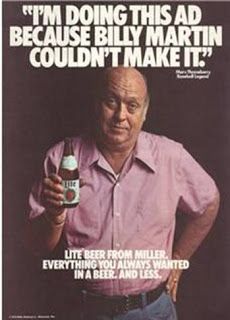
2019-03-05 MarvThroneberryMillerLite

Marvelous Marv, one of the Miller Lite All-Stars.

But somehow, some way, he was unforgotten. In the 1970s he became famous all over again in the fabled Miller Lite commercials featuring former sports stars. Throneberry appeared amidst some of sports’ greats and mere legends, invariably ending his spots with, “I still don’t know why they asked me to do this commercial.”

“At the very least,” Vecsey wrote, “it meant that one of the hip fans from the Polo Grounds had made it to Madison Avenue and was using his 1962 Met-type humor to honor Marvin Eugene Throneberry, who was, in his own weird way, a star.” Marvelous Marv was a star all over again.

Throneberry kept a photograph in his locker, well displayed, of a rather comely young lady in a bikini, and his teammates, including his setup man Ashburn, couldn’t help noticing and ogling, to Throneberry’s quiet amusement. Then, one afternoon, taking pre-game practise, Ashburn saw the woman sitting in the Wrigley Field field boxes. “Marv, you’ve got to see this,” Ashburn hollered to Throneberry.

Throneberry ambled over, and Ashburn pointed the woman out. “That’s the girl in your locker,” Ashburn said.

Throneberry grinned. “That’s my wife,” he said.

Ashburn’s jaw hit the turf promptly.

(Dixie Throneberry died in 2016; the Throneberrys had three daughters and two sons, with eleven grandchildren and fifteen great-grandchildren.)

“Throneberry is the people’s choice,” Ashburn once told Shecter, “and you know why? He typifies the Mets. He’s either great or terrible.” Throneberry happened to be standing next to him. “But you better not get too good,” Ashburn cracked. “Just drop a pop fly once in awhile.”

Throneberry dropped his own jaw twice at season’s end. The first drop was over being given a big cabin-cruising boat because it turned out he hit the O on an outfield fence sign promoting Howard Clothes more than any other Met. It was bad enough that he lived about thirty miles from the nearest river at the time. The second jaw drop came when a Met legal adviser informed Throneberry he had to declare the boat on his income tax—because he’d “earned” the boat.

“You think the fish will come out of the water to boo me this winter?” Throneberry asked.

Not a chance. He had an occasionally powerful bat and a sense of humour about himself, and they took him places enough in life, including the sweet advertising gig where he earned more than baseball, beer distribution, or trucking ever paid him in a year, seemingly. He was a countercultural anti-hero before the counterculture became serious to a dangerous and conformist fault about itself.

“Going to work just two times a month and making a great living,” Throneberry once told the Times of the Miller Lite spots and magazine ads. He’d also moved to the more waters-adjacent Fisherville, where his former major league brother Faye also lived. “I can fish four or five days a week. I’ve got five boats and five motors. I don’t have to worry about things I used to worry about. I wouldn’t trade this for anything.”

Writing his story for the Society for American Baseball Research’s Bio Project, which provided the excuse to write of him now, Alan Raylesberg exhumes a commentary from Throneberry’s oldest son, Jody:

He must have been special to have over 5000 fans wear shirts with VRAM on them. He truly loved his fans. I have watched him sit around hours on end and read fan mail and sign and return them to his fans. In the last days of his life when suffering from terminal cancer he would make it a point to sign as many cards as he could and have them mailed back out. That is the Marvelous Marv we all knew and loved.

And that’s also the Marvelous Marv for whom this journal happens to be named.

It’s about winning, stupid

2019-03-03 PhilliePhanaticBryceHarper.jpg

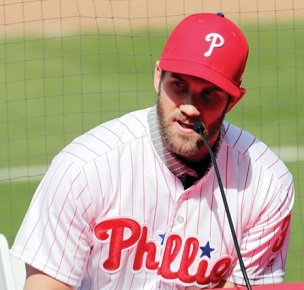
Sharing a high fist with the Phillie Phanatic—it was about a lot more than the money for Bryce Harper. 

For those who think about actual or alleged free agency market tightening and tanking teams, Phillies owner John Middleton has the answer every baseball fan of every team should wish their teams’ owners have every season. It turned out to be a key reason why he was willing to spend for Bryce Harper—and on terms that might surprise you.

It’s about winning, stupid.

At Saturday’s press conference introducing Harper as a Phillie officially, his uber agent Scott Boras told the story, quoting Middleton himself:

Scott, I want to tell you something, I’m not interested in talking about marketing dollars, ticket sales, billboards, concessions. There’s only one reason I’m talking to you, and that’s because I believe this guy can help us win. I’ve made enough money in my life, I don’t need to make more. My franchise value has risen dramatically over the last 25 years. I don’t need it to rise more. If it does, fine. I’m here to win, and I think your guy can help me win.

“He was emphatic on that,” Boras said. “I saw the passion,” Harper said about his own meetings with Middleton. “I saw the fire.”

But Middleton saw such fire in Harper, too. And that’s why Harper now wears the Phillies’ red pinstripes with number 3 on his left shoulder and his back. Among other reasons aside from the fact that he’s a paid-in-full (and how!) member of Millionaire Acres 333 times over.

And that’s why all you tankers pocketing your up to $90 million a year before a season’s first pitch is even thrown, before the first umpire on Opening Day hollers “Play ball,” have just been left with eggs benedict on your faces.

Last year’s mostly young and mostly talented and mostly not-quite-experienced Phillies surprised the game and the National League East until their inexperience caught up to them, perhaps with a little exhaustion thrown in. The Baby Braves snatched the division but the Phillies left an indelible imprint on the race, anyway.

And Middleton—who bought into the Phillies with a fifteen-percent stake in in 1994 and became its principal owner by late 2016—liked the taste of winning after the last great Phillies teams finished their injury-and-aging dissipation.

He had two targets to help kick the new Phillies up a few notches and maybe into the serious championship hunt. Both young, both gifted, both considered mercurial and usually by people who don’t know them, and both worth the equivalent of a Pacific archipelago nation’s economy.

Harper wasn’t likely to become a Yankee no matter how much he rooted for them growing up; the Yankees’ offseason priorities were pitching and a little infield help. Other prospective suitors were more interested in infielders than outfielders. Especially a young power-hitting outfielder whose defense—which was compromised often enough by over-aggressive mistakes and injuries—took a dive in 2018.

Forgotten, formerly: Harper learned to play the outfield only after he signed his first professional baseball contract. He’d been a catcher in his once-celebrated schoolboy youth. He incurred a hyperextended knee on a baserunning play late in 2017, hitting a wet base, and the injury cost him a second National League MVP, most likely. Then he spent the first half of last year trying to shake its lingering effects.

The knee was his left knee. The one from which he drives his swing at the plate. Marry that to his early-season concern with his launch angles and with pulling the ball, and you find the real source of his horrid first half. Then he adjusted right before the All-Star break. And he hit an even .300 the second half while still reaching base and slugging.

If you consider a real batting average (RBA)—the sum of your total bases, walks, intentional walks, sacrifices, and the times you were hit by a pitch, divided by your plate appearances (not your official at-bats)—Harper’s for all 2018 was .429. That was higher than a) all top ten MVP vote-getting position players in the league including winner Christian Yelich, and b) the guy who signed with the Padres, not the Phillies who also wanted him, for ten years and 300 million balloons.

It was also higher than all top ten MVP vote-getting position players in the American League except three: J.D. Martinez, winner Mookie Betts, and Mike Trout, whose .507 RBA beat the whole pack of them.

And as things turned out, Manny Machado himself made sure he wouldn’t be a Phillie from the moment his sit-downs with Middleton began. According to Sports Illustrated‘s Tom Verducci, Machado made a big mistake—he let his agent from the MVP Sports Group do most of the talking. Then Middleton met Harper and Boras together for the first time. And Harper went the opposite way.

Harper did his own talking. About the Phillies’ 2008 World Series conquest, which he’d seen while he was still a high school comer. About how pitchers approach and attack him, and how he approaches and attacks them back. Machado deferred to a mouthpiece; Harper practically taped Boras’s mouth shut. And talked the game as much as himself. Maybe more.

“I’ve been around a lot of professional players,” Middleton says, “but I’ve never seen a player who could talk about the game with such specific recall. This guy is different.”

About the only thing Boras pitched in with at that first confab was on whether Harper would hold up for the ten years he first sought. According to Verducci, Boras then pitched Harper’s core personality, the non-drinking, non-smoking Mormon, who learned what even his critics acknowledge is a strong work ethic from his iron-worker father, whose third home, behind the one he makes with his wife and the one he makes at the ballpark, is the gym.

The third tripped Phillies manager Gabe Kapler’s trigger. For all the (false) speculation that Harper wasn’t exactly a big fan of Kapler’s, it turned out Kapler’s the kind of fitness nut that appeals to Harper. They yakked it up about training, fitness, nutrition, and if Kapler had an intensity about that Harper apparently saw and raised it.

2019-03-03 BryceHarper

Wearing his new number 3 for the first time. Harper refused 34 out of deference to the late Hall of Famer Roy Halladay.

Middleton even made a point of taking no one but his wife, Leigh, to meet Harper and his wife, Kayla, in Las Vegas near February’s end. (The Harpers married near the end of 2016.) “We’re going on 41 years of marriage,” the owner said, “and they were kind of curious as to how that career marriage arc works. We talked about the ups and downs that you face and how you work through those kinds of issues. It was a really personal conversation.”

So the Phillies also brought out a side of Harper unsuspected through all the mohawk flapping when his cap fell off, the legendary “That’s a clown question, bro,” even his “Make Baseball Fun Again,” even the actual or alleged cockiness. Maybe the boy’s growing up faster than we thought.

Whatever you do or don’t think about Boras, this much turned out to be true when it came to Harper this winter: Harper called the dance. Even if it meant calling for things contrary to Boras’s preferences for his clients.

It was Harper who wanted to stay put for the rest of his career; Boras usually prefers to put his clients on the market at least once more before they call it a career. It was Harper who didn’t care about the average annual value of his deal as long as it was more dollars in the long run than Giancarlo Stanton; Boras usually prefers his clients go for the fattest possible yearly salary.

And it was Harper who insisted: no opting out. He wanted a baseball home, preferably with a team either built to win or approaching the winning threshold and committed to staying there.

Put all that together and you not only have Harper as a Phillie but the Phillies with plenty of room to move below the luxury tax—room enough to retool on the fly while playing to win (no tanking here, folks); room enough, even, to think about reeling in Mike Trout, unless the Angels decide they can’t afford to lose him in two years.

The right fielder who’d hoped until the end of last season, and maybe a little beyond, that he’d see that in the Nationals, with whom he actually wanted to stay, didn’t see it in the team that nurtured, raised, and mostly shone with him. When he slipped during his Saturday presser remarks and reference bringing a championship “back to D.C.,” some thought it was a little too telling.

But not the way they think. “I’ve always said: If I’m in [the Nationals’] plans, I’d absolutely love to be here,”  he told the Washington Post in September. “But if I’m not, there’s nothing I can do about it. There’s nothing I can do. I would love to play next to [Victor] Robles or [Juan] Soto or [Adam] Eaton. I’d love to. But am I in those plans? I have no idea.”

He learned soon enough. The Nats wanted him, but on terms that included deferred money that might have shrunk the real value of the ten year/$300 million deal they offered. Not even when Harper and Boras, out of deference to the Lerners who own the Nats, met on their turf instead of Harper awaiting suitors to come to his Las Vegas home.

Now the Nats can think about making Anthony Rendon their long-haul anchor. He’s in his walk year this year, and Harper not returning gives the Nats room to burn to make him that long-term anchor. Harper inadvertently gave Rendon leverage that he himself didn’t quite have no matter how he once thought he’d be a Nat for life.

“For me, it was all about the long haul,” the new Phillie said emphatically. “It was about being able to dig my roots, being able to plant somewhere I wanted to be for a long time. I said that in D.C. when I was there, as well. I said I wanted to be somewhere for a long period of time, and we went through that whole process, and it just didn’t work out. It didn’t happen.”

Middleton and Harper made it happen with the Phillies. In one dramatic swoop, the owner and the player threw a gauntlet down to every major league organisation in thrall to the idea of tearing down, rebuilding slowly, pinching dollars while making them regardless, and barely caring whether anyone cares what’s on the field now.

Middleton cares. In a city where it’s heaven to be a winner but hell resembles a tropical vacation when you lose. So does Harper. “I want to be part of this organization, I don’t want to go anywhere else,” he said Saturday as he slid into a Phillies cap and jersey. “I want to be part of this family, this Phillie nation. Through the bumps, the bruises, the good the bad, I want to be here.”

Harper is also calmly aware that baseball no matter what is a very rich business with or without his own Millionaire Acreage.

“I think baseball is worth about 11.5 billion dollars, so I think some of it should go back to the players, as well,” he said. Citing his annual salary to come, knowing it’s not even close to pulling the Phillies into luxury tax territory, he added, “I think that’s going to be able to bring some other guys in, as well as be able to help this organization win. I know there’s another guy in about two years that comes up off the books, we’ll see what happens then.”

Translation: He’ll like the Phillies continuing to build the farm but he also wouldn’t mind if a certain Angel should happen to become a Phillie in two years. He’d have only about 1.6 million people in Philadelphia agreeing with him both ways. Especially if that certain Angel isn’t made an Angel for life before then.

Harper even refused to wear his old number 34—out of deference to a new Hall of Famer. “I thought Roy Halladay should be the last one to wear it,” he said, perhaps unaware that two others have since the late Halladay’s retirement.

“He’s somebody in this game that, you know, is greater than a lot of guys who have ever played it,” he continued. “A Hall of Famer. Somebody who played the game the right way. Was a great person and was one of the nicest people I’ve ever met, being able to play across from him in 2012. So, for me, it’s Roy Halladay. He’s number 34 and he’s what represents that number in Philly. And when you go in there and see his name on that flagpole in center field, it’s something that he should be remembered for.”

Life as a Phillie wasn’t even a week old and Harper made a pitch for the Phillies’ next uniform number retirement. But he couldn’t resist offering one more good reason to become a Phillie: “I don’t have to face Aaron Nola anymore.”

Harper’s lifetime slash against Nola is .303/.333/.576. despite thirteen strikeouts, and including three home runs and seven steaks. I think it’s probably Nola thinking, instead, “I don’t have to face Bryce Harper anymore.”

Still bitter, still too often

2019-03-02 DougGladstone

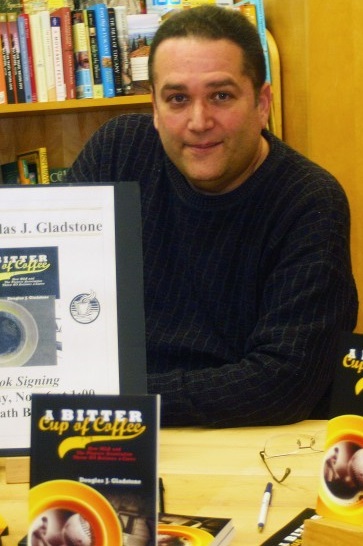
Douglas J.  Gladstone, promoting the original edition of A Bitter Cup of Coffee. “[T]here is no reason, other than sheer mean-spiritedness and pettiness, why the union and league cannot successfully find a way to mediate this issue,” he writes in the new updated edition.

On 9 July 1969, a Cub reserve named Jimmy Qualls, who was inserted into the day’s starting lineup, slashed his way into baseball history with a one-out single in the top of the ninth. It’s not everybody who gets to break up a Hall of Famer’s bid for a perfect game, but that’s what Qualls did to Tom Seaver that day.

Fat lot of good that did. The far more judiciously managed Mets (by Gil Hodges) ended up heating up as the far less judiciously managed Cubs (by Leo Durocher) burned out down the stretch, the Mets going all the way to a miracle World Series conquest. But Qualls eventually took another significant place in baseball, long after he left the game.

Qualls inadvertently tripped the trigger of a journalistic crusader for a lot of the game’s forgotten players. Talking for an eventual Baseball Digest story for the 40th anniversary year of his perfecto breakup, the former outfielder “casually mentioned” to Douglas J. Gladstone that he received no baseball pension, his extremely brief major league life notwithstanding.

A man who might be mistaken for a more burly version of the idiosyncratically effective title detective in television’s Monk, Gladstone was jolted enough by the revelation to hit the trail running, exhuming a considerable crowd of former players to speak up. Some were blinks-of-the-eye like Qualls, some went from big promise to bigger disappearances, some in between. They have in common that they were left in the cold when the Major League Baseball Players’ Association got baseball government to agree—as part of averting a strike in 1980—on changing the minimum requirement for pension vesting.

The change now meant a player needed one day MLB time for health benefit vesting and 43 days for a retirement allowance. The flip side of such a generous-sounding change was in the not-so-fine print: the new agreement didn’t include players whose short careers occurred between 1949 and 1980. The change left over a thousand players out, from reserves like Qualls to mishandled phenomena like David Clyde.

By the time Gladstone published the original edition of A Bitter Cup of Coffee in 2010, the number was down to 874. Now republished as A Bitter Cup of Coffee: How MLB and the Players Association Threw 874 Retirees a Curve—Extra Innings Edition, Gladstone continues to hope, pray, and fight for these players.

The law can’t do a thing for those former players, and Gladstone knows it. But he and the players who took the cause up ask not for legal but moral redress, from the players’ union, from baseball government, and from the Major League Baseball Players Alumni Association alike. The further impetus for such redress came when, in the late 1990s, baseball awarded living former Negro Leagues players with monetary compensation after having had short major league lives themselves following Jackie Robinson’s entry in 1947.

Qualls and his fellow crusaders, some quiet but determined and others noisily so, came to believe that if baseball could do that kind of justice for the former Negro Leaguers, they could at least do at least minimal justice likewise for former players such as themselves, many of whom are black and other ethnic men who at least didn’t have to await the breakage of the old disgraceful colour line.

They didn’t qualify for the old four-year pension vest but many have yet made reasonably successful post-baseball lives. As Gladstone illustrates, in terse prose, such players are more concerned for those whose post-baseball lives haven’t been quite as well lived, and who could use the additional income far more.

Typical among those crusaders is a short-term 1963 Met, infielder Al Moran, whose post-baseball life includes construction work and almost a quarter century coaching college baseball. “I didn’t get on board to help myself,” Moran told Gladstone. “I didn’t give a crap about myself, because frankly, I’ve done alright for myself. But I was worried about all the guys who really needed the help.”

Another former infielder who blows his horn for his fellows can do it literally. When Carmen Fanzone wasn’t a Cub third baseman frozen behind the incumbency of Hall of Famer Ron Santo, he was a trumpeter gifted enough to sit in with jazz groups and eventually work professionally with the like of Don Ho and the Baja Marimba Band, before becoming a music teacher and American Federation of Musicians pension troubleshooter for television and film musicians.

Before that, the Cubs blocked other teams from trading for Fanzone, arguing they needed a steadily available backup to Santo, which may have kept Fanzone from catching on as a more regular player elsewhere. Finally he was cut before he might have earned the old four-year pension vest. “It used to eat me to death thinking about it,” Fanzone told the Los Angeles Times in an article Gladstone recalls. “After I got cut, I called every club, but got no answer. Then I broke my ankle and couldn’t come back.”

But Gladstone and the former players he examines have run into the next best thing to brick walls whenever they’ve approached the players’ union and the owners about it. Even White Sox owner Jerry Reinsdorf tried and failed. Believing that both the former Negro Leaguers who couldn’t make the old four-year major league vest and the players who followed them but couldn’t “got screwed,” too, Reinsdorf found the union “has always said no. Every time the union has been approached about this, they’ve been very negative.”

CLYDE

“Giving ’em all pensions is the least MLB can do when some of the guys are begging for Hamburger Helper. Some of these guys actually need it. Hell, I’d like one but I don’t need one. That’s the difference.”—David Clyde.

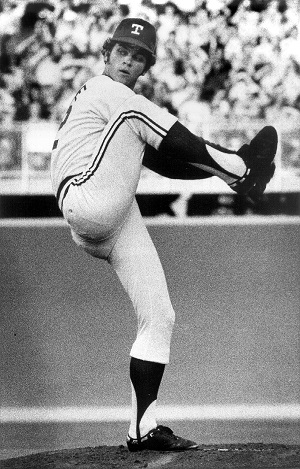
Fanzone’s is only one experience. Maybe the most formerly glittering among the pension issue fighters is Clyde, the one-time Rangers bonus phenom who went right from high school legend (five no-hitters in his senior year) to the Rangers, in then-owner Bob Short’s desperation to goose his sputtering gate.

Knowing Short’s desperation, Clyde cleverly asked only to start two major league games before going to the minors, to which his industrious manager Whitey Herzog agreed, both knowing he needed more seasoning. Then the eighteen-year-old lefthander, whose curve ball especially had scouts’s bells ringing, won those first two games, and Short couldn’t bear to lose his gate attraction.

Clyde stayed on the Rangers’ roster his first two seasons, finally being farmed out in 1975, “probably,” snorted Rob Neyer, “because Short had sold the Rangers to somebody who wasn’t insane.” Woefully ill-prepared for major league life, Clyde’s season and, ultimately, his career, ended up a mess. “Inside of two years,” Herzog would remember in You’re Missin’ a Great Game, “David Clyde was nothing but a cautionary tale.”

That mishandling plus shoulder trouble and alcohol short circuited Clyde’s career with parts of five major league seasons on his resume but not enough major league time to qualify for the old pension vest. Two failed marriages and a sobering up later, Clyde remarried happily, joined his father-in-law’s successful lumber business, and retired as its vice president—while returning to baseball as a pitching coach, teaching high school age pitchers fundamentals and how not to let yourself get caught in the pincers that caught him.

“The one positive that came out of my career,” Clyde told the Dallas Morning News in 2013, “is that to this very day, every now and then, when a very special talent comes along, I hear them say, ‘We are not going to do to this young man what was done to David Clyde’.”

Like Qualls, Moran, and Fanzone, Clyde doesn’t need a better pension benefit for himself. But he told Gladstone he fights for the other players out partially out of guilt: Short’s hunger for Clyde’s original box office appeal cost a roster spot for a player who also didn’t meet the old pension vest—and died of cancer subsequently. Gladstone thinks that would have been outfielder Joe Lovitto.

“There are a lot of guys who were not nearly as fortunate nor nearly as blessed as I’ve been,” Clyde told Gladstone. “Giving ‘em all pensions is the least MLB can do when some of the guys are begging for Hamburger Helper . . . Some of these 900 guys actually need it. Hell, I’d like one, but I don’t need one. That’s the difference.”

One problem is whether today’s players have much if any clue about the pension situation afflicting the 1949-80 players. Gladstone and Clyde think they don’t. So does former Seattle Pilots pitcher Dick Baney, who once thought of organising an All-Star Game protest on behalf of the un-pensioned players.

Often as not Gladstone writes, in A Bitter Cup of Coffee and elsewhere, that whenever the issue comes before the owners or the players’ union, a frequent refrain is that it’ll just have to wait until the next collective bargaining agreement. He compares that to John F. Kennedy’s response after a reporter asked when the United States’ then small military presence in Vietnam would be scaled back. “We don’t see the end of the tunnel,” the ill-fated president replied, “but I don’t think it was darker than it was a year ago.” We know how that worked out after Kennedy’s assassination.

But A Bitter Cup of Coffee achieved something, which is much the subject of the new Extra Innings edition. In 2011, then-comissioner Bud Selig and then-players’ union executive director Michael Weiner announced a new program from which $625 for every 43 days’ major league time would be awarded the players frozen out of the 1980 pension realignment.

Weiner had pushed baseball government and the union alike to agree on taking those monies out of the luxury tax payments levied against bigger market teams spending beyond a particular level. There were, alas, two catches. Catch one: 43 days represented a quarter, and the players in question were limited to sixteen quarters, equal to $10,000—before taxes. Catch Two? Gladstone says it better:

Neither the pre-1947 players nor the Negro League veterans were subject to such stringent criteria. But most of the men didn’t dwell on the restrictive terms of the awards program. They were too happy that they were at last going to receive monies.

However, in their joy to receive any monies after being taken advantage of for more than three decades, they also failed to realize that, unlike a true pension, the monies couldn’t be passed on to any widow, child, loved one or designated beneficiary. When each man died, the payment died with him.

Cooperating with Gladstone’s original book cost Clyde and former Braves pitcher Gary Niebauer their positions on the Alumni Association’s player services committee, when they were replaced by incumbent players (incumbent, mind you) Chris Archer and Nelson Cruz. And, a considerable number of the players affected by the 2011 program still waited long enough to received the promised money, if they received it at all.

Gladstone has asked incumbent commissioner Rob Manfred and incumbent players’ union executive director Tony Clark, both of whom preside over a game that earned $10.8 billion in revenues in 2018, to re-think the issue. So far, he may have an easier time asking for reparations on behalf of the Roman Empire from Attila the Hun. “[T]here is no reason, other than sheer mean-spiritedness and pettiness,” he writes, “why the union and league cannot successfully find a way to mediate this issue.”

Players since the Messersmith decision speak often about honouring the players who came before them when it came time to stare the owners down and and not back down. They could do likewise by engaging the owners on behalf of such players before them as Clyde, Qualls, Moran, Fanzone, Niebauer, all the players still living who were frozen out of the otherwise remarkably generous 1980 pension re-alignment.

That, too, would do the honourable thing, which is the periodically pugnacious but otherwise great faith point of Gladstone’s republished, updated book. It may not make them financially independent at last, but it might tell them that the game didn’t forget them, either.

The Phillies close out Harper’s Bazaar

2019-02-28 MikeTroutBryceHarper

HI, NEIGHBOUR!Bryce Harper, now about to play in Mike Trout’s native neighbourhood, ends his sweepstakes with a deal from the Phillies. It may yet do Trout a bigger favour than it does the Phillies, depending on what the Angels do or don’t do with baseball’s best before he hits the open market after the 2020 season.

If nothing else, Washington’s long Nationals nightmare begins, now that their longtime mainstay Bryce Harper has signed on with the Phillies for 13 years and $330 million. It’s one thing for the Nationals having prepared for a future without him; it’s something else again that that future is here.

The Nats spent the winter preparing by upgrading their bullpen, fortifying their catching corps, outbidding everyone else for starting pitcher Patrick Corbin, and plugging a second base crack with veteran Brian Dozier. Only half hoping that Harper might play the market, find it wanting in one way or another, and come back to take the Nats’ original ten year/$300 million offer.

It turned out that Harper wanted longer term stability than that and that the Phillies were willing to give it to him, including an absence of opt-out clauses. Assuming Harper plays out the full term of the deal, guess how many games the Nats get to play against the Phillies with or without the National League East title at stake. How does 247 games strike you?

The Nats are still a terrific team. They’ll still give the Phillies (and anyone else in the NL East) a run for their money. But they might be just a little less fun without Harper. Unless they have some aces (on and off the mound) up their similarly red sleeves.

When Manny Machado signed with the Padres last week (ten/$300 million) it kicked the rebuilding Padres far closer to returning to real competitiveness, particularly with their well-regarded farm system on the threshold of a harvest. Harper sees and raises.

He kicks the Phillies—whose fortifications to their solid and still ascendant youthful core this winter include J.T. Realmuto, Jean Segura, Andrew McCutchen, and David Robertson—right into being the NL East favourites. The Phillies are already imagining their Opening Day lineup with Aaron Nola on the mound and Harper patrolling right field. Phillies fans may not be muttering “Wait ’till next year” this time around.

It’s not that Harper himself didn’t gamble. The market proved a lot less flexible than he and Machado believed going in. He thought about life as a Yankee, the team his father rooted for, and either he or the Yankees or both thought, “Can’t be done.” He pondered life as a Dodger, closer to his Las Vegas home, until they “apparently offered Harper less than half the guaranteed money he’d already turned down in D.C.,” as Thomas Boswell puts it. He even pondered life as a Giant, who lost 89 in 2018 but still have the weight of several bad contracts and quickly-aging anchor players.

The Phillies showed him two more things. They showed him the guaranteed money (and a far less oppressive tax state than California), but they also showed him a team built to win now and for the next several years. A team young enough despite the veteran additions to stay winners for the next several years. A team that likes the kind of player he is at core, what Boswell called “hard hat with, sometimes, a hard head.”

The hard head cause a few clumps of Nats hair to be torn out while the team’s brain trust struggled to convince him outfield walls are still the least forgiving walls on the planet. Harper’s hustled himself into hardware-costing injuries in the past; he struggled in 2016 because of a shoulder injury and, later, a stiff neck.

Last year, after blasting out of the starting chocks in his first seventeen games, Harper nose-dove until just before the All-Star break. He’d come out of spring training seemingly obsessed with his launch angles and his pull hitting, not to mention defensive overshifts. After making a pre-break correction to that thinking, he hit .300 the entire second half, with a .305/.442/.538 slash line the final two months.

Harper will have his moments of transcendence and his moments of failure, and the notorious Philadelphia boo birds will let him know the difference as they usually do. (“Those people,” legendary pitcher/playboy Bo Belinsky once observed, “would boo at a funeral.”) He’s strong enough to know the difference and experienced enough not to let the worst of the latter stain the shinings of the former.

His critics, pardon the expression, harp on his full-season .247 batting average as evidence he had no business playing this winter’s market for the stakes he wanted. But last year’s NL Most Valuable Player, Christian Yelich, had 41 percent of his hits go for extra bases. Harper had 49 percent go for extra bases. Nolan Arenado, who just signed a delicious extension aimed at making him rich and a Rockie for life, and led the National League with 38 home runs last year, had 45 percent extra-base hits.

Let’s look at the extra-base hit averages among the other top ten position players in last year’s MVP voting (Cy Young Award winner Jacob deGrom and Max Scherzer also finished in the top ten), in descending percentage order:

Matt Carpenter—53%
Trevor Story—49%
Javier Baez (RBI leader)—47%
Ronald Acuna, Jr.—44%
Paul Goldschmidt—42%
Anthony Rendon—42%
Freddie Freeman (hits and doubles leader)—37%
Lorenzo Cain—22%

Harper wasn’t even close to getting a single MVP vote last year but only two MVP candidates had the same or a higher percentage of extra-base hits. And if you’re still harping on his full-season batting average, feel free to remind yourself about the two wounding flaws in batting average:

1) It treats all hits equally, and all hits are not equal. Come to think of it, all .300 hitters aren’t equal, either. If Tony Gwynn was a more valuable or more complete hitter hitting a lifetime .338 than Willie Mays hitting a lifetime .302, the one who says so a) didn’t see either one play all that often; and/or, b) doesn’t read the whole record as it was above, beyond, and deeper than those averages.

2) A batting average accounts only for your hits divided by your credited at-bats. It doesn’t account for everything you do at the plate divided by all your plate appearances, and thus gives an incomplete picture of what you do at the plate to help your team win.

Maybe batting average ought to be called hitting average instead. Or maybe the term for a complete offensive percentage—including hits, walks, intentional walks (yes, count them separately), sacrifices, and the times a batter got hit by a pitch, divided by his total plate appearances—should be called Real Batting Average. (No, it’s not the same as on-base percentage, which factors official at-bats but not total plate appearances.) Here are the RBAs for the aforementioned top ten MVP candidates, including the winner, plus that other guy who just signed with the Padres for ten years and $300 million:

Player PA Hits Walks IBB Sacs HBP RBA
Javier Baez 645 176 29 8 5 5 .346
Trevor Story 656 174 47 3 4 7 .358
Ronald Acuna, Jr. 444 127 45 2 3 6 .376
Nolan Arenado 673 175 73 10 7 3 .398
Manny Machado 709 188 70 18 5 2 .399
Lorenzo Cain 620 166 71 1 2 8 .400
Paul Goldschmidt 690 172 90 11 0 6 .404
Matt Carpenter 677 145 102 17 4 6 .405
Christian Yelich 651 187 68 2 2 7 .409
Freddie Freeman 707 191 76 12 6 7 .413
Anthony Rendon 597 163 55 5 8 5 .417
Bryce Harper 695 137 130 16 9 6 .429

Harper’s 2018 RBA was .429. In other words, even in what was considered a bad full season because of his .247 batting average, Harper was a more complete batter whose real batting average was better than both than the top ten National League position players and his fellow new three hundred times over millionaire Manny Machado. (Last year’s American League MVP, Mookie Betts, shows a .459 RBA.)

And that’s without talking about something else that helps your team put runs on the board: the extra bases you take on followup knocks. Harper wasn’t as good at that last year as in seasons past, but lifetime he’s taken the extra base(s) on the followup knocks exactly half the time he’s reached base in the first place. (For a little perspective, Hall of Famer Rickey Henderson—the Man of Steal himself—did it 55 percent of the time he was on base . . . and Mike Trout does it 57 percent of the time.) He’s not waiting for you to hit one out of the yard to kick on the jets and fly.

(So why did Harper crater to a 1.3 wins above a replacement-level player last year? Easy: bad outfield defense. Even in a down season Harper was still worth 4.2 WAR as an offensive player, just below an All-Star’s level. But his defensive WAR was -3.2. Maybe the weight of the free agency season he’s just finished will be removed enough to clear his head in right field as well as all the way at the plate.*)

Now, who beside their new teams have been done the biggest favours by the Harper and Machado deals? One name seemed to spring to mind at once after Harper signed, and he’s due to hit free agency after the 2020 season.

He’s been the best all-around player in baseball since his first full season. The question is long established that it’s just a question of when, not if he’s inducted into the Hall of Fame, assuming nothing drastic or tragic happens to him before he finishes his tenth major league season. And his 2018 was better than all the above in several ways last year even with missing time due to a thumb injury.

OK, you asked for it. Forty-five percent of Mike Trout’s 2018 hits went for extra bases, but his real batting average, according to the foregoing criteria, was . . . .507.

Mike Trout in 2018 was a more complete hitter doing that much more to help his team win—never mind that Angel fans continue to wish the organisation would build a team its and baseball’s best player can be proud of—than both leagues’ Most Valuable Players and their top-ten MVP finishers among position players.

The Angels had better get to serious work on a) building a team Trout can really be proud of; and, b) making him their Nolan Arenado and not letting him escape without a fight. And there isn’t a fan alive observing the Harper-Machado markets, questioning the sanity of either or both, who’d say Trout doesn’t deserve it even more.


* PostscriptNot long after writing and publishing this essay, I was reminded that Bryce Harper suffered a hyperextended left knee late in the 2017 season, and that the effects may have carried over long enough into the 2018 season to affect both his plate appearances—since the injury occurred, of course, on the leg off which he drives his batting—and his play in right field. Those who feared that he himself feared going for some balls or trying for some plays may well have forgotten that injury, as I did.

He’s ready for the Show, so quit stalling

2019-02-27 VladimirGuerreroJr

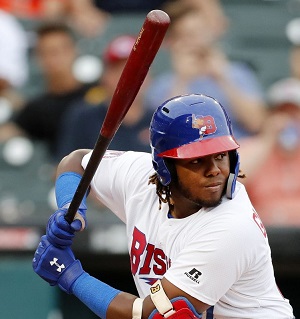
Vladimir Guerrero, Jr.—if he’s anything like his old man, they’re going to love him in the Show. What are the Blue Jays waiting for?

When the children of good, great, or even Hall of Fame players take a turn at baseball, as they do more often than you think, it isn’t always a given that the sons will equal or surpass the fathers. Great or even Hall of Fame fathers don’t necessarily breed Hall of Fame sons or grandsons.

If they did, Earl Averill, Jr., Dale Berra, Eddie Collins, Jr., Tony Gwynn, Jr., Chuck Lindstrom, Earle Mack, Queenie O’Rourke, Eduardo Perez, Tim Raines, Jr., Dick and Dave Sisler, and Ed Walsh, Jr. would be mounted on Cooperstown plaques. There are also two sons who left their fathers far enough behind to become the Hall of Famers the old men weren’t: Roberto Alomar (son of Sandy, Sr.) and Ken Griffey, Jr.

Along comes Vladimir Guerrero, Jr. His father earned the nickname Vlad the Impaler during a career that earned him induction into the Hall of Fame last year. The son may be baseball’s number one major league ready prospect even at nineteen years old. The Blue Jays don’t quite see it that way.

It’s not that Guerrero fils lacks the ability. Last season, during which he earned a promotion to the Triple A level, the young man looked like the second coming of his father: in a mere 95 games (minor league seasons are generally shorter, anyway) Guerrero fils showed a .437 on-base percentage and a .636 slugging percentage, including a .564 slugging percentage in his Triple A time.

Customarily a player who posts a .978 OPS at Triple A has shown he’s major league ready. The bad news is Jays general manager Ross Atkins, believing Guerrero, Jr. isn’t major league ready because he’s . . . only nineteen years old. And Atkins stumbled so clumsily over himself trying to explain that he became an immediate textbook exercise in why players aren’t the only ones who think front offices are talking through their chapeaus about player development versus player control:

It really comes down to development. I just don’t see him as a major league player. You just pencil him in and he’s done. He’s 19. He has accomplished everything he can accomplish as an offensive player. And there’s so many opportunities for him defensively and what he can do to really maximize the power, the size and the strength that he has.

Talking out of both sides of his mouth? Atkins talks through a five-pointed star of an orifice. Never mind that Guerrero fils will be 20 before Opening Day. It makes you wonder where he was or wasn’t, or what he has or hasn’t read, about other nineteen-year-olds brought to the Show and making impacts:

Juan Soto, 2018—He might have been last year’s National League Rookie of the Year if not for a fellow named Ronald Acuna, Jr. Soto posted a .923 OPS and whacked 22 home runs, which was even more impressive considering he didn’t come up to the Nationals to stay until mid-to-late May . . . after earning three minor league promotions up from A-level in a month to start his season.

Bryce Harper, 2012—He was only the National League’s Rookie of the Year, an All-Star, and worth 5.2 wins above a replacement-level player, and his 57 extra base hits that season set a modern-era record for teen players. And now he’s still on the open free agency market with an excellent chance of equaling Manny Machado’s new contract for himself.

Ken Griffey, Jr., 1989—He didn’t do quite as well as Harper or Ott in his age-19 season; the Hall of Fame greatness began the following season. But he finished third in the American League’s Rookie of the Year voting and showed various tastes of what was to come at the plate and in center field alike.

He didn’t quite get to pass Hank Aaron on the all-time home run list, thanks to injuries dogging him constantly after he moved to Cincinnati, but he had more than enough to become a first-ballot Hall of Famer.

Dwight Gooden, 1984—The National League’s Rookie of the Year that season, Gooden busted Herb Score’s record for strikeouts in a rookie season, and Dr. K’s mark (276) remains the modern era rookie record. He went from there to post the impossible season in 1985 . . . and in spring training 1986 the Mets, somewhat insanely, ruined him.

They told a young man who’d struck out 544 batters in his first two seasons, and had a 1.91 fielding-independent pitching rate to line up with his 2.07 ERA those two seasons (and a Cy Young Award the second) that he needed . . . more stuff. As if his multiple-warhead fastball and the most voluptuous curve ball since Sandy Koufax wasn’t enough.

“I always thought they should have left Doc alone,” said Hall of Fame catcher Gary Carter. “[Pitching coach Mel Stottlemyre] thought teaching him a third pitch would be to his advantage. But he didn’t need it. He needed someone to say, ‘Hey, you’ve been successful. Just keep going at it.’ But they didn’t.” It shot Gooden’s confidence and his release point. And something else. Carter: “I also think it hurt his shoulder. The pitches didn’t feel natural to Doc, and pitching was so natural to him. It just wasn’t smart.”

Confidence shot, especially because the pliant Gooden listened to everyone no matter how cockamamie their suggestions. Near-constant shoulder issues and substance abuse to follow. Gooden had a long and very respectable career after all, including a late-career no-hitter, but he was really denied his chance at sustained greatness by short-sighted coaching and management.

Wally Bunker, 1964—Blessed with a deadly sinkerball, Bunker was the American League’s Rookie of the Year runner-up with a 2.69 ERA and a major league-leading .792 winning percentage. The bad news: Bunker experienced arm soreness during a start on a cold Cleveland night. The soreness turned out to be undiagnosed tears in a tendon or a ligament.

Bunker would never be the same pitcher again, though he’d pitch a six-hit shutout in Game Three of the 1966 World Series en route the Orioles’ sweep of the Dodgers. He ended up an original Kansas City Royal and threw the first pitch of their existence, but the arm issues persisted and he was finished by 1970.

Tony Conigliaro, 1964—Tony C. set the modern-era record for home runs by a major league rookie when he bopped 24. The following season, he’d become the American League’s youngest home run champion ever with 32. Three years later, his career would be derailed when, unable to duck out of the way in time, a Jack Hamilton fastball smashed into his face, causing serious eye issues that eventually ended his career in earnest.

Mel Ott, 1928—Ott actually came to the Giants right out of the chute at 17, but manager John McGraw—terrified that some nitwit minor league coach or skipper would try to wreck the kid’s unorthodox but impeccable swing (his front leg kick as he began his swing made him resemble a pitcher about to deliver)—kept him next to him two years to teach him the game before letting him fly as the Giants’ regular right fielder.

Master Melvin merely posted a .921 OPS in 124 games in 1928. And he merely went on to become the National League’s home run king of the pre-World War II era (he was the second behind Babe Ruth to hit 500+ career home runs) and a Hall of Famer.

Those may be the best nineteen-year-old seasons on record. But there’ve been other nineteen-year-olds who came to the majors to stay at that age, under various circumstances. They include but may not be limited to Chief Bender, Ty Cobb, Bob Feller, Felix Hernandez, Al Kaline, Sandy Koufax, Manny Machado, Mickey Mantle, Bill Mazeroski, Milt Pappas, Alex Rodriguez, Babe Ruth, Mike Trout, and Smokey Joe Wood.

All but three of those are Hall of Famers, by the way. Rodriguez would be if not for, you know, that other stuff. And those who think Trout won’t be should know that he’s already above the career WAR of the average peak-value Hall of Famer, and he ranks objectively as the seventh-best all-around center fielder of all time. More’s the pity that baseball’s governors still can’t find a way to promote him as the face of the game.

“Atkins and the Jays’ organization think that they are fooling people by saying it comes down to development,” writes Sportsnaut‘s Vincent Frank. “There’s nothing more that [Guerrero, Jr.] can develop by dominating lesser competition in the minors. It’s that simple.”

Maybe even simpler. The Blue Jays need all the help they can get if they hope to compete in an American League East that’s not necessarily known for showing mercy to the lesser forces.

“Teams are going to be highly resistant to any change that deprives them of cost controlled years of their best players,” writes FanGraphs‘s Craig Edwards. “But the [Major League Baseball Players Association] focusing some of their attention on getting players like Vlad Jr. to the majors, as well as getting better benefits to the minor leaguers left behind, can only be to the game’s benefit. Many of baseball’s stars of tomorrow are ready today. Let’s watch them play, shall we?”

If he’s anything like his father, whether or not he’ll swing at anything within his area code the way Pop did, Guerrero fils is going to make Blue Jays and other fans fall as much in love with him as Expos, Angels, and other fans did with the old man. Let’s, indeed.