Unknown's avatar

About Jeff Kallman

Member, Internet Baseball Writers Association of America and the Society for American Baseball Research.

Mystique and Aura, kidnapped by the Dodgers

Walker Buehler

Walker Buehler (21, far left) about to be swarmed by fellow Dodgers after he locked the Bronx Bumblers down for keeps to finish World Series Game Five.

Has it really sunk in yet that the Dodgers are full-season, no-doubt, take-no-quarter World Series champions? Has it really sunk in yet that the Yankees aren’t just another group of also-rans but a team as fully able to implode at the wrong time as any team in major league history?

Both teams needed the best they had available for Game Five Wednesday night. The Dodgers to win it, the Yankees to stay alive long enough to force a cross-country trip to Los Angeles for Game Six at minimum. When the Dodgers needed reinforcements, they found them, sometimes in places unexpected outside their portal.

Anyone remember Mystique and Aura? The Dodgers kidnapped them with no known ransom demand turning up at this writing. The Yankees needed Mystique and Aura but they got Wobbly and Rickety.

Just one night after showing serious enough life by blowing the Dodgers out of Game Four, the Bronx Bumblers self-dismantled in ways almost unheard-of by any previous World Series contestant. The Series-clinching, Game Five final was 7-6. It was a close game only if you ignore the way the Yankees helped the Dodgers close an early 5-0 Yankee lead.

The Game Five Dodgers almost didn’t need stout innings from their bullpen, a shutdown ninth from projected Game Seven starter Walker Buehler, and too-timely hits enough to matter. If you didn’t know better, you’d be swearing the Yankees were handing it to the Dodgers on a platinum platter.

The 161st Street Stumblers lost the Series to a Dodger team that found ways not to let little things like too many injured pitchers and a half-effective bullpen keep them down for very long. bullpen half of which would be effective keep them down for very long. But Game Five night just might have been the single most surrealistic game of this Series, if not any Series.

Trust me when I say that that’s saying something.

The top of the fifth challenges such sad Series mishaps past as Fred Snodgrass’s glove turning into a trampoline, Freddie Lindstrom’s pebble, Ernie Lombardi being dismantled at the plate, Mickey Owen’s passed ball, Willie Davis losing two Oriole flies in the sun in the same inning, Curt Flood losing Jim Northrup’s drive in the sun, or Bill Buckner’s horror seeing the slow grounder skip beneath his downstretched mitt.

Does anyone remember that the 11-4 Game Four beatdown the Yankees dropped on the Dodgers actually had people predicting with straight faces that the sleeping giants were awakening enough to do the unheard-of and take the next three straight to teach those ornery louts from Los Angeles a lesson in manners and championship?

There went those ideas. Above and beyond the Yankees waiting fifteen years to get back here only to tumble away this time, above and beyond the Dodgers winning eleven out of twelve National League West titles with only one World Series conquest to show for it until now, this is what everyone will remember about this Series in general and Game Five in particular:

They’ll remember Series MVP Freddie Freeman’s Game One-winning ultimate grand salami as the first salvo toward his reaching the seats in the first four games, which marries to his bombs in Games Five and Six in 2021 (when he was still a Brave) to tie George Springer for the longest Series home run streak (six games).

They’ll even remember Freeman overcoming a balky ankle keeping him somewhat calm in the earlier postseason rounds. Somewhat. Because by the time Freeman got finished with his bombing in Game Four, Yankee fans were holding up signs pleading, “Freddie, Please Stop!” As if Freeman had any intention of obeying.

Aaron Judge

First, Judge was the sleeping giant coming wide awake . . .

They’ll remember Shohei Ohtani jamming his shoulder on a failed Game Two stolen base attempt, leaving himself all but useless for most of the Series, but insisting upon staying in the lineup just in case. If only for the presence.

They’ll remember Dodger starting pitcher Jack Flaherty keeping the Yankees to two runs starting Game One but getting flogged for four before he could get out of the Game Five second—including Aaron Judge, heretofore the Yankees’ first among the sleeping giants, awakening himself and Yankee Stadium with a two-run homer in the bottom of the first, followed immediately by Jazz Chisholm, Jr.’s solo bomb . . . until . . .

They remember the Yankees leading 5-0, and Yankee starter Gerrit Cole striking Gavin Lux and Ohtani out swinging back to back, and not one Dodger hit thus far.

Until . . . come the fifth . . .

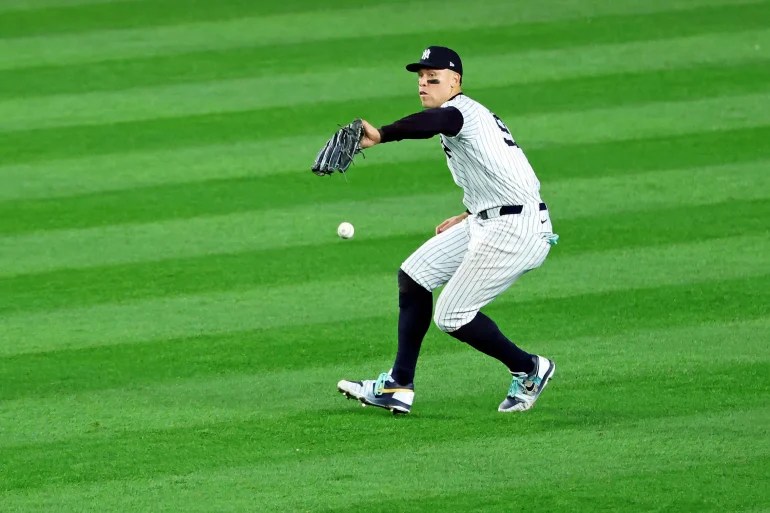
* With Kiké Hernandez aboard on a leadoff single, busting any shot Cole had at a no-hitter, Tommy Edman lined one that Judge—who committed only one error all year to that point—normally catches in his sleep. This time, the ball hit the web of Judge’s glove and bounced away.

* Five pitches later, Will Smith grounded one to Yankee shortstop Anthony Volpe’s right. Volpe picked it clean the way a Gold Glover does. Then he threw an awkward short-hopper to Chisholm at third the way a Cold Glover does. Chisholm couldn’t get the handle on that throw. The Dodgers had the bases loaded and nobody out.

* The Mookie Monster singled Hernandez home, on a squibber first baseman Anthony Rizzo had to step back to snag because it was spinning like a gyroscope, practically . . . leaving Cole not covering first because the pitcher took a bad route to the ball, leaving both men resembling raw rookies with signals crossed and knotted.

* Freeman singled Edman and Will Smith home and set up first and third.

* Teoscar Hernández doubled Betts and Freeman home.

* And every last one of those five runs in the Dodger fifth was unearned.

Aaron Judge

. . . but, then, his unlikely error began handing the Dodgers the fifth inning and beyond.

“This is as bad as it gets,” Cole said postgame. “It’s the worst feeling you can have. You have to keep sometimes willing yourself to believe and give yourself a chance. You keep pushing and pushing, and ultimately, you fall short. It’s brutal.”

“You can’t give teams like that extra outs,” said Judge, who’d made what threatened to be the play of the night when he stole an extra-base hit from Freeman by scaling the left center field fence in the fourth. “They’re going to capitalize—their 1-2-3 at the top of the order, they don’t miss. You give them a chance with guys on base, they’re going to capitalize. You gotta limit the mistakes.”

Then, everyone will remember Blake Treinen, the man who usually gets the final three outs of a Dodger win, coming in a little bit sooner than usual to clean up a mess and keep the Yankees at bay from there. As in, the bottom of the sixth, with the Yankees back in the lead 6-5 but threatening to put the game back out of reach with first and second, two out, and Volpe due at the plate.

The same Volpe who really started the Yankees’ Game Four mayhem—when they were down 2-1 in the third thanks to yet another Freeman flog two innings earlier, but with the bases loaded on two out—by hitting Daniel Hudson’s first service into the left field seats.

Treinen got Volpe to ground out to second for the side this time. Then he retired the Yankees in order in the seventh and squirmed out of a first-and-second jam with a fly out by Giancarlo Stanton and a swinging strikeout on Anthony Rizzo.

Somewhere in the middle of all that, Buehler ambled down to the Dodger bullpen. Just call me if you need me, boss. He’d only told any Dodger personnel, from teammates to front office people, that he was available to work in Game Five if need be. He made for the Dodger bullpen after the bottom of the fifth.

Then, Buehler started loosening up. Then, he started warming up in earnest. He may well have thrown the equivalent of the first two and a half innings worth of a quality start by the time he got the call to handle the bottom of the Game Five ninth.

He got Volpe to open with a sharp ground out to third base. He struck Austin Wells out swinging on a full count. He struck former teammate Alex Verdugo out swinging on 1-2. Buehler then spread his arms like an old-time nightclub singer inviting applause for the big finish and his mates began pouring onto the Yankee Stadium infield to start the party.

They survived the early bombs by Judge, Chisholm, and Giancarlo Stanton. They survived their Game Four bullpen game plan getting vapourised, going into sacrificial lamb mode the better to keep their six best relief arms available for Wednesday night. They survived their own recent past of, manager Dave Roberts admitted postgame, losing games that handed them what Game Five had before the fifth inning.

They didn’t stop to ask questions when the Yankees began passing out early Christmas presents one botched out after the other in the top of the fifth. They knew the answers going into the Series.

Their knowledge only began with Betts working on playing caroms off the wall almost as incessantly as he does on his batting swing. It only continued with every Dodger no matter how wounded attacking basepaths rather than just running them. The Dodgers scouted the Yankees and determined they were über talented but fundamentally lacking. They didn’t have to advertise it. They simply exposed it.

The Yankees didn’t pay close enough attention to any reports telling them the Dodgers could match them talent for talent even with their MIAs. The Dodgers, for all their star and firepower, were too grounded fundamentally to let the Yankees treat them like just another poor-relations team.

Freddie Freeman

To absolutely nobody’s surprise, Freddie Freeman was named the Series MVP. (A home run in each of the first four games, plus tying a Series record with twelve RBIs, does that for you.) Now named for the late Willie Mays, the trophy depicts Mays making his fabled 1954 World Series catch against Vic Wertz.

Most of all—unlike the title they won at the end of the surrealistic, pan-damn-ically shortened season and under-isolation postseason—nobody so inclined can hang any kind of asterisk on this one. These Dodgers went the distance no matter whose interpreter swindled him out of millions to cover debts to a bookie, no matter who hit the injured list, no matter who lost a season to an injury. No matter that they tied and took what proved the winning lead on a pair of eighth-inning sacrifice flies.

The last man standing? A pitcher who once resembled a mound terror until two Tommy John surgeries and other ailments kept him limited this regular season, only to show up in October looking as close to his former self as his age and body allowed and hell bent on doing something, anything, to secure his team the Big Prize.

“This is the only reason I play,” Buehler said postgame, “for games like this. The whole year—the offseason, spring training, the regular season—it doesn’t matter. Well, it matters, but not like these games. To win championships is why I play. It’s the best feeling in the world. I live for this.”

He pitched the ninth to prove it. A ground out and back-to-back swinging strikeouts. Followed by stepping down from the rubber, holding his arms out like a vintage nightclub singer delivering the Big Finish, and being mobbed by a swarm of Dodgers. They all lived for this.

WS Game One: “Those are the scenarios you dream about”

Freddie Freeman

Freeman won Game One with an ultimate grand slam Friday night. Eat your heart out, Lady Liberty!

Has anyone noticed that this year’s World Series features the best regular-season team against the third-best regular-season team? It certainly beats hell out of last year’s Series, when the eighth-best regular-season team had the pleasure of beating the eleventh-best regular-season team.

Right away, then, the Yankees vs. the Dodgers has something going for it above and beyond the ultimate outcome. Above and beyond even ankle-challenged Freddie Freeman seeing and raising Kirk Gibson in Dodger and baseball lore when he walked it off with an ultimate grand slam—in the Game One bottom of the tenth.

Already the World Series has everything real baseball fans crave, from comedy to drama and back to the absurd. Even if both teams had to grind their way through a small pack of also-rans to get to where the Dodgers could overtake the Yankees, 6-3, to start their eleventh World Series against each other.

“Never throw a slider to a cripple,” lamented Hall of Fame pitcher Dennis (the Menace) Eckersley after the legless Gibson pinch-hit for Dodger reliever Alejandro Peña in Game One of the 1988 Series. After Friday night’s eleventh-hour dispatch, Yankee manager Aaron Boone might have been tempted to lament, “Never throw a first-pitch fastball to the near-cripple you preferred to face over Mookie Betts.”

“When you’re five years old with your two older brothers and you’re playing whiffle ball in the backyard,” Freeman said postgame, “those are the scenarios you dream about—two outs, bases loaded in a World Series game. For it to actually happen, and get a home run and walk it off to give us a 1-0 lead, that’s as good as it gets right there.”

They plus the Yankees only had to go through the flotsam and jetsam to make this Series possible in the first place. The Dodgers had to get through the fifth-best Padres and then the tenth-best Mets to get here. The Yankees had to get through the twelfth-best Royals and then the sixth-best Guardians to get here. Is that any way to treat the long season’s champions?

Most of the cream rose to the top regardless of the current postseason system; the second-best regular-season team (the Phillies) got dispatched by the Mets early enough. (A 3-1 division series dispatch.) Forget the old and getting-tired cliché about short series and what the lessers can do with them.

Phrase it another way, if you dare: Four division winners were also shoved to one side and sent home for the winter a lot earlier than they hoped to be sent. One was the season’s second-best Phillies, of course. The other three: The season’s fourth-best Brewers, sixth-best Guardians, and eleventh-best Astros.

In a saner time and place, the Astros, the Braves, the Brewers, the Guards, the Mets, Orioles, the Padres, the Royals, and the Tigers would have been told, quote, “Thank you all for helping make the regular season one whale of a great run, but now it’s time to say goodbye and wait till next year, because something’s still bloody wrong with stirring up the thrills, chills, and spills of fighting to the last breath to finish . . . in second or third place.”

That’s just in divisional terms. Now put it in overall terms. There’s something bloody worse with stirring up the thrills, chills, and spills of fighting to the last breath to finish anywhere from fourth to thirteenth place. Bloody worse about the Dodgers and the Yankees being rewarded for their regular-season efforts by being made to get through their far lessers first.

It’s nothing but wonderful that there are going to be baseball stars in abundance for this Series. Betts vs. Juan Soto. Freeman vs. Giancarlo Stanton. Shohei Ohtani vs. Aaron Judge. Even Commissioner Pepperwinkle isn’t unaware that there’s history blowing in the wind here. “Joe DiMaggio and Jackie Robinson played against each other in a Yankee-Dodger World Series,” he’s told The Athletic. “So did Mickey Mantle and Sandy Koufax. This one is a continuation.”

Well. If you’re going that way, so did Yogi Berra and Don Newcombe. So did Whitey Ford and Duke Snider. So did Reggie Jackson and Tommy John. So did Don Mattingly and Fernando Valenzuela. The latter pair were part of the last Series between these two franchises, at the end of a season whose postseason experiment nobody predicted might seed today’s mishmosh.

Dodgers starting pitcher Jack Flaherty and Yankee starter Gerrit Cole matched shutouts, mostly, until the bottom of the fifth, and a one-out triple (Kiké Hernandez) leading directly to a sacrifice fly down the right field line (Will Smith). Then Flaherty made the only bad mistake of an otherwise superb mound outing, with one on (Soto, leadoff single) and one out (Judge, swinging strikeout), feeding Stantion a 1-2 curve that landed in the lower zone region Stanton happens to love. It flew into the left field bleachers before Flaherty could finish thinking, “Oh, you-know-what!”

A 2-1 score wasn’t really liable to remain static between these two. Sure enough, once the sides were into each other’s bullpens, Soto misplayed Ohtani’s eighth-inning double into allowing Ohtani to third, ending one Yankee reliever’s (Tommy Kahnle) outing, and Betts whacked successor bull Luke Weaver’s 1-2 changeup for a game-tying sacrifice fly.

The game went to the tenth and the Yankees managed to pry one out of Dodger reliever Blake Treinen by way of a one-out single (Jazz Chisholm, Jr.), a stolen base (Chisholm, second), a free pass (Anthony Rizzo), another theft (Chisholm stealing third), and a run-scoring forceout (Chisholm home, Rizzo out at second).

Every Yankee fan in the house who thought their heroes had it in the bag with a one-run lead for the bottom of the tenth got disabused soon enough. Jake Cousins might have gotten rid of inning opener Smith with a fly out to right, but then he walked Gavin Lux and surrendered an infield single to Tommy Edman.

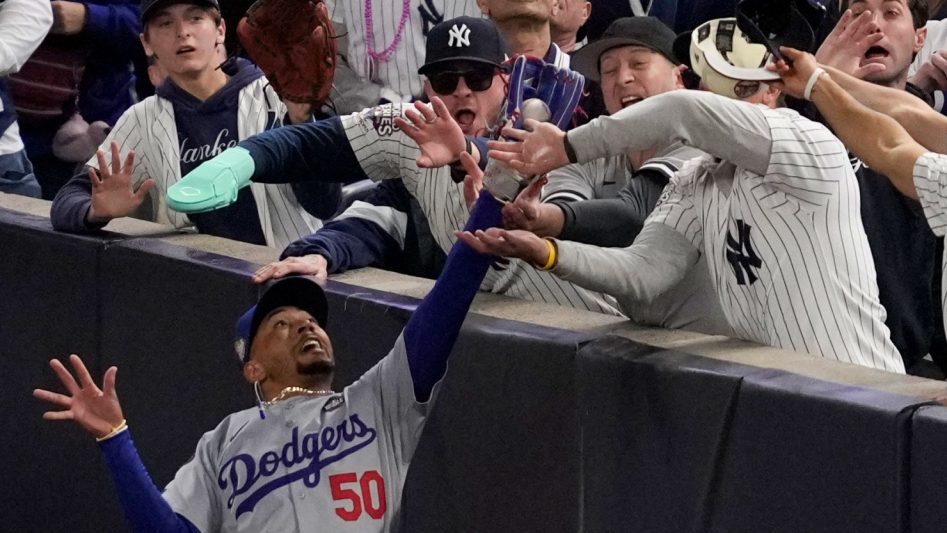
Oops. Cousins gave way to Nestor Cortes, a Yankee who hadn’t pitched since September. Lux and Edman took third and second on Ohtani’s long foul fly out, with Alex Verdugo making what might have ended up the play of the night as he lunged for the ball, caught it, then rolled over the fence before his momentum ended, allowing Lux and Edman’s advances.

Still. It put the Yankees an out away from winning it. That’s when Boone decided he was in far safer hands putting the Mookie Monster aboard to load the pads and hope Cortes could get Freeman and his still-ailing ankle to whack a game-ending grounder or swing into a game-ending strikeout.

“I know everybody’s focused on Ohtani, Ohtani, Ohtani,” said Cortes postgame. “We get him out, but Freeman is also a really good hitter. I just couldn’t get the job done today.” Cortes threw Freeman a fastball toward the inside of the zone—exactly where Freeman was looking for the pitch, knowing Cortes’s heater can ride like a horseman when thrown right.

The only place this one rode was into the right field bleachers.

Cortes threw the pitch he wanted to throw but, as he said postgame, didn’t get it elevated enough in the zone to keep Freeman from detonating it. Among other things, it caused a lot of Yankee fans to wonder why Weaver, who’d been rested well enough, didn’t get to work a second inning, or why sidearming lefthander Tim Hill wasn’t even a topic against the lefthanded swinger.

Freeman held his bat like the Statue of Liberty holding her torch straight up, until he was several steps up the first base line, then dropped it to take his trip around the pillows. Give us your tired, your not-so-poor, your not-so-huddled but standing-O Dodger Stadium mass yearning to breathe the World Series championship.

He became the fifth man in Series history to end a Game One with a home run, joining Gibson plus Adolis Garcia (Rangers, last year), Dusty Rhodes (1954 Giants), and Tommy (Ol’ Reliable) Henrich (1949 Yankees). But he’s the only man to end any World Series game with a slice of salami.

“When you get told you do something like that in this game that’s been around a very long time—I love the history of this game, to be a part of it, it’s special,” Freeman added. “I’ve been playing this game a long time, and to come up in those moments, you dream about those moments. Even when you’re 35 and been in the league for fifteen years, you want to be a part of those.”

Even when you’ve had a season pockmarked by injuries (hand, ankle) and compromised by your alarm as your youngest child fights Guillain-Barré syndrome. That was then: Max Freeman’s father admitting, “It just puts everything in perspective . . . I would gladly strike out with the bases loaded in the bottom of the ninth inning in Game Seven of the World Series 300 million times in a row than see that again.”

This was now: Max Freeman on the way to a full recovery according to the family’s doctors, and his father standing top of the heap for World Series Game One home run hitting. And just about everyone around baseball seemed to agree it couldn’t have happened to a nicer guy.

You might care to note, too, that every one of those teams getting a Game One-winning home run went on to win the Series in question. The ’49 Yankees in seven; the ’54 Giants in a four-game sweep; the ’88 Dodgers in five; last year’s Rangers in five. No pressure, you understand.

ALCS Game Five: Off, Guards

Juan Soto

Juan Soto and everyone in Progressive Field knew bloody well where what he just hit was going in the top of the tenth Saturday night . . .

A Guardian shortstop trying to will a tenth-inning double play before he had full control of the ball. A Yankee right fielder already in line for one of the biggest paydays in baseball history willing to wait for the fastball an off-speed-throwing Guardian reliever proved only too willing to provide.

Brayan Rocchio lost the handle on the toss leaving two Yankees aboard instead of side retired. Guards reliever Hunter Gaddis struck Gleyber Torres out but wrestled Juan Soto through six off-speed breakers and a 1-2 count before someone, who knows whom, thought Gaddis could sneak a fastball past Soto, if not lure him into an inning-ending out.

Good luck with that. Showing precisely why he’s in line for a mid-to-high nine-figure payday this winter to come, Soto got the fastball for which he probably prayed hard. Then, he launched it into the right center field seats with the Yankees’ fortieth American League pennant attached.

With one swing Cleveland’s Progressive Field went from extra-innings thrill to funeral parlour. If that was the ballpark mood, imagine the Guardians’ clubhouse mood when the game ended, the Yankees had a 5-2 ticket to the World Series in their pockets, and the Guardians could only think about how far they’d come in how little time only to feel the big wrench of having not quite enough.

“Because we were so close,” said left fielder Steven Kwan, referring to those in the Guards’ uniform, not necessarily the now-finished American League Championship Series, “it makes it sting a little bit more.”

For the Guardians and their respected rookie manager Stephen Vogt, it was the worst possible ending to an ALCS in which they’d made a better than decent showing—none of the five games was decided by a margin larger than two runs—but lacked the kind of putaway potency with which the Yankees seemed overendowed. On both sides of the ball.

Consider: Twice, in Games Four and Five, Vogt had the opportunity to keep Giancarlo Stanton from making mischief. He could have walked Stanton instead of pitching to him. He pitched to him. Stanton made him pay with interest.

Especially in Game Five, when Guardians starting pitcher Tanner Bibee kept Stanton in check in the sixth inning with nothing but pitches off the zone but not yet dispatched. That was the moment someone should have told Bibee one of two things: 1) Walk him, be done with it, then get rid of Jazz Chisholm, Jr., a far more feeble plate presence. 2) If you must pitch to Stanton, keep the damn ball off the zone.

Bibee tried. The slider aiming for the lower corner ended up hanging up under the middle. Stanton sent it hanging over the left center field fence. Tie game at two each.

Soto slammed home the pennant-clinching exclamation point (did anyone really doubt after that blast that the Guards would go quietly into that not-so-good gray night in the bottom of the tenth?), but there are reasons Stanton ended up as the ALCS Most Valuable Player award winner. In a word, he made it impossible for the Guards to contain him. Still.

This series: Four hits, every last one of them clearing the fences. Eight hits lifetime against the Guardians in the postseason, every last one of them bombs. Three set-clinching wins against the Guards (2020, 2022, Saturday night), and Stanton has dialed the Delta Quadrant in each one of them.

That was the last thing the Guardians needed in a set during which their biggest bopper, third baseman José (The Most Underrated Player in the League ) Ramírez, was practically the invisible man. Oh, he had two doubles and a homer in the series, scored a pair, sent three home, but on a Saturday night when the Guards needed every man to patch the sinking ship Ramírez went 0-for-4 with an intentional walk.

Ramírez wasn’t the number one Guard culprit, though. Their closer Emmanuel Clase recovered his regular season form too little, too late to make a big difference. Rocchio was a little too tentative at shortstop. The rest of the Guardian bullpen seemed gassed by the middle of Game Four.

None seemed more so than Cade Smith—who had the dubious honour of not being told to walk Stanton to set up a likely double play in the Game Four sixth, and being allowed instead to serve Stanton a rising fastball that didn’t rise enough for Stanton to miss planting it out of sight.

Those late home runs from Jhonkensy Noel and David Fry in Game Three sure seemed like last year’s news suddenly. And that Guardian bullpen dominance during the season sure seemed like a figment of somebody’s warped imagination now.

Clase and Smith didn’t surrender three homers all season—but they got ripped for three in this set. Gaddis couldn’t be touched with anything including subpoenas all season—but there he was on the wrong end of Soto’s proved-to-be-pennant-winning detonation.

The team called it, invariably, a season of growth. The Guardians did indeed grow into themselves this year, even if they now face of winter during which they may have to think of a tune-up or three. They own a generally weak AL Central division, but they can’t afford to perform a hot stove league disappearing act.

That they got here at all despite losing their ace starter Shane Bieber for the season to Tommy John surgery tells you something about their resilience and their will. Not to mention losing Triston McKenzie to so much struggling after his 2022 breakout that he was disappeared into the minors. Not to mention Logan Allen lost likewise. Alex Cobb and Matthew Boyd weren’t quite enough to make up for that.

So Vogt had to over-rely on his stellar bullpen. On the regular season they were bank. In the postseason their exhaustion collapsed them slowly but surely. To the point where there’s speculation now that Clase might be considered tradeable for some rotation reinforcement. Might.

The Guards needed more against these Yankees and simply couldn’t find or keep it. In Game Five, they needed more than the brothers Naylor collaborating on a run in the second and Kwan singling Andres Gimenez home in the fifth. A 2-0 lead with elimination on the line isn’t enough against these Yankees.

Not that the Yankees took them for granted. Just ask their oft-criticised general manager, who’s had his job so long some Yankee fans might actually believe he was the guy who first hired Miller Huggins away from the Cardinals to manage them.

“I remember just going, ‘Oh my God’,” said Brian Cashman when Soto dropped the big bomb. “Did the prayer sign. And then knew that we had to somehow put them down in the bottom of the inning, because these guys don’t go easy.” Not even when Lane Thomas hit into the final out of the set, a long fly ball . . . to Soto himself in right field.

All that without Aaron Judge swinging one of the big Yankee bats. He managed to hit a pair out this ALCS but the Leaning Tower of 161st Street was otherwise one of the sleepiest Yankees at the plate. (5-for-31; thirteen strikeouts; two double plays.) His awakening in the World Series would be anything but welcome in the opposing dugout.

NLCS Game Five: A Mets blowout and a Dodgers gambit

Jack Flaherty

On a day he didn’t have it, Dodgers righthander Jack Flaherty had to take eight (runs in three innings) for the team while the Mets blew them out in NLCS Game Five, so as not to compromise manager Dave Roberts’ Game Six bullpen game plan.

If the Mets deliver what some still think is near impossible, and snatch the National League pennant right out from under the Dodgers, don’t be terribly shocked if the number one question on the lips of Dodger fans and others will be, “Why did Dave Roberts leave Jack Flaherty in to take a three-inning, eight-run beating in Game Five?”

The most likely answer—considering the Mets would go on to finish what they started and blow the Dodgers out 12-6, thus sparing their elimination for another day—is Game Six.

In a National League Championship Series during which each team has won its games by blowout, Game Five may yet secure a place among the least conscionably allowed pitcher abuse by any manager. Ever. Abuse nobody could have seen coming. Could they?

Hadn’t Flaherty, a comeback kid of sorts starting with the Tigers before his trade to the Dodgers at this year’s deadline, pinned the Mets with seven shutout innings in Game One en route the Dodgers finishing with a 9-0 opening thrashing?

Yes, he had. But in Game Five he didn’t have it. His fastball wasn’t terribly fast, his breaking balls could have been court-martialed for insubordination, and the Mets were only too willing to wait him out, wait for the balls coming into the meat of the strike zone or close enough, and pounce.

Now the 29-year-old righthander went from virtuoso extension of Dodger pitching’s consecutive scoreless inning streak this postseason to a piñata in five days. But Roberts didn’t want to reach into his bullpen unless he absolutely had to with a likely bullpen game looming for the Dodgers in Game Six.

Their starting pitching has been so compromised that bullpen games became necessary survival for them. Roberts is counting on his Game Six bullpen game to win the pennant for him. He knows these Mets aren’t quite pushovers, but he has to take the chance that, somehow, his bullpen bulls can help him win a pennant and save Walker Buehler to open a World Series.

The manager had better be right, because what the Mets did to Flaherty Friday could have been called human rights violations. They only began with surrendering a one-out, three-run homer to Pete Alonso in the bottom of the first.

Flaherty shook a leadoff double by Starling Marte off to get three straight second inning outs. But then came the third. Then came back-to-back walks (Alonso, Jesse Winker) to open. Then came Marte doubling into left field to send them both home. Two outs later, Marte came home on Francsco Alvarez’s single, Francisco Lindor tripled Alvarez home, and Brandon Nimmo singled Lindor home.

Leaving things 8-1 Mets—Kiké Hernandez scoring on David Peterson’s wild pitch in the top of the inning seemed almost an excuse-us run for a good while—and leaving Flaherty the fourth pitcher in postseason history to get himself torn for eight or more runs in a game  that would have meant a series clinch for his team. (The others: Hall of Famers Walter Johnson [Game Seven, 1925 World Series] and Tom Glavine [Game Six, 1992 NLCS], and Charles Nagy [Game Five, 1999 American League division series].)

On a day Dodgers center fielder Andy Pages homered twice (solo in the fourth, three-run bomb in the fifth), you could remove Flaherty’s eight-run bequest and the Dodgers would have won the game and clinched the pennant with a 6-4 tally. Flaherty didn’t look like his best self early enough, but this was as unconscionable as it could get.

Roberts even hinted postgame that Flaherty was dealing with a health issue. He didn’t specify what, and Flaherty hadn’t discussed it at this writing. He’s dealt with injuries enough in his career—repeated shoulder injuries, an oblique injury—which helped reduce him from a Cardinals super pitcher to a kind of journeyman who shows flashes of his old mound brio and pitches as much on heart as stuff.

That the Dodgers don’t need. Not after everything else bedeviling their starting pitchers this year.

The Mets, of course, are showing how easy it isn’t to kill them this time around. Even if their bullpen isn’t as strong or consistent as the Dodgers. Blow them out one day, get blown out by them the next. With the set returning to Los Angeles, the Mets face yet another arduous test, even if they do find ways to pick, peck, pounce, and pound the Dodgers’ Game Six bullpen parade.

That test, if they make it, is called Game Seven, in hostile territory.

But wouldn’t it be nice to see one or two NLCS games that won’t become blowouts? They’re fun when the team for whom you root does the blowing out, but a good hair raiser has its place as well. Just so long as the hair isn’t raised because of sloppy or shaky play.

NLCS Game Two: Knuke the Knack

Landon Knack, Mark Vientos

The wrestle between a Dodger reliever and a Met batter insulted by a bases-loading intentional walk ahead of him ends with Mark Vientos knuking the (Landon) Knack . . .

Let’s see. The Mets built a postseason rep for deploying serious weaponry when the games got late. But after a 9-0 blowout loss to the Dodgers in Game One of their National League Championship Series, the Mets struck early enough in Game Two. And, as things turned out, often enough, for a 7-3 series-evening Game Two win.

They struck first with one of their usual late-game demolition experts. This time, Mets shortstop Francisco Lindor wrestled Dodgers opener Ryan Brasier to an eighth pitch on a 2-2 count before sending that pitch into the right field bleachers to open the game. One inning later, with second and third, two outs, a second Met run home (RBI double), and rookie Landon Knack working the second for the Dodgers, they elected to put Lindor on to try their luck with Mark Vientos.

Said a broadcast announcer of Vientos: “As good as he’s been this year, nobody’s Lindor.” Said Vientos to himself, probably, knowing that he’s done damage enough for the Mets cause—he had a measly 1.674 with two home runs against the Phillies in the NLDS—Sure, he’s Francisco Freaking Lindor, but you’re gonna put him on thinking I’m a pushover for a third out? Boy, have I got a surprise for you, gentlemen.

It took Vientos a ninth pitch on a full count, but just like that he knuked the Knack.

Just like that, too, his blast over the center field fence had the Mets up 6-0, and they’d never really look back despite a Dodger run in the fifth and two in the sixth. Not on a night Mets starter Sean Manaea had the Dodgers stone frozen until Max Muncy punctured him for a fifth-inning solo bomb before he ran out of fuel in the sixth.

Two walks to open, a bases-loading fielding error at second base, and Manaea’s night was over. Mets manager Carlos Mendoza brought Phil Maton in to pitch. He got an almost immediate pop out from Will Smith. But he surrendered a two-run single to Tommy Edman, before getting Kiké Hernandez to dial Area Code 5-4-3 for the side and before any further Dodger damage.

The Mets tacked another insurance run on in the ninth with Starling Marte’s RBI single. But their bullpen held the Dodgers off admirably from the seventh forward. Even if Edwin Díaz had to channel his inner Craig Kimbrel in the Dodger ninth with a leadoff single (Andy Pages) and a walk (Shohei Ohtani) before striking the side out swinging to secure it.

All most of the Mets seemed to want to talk up, other than sending the NLCS to New York even-up, was Vientos leaving Dodger manager Dave Roberts with an omelette on his face.

“There’s one thing that Mark doesn’t lack,” chuckled Lindor himself, “and that’s confidence. That’s who he is. I’m glad he took it personal.”

“I didn’t think he was going to give me a fastball,” Vientos said of Knack, who’d fed him a diet of sliders four straight, two of which he let go and two of which he fouled off. “My approach was to see a heater up, but I wasn’t expecting heater. I thought I was going to get a slider and I was just going to poke it in the hole.” But he got the fastball at last. “Yeah, I wasn’t going to miss it,” he said.

The Dodgers did win a bullpen game in their division series conquest of the Padres. But that was before one of their key high leverage men, Alex Vesia, was lost for the rest of the postseason thanks to a side injury. And, before one of their others, veteran Daniel Hudson, let Roberts know he was still sore from a twenty-pitch eighth inning in Game One, available only if a dire emergency presented itself.

Roberts got three innings’ shutout relief from Brent Honeywell, Jr. and two innings’ one-run relief from Edgardo Henríquez Monday night. Second guessers might wonder why he didn’t turn to either of those instead of toward Knack, a 27-year-old rookie with a 3.83 strikeout-to-walk ratio on the regular season but a tendency toward surrendering the long ball, as in fourteen bombs in 69 innings.

Still, Roberts did manage to spare some of his other medium-to-high leverage for the New York leg, where the Mets and the Dodgers pick up after a day’s travel and rest. And, with three of those higher-leverage men, Blake Trienen, Michael Kopech, and Evan Phillips, all on four days rest. Considering the Dodgers’ starting rotation took such big hits this year they that have to think of bullpen games now, they may face another one in a Game Six if the game’s needed.

And, by then, the Mets may have figured enough out about working, hitting, pitching, and sneaking their ways around these Dodgers to make it irrelevant. May. They know the series isn’t won just yet. But they also have the home-field advantage now.

Maybe the Mets won’t get a shot at knuking the Knack again too soon, but don’t dismiss their home audience from their chances, either. Citi Field can make Dodger Stadium resemble a crypt when need be.