“Let me wear this uniform one more day!”

2019-06-10 DavidOrtiz2004ALCS

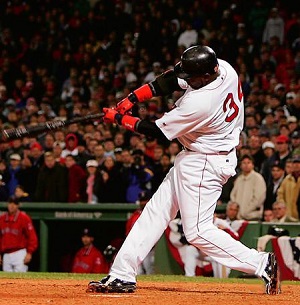
David Ortiz hits the winning bomb,  Game Four of the 2004 ALCS.

Baseball was stunned to learn retired longtime Red Sox superstar David Ortiz was ambushed and shot in the back outside a Santo Domingo nightclub Sunday. His father has said Ortiz is in stable condition following surgery to remove parts of his intestine and his colon as well as his gall bladder.

Aside from prayers for his recovery, I can think of no tribute other than to republish the last essay I wrote about Ortiz, who was responsible for so much Red Sox success after the franchise incurred so many surrealistic failures over its long, storied history. This one’s for you, Big Papi . . .

“Let me wear this uniform one more day!”
(12 October 2016)

Both American League Championship Series combatants get there by way of division series sweeps. For the Indians, it had to be a little extra special to get there by sweeping the Red Sox.

Twelve years ago, Indians manager Terry Francona managed an entirely different club of Red Sox to the Promised Land the franchise hadn’t seen since a kid named Ruth was in the starting rotation.

That was then: Francona’s charges had to figure out a way to keep an entirely different gang of Yankees from sweeping them out of the ALCS when they were down to their last out. This is now: His Indians — who haven’t seen the Promised Land since the Truman Administration — will have to figure out ways to keep the Blue Jays’ bats quiet and arms at bay.

It wasn’t supposed to be that simple against the Red Sox, was it? Even as youthful as they’d become?

But who could bargain that the formidable Red Sox youth corps who’d all but carried the Olde Towne Team to the postseason in the first place, pocketing the American League East to get there, would finally run out of fuel?

As adroitly as Francona shepherded his Indians, especially his bullpen, Red Sox manager John Farrell turned out to have his hands full with young players getting their first tastes of postseason play and a grand old man, who’d meant so much to the franchise’s championship revival for three World Series rings worth, finally spent by the time the postseason arrived.

Rookie left fielder Andrew Benintendi had a decent first trip, going 3-for-9 overall, but all three hits came in Game One, including a solo home run to lead off the third and give the Red Sox a 2-1 lead that lived for exactly that half inning — before the Tribe hit three homers in a sequence of four plate appearances in the bottom of the inning, before Francona answered a too-close 4-3 Indians lead by going to Andrew Miller when starter Trevor Bauer was spent in the fifth.

But Mookie Betts, a young sprout and a Most Valuable Player award candidate, finished 2-for-10 in the series and found himself struggling to adjust when he realised the Indians plan was to keep pitches out of his reach. Fellow young sprout Jackie Bradley, Jr. struck out in seven of his first nine at-bats and had only one hit all series long, a single to right in the Game Three ninth.

And Xander Bogaerts, first seen in 2013 in brief flashes including in the World Series, finished the set 3-for-12 overall, seeming to spend most of his plate time trying to find the target on sliders all over the place.

The homegrown Red Sox trio learned the hard way that your first trip to the postseason can turn into your worst nightmare.

“It’s a great experience, a lot of pressure,” said Bogaerts, whose brief 2013 Series sightings weren’t quite the equal of being thrown full tilt into the postseason fire. “But we have to learn how to control it, how to think in that moment. Just not overthinking a lot of stuff. Just trying to be in the moment and being focused.”

Veteran second baseman Dustin Pedroia, who’d been there/done that himself, concurred. “I think the tough part is you play every day during the year and then you have a few days off,” he told reporters about the young trio’s initiation. “You wait different times between games. It just throws you out of whack. I think they didn’t know what to expect out of that because it is different. It’s hard to get into a rhythm.”

Manager John Farrell, who shepherded the 2013 Series winner, gets it.

“There’s been a lot of conversation for the first-year guys, for the guys going through it for the first time, and not just with the staff but with their teammates,” he told reporters. “But there’s the old adage: You can’t replace experience. There’s a different feel to it. The fact that we had three days down, a later [Game One] start, five guys in our lineup being their first postseason, there were some things that were firsts, and I’m sure that lent to swinging at far too many pitches below the zone and above the zone.”

“Now we kind of know what to expect,” said Betts, rather thoughtfully, when the sweep was finished. “It’s going to be really important in the years going forward. We’ll know what to expect and how to handle adversity and how to go about the games and whatnot. It’s going to definitely be a positive.”

Attitudes like that should carry this coming generation of Red Sox back to postseason contention next year and for several seasons to come. But they’ll miss the big man.

David Ortiz won’t be retiring as a World Series champion. He won’t even see one more American League Championship Series. He’d never admit it, but just maybe, as much fun as it might have been for him to bask in the farewell tributes other Show teams gave him in his final season, it finally wore him down.

His final plate appearance? A four-pitch walk from Indians closer Cody Allen. It triggered an eighth-inning rally that put Fenway Park on gleeful edge for awhile, at least to the extent that Hanley Ramirez moved him to second as the potential tying run with a bullet single to left. Then Bogaerts lined out just as sharply to Indians second baseman Jason Kipnis, one of the Tribe’s Game 1 bombardiers.

He got a final round of twenty-one guns from the Fenway faithful when it was over and the Red Sox were going on winter vacation. And loved it. Tipping his cap, he tried to keep a stone face but his tears betrayed the effort.

“Those moments, they are always going to be special. They are always going to stay with you,” said the man who left Red Sox Nation with about a hundred times more special moments. “I’ve been trying to hold my emotions the best I can, but that last second I couldn’t hold it no more.”

“He’s helped us in so many ways,” Pedroia said. “We wanted to win the World Series and send him out the way we all wanted to, but that didn’t happen.”

He’ll have to step into the next part of his life without a fourth World Series ring. But Ortiz knows how blessed he’s been in baseball terms. Most never get a single Series ring, never mind the love of a city that Ortiz has known.

And he left the younger Red Sox something, too. In the Game Three sixth, with the Indians up 4-1 and Pedroia on third, Ortiz battled Miller, who’s become the Indians’ relief star this postseason thus far. The big left-handed slugger wrestled the big left-handed lancer and finally hit a low-flying line drive to center field. Indians sub centerfielder Rajai Davis caught it practically at his knee.

It was enough to send Pedroia home with the second Boston run. If only it could have been more. When he came off the field for a pinch runner in the eighth, he was heard to holler at his teammates, “Put me back in it! Let me wear this uniform one more day!”

They tried with two gone in the ninth. Bradley singled and Pedroia wrung out a walk off Indians closer Cody Allen, but Travis Shaw wrung a full count for naught as he flied out modestly to right field.

So Ortiz settled for telling the younger team he would now depart to be proud of having gone from last to first in the AL East on the regular season and build on it. Even if he wasn’t going to be there. Except maybe in spirit.

Then, he settled for one more bath of Fenway Park love on a night it seemed to hurt Red Sox Nation less to lose the division series in a sweep to a remarkable club of Indians than to realize the big man with the big heart who often held Boston’s hand when the city needed him most (This is our f@cking city! he bellowed to a city bludgeoned by the Boston Marathon bombing) and wanted him best.

And Francona, who’d never dismiss the meaning of the two World Series rings to which he managed the Red Sox, rings he’d never have won without Big Papi, is probably telling his own youthful enough Indians that right there was the example of what you might do when the rest of the world has its doubts. The Indians will need a big shot of that going forward now.

It’s deja vu all over again

2019-06-09 JoeyGallo

Joey Gallo, Texas Ranger (and absolutely no relation to the legendary New York wiseguy): until straining his left oblique last month, this season’s likely king of the three-true-outcomes . . .

Today’s fan and observer from the old school laments two things primarily about today’s baseball: the three-true-outcomes brand of home runs, walks, and strikeouts uber alles; and, the parade of pitchers paddling in and out of games based upon analytic matchups. Enough of them think it’s ushering in the end of the world as we knew it. And I probably had the first four words of the preceding sentence wrong.

Aside from how new it isn’t—the big power-big strikeout game wasn’t invented in this decade, or in the era of actual or alleged performance-enhancing substances—I’m going to lay down a bet that you can’t show me any generation of baseball in which someone couldn’t call himself justified in thinking the game was no longer what it “should” be.

(Quick aside: How do Joe and Jane Fan reconcile it when they’re tickled to death watching a pitcher strike out ten or more hitters in a game but they’re furious over the team striking out ten or more times in the same game?)

Allow me to share a passage written by a former third baseman and manager. I’m pretty sure you’ll think at first that it comes from someone who played or managed the game within the past ten or twenty years:

Baseball today is not what it should be. The players do not try to learn all the fine points of the game as in the days of old, but simply try to get by. They content themselves if they get a couple of hits every day or play an errorless game. The first thing they do each morning is to get the papers and look at the hit and error columns. If they don’t see them, some sportswriter gets a terrific panning, of which he never hears.

When I was playing ball, there was not a move made on the field that did not cause every one of the opposing team to mention something about it. All were trying to figure out why it had been done and to watch and see what the result would be. That same move could never be pulled again without every one on our bench knowing just what was going to happen.

I feel sure that the same conditions do not prevail today. The boys go out to the plate, take a slam at the ball, pray that they’ll get a hit, and let it go at that. They are not fighting as in the days of old. Who ever heard of a gang of ball players after losing going into the clubhouse singing at the top of their voices? That’s what happens every day after the games at the present time.

In my days, the players went into the clubhouse after losing a game with murder in their hearts. They would have thrown out any guy on his neck if they had even suspected him of intentions of singing. In my days the man who was responsible for having lost a game was told in a man’s way by a lot of men what a rotten ball player he really was. It makes me weep to think of the men of the old days who played the game and the boys of today. It’s positively a shame, and they are getting big money for it.

That was from Bill Joyce, a National Leaguer of the 1890s, quoted in the 1916 edition of The Spalding Base Ball Guide. As the gentleman described in the next passage might say, you never believe anyone did or said anything before they did.

With apologies for deploying “he” instead of the man’s real name just yet, here is the next passage. And, an advisory: think of “odds” in the following passage as “the metrics” in today’s game, and be advised that in his later years he spoke very often about on-base percentages, too:

[I]n talking about “percentage baseball,” [he] said, “Percentage isn’t just strategy. It’s execution. If a situation calls for a bunt and you have a batter who can’t bunt, what’s the percentage of bunting?”

He wanted players who could do things, who could execute . . . “If you’ve got a number of good men setting around on the bench you’ll do yourself a favour playing them, because every time one of my front players got hurt I noticed the fella I stuck in his place would bust out with hits. Then just about the time he slowed down he’d oblige me by stepping in a hole and another fella would take his place and hit. I decided I’d never count on one player taking care of one position for an entire season. If you’ve got two or three men who can’t play anyplace pretty soon you’re gonna run out of room for pitchers, and that’s why you’ve got to have players who can do more than one thing” . . . 

He got pleasure out of baseball, sheer joy when it was played properly. After a Dodger-Yankee World Series game that matched [Eddie] Lopat and Preacher Roe, two smart pitchers who used guile and control with consummate skill, [he] said, “Those two fellas certainly make baseball look like a simple game, don’t they? It makes you wonder. You pay all that money to great big fellas with a lot of muscles and straight stomachs who go up there and start swinging. And [Lopat and Roe] give ’em a little of this and a little of that and swindle ’em.”

He liked pitchers like that, men who could “throw ground balls,” low pitches that batters tended to hit to infielders who could convert them into double plays. He relished double plays and was always looking for deft second basemen who could “make the pivot.” He called the double play the most important play in baseball. “It’s two-thirds of an inning!” he’d say. “One ground ball and two! You’re out of the inning.” For the same reason, he used the sacrifice bunt sparingly, because when you sacrifice you give away an out, and an out is valuable.

He needed players who could do things to make his kind of baseball work . . . And he didn’t like to have to rely on the same eight fielders throughout a game. He understood odds. He disliked playing his infield in to cut off a run, fearing that the defensive gain (a shorter throw to home) was more than offset by the defensive loss (more batted balls that could flit between infielders for base hits). “Playing your infield in,” he said, “turns a .200 hitter into a .300 hitter.” He wanted the best odds he could get, every inning . . .

[He] used his bench. (“We’re paying twenty-five men,” he’d say, “we might as well let them earn their money”.) He didn’t have substitutes around just for emergencies. The process seems so logical that those familiar with the way [he] operated feel a vague sense of shock nowadays when they see a major league team come into the ninth inning behind a run and send up to bat the same weak-hitting shortstop and the same weak-hitting second baseman who have played the entire game. Where are the pinch hitters? Where are the replacement fielders? As a matter of fact, [he] probably would have hit for them long before the ninth inning. If he was up against a competent pitcher and suddenly saw an opening, he didn’t wait for a late inning to pinch hit. If, say, the leadoff hitter in the fifth inning got to second base on a throwing error by the shortstop, and the weak-hitting end of his batting order was coming up, [he] would go at once to his pinch hitters, one after another sometimes, probing, pushing, improving the odds of getting that run in from second. Even if he didn’t succeed, the pressure he put on the pitcher could turn an easy inning into a tough one and possibly make it easier to get to him the following inning.

2019-06-09 CaseyStengel

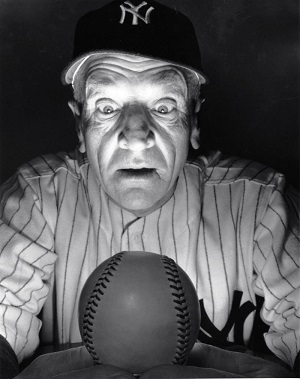
Casey Stengel, who didn’t need a crystal (base)ball to tell him, “Baseball is percentage plus execution.”

That’s from Robert W. Creamer in Stengel: His Life and Times, published in 1984, almost a decade after Stengel’s death. And people wondered why they couldn’t beat Stengel’s Yankees even if they’d snuck into their hotel rooms and broken their legs.

Maybe the nearest thing Stengel’s had to a disciple in the post-Stengel era was Tony La Russa. And maybe, if allowed to manage in today’s game, Stengel would have been either renowned (or denounced) as a human computer or taking to the computer the way La Russa did around the time Creamer’s biography appeared.

Now, allow me to share one more passage:

I have always been a fellow who liked to see efficiency rewarded. If a pitcher pitched a swell game, I wanted him to win it. So it kind of sickens me to watch a typical pastime of today in which a good pitcher, after an hour and fifty minutes of deserved mastery of his opponents, can suddenly be made to look like a bum by four or five great sluggers who couldn’t have held a job as bat boy on the Niles High School scrubs . . .

. . . I mean it kind of upsets me to see good pitchers shot to pieces by boys who, in my time, would have been ushers. It gnaws at my vitals to see a club with three regular outfielders who are smacked on top of the head by every fly ball that miraculously stays inside the park—who ought to pay their way in, but who draw large salaries and are known as stars because of the lofty heights to which they can hoist a leather-covered sphere stuffed with dynamite.

2019-06-09 RingLardner.jpg

Ring Lardner.

Ladies and gentlemen (or sirs and ladies, as he might have written in his time), that was Ring Lardner, writing in The New Yorker in 1930. When the live ball era was a decade old. Admitting the live ball and not the Black Sox scandal soured him on the game he loved and graced with his prose.

“In other words,” wrote Allen Barra in That’s Not the Way It Was, “in an irony as sharp as any in Lardner’s stories, Babe Ruth, the man credited with saving baseball after the Black Sox scandal, is the man who helped ruin it for Ring Lardner.” Also in Lardner’s words, later in “Br’er Rabbit Ball,” as a matter of fact:

Well, the other day a great ballplayer whom I won’t name (he holds the home run record and gets eighty thousand dollars a year) told a friend of mine in confidence (so you must keep this under your hat) that there are at least fifteen outfielders now playing positions in his own league who would not have been allowed bench-room the year he broke in. Myself, I just can’t stomach it . . . 

“Even before 1919,” Barra wrote, “Lardner had already been worn down with the daily grind of beat writing with its train travel and deadline pressures. In any event, he did continue to write about baseball well after 1919, though always on special assignment.” Including “Br’er Rabbit Ball,” which was republished two years ago in The Lost Journalism of Ring Lardner.

All the foregoing leaves us with what, then? Well, it leaves us to remember certain baseball arguments have always been with us; and, certain baseball fans will always lament the actual or alleged loss of the game they used to know. (Why they’re not lamenting the maple bats that hit balls juiced or otherwise harder as loudly as they lament today’s reputed ball escapes me for now.)

And, it leaves us to remember that Chicken Little will never be baseball’s invisible barometer or unseen/unheard self-appointed town crier. It’s deja vu all over again.

We still have too many unwritten rules around here

2019-06-07 MattLipka

Matt (Death to Bunting Things) Lipka about to drop the bunt heard ’round the Twitterverse . . .

There’s no better time to ponder a new book about baseball’s unwritten rules than in the aftermath of a textbook example showing the intellectual barrenness of most of them. The example happened Wednesday night, when the Trenton Thunder, a Yankee AA farm team, batted in the top of the ninth against the Hartford Yard Dogs.

Long story short: The Thunder’s Matt Lipka batted against the Yard Dogs with one out and the Dogs up 3-0. The Dogs were on their fourth pitcher, trying to finish the combined no-no, when Lipka dropped as delicious a dribble bunt as you’re ever going to see. He caught the Dogs so off guard that he almost could have walked to first to beat it out.

OK, that’s a slight exaggeration. The further bad news in terms of the game itself was that the Thunder couldn’t continue any overthrow of the Yard Dogs. And when the 3-0 win held up, the benches emptied. Nothing much came of that, apparently. A lot of milling, a bit of barking, maybe a couple of inadvertent shoves. Maybe.

Then the story hit social media running the way Lipka did up the first base line. And now the Yankees themselves are in the mix. NJ.com writer Mike Rosenstein reported Friday morning that the Yankees are investigating death threats leveled toward Lipka on Twitter and elsewhere.

Don’t the Yankees have enough to do staying very much alive and well in the American League East despite a plague of injuries enough to make Yankee Stadium look more like St. Elsewhere than a ballpark? Are the Sacred Unwritten Rules so sacred that the idiot brigades can throw down death threats against a 27-year-old minor leaguer for breaking one of them?

Except that Lipka didn’t exactly break one when he bunted that night. “Tradition says you don’t,” writes Bleacher Report‘s Danny Knobler in his new book, Unwritten: Bat Flips, the Fun Police, and Baseball’s New Future. “Do it against the wrong pitcher in the old days and you were likely to get a fastball in the back (or an even worse spot) the next time up.”

Like so many other things, it’s much more complicated now. It’s more or less accepted that bunting is fine if the goal is to win the game rather than simply to deny the pitcher his shot at history. If it’s a close game, your team needs baserunners, and bunting for a hit is part of your game, go right ahead. If it’s 7-0 with two out in the eighth, that might not be the best spot for it.

Now with the Astros, Justin Verlander had something close to such an experience when still a Tiger in June 2017, when Jarrod Dyson, then with the Mariners, stood in at the plate while Verlander took a perfect game bid into the sixth with one out and a 4-0 lead. The would-be perfecto became won’t-be when Dyson bunted and beat it out.

Verlander was far more upset about the three-run rally Dyson’s bunt hit began that helped turn the game into a 7-5 Mariners win, Knobler writes. Said Verlander: “It was a perfect bunt. That’s part of his game. I don’t think it was quite too late in the game given the situation to bunt, especially being how it’s a major part of what he does. So I didn’t really have any issues with it. It wasn’t like I got upset about it.”

Verlander at least was still in the game. The Yard Dogs’ would-be no-no was a four-man effort by the time Lipka checked in at the plate. With a measly three-run lead they had less call to fume when Lipka bunted and ground his way aboard in the bottom of the ninth than Verlander would have had if he’d fumed over Dyson in the sixth.

Lipka had every incentive to try something, anything to kick the Thunder into gear. He was the lineup’s number nine hitter and with one out reaching base safely handed things to the top of their order. The traditionalists might swear the proverbial blue streak but the last time I looked the object of the game was getting runs on the board.

Squeal all you want about respect for the game. Now tell me that trying to win isn’t the ultimate respect for the game.

Yard Goats reliever Ben Bowden pitching that ninth had one job: get Lipka and anyone else in Thunder threads out. Lipka with one out and a three-run deficit had one job: get his tail on base by hook, crook, or anything else he could think of. He did his job; more’s the pity that his mates to follow couldn’t get theirs done.

And, as Yahoo! Sports writer Chris Cwik notes, “None of that really matters when we’re talking about death threats, though. No matter how you feel about the unwritten rules of baseball, there’s never any reason to threaten harm—or death—on a player. That is never an acceptable or appropriate response.”

Good thing the Yard Goats didn’t think of putting an overshift on against Lipka. They’d have looked even more foolish if he saw that gifted expanse and decided, “Oh, thank you so much!” before bunting one or grounding one in that direction.

Hark back to last season. When the Angels’ Andrelton Simmons batted against the Indians’ Corey Kluber with one out in the fifth and the Angels down 2-0 and, by the way, Kluber, too, with a no-hitter in the making. Simmons caught Indians third baseman Jose Ramirez playing far too deep and, you guessed it, went for it on the first pitch, dropping a beauty up the third base line.

The Indians and no few others hit the ceiling over the bunt, not over Ramirez playing so deep he’d practically dared Simmons to avoid thinking about it. And after a followup strikeout, AL Rookie of the Year Shohei Ohtani sent one over the left center field fence. The Angels won the game in the thirteenth when former Indian Zack Cozart hit one on a full count into the left field bullpens.

Hark back to last season, too, when the Twins’ Jose Berrios had a one-hitter in the making and a 7-0 lead in the ninth. Orioles catcher Chance Sisco—who just so happened to have accounted for the only Oriole hit of the game to that point—might not have thought of anything cute if the Twins hadn’t overshifted on him and, as Ramirez sort of did with Simmons, handed him the left side of the field on a platter.

Twins second baseman Brian Dozier fumed after the game that he’d have said something to the Sisco kid on the spot “but they have tremendous veteran leadership over there,” after Sisco dropped a bunt and didn’t even have to flap his wings flying to beat it for a hit. Somehow, Berrios survived a followup walk and hit to finish the 7-0 win, anyway.

As I wrote then, did the Twins think Sisco was only supposed to take it as an April Fool’s Day joke and thank the nice Twins by hitting it right into their packed right side and make his out like a good little boy?

But nobody to my knowledge sent Dyson, Simmons, or Sisco death threats over their bunts. Nor did any such thing happen to the Phillies’ Domonic Brown in 2014 when—with one out in the fifth, the Padres up 1-0, and the Friars  overshifting on him as well—he took care of Andrew Cashner’s would-be no-no with a bunt. Even though the Petco Park crowd booed Brown lustily and Cashner stared Brown down.

Knobler writes that Padres manager Bud Black wasn’t exactly one of the outraged, perhaps knowing that Brown reaching base represented a potential tying run. “There was more grumbling in the stands than in the dugout,” the skipper said. “Our defensive metrics say we’re going to shift on this fellow. He’s playing the game.”

“[T]here’s no rule against bunting for a hit, and no unwritten rule against it, either,” Knobler writes. “There’s absolutely nothing suggesting teams can’t bunt for hits when the pitcher is 37 years old, has bad knees, and is overweight.”

He’s talking about you, CC Sabathia, who pitched a small fit when Eduardo Nunez of the Red Sox bunted to try for a one-out hit in the first inning off you at the end of August 2017. You, who ended up having to wiggle out of a ducks-on-the-pond jam of your own making—after you walked Andrew Benintendi and Mookie Betts back-to-back to follow Nunez—by striking out Xander Bogaerts and Rafael Devers back-to-back.

“It’s kind of weak to me,” Sabathia huffed after the game. “I’m an old man. They should go out there and try to kick my butt.” Which in that context may or may not mean he thought they should really have tried to kiss his butt.

How about climbing all over his third baseman that day, Todd Frazier, for the throwing error that helped Nunez reach first in the first place? And—you guessed it again—it was a game the Yankees went on to win, 6-2.

So far as I know, though, Nunez wasn’t subject to death threats, either. Considering the history between the Olde Towne Team and the Empire Emeritus, and no few of either team’s fans, that by itself may qualify as a genuine miracle.

“It was a wacky war”

2019-06-06 YogiBerraNavy

A well-circulated colourising of Yogi Berra’s formal Navy portrait.

Yogi Berra once gave a half-puckish beginning explanation as to how he became part of D-Day, World War II’s major Allied invasion of Europe from the Normandy beaches, as an eighteen-year-old Navy seaman. He made it sound like relief from boredom. As he so often did with his fabled Yogiisms, he had a knack for good humoured understatement.

Something still seems to be missing from America since Berra’s death almost four years ago, which was also more than a year and a half after his beloved wife, Carmen, preceded him. And there may be worse reasons to think about the Hall of Fame catcher and personality than remembering how he got himself aboard a Navy rocket boat in time to be part of D-Day.

Berra was a Yankee prospect playing for their Norfolk, Virginia farm in 1943. Norfolk also just so happened to be the headquarters of the Fifth Naval District. Which meant it was also the governing center of the Navy’s Atlantic Fleet. Which also meant Norfolk and nearby Newport News overrun with sailors and civilian defense workers, an estimated 750,000 of them in a pair of towns whose populations combined weren’t quite as large as that of the Bronx.

His biographer Allen Barra, in Yogi Berra: Eternal Yankee, has written that the lad’s first real problems in Norfolk were long lines at the movie houses he loved and trying to stretch his $90-a-month minor league salary. “I never got too hooked on cigarettes, because I couldn’t afford them,” he once said. “Maybe starvation kept me from getting cancer.”

Once, knowing his team’s two other catchers were ailing, Yogi launched a unique version of a strike, telling his manager he wasn’t well for lack of food and the ploy worked toward getting him a $5 a month raise. His mother, Paulina, helped by slipping him a few extra dollars in the mail with instructions not to tell his father. And Berra became popular enough on the Tars that one ardent fan, a lady, provided him a full hero sandwich of salami and provolone every Sunday game.

That sandwich, Barra wrote, “was for Yogi what spinach was for Popeye.” After he received the first such gift, he smashed twelve hits and drove in 23 runs in two games against Roanoke. (This was the doubleheader that prompted Carmen Berra to remember, “When I heard about the 23 RBI day, I figured he had a future.”) He played well enough to be able to think an equal or better 1944 would get him a Yankee call-up. “Yogi was looking forward to an explosive 1944,” Barra wrote. That’s a polite way to describe the one he got.

Berra knew only two things: 1) He’d be in military service soon. 2) He had no idea where. Told his draft papers were drawn back home in St. Louis, he asked for and got them sent to Norfolk. After the Tars played an exhibition game with the Norfolk Air Station (some of the Norfolk players included such Show men as pitchers Fred Hutchinson and Hugh Casey, outfielder Dom DiMaggio, and Yogi’s future Yankee teammate/fellow Hall of Famer Phil Rizzuto), he talked to a warrant officer at Norfolk’s Navy training station and took the man’s suggestion to enlist in the Navy.

When his boot camp in Maryland ended, his mother underwent surgery; he was allowed to be with her until she could return home. After that, Yogi went to Little Creek to train for the amphibious service. The routine otherwise was so hurry-up-and-wait that the kid relieved his boredom at the base movie theater and with the comic books he fell in love with. Then one night he was watching Boomtown, the Clark Gable-Spencer Tracy film, when the film suddenly stopped and the theater lights suddenly came back up.

Berra and all the other sailors in the theater were ordered to line up. Officers asked for volunteers—for rocket boat duty. None of the young swabbies had a clue about rocket boats but when someone called them rocket ships, Yogi perked up. The idea that volunteering in military service was tantamount to being very careful what you wish for hadn’t yet been programmed into his mental data base.

The boats, as Barra noted, “turned out to be small landing craft, LCSSs (Landing Craft Support Small), whose purpose was to spray rockets on the beach before troop landings. There were duller things to train for. Some of the men got the hint that they might be participating in a major troop landing, perhaps the invasion of Hitler’s Fortress Europe that the papers were always writing about.”

The sailors called the rocket boats big bathtubs. If you played with toy boats in the bath when you were a small child, try now to imagine having a bath with 48 rockets, one twin .50-caliber machine gun and two .30-caliber machine guns. The boats affirmed the aforementioned hints: their purpose in life was to hammer the Normandy beaches and clear the way for the troops’ landing crafts. Yogi and his fellows had a name for them: “The landing craft suicide squad.”

The rocket boatmen first went to Plymouth, England. Once again it seemed to be hurry up and wait. Three weeks after they arrived, though, Berra’s LCSS was attached to what was thought to be the smallest transport ship in the Coast Guard fleet, the USS Bayfield. It made for Normandy early on 4 June. The Bayfield carried six LCSSs. “Just before dawn, on the morning of June 6, 1944,” Barra wrote, “their rocket boat was lifted on the davits and lowered over the side and, in Yogi’s words, ‘expendable as hell, we headed in for Omaha Beach’.”

The LCSSs were the tiniest boats on the waters heading into firing position.

“It was scary,” Yogi would remember, “but really something to see. I was only eighteen, and I didn’t think anything could kill me. I didn’t know enough to be scared. I had my head up over the side of the boat all the time, looking around like it was the Fourth of July in Forest Park and after the fireworks we were going to go over and get some hot dogs and Cokes.”

Bless his innocent soul, Yogi probably had no idea how vulnerable the LCSSs were. The sides of those boats weren’t exactly thick. One errant enemy shell, especially one hitting any of the boats’ rockets, would have made not the Fourth of July hot dogs but them into duck soup. Berra’s peekings over the edges to see the show ended when his lieutenant advised him to put his head down if he had plans to keep it.

The LCSSs waited for their lead boat to fire a test and see if it reached the beach. If it did, the other boats would move in close. It did. And inimitably, Yogi described the boats moving in “closer than the hitter is to the left field [wall] at Fenway Park.” One and all of them began firing. “I couldn’t see all the bloodshed that they showed in the movie [Saving] Private Ryan,” he remembered years later, “but I did see a lot of guys drown.”

Berra’s and all the LCSSs did what they were sent to do. Well enough that by D-Day’s afternoon they could actually relax, though they were under orders to remain through 9 June for cover fire in the event the Nazis had ideas about the counterattack that never came.

They had more trouble from an anticipated storm smashing in on 8 June, battering the boats and even flipping Yogi’s over. Before that they had trouble through no fault of their own—a friendly fire incident. Three fighter planes appeared above and the LCSSs were under orders to shoot down anything flying below cloud level. The LCSSs fired and hit one plane. The pilot bailed and parachuted before the plane hit the drink. Yogi ordered his boatmates to keep him covered, expecting to hear a stream of German.

What he heard was a stream of English language swearing. The crew had shot down an American plane whose markings they couldn’t see in the murk of the storm. When the storm worsened, Berra’s boat flipped over. Try to resist the temptation to say that only Yogi Berra and his boat crew could survive D-Day just to get thatclose to drowning after the artillery stopped.

They hung on until they were rescued and returned to the Bayfield. A Nazi bomb fell near the ship but no serious damage occurred, according to Barra and others. Berra said later he was too tired to be scared. Years later, when he met D-Day’s mastermind, Gen. Dwight D. Eisenhower, he couldn’t bring himself to ask Eisenhower about the invasion. “I never talked about D-Day,” Yogi remembered. “It didn’t seem right, but now I wish I had.”

With good reason. Numerous sailors believed Eisenhower was aboard one of their ships on D-Day. This was because of Eisenhower’s soon-to-be-immortal radio message (You are about to embark on a great crusade) that was actually recorded at the 101st Airborne’s headquarters while watching the first Allied aircraft reach for the skies on that day. Even today, it sounds so clear that when you play it it sounds as though Ike’s telling it to you side by side as you’re about to hit the links.

Berra and his squadron got a break to rest at Portsmouth before going to Bizerte, the North African coastal town, and by 15 August 1944 he was part of the LCSS force hitting Marseilles and strafing hotels and other facilities co-opted by German forces. Berra’s boat was almost hit by mistake by a British shell that turned out to be a dud.

Berra himself got close enough to death when ships of the British Royal Navy behind the LCSSs fired at targets past the hotels and, while holding a rocket, one of his crew hollered to hit the deck. As he ducked under a gun mount, Yogi accidentally dropped the rocket. “It did not go off,” Barra wrote, “or you wouldn’t be reading this book.”

During a furious barrage, Berra got nicked by a bullet from a German machine gun before he manned his twin .50s and fired to cut down fleeing Nazis. As American troops landed, the locals swarmed the sailors with gifts and song. “It was a wacky war,” Yogi would remember. “A half hour after we were getting shot at by the Germans, the French were welcoming us.”

He rarely talked about his World War II experiences in the decades to follow. When he did so, even that provoked a little humour, as in the Los Angeles Times overhearing Berra talking to Hall of Fame pitcher Jim Palmer and Hall of Fame broadcaster Tim McCarver. Wrote the Times: “Yogi survived D-Day and George Steinbrenner, and all in forty years.”

He had to survive a more sensitive customer, though: his mother. After receiving a month’s leave for the Christmas holidays, Berra went home and showed his family his hard-earned decorations: a Distinguished Unit Citation, two battle stars, a European Theater of Operations ribbon, and a Good Conduct Medal.

Paulina Berra was already in tears as it was. Her boy also earned the Purple Heart when he was nicked by that Nazi bullet, but Yogi didn’t dare make the formal application for that medal. He figured that if Mama Berra knew what the Purple Heart really meant, she’d suffer a purple heart attack.

A thinker provokes about the thinker’s game

2019-06-03 InfiniteBaseball“This,” warns University of California Berkeley philosopher Alva Noë in his preface, “is a book about baseball by a philosopher. But do not be alarmed. It is not a work of philosophy, at least not in the conventional, academic sense.” Before getting to the meat of Noë’s Infinite Baseball, whose cover displays the charming twist of a baseball’s stitches into infinity’s symbol, I wasn’t sure whether to thank him or spank him for that.

But he does almost finish his preface by calling it a philosophical game after explaining his grounds for that. “It’s not a quantitative game,” he writes. “It’s a normative game, for its main concern is who deserves credit or blame for what.

Infinite Baseball is a small collection of essays written for NPR’s former science and culture Website 13.7: Cosmos and Culture. Noë goes forward to reassure that he is indeed writing as a philosopher about a game that is as metaphysical as philosophical, though Noë doesn’t say the metaphysical part.

Aside from thinking baseball’s main concern was one team putting more runs on the scoreboard than the other, I also get that Joe and Jane Fan in their ballpark pews or television seats often seem more animated by blame over a loss than credit for a win. So do Joseph and Janette Front-Office Muckety-Muck, who have the power Joe and Jane Fan merely dream of wielding, the power of the purge.

The italics in the aforequoted sentence were Noë’s. The timing of the book’s publication was impeccable: April Fool’s Day. Except that he isn’t kidding around when, in his more involved introduction, he says baseball is more than just the players on the diamond:

Baseball is also the practise of trying to understand what the men on the diamond are doing not only while they are doing it but in the larger setting of the game’s past and future. It is something that engages not only the coaches and managers and trainers but also the players and umpires and fans. Take away the reflection on and you are left with mere activity–with something robots could do. And that’s not baseball. Baseball without umps and coaches and fans and players trying to decide what’s happening on the field of play would no more be baseball than justice would be at work in a courtroom in which there were no parties to dispute vying with each other to resolve their conflict.

He also reminds us that an awful lot of what agitates the game’s fans and governors alike about certain contemporary bugaboos like time is an awful lot of bunk:

The idea that baseball is too slow is based on the premise that only explosive plays and big hits count as action. But baseball is more subtle than home runs and double plays. When the batter steps out of his box and fixes his batting gloves, or weighs his bat, or scratches around in the box, he’s not wasting time; he is surveying the situation before him, reading the signs, trying to figure out what pitch to look for. He is working. For the knowledgeable fan, these are moments of tactical complexity and high suspense. There’s a lot going on and there’s a lot for the spectator, together with the player, to try to appreciate. The same is true of mound visits by the coaching staff. In those moments, the coach is like the corner guy in a boxing bout; with his words he makes it possible for the pitcher to keep on pitching.

Noë thinks television obstructs that view to a certain extent, and to a certain extent he’s right. You suspect a lot of fans might be influenced by the scene in Bull Durham in which catcher Crash Davis, pitcher Nuke LaLoosh, the entire infield, and the bench coach confer on the mound—about things having little enough to do with the game and more to do with wedding gifts and religious sacrifice. It made for comic relief and distorted baseball. Real catchers and coaches won’t go to lengths that extreme to settle a pitcher down.

Baseball isn’t a perpetual motion sport, and Noë knows it. It provokes contemplation as well as drama; reflection as well as excitement. Perhaps the reason so many writers over so many generations took to baseball as an analogy of human life itself, above and beyond other games, is that they know life is not perpetual excitement. Even the most successful lives, normally, involve genuine excitement maybe a quarter of the time.

If I were to tell you nothing more than the Dodgers dropped fifteen runs on the Reds in the first inning, you might say, “Yep! That’s today’s baseball, and that’s just wrong!” You might assume the Dodgers, powerful enough in a high power era, absolutely bludgeoned the Reds. You’d be wrong. It wasn’t this year’s game. It was 21 May 1952 . . . when the Dodgers belonged to Brooklyn and played in a little temple called Ebbets Field.

And, except for Hall of Famer Duke Snider’s two-run homer off Ewell (The Whip) Blackwell to start the carnage, no other Dodger runner scored on a home run. Except for a pair of bases-loaded walks and a bases-loaded hit batsman, the remaining thirteen runs in the inning came home on singles. One homer-exhausted fan might look at that and have a hearty laugh. Another might see a swarm of tactical ground support awaiting the heavy bomber(s) that never showed up.

(Blackwell was lifted after surrendering a third Dodger run. Legend has it that no sooner did he return to the team hotel, leaving the park in disgust, than the Whip went to the bar, and saw two things: the television set showing the game still in the bottom of the first, and his own relief Bud Byerly coming into the bar after he’d surrendered a walk and four straight RBI singles. Baseball being a game of sometimes mordantly organic humour as well as metaphysical joy, you hope that’s a true story.)

You think the game qua the game is too slow for comfort? Ask yourself how you’re feeling when one team drops a 19-1 blowout on the other with most of the runs scoring in the first inning, and you still have eight more innings to watch. Other than two Dodger runs each in the third and the fifth, and one Reds run in the fifth (trivia buffs: it was Dixie Howell hitting a two-out solo home run), the rest of that game must have been a snooze. Bludgeoned into a nap. Right?

“It takes not only experience but also curiosity and patience to realise what’s at play in a baseball game,” Noë writes. Good luck with that, if you’re aware of the American prayer cited several hundred times to my knowledge in the past three decades: “Lord, grant me patience—and I want it right now!

Inside Baseball‘s first essay is called “Do We Need to Speed Up Baseball?” Noe, you might have guessed, says no way, Jose (Altuve and otherwise): “Players and spectators alike need to slow down and let baseball happen.” Its next essay is called “In Praise of Being Bored.” Stop snorting and think about it: “I say, God save us from today’s ramped-up, multi-interrupted, selfie-consumed, fast-paced world! We need to slow down. We need to turn off. We need to unplug. We need to start things and not know when they are going to end. We need evenings at the ballpark, evenings spent outside of real time.”

It isn’t A. Bartlett Giamatti (I need to think something lasts forever, and it might as well be that state of being that is a game; it might as well be that, in a green field . . . ) but it’ll work. Noe goes from there to ponder:

Instant replay. He’s a converted skeptic but still accepts the humanness of umpires.

Television. When it comes to baseball, Noë tolerates it—barely, because it leaves certain elements unseeable or undiscernable for all that it allows a viewer to see now as opposed to in its infancy.

Scorekeeping and performance numbers. He calls it all a “forensic” act, by which he doesn’t mean to equate it with performing an autopsy.

No-hitters and perfect games. Noë laments batters getting no credit for walks or taking one for the team to reach base otherwise; he also believes a perfect game—like a lot of other things credited to pitchers—is at least half a team accomplishment, however fun it is admiring a pitcher who pitched such a game.

Sabermetrics. He calls it (and the essay in which he addresses it, not always by name)  “The Numbers Game.” Noë finds it useful for true analysis and evaluation but not for controlling value. My own experience is that you’ll find as many sabermetric stat geeks declining to allow it to control all value as attempting to allow it. Makes for one of the great sub-pastimes of baseball: arguments.

Baseball language. It intrigues and amazes him that there remain those who think both are or should be finite. It also intrigues and amazes me that, in a collection of essays in which baseball language is a topic, he never once even thinks about Yogi Berra.

Pharmacy. Noë believes there’s not as much wrong as you think with baseball players and other athletes accepting pharmaceutical help, especially with injury recovery, especially when the governors of their sports tell them, in essence, “You can’t pick and choose your pain relief! Only we can pick and choose your pain relief.” (He also thinks there’s something weird when people object to people augmenting things their bodies produce with . . . things their bodies produce.)

He doesn’t address it, but my own question is whether there’s hypocrisy in Joe and Jan Fan not going “boo” when baseball’s governors approve team medical staffs administering a steroid known as cortisone—in such abundance as to risk long-term, post-baseball health—while they’re screaming bloody murder over which players sought steroids (and other actual or alleged performance-enhancing substances) by any other names.

As a society, we seem to have a totally incoherent set of values regarding the place of medicine and technology in the cultivation of athletic talent. We categorically prohibit the use of strength-building and injury-protecting PEDs, yet we allow surgical interventions like Tommy John (surgery) to become business-as-usual, letting pitchers use their body well beyond biologically sanctioned safety and performance specs.

Social media and the game. Noë wonders aloud whether the combination hasn’t produced “a whole new and very brutal kind of reality TV,” using the botched Mets trade of Wilmer Flores for Carlos Gomez in 2015—the news of which reached the fans in the stands before it reached the Mets’ social media-lacking then-manager, Terry Collins, whom Noe thinks proved “above it all” instead of “out of it”—as a microcosm in the middle of which the hapless Flores “was made to live out a social media lie.”

Within two days the Mets backed out of the deal (Gomez’s hip was an issue at the time; this year, he re-joined the Mets) and Flores punctuated his hoped-for reprieve with a game-winning home run off Nationals reliever Felipe Rivero. It helped launch the Mets’ stretch resurgence and the Nationals’ stretch fade. Go figure.

“The Matt Harvey Affair” (that, too, is an essay title)—no, silly, not the one that finally rousted the former Dark Knight out of New York last year, the one that left people “blindsided” in 2015 when Harvey (the nerve of him!) preferred to listen to his doctors (as a post-Tommy John surgery pitcher) and ease his workload until the postseason. And people wonder why when it comes to medicine baseball is more often The Daffy Doc than Dr. Michael DeBakey.

The knuckleball. Noë wonders why so few pitchers take it up in the beginning instead of as a last resort, since the pitch “can be so devilishly effective.” (He wrote the essay after R.A. Dickey, late-career knuckleballer, became the first making it his money pitch to win the Cy Young Award.) Baseball people still dismiss it often as just a trick pitch, a novelty pitch—despite Hoyt Wilhelm and Phil Niekro going into the Hall of Fame after making long careers throwing it. How many novelties are that tricky to master?

You’ll have to navigate your way through a few spells of awkward prose in the preface and the introduction (what? no foreword?) to get there, but Noë’s essays achieve the one thing baseball at its best and baseball writing at its best should achieve, even when it doesn’t convince or convert you so much as it interests you: Provoke thinking, re-thinking, arguing, and re-arguing. With far less animosity, and not a lick of the coarsely vulgar tongue that’s become epidemic in our public discourse.