ALCS Game Two: Rangers bent, not broken

Nathan Eovaldi

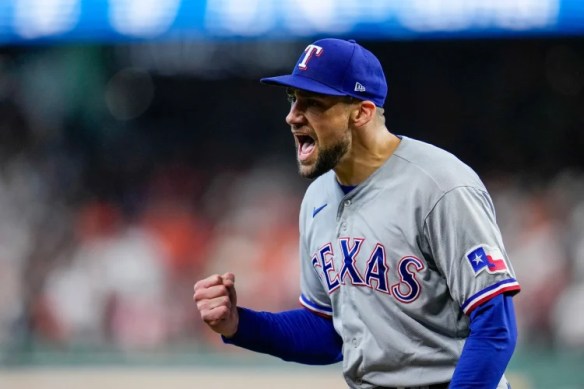
Nathan Eovaldi, after wresting the Rangers out of a bases-loaded jam in ALCS Game Two. It helped the Rangers go up 2-0 despite Houston bombardier Yordan Álvarez’s two-homer day.

The War for Texas is two games in. The Rangers have won them both, in Houston. Despite being bent a lot more in American League Championship Series Game Two than they were in Game One.

That’s what a four-run first, an arduous wriggle out of a bases-loaded/nobody out fifth-inning jam, and a gutsy four-out save does for you. Even on a day when Yordan Álvarez recovers from an apparent virus and a three-strikeout Game One to hit two bombs.

Álvarez turned out trying to play Game One through an ailment that left him unable to hold food down or avoid headaches, not to mention unable to sleep very much. When it came time for Game Two, Álvarez still knew something his team didn’t until game time: he was going to play Monday no matter what, and nothing short of house arrest would stop him.

And if only the Rangers hadn’t jumped all over Astros starting pitcher Framber Valdez in a four-run first inning, Álvarez’s two-homer Game Two might, maybe, have become something beyond just another tale he can tell his eventual grandchildren.

But it still took a large effort by the Rangers to keep the Astros from overthrowing them and sweeping the first Houston leg of this ALCS. Large enough to prove that you can bend but not quite break these Rangers, who held on tight to win Game Two, 5-4.

It took ten pitches and a throwing error from Valdez to put the Rangers up 4-0 before the game’s first out was recorded. With Nathan Eovaldi starting for the Rangers, Ranger fans could have been forgiven if they thought the rest of the game might, maybe, be something of a leisurely game.

Marcus Semien and Corey Seager opened by hitting the first pitch of each plate appearance for back-to-back singles, Seager’s a shuttlecock that landed before Astros third baseman Alex Bregman running out could reach it. Then it took Valdez pouncing upon Robbie Grossman’s dead-fish tapper back but bobbling it a moment before throwing wild past first, allowing Semien to score and leaving second and third.

Then came Adolis García lining a single the other way to right to score Seager, and Mitch Garver pulling a line single to left to score Grossman. Finally, Valdez nailed an out striking Josh Heim out swinging on three pitches, but Nathaniel Lowe replied almost immediately to follow by sneaking a base hit through the left side of the infield to score García.

That wasn’t exactly in the Astros’ game plan. Valdez finally struck Josh Jung out and got a fly out by Leody Taveras to end the inning. It made Álvarez’s first homer, a yanking drive into the second deck behind right field in the bottom of the second, a crowd pleaser but a mere interruption. Eovaldi went from there to sandwich a strikeout between two ground outs to third, the first of which took a grand throw by Jung from the foul side behind third base to get Chas McCormick by a step.

Nor was it in the Astro plan for Valdez to last only two and a third innings, after Heim led off the top of the third with a blast into the Crawford Boxes for the fifth Rangers run.

“I thought the quality of my pitches were good,” the righthander said through his interpreter postgame. “I think they were good and they maybe got a little bit lucky. There were a couple of balls that they didn’t hit well that fell for base hits a couple times. I tried going as far as I could.”

Valdez has a few more things to learn about luck. These Rangers prefer to make their own luck. They might attack with aplomb at the plate but they’re going to turn your mistakes into disaster, too. You’d better not call them lucky, either, when you’re the poor soul who mishandled and then threw away a potential double play grounder that might have kept the Rangers’ first-inning damage down to a small dent.

Bregman nudged the Astros a little closer back with a leadoff bomb ringing the foul pole in the fourth. Then Eovaldi had to shove his way out of a no-out, bases-loaded jam in the fifth by striking pinch-hitter Yainer Díaz and José Altuve out back-to-back before Bregman beat one into the ground toward third—where Jung, whose over-run of Jeremy Peña’s bouncer loaded the pads in the first place, threw him out at first by three steps.

Michael Brantley pulled the Astros back to within a pair with a sixth-inning RBI double. Josh Sborz relieved Eovaldi for the seventh and got the side in order, including a called third strike on Altuve to end it. Aroldis Chapman went out to pitch the eighth and, after a Bregman fly out to center and a Tucker ground out to second, the first pitch he threw Álvarez would be his last of the day, Álvarez lining it hard and fast into the lower right field seats.

“You can never count us out,” McCormick said of his Astros post-game. “We don’t ever quit.” That was true enough to compel Rangers manager Bruce Bochy to get Chapman out of there after Alvarez’s second launch and ask Jose Leclerc for a four-out save.

Leclerc shook off back-to-back walks to get McCormick to force José Abreu at third for the side, then dispatched the Astros in order in the ninth—the hard way. Peña’s deep fly to right collapsed into an out at the track. Díaz’s grounder toward third was stopped by Jung on the slide before Jung threw him out. Altuve’s fly to center was only deep enough to land in Taveras’s glove for the side and the game.

“We’ve had some chances to win some games,” said McCormick, painfully aware the Astros had several grand Game Two chances laid waste. “Usually we do come through with some big hits. We did earlier in the year and, this time around, we haven’t come up with that big hit.”

Indeed. The Astros have been 1-for-9 with men in scoring position all ALCS so far. And, out of their 24 postseason runs thus far this time around, Álvarez is responsible for eighteen of them, either scoring them or sending them home. But even he can’t thwart the Rangers by himself. Not the way these Rangers do things. Not when they can make a two-homer game by him a sidebar.

“We’re jumping on teams early,” Jung said postgame, “and that helps us settle in. Our pitching has been outstanding. You can’t ask for anything more than what they’ve given us.”

Eovaldi has the knack of transforming from a solid regular-season pitcher to a Hall of Fame-level pitcher in the postseason. Even if he wasn’t quite at his pure best in Game Two, he still had enough to keep the Rangers well ahead of the game by the time his outing ended. He now has a 2.87 ERA and a 2.60 fielding-independent pitching rate in nine career postseason series.

“Something just clicks for him,” his catcher Heim said postgame. “I’m not sure. Same preparation. Same mentality that he has had all year. Just something about big games that he loves.”

It may yet prove to be something Ranger fans will love for eternity and beyond. The Rangers are halfway to the World Series, still unbeaten this postseason, and going home to their own inviting playpen in Arlington. They were far better at home than on the road in the regular season—but now they’ve won seven straight postseason contests with six coming on the road.

“We’ll get ’em in Texas,” Astros manager Dusty Baker vowed after Game Two. Ahem. You weren’t exactly out of Texas in Games One and Two, sir. You’ve been gotten in Texas so far.
A pitcher’s lament, a manager’s triumph

Dusty Baker

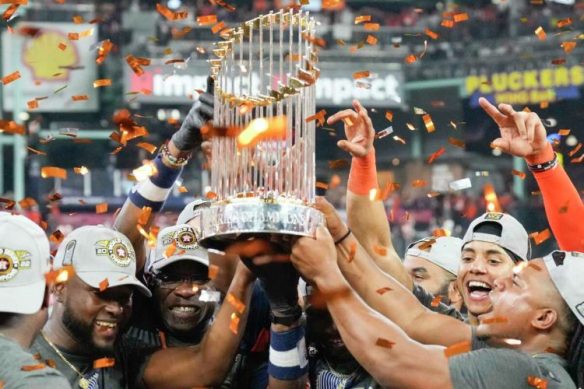
Astros manager Dusty Baker (second from left) joins his players—including Game Six starting pitcher Framber Valdez and World Series MVP Jeremy Peña (second from right), the first rookie to win that prize—hoisting the Series trophy after beating the Phillies 4-1 Saturday night.

If Jose Alvarado wants to find the nearest deep cave into which to make his residence until spring training, nobody should fault him. Not everyone can perform the impossible at will.

The Phillies’ redoubtable lefthanded reliever came into the bottom of the sixth of World Series Game Six with one key mission, take care of the Astros’ lefthanded munitions expert Yordan Alvarez with runners on the corners and one out. It might have been easier for Tom Thumb to scale the Empire State Building with a crosstown bus on his back.

This could have been construed as Phillies manager Rob Thomson believing he was still living a charmed life in his first two-thirds season on the bridge. Believing that a hard-won 1-0 Phillies lead could be kept in place or possibly enlarged the rest of the way.

Believing his righthanded starter Zack Wheeler wasn’t the right matchup for Alvarez looming with two occupied bases. Believing Alvarado would avoid the disaster into which he pitched when brought in for the same matchup in Game Five and hit Alvarez on the first pitch.

All Alvarez did now with a 2-1 pitch was send it over the farthest ledge behind center field, into some seats beneath a Blue Cross/Blue Shield advertising sign. All that did was sink the Phillies and yank the Astros to what they, and their fan base, needed in the worst way possible, a no-questions-asked, untainted World Series conquest.

Alvarado didn’t get beaten doing what he knew he wasn’t supposed to do. He didn’t get beaten serving a meatball without sauce. He got beaten throwing one of his best pitches, a nasty, shivering two-seam fastball, to a bomber who can and often does turn your best pitches into nuclear warheads no matter how they swivel up to the plate.

“Nothing moving. It didn’t move,” Alvarado said postgame. “If it moved, he had no chance. When he hit the ball, the sound says, ‘OK, that’s gone’. Because the guy is a power hitter. I watched it. But, again, sometimes you win, and sometimes you tip your cap.”

But Alvarado was wrong. The pitch moved enough. He got beaten by a hitter who moved his bat more than enough into it. Don’t condemn him. Don’t demand his post-haste measuring for a guillotine brace.

“[Y]ou’ve got Alvarado throwing 99 mph left-on-left sinkers,” Kyle Schwarber said. “And [Alvarez] ran into it and hit it out. Tip your cap. That’s a good hitter over there. I would take [Alvarado] on him any day of the week.”

Embrace Alvarado for having the guts to stare into the belly of the best a second straight World Series game and not run home to Mami at the very thought of it. A man with a regular-season 1.92 fielding-independent pitching rate earns more than a little respect.

Thomson may have some real explaining to do, though, as to why he kept Nick Castellanos—whose bat was as feeble as his glove had become a half-out-of-nowhere defensive weapon during the Series—batting behind Bryce Harper and, essentially, affording Harper as much protection as a tot with a pop gun offers a Brinks truck.

Just don’t be stupid enough to blame Alvarado for the Phillies’ inability to make Schwarber’s leadoff homer in the top of the sixth stick long enough to buy some insurance. Be better than that, this time, Phillie fan.

These upstart, self-resurrecting Phillies finally couldn’t hit what these Astro pitchers served them. They lunged at too many breakers instead of forcing them to come to their wheelhouses, they let too many fastballs elude them, and when they still had three innings left to overthrow the 4-1 Astro lead that stuck, they couldn’t and didn’t summon up enough.

Then give these Astros their due. Give them the credit they deserve for finally overcoming one World Series loss in which they won nothing at home, a second when they ran into a chain saw made in Atlanta, and the single worst cheating scandal in 21st century baseball, if not all baseball history.

Give these Astros the credit for playing untainted, un-sneaky, un-shifty (except on one or the other side of the infield here and there), unapologetically excellent baseball to beat these Phillies in six usually thrilling games.

Give them credit for making hash out of Commissioner Rube Goldberg’s more-cookies-for-everyone, three-wild-cards postseason array, not to mention defying the early-round upsets over the biggest-winning regular season teams, and living up to their 106 game-winning season where the 111 game-winning Dodgers couldn’t.

Give splended Astros rookie shortstop Jeremy Peña his props for earning both the Most Valuable Player Award of the American League Championship Series and the World Series (the first rook ever to win a Series MVP and a Gold Glove for his defense) and for damn near making Houston forget it ever had a fellow named Carlos Correa holding shortstop down.

Give center fielder Chas McCormick his props for running down what would have been J.T. Realmuto’s at-minimum eighth-inning double in Game Five and leaping to catch it before hitting the Citizens Bank Park scoreboard wall and landing in a heap on his back while leaving his imprint on the warning track and holding onto the ball like a life preserver.

Give Game Six starter Framber Valdez and the Astro bullpen their props for keeping the formerly vaunted Phillies offense—capable of turning games around in single swings until running into a no-hit wall in Game Four—from getting any ideas above and beyond The Schwarbinator’s liner into the right field seats.

And then give Astros manager Dusty Baker the biggest hug you’ve got to give for a man who’s been in this game fifty-four years as a player and manager, won a World Series ring as a player, had several postseason heartbreaks including World Series losses as a manager, and finally reached the Promised Land.

Baker really had to do this one the hard way. He took on the uphill job of managing a team riddled by the disgrace of Astrogate and their inability to speak entirely forthrightly about their 2017-18 cheating including about it being part of their 2017 Series triumph. It was comparable to Gerald Ford trying to clean up after the Nixon Administration’s Watergate mess.

But Ford lost the only presidential election for which he stood after that. Baker withstood the Astrogate heat, kept his head as the self-battered organisation turned itself and its Show roster over and away from the Astrogate stench, and brought his Israelites across the Jordan at last.

“Game Six has been my nightmare,” Baker told his team in the clubhouse after this Game Six. “I ain’t lying. I was like, damn that, man. We’re going to win today. I got Game Six off our ass, off my ass. We’ve got (Justin Verlander’s first credited World Series) win off his ass. And I’m telling you, you guys played your asses off. I didn’t have to do [poop].”

Baker and Game Sixes formerly meant disaster. 2002 World Series: he lifted starter Russ Ortiz with his Giants up 5-0 and ostentatiously handed Ortiz the “game ball.” The Angels thrashed back with three runs each in the next two innings, then ran away with Game Seven.

2003 National League Championship Series: Baker’s Cubs were five outs from going to the World Series when a double-play grounder bounded off his shortstop instead of turning two, opening the dam for a five-run Marlins rally and a Game Seven loss.

Game Six, last year’s World Series: Baker’s Astros didn’t incur anything close to those two disasters. The Braves made sure of that by shutting them out 7-0 to win the Series.

Now he couldn’t forget what his father told him after the 2002 deflation: “Man, after the way you lost that one, I don’t know if you’ll ever win another one.” Now, the son could be sanguine about the father’s fatalism.

“I was, like, I didn’t really want to get to Game Six again, but I was like, well, maybe this is how it’s supposed to be,” the son said Saturday night. “My dad didn’t mean anything negative . . . back in the old school, there was such thing as negative motivation. In the new school, negative motivation doesn’t work.”

No team had quite the negative motivation these otherwise filthy-dominant Astros have had since their 2017-18 cheating, which went above and beyond anything else devised and executed by teams past, exposing and staining them in the wake of their 2019 World Series loss.

It’s the black mark on a franchise that’s gone to six straight American League Championship Series and won four of them. A franchise that’s won two World Series titles over six years with a .622 winning percentage over those six regular seasons, something  almost never done, according to Hall of Fame writer Jayson Stark, by the greatest teams.

Not the Oakland Mustache Gang of the early 1970s. Not the Big Red Machine. Not the 1996-2002 Yankees. Not the Aughts’ Red Sox. Not the 2010s Giants. You’d have to go back to the 1953-58 Yankees—those of Hall of Famers Yogi Berra, Whitey Ford, Mickey Mantle, and manager Casey Stengel—to find one from the post-World War II era.

But guess what, ladies and gentlemen? Only three position players remained from the Astrogate teams. And they had almost nothing to do with the biggest of the big Series moments for these Astros and this manager. Air Yordan? Flying Jeremy? Tucker the Man and His Dream? Framber Valdez (is Coming)? Cristian (Soldier) Javier and his no-hit-opening oratorio? Every member of the bullpen that just rolled a Series ERA of 0.83? They didn’t show up until the Astrogate aftermath.

What the Astros needed most, said broadcast legend Bob Costas, himself a Frick Award winner thus enshrined in the Hall of Fame, was “to win outside the shadow of 2017 . . . ”

There will always be skeptics because of ’17. But they have now been a truly excellent team for a sustained period of time. I think fair-minded people already have put this in its proper context and proper proportion. So by winning again, especially with Dusty Baker as one of the faces of it, and five years removed from 2017, I think most people will have a fair sense of it.

Guess what else we can do now? We can put to bed forever all the talk over all the years about the long-suffering Baker’s “entitlement” to win a World Series at last.

It was both annoying as the day was long and absolutely unworthy of the man himself, the man who loved and encouraged all his players, from the last man on the roster to the cock of the walk, to exercise their abilities as they are, rather than as anyone else demanded, and was loved back by anyone who dealt with him over all those seasons.

Baker felt less “entitled” to anything than those who admire him and even criticise him when need be felt for him. Now he can put all that in a trunk, flashing one of his signature toothpick-punctuated grins, and lock it tight.

“After a while,” he said thoughtfully after Game Six, “I quit listening to folks telling me what I can’t do. All that does is motivate me more to do it because I know there’s a bunch of people in this country that are told the same thing, and it’s broken a lot of people. But my faith in God and my mom and dad always talking to me made me persevere even more.”

The 73-year-old man who once took too much blame for a few extraterrestrial calamities now didn’t give himself quite enough credit. There’s only so much Mom, Dad, and even God can do for a man, with a World Series or anything else.

Nuke box music

Yordan Alvarez home run

Artist’s rendition of the nuke Yordan Alvarez dropped—covering Texas, half of Oklahoma, and a third of the Gulf of Mexico; and, enabling the Astros to take ALDS Game One. (Kidding . . . kind of . . .)

The one man in Astros silks nobody wants to face in the bottom of the ninth with men on base stepped in with two out in the bottom of the ninth in Minute Maid Park Tuesday afternoon. This lefthanded swinger had first and second and one out. He had a lefthanded pitcher to face on the mound.

It didn’t matter to Yordan Alvarez. But it came to matter phenomenally to the Mariners, who came into the half inning having seen an early 7-3 lead cut down to 7-5. And it came to matter even more to Robbie Ray, the defending Cy Young Award winner who usually starts but was brought in now for the lefty-lefty gambit.

First, Alvarez fouled off a sinker that arrived a little outside and just under the middle of the plate. Then, Ray threw him a second sinker, just under the middle of the plate but a little inside. In other words, right into one of Alvarez’s wheelhouse spots.

The two-out mushroom cloud from the warhead that won American League division series Game One for the Astros spread its umbrella over all Texas, half of Oklahoma, and maybe a third of the Gulf of Mexico. The Mariners might have sung a sailor’s lament, but the Astros probably thought it was the sweetest nuke box music this side of heaven.

We fear no team, the Mariners all but said entering this set, after a regular season surprise of finishing second to the Astros in the American League West, then sweeping the  Blue Jays out in a wild card series. They may fear no team, but they wouldn’t be the only ones to determine a little fear of Alvarez might be gentler upon their health. Short and long term.

Mariners manager Scott Servais had no reason to fear Ray faltering against a lefthanded hitter, since he kept them to a .212/.260/.347 slash line and a .647 OPS on the regular season. When his ninth-inning man Paul Sewald got a quick ground out to open but plunked rookie pinch-hitter David Hensley on a full count, then struck Jose Altuve out before Jeremy Peña singled, Servais went to the percentages.

He wasn’t going to let his righthander who’d already been bopped for the two-run homer by Alex Bregman that pulled the Astros back to within a pair an inning earlier stick around to incur further disaster. But as the mushroom cloud dissipated, the skipper was left to shake it off, remind himself it’s a best-of-five, and wait till Game Two for vengeance.

Servais may have forgotten the percentage that might have reminded him Alvarez is almost as deadly against lefthanded pitching as he is against righthanded pitching. He might have hit 17 more home runs against the starboard side, but his OPS against the port side is a deadly enough .947, and his on-base percentage is eight points higher.

Not to mention his Real Batting Average (total bases + walks + intentional walks + sacrifice flies + hit by pitches, divided by total plate appearances) against the port side (.651) is only 62 points lower than against the starboard—and would be a career year for a lot of batters no matter what side.

The data tells you what’s been. It only suggests what might be. But Alvarez’s data suggestion should have alerted Servais that, as tenacious a competitor as Ray is—and this was only the seventh relief appearance of Ray’s major league career—there was at least a 50-50 chance that Ray confronting Alvarez might not end well for his team.

Alvarez also started the Houston scoring with a two-run double in the third, cutting the early 4-0 Seattle lead exactly in half. Only nobody’s going to remember that cruise missile as vividly as they’re going to remember that ninth-inning hydrogen bomb.

Yordan Alvarez

Very well, this is the real look of Alvarez bombing the Mariners away Tuesday . . .

He didn’t just nuke the Mariners at Game One’s eleventh hour. He bombed his way into the history books. He’s only the second man in postseason history—after Kirk Gibson (Game One, 1988 World Series)—to walk it off with a home run when his team was down to their final out of the game. It was also the first postseason game-ending bomb hit with the bombardier’s team in a multiple-run deficit.

Alvarez also reminded the Mariners it’s not wise to assume that getting the early drop on a future Hall of Famer means it’s going to finish in their favour. The Mariners thumped Justin Verlander—who’d pitched a comeback season that has him in the Cy Young Award conversation—for six runs on ten hits in the first four innings, including a two-run double by Julio Rodríguez in the second and a solo blast by J.P. Crawford in the fourth.

Verlander’s final four batters faced, in fact, hit for the reverse cycle: Crawford’s homer plus Rodríguez’s immediate triple, Ty France’s immediate RBI double, and Eugenio Suárez’s single—that might have been an RBI job itself but for France being thrown out at the plate.

Yuli Gurriel cut another Mariners lead in half with his fourth inning solo launch, leaving the score 6-3, before Eugenio Suárez made it 7-3 with his own solo but Bregman—with Alvarez aboard on a one-out single— took hold of a Sewald sinker that didn’t sink quite far enough down and sent it over the left center field fence in the bottom of the eighth.

One inning later, Alvarez trained his bomb sight, pushed the button, and put a finish to one of the Astros’ more dubious streaks: until Tuesday, they’d been 0-48 in postseason play when they entered the ninth trailling by two runs or more.

It didn’t necessarily have to take the most monstrous home run hit in Minute Maid Park since now-retired, Hall of Famer-in-waiting Albert Pujols’s ICBM in the 2005 National League Championship Series. (The ancient days, before the Astros were the team to be named later in the deal making a National League franchise out of the Brewers.)

But it didn’t exactly hurt, unless you wore a Mariners uniform. And in that moment the number on Alvarez’s Astros uniform looked huge considering a little piece of baseball history involving that number. 44.

Mr. Commissioner, meet the real faces of the game

Rob Manfred, Liam Hendriks

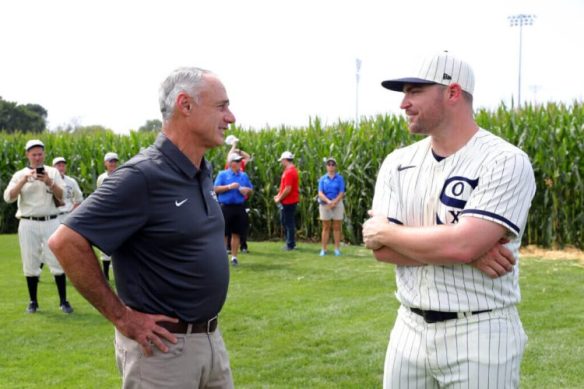
Commissioner Rob Manfred with White Sox relief pitcher Liam Hendriks before last year’s Field of Dreams game. (The Athletic.)

Having a read of ESPN writer Don Van Natta, Jr.’s profile of commissioner Rob Manfred, I was almost convinced that maybe, just maybe, there really was more to Manfred than met the eye. Or, more than what comes forth in his stiff presence and often clumsy remarks.

Just maybe, the man isn’t the baseball-hating or baseball-illiterate Rube Goldberg-like abecedarian the caricatures so often portray. He did, after all, grow up a Yankee fan in upstate New York and can say proudly enough that he’s the only baseball commissioner ever who played Little League baseball. “All glove, no bat,” he remembers of being a Little League infielder.

My parents received a set of classic Revere copper-bottom cookware as a wedding present eight years before Manfred was born. (I still remember the fragrance of that special powder used to clean the copper bottoms, too.) Who knew Manfred (three years my junior) was the son of Revere’s production supervisor at their home plant in Rome, New York? An hour’s drive from Cooperstown, as it happens.

Born in 1958, Manfred took in his first live major league game at Yankee Stadium with his sports-obssessed father, sitting between the plate and first base on an Old Timers’ Day. Come game time, Hall of Famer Mickey Mantle crashed a pair of home runs and the Yankees beat the Twins, 3-2. When he finally became the game’s commissioner, he handed his father the first baseball with his stamp upon it.

“This is really an unbelievable thing,” Manfred, Sr. told his son. “I can’t say I disagree,” Manfred, Jr. told Van Natta.

A couple of hundred fathoms down, though, Van Natta noted that “more than once” Manfred told him what few baseball commissioners have dared to admit, that being the buffer absorbing the heat that should go to his bosses, the owners, is part of his job. Even if it’s about as pleasant as your private parts being caught in the vacuum cleaner’s handle.

And then it came.

“Every time it’s me, it ain’t one of those 30 guys—that’s good,” Van Natta quoted Manfred as saying. “Look, who the hell am I? I don’t have $2 billion invested in a team. I’m just a guy trying to do a job. I mean it. [The owners] deserve that layer. I believe they deserve that layer of protection. I’m the face of the game, for good or for bad.”

Mr. Manfred, unless it’s to boo and hiss your heads off over this or that piece of mischief, you may rest assured that no baseball fan anywhere in this country is paying his or her hard-earned money to head for the ballpark to see you or your bosses.

But I’m going to do you a small favour, as if you know me from the greenest bat boy on any professional baseball team. I’m going to introduce you to the true faces of the game. The ones whom those fans do pay their hard-earned money to see at the ballpark regardless of the machinations and deceptions of your bosses and theirs.

Mr. Manfred, meet Mike Trout. This is the guy you blamed once upon a time for not being baseball’s face, based upon his committing no crime more grave than letting his play and his clubhouse presence and his agreeability with fans before and after games speak for themselves, with no jive about the magnitude of being him.

Meet Shohei Ohtani. This is the two-way star who lights up the joint just by flashing that thousand-watt grin of his, never mind when he strikes thirteen out on the mound one night and belts baseballs onto the Van Allen Belt the very next. Between himself and Mr. Trout, you should be asking what on earth is wrong with the Angels that they still can’t find quality pitching enough to keep them in a race after they start in one but sputter unconscionably.

Meet Aaron Judge. This is the Leaning Tower of River Avenue who sends baseballs into the Delta Quadrant one moment and then, when made aware, goes out of his way to meet a Canadian kid to whom he’s number one among baseball men and who was handed one of his mammoth home run balls by an adult fan who knew the boy wanted nothing more than to catch one Judge hit out.

Meet Joey Votto. This is the future Hall of Fame first baseman who got himself tossed from a game early last year, but—after he learned his ejection broke the heart of a little California girl to whom he’s a hero above heroes—sent her a ball with his handwritten apology and autograph on it, prompting his team to drop game tickets and a little extra swag upon her the very next day.

Meet Bryce Harper. This is the guy who never apologised for being on board with letting the kids play. The guy now on the injured list with a thumb fracture and surgery to repair it after getting hit by a pitch thrown with one of the baseballs you and yours still can’t see fit to manufacture uniformly and with allowance for fairness on both sides of it, fairness for the pitchers and for the hitters alike.

Meet Vladimir Guerrero, Jr. and Bo Bichette. One is the son of a Hall of Famer who did last season what even his old man never did: led his league in on base percentage, slugging percentage, OPS, and OPS+, and led the entire Show in total bases. The other is the son of a respected major league slugger, has quite a lethal bat in his own right when his swing is right, and currently leads his league in trips to the plate. Together they’ve put some zip back into the Blue Jays.

Meet Oneil Cruz. The bat has yet to come to full life but the footwork, the glove, the throwing arm, have shown so far that you can be as tall as Frank Howard, J.R. Richard, and Randy Johnson and still play shortstop as though the position was created for you and not the Little Rascals in the first place. They’re falling in love with him in Pittsburgh, which needs all the love it can get, but they ought to fall in love with him all around the Show—except when he’s going so deep into the hole grabbing a grounder or a hopper that an enemy batter loses his lunch when he’s had a base hit stolen from him.

Meet Clayton Kershaw. He’s been around the block a few times. He’s a Hall of Fame lock as maybe the best pitcher of his generation. He’s still a quality pitcher and a class act. They still buy tickets on the road when they know he’s going to take the ball for the Dodgers. He’s faced his baseball aging curve with grace under pressure. And, for good measure, he’s the one active player who was seen fit to be part of the ceremony when the Dodgers unveiled that statue of their Hall of Fame legend Sandy Koufax this month, and you know (well, you damn well should know) what a class act Koufax was on the mound and has been in the decades since off it.

(You’re not still P.O.ed that Koufax waxed your Yankees’ tails twice while his Dodgers swept them in the 1963 World Series when you were seven, are you?)

Meet Justin Verlander. Missed a year plus recovering from Tommy John surgery. He has a 2.23 ERA and a 3.53 fielding-independent pitching rate so far this season. For any pitcher that’d be a remarkable return so far. For a future Hall of Famer who’s still suiting up at Jack Benny’s age (that’s a joke, son), it’s off the chart so far.

Meet Verlander’s 25-year-old Astros teammate, Yordan Álvarez. He’s leading the entire Show with his .667 slugging percentage, his 1.081 OPS, and his 206 OPS+. If there’s one untainted Astro who’s must-see viewing whenever he checks in at the plate, it’s him.

Meet Xander Bogaerts and Rafael Devers. The left side of the Red Sox infield is a big reason why the Olde Towne Team yanked themselves back up from the netherworld into second place in that rough and tumble American League East. Did I mention that Devers currently leads the entire Show with 177 total bases?

Meet José Ramírez. The Guardians’ third baseman is giving Devers a run for his money in the All-Star balloting that closes today. That thumb injury has put a crimp into his bat for now, and it’s had its role in the Guardians’ sudden deflation at the plate, but this guy just may be the face of his franchise right now. He ought to be one of the faces of this game.

Meet Mark Appel. This is the guy who went from number one in the draft to injuries as well as pressures and even to an exit from the game only to try giving it one more try—and finally coming up with the Phillies, nine years after that draft, and tossing a scoreless inning . . . at age 30. That’s as feel good a story as it gets for the oldest former number one to make his Show debut, no matter what happens with the rest of what remains of Appel’s career. They don’t all go to hell and back.

Those are only some of baseball’s faces, Mr. Commissioner. They’re the ones the fans want to see and pay through the nose to see. Despite your tinkerings. Despite your often erroneous readings of the room. Despite your inability or unwillingness to demand the same accountability of umpires that you do of players, coaches, and managers.

Despite your inability to let your professed deep love of the game come through without tripping over itself because, as an improvisor, well, if you were a musician the consensus would be that Miles Davis you ain’t.

Opening Day: Cross it off the bucket list

Shohei Ohtani

Shohei Ohtani, shown on the Angel Stadium video board during his pre-game warmup as the teams lined up on the foul lines, on Opening Day. He pitched brilliantly but in a lost cause, the Angels losing 3-1.

The owners probably won’t stop by to see what I’m about to write, but their otherwise ill-advised 1 December-10 March lockout did me one solid. But only one.

After the World Series, and as soon as they went on sale, I’d bought tickets for what I thought would be the Angels’ home opener. They were scheduled originally to open the season on the road. But commissioner Rob Manfred’s cancellation of the regular season’s first series, in light of the owners’ further goalpost-moving shenanigans, turned the Angels’ home opener into Opening Day, after all.

It wasn’t enough to turn my thinking toward the owners’ side one iota, but it did enable me to cross something off my bucket list. Despite a lifetime of loving the game and watching countless games in the stands and on television, I’d never actually had the chance to be at the ballpark on Opening Day. Until Thursday evening.

The best part of the evening was that I got to do it with my now 28-year-old son, Bryan. The second-best part was being able to cross another item off the baseball bucket list within half an hour of us getting our pre-game food and drink, after putting replica 1972-1990 Angels hats onto our heads.

The Ball

The foul ball, now crossed off my bucket list, sitting atop my notebook, before I handed it to my son.

While the visiting Astros took batting practise, a line drive sailed into our section down the right field line. Adjacent fans made it impossible for me to see just which Astro hit the ball, but the ball bounced around off seats in front of us, then under them, and riocheted off a fan two seats to our right, before rolling on the floor under us to where I could grab the ball before another fan reaching under the seat in front of me did.

I held the ball up to see for myself that I wasn’t seeing or imagining things, then handed it to my son. He’d only been asking to try to catch a ball at Angel Stadium since, oh, the first time I got to take him there—in 2000, when the Angels beat the visiting Yankees one fine evening by prying the winning run out of The Mariano himself. We’d gone to plenty of games since. Thursday night, it was pay dirt at long enough last.

Of course, there was now a game to play, and the Angels lost, 3-1. These are my ten takeaways:

1) Shoh-time! The good news for the Angels was Shohei Ohtani starting on the mound. I’m convinced that what looked to be a lockout-dejected, ho-hum crowd in advance, shot into a near-sellout once Ohtani was announced as the Opening Day pitcher. Lockout after-effect, I suspected: I’d checked the ticketing for the game just prior to the announcement and there were several thousand seats remaining for the taking.

Well, now. The day before I set out for southern California from my home in Las Vegas, I checked the ticketing again. The tickets seemed to have flown off the board once Angel fans knew it would be Shoh-time. And Ohtani didn’t disappoint, much. He pitched four and two-thirds innings of one-run, nine-strikeout, four-hit, one-walk baseball.

The best the Astros could do against him was the third inning, after he caught Martin Maldonado looking at strike three and blew Jose Altuve away with a swinging third strike: Michael Brantley banged a double off the right center field fence and Alex Bregman sent him home promptly with a base hit to left center.

As a matter of fact, when Ohtani wasn’t becoming the first player in Show history to throw his team’s first pitch of the season and make his team’s first plate appearance of the season (the Angels like to bat him leadoff), he manhandled Altuve for three strikeouts on the night, including the nasty slider that shot over Altuve’s hard swing for the third such strikeout in the top of the fiftyh.

2) The bad news: Astros starter Framber Valdez was just as effective in six and two-thirds innings. (The Angels planned to keep their starting pitchers on an 80-pitch limit for the time being, after the lockout-imposed too-short spring training.) He struck six out, walked one, and surrendered two of the Angels’ four hits on the night.

3) The worse news, for the Angels: They came to within inches of taking a 2-1 lead in the seventh. Mike Trout led off by beating out a throw from shortstop that should have been ruled an infield hit but was ruled an error. Then Anthony Rendon hit a high liner that sailed into the left field seats . . . but missed the foul pole on the wrong side by a hair.

“When I saw the ball flying in the air,” Valdez said post-game of his narrow escape, “I got mad with myself that I didn’t make my best pitch. I just took a deep breath and threw my best pitch.” That would be the hard sinkerball on which Rendon promptely dialed Area Code 4-6-3.

Matt Duffy promptly beat out an infield hit to third, which promptly moved Astros manager Dusty Baker to end Valdez’s night and bring Phil Maton in to strike Jo Adell out swinging for the side.

4) Cruising speed: Maton seemed on a bit of a cruise in relief until he hit Brandon Marsh with a pitch with two out in the bottom of the eighth and David Fletcher shot a 1-2 pitch through to the back of left center and gunned it for an RBI triple. That was the Angels’ first and last run of the game, alas.

5) The worse news, for baseball as a whole: That ridiculous three-batter minimum for relief pitchers. Under normal circumstances, if your reliever comes into the game and gets murdered right away—as Angels reliever Ryan Tepera was in the top of the eighth—you’d know he didn’t have it that night, right?

Father and son

Father (right) crossed Opening Day off his bucket list at last—and had the pleasure of doing it with his 28-year-old son.

Oops. Tepera’s first pitch to Alex Bregman sailed into the left field seats. The next Astros batter, Yordan Alvarez, hit a hanging slider on 1-1 over the center field fence. The Angels were lucky to escape with their lives after two prompt deep fly outs (Yuli Gurriel, Kyle Tucker) followed by a sinking liner up the middle (Jeremy Peña) that Trout caught on the dead run in from somewhat deep center to retire the side. (Trout also drew a loud ovation after he turned around and, from half-shallow center, winged the ball to fans halfway up the right center field bleachers.)

6) But there was good news on the relief front. Neither manager burned his relievers in the bullpens. If either Baker or Joe Maddon warmed a pitcher up, he either came into the game as soon as needed or he was handed what amounted to the rest of the night off. No Angels or Astros reliever was called upon to warm up more than once.

I paid as much attention to the relievers in the pen as I could, considering I was seated far opposite the pens behind the left field fence. The Angels used five relievers and the Astros, three. None of those eight pitchers threw any more than maybe 20-25 pitches before they were brought into the game. None of them could be called gassed going in.

Tepera simply didn’t have it Thursday night; Maton got vulnerable after ending one inning and getting two outs to open the next. The rest of the two teams’ bullpen corps (Hector Neris and Ryan Pressly for the Astros; Aaron Loup, Austin Warren, Jose Quijada, and Archie Bradley for the Angels) pitched clean-as-a-hound’s-tooth relief. Would that all major league managers were that judicious handling their pen men.

7) Memo to: Angel fans. Subject: The Wave. The 1980s called. They want their obnoxious, obstructive Wave back. One fan adjacent to our section kept calling for fans to do the Wave. I kept shaking my head, but I did notice that each of about ten attempts at it starting in our part of the park died before flowing to a fourth section of the field-level seats. Maybe there’s hope in such deaths, after all.

8) You were saying? The back-to-back Astro bombs to one side, this game wasn’t exactly the kind to send the old farts screaming to the whiskey shots. The game’s twelve total hits included three Astros doubles, Fletcher’s triple, and six singles. Altuve even stole second in the ninth, for whatever that was worth, since he ended up stranded.

9) Wasted Out Department: Altuve, the Astros’ pint-sized, gallon-hitting second baseman, also dropped a sacrifice bunt to third with one out in the seventh against righthanded reliever Warren, after Chas McCormick opened the inning with a double. Remember: A man on second with one out, and you have less chance of scoring a run after that bunt than you did before the bunt, even if you do exactly what Altuve did pushing McCormick to third.

Just what a man with a lifetime .512 Real Batting Average (total bases + walks + intentional walks + sacrifice flies + hit by pitches, divided by total plate appearances), and a .297 lifetime hitting average with a man on second and one out, is doing thinking sacrifice escapes. With his team leading a mere 1-0 at the time, the Angels brought Quijada in to pitch to Brantley, and Brantley flied out shy of the track in right center for the side.

That’s what a wasted out did. The righthanded-hitting Altuve might have been futile against Ohtani on the night, but he has a lifetime .301 hitting average against righthanded pitchers. The Astros would have had a better chance scoring McCormick if Altuve hit away.

10) When Bregman checked in at the plate in the top of the eighth, the Angel Stadium video boards flashed a graphic with Bregman’s head shot plus this: [He] donated over 200 iPads  w/protective cases and iTunes gift cards to several Houston-area elementary schools that have autistic classrooms. He does that through his Bregman Cares charity, with a particular focus upon autistic children.

It was almost as admirable for the Angels to show Bregman such respectful acknowledgement as it was for Bregman and his wife, Reagan, to take such an interest in lending hands to autistic children. Even if Bregman’s idea of saying thank you for such respect was to smash a leadoff homer in reply.