We can’t have nice things for too long

Emmanuel Clase

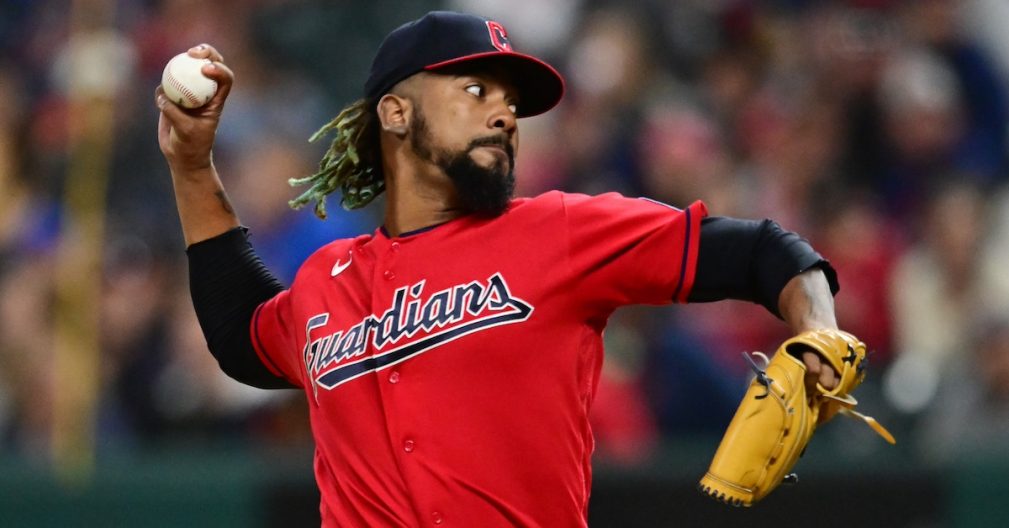
Emmanuel Clase, whom the feds charge masterminded a pitch-rigging scheme for bettors and his fellow Guardians pitcher Luis Ortiz.

How tempting is it to define the present era as the one that tells us we can’t have nice things? And, the one that delivers the message more brutally after each of the rare nice things we get.

Baseball just delivered us a postseason for the ages, even if you don’t hold with the wild card system. Put that to one side a moment and admit it. The game we love spent a month showing us that, any time we care to write the game off as a self-immolating bore, it’ll be more than happy to disabuse us.

Think about it. When you get seven postseason sets ending with winner-take-all games, you’ve been blessed to the tenth power. When you get more than one extra-inning postseason hair raiser without the disgrace of Manfred Man (who’s not allowed anywhere near the postseason—yet), you’ve been blessed that big again.

When you get utter cream-always-rises defiance against the wild card system, putting nobody in either League Championship Series except teams whose butts were parked in first place at season’s end, you’ve been blessed above and beyond whatever it was you had the right to expect.

When you get Shohei Ohtani spending one postseason game striking ten out from the mound and hitting three out at the plate, then spending World Series Game Three reaching base nine times—five with the near-complete consent of the Blue Jays who seemed to prefer death to Ohtani’s singular controlled mayhem—your cups runneth over.

When you get a postseason seeing regular-season supermen continue their feats of derring-do and damage (can we forget Cal Raleigh crowning a 60-homer regular season with five intercontinental ballistic missle launches while the Mariners were in the postseason? Freddie Freeman’s eighteenth-inning walkoff?), and heretofore dismissable Clark Kents turning into assorted breeds of Supermen (Addison Barger, Miguel Rojas, call your offices), your bowls, barrels, vats, and tanks runneth over, under, sideways, down, and back.

In other words, this postseason couldn’t have been more entertaining, exciting, and exemplary if it had been coordinated, produced, and directed by Bill Veeck, Casey Stengel, Kevin Costner, and The Chicken.

No, that beyond good deed couldn’t go unpunished, could it? Can we have (demand) this Sunday back?

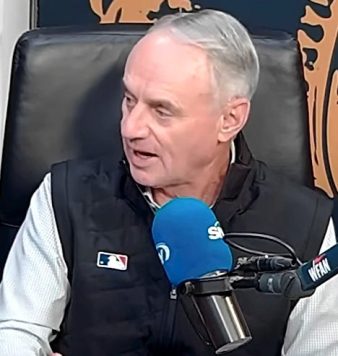
First there came the should-be-frightening revelation that, according to a popular podcast, Bryce Harper—he who told commissioner Rob Manfred firmly enough to get the you know what out of the Phillies clubhouse if he wanted to talk salary cap, though the two shook hands and shook it off later on—was threatened by “one of Manfred’s deputies,” who said, supposedly, “Don’t ever disrespect [the Commish] like that again. That’s how people end up in a ditch.”

“If this threat is true,” wrote Yardbarker‘s David Hill, “the next labor stoppage could get ugly fast.” If that threat is true, we don’t have to wait for a lockout or a strike to get ugly fast. It’s just become ugly fast.

And how about the ugly-fast-enough revelation that two Guardians pitchers, relievers Emmanuel Clase and starter Luis Ortiz, on administrative leave since late July on pitch-rigging suspicions, have just graduated from suspicion to formal charges of fraud, conspiracy, bribery, and money laundering? Charges “stemming,” as the federal indictment out of Brooklyn says, “from an alleged scheme to rig individual pitches that led to gamblers winning hundreds of thousands of dollars, according to an indictment unsealed by federal prosecutors Sunday.”

The U.S. Attorney’s Eastern District office in Brooklyn said Sunday that Clase’s involvement in the pitch-rigging plot goes back to May 2023, with Ortiz joining up last June. It didn’t exactly cripple the Guardians’s season to lose the pair, especially when they ended up snatching the American League Central from the unexpectedly rising/unexpectedly sputtering Tigers.

But then came the postseason. The Tigers nudged the Guardians out of the picture in a wild card series. From there, aside from the usual off-season doings, undoings, maneuverings, and meanderings, the question around the Guards became when the other shoes would drop around Clase and Ortiz.

They dropped Sunday, all right. The indictment says Clase arranged with a gambler to throw particular pitches for ball counts so the bettor could bet on those pitches (it’s called proposition betting) and reap the financial reward. The indictment says further that gamblers won almost half a million betting on pitches thrown by the Guardians pair, while the pitchers themselves earned kickbacks for helping the bettors clean up.

Clase and Ortiz, said Eastern District U.S. Attorney Joseph Nocella, Jr., “deprived the Cleveland Guardians and Major League Baseball of their honest services.”

They defrauded the online betting platforms where the bets were placed. And they betrayed America’s pastime. Integrity, honesty and fair play are part of the DNA of professional sports. When corruption infiltrates the sport, it brings disgrace not only to the participants but damages the public trust in an institution that is vital and dear to all of us.

“While the pervasiveness of legalized gambling has upended the sports world, the allegations against Clase and Ortiz are the most severe for the sport since Pete Rose agreed to a lifetime ban for betting on baseball in 1989,” ESPN’s Jeff Passan wrote. “MLB’s rules against gambling on the sport are strict, and Clase and Ortiz could face lifetime bans similar to the one delivered last year to San Diego Padres infielder Tucupita Marcano, who placed nearly 400 bets on baseball.

Nocella’s office described Clase as the scheme’s mastermind, saying he’d throw balls instead of strikes and sliders instead of cutters on first pitches, with gamblers betting on each pitch to be called balls or traveling under specific speeds. The indictment said further that such proposition bets would be stacked in parlays often as not, meaning bigger winnings.

But the indictment also charges that Clase gave money to gamblers to bet on his own behalf, texted with them while games were in progress, and was joined up by Ortiz after he  came to the Guards in a winter 2024-25 trade, Passan said.

Among others, Clase helped gamblers win $27,000 apiece on one Clase pitch faster than 94.9 mph in an interleague game with the Mets. “Weeks later,” Passan said, referring to the indictment, “bettors added a leg to a parlay for a pitch to be a ball slower than 94.95 mph—and won $38,000 when Clase spiked a slider at least five feet in front of home plate.”

By last April, Clase asked for and got kickbacks for throwing specific pitches. He even asked one winning bettor to send kickback money to his native Dominican Republic “for repairs at the country house.” Last June, Ortiz joined the scheme by agreeing to be paid $5,000 to throw a first second-inning pitch for a ball call, with Clase getting $5,000 himself for arranging it, the indictment charges.

The same month, Ortiz agreed to open the third inning with ball one for $7,000. The indictment also says bank security cameras caught Clase withdrawing $50,000 cash, $15,000 of which went to one bettor in a group who placed $18,000 on that pitch.

Ortiz’s attorney denied in a formal statement that his client would do anything to influence a game improperly, “not for anyone and not for anything.”

Clase was making $4.9 million for 2025 and stood to make $6.4 million for 2026, with a pair of team options for 2027 and 2028 at $10 million each. Ortiz wasn’t near six figures yet so far as I could determine, but he wasn’t exactly improverished, either. Why on earth would either man slide into a shady side profession that could end their baseball lives if convicted and banished?

Maybe we shouldn’t ask. Maybe it won’t matter, at least until the case goes to trial, barring any for-now-unknowable chance of one or both pitchers coming to take plea deals and then throwing themselves upon the mercy of the courts of law and public opinion.

Maybe it won’t mean a thing until or unless baseball decides to take a second, third, and fourth look at its cross-promotion deals with legal sports books. Yes, those were supposed to encourage fan betting alone. Baseball’s prohibitions against players, coaches, managers, and team personnel betting on the sport remain stringent.

Oops. Manfred took a presidential gumshoe in the gluteus to declare Rose’s “permanent” and wholly justified banishment applied only while he was alive on earth—thus making Rose eligible to appear on the Hall of Fame’s next Classic Baseball Era Committee ballot.

But five months after Ohtani’s original interpreter Ippei Mizuhara went to the federal calaboose for stealing $17 million of Ohtani’s money to support an out-of-control gambling habit, it might be wise to review and perhaps repel those cross-promotions. Which might require the kind of spine this commissioner displays very selectively.

When an uppity player told Manfred where he can take his salary cap talk, the commissioner’s office ironed up to slap him down. But when an uppity president behaving like the school bully crooked his finger and demanded Rose be sent to Cooperstown as soon as last week, regardless that Rose earned his banishment, Manfred’s spine went Vaseline.

The stove isn’t the only thing that’s hot. It won’t shock me if baseball tempers get a little hot for a good while. That’s the risk whenever baseball’s witless remind us that we can’t have nice things for very long.

We interrupt your World Series fun . . .

Yoshinobu Yamamoto

Yamamoto carving the Blue Jays in Game Two, following the Jays’ bludgeoning the Dodgers in Game One, was rudely interrupted by the commissioner putting his foot in his mouth again.

Hand it to Rob Manfred. Baseball’s commissioner certainly found a way to soil or at least cloud our World Series pleasure. The Blue Jays bludgeoned the Dodgers in Game 1; Yoshinobu Yamamoto put restraints on almost all the Blue Jays to even it up in Game 2. Nothing but fun.

That’d teach us. Baseball’s lessons include periodic reminders that Murphy’s Law includes a clause about no good deed going unpunished. We just couldn’t be allowed to love this Series without Manfred invited to spread a little fertilizer across the field.

We couldn’t be allowed to enjoy Blue Jays outfielder Addison Barger becoming history’s first pitch hitter to step up with the bases loaded and send one into the seats. We couldn’t be allowed to enjoy Barger plus Dominic Varsho and Alejandro Kirk going long in the middle of the Jays making life miserable for Dodger starter Blake Snell and a few other starters-turned-bullpen bulls, to the tune of a 11-4 Game 1 blowout.

We couldn’t be allowed enjoy Yoshinobu Yamamoto carving the Blue Jays like Thanksgiving turkeys in Game 2, going the distance for a second straight postseason start, the first Dodger to do that since Orel Hershiser in 1988 and the first anyone to do that since Curt Schilling in 2001. Not to mention the Dodgers making a nice mix of small and tall ball — an RBI single here, a pair of solo homers there, a bases-loaded wild pitch, and a run-scoring force out yonder, to beat the Jays in Game 2, 5-1.

No, that pleasure was just too much, wasn’t it? We couldn’t even enjoy the pleasure of calling out the cone-head contingency in Rogers Centre chanting, “We don’t need you! We don’t need you!” whenever Shohei Ohtani strode to the plate, Ohtani having spurned a Jays offer on behalf of staying in southern California even if it meant switching leagues.

It wasn’t quite as contemptibly disgusting as the notorious AI-generated feces flyer his apparent pal in the White House dreamed up a weekend ago. No one that I know of is rushing to strap Manfred into the cockpit of a Boeing Shitterfortress yet. But if reporters who spotted and buttonholed him before World Series Game 2 had premeditated it, they couldn’t have done a better job of getting Manfred to put his foot in his mouth. Yet again.

With a gambling scandal battering the NBA, Manfred was asked whether baseball remains vigilant in protecting the game’s integrity from gambling infestations. After all, two Guardians pitchers (Emmanuel Clase, Luis Ortiz) remain in drydock while investigations continue into whether they accommodated suspicious microbets while pitching in June.

“We didn’t ask to have legalized sports betting,” Manfred said Saturday night. “It kind of came, and that’s the environment in which we operate. Now we don’t have a lot of choice about that, and if it’s going to change — broadly change — probably the only way it would happen is the federal government.”

The federal government.

The one whose chief executive may have strong-armed Manfred into declaring, whoops, the “permanent” banishment mandated for violating Rule 21(d) didn’t mean “permanent,” after all, meaning the end of the late Pete Rose’s exile from baseball and blockage from the appropriate Hall of Fame ballot.

The one whose chief executive conducts a dog-ate-my-homework presidency with more glee than his predecessors ever showed, while threatening the long tentacles of the law upon people in and out of government, for no crime other than disagreeing that he can do as he damn well pleases, indeed, the Constitution (which says otherwise) and the law be damned. And, with more glee than his worst such predecessors ever allowed themselves.

Manfred also said he didn’t want to discuss baseball’s pending labour issues right now (“I want to get seven exciting [World Series] games. A year from now, we’ll have plenty of time to talk about labor”), but boy have we had great postseasons since the 12-team system with wild card rounds, haven’t we?

If anyone put in front of Manfred the thought that this postseason has actually seen nothing but first-place teams in both the League Championship Series and the World Series, I haven’t been able to spot it yet.

Perhaps the commissioner wishes to fix things that might actually be broken. How about negotiating a salary floor, not a salary cap, with reasonable penalties for falling short of the floor, the better to get those billionaires’ boys’ club members who refuse to invest in their teams to either invest or divest?

How about expanding to two more major league teams, one for each league? Then, how about rebuilding baseball’s leagues and divisions thus:

1) Two conferences in each league. We’ll argue over naming them later.

2) Two divisions per conference. We’ll argue over naming them later, too.

Then, we move toward restoring genuine championship play:

3) No more wild card nonsense. If you didn’t finish the regular season with your butts parked in first place, you get to wait till next year. (A properly instituted and enforced salary floor may also stop Reds, White Sox, Rockies, and Pirates fans from awakening on Opening Day thinking, “This year is next year,” but I’d rather sacrifice a great if sad saying on behalf of up-and-down league competitiveness.)

4) No more regular season interleague play. Save it for the All-Star Game. And, while we’re at it, be done at last with those fakakta All-Star and City Connect uniforms that run the gamut from ugly to disgusting and back to repulsive. Let the players wear their proper team uniforms for the All-Star Game again. (And, for the Home Run Derby, if it must continue and for those invited to swing. Which reminds me: only bona-fide All-Stars shall be considered for Home Run Derby participation.)

5) Best-of-three division series, featuring none but the regular season division winners.

6) Best-of-five League Championship Series — the way it was from the 1969 birth of divisional play through 1984.

7) The World Series shall remain a best-of-seven, and thus have its absolute primacy restored.

Last but not least: 8) The foregoing will prevent postseason saturation, while 9) still providing plenty of postseason games. At maximum, there would be (count them!) 29 games. Even if every such series ends in a sweep (remember, baseball is the sport where anything can happen — and usually does), you’d still have 20 games.

Now, back to our World Series fun. Let’s get back to determining whether ancient Max Scherzer, the Blue Jays’s planned Game 3 starter at this writing, can summon up the old Max the Knife one more time. Or, whether the Dodgers help him decide the hard way whether it’s time to think about having his glove bronzed and letting those great seasons past make his Cooperstown case.

On Harper telling Manfred where not to go

Bryce Harper

Bryce Harper, a player who suffers neither fools nor commissioners (did I repeat myself?) gladly . . .

Once upon a time, when John Glenn’s Mercury space flight ran into a brief postponement,  then-Vice President Lyndon Johnson all but demanded he be sent through the phalanx of press outside Glenn’s home to have some television time with Glenn’s wife, Annie. Rebuffed before the postponement, Johnson now thought it’d be just the thing if he could “console” Mrs. Glenn over the airwaves.

Mrs. Glenn wanted no part of Johnson’s publicity hounding. NASA, as Tom Wolfe phrased it so deftly in The Right Stuff (the book, not the movie, you miserable pudknockers), wanted no part of Mrs. Glenn’s demurrals: “There’s John, covered with sweat, drawn, deflated, beginning to feel very tired after waiting for five hours for 367,000 pounds of liquid oxygen to explode under his back . . . and the hierarchy of NASA has one thing on its mind: keeping Lyndon Johnson happy.”

You remember the film version, no? John, we’ve got a problem with your wife, said NASA’s program chief to the astronaut. Oh, no you don’t, Glenn said, figuratively, when replying to his wife that, if she didn’t want Johnson or the networks coming in, “then that’s it, as far as I’m concerned, they are not coming in—and I will back you all the way, one hundred percent, on this, and you tell them that . . . you tell them astronaut John Glenn told you to tell them that.”

NASA program chief to Glenn: John, it’s the vice president!! Glenn to NASA chief: You are way out of line here!  NASA chief: Yeah? Well, I’m thinking of changing the order of flight assignments! Six other Mercury astronauts, not all of whom thought as highly of Glenn as the nation would after his orbital flight and gutsy re-entry, five of whom might well have given their left testicles to be the first American into full orbit (the first two Mercury flights were up to the wild blue yonder, a brief kiss of space, then right back down to the ocean), said that’s what you think: Oh, yeah, Who you gonna get?

Now, my question: If one astronaut could tell a pushy vice president where not to go and get away with it, why on earth couldn’t one baseball player tell a pushy commissioner—whose tricks and rhetoric stand athwart the good of the game he professes to have first on his mind—where to go and get away with it.

I’m not going to repeat the names of the philistines who’ve called for Bryce Harper’s suspension or at least formal and loud enough reprimand after last week’s confrontation with Rob Manfred. The one in which Commissioner Pepperwinkle visited the Phillies clubhouse (as he does with all major league clubhouses each year) with his economic agenda to discuss, and Harper—one of the game’s most intelligent as well as talented and accomplished players—told him flatly that if he wanted to talk salary cap, “you can get the [fornicate] out of our clubhouse.”

Manfred subsequently said that he and Harper shook hands near the end of the meeting. Other reports suggested Manfred tried to contact Harper the following day but Harper declined. To reporters afterward, Harper said, only, “Everybody saw the words and everything that happened. I don’t want to say anything more than that. I’ve talked labor and I’ve done it in a way that I don’t think I need to talk to the media about it . . . I’ve always been very vocal, just not in a way that people can see.”

Perhaps the worst kept secret in baseball right now has been Manfred’s subtle-as-a-jellyfish-sting push to put a salary cap onto the negotiating table for the next collective bargaining agreement, though he doesn’t use the specific phrase “salary cap” and prefers now to use such language as baseball’s “economics.” The lesser volume of talk involving the far more necessary (and viable) salary floor—a requirement that baseball’s owners whose teams aren’t named the Dodgers, the Mets, the Phillies, or the Yankees, among an extremely few others, should either spend a negotiated minimum on player payroll or sell to ownerships more than willing to spend—tells you all you need and more than you want.

Manfred thinks he’s baseball’s grand protector and preserver. But for every one smart thought or plan he devises (smart and thoughtful: the universal designated hitter; the Field of Dreams Games) he devises numerous dumb and dumbers: The free cookie on second base to open each half inning; the continuing City Connect uniform abominations; abetting the Oakland Athletics’ abandonment of a fan base who loved them, in favour of an owner who let the team and their old park go to seed absent “public financing” [read: public fleecing]; NASCAR-like ad patches on uniform jerseys; redefining “permanent” as “lifetime” regarding the late, flagrant Pete Rose; and, the Speedway Classic (please don’t say you couldn’t see this one coming), in which a baseball field was implanted and a baseball game was played inside a NASCAR track, all sit as evidence for the prosecution.

Did you really love looking at the sentence linking to ESPN’s story of the Speedway Classic game between the Braves and the Reds, pushed to Sunday when the rain washed it out in the first inning Saturday? After red flag, [Eli] White’s 2 HRs let Braves lap Reds. See if you can tell where such a sentence as that fits better, especially since no major league team is named for either cars or curs: the Daytona 500, or the Westminster Kennel Club Dog Show. Should Bristol Motor Speedway have sent a home run pace car around the track after every homer . . . or a pack of greyhounds?

Don’t tell me about the Speedway Classic crowd breaking a major league attendance record. American immunity to novelty didn’t end with the pet rock, the Garbage Pail Kids, the Macarena, Beanie Babies, Furby, Pogs, and Fidget Spinners. The good news, otherwise: It broke a major league attendance record. The bad news, further: Bristol Motor Speedway ran out of food and drink on Saturday night; stories abound about motorists stopping at convenience stations and being crowded by Braves and Reds fans allowed to bring their own provisions Sunday.

Maybe a player making nine figures on a thirteen-year deal with six years and $153.2 million yet to come, playing for a team whose owner actually does operate as though the common good of the game isn’t solely to make money for himself*, isn’t quite the ideal man to speak up. But Barnum’s Law has yet to be repealed, and Manfred has proven himself one of its least apologetic supplicants.

————————————–

* Hark back to spring training 2019, when Bryce Harper signed his thirteen year/$330 million deal with the Phillies, after talking directly with Phillies owner John Middletown and all but ordering his agent Scott Boras to sit down and keep his big trap shut. After impressing Middleton with his knowledge of the game’s play and its history, not to mention asking how Middleton himself made a long, happy marriage work, Middleton had this to say to Boras

Scott, I want to tell you something, I’m not interested in talking about marketing dollars, ticket sales, billboards, concessions. There’s only one reason I’m talking to you, and that’s because I believe this guy can help us win. I’ve made enough money in my life, I don’t need to make more. My franchise value has risen dramatically over the last 25 years. I don’t need it to rise more. If it does, fine. I’m here to win, and I think your guy can help me win.

You want to know why players think owners and even commissioners lie whenever their lips move? Middleton is the rare contemporary MLB owner who speaks as a man who’s in it for the love of the game and behaves as though it’s not a mere platitude, whether in Philadelphia or Pudknock. (For the record, too, Harper as a Phillie has more than lived up to his end of the bargain, a few injury disruptions notwithstanding.)

ASG: As (almost) usual, show biz yields to baseball

Jarren Duran

Red Sox center fielder Jarren Duran hoists the clear bat awarded the All-Star Game’s Most Valuable Player. His tiebreaking two-run homer held up to give the AL the 5-3 win.

God help us all, everyone. The All-Star break began with a pre-Home Run Derby singing of “The Star Spangled Banner” Monday night (by country star Ingrid Andress) that made youth cringe and elders think wistful thoughts of Roseanne Barr. It ended with a tenth American League All-Star Game win in eleven seasons.

In between, of course, was much to ponder and much to dismiss as patent nonsense, which seems to be far more the norm than Chicago Tribune sports editor Arch Ward, who initiated the game in 1933, might have imagined.

Phillies third baseman Alec Bohm could be seen having to labour to keep from laughing (presumably, that he might not weep—or wish to commit manslaughter) when Andress tackled “The Star Spangled Banner” as though too well besotted. It turned out that appearance was everything: She copped the following day to being drunk and having enough issue with it to seek rehab and recovery.

Wish her well, but demand to know why nobody in baseball’s administration noticed she was drunk as she took the mike in the first place.

That was then: The Derby rules were, a participant had ten outs to hit as many homers as they could, the hitter with the most such bombs advanced, and that was that. So simple that, in fact, even Mark Belanger (human Electrolux at shortstop, but a spaghetti bat who hit three fewer homers in eighteen major league seasons than the late Hall of Famer Willie Mays hit in the first half of 1965) could have done it.

This is now: Round One—three minutes or forty batted balls, whichever came first, followed by an old-style three outs to hit as many bombs as possible. Round Two—the top four floggers moved to a bracket-like semifinal. Round Three—the two semifinal winners head to head. The net result: Teoscar Hernandez (Dodgers) defeating Bobby Witt, Jr. (Royals), who nearly forced a playoff with a ICBM-like blast stopped only by the left center field fence.

Some of us still wonder why we’re supposed to tolerate three-hour long Home Run Derbies but arise armed against two and a half hour-plus real baseball games. Or, why we had three-minute commercials aboard Fox’s All-Star Game telecast Tuesday before seeing supersonic relief pitchers blowing the side away in order in a minute and a half if that long.

Perhaps commissioner Rob Manfred might have an answer to that one. At least he has a sort-of answer to the question (posed by The Athletic‘s Tyler Kepner) of when the ever-more-hideous generic All-Star Game uniforms of the past several years will be disappeared in favour of returning the fine old tradition of All-Stars wearing their own uniforms and thus representing their teams.

“I am aware of the sentiment and I do know why people kind of like that tradition,” Commissioner Pepperwinkle told Kepner. “There will be conversations about that.” The proper two-word answer to that, of course, is, prove it. About knowing why people (more than kind of) like that tradition and holding serious conversations about it.

Well, take the proverbial pause for the proverbial cause. That very first All-Star Game featured the American League representatives wearing their own teams’ home uniforms with the National League wearing road threads, as modeled below by Hall of Fame catcher Gabby Hartnett:

Gabby Hartnett

Behold now this year’s threads for each league:

Yes, we have seen far worse for generic All-Star uniforms.

Except for each league’s colour scheme, is it really that radically different from the 1933 NL haberdashery? Now, this year’s threads would look far nicer if the American League jersey was done with red-on-white (the AL was the home team in Globe Life Field) and the National League was done with blue-on-gray (since the NL is the visiting team). And worn over either white (home) or gray (road) pants.

My normal position is to be all-in on returning to the practise of each league’s All-Stars wearing their own teams’ uniforms, representing their teams and fan bases, as their forebears did for so many decades. If Commissioner Pepperwinkle insists ultimately upon keeping generic league uniforms, this year’s style just might be the right way to go, switching the core white and gray each year depending upon which league is the All-Star host.

The wherefores of this year’s uniforms mattered less when the game got underway, and rookie NL starting pitcher Paul Skenes (Pirates) got to face Aaron Judge (Yankees) after all, thanks to Judge’s teammate Juan Soto wringing himself into a walk. The bad news: Judge forcing Soto at second with a grounder to third for the side.

AL manager Bruce Bochy (Rangers) was well aware of the marquee appeal of Skenes versus Judge while penciling Judge into his cleanup slot. But he sent three lefthanded swingers with impeccable on-base credentials up against the righthanded Pirate phenom to open, hoping precisely to get that marquee match without sacrificing his best chances to start winning the game.

Joe and Jane Fan insist, “This is just an exhibition, dammit!” Maybe they’re right. Maybe the metastasis of regular-season interleague play to a full-season thing has left the All-Star Game bereft of meaning, as opposed to such artifices as the period when postseason home field advantage went to the league who won the Game..

But maybe a Hall of Famer in waiting who’s won four World Series as a skipper knows, however the game’s been kicked around like a commissioner’s plaything for too damn long, that himself, his NL counterpart Torey Lovullo (Diamondbacks), and the players on both sides, actually do play this particular game as baseball, not show business.

Shohei Ohtani

Shohei Ohtani detonating a three-run homer in the third inning. “To be able to share a dugout with him was surreal.”—Pirates pitcher Paul Skenes. Ohtani is now the only player in Show history to earn a pitching win in one All-Star Game and a home run in another All-Star Game.

So Bochy got Joe and Jane Fan their marquee matchup the old fashioned way, and Skenes came out of it on top, but Bochy’s diligence left him the only manager in major league history to win a World Series and an All-Star Game in each league. And, the first since Hall of Famer Joe McCarthy to manage an All-Star Game at home the season after he won a World Series.

Putting baseball ahead of show biz has enriching payoffs, of which Commissioner Pepperwinkle seemed as unaware as both managers were reminded soon enough en route the American League’s 5-3 win Tuesday.

Lovullo got the first such reminder when Shohei Ohtani (Dodgers) faced Tanner Houck (Red Sox) in the top of the third with nobody out, two men on, and sent a 2-0 splitter a few rows back into the right center field seats. (The last Dodger to hit one out in All-Star competition? Hall of Famer Mike Piazza, 28 years earlier.) Bochy got his in the bottom of that inning, when Soto shot a two-run double to center and David Fry (Guardians) singled him home to tie the game at three after another Judge ground out.

Two innings later, Lovullo got the reminder that ended up counting for the game, when Jarren Duran (Red Sox) batted with two out and one on, took a strike from Hunter Greene (Reds), then caught hold of a Greene splitter and sent his own message into the same region of seats where Ohtani’s blast landed.

“It won’t hit me until I try to go to sleep tonight,” Duran told The Athletic postgame. “Who knows if I’ll be able to sleep tonight.”

A guy in his fourth Show season who entered this All-Star Game leading it with ten triples and the AL with 27 doubles, then detonated what proved the winning bomb Tuesday, deserves to sleep the sleep of the just. So does the rookie whose first two months in Show have made him a name and an arm to reckon with as it was, without giving him the additional gift of being an Ohtani teammate even for just one game—thus far.

“I tried to enjoy the three hours I had on a team with him,” Skenes said postgame, “because that’s probably only going to happen once a year. It was really cool to watch him do that, really cool to watch him go about his business and get to meet him and all that. You know, he’s—I don’t know of any hitters I’ve faced that’s better than him in my career. So, to be able to share a dugout with him was surreal.”

The only thing better for either would have been an NL win, of course. Nobody had to tell Skenes it was neither his nor Ohtani’s fault the NL came up two bucks short Tuesday.

Where’s baseball’s Mr. Blackwell?

Shohei Ohtani

If he wasn’t already the arguable most famous player on the planet, Shohei Ohtani might be unrecognisable in baseball’s new Vapor Jersey.

Rob Manfred has announced he will retire as baseball commissioner when his contract expires in 2029. Before anyone thanked him for the gift a day after pitchers and catchers reported officially for spring training, enough remembered that it means he has nearly six full seasons yet ahead to commit more mischief than he’s committed already.

He’s the classic instance of the tinkerer who develops one sound idea in the middle of developing twenty more about which “sound” is inoperative. Perhaps more than most commissioners, Commissioner Pepperwinkle’s been one to whom there’s rarely an issue he can’t make worse.

“Politics,” Groucho Marx once observed, “is the art of looking for trouble, finding it, misdiagnosing it, and misapplying the wrong solutions.” Baseball under Manfred’s stewardship has been the same art on another level.

Manfred sought and imposed assorted changes aimed mostly at appeasing that part of its audience to whom the ballpark and its intended presentation shouldn’t interfere with its online life. So long as it continued to make money for the owners, there has seemed precious little he couldn’t entertain, the game itself be damned.

Baseball still has issues enough to resolve or relieve without Commissioner Pepperwinkle and his minions trying and failing at fashion consultation. The players were greeted for 2024 with new uniforms about which the word “abomination” seems an understatement so far as many if not most are concerned.

Officially, the new jerseys are known as the Nike Vapor Premier, the athletic gear maker promoting the new product manufactured by Fanatics. The good news is that they’re made to withstand the peaks of the summertime heat, and that exhausts the good news. Nike’s claim that the new jerseys are “softer, lighter, stretchier,” in the words of Athletic writer Stephen J. Nesbitt, seem to enough players code for poor fitting, cheap looking, and inconsistently made.

“It looks like a replica,” says an Angels outfielder, Tyler Ward, to Nesbitt. “It feels kind of like papery. It could be great when you’re out there sweating, it may be breathable. But I haven’t had that opportunity yet to try that out. But from the looks of it, it doesn’t look like a $450 jersey.”

It also doesn’t look like anyone will be able to recognise its wearers. The name on the uniform front may be the most important thing, but the names on the back look to be about half or less the size they usually were. “Look at the last names, bro,” urged another Angel, relief pitcher Carlos Estévez, to another Athletic writer, Tyler Kepner. “I’m six-foot-six. This is going to look tiny on me.”

“Hey, maybe the players–many with Nike sponsorship deals–will change their minds once they play a few games,” Kepner observes. “Maybe, in time, the jerseys won’t look like the replica you buy when you’re trying to save money but still want to kinda look authentic. But the underlying concept persists. Baseball, guided by Nike, is trying to force-feed all these stylistic changes instead of just letting them happen organically.”

If Shohei Ohtani wasn’t already baseball’s most famous and familiar player, you might have a hard time recognising him in his new field threads.

Trying to force-feed changes not limited to the stylistic alone has been a Manfred trademark, one he took up only too happily from his predecessor and former boss Bud Selig. You remember Selig, the man who believed baseball needed regular-season interleague play and wild card postseason entrants in the first place, beliefs Manfred has pushed to extremes that have turned baseball’s postseason into just another playoff system and rendered the All-Star Game entirely meaningless.

Remember: Manfred was the man who assumed office swearing baseball uniforms needed no advertising on them. He swore it long enough to cave in and allow it, a few years later. At least, as Kepner notes, he was honest about it when talking about it two years ago: “It’s a revenue source that is significant enough that it’s really impossible for a sport to ignore over the long haul. I think that’s the truth.”

Some think he’s full of what’s spread around the infield and outfield grass to keep it healthy. That works for the field but not for the game. “[J]ust because you can make money by selling something,” Kepner continues, “doesn’t mean you should.” True that. Ask anyone who thinks as I do that such abominations as City Connect and All-Star Game uniforms make baseball look like anything but the thinking person’s sport.

Baseball never seems to have a Mr. Blackwell around when it needs him.

Speaking of the All-Star Game’s threads, Manfred did just that when getting candid about the advertising patches on the sleeves: “I never thought that a baseball team wearing different jerseys in a game was a particularly appealing look for us. I understand that people can have different views on that topic, but it is part of a larger program designed to market the game in a non-traditional way.”

It’s one thing to acknowledge there’ve been several baseball “traditions” that needed to go the way of large stones for bases. But did Manfred ever stop to think there was particular pride in ballplayers chosen as All-Stars representing, you know, their teams and their home fans? (The super cynics among us might follow that by asking, “Did Manfred ever stop to think, period?”)

Manfred has also spoken up about himself and the owners for whom he truly works pondering a defined free agency signing period. That seems not to be a terrible thing in and of itself, when you observe how many valuable free agents are still without teams as spring training settles in. On the surface, a defined signing period looks sound as a nut. On the surface. Beneath the surface? Be very afraid.

Baseball ownerships historically have found ways to make the sound unsound and to sneak around what were thought to be impeccable guidelines. They’ve been pulled over as scofflaws often enough by officers of Murphy’s Law. And Commissioner Pepperwinkle may yet have more cringe-creating in him before the intended retirement enough people think can’t arrive soon enough.