Marcus Stroman and other trade deadline thoughts

2019-07-30 MarcusStroman

Marcus Stroman to the Mets—method to madness or madness to method?

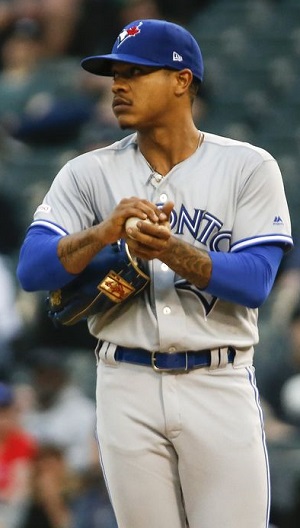
As regards the Mets dealing a pair of mixed-reviews pitching prospects to the Blue Jays for their staff ace Marcus Stroman, and the coming trade deadline in general a few observations. Beginning with the one that tells me it seems at least three-quarters of baseball never saw this Stroman deal coming.

Anyone who thought Stroman’s new address would be New York by this year’s new single trade deadline figured it would involve the Yankees, leaders in the American League East, and not the Mets, strugglers to stay within reasonable sight of even the second National League wild card.

Or, if Stroman was going to move on from Toronto, he’d be more likely to land with one or another viable 2019 competitor—say, the Braves, where I seem to recall some observers thought he’d make a better mutual fit if the Yankees really were convinced Stroman was good enough to pitch but not necessarily fit.

But Stroman, who makes his living largely by way of his ability to lure ground balls, is now a Met. So where do we and they go from here?

1. Former major league general manager Jim Bowden, who now writes for The Athletic, says the Mets have no intention of landing Stroman just to flip him for a better package by the close of trade business Wednesday. And the two pitching prospects going to the Jays—Anthony Kay and Simeon Woods-Richardson—are considered solid but not elite prospects, but the Jays believed they weren’t going to get better than them for Stroman when all was said and done.

2. The Mets aren’t a team of elite defenders especially around their infield this year, and yet Steven Matz—returning to the rotation after a brief spell in the bullpen to re-horse—pitched a complete-game 3-0 shutout Saturday night in which his calling cards were a deft blend of breaking and off speed stuff and putting his fielders to work, which for a change they did rather admirably behind him.

3. Matz’s performance may well have had a firm impact on the Mets’ pitching thought. May. They’ve tried since 2013 to cultivate an arsenal of power arms in the rotation and seen, when all is said and done, only Jacob deGrom live up to any expectations. They watched Matt Harvey’s injuries collapse him from a power pitcher to one in search of a new cause and, now, a new team. They’ve seen Noah Syndergaard and Zack Wheeler bring the power without delivering the consistent results.

If the Mets had eyes for Stroman before Matz took the mound Saturday night, Matz’s performance had to have told them it wouldn’t be a terrible idea to add another arm to the rotation that belonged to a young man who uses more than his arm to survive on the mound. Stroman isn’t a strikeout machine; he has the second highest ground ball rate among all Show starting pitchers.

4. Maybe acquiring Stroman begins to get the Mets re-thinking their incumbent defense, too, especially marrying him to Matz in their rotation. Rookie of the Year candidate Pete Alonso forced Dominic Smith off first base, but Smith in the outfield looks almost exactly like the un-natural he is out there even though he hits with authority. Rookie general manager Brodie Van Wagenen’s willingness to take aging Robinson Cano if he wanted closer Edwin Diaz from the Mariners last winter forced Jeff McNeil, their obvious second baseman of the future, likewise into an outfield where he’s about as comfortable as an elephant in front of a mouse much of the time.

5. Diaz has been a mess not entirely of his own making this season, mishandled, sometimes mis-deployed, and while the raw talent is still there the Mets are now rumoured to be shopping him. Cano has four years left on the contract the Mets took on from the Mariners, making him almost an immovable force. Whether the Mets’ contradictory ownership might be willing to take a bath on the deal in order to start moving defensive parts back where they belong is anyone’s guess.

6. With Stroman off the market eyes turned not just upon Syndergaard but the rest of this trade deadline’s pitching market.

The Giants’ unexpected resurgence means Madison Bumgarner isn’t likely to go anywhere the rest of the season, compared to a month ago when the observers and speculators pondered where, not if he’d move on. The Yankees need whatever starting pitching help they can get but the market now seems more constricted—and as much as they’re wary of dealing with the Mets, Syndergaard now might look like an attractive Yankee target. Might.

And the Nationals, like the Giants but at a higher level, have had an unexpected resurgence of late after they were all but written off as dying as late as early June. They ran into a buzzsaw in Los Angeles this past weekend, needing Stephen Strasburg to pitch the masterwork he did in seven Sunday innings to escape with even a single win, but now Max Scherzer—whom all the Smart Guys said had to go on the trade deadline block once upon a time, in large part to bring them badly needed bullpen relief—may find his barking back barking well enough into August.

At first glance, then, it would seem the Nats have a big problem as they prepare to square off against the National League East-leading Braves Monday night. Except that the Braves, who ran roughshod over the league before the All-Star break and still lead the Nats by five and a half games, have suddenly regressed to being only human. Not only have they lost seven of their last eleven, they’ve lost two critical elements—shortstop Dansby Swanson, resurgent veteran right fielder Nick Markakis—to the injured list. The Nats won’t have Strasburg or Scherzer to throw at the Braves this week but the Nats might still gain key ground, anyway.

7. The bullpen dominos began falling over this past weekend, too. Veteran Sergio Romo, once a key to a couple of Giants World Series winners, just went from Miami to Minnesota where the Twins, this year’s American League surprise, just bumped their bullpen up several notches by bringing him aboard. Jake Diekman went from Kansas City to Oakland, a sign the Athletics are gearing up for another wild card run. There are contenders aplenty who need help in the pen and few more than the Nats.

8. If the Jays are rebuilding in earnest, bullpen-longing eyes may be cast upon the surprising Ken Giles. After his 2017 World Series mishap (which wasn’t entirely his sole responsibility) and subsequent personal and mound meltdowns, Giles has rehorsed completely in Toronto. As in, a career year: a 1.54 ERA and a 1.60 fielding-independent pitching rate. Not to mention a 5+ strikeout-to-walk rate and a 14.9 strikeout-per-nine rate.

Yes, the Nats have eyes upon Giles and his Jays pen mate Daniel Hudson. But so may the Red Sox and any other contender who needs a bump among the bulls. Even the Twins, despite landing Romo, might still make a play for Giles at least or, if Giles eludes them, Norman, whose 2.87 ERA and June-July of only four earned runs in 21 innings’ work yanked his trade value up accordingly.

Bowden rates the Stroman deal a B+ for the Mets and a B- for the Jays. It wouldn’t hurt the Jays’ standing to try prying a slightly better haul back for Giles and/or Hudson. And although Giles is dealing with a slight nerve issue in his pitching elbow, wiping out the side as he did in a Saturday night assignment should make his suitors breathe a little easier, assuming they don’t fall tempted to overwork him while he works through it.

9. The Mets may or may not yet have a wild card long shot this year, but don’t kid yourselves: they were thinking as much about 2020 as now when they made their play for Stroman. And since Stroman is under team control through the end of 2020, don’t be surprised if they like what they see from him the rest of this season and start talking extension with him before 2020 begins.

Which might also mean that Syndergaard at minimum, and Wheeler at maximum, may yet have changes of address coming by Wednesday afternoon. And with whisperings that the Red Sox have eyes upon Diaz for their pen, which needs a little help but isn’t as badly mismanaged as the Mets pen has been this year, the Mets should be thinking smart and looking very closely at that Red Sox farm system.

Because the Mets could also use a third base upgrade from veteran Todd Frazier, who’s reliable but beginning to show his age. And as thin as the Red Sox system is for now, AAA third baseman Bobby Dalbec was named both the offensive and defensive player of the year for 2018 in the Red Sox’s minor league award valuations. If the Olde Towne Team wants Diaz for their pen that much, the Mets should all but demand Dalbec in the return haul.

10. Too many teams never quite do what they should when it counts. The Mets, alas, are notorious for that. Even when they’re winning.


Some people can never be satisfied, still

20190627_190740

Left to right: Emily, Bryan, and the author, Bryan’s father, relax in Angel Stadium before a game between the Angels and the Athletics Thursday night. Guess which of the game’s seventeen total hits got the loudest ovations . . .

What’s that old saying about some people can never be satisfied? Unfortunately it also remains a true saying. That’s whether baseball’s get-off-my-lawn contingency complains about not enough hitting (in 2014) or too many home runs (this year), or whether Orioles fans look the proverbial gift horses in the mouth because of a choice of . . . uniform.

This year’s epidemic of home runs includes such side effects as strikeouts rising, singles falling, stolen bases on various endangered species lists, and howitzer-armed bullpens turned to arson squads.

It’s not unreasonable to lament the large percentage of game action that involves home runs. The absolute flip side of the proverbial coin would be a game full of nothing but singles and a crashing bore unless the pitchers are virtuoso charismatics and the fielders resemble the Flying Wallendas. (Only nine percent of this season’s fielding assists so far involve turning double plays. Ground ball pitchers, where are thy stings?)

I happened to be in Angel Stadium Thursday night, treating my son, Bryan, and his girlfriend, Emily, to a game, the first of a weekend set between the Angels and the rival Athletics, to finish their final home stand before the All-Star break. (They hit the road to meet the Rangers and the Astros to finish the season’s first half.)

The occasion was a gift for Bryan’s graduation from southern California’s North Orange Continuing Education program in which disabled students make their transitions gradually but affirmatively to whatever full collegiate work they can perform toward the level of independent life they can attain.

Bryan is speech-language impaired, and the only one in the house more proud of the courage he shows living, laughing, and persevering through his disability is his father, to whom Bryan is a hero every day, not just those during which he graduates or helps his Special Olympics team nail a silver medal in softball, as he did at last year’s national games in Seattle.

(P.S. In his first ever plate appearance in a national Special Olympics, Bryan socked a home run. In baseball, 118 players have homered in their first major league at-bats. The most recent: Lane Thomas, Cardinals, 19 April.)

And lo! Come Thursday night, the Angels defeated the Athletics, 8-3, to open a weekend set. From our nesting at field level down the right field line, we saw the runs score on:

* A second-inning home run. (A’s center fielder Ramon Laureano, leading off.)

* Another second-inning home run. (Kole Calhoun, a two-run shot that ricocheted off the rocks behind the left center field fence in the bottom of the inning.)

* A third-inning home run. (Shohei Ohtani, the defending American League Rookie of the Year, resuming designated-hitter duties if not pitching as he continues recovering from Tommy John surgery, hitting one clean over the center field fence.)

* A pair of third-inning RBI singles. (Hall of Famer in waiting Albert Pujols, driving home Justin Upton; and, Luis Rengifo, driving home Calhoun.)

* A fourth-inning home run. (Matt Olson of the A’s, leading off the top.)

* A sixth-inning single. (Mike Trout, the Angels’ all-everything center fielder, sending home Andrelton Simmons, the flying shortstop freshly restored from the injured list.)

* An eighth-inning single. (Oakland’s Marcus Semien, sending home Robbie Grossman.)

Of the game’s seventeen hits (the Angels had twelve), 24 percent of them sailed over the fences. Through this morning’s writing, major league games this season have featured 3,390 home runs out of 21,265 hits. That, folks, is 16 percent of this season’s hits. Last year, 14 percent of baseball’s hits were home runs. Oh, the horror.

Fume all you like about the home run epidemic, if epidemic it is, but doesn’t it seem peculiar that such an epidemic accounts for that small a percentage of baseball’s hits? Thirty-six percent of this year’s hits are doubles; two percent are triples. But we don’t hear either loud complaints about the epidemic of doubles or the near-extinction of triples as much as we hear about the bombs bursting in air at record levels.

On Thursday night, except for Trout’s RBI knock in the sixth, knowing that this guy gets standing ovations just taking his position in the field to open a game (a cursory look around the park tells you Trout remains the single most popular Angel based on jerseys and jersey-reproducing T-shirts with Ohtani a close enough second), guess which hits got the loudest ovations, even among the A’s fans who scattered around the stands?

Hint: it wasn’t the four RBI singles.

(A note on the Angel Stadium video display when Laureano batted midway through the game: he’s the first Athletic in their entire franchise history—going all the way back to the birth of the Philadelphia Athletics—to have made his first major league hit a game-winning RBI hit. Ever. Not even the franchise’s celebrated Hall of Famers—not Home Run Baker, Jimmie Foxx, Al Simmons, or Reggie Jackson—did that. Laureano did it in 2018.)

Once upon a time, Washington Senators owner Clark Griffith bragged (if that’s the correct word), “The fans love home runs, and we have assembled a pitching staff that is certain to please them.” This year, commissioner Rob Manfred all but brags that since the fans like home runs, baseball has introduced a ball that was certain to please them. Apparently, the “pill” at the ball’s center is being centered more accurately. Makes some people want to reach for the nearest bottle of pills.

Pitchers may not be pleased as greatly as the fans seem to be. Rangers pitcher Drew Smyly picked the wrong year to return from Tommy John surgery: he surrendered nineteen bombs in 51 and a third innings before the Rangers released him last week. And until Phillies pitcher Jared Eickhoff landed on the injured list, he’d pitched 58 and a third 2019 innings and eighteen services landed on the far side of the fence.

ESPN’s David Schoenfield says Smyly’s home run rate per nine innings this year (3.3) was baseball’s worst and Eickhoff’s (2.8) the seventh worst, but don’t get him started on those who’ve been nuked worse in fewer innings. Poor souls such as Alex Cobb (nine bombs in twelve and a third), Edwin Jackson (twelve in 25.1), or Dan Straily (22 in 47.1).

And, yet, Schoenfield continues, overall scoring per game remains “within historical norms” at 4.78 runs a game, which he says is the highest since 2007’s 4.80. Apparently it’s how you score that matters yet again. If the game levels itself out in due course (as it always seems to do, never mind the periodic equipment tinkerings) and the runs begin coming in singles-, doubles-, and triples-hitting droves, brace yourself. The death of the home run will be pronounced loud and long, too.

I mentioned the Orioles earlier. Back to them. How does this strike you—the Orioles, who are on a pace Schoenfield says will see them surrender 324 home runs for the full season (or, if you’re scoring at home, an average of 36 homers per lineup spot against them), spent Friday and Saturday doing what no team before them has done: back-to-back shutouts in which they themselves scored thirteen runs or more.

The Indians were the victims. On Friday night, John Means and three Orioles relievers kept the Indians to six hits against Mike Clevinger and three Indians relievers surrendering sixteen hits—only (count them) two of which were home runs. On Saturday night, Andrew Cashner and one reliever kept the Tribe to five hits against Zach Plesac and four Indians relievers surrendering thirteen hits—only four of which were home runs. That’s back-to-back home run percentages of 13 and 31 percent per game, and 21 percent for the two games.

But Oriole fans couldn’t even enjoy that rare a two-night spread without finding something to complain about. In this case, the Orioles’ uniforms Saturday. Commemorating Maryland Day, a state holiday, the Orioles’ jersey sleeves and cap visors displayed the image of Maryland’s state flag. “Hideous” was probably the least indignant adjective applied.

Well, as I was saying, some people can never be satisfied. Thank God and His servant Jackie Robinson that my son and his lady aren’t among the perpetually dissatisfied.


Fiers burns a milestone

2019-05-07 MikeFiers

After spreading his wings to no-hit the Reds, Mike Fiers spread his wings to start the celebration . . .

You’d be hard pressed when asked to think of things baseball people love more than milestones. Except maybe excuses for puns clever and otherwise.

“A’s to Reds: You’re Fiered!” went one such posted on Facebook, after Mike Fiers threw a curve ball that took a swan dive below Eugenio Suarez’s bat to finish a no-hitter Tuesday night.

Imagine if that Facebooker and others in the moment knew it was the 300th no-hitter in major league history. Three hundred has a few magic connotations in baseball and otherwise.

Pitching wins are now overrated in evaluating a pitcher’s actual value, but even those who overrate them with cause like to ponder who’s likely to to be credited for 300 of them next. CC Sabathia’s out of that running since he plans to retire after this season and isn’t likely to earn 52 wins between now and then. Justin Verlander may have an outside shot if his arm obeys his known wishes and lets him pitch another five or six years.

But Fiers didn’t just pitch baseball’s 300th no-hitter but the second one of his otherwise journeyman major league career. With a 4.38 lifetime fielding-independent pitching rate (that’s your ERA when your defenses are removed from the equation, folks) so far in a nine-year career, to go with his 4.11 lifetime ERA, Fiers isn’t exactly a Hall of Famer in the making.

But modestly gifted men have been known to perform immodest deeds now and then. And fans of modest intelligence have been known to say that certain milestones “should” be reached by none but the proven absolute greats.

Such fans several generations ago said it about Roger Maris daring to chase, catch, and pass Babe Ruth’s single-season home run record. You could almost hear the isolated harrumphing now: “Who the hell is this guy to pitch the 300th no-hitter? That’s supposed to be Max Scherzer! Or Justin Verlander! Or Clayton Kershaw! Mike Who?!?”

Unfortunately, baseball doesn’t always work that way, bless the game. If the guy you wouldn’t spot in a Grand Central Station rush hour throng can come up big in the biggest moments like the postseason (Howard Ehmke, Al Gionfriddo, Sandy Amoros, Don Larsen, Moe Drabowsky, Al Weis, Denny Doyle, Mark Lemke, and David Freese, anyone?), why can’t the guy you’d never mistake for Tom Seaver throw a milestone no-hitter?

There are 35 pitchers who’ve thrown more than one no-hitter in their careers and, not counting such still-active men as Justin Verlander and Max Scherzer, 22 of them aren’t Hall of Famers.

Among those like Fiers who’ve thrown two, Cooperstown has seven: Pud Galvin, Christy Mathewson, Addie Joss, Warren Spahn, Jim Bunning, Randy Johnson, and Roy Halladay. Three men have thrown three and only one of those, Larry Corcoran, isn’t a Hall of Famer.

Fiers is also one of only eight men to pitch a no-hitter for more than one team. He’s done it for the Astros (in 2015) and now the A’s. The list includes Cy Young, Bunning, Johnson, and Ryan among the Hall of Famers and Ted Breitenstein, Adonis Terry, and Hideo Nomo otherwise.

Johnny Vander Meer (not a Hall of Famer) is still the only man to pitch no-hitters in back-to-back starts; Sandy Koufax is still the only man to throw no-hitters in four consecutive seasons, with his fourth proving literally that practise makes perfect. Nolan Ryan fell short of that streak by a season (he pitched two in 1973 and one each in 1974 and 1975) while working toward his record seven.

Fiers is in rather charmed company now. Especially since May is the month for milestone no-nos, and the two previous to his were also thrown by Hall of Famers. Carl Hubbell threw number 100 ninety years ago today; and, Dennis Eckersley threw number 200 on 30 May 1977. Anyone care to predict which May to come will feature no-hitter number 400?

And Fiers is another kind of outlier. No pitcher ever took a season’s 6.81 ERA to the mound before throwing a no-hitter.

“I’m just glad they got those lights working,” Fiers deadpanned after the 2-0 win.

He referred to three panels of lights failing above the left field stands in Oakland’s otherwise unloveable Oakland-Alameda County Coliseum. Game time was delayed a little over an hour and a half. Finally, the A’s and the Reds said let’s play ball and Joey Votto checked in at the plate to open.

Votto popped out to the infield to open. Suarez struck out to finish. Except for an error at third in the fourth, Suarez working out a leadoff walk in the seventh, and Yasiel Puig walking later in the inning, no Red reached base in any way, shape or form.

And, yes, Fiers needed a little help from his friends in the sixth inning, such as Jurickson Profar ambling out to shallow right to catch Kyle Farmer’s quail and, especially, Ramon Laureano—making a fresh reputation as an outfield acrobat—taking a home run away from Votto with a leap up the short end of left center field wall.

Not to mention Profar driving home both the runs in the game, first with a two-out double in the second with Stephen Piscotty aboard and then with a two-out launch over the right field fence in the seventh.

Maybe the testiest moment of the game came in the ninth with one out, when Fiers fell behind Votto 3-1 before throwing the Reds first baseman a changeup nasty enough to be worth nothing more than a ground out to first base.

For Laureano that play was an awakening. “That’s the first time I realized he had a no-hitter,” he said of Fiers’ performance. “Really, I didn’t know.”

“I think the stars aligned tonight,” said Farmer of the Profar and Laureano catches. “Once we saw those two plays happening, we said this might be his night.”

It wasn’t exactly a picnic for the last A’s pitcher to throw a no-hitter. “It was way more nerve-wracking then when I was doing it,” said Sean Manea, who threw his last year but who’s still working his way back from September surgery to repair a torn shoulder labrum. “I was shaking on the bench. I don’t know, it was crazy seeing him do it.”

It didn’t stop Manea from being the man to shower Fiers—who wouldn’t have pitched Tuesday at all if the A’s hadn’t shuffled their rotation on their off day, as things turned out—with the Gatorade tank.

“I remember when I was drafted, I wasn’t too high on the charts,” Fiers told reporters after surviving the mobbing he got on the mound when the game ended. “I was a guy throwing 88 to 90, down in South Florida. I’m one in a million down there.” And in more ways than one, his million-to-one shot came home.

New park, renamed team, a Las Vegas blast—but you had to be there

20190411_190008

A view of the left field wall and panorama at the new Las Vegas Ballpark Thursday night.

The Las Vegas Aviators had a bit of a blast Thursday night, in their new Las Vegas Ballpark playpen in the west side of town’s Summerlin district. They smothered the Sacramento River Cats, 11-3, on a cool-turned-chilly night, heavy enough on the wind, with the key inning the third when the Aviators showed themselves triple players of the better kind.

As in, four triples in five plate appearances in the inning, and three of them hit consecutively. As in, the first of the three landing on the fly into a warning track wedge. As in, an eighth-inning home run missing being a splash hit by about a foot farther.

Unless you were at the game, as I was, or listening free via MiLB.com, you wouldn’t have known all that by picking up the Las Vegas Review-Journal Friday morning. All you knew was that the Aviators (now an Oakland Athletics AAA affiliate) sicced the hounds on the River Cats (a San Francisco Giants AAA affiliate).

You didn’t know that Aviators shortstop Jorge Mateo started the third inning fun by hitting the curvy line drive that landed on the fly between the track and the bottom of the right center field fence padding.

You didn’t know that, one called strikeout later, left fielder Dustin Fowler, first baseman Seth Brown, and catcher Sean Murphy all tripled in succession, leaving things 5-1, Las Vegas.

You didn’t know that called strikeout kept the Aviators from doing what’s only been done once in the major leagues, the Boston Red Sox hitting four straight triples in the bottom of the fourth 6 May 1934, en route a 14-4 blowout of the eventual American League pennant-winning Detroit Tigers.

Or, that the last time any team anywhere hit three straight triples was the Montreal Expos in the bottom of the ninth of a 5 May 1981 game—and it wasn’t enough to keep the Expos from getting blown out by the San Diego Padres, 13-5. (The Colorado Rockies almost did it, but Troy Tulowitzki rudely interrupted the string by hitting a two-run homer after the first two and just before the third triple.)

You didn’t know that, in the top of the eighth, with the Aviators keeping the game pretty much out of reach, River Cats third baseman Zach Green led off against relief pitcher Jerry Blevins, the former New York Met, and hit a 2-1 pitch over the right center field fence and into the ballpark’s swimming pool patio, until it landed just past the pool and bounded around the patio concrete. Since no fans were at poolside we assume a ballpark staffer retrieved the souvenir.

20190412_122658You didn’t know that until Green teed off the Cats’ first run scored in the top of the second when their first baseman Austin Slater scored while left fielder Michael Reed was dialing Area Code 5-6-3.
You didn’t know that the Aviators went 6-for-19 with men in scoring position on the night while the Cats went a mere 1-for-5. Or, that the Aviators did more damage against two Sacramento relief pitchers (Chase Johnson in two and two thirds, and Ray Black in the eighth) than they did against River Cats starter Shaun Anderson in the second and the third.

At least the Associated Press, whose coverage the R-J did use, was kind enough to tell you that Murphy missed the cycle by a double and a homer, while presuming you could figure out for yourself that Mateo’s triple, two doubles, and a single put him short of the cycle by one bomb.

The AP was also kind enough to tell you the Aviators turned the game into a full blowout with a four run eighth including Murphy hitting a three-run homer. Brown singled before Murphy launched one that flew about twelve feet over the right center field fence.

I get that the paper’s sports department is probably all over the NHL’s Golden Knights in the Stanley Cup playoffs. As in, a 31-team league allowing 51 percent of its teams to play for a championship, which is simply unserious no matter how engaging the sport actually is when it isn’t fans going to the fights where a hockey game breaks out. (I’ve never forgotten the year TV Guide‘s fall sports preview said, “Good news for fight fans—the NHL is back.”)

The Knights shocked hockey (and a lot of other people) by winning the Pacific Division title in their inaugural season, 2017-18. And they still had to slog through a playoff against less worthy teams before they got to be demolished by the Washington Capitals in the finals. This season, they finished third in the Pacific. And they lost a sloppy first-round first game to the San Jose Sharks, 5-2. It might as well have been Sir Loin of Beef against Jabberjaw.

Baseball may have the ridiculous wild card system in a pair of three-division leagues, but nobody finishing lower than second place in their division gets either of the two wild cards in each league. In the NHL and in the NBA (thirty teams, half of them making last year’s playoffs), you might as well not even play the regular season, almost.

And I get that Las Vegas Ballpark had some Opening Night problems, 40 mph winds hardly of the park’s own making, which thinned the starting crowd of over 11,000 before the third inning was over. The Thursday night winds weren’t that furious, but they were chilly enough by the time the fifth inning came around, and the crowd didn’t really begin thinning until around the sixth.

The Howard Hughes Corporation—which bought and renamed the team (they’re the former 51s) and built the ballpark—is capable of many things, but I’m not entirely sure that weather-making is among their talents.

I don’t know if the Review-Journal lacks a substantial baseball staff, or they decided to just follow the Knights strictly after the unexpected Opening Night windstorm. But at least they were kind enough to let the AP tell you that the Aviators have a four-game winning streak and a 7-1 season-opening record, which they haven’t done since they were still the 51s and a Los Angeles Dodgers affiliate in 2006.

Or maybe Thursday’s game just didn’t have the pizzazz of Opening Night when an umpire took a bat out of the mouth of the Aviators’ bat dog, Finn, a labrador who’s trained to retrieve bats. The booing was loud enough to make you think the Orioles traded Chris Davis to the A’s and that the A’s sent Davis to Vegas to try to straighten himself out.

Or, maybe, two blowouts in their first three home games of the year just struck the R-J as dog-bites-man.


Maxwell’s star-spangled hammer

2018-12-26 BruceMaxwell

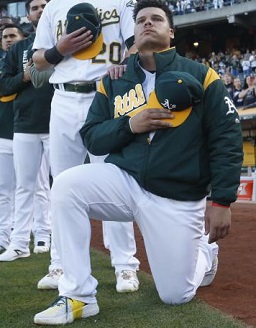
Bruce Maxwell, taking a National Anthem knee in September 2017.

How much it was noticed outside Oakland seems an open question, but now-former Athletics catcher Bruce Maxwell was designated for assignment in early September, released in due course, and, lacking a new job since, he fired his agent around this month’s winter meetings. That’s how ended a year that began with the A’s planning on him being the everyday catcher and ended with Maxwell under-performing in the minors after his demotion following eighteen games.

In between, the plan for Maxwell as the everyday catcher turned into signing Jonathan Lucroy as a free agent after Maxwell came to spring training overweight. Lucroy entering 2018 went from thought-elite once upon a time to lucky-to-have-a-job in spring 2018, even seeming to lose his once-formidable pitch framing skill as well as his batting stroke. The A’s made it to the wild card game but Lucroy wasn’t really an improvement.

Maxwell has two other issues thought to be weighing against him. One is that he’s the only major league baseball player yet to take a knee during any playing of the National Anthem, which he did in September 2017. But Maxwell, a German-born son of an Army officer, actually saluted the flag while he was on his knees, hand over heart. (A few of the notorious National Football League anthem kneelers have done likewise.) He said soon enough that that was because he believed protesting real or suspected racial injustice didn’t have to equal disrespecting the flag or the military.

A month after he took that knee came issue number two, when he was busted in Arizona for pulling a gun on a fast food delivery worker, a case in which he ultimately took a plea deal that reduced the charge to disorderly conduct. Amplifying it, according to San Francisco Chronicle baseball writer Susan Slusser—the same writer whose nomination led to enshrining New Yorker legend Roger Angell in the writers’ wing of the Hall of Fame—was a police video of his arrest in which he spoke “antipolice sentiment.”

Also as the winter meetings ended, an unnamed baseball executive told Slusser the anthem knee may mitigate more against Maxwell than the Scottsdale arrest. But another unnamed baseball figure told her it was “as if Colin Kaepernick had knelt for the anthem and also been arrested for a gun crime.” And a third, a National League scout who also apparently asked not to be identified by name, suggested Maxwell’s only route back to the majors may be playing in the independent minors. “[T]here is too much baggage,” the scout said.

If Maxwell’s now-former agent Matt Sosnick is right, the anthem knee weighs more heavily against Maxwell than the Scottsdale arrest case and a subsequent incident in Alabama, where Maxwell was refused restaurant service by a waiter angered over the anthem knee. The waiter said Maxwell portrayed the incident wrongly, and the restaurant stood by their man, but a local politician in Maxwell’s party backed his version.

By his actual playing record alone, Maxwell wouldn’t exactly have teams crowding the streets to reach him, especially now that he’s 28 years old. This isn’t exactly a Hall of Famer in the making we’re talking about. But any team passing on taking another flyer on him won’t really know, unless they make it straight, no chaser, whether people believe it’s because he’s not a great or even a decent player or because he took a stand that’s anything but massively accepted.

As a player, Maxwell was a second-round draft by the A’s in 2012, but he’s played only three partial seasons with the A’s. (His 127 games over the three is still shy of a full single season worth of play.) His slash line at the plate is modest enough (.240/.314/.347); his minor league record suggested he wasn’t terrible against the running game but he’s never really been tested that way in the Show. And the A’s pitchers who’ve thrown to him have a 4.58 ERA to show for it as a group when he was their catcher.

Is it those red flags or is it The Flag?

I’ve argued in the recent past that it’s probably time to reconfigure when the national anthem is played before baseball games or other sporting events. Even remembering a Casey Stengel biographer, Robert Creamer, recording something “I hope is true” (Creamer’s words): On his 1975 death bed, stricken with inoperable lymphatic cancer, Stengel watched a baseball telecast begin with the pre-game playing of “The Star Spangled Banner.” As the anthem was announced, the story went, Stengel slid out of bed, held over his heart the Mets cap he kept by his bedside, and said to himself, “I might as well do this one more time.”

“If patriotism and respect can’t and shouldn’t be compelled officially,” I wrote last May, “is it time to modify the national anthem tradition regarding sports?”

Is it terrible to suggest American (and Canadian, for that matter) professional sports leagues can it with national anthems before every last game, but save it for games played on significant national holidays? Would it be terribly un-American if “The Star Spangled Banner” were to be played only before baseball games played on Memorial Day, Independence Day, and Labour Day? Before football, basketball, and hockey games played on Veterans Day, Thanksgiving, and Presidents’ Day? Before NASCAR races run on most of those? (Would it be terrible likewise if Canadian sports teams limited “O Canada” to their home games on Canada’s national or provincial holidays, one of which they share with the U.S., though they call it Remembrance Day and not Veterans Day?)

Saluting during “The Star Spangled Banner” began organically at a baseball game in the first place—in 1918, when the song wasn’t yet ordained as the national anthem of the United States. (During Game One of that World Series, Red Sox second baseman Fred Thomas, on furlough from the Navy to play, saluted the flag in Fenway Park while the U.S. Navy band played the song . . . during the seventh inning stretch.) By the way, there’s no formal Major League Baseball rule, still, about playing “The Star Spangled Banner” at the ballpark. So far, so good.

There’d be absolutely no harm done, except to over-politicised sensitivities, if playing the national anthem was restricted to games played on significant national holidays and before the opening games of assorted championships. (The World Series, the Super Bowl, the Stanley Cup final, the NBA final, the Masters, the Triple Crown thoroughbred races, whatever’s the NASCAR championship, you get the idea.) Even allowing that there are fans of the combatants who often consider them matters of life and death, if not heaven and hell.

But that won’t help Maxwell right now. If he isn’t employed as a catcher by a major league baseball organisation any time soon, it should be because of his lack of performance. (It wouldn’t be terribly unfair if the Scottsdale incident were factored in, depending on Maxwell’s thinking about it now. Objecting to particular real police misconduct by itself shouldn’t be held against a man, but doing it when you’re being cuffed for waving a gun at someone makes you the fool.) And the organisations to whom Maxwell’s new agent petitions should say so clearly, without apology, without a single mention of the anthem issue.