If we must retire one more Yankee number . . .

Gil McDougald

Gil McDougald, the infield jack-of-all-trades for the 1950s Yankees. If we must have yet another retired Yankee uniform number, let it be his. 

My rejoinder to Dr. Paul Semendinger’s argument to co-retire Yankee uniform number 9 in honour of Hank Bauer (it’s already retired for Roger Maris) provoked a pleasant enough debate, when Dr. S. republished it on his Yankee blog Start Spreading the News a couple of days ago. Well, it was pleasant until some comments.

Nobody attacked me, but some of the arguments addressing retired Yankee uniform numbers went from the ridiculous to the more ridiculous. Now there came calls from one or another place to think about retiring the numbers of such Yankee ghosts as Spud Chandler, Tommy Henrich, Graig Nettles, Willie Randolph, and Roy White.

Let’s just say for openers that the Yankees have so damn many retired uniform numbers that they’ve made the honour almost meaningless. I’ll say it again: Be not surprised if you live long enough to see the middle of this century featuring all active Yankees wearing triple digits on their backs.

But let’s say, too, that in the cases of Chandler and Henrich, there’s more than one number to ponder. Presumably, Chandler’s likeliest target for uniform retirement would be 21, which he wore for the bulk of his Yankee career. Oops. Paul O’Neill’s getting the honour of number 21 retired.

Henrich wore four numbers in his career. Of those, he wore 7 from 1939-42, when he went into World War II service; and, 15 from 1946 until his retirement after the 1950 season. Ol’ Reliable’s 7 was taken in due course by Mickey Mantle. And 15 is retired already—for Thurman Munson. Whoops.

Semendinger has no apparent issue with co-retiring uniform numbers as it is. He thinks (erroneously) that there’s nothing wrong with declaring 9 co-retired between Maris and Bauer, not to mention Nettles who wore it as a Yankee. I’ll answer that again soon, promise. But I’d like to see him come right out and argue that Chandler ought to be part of O’Neill’s number retirement or, even better, that Mantle should share 7’s retirement with Henrich or Munson should share 15 likewise.

Not even the most casual of the casual among Yankee fans would stand for that without a rip-roaring fight. (Or would they?)

Chandler was a tough righthanded pitcher for three Yankee World Series winners (1941, 1943, 1947). Much of his reputation rests on a fluke 1943, when he posted both the lowest ERA (1.64) and fielding-independent pitching rate (FIP: 2.54) of his major league career. Credited with a league-leading 20 pitching wins, Chandler was named the American League’s Most Valuable Player even though the award probably should have gone to Cleveland’s Hall of Fame shortstop Lou Boudreau. (Boudreau: 8.1 wins above replacement-level, leading the league; Chandler: 7.3.)

Why call Chandler’s 1943 a fluke? Easy: 1) Baseball was already depleted of enough prime talent by World War II. (The Yankees themselves lost Henrich, Joe DiMaggio, Phil Rizzuto, and Red Ruffing, not to mention a catching prospect named Yogi Berra.) 2) His ’43 ERA was 1.20 below his career mark. 3) His ’43 FIP was 75 points under his career mark. He did get a late major league career start thanks to several minor-league injuries, and the injury bug also kept him out of a few World Series pre-1941.

Chandler himself was pulled into the Army after the ’43 Series, though his injury history kept him from combat. He returned near the end of the 1945 season, posted two more solid seasons in 1946 and 47, but age and injuries compelled the Yankees to release him at 39 in April 1948.

He was a good pitcher who was probably held back by his minor league injuries in the 1930s (he didn’t throw a major league pitch until he was 29) and a few more injuries as a Yankee, where he was respected for a toughness that sometimes bordered on recklessness. But if you’re even thinking about retiring or co-retiring the uniform number of the 377th starting pitcher of all time, who isn’t even one of the ten best Yankee pitchers ever, you should quell that thought post-haste.

Henrich was a terrific player whose travel over the top of the mountain toward his decline phase was rudely interrupted by World War II—Ol’ Reliable lost three seasons to the war. He was one of the solid men when he returned, too; somehow, he remained much the same player after the war as he’d been before it.

As a matter of fact, my Real Batting Average places Henrich (.558) just behind Paul O’Neill (.565 as a Yankee) and way ahead of Hank Bauer (.500), while the defensive metrics show Henrich pretty much a match for both those men, whom Dr. Semendinger think deserve equal uniform retirement. Well, now. Henrich is ranked as the 58th best right fielder ever; Bauer, the 88th best. Case closed.

But you’re not even going to think about compelling Munson or Mantle to share a uniform retirement even with Henrich. You’re not going to compel a shared uniform retirement between the second-best catcher in Yankee history, the arguable greatest all-around player ever to wear the Yankee uniform, and the guy who isn’t quite one of the Yankees’ top ten right fielders. Not unless you require psychiatric evaluation.

Think of Monument Park as the Yankees’ team Hall of Fame. That’s where you honour the Chandlers, the Henriches, the Bauers. Strike their Monument Park plaques. (While we’re at it, do likewise for Nettles and White; Randolph already has his plaque there.) That’s it. They don’t quite deserve uniform number retirements.

Co-retired numbers are also unwarranted insults. Yogi Berra didn’t deserve to be co-retired with Bill Dickey; Berra was ten times the catcher Dickey was and he’s a hair’s breadth ahead of Johnny Bench as the greatest all-around catcher who ever strapped it on. And Roger Maris was insulted without warrant more than enough in his Yankee career without handing him one more by compelling him to share retired number 9, even with Hank Bauer.

You want to think about a Yankee uniform retirement that a) hasn’t been done yet (believe it or not) and b) would do honour to a truly underrated Yankee great? I’ll give you one. Number 12. It’s the only number Gil McDougald wore in his entire Yankee life. Of all the not-quite-Hall of Famers to play for Hall of Fame manager Casey Stengel under his platoon-and-multiples system, McDougald was the best of the group.

He was a fair hitter (he led the league with nine triples in 1957) and a 1951 American League Rookie of the Year. (Even though Minnie Miñoso really deserved the award.) But he was a defensive virtuoso at the three toughest infield positions, finishing his career in double figures on the positive side for defensive runs above his league average at all three. (Second base: +46. Shortstop: +16. Third base: +13.)

Maybe McDougald gets short shrift even among Yankee fans because he wasn’t exactly one of the most glittering Yankees of his time. Maybe, too, he gets such short shrift because of Cleveland pitching legend Herb Score.

You know, the line drive McDougald cracked off Score’s face in 1957 that people to this day believe ruined the Cleveland lefthander’s career. False. Score returned in 1958, had a shaky season’s start before he began to find his proper form again . . . then blew his left elbow out pitching eight innings on a damp night. That, and not the McDougald liner, ultimately put paid to Score’s effectiveness and, soon enough, his pitching career.

McDougald tried to visit Score in the hospital but was blocked by hospital personnel. Yet Score’s sister disclosed decades later that their mother told her, “It’s bad, but he’s got the finest doctors in the world and they will do everything that they can. You need to go down to the church and say your prayers for Herb, but more than that to pray for Gil McDougald. That man is a hurting man.”

Indeed. McDougald wouldn’t quite be the same player after the Score incident, even though Score’s mother herself reached out to him as her son did to tell him the injury was nobody’s “fault.” (McDougald in gratitude visited the older woman regularly for the rest of her life as well as swapping holiday cards with Score himself.) The Yankees left him open to the American League’s first expansion draft but he elected to retire, instead.

“The way that Stengel used him,” Bill James has written of him (in The New Historical Baseball Abstract), “kept him from becoming a star . . . But then, Gil McDougald wasn’t born to be a star. He was born to be a Yankee.”

The sad irony is that McDougald suffered an almost Score-like injury in spring training two years earlier, when a batting practise line drive caught him behind his ear while he was chatting with coach Frank Crosetti. The ball fractured a hearing tube; in his baseball retirement, successful with a dry cleaning business and a building maintenance business, as well as coaching Fordham University baseball, McDougald went completely deaf by the mid-1970s.

New York Times writer Ira Berkow told the story in “McDougald, Once a Quiet Yankee Star, Now Lives in a Quiet World” in 1994. Not long after, McDougald received a cochlear implant that restored his hearing. (“They’ve turned the music back on,” he said happily.) Both Berkow’s original story and the happy followup (“For McDougald, the Miracle of Sound”) were republished in 2009’s Summers in the Bronx: Attila the Hun and Other Yankee Stories.

McDougald got to live another fifteen years with his restored hearing until his death at 82 in 2010. Like too many honours it should have been done while he was still alive to appreciate and accept. But if there’s one more Yankee who really does deserve his uniform number retired, McDougald does.

Paul O’Neill vs. Hank Bauer?

Mickey Mantle, Casey Stengel, Yogi Berra, Hank Bauer

Hank Bauer (far right) with (left to right) Mickey Mantle, Casey Stengel, and Yogi Berra, in 1954. A key element in Stengel’s platoon system, Bauer was immortalised by a comic as a man “with a face that looks like a clenched fist.” (UPI photo.)

My Friday morning e-mail included a copy of the Internet Baseball Writers Association of America’s Here’s the Pitch newsletter. Fair disclosure: I contribute to that newsletter once a month at minimum, sometimes more if called upon, and no one has requested my assassination over anything I’ve written there. Yet.

Further fair disclosure: Paul Semendinger, Ed.D., is an educator, elementary school principal, enthusiastic Yankee blogger, and author of The Least Among Them. He has even been agreeable enough to republish a few of my own writings on his blog Start Spreading the News.

Dr. Semendinger may not be so agreeable about my demurral from this: he says in this morning’s HTP that Hank Bauer deserves a Yankee uniform retirement number just as the forthcoming Paul O’Neill does. (O’Neill’s 21 will be retired this season.) Until this morning’s e-mail, and nothing against O’Neill himself, I’d never considered him a candidate for uniform retirement.

Not just because the Yankees have retired a few too many numbers already (21); not just because eight of the 21 don’t belong to Hall of Famers. (Thurman Munson’s 15 is retired, but he deserves a plaque in Cooperstown and will get one in due course from the Hall’s Classic Era Committee covering pre-1980 players.) Yankee players may be wearing triple-digit uniform numbers exclusively by the time this century is half over.

O’Neill was as solid a ballplayer as you could ask. So was Bauer. They have much in common. They were both right fielders with good throwing arms and route instincts; they both hit for extra bases as often as not; they both played on multiple World Series winners. They were both the kind of men to whom teammates looked in the clubhouse as well as on the field.

They also both played in high-offense eras though O’Neill’s was somewhat higher than Bauer’s. Neither is close to having been a Hall of Famer, but Dr. Semendinger thinks Bauer was the better ballplayer by margin enough. I’m no more convinced of that than I am that either man deserves a number retirement, however excellent they happened to be.

The traditionalists might care to note that O’Neill has a higher batting average as a Yankee than Bauer: .303 vs. .277. Even allowing the righthanded Bauer some slack for having to hit to that cavernous left center field in the old Yankee Stadium, that’s a big river between them. Bauer hit only a couple of points higher at home while slugging a few points less at home.

O’Neill was a lefthanded batter who hit better at home in two cavernous ballparks (Riverfront Stadium, the remodeled old Yankee Stadium which kept the shorter right field porch) than on the road. But the splits aren’t as wide between the two as you might think.

So we should take a look at the two right fielders as Yankees according to my Real Batting Average metric: total bases + walks + intentional walks + sacrifice flies + hit by pitches, dividing that sum by their total plate appearances. Dr. Semendinger may or may not like this:

Player PA TB BB IBB SF HBP RBA
Hank Bauer 5375 2123 491 24 19 33 .500
Paul O’Neill 5368 2313 586 51 69 13 .565
Paul O'Neill

Paul O’Neill at the plate during his Yankee seasons.

How could Bauer have only nine more plate appearances than O’Neill despite playing three more seasons as a Yankee than O’Neill did? Simpler than you might think if you know where to look.

Bauer has been remembered as one of the near-typical elements of Hall of Fame manager Casey Stengel’s platoon system, usually in hand with fellow outfielder Gene Woodling. He averaged 117 games a season as a Yankee. O’Neill wasn’t a platoon player in the Joe Torre era and averaged a percentage point short of 140 games a season in the pinstripes.

And in nine fewer Yankee plate appearances O’Neill has 190 more total bases, drew 27 more walks, and was handed 27 more intentional walks. I submit the last indicates the pitchers in Bauer’s time feared him at the plate less than the pitchers in O’Neill’s time feared him.

Dr. Semendinger points to Bauer’s 29.3 wins above replacement-level as a Yankee and O’Neill’s 26.7 WAR as a Yankee as further evidence. Well, now. If you got to play three more Yankee seasons than the next guy even if you were almost the same kind of player, of course you’re going to have 2.6 more WAR.

Bauer also has one leg up for being a slightly better defensive right fielder than O’Neill was, but have a look at their offensive WAR as Yankees: O’Neill (29.9 oWAR) has Bauer (24.0 oWAR) beaten by a decent distance. Bauer’s seven-year peak WAR is 25.7 . . . but O’Neill’s is 27.4.

Dr. Semendinger made a point of noticing Bauer’s 158 home runs in a Yankee uniform. I did mention both men had some power. But I forgot to mention O’Neill hit 185 out as a Yankee. It’s not exactly Bauer’s fault that Stengel saw him as the kind of player who’d shine in his platoon system as a platoon man, though Bauer did get remarkable enough playing time for a man made a key part of that platoon system.

But O’Neill wasn’t considered a platoon player, and I submit the final numbers say O’Neill was just that much more valuable to his generation of Yankees than Bauer was to his. Not so fast, Dr. S. might rejoin.

“If O’Neill deserves credit for being a leader on four championship teams, Bauer also deserves that same credit, and then some,” he writes. “Bauer was a leader on seven World Championship Yankees teams.” It’s O’Neill’s fault that he didn’t have the full caliber of teammates Bauer had?

Let’s see. Bauer played with three full-time Hall of Famers: Yogi Berra, Whitey Ford, and Mickey Mantle. O’Neill as a Yankee played with two enshrined full-time Hall of Famers (Derek Jeter, Mariano Rivera) and a third who belongs in Cooperstown (Roger Clemens) but isn’t there yet thanks to continuing suspicions (as opposed to, you know, evidence) about involvement with actual/alleged performance-enhancing substances.

Bauer’s teams had the slightly better role and platoon players. (Imagine if O’Neill’s Yankees could have had their own Gil McDougald, to name only the most versatile.) They also had Berra behind the plate doing what almost no other catcher in major league history did: helping their pitchers pitch better as Yankees than they did a) with any other Yankee  behind the plate and b) on any other team in their careers.

Bauer also played in the pre-division era where you finished in first place or you went home for the winter a couple of weeks early. He got to play in nine World Series and on seven Series winners, of course, and he finished with a .245/.279/.399 career postseason slash line. O’Neill played in seven division series, six League Championship Series (five as a Yankee), and six World Series with five rings (four as a Yankee) to show for it . . . and his career postseason slash line is .284/.363/.465.

Does this mean Hank Bauer doesn’t deserve Yankee recognition? Of course not. But if you’re going to even think about retiring his uniform number, too, you’re going to have a problem. Dr. Semendinger thinks it’s not that big a problem:

[H]ere’s the beautiful thing—retiring Hank Bauer’s number wouldn’t change anything uniform wise. His number 9 is already retired for Roger Maris.  By retiring the number in Bauer’s name as well, the Yankees would simply be recognizing another great Yankee.  The fact that this is so easy and obvious makes me wonder why this hasn’t been part of the plan already.

Hank Bauer

Bauer managed after his playing days and skippered the Orioles to their franchise-first World Series championship in 1966.

He’s kidding, right? There’d be nothing beautiful about co-retiring number 9, it’d be a downright insult—to Roger Maris, for whom it was retired in the first place, a man who was probably the single most insulted and disrespected Yankee great of them all.

Maris busted the single-season home run record held by an all-time Yankee idol and received more opprobrium than praise for doing so, for not being the glib, movie-star-handsome idol just about every Yankee fan prayed would break it if it had to be broken. And if you insist on going there, Maris was a better man than both the guy whose record he smashed and the guy Yankee World prayed would do it instead.

What might have been regarding Maris’s career remains unknown; he was ground down first by the unwarranted attacks for pursuing and breaking ruthsrecord (that’s how they said it back then, folks) and then by numerous injuries.

The Yankees have also insulted one great with a co-retired number already. There was no way they should have retired number 8 for anyone other than Hall of Fame catcher Yogi Berra . . . but the Yankees made it a co-retirement with Bill Dickey, the pre-integration great who mentored and taught Berra the fineries of the position. (Surely you’ve seen Yogi’s observation, “Bill is learning me all his experiences.”)

Dickey on the surface resembles a better hitter than Berra, but Dickey played in an even higher-offense era than Berra did, and Berra shook out as the far better receiver and handler of pitchers behind the plate. (Yogi also caught the same number of World Series winners as Dickey while catching one more pennant winner, by the way.)

Dickey deserved a plaque in Monument Park more than he deserved a uniform retirement. Yogi deserved the uniform retirement exclusively. Bauer absolutely deserves the Monument Park plaque (O’Neill has one), but that’s it. (For that matter, so does another Stengel Yankee, Gil McDougald.) But number 9’s retirement deserves to belong to Maris alone.

Bauer was an underappreciated ballplayer, generally. He could hit leadoff, hit third, hit almost anywhere in the order and deliver. He was also underappreciated for his World War II service as a Marine in the Pacific. That service didn’t exactly harm him as a player; he’d played only one minor league season in 1941, then enlisted at age eighteen after Pearl Harbour. (His father had to sign his enlistment papers. “I traded a bat for a rifle,” he once said.)

He saw action among the Marines who invaded New Georgia, Emirau, Guam, and Okinawa, taking shrapnel in his thigh that stayed for life because it was considered too dangerous to remove. He also battled malaria while he was at it in the middle of all that. He returned to the Yankee system and didn’t get his call to the parent club until 1949; he might (underline that) have made it about two seasons sooner otherwise.

But as Bauer settled into his fine Yankee career, according to Bill James (in The New Bill James Historical Baseball Abstract), he endured a nastier insult than even the time comedian Jan Murray immortalised him as a man “with a face that looks like a clenched fist”:

A Congressman trolling for publicity published a list of athletes who had gotten “soft duty” in World War II, and put Bauer’s name on the list. This didn’t get the distinguished gentleman the kind of publicity he had been hoping for. “Did I say Bauer?” said the Congressman. “I meant Sauer, Hank Sauer.” Sauer had also seen combat, although not as much as Bauer, so that didn’t help much.

Paul O’Neill looked the military type (you could see him just as readily in an Air Force uniform as a Yankee uniform) but he never saw military service, never mind combat. He was 27 and six years into his baseball career when Saddam Hussein’s takeover attempt of Kuwait stirred Operation Desert Storm. As much as O’Neill looked the part, the military might not have wanted to recruit a fellow his age, anyway.

“Making [maternal fornicators] shut the [fornicate] up”

Tim Anderson

Tim Anderson can only hope to shush the Yankee Stadium louts rounding third on a late Sunday three-run homer . . .

You think of the damnedest things at times, in the immediacy of controversy. When Tim Anderson checked in at the plate in the top of the eighth Sunday, in the second game of a Yankee Stadium doubleheader, his uniform number suddenly seemed very large and very, very vivid.

Seven. The number retired by the Yankees in honor of their Hall of Fame center fielder Mickey Mantle. A player whose off the charts performances and record were equaled only by his off the charts flaws as a man who finally told the world, as he battled cancer by way of a liver transplant, “This is a role model: Don’t be like me.”

Seven. Now on the back of the White Sox’s shortstop, a black man who declared three years ago that he wanted to be the Jackie Robinson of bringing and keeping fun in the actual playing of professional baseball, in front of a crowd that roots for the team whose third baseman didn’t know when what he called a joke wasn’t funny anymore.

By Josh Donaldson’s own admission he’d first needled Anderson by calling him “Jackie” shortly after that 2019 interview, and that Anderson and himself shared a laugh over it. By Donaldson’s further admission, he’d pulled the joke a few times since, right up to Saturday’s game. He said he intended nothing racial by it. Pardon the expression, he may be a minority of one.

The White Sox took the first game 3-1 Sunday and led 2-0 in the nightcap, on a pair of two-out RBI singles from Andrew Vaughn and Reese McGuire, when Anderson checked in against Yankee reliever Miguel Castro.

Every time Anderson batted Sunday the Yankee Stadium boo birds hammered him with boos and jeers, which you’d just about expect in any ballpark when a particular field or plate antagonist on the visiting team shows up and goes to the serious work of play. But Anderson was also hammered with more than a few noisy chants of “Jac-kie! Jac-kie!” during the twin bill.

Such is the lack of class for which particular fans are known to be particularly shameless. Yankee fans are no strangers to the loutish among them who would do such things as taunt an opposition pitcher during his pre-game warmups over his known battles with anxiety and depression. They may not love such louts among them, but they never seem in too big a hurry to thwart them, either.

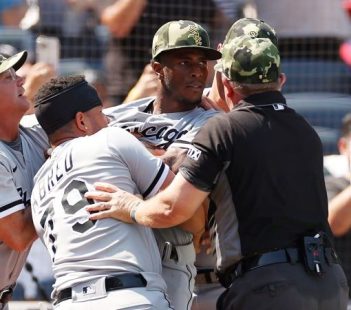
That lout contingency would hardly reject a chance to hammer an opponent taunted by one of their own with a particularly nasty racial reference during a game the day before, a reference that led in due course to a sharp exchange of words behind the plate and the benches and bullpens clearing, with Anderson needing to be restrained from potentially tearing Donaldson apart.

Even Donaldson’s own manager demurred from defending his man entirely after Saturday’s incident. “I don’t believe there was any malicious intent in that regard,” began Aaron Boone. “But you know, this is—just in my opinion—somewhere he should not be going.”

Donaldson went 0-for-4 at the plate during the doubleheader’s opener, which the White Sox won after busting a one-all tie in the ninth inning thanks to A.J. Pollock sending one into the left field seats and Adam Engel sending Vaughn home with an RBI double. He sat out the nightcap, during which the Yankees could summon up a measly three hits to no avail against three White Sox pitchers.

Now, in the top of the nightcap eighth, with first and second, on 1-1, Castro threw a slider that hung up just enough for Anderson to drive it the other way into the right field seats for what proved the final 5-0 score.

A Yankee fan wearing the jersey of retired Yankee first baseman Mark Teixiera threw the ball back onto the field on a no-doubt line, perhaps blissfully unaware that Teixiera as a player (and now a broadcaster) had too much class to applaud such depths. Unlike the Toronto fan in Rogers Centre who handed an Aaron Judge home run ball to a young fan wearing a Judge jersey, this fan probably wouldn’t have shown that kind of character if there’d been an Anderson fan adjacent to him.

A young White Sox fan wearing a replica of the team’s mid-1980s game jersey snapped a photo with his cell phone as Anderson continued his travels around the bases. When Anderson stepped on the plate it was as though planting an exclamation point at the end of an emphatic sentence.

As he took a few steps toward the White Sox dugout, Anderson put his index finger to his lips as he looked toward the crowd, just as he had rounding third. He didn’t talk to reporters after the game but a hot microphone courtesy of the game’s broadcast aboard ESPN captured his no-doubt explanation: “Making [maternal fornicators]  shut the [fornicate] up.”

Anderson probably knows in his heart of hearts that it’s easier to pass the proverbial camel through the eye of the proverbial needle than to shut the worst of Yankee or any other fans the fornicate up. Not even the evidence that Donaldson hasn’t exactly been a friendly opponent to Anderson and other White Sox in the recent past would convince them otherwise.

“[I]n this clubhouse,” said White Sox relief pitcher Liam Hendricks before Sunday’s doubleheader, “we have TA’s back in everything. It’s like having an inside joke with a guy you are a nemesis with, I guess you could say, but yeah, that’s not how it went down in this clubhouse and I don’t understand how, if [Donaldson] ever thought about [his “Jackie” taunt] like [a joke], it’s straight delusional.”

Anderson sent a message back on enemy territory in the best way possible. If only it could have been as joyous as the one he sent in the bottom of the ninth in last August’s Field of Dreams Game, against most of these same Yankees.

“The game’s never over,” Anderson said after that one. “And once [Yankee reliever Zack] Britton walked [White Sox catcher Seby Zavala], I knew there was a chance to start something real dope.”

That was then, this was Sunday. The hankering to know just what MLB’s reported investigation of the Saturday incidents determines heightens. But now Anderson finished something real dope under unwarranted provocation from a real dope.

On Anderson, Robinson, Donaldson, and jokes

Tim Anderson

Tim Anderson has to be restrained by teammates including Jose Abreu, and plate umpire Nick Mahrley, after Josh Donaldson took what he calls a joke too far Saturday.

That’d teach him. Three years ago White Sox shortstop Tim Anderson gave Sports Illustrated reporter Stephanie Apstein an interview in which he likened himself to Jackie Robinson. Not as a race pioneer, but as the kind of pioneer looking to break down another barrier, the barrier against having plain fun and letting it show while you play baseball.

Anderson didn’t kid himself. He as much as said he didn’t and probably wouldn’t face the kind of obstacles Robinson faced. What he did say, in language as plain as the plays he makes at shortstop or the hits he nails at the plate, was that he didn’t care two figs what you thought of him having fun playing, you know, a game.

The impetus for the interview was his then-recent suspension for hollering an insult back at Kansas City pitcher Brad Keller, after Keller hit him on the rump roast with the first pitch, two innings after Anderson demolished a Keller pitch for a two-run homer, looked to his dugout, and nailed a delicious bat-flip as he proceeded up the first base line.

“I kind of feel like today’s Jackie Robinson,” Anderson told Apstein then. “That’s huge to say. But it’s cool, man, because he changed the game, and I feel like I’m getting to a point to where I need to change the game.” In other words, Anderson planned to have his fun while he played. Oh. The hor-ror.

“Anderson’s point is more nuanced than it might sound,” Apstein wrote.

Robinson remains an American hero, and Anderson will never face the Jim Crow horrors Robinson and the first generation of black major leaguers endured. Also, plenty of players, white and nonwhite alike, have had fun while playing the game.

But, as a rule, baseball does not encourage individualism. As other sports have evolved to showcase their stars’ personalities, the baseball old guard has held tight to its principles. Run out ground balls. Keep your mouth shut. Gently place your bat near home plate—a player should react to a home run just as he would react to the news that an acquaintance filed his taxes on time.

Yankee third baseman Josh Donaldson remembered Anderson’s “I kind of feel like today’s Jackie Robinson” only too well. On Saturday, the Yankees and the White Sox had a dustup on the field over it, a few innings after Anderson says Donaldson greeted him with an apparent “What’s up, Jackie?”

A few innings later, as Donaldson approached the plate with the Yankees up 6-3, White Sox catcher Yasmani Grandal engaged him in a little chat. It didn’t look like anything drastic at first—from the outside. The next thing anyone knew, plate umpire Nick Mahrley was moving between the pair and the benches and bullpens emptied. With White Sox teammates moving Anderson back to the dugout before any serious damage could be done.

Nobody other than the immediate participants had any clue until White Sox manager Tony La Russa spoke to reporters following the 7-5 Yankee win. “He made a racist comment, Donaldson, and that’s all I’m gonna say,” La Russa said. It took Anderson himself to elaborate.

“He just made a disrespectful comment,” the shortstop said of Donaldson. “Basically was trying to call me Jackie Robinson, like ‘what’s up Jackie?’ I don’t play like that. I don’t really play at all. I wasn’t really gonna bother nobody today. But he made the comment, and it was disrespectful. I don’t think it was called for.”

Donaldson didn’t deny calling Anderson “Jackie,” but he did say the motive had nothing to do with race and everything to do with Anderson telling SI he felt like the Robinson of defunding baseball’s Fun Police.

“All right, so first inning I called him Jackie,” Donaldson told reporters post-game.

He’s gonna bring back fun to the game. [In] 2019 when I played for Atlanta, we actually joked about that on the game.

I don’t know what’s changed — and I’ve said it to him in year’s past. Not in any manner than just joking around for the fact that he called himself Jackie Robinson. If something has changed from that, my meaning of that — has not any term trying to be racist by any fact of the matter. It was just off of an interview of what he called himself.”

Donaldson may have lacked racial intent but his timing Saturday was a terrible look. “The very simple problem with Josh Donaldson calling Tim Anderson ‘Jackie’,” tweeted Business Insider writer Bradford William Davis, “is that he perverted honour into mockery.”

Could there have been those thinking Anderson, who’s normally as unpretentious as the morning sun, did likewise when he suggested himself as the Jackie Robinson of letting the kids play? Robinson broke barriers far more severe and grave than those between ballplayers letting joy in accomplishment show and ballplayers still artery-hardened enough to continue thinking you should play a game as though you’re wearing a three-piece suit in the board room.

And I for one have long tired of the hypocrisy saying one moment that you need to play professional baseball like a business but saying the next—as in, contract talks, free agency markets, or collective bargaining agreement skirmishes—that you need to remember you’re only playing a kids’ game, dammit.

Maybe Anderson was being just a little grandiose in 2019, while his heart was clearly enough in the right place. Maybe Donaldson chose the absolute wrong conversational weapon to send a message that baseball’s Fun Police aren’t about to be defunded without a fight.

Or, giving him the benefit of the doubt about the exchange he cited from 2019, maybe Donaldson doesn’t get that a joke has a finite shelf life. As in, immediately after he and Anderson laughed about it the first time. Cracking it three years past that expiration date doesn’t mean a laugh or a tension dissipator but a nasty cut to the heart and soul.

“This game went through a period in time where a lot of those comments were meant,” said Grandal post-game, after telling reporters they didn’t want him to tell them what he actually said to Donaldson behind the plate. “And I think we’re way past that. And it’s just unacceptable. I just thought it was a low blow and I want to make sure I’ve got my team’s back. There’s no way that you’re allowed to say something like that.”

Baseball government told Anderson with a suspension that there’s no way he’s allowed to call Keller, who’s white, “a weak-assed [N-word]” after he got drilled in 2019. Let’s see if baseball government tells Donaldson the same way that there’s no way he’s allowed to call a black player “Jackie” even as a joke, three years after the joke’s shelf life expired.

Listen up, Bleacher Creatures

Derek Rodriguez, Mark Lanzillotta

Derek Rodriguez (in his Yankee hat and Aaron Judge T-shirt) hugging Mark Lanzillotta gratefully, after Lanzillotta handed the boy a sixth-inning bomb Judge hit in Rogers Centre.

Recall if you will that I went to Opening Day in Anaheim with my 28-year-old son. From the moment he became a baseball fan in earnest at age six, his dreams included catching or otherwise obtaining one bona-fide major league baseball at the ballpark. On said Opening Day, 22 years later, I managed to make his wish come true.

An Astro lined a foul into our section during batting practise. Thanks to a small but clustered group of fans standing up adjacent to us, neither Bryan nor myself could see which Astro hit the ball. No matter. It bounded around a few times before making its way beneath my seat, where I snatched it and handed it to him.

Neither Bryan nor I cared that it came off an Astro bat, even if he (and I) might have preferred it courtesy of an Angels bat. It was a baseball, major league regulation, a simple but profound little prize of fandom that you can go a lifetime without obtaining, regardless of how often you’re at the ballpark.

My son’s gratitude was boundless, of course, even at age 28. “You gotta be a man to play baseball for a living,” Hall of Fame catcher Roy Campanella once said, “but you gotta have a lot of little boy in you, too.” Savouring and rooting and appreciating this game means the same thing when you’re watching at home or at the ballpark. Even professionally.

So imagine easily how it felt for a nine-year-old boy in Rogers Centre Tuesday, wearing a Yankee T-shirt with Aaron Judge’s surname and number 99 on his back, praying to God and His servants in the Elysian Fields that maybe, just maybe, he might catch a ball hit by his hero. He got the absolute next best thing.

A Blue Jays fan named Mike Lanzillotta sat in the second deck behind young Derek Rodriguez and his father, Cesar, Venezuelan natives living in Toronto the past five years.  Somehow, the boy’s eagerness got to Lanzillotta throughout the game. He didn’t have to imagine when lo! Judge batted a third time in the top of the sixth inning, against Jays pitcher Alek Manoah, who’d struck him out twice earlier in the game.

Not even Mark Harris, W.P. Kinsella, Ring Lardner, Bernard Malamud, or John Updike could have sketched this one. I’m nowhere in their league so I’m not sure I’m doing it right.

Judge caught hold of a fastball sailing a little inside and drove it . . . right into Lanzilotta’s hands. As Judge rounded the bases, Lanzillotta kept the promise he made to himself and handed Derek the ball. The boy’s gratitude poured into a hug around the older man’s neck and shameless tears of joy. Television cameras caught the moment and it went viral almost at once.

“I almost started crying,” Lanzillotta admitted to reporters. “For real, I almost started crying.” The father soon enough faced a question from his son: “I said, ‘If you were young, and the same thing happened to you, but with a home run off of Derek Jeter, what would you do?’” the boy revealed. “And he said I would cry the same. And fun fact, I was named after Derek Jeter.”

Aaron Judge, Derek Rodriguez

Derek got to meet his Yankee hero before Wednesday’s game.

Funner fact: The tale of Derek Rodriguez, Mike Lanzilotta, and Aaron Judge’s blast reached Judge himself after the Yankees demolished the Jays, 9-1. Reporters told Judge of the Kodak moment. (Oops! Today we’d call it an iPhone moment.) Known for being as fan friendly as the day is long, Judge himself seemed almost overcome by the revelation.

“That’s what’s special about this game, man,” the Yankees’ Leaning Tower of River Avenue told reporters, after grinning and observing you’ll find Yankee fans around the world. “It doesn’t matter what jersey you wear, everybody is fans, everybody appreciates this game. That’s pretty cool. I’ve got to check out that video. That’s special.”

He did more than just check out that video. Before today’s game, Derek got to meet his Yankee hero, who signed the home run ball for him. The still boyish-looking Judge looked as though he’d been taken back to his own boyhood for a few shining moments.

The Blue Jays didn’t exactly appreciate being blown away by the Yankees Tuesday, but it didn’t stop the team from giving more than a tip of the beak to Lanzillotta. They dropped a special team gift package on him for his sportsmanship. Cesar Rodriguez called him a friend for life. His cell phone was all but nuked with texts and calls following his gesture.

“I spilled my beer” retrieving the Judge home run ball, Lanzillotta said, “but it was worth it.”

Now listen up, all you Bleacher Creatures around the Show. You, the mental midgets who think it’s funny as hell throwing the opposition’s home runs back onto the field, pouring  abuse upon an opposition pitcher known to struggle with clinical depression, thinking it’s funny as hell throwing garbage and other debris on the field when an opposition fielder is injured on a play.

You should be made to watch that Judge bomb, that Lanzillotta gift to nine-year-old Derek Tuesday, and the boy’s meeting with Judge today. You might learn or re-learn a few things about sportsmanship. About real baseball rooting and caring. About plain human decency.