An epic Yankee fall?

Aaron Boone

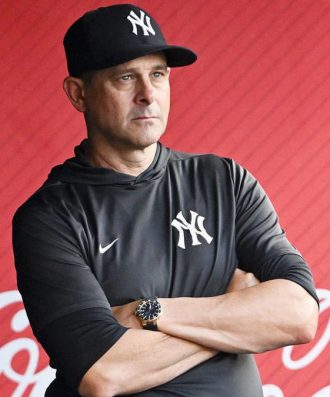
Aaron Boone—how often does a four-game division lead feel like the next rung down of a collapse?

“If we don’t dig ourselves out,” Yankee manager Aaron Boone told reporters after the Yankees lost to the Rays 2-1 Saturday night, “you’ll have a great story to write.” Sometimes, greatness is in the eye of the beholder. If the beholder is a typical Yankee fan, this kind of greatness is the last thing the Yankees need.

There’s always been a trunk full of cliches about the Yankees. The two most significant have been a) they don’t like to lose; and, b) their fans consider no postseason legitimate unless the Yankees are in it. (The third most significant, at least since a certain man bought the team in 1973: To err is human; to forgive is not Yankee policy.)

Even the terminally optimistic Boone feels the weight. If he’s telling reporters they’ll have a “great” story to write unless the Yankees find a way out of their current spinout, there’s no joy in half of New York. The other half is hanging with the Mets, who may have a mere two-game lead in the National League East but whose fans aren’t exactly ready to call for summary executions despite their team having ended May 10.5 games ahead of their divisional pack.

The Mets’ faithful learned from the crib that there’s no such thing as an entitlement to success. (Quick: Name any Yankee team ever called a miracle team.) The Yankee faithful were spoiled so rotten by their 20th Century success that their descendants still think the World Series trophy is fraudulent unless it has the Yankee name on it.

Maybe the Yankees will dig themselves out of their present funk. But maybe they won’t. They’re 15-16 in the second half so far and went 10-18 in August alone, but they awoke Sunday morning having lost six of nine. Dropping the first pair of a weekend set with the second-place Rays is one thing, but entering that set splitting four with the sad-sack Athletics and two of three to the equally sad-sack Angels is not the look the Yankees wanted going in.

Their toughest opponents the rest of the way will be those same Rays for a three-game set in Yankee Stadium starting 9 September. They return home from Tampa Bay to host the Twins for four, and the Twins are no pushovers, but they’re not exactly up to the Rays’ performance level just yet. They’re also not quite up to the level of the suddenly-amazing Orioles, whom the Yankees host to end September and open October.

The Orioles—who looked as though they’d surrendered their heart and soul when trading Trey Mancini at the trade deadline, which could have threatened their unlikely sightline to the wild card picture. While almost nobody was looking, the Orioles not only finished July with a 16-9 month but they consummated a 17-10 August and opened September with three straight wins—one against the AL Central-leading Guardians and two against the A’s. Once upon a time the victims of a miracle team (in 1969), these Orioles may yet <em>become</em> a miracle team themselves.

They were as deep as 23 games in the AL East hole as of 2 July. They were 35-44. They’ve since gone 36-25. This regular season may yet finish with a debate over which was greater, the Yankees’ collapse from a one-time 15.5 game AL East lead or the Orioles’ resurrection from a 23-game divisional deficit to a postseason berth.

Yankee and other eyes concurrently train upon Aaron Judge’s pursuit of the 60 home run barrier across which two Yankees have gone (Hall of Famer Babe Ruth’s 60 in 1927; Roger Maris’s 61 in ’61) and—after a healthy leadoff belt in the top of the ninth off Rays reliever Jason Adam Saturday night—Judge himself is only eight shy of meeting. Some think Judge is so locked in he may even meet the 70-bomb single-season barrier head-on before the regular season expires. He’d be the first player to reach it without being under suspicion of actual/alleged performance-enhancing substances, anyway.

But Yankee cynics make note that, for thirty days including Saturday night, the Yankees’ team slash line of .213/.289/.325 is only that high with Judge, himself the possessor of a .279/.446/.593 slash for the same span. Without him, they’d be .208/.268./.295. Their Lost Decade of 1965-75 looked better than that.

How on earth did the Yankees get here? Easy enough. Hal Steinbrenner isn’t the man his father was, good and bad. The good side: Prince Hal isn’t exactly the type to decide one bad inning is enough to demand heads on plates, and if he fires a manager he wouldn’t have the gall to say, “I didn’t fire him. The players did.” The bad side: He doesn’t like to invest half as much as his father did.

Say what you will about George Steinbrenner, but the man didn’t care how much he had to spend, either on the free agency market or on keeping the farm reasonably fresh. Prince Hal’s running the most profitable franchise in the American League as if they were a minor league outlier or the A’s, whichever comes first. Nobody wants the bad side of The Boss resurrected, no matter how often Yankee fans demand it now. But nobody wants the good side buried interminably, either.

Which means general manager Brian Cashman, the longest-tenured man in his job in baseball, had little choice but to cobble a roster with one proverbial hand tied behind his back. But that acknowledgement goes only so far. Cashman’s eye for diamonds in the rough has failed him long enough. The present Yankee roster makes some rebuilding teams (the Orioles, anyone?) resemble threshing machines.

Which also means Boone—the only man in Yankee history to manage back-to-back 100-game winners in his first two seasons on the bridge—looks a lot larger for his faltering in-game urgency managing and getting less than the best of the men not named Judge or (relief pitcher) Clay Holmes on his roster. So do the three Yankee hitting coaches who can’t seem to shake the non-Judge bats out of what one of them is quoted as calling the wrong case of the “[fornicate]-its.”

The definition to which those coaches hold is translated admirably by strongman designated hitter Giancarlo Stanton: “We’ve just got to give whoever is on the mound a tough at-bat, even if we get out. We’ve just gotta wear ’em down a little bit. Just be a little tougher on them.” The definition to which the Yankee bats have held mostly of late seems to be unintentional surrender.

Yes, the Yankees have been injury-addled. Yes, they’ve been playing a curious chess game with minor leaguers brought up to the club to the point where they had to send two promising pitchers back down because the roster was about as flexible as an iron gate. But the lack of urgency the Yankees seemed to feel when they looked like AL East runaways hasn’t been resolved just yet with the team looking as though they can be overtaken before this is over.

Once upon a time, New York was rocked by a Brooklyn Dodgers team that looked as though it was shooting the lights out in the National League but found itself overtaken into a pennant tie by a New York Giants team that was 13 games out at one point. That tie and subsequent playoff, of course, turned out to be as tainted as the day was long. (The Giants stole the pennant! The Giants stole the pennant!)

To the best of anyone’s knowledge, nobody’s cheated their way back into the AL East race. If the Yankees keep up their current malaise, nobody would have to. Collapsing entirely from a 15.5 game lead would stand very much alone on the roll of Yankee infamy.
The spirit of 74

Aaron Judge

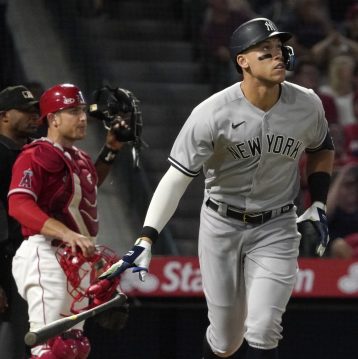
Hitting number 51 against the Angels Tuesday, Aaron Judge may yet break the single-season home run record. May.

We’re well enough past the point where looking at the scores to see how the Yankees are doing has nothing to do with a certain Yankee’s performance. If you turn to see the latest in any Yankee game without checking first on Aaron Judge’s in-game doings to that point, you’re going to flunk a polygraph hooked upon that question.

The Leaning Tower of River Avenue (how the mind’s eye produces fantasies of him squaring off against such lamp post-tall pitchers as Hall of Famer Randy Johnson and the late J.R. Richard) is having his best unimpeded (yet) season since his Rookie of the Year campaign five years ago. But nobody cares a whit about anything other than what he hits over the fence.

This year, the baseballs may still come having been consciously deadened but Judge couldn’t care less. He’s sent 51 of the miniature medicine balls into the seats through this writing. Those who care will note that he did that fourteen days before Babe Ruth reached 51 in 1927 and four days after Roger Maris reached it in 1961.

That’s talking purely about single-season home run record held by Yankees, about which there was once and still often enough not always cheerful insanity. Yankee chauvinists insist that and just about any other slugging record lack legitimacy unless set or held by Yankee batters. Which is almost (underline, please) as obnoxious as their (frequent enough) insistence that the postseason is illegitimate without a Yankee team in it.

Judge is one of the most likeable players on a team with which baseball fans not roosted in New York (and enough who are) have had, shall we say, a mixed relationship. The Yankees’ history is respected and even admired, however grudgingly, but the team is not always beloved. What’s true of several other teams is true exponentially about them.

But now and then even such parochial rooting or anti-rooting steps to one side when an individual Yankee threatens to launch himself into the precincts of the gods. That polygraph’s needles will jump right off the machine and onto the floor the moment you say that you don’t care if Judge hits a hundred home runs by the time this regular season ends just as long as the Yankees don’t win.

He’s not going to hit a hundred, of course. Seventy isn’t an unrealistic expectation at his pace. Seventy-four, which is what Judge would need to become the undisputed all-time single-season home run champion, may not be as much of a pipe dream as you think.

Judge doesn’t play under the witless lash of a commissioner who insisted without true authority to do so that the record would be illegitimate if broken after 154 games. He does play under the eye of a considerable crowd praying he gets to 74, the better to knock a suspect player out of the way. The incumbent record holder was a) not a Yankee and b) suspected of using actual or alleged performance-enhancing substances to get there.

And that record holder took the record from another who was not a Yankee and suspected of actual or alleged PEDs. The point that they were quite the outliers, in a generation where numerous players using or suspected of using such substances actually saw statistical dips instead of spikes (and, yes, you can look it up), usually escapes the usually self-appointed arbiters of sports morality.

It won’t condone those users or elevate those accusers if and when Judge parks number 74. But it would be nice to remember that baseball government did nothing about the plague until that government bumped into the government government. And the government government seemed far more interested in leading players on the perp walk than they were in sending swell if hypocritical messages to kids.

Without all that, we might be allowed to watch the Judge pursuit with more joy. Without all that, we might have nothing more grave to consider than this: If Judge can send baseballs that might as well be miniature medicine balls into earth orbit, what incentive does the sport’s administration have to iron up, remove its blinders, and insist upon a uniformly made baseball that allows both pitchers and hitters a fair shake?

The only blemish I can think of that attaches to Judge was his extremely rare attack of hubris in trolling Red Sox fans after the Yankees tied their 2018 American League division series, blasting Frank Sinatra singing “New York, New York” (a staple in Yankee Stadium after Yankee wins) from his boom box as he departed Fenway Park.

That’d teach him. In New York, the Red Sox destroyed the Yankees in the third division series game (16-4) and hung in despite a Craig Kimbrel meltdown in the bottom of the ninth to take it with a 4-3 Game Four win. Yankee fans were grateful that, to the best of anyone’s knowledge, none of those Red Sox (who went on to win the World Series) trolled them with boom boxes blasting the Standells’s garage band classic “Dirty Water.” (Boston, you’re my home . . .)

If that’s the only crime against common sense Judge has committed in his career, it’s not exactly a rap sheet on which to hang a man. Facing his first free agency this coming off-season, Judge stands to reap a payday equal to the value of some companies and a few tiny nations. He couldn’t have made a more powerful case in his dreams.

But this is the same player who was made aware of a Blue Jays fan handing one of his mammoth-blasted balls to another Rogers Centre fan who’d made no secret of Judge being his baseball idol and hoping to have a ball hit by Judge himself.

“That’s what’s special about this game, man,” he told reporters, after learning video of the moment went viral. “It doesn’t matter what jersey you wear, everybody is fans, everybody appreciates this game. That’s pretty cool. I’ve got to check out that video. That’s special.”

He did more than check the video out. The following say, before the game, he made a point of meeting the boy and his family and the fan who handed the ball to the boy, signing the home run ball for him and giving him the batting gloves he wore while hitting it.

Judge still resembles an eager nine-year-old boy himself when he flashes his familiar snaggle-toothed grin. But in the batter’s box he resembles the Jolly Green Giant when he pumps his bat and turns a pitcher’s mistake into another long bomb. Where he does it from hardly matters. His 199 OPS+ through this writing indicates he could clear several zip codes from the Grand Canyon or the last known surviving telephone booth.

If the Leaning Tower of River Avenue does it 23 more times between this writing and the regular season’s conclusion, there shouldn’t be a single baseball fan (even of the Yankee-hating variety) declining to stand up and cheer. If he doesn’t make it, stand up and cheer, anyway. Between his pursuit of 74 and Albert Pujols’s renaissance pursuit of career number 700, they’ve made the home run fun again.

Are Hal Chase’s statistics “meaningless?”

Hal Chase

Hal Chase—The talent said a great defensive first baseman; the corruption says otherwise. (Sporting News photo.)

If there’s one thing that baseball itself will debunk somewhere, some time, somehow when you least expect it, it’s the idea that you’ve seen everything on or off the field. The moment you satisfy yourself that you have, the game has a way of replying in a split second, “Pants on fire!”

That doesn’t work with great hits or great plays alone. You think you hear it all (over again) whenever Pete Rose’s dwindling supporters burp up yet another mealymouth argument on behalf of putting him into the Hall of Fame despite what Rule 21(d) and the Hall’s own rule about ballot eligibility say? Brace yourselves.

For whatever reason, the subjects of the day a few days ago, on a Society for American Baseball Research (SABR) social media group thread, included Hal Chase, whom history still treats as perhaps the poster boy for baseball’s gambling infestation from the late 1800s through the end of the Dead Ball Era.

A thread opener cited Babe Ruth’s once-famous observation, when asked to name those he thought the best at their positions:

[T]he Prince was also a very fine hitter who played his entire career before the ball was juiced up. He couldn’t run, he could fly. And aside from Ty Cobb, he was the best baserunner I ever saw. Fielding, are you kidding? Prince Hal was the greatest fielding first baseman that ever played. He was worth the price of admission just to watch him toe-dance around first base and pick those wild throws out of the dirt.

Funny, but that’s not exactly what Chase’s statistics say. When I pointed that out in the thread, among the replies was, “And that’s what makes the stats on him useless,” which was dubious enough. But then came the real corker: “Just goes to show how much stats are useless.” Not the stats on Chase himself but stats overall. On a SABR group thread, no less.

Just about all accounts of Chase affirm that what Ruth saw in him was there. But add that it tended to happen only when Chase was of a mind to exercise it. You don’t even have to read Donald Dewey and Nicholas Acocella’s The Black Prince of Baseball to comprehend. The record was long enough in place attesting that, in baseball’s arguable most corrupt era, Chase was its arguable most corrupt figure.

“Chase’s talents,” wrote SABR director of editorial content Jacob Pomrenke in a 2013 essay, “were legendary: He made one-handed catches with astonishing ease, played farther off the bag than anyone had ever seen and charged sacrifice bunts with speed and agility. He also earned the reputation of being the best hit-and-run batter in the American League and frequently ranked among league leaders in batting average, RBI and stolen bases.”

There is, of course, an ocean’s worth of distance between one’s talents and one’s development and exercise of them. In this instance Pomrenke’s reminder is vivid enough:

His career in the major leagues from 1905 to 1919 was checkered with accusations of game-fixing. Two of his managers with the New York Highlanders (later the Yankees), George Stallings and Frank Chance, accused him of “laying down” on the team. He missed signs frequently (especially on the hit-and-run, causing base runners to be hung out to dry) and dropped balls from his infielders in such a subtle way that it made their throws look like errors. But whenever a stink was raised about his play, club owners Frank Farrell and Big Bill Devery sided with their star first baseman—and even made him the manager once, a decision that satisfied no one. Chase lasted just one full season in the role.

We’re not going to run down the entire record of Chase’s corruption here. We know that the Dead Ball Era could also have been called the Dubious Ball Era considering how many players were involved in gambling-inspired game fixing and how many owners and managers lacked clean hands themselves. (It only begins with remembering New York Giants manager John McGraw owned a piece of a pool hall belonging to and run by eventual 1919 World Series financier Arnold Rothstein.)

We won’t even go into the complete details about how Christy Mathewson—pitching star (and charter Hall of Famer) turned manager of the 1916 Reds, where Chase landed after a two-season term in the upstart/outlaw Federal League—caught Chase dead to right bribing teammates and opponents to help him fix games and suspended him, only for Chase to be let off after Mathewson entered the Army during World War I and was unable to testify at a league hearing.

Let’s hark back to the Ruthian recollection of Chase’s abilities. Far from being meaningless, Chase’s actual major league statistics do portray him the way the stats so often portray outsize talents that don’t turn them into performance at the plate or on the field:

A very fine hitter. Well, Chase won a batting title in 1916 and had four other top-ten finishes. That might speak well of a player with a short career, but Chase played fifteen major league seasons. He finished third in the batting race once, eighth once, and tenth once. For eleven major league seasons (including his Federal League years) he wasn’t a top-ten guy for batting average.

Aside from Ty Cobb, he was the best baserunner. This one’s tricky, because the stats are incomplete on how often Chase was caught stealing while he did steal 363 bases and finished in the lower third of his league’s top ten three times.

He was worth the price of admission just to watch him toe-dance around first base and pick those wild throws out of the dirt. Ruth’s hardly the only Chase contemporary or semi-contemporary to praise Chase as a fielder. But considering the full story, isn’t it possible that Chase flashed that amazing ability selectively, delivering the goods just as Pomrenke observed, when he bloody well felt like it or when it was in his personal as opposed to his teams’ interest?

Think of this, too: Forgot for the moment how dubious “errors” are (think deep and ponder that an “error” is some official scorer’s notion of what should have happened on a play no matter how tough) and consider that Chase led his league eight times (it’s the most black ink on his record), finished second three times, third twice, fourth twice, fifth once, and seventh once. All fifteen major league seasons he played show him with top ten finishes including eight league leaderships in fielding errors.

Christy Mathewson

Christy Mathewson—the charter Hall of Fame pitcher turned manager may have been the only man in pre-Landis baseball willing to challenge and try purging Chase and other gambling-corrupt elements in the game before the Black Sox scandal forced the game’s hand.

The final stats show Chase shaking out as the 124th best first baseman who ever played the major league position. I think the entire body of evidence shows that he didn’t just hurt his teams and his game with his game-fixing actions.

Writing The New Historical Baseball Abstract, Bill James ranked him number 76, but that was published in 2001. “[W]hat greatness as a baseball player comes down to is, ‘What did he do to help his teams win?’ If you were trying to win a pennant, how badly would you want this guy? Hey, this is not Joe Jackson that we are talking about here. This is not the corrupted. This is the corrupt.”

As James pointed out further, Chase never played on a pennant winner, “and most of the teams he played for declined precipitously when he joined them and improved dramatically after he was gone.” Let’s look at that all the way. Was James right? The following table shows where Chase’s teams finished the year before he joined, right after he joined, and the year after he left:

Joined Before After Left Year After
New York (AL) 1905 2nd 6th (-) 1913 6th (push)
Chicago (AL) 1913 4th 5th (-) 1916 3rd (+)
Cincinnati (NL) 1916 7th 7th (push) 1918 1st (+)
New York (NL) 1919 2nd 2nd (push) 1919 2nd (push)

Two Chase clubs finished farther out of the race after he joined them than they finished the year before. Two finished exactly the same after he joined, but one (the 1916 Reds) won the pennant the year after he left. One (the 1919 Giants) finished the same before, with, and after Chase.

What we have is a baseball talent who elected to undermine his own skills on behalf of the worst elements in baseball during the era that climaxed with the disgraces of the Black Sox scandal. (Chase had no part in the 1919 World Series fix attempt himself, but it’s on the record that he made $40,000 betting against the White Sox.) He was avariciously corrupt enough to undermine his own abilities and thus his own final statistics.

You can run down baseball history and find scores of players who had all the talent but none of the final results that equaled the talent. Many were undermined by injuries, many squandered or eroded their talents by themselves. For every truly talented player who worked concurrently on the team-first ethic, there’s another who placed himself well beyond the team need.

Chase was a team player in the sense that he enlisted teammates and even opponents to be part of a game-tanking for profit fraternity whose purpose was to continue undermining the very essence of honest competition for his and their own profit.

Ruth and other contemporaries praising Chase’s skills so extravagantly begs the question of just how far they were willing to look the other way. How far were they willing to ignore the dark side leaving Chase with a statistical record on both sides of the ball that’s nowhere near what you expect or hope of a ballplayer that gifted who exercises and advances his talent.

You’d be as hard pressed to find a player as simultaneously gifted and corrupt as Chase as you’d be to understand what about him (other than equally corrupt or corrupted officials) enabled him to skate on numerous attempts to run him out of the game. Except perhaps his personal popularity.

Rose’s gambling issues traced back at least to the mid-1970s. But as John Helyar wrote, in The Lords of the Realm, “baseball let him get away with it. GMs wouldn’t mess with a gold-plated gate attraction. Writers had no need to expose the best quote in the business. And baseball’s security director then, Henry Fitzgibbon, limited himself to Dutch-uncle talks with Rose.”

Only when it became too flagrant to dismiss did baseball finally take steps forward. But in Peter Ueberroth’s final days as commissioner he called Rose in, listened to Rose’s flat denials, then told a reporter, “There’s nothing ominous, and there won’t be any follow-through.” Not so fast, we came to learn the hard way soon enough.

Chase was insulated similarly long enough. He was popular, according to most accounts from his time; in fact, he was the first homegrown star of the Yankee franchise. (They were known as the Highlanders when he came up; the name changed in 1913.) A game that deep in gambling corruption wasn’t that anxious to make an example of Chase, no matter how earnest the equally popular Mathewson was—and he might have been the only man in pre-1920 baseball willing to stand up to the gambling cancer—in trying to purge him and similar elements.

Only in 1919 as a Giant did Chase’s major league career come to a halt. Technically, he suffered an injured wrist, but even McGraw couldn’t look the other way anymore when he’s said to have caught Chase and third baseman Heinie Zimmerman trying to bribe teammates to tank a few games.

The following spring, Chase was home on the west coast playing semipro ball when his old Reds teammate Lee Magee blew the whistle: Magee and Chase conspired to throw games in 1918. Chase was also caught trying to bribe players in the Pacific Coast League in 1920. The only thing knocking those out of the headlines was the slowly revealing scandal of the 1919 World Series.

The PCL banned Chase for life. (Chase came to the Highlanders/Yankees attention originally when he starred for the PCL’s Los Angeles Angels.) Incoming baseball commissioner Kenesaw Mountain Landis didn’t ban Chase formally from the rest of organised ball, but the hammer upon the Black Sox plus Chase’s age (37), injuries, and flagrant corruption meant he wasn’t going to be seen in the majors again.

Chase didn’t inaugurate baseball’s gambling corruption. That was established before he emerged as a major league first baseman. He merely found himself at home on the corrupt side. His major league statistics aren’t meaningless. They’re the outcome for a genuinely talented player who embraced instead of rejecting the game’s pre-1920 corruption.

If we must retire one more Yankee number . . .

Gil McDougald

Gil McDougald, the infield jack-of-all-trades for the 1950s Yankees. If we must have yet another retired Yankee uniform number, let it be his. 

My rejoinder to Dr. Paul Semendinger’s argument to co-retire Yankee uniform number 9 in honour of Hank Bauer (it’s already retired for Roger Maris) provoked a pleasant enough debate, when Dr. S. republished it on his Yankee blog Start Spreading the News a couple of days ago. Well, it was pleasant until some comments.

Nobody attacked me, but some of the arguments addressing retired Yankee uniform numbers went from the ridiculous to the more ridiculous. Now there came calls from one or another place to think about retiring the numbers of such Yankee ghosts as Spud Chandler, Tommy Henrich, Graig Nettles, Willie Randolph, and Roy White.

Let’s just say for openers that the Yankees have so damn many retired uniform numbers that they’ve made the honour almost meaningless. I’ll say it again: Be not surprised if you live long enough to see the middle of this century featuring all active Yankees wearing triple digits on their backs.

But let’s say, too, that in the cases of Chandler and Henrich, there’s more than one number to ponder. Presumably, Chandler’s likeliest target for uniform retirement would be 21, which he wore for the bulk of his Yankee career. Oops. Paul O’Neill’s getting the honour of number 21 retired.

Henrich wore four numbers in his career. Of those, he wore 7 from 1939-42, when he went into World War II service; and, 15 from 1946 until his retirement after the 1950 season. Ol’ Reliable’s 7 was taken in due course by Mickey Mantle. And 15 is retired already—for Thurman Munson. Whoops.

Semendinger has no apparent issue with co-retiring uniform numbers as it is. He thinks (erroneously) that there’s nothing wrong with declaring 9 co-retired between Maris and Bauer, not to mention Nettles who wore it as a Yankee. I’ll answer that again soon, promise. But I’d like to see him come right out and argue that Chandler ought to be part of O’Neill’s number retirement or, even better, that Mantle should share 7’s retirement with Henrich or Munson should share 15 likewise.

Not even the most casual of the casual among Yankee fans would stand for that without a rip-roaring fight. (Or would they?)

Chandler was a tough righthanded pitcher for three Yankee World Series winners (1941, 1943, 1947). Much of his reputation rests on a fluke 1943, when he posted both the lowest ERA (1.64) and fielding-independent pitching rate (FIP: 2.54) of his major league career. Credited with a league-leading 20 pitching wins, Chandler was named the American League’s Most Valuable Player even though the award probably should have gone to Cleveland’s Hall of Fame shortstop Lou Boudreau. (Boudreau: 8.1 wins above replacement-level, leading the league; Chandler: 7.3.)

Why call Chandler’s 1943 a fluke? Easy: 1) Baseball was already depleted of enough prime talent by World War II. (The Yankees themselves lost Henrich, Joe DiMaggio, Phil Rizzuto, and Red Ruffing, not to mention a catching prospect named Yogi Berra.) 2) His ’43 ERA was 1.20 below his career mark. 3) His ’43 FIP was 75 points under his career mark. He did get a late major league career start thanks to several minor-league injuries, and the injury bug also kept him out of a few World Series pre-1941.

Chandler himself was pulled into the Army after the ’43 Series, though his injury history kept him from combat. He returned near the end of the 1945 season, posted two more solid seasons in 1946 and 47, but age and injuries compelled the Yankees to release him at 39 in April 1948.

He was a good pitcher who was probably held back by his minor league injuries in the 1930s (he didn’t throw a major league pitch until he was 29) and a few more injuries as a Yankee, where he was respected for a toughness that sometimes bordered on recklessness. But if you’re even thinking about retiring or co-retiring the uniform number of the 377th starting pitcher of all time, who isn’t even one of the ten best Yankee pitchers ever, you should quell that thought post-haste.

Henrich was a terrific player whose travel over the top of the mountain toward his decline phase was rudely interrupted by World War II—Ol’ Reliable lost three seasons to the war. He was one of the solid men when he returned, too; somehow, he remained much the same player after the war as he’d been before it.

As a matter of fact, my Real Batting Average places Henrich (.558) just behind Paul O’Neill (.565 as a Yankee) and way ahead of Hank Bauer (.500), while the defensive metrics show Henrich pretty much a match for both those men, whom Dr. Semendinger think deserve equal uniform retirement. Well, now. Henrich is ranked as the 58th best right fielder ever; Bauer, the 88th best. Case closed.

But you’re not even going to think about compelling Munson or Mantle to share a uniform retirement even with Henrich. You’re not going to compel a shared uniform retirement between the second-best catcher in Yankee history, the arguable greatest all-around player ever to wear the Yankee uniform, and the guy who isn’t quite one of the Yankees’ top ten right fielders. Not unless you require psychiatric evaluation.

Think of Monument Park as the Yankees’ team Hall of Fame. That’s where you honour the Chandlers, the Henriches, the Bauers. Strike their Monument Park plaques. (While we’re at it, do likewise for Nettles and White; Randolph already has his plaque there.) That’s it. They don’t quite deserve uniform number retirements.

Co-retired numbers are also unwarranted insults. Yogi Berra didn’t deserve to be co-retired with Bill Dickey; Berra was ten times the catcher Dickey was and he’s a hair’s breadth ahead of Johnny Bench as the greatest all-around catcher who ever strapped it on. And Roger Maris was insulted without warrant more than enough in his Yankee career without handing him one more by compelling him to share retired number 9, even with Hank Bauer.

You want to think about a Yankee uniform retirement that a) hasn’t been done yet (believe it or not) and b) would do honour to a truly underrated Yankee great? I’ll give you one. Number 12. It’s the only number Gil McDougald wore in his entire Yankee life. Of all the not-quite-Hall of Famers to play for Hall of Fame manager Casey Stengel under his platoon-and-multiples system, McDougald was the best of the group.

He was a fair hitter (he led the league with nine triples in 1957) and a 1951 American League Rookie of the Year. (Even though Minnie Miñoso really deserved the award.) But he was a defensive virtuoso at the three toughest infield positions, finishing his career in double figures on the positive side for defensive runs above his league average at all three. (Second base: +46. Shortstop: +16. Third base: +13.)

Maybe McDougald gets short shrift even among Yankee fans because he wasn’t exactly one of the most glittering Yankees of his time. Maybe, too, he gets such short shrift because of Cleveland pitching legend Herb Score.

You know, the line drive McDougald cracked off Score’s face in 1957 that people to this day believe ruined the Cleveland lefthander’s career. False. Score returned in 1958, had a shaky season’s start before he began to find his proper form again . . . then blew his left elbow out pitching eight innings on a damp night. That, and not the McDougald liner, ultimately put paid to Score’s effectiveness and, soon enough, his pitching career.

McDougald tried to visit Score in the hospital but was blocked by hospital personnel. Yet Score’s sister disclosed decades later that their mother told her, “It’s bad, but he’s got the finest doctors in the world and they will do everything that they can. You need to go down to the church and say your prayers for Herb, but more than that to pray for Gil McDougald. That man is a hurting man.”

Indeed. McDougald wouldn’t quite be the same player after the Score incident, even though Score’s mother herself reached out to him as her son did to tell him the injury was nobody’s “fault.” (McDougald in gratitude visited the older woman regularly for the rest of her life as well as swapping holiday cards with Score himself.) The Yankees left him open to the American League’s first expansion draft but he elected to retire, instead.

“The way that Stengel used him,” Bill James has written of him (in The New Historical Baseball Abstract), “kept him from becoming a star . . . But then, Gil McDougald wasn’t born to be a star. He was born to be a Yankee.”

The sad irony is that McDougald suffered an almost Score-like injury in spring training two years earlier, when a batting practise line drive caught him behind his ear while he was chatting with coach Frank Crosetti. The ball fractured a hearing tube; in his baseball retirement, successful with a dry cleaning business and a building maintenance business, as well as coaching Fordham University baseball, McDougald went completely deaf by the mid-1970s.

New York Times writer Ira Berkow told the story in “McDougald, Once a Quiet Yankee Star, Now Lives in a Quiet World” in 1994. Not long after, McDougald received a cochlear implant that restored his hearing. (“They’ve turned the music back on,” he said happily.) Both Berkow’s original story and the happy followup (“For McDougald, the Miracle of Sound”) were republished in 2009’s Summers in the Bronx: Attila the Hun and Other Yankee Stories.

McDougald got to live another fifteen years with his restored hearing until his death at 82 in 2010. Like too many honours it should have been done while he was still alive to appreciate and accept. But if there’s one more Yankee who really does deserve his uniform number retired, McDougald does.

Paul O’Neill vs. Hank Bauer?

Mickey Mantle, Casey Stengel, Yogi Berra, Hank Bauer

Hank Bauer (far right) with (left to right) Mickey Mantle, Casey Stengel, and Yogi Berra, in 1954. A key element in Stengel’s platoon system, Bauer was immortalised by a comic as a man “with a face that looks like a clenched fist.” (UPI photo.)

My Friday morning e-mail included a copy of the Internet Baseball Writers Association of America’s Here’s the Pitch newsletter. Fair disclosure: I contribute to that newsletter once a month at minimum, sometimes more if called upon, and no one has requested my assassination over anything I’ve written there. Yet.

Further fair disclosure: Paul Semendinger, Ed.D., is an educator, elementary school principal, enthusiastic Yankee blogger, and author of The Least Among Them. He has even been agreeable enough to republish a few of my own writings on his blog Start Spreading the News.

Dr. Semendinger may not be so agreeable about my demurral from this: he says in this morning’s HTP that Hank Bauer deserves a Yankee uniform retirement number just as the forthcoming Paul O’Neill does. (O’Neill’s 21 will be retired this season.) Until this morning’s e-mail, and nothing against O’Neill himself, I’d never considered him a candidate for uniform retirement.

Not just because the Yankees have retired a few too many numbers already (21); not just because eight of the 21 don’t belong to Hall of Famers. (Thurman Munson’s 15 is retired, but he deserves a plaque in Cooperstown and will get one in due course from the Hall’s Classic Era Committee covering pre-1980 players.) Yankee players may be wearing triple-digit uniform numbers exclusively by the time this century is half over.

O’Neill was as solid a ballplayer as you could ask. So was Bauer. They have much in common. They were both right fielders with good throwing arms and route instincts; they both hit for extra bases as often as not; they both played on multiple World Series winners. They were both the kind of men to whom teammates looked in the clubhouse as well as on the field.

They also both played in high-offense eras though O’Neill’s was somewhat higher than Bauer’s. Neither is close to having been a Hall of Famer, but Dr. Semendinger thinks Bauer was the better ballplayer by margin enough. I’m no more convinced of that than I am that either man deserves a number retirement, however excellent they happened to be.

The traditionalists might care to note that O’Neill has a higher batting average as a Yankee than Bauer: .303 vs. .277. Even allowing the righthanded Bauer some slack for having to hit to that cavernous left center field in the old Yankee Stadium, that’s a big river between them. Bauer hit only a couple of points higher at home while slugging a few points less at home.

O’Neill was a lefthanded batter who hit better at home in two cavernous ballparks (Riverfront Stadium, the remodeled old Yankee Stadium which kept the shorter right field porch) than on the road. But the splits aren’t as wide between the two as you might think.

So we should take a look at the two right fielders as Yankees according to my Real Batting Average metric: total bases + walks + intentional walks + sacrifice flies + hit by pitches, dividing that sum by their total plate appearances. Dr. Semendinger may or may not like this:

Player PA TB BB IBB SF HBP RBA
Hank Bauer 5375 2123 491 24 19 33 .500
Paul O’Neill 5368 2313 586 51 69 13 .565
Paul O'Neill

Paul O’Neill at the plate during his Yankee seasons.

How could Bauer have only nine more plate appearances than O’Neill despite playing three more seasons as a Yankee than O’Neill did? Simpler than you might think if you know where to look.

Bauer has been remembered as one of the near-typical elements of Hall of Fame manager Casey Stengel’s platoon system, usually in hand with fellow outfielder Gene Woodling. He averaged 117 games a season as a Yankee. O’Neill wasn’t a platoon player in the Joe Torre era and averaged a percentage point short of 140 games a season in the pinstripes.

And in nine fewer Yankee plate appearances O’Neill has 190 more total bases, drew 27 more walks, and was handed 27 more intentional walks. I submit the last indicates the pitchers in Bauer’s time feared him at the plate less than the pitchers in O’Neill’s time feared him.

Dr. Semendinger points to Bauer’s 29.3 wins above replacement-level as a Yankee and O’Neill’s 26.7 WAR as a Yankee as further evidence. Well, now. If you got to play three more Yankee seasons than the next guy even if you were almost the same kind of player, of course you’re going to have 2.6 more WAR.

Bauer also has one leg up for being a slightly better defensive right fielder than O’Neill was, but have a look at their offensive WAR as Yankees: O’Neill (29.9 oWAR) has Bauer (24.0 oWAR) beaten by a decent distance. Bauer’s seven-year peak WAR is 25.7 . . . but O’Neill’s is 27.4.

Dr. Semendinger made a point of noticing Bauer’s 158 home runs in a Yankee uniform. I did mention both men had some power. But I forgot to mention O’Neill hit 185 out as a Yankee. It’s not exactly Bauer’s fault that Stengel saw him as the kind of player who’d shine in his platoon system as a platoon man, though Bauer did get remarkable enough playing time for a man made a key part of that platoon system.

But O’Neill wasn’t considered a platoon player, and I submit the final numbers say O’Neill was just that much more valuable to his generation of Yankees than Bauer was to his. Not so fast, Dr. S. might rejoin.

“If O’Neill deserves credit for being a leader on four championship teams, Bauer also deserves that same credit, and then some,” he writes. “Bauer was a leader on seven World Championship Yankees teams.” It’s O’Neill’s fault that he didn’t have the full caliber of teammates Bauer had?

Let’s see. Bauer played with three full-time Hall of Famers: Yogi Berra, Whitey Ford, and Mickey Mantle. O’Neill as a Yankee played with two enshrined full-time Hall of Famers (Derek Jeter, Mariano Rivera) and a third who belongs in Cooperstown (Roger Clemens) but isn’t there yet thanks to continuing suspicions (as opposed to, you know, evidence) about involvement with actual/alleged performance-enhancing substances.

Bauer’s teams had the slightly better role and platoon players. (Imagine if O’Neill’s Yankees could have had their own Gil McDougald, to name only the most versatile.) They also had Berra behind the plate doing what almost no other catcher in major league history did: helping their pitchers pitch better as Yankees than they did a) with any other Yankee  behind the plate and b) on any other team in their careers.

Bauer also played in the pre-division era where you finished in first place or you went home for the winter a couple of weeks early. He got to play in nine World Series and on seven Series winners, of course, and he finished with a .245/.279/.399 career postseason slash line. O’Neill played in seven division series, six League Championship Series (five as a Yankee), and six World Series with five rings (four as a Yankee) to show for it . . . and his career postseason slash line is .284/.363/.465.

Does this mean Hank Bauer doesn’t deserve Yankee recognition? Of course not. But if you’re going to even think about retiring his uniform number, too, you’re going to have a problem. Dr. Semendinger thinks it’s not that big a problem:

[H]ere’s the beautiful thing—retiring Hank Bauer’s number wouldn’t change anything uniform wise. His number 9 is already retired for Roger Maris.  By retiring the number in Bauer’s name as well, the Yankees would simply be recognizing another great Yankee.  The fact that this is so easy and obvious makes me wonder why this hasn’t been part of the plan already.

Hank Bauer

Bauer managed after his playing days and skippered the Orioles to their franchise-first World Series championship in 1966.

He’s kidding, right? There’d be nothing beautiful about co-retiring number 9, it’d be a downright insult—to Roger Maris, for whom it was retired in the first place, a man who was probably the single most insulted and disrespected Yankee great of them all.

Maris busted the single-season home run record held by an all-time Yankee idol and received more opprobrium than praise for doing so, for not being the glib, movie-star-handsome idol just about every Yankee fan prayed would break it if it had to be broken. And if you insist on going there, Maris was a better man than both the guy whose record he smashed and the guy Yankee World prayed would do it instead.

What might have been regarding Maris’s career remains unknown; he was ground down first by the unwarranted attacks for pursuing and breaking ruthsrecord (that’s how they said it back then, folks) and then by numerous injuries.

The Yankees have also insulted one great with a co-retired number already. There was no way they should have retired number 8 for anyone other than Hall of Fame catcher Yogi Berra . . . but the Yankees made it a co-retirement with Bill Dickey, the pre-integration great who mentored and taught Berra the fineries of the position. (Surely you’ve seen Yogi’s observation, “Bill is learning me all his experiences.”)

Dickey on the surface resembles a better hitter than Berra, but Dickey played in an even higher-offense era than Berra did, and Berra shook out as the far better receiver and handler of pitchers behind the plate. (Yogi also caught the same number of World Series winners as Dickey while catching one more pennant winner, by the way.)

Dickey deserved a plaque in Monument Park more than he deserved a uniform retirement. Yogi deserved the uniform retirement exclusively. Bauer absolutely deserves the Monument Park plaque (O’Neill has one), but that’s it. (For that matter, so does another Stengel Yankee, Gil McDougald.) But number 9’s retirement deserves to belong to Maris alone.

Bauer was an underappreciated ballplayer, generally. He could hit leadoff, hit third, hit almost anywhere in the order and deliver. He was also underappreciated for his World War II service as a Marine in the Pacific. That service didn’t exactly harm him as a player; he’d played only one minor league season in 1941, then enlisted at age eighteen after Pearl Harbour. (His father had to sign his enlistment papers. “I traded a bat for a rifle,” he once said.)

He saw action among the Marines who invaded New Georgia, Emirau, Guam, and Okinawa, taking shrapnel in his thigh that stayed for life because it was considered too dangerous to remove. He also battled malaria while he was at it in the middle of all that. He returned to the Yankee system and didn’t get his call to the parent club until 1949; he might (underline that) have made it about two seasons sooner otherwise.

But as Bauer settled into his fine Yankee career, according to Bill James (in The New Bill James Historical Baseball Abstract), he endured a nastier insult than even the time comedian Jan Murray immortalised him as a man “with a face that looks like a clenched fist”:

A Congressman trolling for publicity published a list of athletes who had gotten “soft duty” in World War II, and put Bauer’s name on the list. This didn’t get the distinguished gentleman the kind of publicity he had been hoping for. “Did I say Bauer?” said the Congressman. “I meant Sauer, Hank Sauer.” Sauer had also seen combat, although not as much as Bauer, so that didn’t help much.

Paul O’Neill looked the military type (you could see him just as readily in an Air Force uniform as a Yankee uniform) but he never saw military service, never mind combat. He was 27 and six years into his baseball career when Saddam Hussein’s takeover attempt of Kuwait stirred Operation Desert Storm. As much as O’Neill looked the part, the military might not have wanted to recruit a fellow his age, anyway.