The Yankees rock and troll

Yankee Stadium

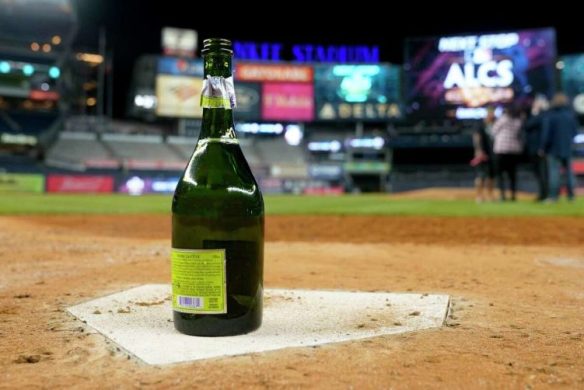
A spent champagne bottle placed on home plate after the Yankees won a trip to the ALCS Tuesday night. The Yankees had to celebrate their win in a hurry—they open against the Astros Wednesday night.

The good news is, Year One of Comissioner Rube Golberg’s triple-wild-cards postseason experiment isn’t going to have an all also-ran World Series, after all. It still yielded a pair of division-winning teams getting to tangle in the American League Championship Series.

The bad news is, those two division winners are still the Yankees and the Astros, after the Yankees sent the AL Central-winning Guardians home for the winter with a 5-1 win Tuesday that wasn’t exactly an overwhelming smothering.

What it was, though, was the game for which the Guardians shot themselves in the proverbial foot. Specifically, two Guardians, one of whom is old enough to know better and the other of whom needs a definitive attitude adjustment.

Guardians manager Terry Francona has more World Series rings this century (two) than Yankees manager Aaron Boone (none). Francona is considered by most observers to be one of the game’s smartest managers who’s made extremely few mistakes and learned from one and all; Boone is one of those skippers about whom second-guessing is close enough to a daily sport in its own right.

But when push came to absolute shove for rain-postponed AL division series Game Five, Boone proved willing to roll the dice Francona finally wasn’t.

After Gerrit Cole held the Guards off with a magnificent Game Four performance Sunday but the rain pushed Game Five from Monday to Tuesday, Boone was more than willing to throw his original Game Five plan aside—Jameson Tallion starting and going far as he could to spell the beleaguered Yankee bullpen—and let Nestor Cortes pitch on three days’ rest for the first time in his major league life.

Francona wouldn’t even think about changing his original Game Five plan, opening with his number-four starter Aaron Civale, who hadn’t even seen any action this postseason until Tuesday, then reaching for his bullpen at the first sign of real trouble. He wasn’t willing to let his ace Shane Bieber go on three days’ rest for the first time in his major league life.

Mother Nature actually handed Francona one of the biggest breaks of his life when she pushed Game Five back a day. Either he missed the call or forgot to check his voicemail. “I’ve never done it,” said Bieber postgame Tuesday, about going on three days rest. “But could I have? Sure.”

“It’s not because he can’t pitch,” said Francona after Game Five. “It’s just he’s been through a lot. You know, he had [a shoulder injury in 2021] and he’s had a remarkable year, but it’s not been probably as easy as he’s made it look.”

It might have been a lot easier on the Guardians if Francona handed his ace the chance to try it, with reinforcements ready to ride in after maybe three, four innings. Even year-old-plus shoulder injuries deserve appropriate consideration, of course. But Bieber surrendered a mere two runs in five-and-two-thirds Game Two innings. Francona’s hesitation when handed the chance helped cost him a shot at another AL pennant.

Civale didn’t have it from the outset. He had as much control as a fish on the line jerking into death out of the water. Giancarlo Stanton slammed an exclamation point upon it when he slammed a hanging cutter the other way into the right field seats with two aboard and one out.

The Guards’ pen did surrender two more runs in the game, including Aaron Judge’s opposite field launch the next inning. But they spread those runs over eight and two-thirds innings’ relief while otherwise keeping the Yankees reasonably behaved. They gave the Guards every possible foot of room to come back and win it.

That was more than anyone could say for Josh Naylor. The Guards’ designated hitter had already raised temperatures among enough Yankees and around a little more than half of social media, when his Game Four home run off Cole resulted in him running the bases with his arms in a rock-the-baby position and motion.

Naylor intends the gesture to mean that if he hits you for a long ball he considers you his “son” in that moment. It wasn’t anything new for him or for those pitchers surrendering the 20 bombs he hit on the regular season. And Sunday’s blast was the third time Naylor has taken Cole into the seats in his major league life. He was entitled to a few bragging rights.

Cole himself thought the bit was “cute” and “a little funny.” He wasn’t half as offended as that half-plus of social media demanding Naylor’s head meet a well-placed fastball as soon as possible. Yesterday, if possible. The Yankees found the far better way to get even in Game Five than turning Naylor’s brains into tapioca pudding.

“We got our revenge,” Yankee shortstop Gleyber Torres all but crowed postgame. Torres even did a little rocking of the baby himself in the top of the ninth, after he stepped on second to secure the game-ending force out. “We’re happy to beat those guys,” he continued. “Now they can watch on TV the next series for us. It’s nothing personal. Just a little thing about revenge.”

Naylor was also serenaded mercilessly by the Yankee Stadium crowd chanting “Who’s your daddy?” louder with each plate appearance. Every time he returned to the Guards’ dugout fans in the seats behind the dugout trolled him with their own rock-the-baby moves. And his most immediate postgame thought Tuesday was how wonderful it was that he’d gotten that far into their heads.

Some say it was Naylor being a good sport about it. Others might think he was consumed more with getting into the crowd’s heads than he was in getting back into the Yankees’ heads. The evidence: He went 0-for-4 including once with a man in scoring position Tuesday.

Oh, well. “That was awesome,” he said postgame of the Yankee Stadium chanting. “That was so sick. That was honestly like a dream come true as a kid—playing in an environment like this where they’ve got diehard fans, it’s cool. The fact I got that going through the whole stadium, that was sick.”

Josh Naylor

Rock and troll: Yankee fans letting Josh Naylor have it on an 0-for-4 ALDS Game Five night.

Did it cross his mind once that his team being bumped home for the winter a little early was a little more sick, as in ill, as in not exactly the way they planned it? If it did, you wouldn’t have known it by the way he continued his exegesis. “If anything, it kind of motivates me,” he began.

It’s fun to kind of play under pressure. It’s fun to play when everyone’s against you and when the world’s against you. It’s extremely fun.

That’s why you play this game at the highest level or try to get to the highest level: to play against opponents like the Yankees or against the Astros or whoever the case is. They all have great fanbases and they all want their home team to win, and it’s cool to kind of play in that type of spotlight and in that pressure.

Wouldn’t it have been extremely more fun if the Guardians had won? Did Naylor clown himself out of being able to play up in that spotlight and its pressure this time? Those are questions for which Cleveland would love proper answers.

So is the question of how and why the Guards didn’t ask for a fourth-inning review that might have helped get Cortes out of their hair sooner than later, after a third inning that exemplified the Guards’ hunt-peck-pester-prod limits.

They went from first and second and one out in the top of the third—one of the hits hitting the grass when Yankee shortstop Oswaldo Cabrera collided with left fielder Aaron Hicks, resulting in a knee injury taking Hicks out of the rest of the postseason—to the bases loaded and one out after Guards shortstop Amed Rosario wrung Cortes for a four-pitch walk. They got their only run of the game when Jose Ramírez lofted a deep sacrifice fly to center.

Now, with two outs in the top of the fourth, Andres Giménez whacked a high bouncer up to Yankee first baseman Anthony Rizzo, who had to dive to the pad to make any play. The call was out, but several television replays showed Giménez safe by a couple of hairs. Perhaps too mindful of having lost three prior challenges in the set, the Guardians’ replay review crew didn’t move a pinkie. Francona seemingly didn’t urge them to do so.

Never mind that it would have extended the inning and given the Guards a chance to turn their batting order around sooner, get Cortes out of the game sooner, and get into that still-vulnerable Yankee pen sooner. Francona’s been one of the game’s most tactically adept skippers for a long enough time, but not nudging his replay people to go for this one helped further to cost him an ALCS trip.

These Yankees don’t look proverbial gift horses in the proverbial mouths. An inning later, with Torres on first with a leadoff walk and James Karinchak relieving Trevor Stephan following a Judge swinging strikeout during which Torres stole second, Rizzo lined a single to right to send Torres home. That was all the insurance the Yankees ended up needing.

Especially when these so-called Guardiac Kids, the youth movement whose penchant for small ball and for driving bullpens to drink with late rallies, forcing the other guys into fielding lapses, winning a franchise-record number of games at the last minute, had nothing to say against three Yankee relievers who kept them scoreless over a final four solid shutout innings.

Especially when they actually out-hit the Yankees 44-28 and still came up with early winter. The trouble was, the Guards also went 3-for-30 with men in scoring position over Games One, Two, Four, and Five, and had nobody landing big run-delivering blows when needed the most. Their ability to surprise expired.

Now the Yankees have a chance for revenge against the Astros who’ve met them in two previous ALCSes and beaten them both times. They had to hurry their postgame celebration up considerably—the ALCS opens Wednesday night.

The Guardians could take their sweet time going home for the winter and pondering the season that traveled so engagingly but ended so ignominiously.

“Winning the division was the first part,” Hedges said postgame. “Wild-card round. Put ourselves in position to beat the Yankees. And we wanted to win the World Series, but that’s a good Yankees team. The cool thing is, now we have a bunch of dudes with a ton of playoff experience in the most hostile environment you can imagine.”

The Guards were bloody fun to watch for most of it. Then Cole, Stanton and Judge rang their bells in Games Four and Five, and they had nothing much to say in return. The Guardiac Kids were the babies who got rocked. There was nothing much fun about that.

Two relief tales from . . .

Two relief pitchers will miss postseason time thanks to circumstances unrelated to play on the field. One will miss the rest of his team’s postseason, however long it lasts, thanks to a self-inflicted injury. The other will miss his team’s postseason and say goodbye to that team. Neither man’s postseason had to end this way.

Astros reliever Phil Maton broke a bone in his right pinkie after his appearance in the team’s final regular season game. He’d surrendered two hits plus the only two runs the Phillies scored in that finale, and he was unamused, understandably. What wasn’t so understandable was Maton punching his locker in frustration.

Lockers aren’t any more forgiving that outfield walls or pitchers’ mounds when it comes to human flesh and bone piledriving into them. It doesn’t matter whether the flesh and bone combination is 20, 22, or 29 years old, the latter being Maton’s age. Those stiff, hard, stationary structures can do more damage to their attackers than Muhammad Ali did to his when answering a right cross.

Yankees reliever Aroldis Chapman had annoyed his team already with an injury from a tattoo he acquired, costing him almost a month’s worth of time over August and September, never mind that prudence and his team overseers probably couldn’t convince him to wait until winter vacation to think about another work of body art.

But Chapman’s decline this season prompted his replacement as the Yankees’ closer and, apparently, didn’t sit well with the howitzer, either. Thus did he fume about his demotion until Friday last, when the Yankees conducted a team workout preparing for the division series with what proved to be the Guardians. (Their first place finish rewarded the Yankees with a wild card series bye under the new, dubious postseason system.)

Chapman had told the team he’d be there. Until he wasn’t. To put things kindly, Yankee general manager Brian Cashman was far less amused than was Maton to have handed the Phillies a pair of hits and runs:

It was surprising at first, a little shocking, but after the shock wore off, when you add everything up, it’s not surprising. There’s some questions about whether he’s been in all-in or not for a little while. He’s maintained verbally that he’s in, but at times, actions don’t match those words.

Maton knew at once he’d been a damn fool. “It was a short-sighted move,” he told the press after that game, “and, ultimately, it was selfish. It’s one of those things that I hope doesn’t affect our team moving forward.”

He may be fortunate that the Astros have someone to step in. The Astros may be more fortunate. Bryan Abreu’s fielding-independent pitching rate for 2022 is 2.12, against Maton’s 4.33 FIP. It won’t parole Maton from the Dumbass Zone just because his absence may actually have done the Astros a small favour.

Cashman merely fined Chapman for his absence. He left the roster decision up to manager Aaron Boone. Boone wasted very little time in removing Chapman, despite the Yankee bullpen overall being in questionable enough shape as it was before it lost stretch-drive comer Scott Effross to forthcoming Tommy John surgery.

“I think he questioned whether or not he was going to be on the roster or not,” the manager told a reporter. “But he needed to be here . . . I think there’s a chance he absolutely could have been [on the roster]. We’re still actually getting ready to start those conversations now. He may have been. It’s a moot point now.”

The Yankees told Chapman—whose once-vaunted fastball still had the speed of light but wasn’t exactly invulnerable any longer, not with his 2022 marks of a 4.46 ERA and a 4.57 FIP—to go home to Florida for the division series.

That’s the official word. Unofficially, the word comes forth that, in effect, they’ve told him they’re not terribly inclined to think about bringing him back after he hits free agency this winter. Not with Clay Holmes having emerged as an All-Star reliever and the Yankees’ number one closing option.

It may be lucky for Maton that the Astros may not be injured (oops) by his absence as their postseason gets underway. (The AL West ogres, too, earned a round-one bye under the new system and will tangle with the pleasantly surprising Mariners in their division series.) They can absorb his D.Z. moment and hope he’s learned or re-learned something about self-control.

It’s anything but lucky for Chapman that the Yankees would have needed him to stay all in and step up as big as he could with most of the Yankee pen now in shambles. Holmes (shoulder strain) and Wandy Peralta (a back issues) are back for the division series, but Zack Britton (arm fatigue), Chad Green (Tommy John surgery), Michael King (elbow fracture), and Ron Marinaccio (shin injury) aren’t.

Chapman isn’t any D.Z. non-entity, of course. Not with his domestic violence history that caused enough people to question why the Yankees traded for him (from the Reds), traded him away (to the Cubs, for key contributor Gleyber Torres), then re-signed him in the first place, all within the same year.

When a howitzer that can fire 100+ mph shells gets a pass from domestic violence but finally runs around over an injury from an elective act and, then, shenks a team workout atop a questionable attitude as they prepare for a postseason, something seems badly imbalanced there. It might begin with a 34-year-old who still displays often enough the mind of a four-year-old.

Summary Judgement: 62 in ’22

Aaron Judge

“I think it won’t sink in until the offseason.—Aaron Judge became the AL’s new single-season home run king at last Tuesday night in Texas.

Maybe Aaron Judge should be playing things like the stock market. Without making as grand a show of things as observers paid to be so grand (and perhaps foolish), he gambled early that he could turn his first walk year into something big when he achieves his first free agency.

He probably didn’t think he’d smash a longstanding American League home run record along the way. Certainly not in a season in which hitting across the major league board was at one of its lowest levels in the professional game’s history, and he could never be certain he’d get a miniature medicine ball or a turbocharged orb to launch.

But smash it Judge did Tuesday night. In the second game of a doubleheader in Texas. If you’re going to slam the season’s biggest exclamation point down but you can’t do it in front of the home audience, there are few places bigger than there to do it.

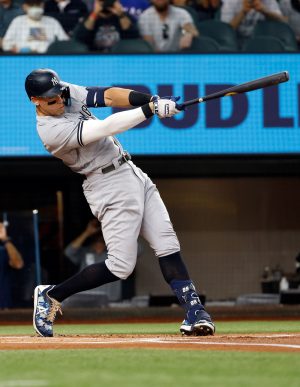
Batting leadoff for the 106th time at all this year, and batting first in the lineup for the 34th time, Judge squared up Rangers righthander Jesus Tinoco’s slightly hanging slider on 1-1 and drove it parabolically several rows up the lower left field seats. Even the Globe Life Field audience couldn’t contain their pleasure in seeing the Leaning Tower of 161st Street make American League history.

Almost a full week after he met Roger Maris, with the Yankees having banked the AL East title in the same week, the tall swinger from California passed the comparatively compact swatter from the Dakotas. And unlike Maris’s abusively unfair experience in 1961, Judge got there with almost universal approval from the moment it looked as though he had a serious shot at getting there.

There was nothing unfair about Judge’s achievement, unless you count that this is a young man to whom you can throw a ball of Play-Doh and he can still hit it across the county line. Tinoco had never faced Judge before and had only surrendered one home run in 19.2 innings work on the season before Judge rang his and history’s bells.

“We knew it was going to happen and nobody wants to give it up,” said Tinoco—a reliever but pitching as the Rangers’ second-game opener Tuesday night, “but it’s part of the game. I challenged him and he hit it. That’s my job. All I can say is ‘congratulations’ to him.”

“I know he has a nasty sinker and a nasty slider,” said Judge postgame. “We were kind of waiting to hear who the starter of Game Two was gonna be. When I heard it was him, I saw what he did the night before and I said, ‘This isn’t a good matchup to start the game off with a guy with high velocity like that and a good off-speed pitch.’ So going into it, I think that helped me relax: ‘Hey, this is a good pitcher. Let me go up there and let’s see what happens’.”

Maybe he pressed a little too much between home runs 61 and 62. Maybe the opposition pressed a little hard trying to pitch around him until Tinoco’s slider didn’t slide enough. Maybe, too, Judge clung just hard enough to his insistence that, sure, it’d be great to do it, but he had more important things such as postseason prep to think about.

But maybe even this still-boyish looking galoot, who softens the most when interacting with the children who like and admire him while maintaining his privacy otherwise without an ostentatious harrumph, wanted the record so badly he could taste it even up with whatever he’d had for a meal before and after his long day’s work of play Tuesday.

The Yankees won the first of the twin bill without Judge going long. They ended up losing 3-2 in the nightcap Judge opened so historically, before he was given the rest of the night off by manager Aaron Boone, following a second-inning strikeout, and a double switch of second baseman Oswaldo Cabrera to Judge’s position in right field, shortstop Oswald Peraza to second, and Isiah Kiner-Falefa out to play short.

A few hours after the second game ended, and he’d run the gamut of reporters and well-wishers, Judge reportedly found some quiet in the clubhouse until a small voice reached his ears. Asking who was there, Judge then found himself spending a little time with Yankee catcher Jose Trevino’s little son, Josiah.

The gentle giant who helped make a Toronto kid’s week, after seeing the kid in tears of joy when an adult Blue Jays fan handed him a ball Judge sent into the Rogers Centre upper deck in May, spends as much time entertaining his teammates’ kids as he does entertaining fans in the stands with blasts past the ionosphere.

It may not yet have hit him completely that he’d claimed one of the most sacred pages in the AL record book for his own. And it may take the length of the postseason, however long the Yankees prove to stay there, before it does.

“In my book,” the Leaning Tower of 161st Street said after the second doubleheader game, “it’s just another day. I wish we would have gotten the win, that would have made it a little sweeter I think. But I’m going to try to soak it in, soak in the moment with my family, and get ready for the game tomorrow. I think it won’t sink in until the offseason.”

That’s his story and he’s sticking to it. Even through his very visible effort to suppress his patented big snaggle-tooth grin as he rounded first heading for second. Even with his teammates swarming from the dugout starting about two seconds after he dropped his bat to run the bomb out. Even with his wife, Samantha Bracksieck, and his parents, Wayne and Patty Judge, leading the loud ovation.

“We just wanted it to happen so bad,” said Yankee pitcher Gerrit Cole postgame. “I don’t know if that’s pressing, or just hoping hard. We were all just hoping really hard, I think.”

Maris’s 1961 teammates pressed just as hard for him to make it once Mickey Mantle fell out of that unwarrantedly-controversial chase with a hip abscess. But they were almost alone there. Thanks to a capricious conflicted-of-interest commissioner, and a particularly nasty contingency in the baseball press of the time, Maris was denied his due for driving a baseball idol (some think sacred cow) to one side.

Judge has tried to sustain his sense of proportion throughout the entire run. Maybe come the postseason he and his wife will kick their shoes off and romp and play in wild celebration. First, he has his sixth postseason in as many seasons of being a Yankee to play.

Maris, a refugee from the then-Indians and the Kansas City Athletics, and the AL’s defending Most Valuable Player while he was at it, was en route his second consecutive World Series in a Yankee uniform. They lost a seven-game heartbreaker to the Pirates in 1960 but won a five-game laugher against the upstart Reds in 1961.

For daring to challenge and pass the Sacred Babe, Maris was battered unconscionably in ways that would be called child abuse if done by a parent to a child.

“At the plate, he heard obscene abuse from the creeps who think that a ticket to the game entitles them to horsewhip the entertainers,” wrote sportswriting legend Red Smith, then still with the New York Herald-Tribune.

Off the field he was badgered ceaselessly by fans, the press, radio-TV, press agents, promoters. Only on rare occasions did this quiet, candid young man let his temper slip, and then it was due to some especially outrageous question or repeated references to “pressure,” with the implication that he was choking up.

Some social media idiots thought and said the same about Judge as he laboured almost that full week to get from 61 to 62. For those who care about incompetent irrelevancy, let it be recorded that it took Judge two fewer plate appearances to hit 62 than it took Maris to hit 61.

Milton Gross of the New York Post, perhaps the only other writer in New York unwilling to even think about trying to beat Maris into submission or worse, had dinner with Maris and his wife plus their closest New York friends, Julie and Selma Isaacson, the evening that followed Maris’s money blast. When Isaacson toasted Maris, Gross wrote, Maris thanked him but added: “This was the greatest experience of my life. It has to be, but I wouldn’t want to go through it again for anything.”

Soon afterward, a teenage girl approached Maris politely for an autograph and asked him likewise to include the date. “What is today’s date?” Maris asked. Isaacson chimed in at once: “The date is the one you did what nobody else ever did.”

On 4 October 2022—65 years to the day after Sputnik launched the space race—the Leaning Tower of 161st Street did what nobody else in the American League ever did. You could hear Ruth and Maris together in the Elysian Fields, clinking glasses and quaffing a cold one in praise.

“I’d trade my past for his future,” the Babe must have said, knowing that Judge blasted himself toward a payday that might come close to equaling the U.S. Department of Defense’s annual budget.

“I’d trade your past for his future, too,” Maris must have cracked. “His future, and two stock splits to be named later.”

What really kept Maris from Cooperstown?

Roger Maris

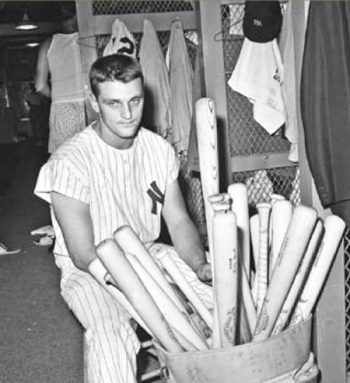
Roger Maris in the Yankee clubhouse, 30 September 1961—the day before he swung his way into history.

Bad enough when I spot those in the baseball press I don’t know personally but perpetuate mythology over factuality. But now my editor at the Internet Baseball Writers Association of America’s Here’s the Pitch newsletter, a man who’s become a friend in the bargain, does it.

Pondering Aaron Judge’s choice of number 99 on his Yankee uniform, Dan Schlossberg writes in today’s HTP, “Perhaps he knew he would become twice as good as [Roger] Maris? Certainly, Maris never chased a Triple Crown. In fact, his .260 lifetime batting average is the leading negative whenever his Hall of Fame candidacy is considered.”

Not even close, my good friend.

Mike Schmidt hit only seven points higher than Maris lifetime and that didn’t stop his election to the Hall of Fame. OK, that’s a ringer. Schmidt is the arguable greatest all-around third baseman ever to play the game. But his lifetime .267 hitting average didn’t exactly block him from Cooperstown, either.

There are lots of Hall of Fame players who hit in the .260-.269 range lifetime. Those modest hitting averages didn’t block them, either. They had other factors in their favour. And so might have Roger Maris except for one pair of problems.

Problem one: Maris was so badly seared by his pursuit and breaking of ruthsrecord in 1961 that there were times too many writers of the time believed he began to shy away from perpetuating the greatness that was his for the taking. Never permitted to enjoy truly the blessings of having cracked baseball’s single most prestigious record, Maris looked from there like a man to whom greatness was an intruder, not a companion.

Problem two: After a solid 1962 season, the injury bug began to hit Maris. Back trouble  limited him to ninety games in 1963. He had a bounceback 1964, with 26 home runs, despite missing twenty games with assorted leg injuries. Then came 1965 and the injury that should have proved scandalous for the manner in which the Yankees handled it.

First, Maris suffered a pulled hamstring that kept him out 26 games after the first three weeks of the 1965 season. Then, come 20 June, Maris jammed his hand against the plate umpire’s shin guard while sliding home. He tried playing a few after that, but the injury was severe enough to take him out of the second game of a doubleheader against the Kansas City Athletics and out of the Yankee lineup after 28 June.

Finally the hand injury was diagnosed as bone chips for which he underwent offseason surgery. It turned out to be far worse. The hand continued to bother him as he started 1966. At last he complained about the problem, and all that did was crank the New York sports press that never truly accepted him and the Yankees themselves into harrumphing that he had no business complaining.

The hand injury turned out to have been a misdiagnosed fracture. Whatever remained of his once-formidable home run power was gone. So was Maris’s desire to continue playing. He’d played through enough injuries as it was and felt unappreciated for the effort.  The Yankees aged profoundly during and after 1964, the final pennant winner of the old Yankee guard, but the Yankees needed the Maris, Mickey Mantle, and Whitey Ford box office more than they needed them properly healthy, so it seemed in retrospect.

The writers chose Maris as the primary culprit, often accusing him of loafing, as some teammates did, both of whose sides were unaware of the true severity of the hand injury. If you’re looking for evidence as to why other players become either paranoid or hypochondriacal about their physical health, Maris was key evidence on their behalf.

“For those who had refused to appreciate Maris in the early 1960s,” wrote his Society for American Baseball Research biographer Bill Pruden, “his injury-plagued performance in the middle part of the decade, coming when the Yankees as a team were faltering, only seemed to confirm their views.”

For a man who had never placed any individual accomplishment above winning, it was a difficult time. Indeed, tired of battling injuries, of trying to play, even when hurt, but never seeming to be appreciated for the effort regardless, Maris gave much thought to retirement. However, before that decision could be made, the struggling Yankees traded Maris to the St. Louis Cardinals for third baseman Charley Smith.

Maris continued to play a solid right field in St. Louis for two consecutive pennant winners and their 1967 World Series champions (he also had the best Series of his career individually), before retiring at last and accepting Cardinal owner Gussie Busch’s offer to operate a Budweiser beer distributorship in southern Florida. He throve in the business with his brother Rudy as his partner, until he succumbed to lymphoma at 51 in 1985.

Injuries, not indifference or loafing, put paid to Maris’s Hall of Fame case before he had the chance to solidify one following his Hall-caliber 1960-62 seasons. Meanwhile, my friend Schlossberg went on to write, “Maris batted just .269 [in 1961] against expansion-diluted pitching.” Halt right there, Daniel.

The fear of diluted pitching when the American League expanded for the first time was probably one of the factors animating commissioner Ford Frick’s scurrilous conflict-of-interest bid to deny anyone, Maris or otherwise, legitimacy in pursuing ruthsrecord in 1961. Well, now. Would you like to know how “diluted” the league’s pitching actually became?

I know I sure did. And I found out. Pay very close attention to the following table, showing the league’s 1960 and 1961 earned run averages, fielding-independent pitching rates, walks and hits per inning pitched, strikeouts per nine innings, and walks per nine.

AL Pitching ERA FIP WHIP K/9 BB/9
1960 3.87 4.00 1.37 4.9 3.6
1961 4.53 4.09 1.38 5.2 3.7

There was a 66 point jump in the league’s ERA for 1961, well enough shy of a full run’s difference. But look further and closer. That’s not the place you end pondering the difference in the league’s pitching from ’60 to ’61, it’s the place where you only begin.

The league’s FIP—measuring that for which pitchers alone are responsible (you can call it their ERA without their fielders’ performances factored in) remained practically the same, unless you think a mere nine-point rise is equivalent to scaling the Empire State Building.

AL pitchers also averaged a lousy single point more walks and hits per inning pitched (WHIP) in ’61 than in ’60. They struck out practically the same average per nine innings and walked almost exactly the same per nine. If that’s drastically “diluted” pitching, I’m a dead bolt.

If anything, Maris had a tougher time hitting 61 in ’61 than the Sacred Babe had in 1927. I’ve noted it before but it’s worth nothing again here: The advent of relief pitching above and beyond being the final repose of pitchers who couldn’t cut it as starters had a big say in it.

Ruth in ’27 faced 67 pitchers all season long, while Maris in ’61 faced 101. Ruth got to face pitchers a third time around in games 35 percent of the time in ’27; Maris enjoyed that privilege only 30 percent. He faced more fresh arms in games than Ruth did.

Did I mention again, too, that this year Aaron Judge faced 232 pitchers by the end of the doubleheader during which he hit his 55th home run of the year? That he faced pitchers a third time around in only seventeen percent of his games as of the end of that twin bill?

The myth of diluted AL pitching in 1961 isn’t quite as grave as the truly unconscionable myth of The Asterisk, of course. But it has in common with that disgrace that it never truly existed in the first place.

You’re welcome, Dan.

Well-understood Judge meets misunderstood Maris

Aaron Judge

Aaron Judge hitting his 61st home run of the season, tying Roger Maris’s league record and keeping it in the Yankee family.

Reaching a milestone is both tough enough and impressive enough in its own right. When your reaching it busts a tie and puts your team ahead to stay, as it turns out, the satisfaction multiplies exponentially.

Roger Maris blasted his 61st home run of 1961 on the season’s final day, cracking a scoreless tie and proving to be the game’s only run. Aaron Judge met his tortured Yankee forebear Wednesday night, cracking a three-all tie and pushing his American League East champion Yankees past the Blue Jays to stay.

Maris drove a one-out Tracy Stallard fastball into the right field seats and Babe Ruth to one side before a Yankee Stadium audience a little over a third of the old ballpark’s capacity. Judge checked in with Aaron Hicks aboard on a leadoff single, caught hold of Blue Jays reliever Tim Mayza’s hanging full count sinker, and drove it off the edge of the stands and into the Rogers Centre left field bullpen.

Thanks in large part to a capricious, conflict-of-interest commissioner’s foolish edicts, a hostile press, and his own unadorned personality, Maris endured a season in hell at home and on the road from fans hell bent on seeing anyone but the plain Dakotan take the Sacred Babe’s place in the hallowed single-season homer record book.

Judge has known the opposite all season long. At home, he’s been a Yankee matinee idol since he set the since-broken record for home runs in a season by a rookie. On the road, he’s a respected and even well-liked opponent. Even fans jaded by the bazillionaires playing the game don’t quake when pondering not whether but how much of a payday Judge will receive during his first free agency in the off-season to come.

In Toronto, Judge may be more than all that. He may be the one Yankee above all that even Blue Jays fans actually root for. For thanks he has only to remember an early May game and its day-after aftermath.

That was the day Blue Jays fan Mike Lanzillotta got hold of a home run Judge drove into the Rogers Centre upper deck . . . and handed the ball to nine-year-old Derek Rodriguez, wearing a T-shirt done into a Yankee jersey with Judge’s name and number 99 on the back, whom Lanzillotta knew prayed to get a ball hit by Judge.

The moment was caught on video and went viral at once, and it got to Judge’s attention after the game. The Leaning Tower of 161st Street saw it and arranged to meet the boy, his family, and the beneficient fan before the next day’s game.

When Judge hit the line running after hitting Number 61, it ended a streak of 34 plate appearances without hitting one out since he matched Ruth’s 60 of 1927. Rogers Centre bathed him in a loud ovation. Rising from their seats behind the Yankee dugout, Judge’s mother shared an embrace with Roger Maris, Jr. The Yankees swarmed him in hugs. The Blue Jays’ bullpen coach, Matt Buschmann, retrieved the landmark ball and made sure the Yankees got hold of it.

Judge even got a present from home plate umpire Brian O’Nora after the game. O’Nora congratulated Judge outside the Yankee dugout and handed him the game’s official lineup card.

“It’s an incredible honor, getting a chance to be associated with one of the Yankee greats, one of baseball’s greats, words can’t describe it,” Judge said postgame. So, perhaps naturally, he tried to make words do just that.

“That’s one thing so special about the Yankees organization,” he continued, “is all the guys that came before us and kind of paved the way and played the game the right way, did things the right way, did a lot of great things in this game and getting a chance to be mentioned with those guys now is, I can’t even describe it, it’s an incredible honor, that’s for sure.”

Roger Maris

Roger Maris, hitting the home run it often seemed nobody wanted him to hit, 1 October 1961.

He also made bloody well certain to give props directly to Maris, who died of lymphoma at 51 in 1985. “Getting a chance to tie Roger Maris, you dream about that kind of stuff,” he said. “It’s unreal.” So is the point that Judge still has eight games left to break the tie with Maris, never mind put a little more distance between them.

Maris, Jr. intends to be there when Judge passes his father. “I don’t think it’s going to take very long,” he told reporters. “I think he’s loose. I think the party last night, the celebration, loosened him up . . . You can tell that he’s back, and he’s ready to go now.” If only things were that simple for his father.

This is now: Nobody has thundered against Judge even thinking about equaling, never mind passing, either Ruth or Maris, Sr. That was then: The elder Maris was never allowed to enjoy even the simple fact of his feat, never mind its magnitude. “Do you know what I have to show for 61 home runs? Nothing,” he said at the All-Star Game in 1980. “Exactly nothing.”

“Heaven protect us from achieving a greatness that the world decides we do not deserve,” wrote Thomas Boswell of the Washington Post upon Maris’s too-early death. “Mortal men can be crushed by immortal deeds. Wasn’t that the moral of Roger Maris’s career?”

A compact, wiry six feet tall, Maris was unprepared and unwilling to make himself a star as the true media age began. Judge, a 6’7” galoot with a still-boyish, snaggle-tooth grin, who looks at times as if he could get from first to second in two strides on a home run circuit, accommodates the public and the media without letting either control or demean him.

What Judge has in common with Maris, aside from a place in the record book he still might claim as his own, is an easy manner with children. Father of four Maris came to quit reading his fan mail unless he was sure it came from kids. As Derek Rodriguez got to prove, Judge savours encounters with kids when they come.

“Maris,” Boswell continued, “was in all ways pronounced deficient. With his flattop haircut, he looked more Hessian than handsome. At twenty-six, the introverted, proud young man from Fargo, North Dakota, did not have a fraction of the charm, sophistication, or patience to deal with becoming one of the most famous and controversial figures in America.

“It might help our sleep to believe Maris was a reclusive oddball figure, uniquely ill-suited to fame. For years he was portrayed as an antisocial grouch. With time, a contrary profile emerged. Now, as eulogies roll in, he’s painted as a family man, a loyal friend, a modest down-to-earth guy proud of his unselfishness as an all-around ballplayer.”

That family man, loyal friend, and modest down-to-earth guy must have savoured and applauded Wednesday night’s doing from his repose in the Elysian Fields. Even if he also expressed just a flickering wish that he could have known even a fragment of the respect, if not adulation, that Judge receives. You can’t blame Maris for either.